Visualizing Cytoskeletal Dynamics: A TIRFM Guide to Actin-Microtubule Wave Propagation Analysis
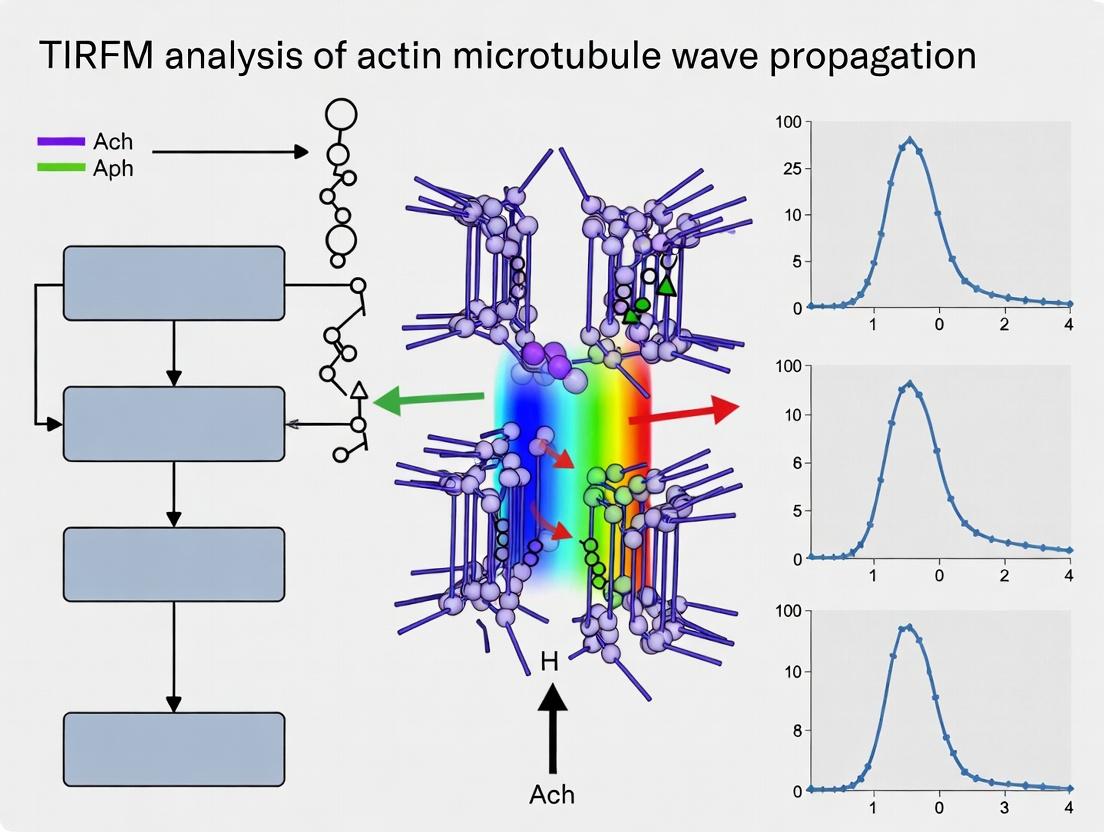
This article provides a comprehensive guide for researchers studying cytoskeletal coordination, focusing on the use of Total Internal Reflection Fluorescence Microscopy (TIRFM) to analyze propagating actin-microtubule waves.
Visualizing Cytoskeletal Dynamics: A TIRFM Guide to Actin-Microtubule Wave Propagation Analysis
Abstract
This article provides a comprehensive guide for researchers studying cytoskeletal coordination, focusing on the use of Total Internal Reflection Fluorescence Microscopy (TIRFM) to analyze propagating actin-microtubule waves. We first explore the foundational biology of these dynamic structures and their role in cell polarization, migration, and division. We then detail a robust methodological workflow for TIRFM imaging, from sample preparation and dual-color labeling to live-cell acquisition protocols. The guide addresses common troubleshooting challenges in TIRFM experiments, including photobleaching, fiduciary marker selection, and drift correction. Finally, we compare TIRFM with complementary techniques like spinning disk confocal and STORM super-resolution microscopy, validating quantitative metrics for wave velocity, frequency, and coupling efficiency. This resource empowers scientists and drug development professionals to precisely interrogate cytoskeletal crosstalk, with implications for targeting metastatic cancer and neurodegenerative diseases.
Understanding Actin-Microtubule Waves: Biology, Function, and Why They Matter
Propagating actin-microtubule waves are self-organizing, large-scale cytoskeletal structures observed in various cell types, including fibroblasts and neurons. They consist of co-dependent, coupled patterns of actin filaments and microtubules that periodically form and traverse the cell periphery or cytoplasm. These waves are not mere structural rearrangements but are dynamic signaling platforms, integrating mechanical and chemical cues to regulate cell shape, polarization, and migration. Their study is crucial within the broader thesis on TIRFM analysis, as Total Internal Reflection Fluorescence Microscopy (TIRFM) is the premier technique for visualizing the precise, sub-membrane dynamics of these wave initiation and propagation events in living cells.
Table 1: Key Quantitative Parameters of Actin-Microtubule Waves
| Parameter | Typical Range / Value | Measurement Technique | Biological Significance |
|---|---|---|---|
| Propagation Velocity | 0.1 - 0.3 µm/s | TIRFM/Kymograph Analysis | Indicates polymerization & motor protein activity. |
| Wavelength | 20 - 100 µm | Fluorescence Microscopy | Reflects spatial coordination and feedback loop length. |
| Periodicity | 50 - 200 s/cycle | Time-lapse Analysis | Suggests underlying oscillator mechanism (e.g., GTPase cycles). |
| Actin Wave Thickness | 0.5 - 2 µm | TIRFM/Super-resolution | Defines the zone of actin polymerization and regulatory protein concentration. |
| Microtubule Bundling | 3-10 MTs per bundle | TIRFM/EM | Induces mechanical rigidity and tracks for intracellular transport. |
Table 2: Pharmacological & Genetic Perturbations of Wave Dynamics
| Intervention Target | Effect on Wave Propagation | Key Molecule/ Drug | Implication for Mechanism |
|---|---|---|---|
| Actin Polymerization | Complete Abolition | Latrunculin A / Cytochalasin D | Actin network is structural scaffold & essential for coupling. |
| Microtubule Dynamics | Inhibition/Arrest | Nocodazole / Taxol | Microtubules provide directional cue and stability for actin wave. |
| Formin Activity | Reduced Velocity & Frequency | SMIFH2 | Implicates formins (mDia) in linear actin nucleation within wave. |
| Rho GTPase Signaling | Disrupted Initiation & Pattern | C3 Transferase (Rho inhibitor) | RhoA is a master regulator of the wave-cycle oscillator. |
| Motor Protein (Kinesin) | Altered Propagation Direction | Kinesin-5 (Eg5) Inhibitors | Microtubule sliding contributes to wavefront advancement. |
Experimental Protocols for TIRFM-Based Wave Analysis
Protocol 1: Live-Cell Imaging of Propagating Waves via Dual-Color TIRFM
Objective: To simultaneously visualize the spatiotemporal dynamics of actin and microtubules during wave propagation in live fibroblasts.
Materials: See "The Scientist's Toolkit" below.
Procedure:
- Cell Preparation: Plate serum-starved NIH/3T3 or REF-52 fibroblasts on high-precision #1.5 glass-bottom dishes 24h prior. Transfect with fluorescent probes (e.g., LifeAct-mCherry for actin, EB3-GFP for growing microtubule plus-ends) using a standard lipofection protocol.
- Serum Stimulation: Prior to imaging, replace medium with full serum (e.g., 10% FBS) to induce wave formation. Incubate for 5-10 minutes at 37°C.
- TIRFM Setup: Mount dish on a stage-top incubator (37°C, 5% CO2). On a dual-laser TIRFM system, calibrate the TIRF angle for both 488nm (GFP) and 561nm (mCherry) channels to achieve an evanescent field depth of ~100nm.
- Image Acquisition: Use a high-sensitivity EM-CCD or sCMOS camera. Acquire simultaneous dual-color images every 2-5 seconds for 15-30 minutes. Maintain low laser power to minimize phototoxicity.
- Data Output: Generate time-lapse stacks for each channel. Use kymograph analysis along the cell periphery to quantify wave speed and frequency.
Protocol 2: Quantitative Analysis of Wave Propagation Parameters
Objective: To extract quantitative metrics of wave dynamics from TIRFM time-lapse data.
Procedure:
- Image Pre-processing: Apply a Gaussian blur (σ=1) to reduce noise. Correct for photobleaching using an exponential fit algorithm.
- Kymograph Generation: Define a region of interest (ROI) along the leading edge of the cell. Using Fiji/ImageJ, generate a kymograph (
Multi Kymographplugin) for both actin and microtubule channels. - Velocity Calculation: In the kymograph, measure the slope of diagonal lines representing propagating wavefronts. Velocity = (Distance in µm) / (Time in s).
- Co-Localization Analysis: Using the
Coloc 2plugin, calculate Pearson's Correlation Coefficient (PCC) or Mander's Overlap Coefficient between the actin and microtubule channels over time within the wave region. - Statistical Analysis: Pool data from at least 10 cells over 3 independent experiments. Present as mean ± SEM. Use Student's t-test or ANOVA for comparing conditions.
Signaling and Mechanical Pathways in Wave Propagation
Title: Core Signaling Pathway in Actin-Microtubule Wave Initiation
Title: TIRFM Workflow for Wave Analysis
The Scientist's Toolkit: Essential Research Reagents & Materials
Table 3: Key Reagent Solutions for Wave Research
| Item | Function in Experiment | Example Product/Catalog # |
|---|---|---|
| High-Precision Glass-Bottom Dish | Optimal optical clarity for TIRFM; #1.5 thickness (0.17mm) ensures correct laser penetration. | MatTek P35G-1.5-14-C |
| Live-Cell Fluorescent Actin Probe | Labels F-actin without significant disruption of dynamics. | LifeAct-TagGFP2 (IBA, 2-03102) |
| Microtubule Plus-End Tracking Protein | Visualizes dynamic, growing microtubule ends. | EB3-TagRFP (Addgene, plasmid #50708) |
| RhoA Activity Inhibitor | Probes the role of Rho GTPase signaling in wave initiation. | Cytoskeleton, Inc., CT04 (C3 Transferase) |
| Actin Polymerization Inhibitor | Negative control to abolish actin-based structures. | Latrunculin A (Cayman Chemical, 10010630) |
| Stage-Top Incubator | Maintains live cells at 37°C and 5% CO2 during extended imaging. | Tokai Hit STX or similar |
| TIRF-Objective Lens | High NA (>1.45) for generating the critical evanescent field. | Nikon Apo SR TIRF 100x/1.49 or Olympus UAPON 100XOTIRF |
| Image Analysis Software | For kymograph generation, co-localization, and quantification. | Fiji/ImageJ, Imaris, Metamorph |
This application note details protocols for studying actin-microtubule (MT) wave propagation and its role in coordinating cell edge protrusion with intracellular organization. The content is framed within a broader thesis utilizing Total Internal Reflection Fluorescence Microscopy (TIRFM) to analyze the spatiotemporal dynamics and coupling of these cytoskeletal waves, a key mechanism in cell polarization, migration, and division.
Key Quantitative Findings in Actin-MT Wave Research
Table 1: Characteristics of Cytoskeletal Wave Propagation
| Parameter | Actin Waves (Lamellipodia) | Microtubule Waves (Dynamic Instability) | Coupled Actin-MT Waves (TIRFM Analysis) |
|---|---|---|---|
| Propagation Velocity (µm/min) | 10 - 30 | 5 - 20 (growth) | 7 - 15 (coordinated) |
| Wave Frequency (events/µm/min) | 0.5 - 2.0 | 0.1 - 0.5 | Synchronized at ~0.3 - 1.0 |
| Primary Nucleator | Arp2/3 Complex | γ-TuRC (nucleation), EB1 (tip tracking) | CLASPs, +TIPs at interface |
| Key Regulator | Rac1, WAVE complex | GTP-tubulin cap, Stathmin | Rho GTPase crosstalk (Rac1/RhoA) |
| Typical TIRFM Frame Rate (fps) | 1 - 5 | 0.5 - 2 | 2 - 5 (dual-channel) |
| Pharmacological Inhibitor | CK-666 (Arp2/3), Latrunculin A | Nocodazole, Taxol (stabilizer) | Blebbistatin (Myosin II) affects coupling |
Table 2: TIRFM Imaging Parameters for Dual-Color Wave Analysis
| Imaging Parameter | Specification | Purpose/Rationale |
|---|---|---|
| Laser Wavelengths | 488 nm (actin), 561 nm (MTs) | Excitation of GFP-Lifeact/mScarlet-α-Tubulin |
| Penetration Depth | 70 - 150 nm | Selectively image cytoskeleton near adhesion plane |
| EMCCD/ sCMOS Gain | 50 - 300 (signal-dependent) | Maximize detection of low-signal propagating tips |
| Temporal Resolution | 2 - 10 sec intervals for >15 min | Capture complete wave initiation, propagation, decay |
| Temperature Control | 37°C ± 0.5°C | Maintain physiological dynamics |
| Analysis Software | FIJI/ImageJ with TrackMate, kymograph tools | Quantify velocity, frequency, and coincidence |
Detailed Experimental Protocols
Protocol 1: Cell Preparation and Dual-Color Labeling for TIRFM
Objective: Express fluorescent biosensors to visualize actin and microtubule dynamics simultaneously.
- Seed cells (e.g., U2OS, MEFs, B16-F1) on high-precision #1.5 glass-bottom dishes 24h prior.
- Transfert with plasmids using lipid-based reagent:
- Actin: 0.5 µg GFP-Lifeact or Utrophin-CH-GFP.
- Microtubules: 0.5 µg mScarlet-α-Tubulin or EB3-tdTomato.
- Use 2:1 ratio (µL reagent:µg DNA) in serum-free medium; incubate 4h.
- Replace with complete growth medium and incubate for 18-24h.
- Serum-starve (0.5% serum) for 4h to synchronize cell activity prior to imaging.
Protocol 2: TIRFM Imaging of Propagating Cytoskeletal Waves
Objective: Capture high-resolution, low-background dynamics of coupled wave events.
- Mount dish on TIRFM stage with on-stage incubator (37°C, 5% CO₂).
- Find cell edge using epifluorescence with low laser power (<5%).
- Align TIRF angle to achieve evanescent field illumination at cell-substrate interface.
- Set acquisition parameters:
- Dual-channel sequential acquisition.
- 488 nm laser (5-10% power), 561 nm laser (5-10% power).
- Exposure time: 200-400 ms per channel.
- Interval: 3 seconds for 20 minutes total.
- EM gain: 100-200.
- Acquire time-lapse series, ensuring minimal photobleaching.
Protocol 3: Pharmacological Perturbation of Wave Coupling
Objective: Test dependency of coordinated waves on specific cytoskeletal components.
- Acquire 5-minute baseline TIRFM recording (as per Protocol 2).
- Perfuse inhibitor directly into dish without moving sample:
- Actin inhibition: 50 µM CK-666 (Arp2/3 complex inhibitor) or 1 µM Latrunculin A.
- Microtubule inhibition: 5 µM Nocodazole or 10 µM Taxol.
- Myosin II inhibition: 50 µM Blebbistatin.
- Continue imaging immediately for 20+ minutes post-addition.
- Analyze changes in wave initiation frequency, propagation velocity, and coupling.
Protocol 4: Kymograph and Spatiotemporal Correlation Analysis
Objective: Quantify wave dynamics and actin-MT coordination.
- Preprocess stacks in FIJI: Apply Gaussian blur (σ=1), correct drift using Template Matching.
- Draw line ROI perpendicular to cell edge in direction of wave travel.
- Generate kymograph using "Reslice" function for each channel.
- Measure from kymographs:
- Wave velocity = slope of leading edge.
- Wave frequency = counts of diagonal lines per unit time.
- Perform correlation analysis: Use "Coloc 2" plugin with time-shift analysis to calculate cross-correlation coefficient between actin and MT channels over time.
Diagrams
Title: Signaling Pathway for Actin-MT Wave Coupling
Title: Experimental Workflow for TIRFM Wave Analysis
The Scientist's Toolkit: Research Reagent Solutions
Table 3: Essential Materials for Actin-MT Wave Research
| Reagent/Material | Function in Experiment | Example Product/Catalog # |
|---|---|---|
| High-Precision Glass-Bottom Dishes | Optimal for TIRFM; minimal thickness variation. | MatTek P35G-1.5-14-C |
| GFP-Lifeact Plasmid | Labels F-actin structures without significant perturbation. | Addgene #51010 |
| mScarlet-α-Tubulin Plasmid | Bright, photostable label for microtubule dynamics. | Addgene #85054 |
| Lipid-Based Transfection Reagent | Efficient plasmid delivery for adherent cells. | Lipofectamine 3000 |
| CK-666 (Arp2/3 Inhibitor) | Specifically blocks branched actin nucleation. | Sigma-Aldrich SML0006 |
| Nocodazole (MT Depolymerizer) | Rapidly depolymerizes microtubules; tests MT-dependence. | Sigma-Aldrich M1404 |
| Blebbistatin (Myosin II Inhibitor) | Inhibits myosin II ATPase; probes actomyosin contraction role. | Tocris 1852 |
| On-Stage Incubator | Maintains 37°C & 5% CO₂ during live imaging. | Tokai Hit Stage Top Incubator |
| Immersion Oil (nD=1.515) | High-quality oil for 60x/100x TIRF objectives. | Cargille Type 37L |
| FIJI/ImageJ Software | Open-source platform for kymograph and colocalization analysis. | ImageJ.net |
Application Notes
Actin-microtubule (MT) wave propagation is a self-organizing phenomenon underlying fundamental cellular processes like polarization, migration, and morphogenesis. Total Internal Reflection Fluorescence Microscopy (TIRFM) is pivotal for visualizing the spatiotemporal dynamics of these waves at the cell cortex with high signal-to-noise ratio. The coordinated action of four key molecular classes—nucleators, polymerases, cross-linkers, and motors—governs wave initiation, propagation, and termination. This note details their functions, quantitative dynamics, and protocols for their study in the context of TIRFM-based wave analysis.
Table 1: Key Molecular Players in Actin-MT Wave Propagation
| Molecular Class | Example Proteins | Primary Function in Waves | Typical TIRFM Observable | Reported Velocity/ Frequency (Mean ± SD) |
|---|---|---|---|---|
| Nucleators | γ-TuRC (MT), ARP2/3 (Actin) | Template new filament growth from existing structures or monomers. | Discrete nucleation foci preceding wavefront. | γ-TuRC recruitment: 3.2 ± 0.8 events/µm²/min (at wave initiation). |
| Polymerases | XMAP215/Stu2 (MT), Formins (Actin) | Catalyze filament elongation by adding subunits. | Linear growth of filaments at the wave leading edge. | MT plus-end growth in waves: 12.5 ± 3.1 µm/min. Actin growth: 1.8 ± 0.4 µm/min. |
| Cross-linkers | MAP65/Ase1 (MT-MT), Fascin (Actin-Actin), Shot/ACF7 (MT-Actin) | Bundle filaments, providing mechanical coupling and force transmission. | Alignment and co-movement of parallel filaments within the wave. | Wavefront correlation index (actin-MT): 0.75 ± 0.15 (1=perfect sync). |
| Motors | Kinesin-5/Eg5, Kinesin-1 (MT), Myosin-II (Actin) | Generate relative filament sliding or cortical contraction. | Directional movement of bundles or wave retrograde flow. | Myosin-II contractile pulses: 0.05 ± 0.02 Hz; Speed of MT sliding: 0.8 ± 0.3 µm/s. |
Detailed Experimental Protocols
Protocol 1: TIRFM Live-Cell Imaging of Cofilin-Driven Actin Wave Propagation Coupled to MT Capture
Objective: To visualize the initiation of actin waves and subsequent recruitment and polymerization of microtubules at the cell cortex.
Materials: See "Research Reagent Solutions" table.
Procedure:
- Cell Preparation: Plate NIH/3T3 or B16-F1 cells on high-precision #1.5H glass-bottom dishes coated with 10 µg/mL fibronectin. Culture for 18-24 hrs to 60-70% confluence.
- Transfection: Transfect with plasmids for LifeAct-mRuby2 (actin label) and EB3-GFP (MT plus-end label) using a lipid-based reagent. Incubate for 24 hrs.
- Serum Starvation & Stimulation: Replace medium with low-serum (0.5% FBS) medium for 4-6 hrs to induce actin wave activity. Optionally, stimulate with 10 ng/mL PDGF to synchronize wave initiation.
- TIRFM Setup: Mount dish on a stage-top incubator (37°C, 5% CO₂). Align 488nm and 561nm lasers for TIRF illumination. Set penetration depth to 100-150 nm.
- Dual-Color Acquisition: Acquire time-lapse images at 2-3 second intervals for 10-15 minutes. Use a 100x/1.49 NA oil-immersion TIRF objective. Emissive filters: 525/50 nm (GFP), 600/50 nm (mRuby2).
- Drug Perturbation (Optional): To test motor function, add 100 µM (-)-Blebbistatin (in DMSO) after 5 min of imaging to inhibit Myosin-II. Include vehicle control.
Protocol 2: In Vitro Reconstitution of Actin-MT Cross-talk Using TIRFM
Objective: To biochemically dissect the role of specific cross-linkers (e.g., ACF7) in coupling actin and MT dynamics.
Materials: See "Research Reagent Solutions" table.
Procedure:
- Flow Chamber Assembly: Create a passivated flow chamber by attaching a silanized coverslip to a slide using double-sided tape. Sequentially flow in: a. 0.2 mg/mL anti-GFP antibody in PBS, incubate 5 min. b. 1% Pluronic F-127 in PBS, incubate 10 min, wash with BRB80 buffer (80 mM PIPES, pH 6.9, 1 mM MgCl₂, 1 mM EGTA).
- Surface Tethering: Flow in GFP-labeled, GMPCPP-stabilized MT seeds (diluted in BRB80). Incubate 5 min for antibody capture. Wash with BRB80.
- Polymerization Mix Introduction: Prepare a pre-mixed, oxygen-scavenging reaction mix containing:
- BRB80 buffer
- 1 mM ATP, 1 mM GTP
- 0.5% Methyl Cellulose (4000 cP)
- Oxygen scavenging system (0.25 mg/mL glucose oxidase, 0.045 mg/mL catalase, 25 mM glucose)
- 2 µM G-actin (20% Alexa Fluor 568-labeled)
- 2 µM tubulin (20% HiLyte 488-labeled)
- 50 nM full-length, purified ACF7 protein.
- Imaging: Flow the reaction mix into the chamber. Immediately image using dual-color TIRFM at 37°C. Acquire images every 5 seconds for 30 minutes.
- Analysis: Kymograph analysis along the axis of seed elongation to quantify co-polymerization and coupling efficiencies.
Visualizations
Title: Signaling Cascade in Actin-MT Wave Initiation
Title: TIRFM Live-Cell Wave Imaging Workflow
The Scientist's Toolkit: Research Reagent Solutions
Table 2: Essential Materials for TIRFM Wave Studies
| Reagent/Material | Supplier Examples (Catalog #) | Function in Experiment |
|---|---|---|
| High-Precision #1.5H Coverslips | MatTek (P35G-1.5-14-C) or Glaswarenfabrik Karl Hecht | Optimal for TIRFM illumination, ensuring consistent evanescent field depth and minimal spherical aberration. |
| LifeAct-mRuby2 Plasmid | Addgene (#54561) | Genetically encoded, low-perturbance F-actin label for live-cell imaging with red fluorescence. |
| EB3-GFP Plasmid | Addgene (#39299) | Labels growing microtubule plus-ends, allowing quantification of MT polymerization dynamics in waves. |
| Recombinant ACF7 (dCH) Protein | Custom purification or Cytoskeleton Inc. (AP-101) | Key actin-microtubule cross-linker for in vitro reconstitution assays to test mechanical coupling. |
| (-)-Blebbistatin | Sigma-Aldrich (B0560) | Specific, reversible inhibitor of non-muscle Myosin II ATPase, used to disrupt actin contractility in waves. |
| GMPCPP (Tubulin Stabilizer) | Jena Bioscience (NU-405S) | Slowly hydrolyzable GTP analog used to create stable, short MT seeds for in vitro TIRFM assays. |
| Anti-GFP Antibody, Agarose Conj. | Chromotek (gta-20) | For surface tethering of GFP-labeled MT seeds in in vitro flow chamber assays. |
| Glucose Oxidase/Catalase System | Sigma (G2133 & C100) | Oxygen scavenging system crucial for prolonged in vitro TIRFM assays to prevent photodamage. |
Application Notes
The initiation of actin-microtubule (AC-MT) wave propagation is a dynamic, spatially regulated process fundamental to cell polarization, migration, and morphogenesis. Recent advances in Total Internal Reflection Fluorescence Microscopy (TIRFM) have enabled the real-time, high-resolution visualization of this phenomenon, revealing a critical signaling nexus centered on Rho GTPases (Cdc42, Rac1, RhoA) and key kinases (PAK1, ROCK, LIMK). This regulatory module integrates upstream signals to orchestrate localized cytoskeletal remodeling.
Key Regulatory Interactions
- Cdc42 acts as a primary initiator, responding to polarizing cues (e.g., growth factors) at the presumptive wave front. Its activation recruits and activates the Par6/aPKC complex and the p21-activated kinase (PAK1).
- PAK1 phosphorylates and inactivates the actin depolymerizing factor cofilin (via LIM kinase), promoting local actin filament stabilization—a prerequisite for wave nucleation.
- Rac1 amplifies the wave initiation signal, promoting Arp2/3-mediated actin branching. Positive feedback loops between Rac1 and actin polymerization drive wave propagation.
- RhoA-ROCK signaling operates in a spatially and temporally distinct manner, often at the wave flanks or rear, to regulate actomyosin contractility. This confines the wave and establishes directional persistence.
- Cross-talk with Microtubules: +TIP proteins (e.g., EB1, CLIP-170) at growing microtubule plus-ends deliver regulatory factors to the cortex. Microtubule dynamics modulate Rho GTPase activity via GEF-H1 and other GTPase-activating proteins (GAPs), creating a bidirectional feedback loop.
Quantitative Insights from TIRFM Studies
Quantitative analysis of wave initiation dynamics using TIRFM has yielded the following key parameters:
Table 1: Quantitative Parameters of Actin-MT Wave Initiation Regulated by Rho GTPases
| Parameter | Control (Mean ± SD) | Cdc42 Inhibition (Mean ± SD) | PAK1 Inhibition (Mean ± SD) | Measurement Technique |
|---|---|---|---|---|
| Wave Initiation Frequency (events/µm²/min) | 0.45 ± 0.12 | 0.11 ± 0.05* | 0.18 ± 0.07* | TIRFM, automated particle detection |
| Initial Wave Propagation Speed (µm/min) | 12.3 ± 2.1 | 5.2 ± 1.8* | 8.1 ± 2.0* | Kymograph analysis |
| Latency to Initiation Post-Stimulus (sec) | 28.5 ± 6.4 | 89.2 ± 22.1* | 52.7 ± 10.5* | TIRFM time-series |
| Co-localization Coefficient (Cdc42/Actin) at nucleation site | 0.78 ± 0.09 | 0.15 ± 0.08* | 0.65 ± 0.11 | Intensity correlation analysis (ICA) |
| F-actin Density at Nucleus (A.U. x 10³) | 2.45 ± 0.41 | 1.12 ± 0.33* | 1.87 ± 0.39* | Phalloidin intensity quantification |
*Significant difference from control (p < 0.01, n≥20 cells per condition).
Table 2: Kinase Activity Impact on Cofilin and Wave Properties
| Experimental Condition | p-Cofilin/Cofilin Ratio (Nucleation Site) | Mean Wave Lifetime (sec) | Wave Anterior-Posterior Polarity Index |
|---|---|---|---|
| Control (Serum Starved -> Stim.) | 3.2 ± 0.5 | 210 ± 45 | 0.91 ± 0.06 |
| + LIMK Inhibitor (BMS-5) | 0.8 ± 0.3* | 95 ± 28* | 0.52 ± 0.12* |
| + ROCK Inhibitor (Y-27632) | 2.9 ± 0.6 | 185 ± 40 | 0.61 ± 0.10* |
| + PAK1 Inhibitor (IPA-3) | 1.4 ± 0.4* | 130 ± 35* | 0.73 ± 0.09* |
*Significant difference from control (p < 0.01).
Experimental Protocols
Protocol: TIRFM Live-Cell Imaging of Rho GTPase Activity During Wave Initiation
Objective: To visualize the spatiotemporal dynamics of active Rho GTPases at sites of actin-microtubule wave nucleation.
Materials:
- Cell Line: U2OS or NIH/3T3 cells stably expressing F-tractin (F-actin marker) and EB3-GFP (microtubule plus-end marker).
- Biosensors: FRET-based Rho GTPase activity biosensors (e.g., Raichu-Cdc42, Raichu-Rac1, or RhoA Flare).
- TIRFM System: Inverted microscope with 488nm and 561nm laser lines, 100x/1.49 NA oil-immersion TIRF objective, EM-CCD or sCMOS camera.
- Environmental Chamber: Maintained at 37°C and 5% CO₂.
- Imaging Chamber: µ-Slide 8 Well glass-bottom chamber.
- Software: MetaMorph, ImageJ/FIJI with GDSC plugin for FRET ratio analysis.
Procedure:
- Cell Preparation: Plate cells at 60% confluency in the imaging chamber 24h prior. Transfect with the appropriate Raichu FRET biosensor using a low-cytotoxicity reagent (e.g., Lipofectamine 3000) for 18-24h.
- Serum Starvation: Replace medium with low-serum (0.5% FBS) medium for 4-6h to synchronize cells in a quiescent state.
- Microscope Setup: Align the TIRFM illuminator to achieve a consistent evanescent field depth (~100nm). Set up sequential imaging for CFP (donor), YFP (FRET acceptor), and a reference channel (e.g., EB3-GFP or mCherry-actin).
- Acquisition Parameters: Use 200-500ms exposure per channel, with minimal laser power to avoid phototoxicity. Acquire images every 10-15 seconds for 30-60 minutes.
- Stimulation: After acquiring a 5-minute baseline, carefully add pre-warmed medium containing the wave stimulus (e.g., 10% FBS, 50ng/mL EGF, or 10% LPA) directly to the well without moving the stage.
- Image Analysis:
- FRET Ratio Calculation: Generate ratio images (YFP/CFP) for each time point after background subtraction. This ratio reflects GTPase activity.
- Region of Interest (ROI) Analysis: Define ROIs at wave nucleation sites (identified in the actin channel) and a cytoplasmic control region.
- Quantification: Plot FRET ratio over time for each ROI. Calculate the latency, peak amplitude, and duration of GTPase activation.
Protocol: Pharmacological Dissection of Kinase Pathways in Wave Initiation
Objective: To determine the functional contribution of PAK, ROCK, and LIMK to wave initiation parameters.
Materials:
- Inhibitors: IPA-3 (PAK1 auto-inhibitor, 10µM), BMS-5 (LIMK inhibitor, 5µM), Y-27632 (ROCK inhibitor, 10µM). Prepare stock solutions in DMSO.
- Cell Line: U2OS cells expressing LifeAct-mCherry and EB3-GFP.
- TIRFM System: As in Protocol 2.1.
- Analysis Software: ImageJ with KymographBuilder and Manual Tracking plugins.
Procedure:
- Pretreatment: Serum-starve cells as in 2.1. Add the kinase inhibitor or an equivalent volume of DMSO (vehicle control) to separate wells 30 minutes prior to imaging.
- TIRFM Imaging: Set up multi-position imaging for control and treated conditions. Acquire simultaneous dual-channel (GFP/mCherry) images every 5 seconds for 20 minutes post-stimulation with 10% FBS.
- Wave Detection & Kymograph Analysis:
- Use the actin channel to identify initiation events. An initiation event is defined as a discrete, growing actin condensation exceeding 2µm in diameter.
- Generate kymographs along a line drawn perpendicular to the wave front.
- From kymographs, measure: Initiation Frequency (events/cell edge/min), Propagation Speed (slope of the leading edge), and Wave Lifetime (from nucleation to dissipation).
- Immunofluorescence Validation: Fix cells immediately after a live-imaging experiment with 4% PFA for 15 min. Permeabilize and stain with antibodies against phospho-cofilin (Ser3) and total cofilin. Quantify the fluorescence intensity ratio at wave sites versus cytoplasm.
Diagrams
Title: Rho GTPase & Kinase Signaling Network for Wave Initiation
Title: TIRFM Experimental Workflow for Wave Analysis
The Scientist's Toolkit: Research Reagent Solutions
Table 3: Essential Reagents for Studying the Rho/Kinase Nexus in Cytoskeletal Waves
| Reagent Category | Specific Example(s) | Function in Experiment | Key Considerations |
|---|---|---|---|
| Live-Cell Biosensors | Raichu FRET biosensors (Cdc42, Rac1, RhoA); F-tractin, LifeAct; EB3-GFP/mCherry. | Visualize spatiotemporal activity of GTPases and cytoskeletal structures in real time. | Choose bright, validated constructs; optimize expression level to avoid artifacts. |
| Pharmacological Inhibitors | IPA-3 (PAK1), Y-27632 (ROCK), BMS-5 (LIMK), NSC23766 (Rac1), ML141 (Cdc42). | Dissect functional contributions of specific signaling nodes. | Verify specificity for target in cell type; use appropriate DMSO controls. |
| Activation State Pull-Down Assays | GST-RBD (Rhotekin) for RhoA; GST-PBD (p21-binding domain) for Cdc42/Rac1. | Biochemically quantify GTP-bound (active) levels of Rho GTPases from lysates. | Snap-freeze cells at precise time points post-stimulation during live imaging. |
| TIRFM-Optimized Cell Lines | U2OS, NIH/3T3, or MEFs stably expressing fluorescent cytoskeletal markers. | Provide consistent, low-background fluorescence for high-resolution imaging. | Use low-passage cells; maintain selection pressure for markers. |
| High-Fidelity Imaging Chambers | µ-Slide 8 Well (ibidi), Lab-Tek II Chambered Coverglass. | Provide optimal optical clarity and maintain sterility/physiology during long-term TIRFM. | Ensure glass thickness (#1.5) matches TIRF objective correction collar. |
| Analysis Software | ImageJ/FIJI (GDSC FRET, KymographBuilder), MetaMorph, NIS-Elements, Imaris. | Process large TIRFM datasets, perform FRET calculations, track particles, generate kymographs. | Standardize analysis pipelines across experimental conditions for unbiased comparison. |
This document details the application of Total Internal Reflection Fluorescence Microscopy (TIRFM) in analyzing actin-microtubule (MT) cytoskeletal wave propagation, framed within the broader thesis that dysregulated cytoskeletal dynamics are a convergent pathological mechanism in cancer metastasis and neurological disorders. TIRFM's high signal-to-noise ratio and axial resolution (~100 nm) make it ideal for visualizing the dynamic interface between cortical actin and microtubules in living cells.
Recent research (2023-2024) has established that coordinated actin-MT waves are not merely structural phenomena but are critical signaling platforms. In cancer, these waves drive invadopodia formation, extracellular matrix degradation, and amoeboid migration. In neurons, they regulate growth cone guidance, synaptic plasticity, and organelle transport. Disruption in the coupling mechanics, often mediated by +TIP proteins (e.g., EB1, CLIP170), motor proteins (kinesin, myosin), and Rho GTPases, leads to pathological states.
Table 1: Key Quantitative Findings Linking Cytoskeletal Waves to Disease
| Parameter | Cancer Metastasis Context | Neurological Disorder Context | Measurement Technique |
|---|---|---|---|
| Wave Propagation Speed | 0.5 - 2.0 µm/min (increased in invasive lines) | 0.1 - 0.8 µm/min (altered in ALS models) | TIRFM kymograph analysis |
| Wave Frequency | 3-8 waves/cell/hour (correlates with invasiveness) | 1-3 waves/neurite/hour (reduced in AD models) | TIRFM time-series quantification |
| MT Growth Speed in Wave | 15 ± 5 µm/min (catastrophe-prone) | 10 ± 3 µm/min (stabilized defect in tauopathy) | EB3-TIRFM comet tracking |
| Actin Flow Correlation | Strong positive (R > 0.7) with protrusion | Decoupled in C9orf72 ALS/FTD | Dual-color TIRFM (LifeAct & EB3) |
| Key Dysregulated Protein | Cortactin (overexpressed) | Tau (hyperphosphorylated, mislocalized) | FRET / FLIM-TIRFM biosensors |
Detailed Experimental Protocols
Protocol 2.1: Dual-Color TIRFM Live-Cell Imaging of Actin-MT Waves in Invadopodia
Objective: To visualize the spatiotemporal coordination of actin and microtubules during invadopodia maturation in metastatic cancer cells. Materials:
- MDA-MB-231 human breast adenocarcinoma cells (highly invasive).
- TIRFM system with 488nm and 561nm laser lines, 100x/1.49 NA TIRF objective.
- Plasmids: EB3-mCherry (MT plus-end marker), LifeAct-EGFP (F-actin marker).
- Matrigel-coated 35mm glass-bottom dishes.
- Phenol-red free Leibovitz's L-15 medium with 10% FBS.
Procedure:
- Cell Preparation & Transfection: Plate cells at 60% confluence. Transfect with EB3-mCherry and LifeAct-EGFP using lipid-based transfection reagent. Incubate for 24h.
- Sample Mounting: Replace medium with pre-warmed imaging medium. Mount dish on stage pre-equilibrated to 37°C.
- TIRFM Calibration: Align lasers for simultaneous dual-color imaging. Set TIRF penetration depth to 100-150nm.
- Image Acquisition: Acquire time-lapse images every 3-5 seconds for 10-15 minutes. Use EMCCD or sCMOS camera with low gain to minimize phototoxicity.
- Data Analysis: Generate kymographs along invadopodia protrusions using ImageJ/Fiji. Quantify wave initiation timing, propagation speed, and co-localization coefficients (Pearson's R) between EB3 and LifeAct channels.
Protocol 2.2: TIRFM Analysis of MT Entry into Dendritic Spines in Neuronal Models
Objective: To quantify defective MT wave invasion into postsynaptic spines in neurodegenerative disease models. Materials:
- Primary hippocampal neurons (DIV 14-21) from wild-type and Tau P301L transgenic mice.
- TIRFM system as above.
- Plasmids: EB3-GFP, mRFP as cell fill.
- Synaptophysin-mCherry to label presynaptic terminals.
- Neurobasal medium with B27 supplement.
Procedure:
- Culture & Transfection: Culture neurons on poly-D-lysine coated coverslips. Transfect at DIV 10 using calcium phosphate.
- Imaging Setup: At DIV 14-21, transfer coverslip to imaging chamber with HEPES-buffered saline. Maintain at 37°C.
- Targeted TIRFM: Identify mRFP-filled dendrites and adjacent synaptophysin-mCherry puncta. Position TIRF illumination field on spine head.
- High-Frequency Acquisition: Acquire EB3-GFP images at 1-second intervals for 5 minutes to track rapid MT dynamics.
- Quantification: Track EB3 comets. Define "MT invasion event" as a comet traversing >50% of the spine head. Calculate frequency of invasion events per spine per minute. Compare between WT and Tau P301L groups.
Signaling Pathway & Experimental Workflow Diagrams
Title: Cytoskeletal Wave Dysregulation in Disease
Title: TIRFM Workflow for Actin-MT Wave Analysis
The Scientist's Toolkit: Key Research Reagent Solutions
Table 2: Essential Materials for TIRFM Analysis of Cytoskeletal Waves
| Reagent / Material | Supplier Examples | Function in Protocol | Critical Notes |
|---|---|---|---|
| EB3-EGFP/mCherry Plasmid | Addgene (#39299, #55076) | Labels growing MT plus-ends for dynamic visualization. | Use low expression levels to avoid artifacts. |
| LifeAct-EGFP/RFP | Sigma-Aldrich, Ibidi | Binds F-actin without stabilizing it, ideal for live-cell imaging. | Prefer LifeAct over phalloidin-GFP for dynamics. |
| Glass-bottom Dishes (No. 1.5) | MatTek, CellVis | Optimal for TIRFM; ensures correct laser penetration and image quality. | Must be high-precision, uncoated for custom coating. |
| Matrigel / Poly-D-Lysine | Corning, Sigma-Aldrich | Provides physiological (Matrigel) or defined (PDL) substrate for cell adhesion. | Growth factor-reduced Matrigel for migration studies. |
| siRNA Libraries (Rho GTPases) | Dharmacon, Qiagen | Knockdown key regulators (Rac1, Cdc42, RhoA) to test function in wave initiation. | Always include non-targeting and rescue controls. |
| TIRF-Compatible Objective (100x/1.49 NA) | Nikon, Olympus, Zeiss | Core optical component; high NA is essential for generating evanescent field. | Requires regular collimation and alignment. |
| Photo-stable Fluorophores (mNeonGreen, HaloTag) | Chromotek, Promega | Enables longer, higher-frame-rate acquisition with less photobleaching. | Crucial for capturing rapid wave events. |
| Metastatic & Isogenic Cell Lines | ATCC, NCI-60 Panel | Provide disease-relevant context (e.g., MDA-MB-231 vs. MCF-10A). | Authenticate regularly; use low passage. |
| Neuronal Culture Systems (iPSC-derived) | Fujifilm Cellular Dynamics, StemCell Tech | Patient-derived neurons for modeling neurological disorders. | Requires specialized differentiation protocols. |
| FRET/FLIM Biosensors (RhoA, cAMP) | Addgene, Kerafast | Reports activity of signaling molecules in real-time within the TIRF field. | FLIM provides absolute quantification independent of concentration. |
A Step-by-Step TIRFM Protocol for Imaging Cytoskeletal Wave Dynamics
1. Introduction and Relevance to Thesis Within the broader thesis investigating the self-organization and propagation mechanisms of actin-microtubule (MT) cortical waves—a phenomenon critical for cell polarity, division, and motility—Total Internal Reflection Fluorescence Microscopy (TIRFM) emerges as the indispensable imaging modality. This document outlines the optical principles of TIRFM, explicates its specific advantages for analyzing sub-resolution cortical wave dynamics, and provides detailed protocols for its application in this research.
2. The TIRFM Principle: Generating the Evanescent Field TIRFM exploits the physics of total internal reflection. When excitation light, typically from a laser, travels from a high-refractive-index medium (e.g., a glass coverslip, n~1.52) to a lower-index medium (e.g., aqueous cell cytoplasm, n~1.33-1.38) at an angle greater than the critical angle, it is completely reflected. This reflection generates an evanescent wave, an electromagnetic field that decays exponentially in intensity with distance from the interface (z-direction).
- Penetration Depth (d): The distance at which intensity falls to 1/e (~37%) of its value at the surface.
- Formula: d = (λ₀ / 4π) * [n₁²sin²θ - n₂²]^(-1/2) where λ₀ is the excitation wavelength in vacuum, n₁ and n₂ are the refractive indices of the coverslip and sample, and θ is the incident angle.
This creates an optical section typically 70-200 nm thick, selectively exciting fluorophores within this thin region adjacent to the coverslip—perfectly matched to the cortical cytoplasm where actin-MT waves propagate.
3. Advantages of TIRFM for Cortical Wave Analysis The evanescent field confers unique benefits for live-cell wave analysis, summarized in Table 1.
Table 1: Quantitative Advantages of TIRFM for Cortical Wave Analysis
| Advantage | Mechanism | Quantitative Benefit for Wave Analysis |
|---|---|---|
| Exquisite Z-Axis Resolution | Exponential decay of evanescent field. | Limits excitation to ~100-200 nm from coverslip. Isolates cortical events from bulk cytoplasmic background. |
| High Signal-to-Noise Ratio (SNR) | Drastic reduction of out-of-focus fluorescence. | Typical SNR improvement >5x vs. epifluorescence. Enables detection of single fluorophore-labeled cytoskeletal components. |
| Minimized Phototoxicity & Photobleaching | Restricted excitation volume. | Illumination volume is ~1-10% of a typical cell volume. Enables prolonged timelapse imaging (minutes to hours) of delicate wave dynamics. |
| Compatibility with High Temporal Resolution | High SNR enables short exposures. | Compatible with acquisition rates of 1-100 fps, sufficient to track fast wavefront propagation (µm/sec scale). |
4. Core Protocol: TIRFM Imaging of Actin-Microtubule Wave Propagation
- Cell Line: HeLa or U2OS cells, expressing fluorescent fusion proteins (e.g., LifeAct-mCherry for F-actin, EB3-GFP for MT plus-ends).
- Imaging Medium: Leibovitz's L-15 medium (without phenol red) supplemented with 10% FBS, at 37°C.
Protocol Steps:
- Sample Preparation: Seed cells on high-precision, #1.5H (0.17 mm thick) glass-bottom dishes 24-48h prior. Transfect with appropriate fluorescent constructs using standard protocols.
- TIRF System Setup: Align lasers (e.g., 488 nm for GFP, 561 nm for mCherry) on a motorized TIRF microscope with a 100x or 60x, NA ≥ 1.45 objective. Pre-warm stage to 37°C.
- Calibration & Penetration Depth Adjustment: Using system software, adjust the laser incident angle to achieve the desired penetration depth (e.g., 100 nm). Deeper penetration (~200 nm) may be used for thicker cortical regions.
- Dual-Color Timelapse Acquisition: Set acquisition parameters: 200-500 ms exposure per channel, 5-10 sec intervals, 20-30 min total duration. Use hardware-based sequential imaging to eliminate channel cross-talk.
- Control Experiment: Acquire a Z-stack via epifluorescence or confocal to confirm cortical localization of wave structures.
- Data Output: A timelapse movie where propagating wavefronts of F-actin and dynamically growing MTs appear as bright structures against a near-black background.
5. Advanced Protocol: Pharmacological Perturbation of Wave Dynamics To dissect molecular mechanisms, treat cells with specific inhibitors and quantify wave parameters via TIRFM.
- Image pre-treatment control waves for 10 min (as per Core Protocol).
- Gently perfuse pre-warmed imaging medium containing the drug into the dish without moving the field of view.
- Example 1: 10 µM CK-666 (Arp2/3 complex inhibitor) to disrupt actin nucleation in waves.
- Example 2: 100 nM Nocodazole (MT depolymerizing agent) to test MT dependency.
- Immediately resume dual-color TIRFM timelapse for an additional 20-30 min.
- Quantitative Analysis: Extract wave velocity, frequency, and spatial correlation between actin and MT signals before and after treatment (see Table 2).
Table 2: Example Quantitative Analysis of Pharmacological Perturbation
| Condition | Wave Velocity (µm/min) | Wave Frequency (events/µm²/min) | Actin-MT Spatial Correlation (Pearson's R) |
|---|---|---|---|
| Control (Pre-treatment) | 2.5 ± 0.3 | 0.15 ± 0.02 | 0.72 ± 0.05 |
| Post CK-666 (10 µM) | 0.8 ± 0.4 | 0.04 ± 0.01 | 0.25 ± 0.10 |
| Post Nocodazole (100 nM) | 1.2 ± 0.3 | 0.10 ± 0.03 | N/A (MT signal lost) |
The Scientist's Toolkit: Key Research Reagent Solutions
| Item | Function in TIRFM Wave Analysis |
|---|---|
| High-precision #1.5H Coverslips | Provides optimal thickness and flatness for consistent TIRF illumination and minimal spherical aberration. |
| Leibovitz's L-15 Medium (no phenol red) | CO₂-independent imaging medium that maintains pH without a controlled atmosphere, ideal for open-stage TIRFM. |
| LifeAct-fluorophore (e.g., mCherry, GFP) | A 17-aa peptide that labels F-actin without perturbing actin dynamics, allowing visualization of wave architecture. |
| EB3-fluorophore (e.g., GFP, tdTomato) | Binds to growing MT plus-ends, enabling visualization of MT polymerization dynamics within waves. |
| CK-666 (Arp2/3 Inhibitor) | Selective, cell-permeable inhibitor used to probe the role of branched actin nucleation in wave initiation/propagation. |
| SIR-Tubulin / Actin Kits | Live-cell compatible, photostable dyes for labeling cytoskeletal structures with minimal perturbation in TIRFM. |
| Anti-fade Reagents (e.g., Oxyrase) | Oxygen-scavenging systems to reduce photobleaching during prolonged TIRFM timelapse acquisition. |
TIRFM Optical Pathway for Cortical Imaging
Actin-MT Wave Signaling & Propagation Logic
TIRFM Experimental Workflow for Wave Analysis
This protocol details the cell preparation and transfection methodologies essential for dual-color live imaging, specifically optimized for Total Internal Reflection Fluorescence Microscopy (TIRFM) analysis of actin and microtubule co-dynamics and wave propagation. Within the broader thesis on cytoskeletal wave research, these standardized procedures ensure high reproducibility, optimal expression levels, and minimal phototoxicity for capturing rapid, transient wave events at the cell cortex.
Research Reagent Solutions Toolkit
The following table summarizes the essential materials required for the protocols described herein.
Table 1: Essential Research Reagents and Materials
| Item | Function in Protocol |
|---|---|
| HeLa Kyoto or RPE-1 Cells | Standard, well-characterized cell lines suitable for cytoskeletal imaging; adherent and easily transfected. |
| #1.5 High-Performance Coverslips | Optimal thickness (0.17mm) for high-resolution TIRFM; often plasma-cleaned for coating. |
| Fibronectin or Poly-L-Lysine | Extracellular matrix coating to promote consistent cell adhesion and spreading for imaging. |
| FluoroBrite DMEM | Low-fluorescence imaging medium, reduces background autofluorescence during live imaging. |
| Actin Live-Cell Probe: SiR-Actin or LifeAct-mRuby3 | Specific, minimally perturbing fluorescent labels for actin filaments. |
| Microtubule Live-Cell Probe: mEmerald-EMTB or mApple-EB3 | Fluorescent probes for microtubule dynamics (full microtubule labeling or +TIP tracking). |
| Lipofectamine 3000 or JetPrime | High-efficiency, low-toxicity transfection reagents for plasmid and/or siRNA delivery. |
| Histone H2B-mCherry Plasmid | Optional nuclear marker for cell cycle staging and tracking during long-term imaging. |
| CO2-Independent Medium | For imaging without an on-stage incubator, maintains pH for shorter experiments. |
| ROCK Inhibitor (Y-27632) | Optional: Reduces apoptosis in sensitive cell lines post-transfection or during cloning. |
Protocols
Coverslip Preparation and Cell Plating
Objective: To create a reproducible, clean, and biocompatible imaging substrate.
Detailed Protocol:
- Coverslip Cleaning: Place 25mm #1.5 circular coverslips in a ceramic rack. Sonicate sequentially in 1M HCl (20 min), 100% ethanol (20 min), and 1M KOH (20 min). Rinse 5x in distilled water after each step. Dry in a laminar flow hood and sterilize under UV light for 30 min.
- Surface Coating: Prepare a 5 µg/mL solution of human fibronectin in sterile PBS. Pipette 100 µL onto the center of each clean coverslip in a 6-well plate. Incubate for 1 hour at 37°C or overnight at 4°C.
- Aspiration & Cell Seeding: Aspirate the fibronectin solution. Seed HeLa Kyoto cells at a low density of 15,000 - 20,000 cells per coverslip in 2 mL of complete growth medium (e.g., DMEM + 10% FBS). This ensures isolated, well-spread cells for imaging.
- Incubation: Allow cells to adhere and spread for 18-24 hours in a 37°C, 5% CO2 incubator prior to transfection. Target cell confluency at 40-60%.
Dual-Color Plasmid Transfection
Objective: To introduce fluorescently tagged actin and microtubule probes with high efficiency and low cytotoxicity.
Detailed Protocol (Using Lipofectamine 3000):
- Solution Preparation (per coverslip in a 6-well plate):
- Solution A: Dilute 1.0 µg of total plasmid DNA (e.g., 0.5 µg mEmerald-EMTB + 0.5 µg LifeAct-mRuby3) in 100 µL of Opti-MEM I Reduced Serum Medium. Add 2 µL of P3000 Reagent.
- Solution B: Dilute 2.0 µL of Lipofectamine 3000 reagent in 100 µL of Opti-MEM.
- Complex Formation: Combine Solution A and Solution B. Mix gently by pipetting. Incubate at room temperature for 15 minutes.
- Transfection: Add the 200 µL DNA-lipid complex dropwise to the well containing the cell-seeded coverslip in 2 mL of complete medium. Gently rock the plate.
- Expression: Return cells to the incubator for 4-6 hours. Critical: Replace the transfection mixture with fresh, pre-warmed complete medium after 6 hours to minimize reagent toxicity.
- Incubation for Expression: Culture transfected cells for 18-24 hours to allow optimal protein expression before imaging. For probes like SiR-Actin (small molecule), proceed to Section 3.3.
Small-Molecule Probe Staining (Alternative/Complement)
Objective: To label cytoskeletal structures with cell-permeable, low-affinity fluorogens, minimizing genetic manipulation.
Detailed Protocol (for SiR-Actin):
- Stock Solution: Prepare a 100 µM stock of SiR-Actin in DMSO. Aliquot and store at -20°C.
- Staining Solution: On the day of imaging, dilute SiR-Actin to a final concentration of 100 nM in FluoroBrite DMEM supplemented with 10% FBS and 1 µM of the efflux inhibitor Verapamil (to enhance staining).
- Application: For a coverslip in a 6-well plate, aspirate the growth medium and add 2 mL of the staining solution.
- Incubation: Incubate cells at 37°C, 5% CO2 for 1-2 hours. For dual-color with a transfected microtubule marker, cells are already transfected per 3.2.
- Final Preparation: Immediately prior to mounting on the microscope stage, replace the staining solution with fresh, probe-free FluoroBrite imaging medium (without Verapamil).
Sample Mounting for Live Imaging
Objective: To transfer the prepared cells to a stable imaging chamber while maintaining physiological conditions.
Detailed Protocol:
- Chamber Assembly: Use a metal or plastic microscope stage insert designed for 25mm coverslips.
- Transfer: Using fine forceps, carefully retrieve the transfected/stained coverslip from the well. Briefly wick excess medium by touching the edge to a Kimwipe.
- Mounting: Invert the coverslip (cell-side down) onto a pre-warmed (37°C) imaging chamber containing 500 µL of FluoroBrite DMEM. Avoid bubbles.
- Sealing: Seal the edges with high-vacuum grease or a VALAP mixture to prevent evaporation and media shift during imaging.
- Place on Microscope: Secure the chamber on the pre-warmed TIRFM stage (37°C). Allow the sample to thermally equilibrate for 10-15 minutes before initiating time-lapse acquisition.
Table 2: Transfection and Expression Optimization Parameters
| Parameter | Recommended Condition | Rationale & Impact on Imaging |
|---|---|---|
| Cell Line | HeLa Kyoto, hTERT RPE-1 | Flat, adherent, robust for transfection; clear cortical actin network. |
| Plating Density | 15,000 - 20,000 cells / coverslip | Prevents cell-cell contact, ensures isolated cells for clear TIRFM optical section. |
| DNA Amount (Total) | 0.5 - 1.0 µg per coverslip | Balances expression signal against overexpression artifacts in cytoskeletal dynamics. |
| Transfection-to-Imaging Time | 18-24 hours | Allows robust expression while minimizing acute stress from transfection reagent. |
| SiR-Actin Concentration | 100 nM | Provides strong signal-to-noise with minimal perturbation to actin polymerization. |
| Serum Concentration during Imaging | 0.5 - 2.0% | Reduces background fluorescence while maintaining short-term cell viability. |
Table 3: TIRFM Imaging Settings for Dual-Color Wave Propagation
| Setting | Actin Channel (e.g., mRuby) | Microtubule Channel (e.g., mEmerald) |
|---|---|---|
| Laser Wavelength | 561 nm | 488 nm |
| Exposure Time | 50 - 200 ms | 50 - 200 ms |
| TIRF Penetration Depth | ~100 nm | ~100 nm |
| Time Interval | 3 - 10 seconds | 3 - 10 seconds |
| EMCCD/Gain | Adjusted to avoid saturation | Adjusted to avoid saturation |
| Total Duration | 5 - 15 minutes | 5 - 15 minutes |
Experimental Workflow and Pathway Diagrams
Diagram 1: Sample Preparation and Imaging Workflow
Diagram 2: Logical Relationships in Cytoskeletal Wave Research
Total Internal Reflection Fluorescence Microscopy (TIRFM) is a pivotal technique for studying the dynamics of actin and microtubule wave propagation at the cell cortex. This spatial and temporal analysis requires specific, bright, and minimally perturbative fluorescent probes. The selection and validation of labels like LifeAct for actin and EB3 for dynamic microtubule plus-ends are critical for generating reliable data in drug development and basic cytoskeleton research.
Selecting the optimal fluorescent probe requires balancing brightness, photostability, binding kinetics, and minimal perturbation of native dynamics. The following table summarizes key quantitative parameters for common probes, based on current literature.
Table 1: Quantitative Comparison of Actin and Microtubule Probes for TIRFM
| Probe Name | Target | Excitation/Emission Max (nm) | Molecular Weight (kDa) | Binding Mode | Reported Perturbation (e.g., on polymerization rate) | Typical TIRFM Concentration |
|---|---|---|---|---|---|---|
| LifeAct-GFP/mCherry | F-actin | 488/510; 587/610 | ~27 (fused) | Binds filament side, 1:1 G-actin | Minimal (<10% effect on dynamics in most cell types) | 100-500 nM (transfected) |
| phalloidin- Alexa Fluor 488/647 | F-actin | 495/519; 650/668 | ~1.25 (toxin) | Stabilizes, binds filament seam | High (stabilizes, non-dynamic; for fixed cells only) | 5-20 U/mL (fixed samples) |
| Utrophin calponin homology (UtrCH)-GFP | F-actin | 488/510 | ~70 (fused) | Binds filament side, 1 G-actin: 1 UtrCH dimer | Very low (considered a gold standard) | 100-300 nM (transfected) |
| EB3-GFP/mCherry | Microtubule plus-ends | 488/510; 587/610 | ~35 (fused) | Binds growing plus-end GDP/GTP cap | Low (reports dynamics without major perturbation) | 100-400 nM (transfected) |
| mCherry-α-Tubulin | Microtubule lattice | 587/610 | ~55 (fused) | Incorporates into polymer | Moderate (can alter dynamics at high expression) | 50-200 nM (transfected) |
| SIR-Tubulin | Microtubule lattice | 652/674 | ~2.5 (synthetic) | Binds β-tubulin, non-perturbative | Low (cell-permeable, live-cell compatible) | 50-200 nM (incubation) |
Detailed Validation Protocols
Protocol: Validating LifeAct Specificity and Minimal Perturbation for Actin Wave Imaging
Objective: To confirm LifeAct labels F-actin specifically without altering actin polymerization dynamics in the experimental cell system.
Materials (Research Reagent Solutions):
- Plasmid: LifeAct-GFP or LifeAct-mCherry expression vector.
- Transfection Reagent: Polyethylenimine (PEI) or Lipofectamine 3000.
- Cell Line: Appropriate model (e.g., PtK2, BSC-1, NIH/3T3).
- Control Probes: phalloidin-Alexa Fluor 647 (for fixed), SiR-actin (live-cell).
- TIRFM System: Microscope equipped with 488 nm and 561 nm lasers, >60x 1.49 NA TIRF objective, EMCCD/sCMOS camera.
- Imaging Buffer: Live-cell imaging medium (e.g., FluoroBrite DMEM) without phenol red.
Procedure:
- Transfection: Transfect cells with LifeAct plasmid using standard protocols. Optimize DNA/reagent ratio for low, uniform expression. Include an untransfected control.
- Fixation & Co-staining (Specificity):
- At 24-48h post-transfection, fix cells with 4% paraformaldehyde for 15 min. Permeabilize with 0.1% Triton X-100 for 5 min.
- Incubate with phalloidin-Alexa Fluor 647 (1:200 in PBS) for 30 min in the dark.
- Image same cell region via TIRF for GFP (LifeAct) and far-red (phalloidin) channels.
- Live-cell Co-localization (Specificity):
- Image live LifeAct-expressing cells in TIRFM. Add 100 nM SiR-actin to the medium and incubate for 1h.
- Acquire simultaneous or rapid alternating TIRF images in green and far-red channels.
- Quantitative Analysis:
- Calculate Pearson's Correlation Coefficient (PCC) and Manders' Overlap Coefficients (M1, M2) between LifeAct and phalloidin/SiR-actin signals using ImageJ/Fiji.
- A PCC >0.85 indicates high specificity.
- Perturbation Assay (Dynamics):
- Image actin dynamics via LifeAct-TIRFM in control cells and cells treated with 100 nM Latrunculin B (actin depolymerizer) or 1 µM Jasplakinolide (stabilizer).
- Quantify actin wave propagation speed, frequency, and lifetime using kymograph analysis.
- Compare LifeAct-expressing cells to cells labeled with SiR-actin (gold standard) to assess any probe-induced changes in dynamic parameters.
Protocol: Validating EB3 as a Dynamic Microtubule Plus-End Reporter
Objective: To confirm EB3-GFP/mCherry faithfully tracks growing microtubule plus-ends without affecting polymerization kinetics.
Materials (Research Reagent Solutions):
- Plasmid: EB3-GFP or EB3-mCherry expression vector.
- Drug Controls: Nocodazole (10 µM, depolymerizer), Taxol (10 µM, stabilizer).
- Cell Line & TIRFM System: As in Protocol 3.1.
- Imaging Buffer: As in Protocol 3.1, optionally supplemented with 10 mM HEPES.
Procedure:
- Transfection & Sample Prep: Transfect cells with EB3 plasmid. Use cells 24h post-transfection.
- TIRFM Imaging: Acquire time-lapse TIRF images of EB3 comets at 1-3 sec intervals for 2-5 minutes.
- Drug Perturbation (Specificity):
- Acquire a baseline movie. Gently perfuse imaging chamber with medium containing 10 µM Nocodazole.
- Resume imaging. EB3 comets should disappear within 1-2 minutes, confirming specificity for dynamic microtubules.
- Wash out and image recovery, or test with Taxol (comets should persist but dynamics change).
- Dynamics Analysis (Validation):
- Use plus-end tracking software (e.g., U-Track, PlusTipTracker) to automatically detect EB3 comets and track their trajectories.
- Extract quantitative parameters: Growth Speed (µm/min), Catastrophe Frequency (events/min), and Microtubule Growth Lifetime.
- Co-visualization with Lattice: Co-transfect EB3-GFP with mCherry-α-tubulin at low levels. Validate that EB3 signals are precisely localized to the tips of growing microtubules visualized by mCherry-α-tubulin.
Application Notes for TIRFM Wave Propagation Studies
- Dual-Color Imaging: For studying actin-microtubule interaction waves, use LifeAct-mCherry (actin) with EB3-GFP (microtubules). Ensure spectral separation and perform careful channel alignment using multi-spectral beads.
- Photobleaching Minimization: Use low laser power (0.5-5%), high-sensitivity cameras, and oxygen-scavenging systems (e.g., glucose oxidase/catalase) for prolonged TIRFM acquisitions.
- Expression Level Titration: High probe concentration can lead to background signal and artifacts. Always titrate DNA amount to find the lowest usable expression level.
- Controls: Include untransfected cells imaged under identical settings to check for autofluorescence. Always use pharmacological perturbations (e.g., Latrunculin, Nocodazole) as negative controls for specificity.
Key Signaling Pathways in Cytoskeletal Wave Regulation
Actin-microtubule wave propagation is often regulated by signaling hubs like Rho GTPases and their effectors.
Diagram Title: Signaling Hub Regulating Actin-Microtubule Wave Crosstalk
Experimental Workflow for TIRFM Cytoskeletal Wave Analysis
Diagram Title: TIRFM Workflow for Cytoskeletal Wave Propagation Analysis
The Scientist's Toolkit: Essential Research Reagent Solutions
Table 2: Key Reagents for Cytoskeletal Probe Validation & TIRFM
| Reagent Category | Specific Example(s) | Function in Experiment | Critical Notes |
|---|---|---|---|
| Actin Probes (Live) | LifeAct-GFP/mCherry, SiR-actin, UtrCH-GFP | Label F-actin structures for dynamic TIRFM imaging. | LifeAct: quick, minimal perturbation. SiR-actin: cell-permeable, far-red. UtrCH: gold standard but larger. |
| Microtubule Probes (Live) | EB3-GFP/mCherry, SIR-Tubulin, mCherry-α-Tubulin | Label dynamic plus-ends (EB3) or microtubule lattice. | EB3 is a bona fide +TIP protein, reports polymerization. |
| Pharmacological Perturbators | Latrunculin A/B, Jasplakinolide, Nocodazole, Taxol | Validate probe specificity and manipulate cytoskeletal dynamics. | Essential negative/positive controls for any live-cell experiment. |
| Transfection Reagents | Lipofectamine 3000, Polyethylenimine (PEI), FuGENE HD | Introduce plasmid DNA encoding fluorescent probes. | Optimize for low, non-toxic expression; critical for TIRFM. |
| Live-Cell Imaging Medium | FluoroBrite DMEM, Leibovitz's L-15, CO₂-independent medium | Maintain cell health during imaging with low autofluorescence. | Phenol-red free. May require serum or supplements. |
| Mounting/Oxygen Scavenging | Glucose Oxidase/Catalase System, Trolox | Reduce photobleaching and phototoxicity during prolonged TIRFM. | Crucial for acquiring long time-lapses of dynamic waves. |
| Fixed-Cell Counterstains | Phalloidin (conjugated), Anti-tubulin Antibodies | Validate specificity of live-cell probes in fixed samples. | Use spectrally distinct fluorophores from the live probe. |
| Calibration Standards | Multi-spectral Fluorescent Beads (0.1 µm), Focal Check Beads | Align TIRFM lasers and perform channel registration for co-localization. | Mandatory for quantitative dual-color experiments. |
This protocol details the critical setup parameters for a dual-channel Total Internal Reflection Fluorescence (TIRF) microscope, framed within a broader thesis investigating the dynamic propagation of actin-microtubule cytoskeletal waves. Precise TIRF configuration is paramount for visualizing the nanoscale interface and cooperative dynamics between actin filaments and microtubules, a process implicated in cell motility, polarization, and targeted drug delivery. Incorrect alignment leads to poor signal-to-noise, channel misregistration, and ambiguous biological interpretation.
Core Optical Principles & Critical Parameters
TIRF achieves thin optical sectioning (~100-200 nm) by generating an evanescent field at the coverslip-cell interface. For dual-channel experiments, simultaneous alignment of two lasers for identical penetration depth and illumination field is essential.
Table 1: Critical Microscope Setup Parameters for Dual-Channel TIRF
| Parameter | Typical Value/Range | Impact on Actin-Microtubule Wave Imaging | Calibration Protocol |
|---|---|---|---|
| Incidence Angle (θ) | 66° - 72° (≥ critical angle) | Controls evanescent field depth (d). Inconsistent θ between channels causes differential excitation of top vs. bottom layers of waves. | Use microscope software to adjust laser beam position. Calibrate with fluorescent beads immobilized on coverslip; optimize for thinnest visible section. |
| Penetration Depth (d) | 60 - 150 nm | d = λ / (4π * sqrt(n₁²sin²θ - n₂²)). Must be matched for both channels to ensure co-localization accuracy. |
Calculate for each λ using known n₁ (glass, ~1.52), n₂ (imaging medium, ~1.33-1.38), and measured θ. |
| Laser Alignment & Overlay | Pixel-perfect co-registration | Misalignment creates false-negative colocalization between actin (e.g., labeled with SiR-actin) and microtubule (e.g., labeled with Alexa Fluor 488) probes. | Use multicolor fluorescent beads (100 nm TetraSpeck). Acquire both channels and adjust beam steering to achieve >95% correlation of bead centroids. |
| Laser Intensity at Sample | 488 nm: 1-10 mW; 561/640 nm: 2-15 mW | High intensity causes photobleaching of fiduciary markers and phototoxicity, perturbing wave dynamics. Low intensity yields poor SNR. | Titrate to achieve sufficient SNR while maintaining wave propagation rate over 5-minute acquisition. Use power meter at objective back aperture. |
| EMCCD/sCMOS Gain | EMCCD: 50-300; sCMOS: 1-4 (Digital) | Optimizes detection of low-intensity signals from single fluorescently-tagged proteins within waves. | Set to keep background noise (std. dev. of dark current) < 2 counts above read noise. |
| Critical Angle (Θc) | ~65° for glass/water interface | Absolute minimum angle for TIR. Θc = arcsin(n₂/n₁). |
Calculation-based; ensure hardware allows fine adjustment 2-5° above this value. |
Detailed Protocol: Dual-Channel TIRF Setup for Cytoskeletal Wave Imaging
Pre-Alignment Checklist
- Microscope: Inverted microscope with motorized TIRF illuminator, high NA oil-immersion TIRF objective (e.g., 100x, NA 1.49), perfect alignment collar.
- Lasers: 488 nm (for microtubules, e.g., GFP-EB3) and 561 nm or 640 nm (for actin, e.g., mCherry-LifeAct, SiR-actin). Ensure lasers are fiber-coupled and cleaned.
- Filters: Multiband dichroic and emission filters matched to fluorophores (e.g., Semrock Di01-T405/488/561/635 for excitation, FF01-446/523/600/677 for emission).
- Camera: EMCCD or back-illuminated sCMOS, cooled to -70°C or -45°C respectively.
- Calibration Sample: 100 nm TetraSpeck beads (Thermo Fisher T7279) dried on a clean #1.5H coverslip and mounted in imaging buffer.
Step-by-Step Alignment Protocol
Step 1: Single-Channel Laser Path Alignment.
- Place bead sample. Illuminate with the lower-wavelength laser (e.g., 488 nm). Use camera in widefield mode to focus on beads.
- Switch to TIRF mode. Gradually increase the incident angle via software until the illumination switches from a wide spot (sub-critical) to a thin, intense sheet (TIR). Beads will appear as discrete, diffraction-limited spots.
- Record the beam position setting. Repeat for the second laser (e.g., 561 nm) independently, optimizing for the thinnest illumination.
Step 2: Dual-Channel Overlay Calibration.
- With the bead sample, acquire a simultaneous dual-channel TIRF image using the aligned positions.
- Apply a bandpass filter to separate beads in each channel. Use software to determine the centroid (x,y) of 10-20 isolated beads in both images.
- Calculate the mean translational offset (
Δx, Δy). Use the microscope's software or beam steering mirrors to apply a corrective shift to one laser path. - Iterate until the mean offset is < 1 pixel (e.g., < 100 nm for a 100x/1.49 NA system). Confirm with a correlation plot.
Step 3: Penetration Depth Matching & Validation.
- Calculate the penetration depth
dfor each laser at its set angle using the formula in Table 1. - If depths differ by > 10%, slightly adjust the angle of the shallower channel to increase its depth to match the deeper one. Re-calibrate overlay (Step 2) after any angle adjustment.
- Functional validation: Image live cells co-expressing cytoskeletal markers (e.g., GFP-EMTB and mCherry-LifeAct). Acquure a z-stack (0.2 μm steps) from TIRF into widefield. The fluorescence intensity decay from the coverslip should be nearly identical for both channels.
Step 4: Acquisition Parameter Optimization for Dynamic Waves.
- Prepare sample: e.g., Xenopus egg extract or mammalian cells seeded on #1.5H imaging dishes, expressing appropriate fluorescent probes.
- Set dual-channel acquisition to simultaneous or rapid alternation (< 50 ms delay). Exposure time: 50-200 ms.
- Set laser power to the minimum required to achieve a signal 3x above the cytoplasmic background.
- Acquire a time series (5-10 min, 1-5 sec interval). Analyze wave propagation speed and frequency. If dynamics slow over time, reduce laser power or increase interval.
The Scientist's Toolkit: Research Reagent Solutions
Table 2: Essential Materials for TIRFM of Actin-Microtubule Waves
| Item (Example Product) | Function in Experiment |
|---|---|
| #1.5 High-Precision Coverslips (0.170 ± 0.005 mm) | Ensures optimal TIRF illumination by providing consistent thickness for oil immersion objectives with corrected collar. |
| Immersion Oil (Type HF/LDF) | High-quality, non-fluorescent oil matching the objective's dispersion characteristics. Minimizes spherical aberration and light scattering. |
| Live-Cell Imaging Medium (e.g., CO₂-independent medium) | Maintains cell health without phenol red during time-lapse. May include oxygen scavengers (e.g., Oxyrase) for reduced phototoxicity. |
| Fluorescent Probes: SiR-actin (Spirochrome), GFP-EMTB | High-affinity, cell-permeable live-cell labels for actin and microtubules respectively. Offer high photon yield and low background for superior SNR. |
| Fiduciary Markers: TetraSpeck Beads (100 nm, Thermo Fisher) | Multicolor beads for precise channel alignment and correction of spatial drift during long acquisitions. |
| Anti-Fade Reagents (e.g., Trolox, ASC/PCD system) | Reduces photobleaching of fluorescent probes, enabling longer time-lapse imaging of dynamic wave events. |
Visualization Diagrams
Dual-Channel TIRF Microscope Alignment Workflow
TIRF Optical Principles & Evanescent Field Generation
The study of cytoskeletal wave propagation, particularly of actin and microtubules, provides critical insights into cell polarization, migration, and morphogenesis. Within the broader thesis on TIRFM analysis, capturing the rapid, dynamic assembly and disassembly of these polymers is paramount. Total Internal Reflection Fluorescence Microscopy (TIRFM) is uniquely suited for this, as it generates a thin evanescent field (~100-200 nm) to selectively excite fluorophores near the coverslip, providing exceptional signal-to-noise ratio for imaging subcellular events at the plasma membrane. This application note details a workflow optimized for acquiring high-temporal-resolution image sequences of propagating actin/microtubule waves, enabling quantitative analysis of wave velocity, frequency, and protein recruitment kinetics—key parameters for assessing perturbations in drug development screens.
Core Imaging System Configuration and Calibration
A stable, precisely configured microscope system is the foundation of high-speed TIRF imaging.
Essential Hardware Specifications
- Microscope: Inverted stand with perfect focus system (PFS) or hardware autofocus.
- Objective: High-NA TIRF objective (e.g., 60x or 100x, NA ≥ 1.49, oil-immersion).
- Laser Launch: Multi-line (405, 488, 561, 640 nm) fiber-coupled laser system with independent power control and rapid switching (µs).
- TIRF Illuminator: Motorized, software-controlled prismless TIRF arm for precise angle adjustment.
- Camera: Scientific Complementary Metal–Oxide–Semiconductor (sCMOS) camera with high quantum efficiency (>70%), small pixel size (6.5-11 µm), and fast readout speed. Electron-Multiplying CCD (EMCCD) remains suitable for very low-light conditions.
- Environmental Chamber: Temperature (37°C) and CO2 (5%) control for live-cell imaging.
Critical Calibration Protocol
Protocol: TIRF Angle and Alignment Calibration
- Prepare Calibration Sample: Adhere fluorescent beads (100 nm, excitation/emission matched to laser lines) to a clean coverslip in mounting medium.
- Initial Setup: Using epi-fluorescence, focus on beads. Switch to TIRF mode and slowly increase the incident angle of the laser using the software controls.
- Identify Critical Angle: Observe the transition from a wide illumination field to a distinct, thin illumination sheet. The beam will appear as a defined, off-center spot in the back focal plane (BFP) image.
- Optimize for Evanescent Field: Adjust the angle just beyond the critical angle to achieve the thinnest possible illumination. Use axial resolution profiling (with stage movement) to verify evanescent field depth (~100-150 nm).
- Align Multiple Lasers: Repeat angle adjustment for each laser line to ensure co-alignment in the same optical plane. Use multi-spectral beads for confirmation.
Table 1: Typical Performance Metrics for High-Speed TIRF Wave Imaging
| Parameter | Target Specification | Impact on Wave Imaging |
|---|---|---|
| Temporal Resolution | 50 - 500 ms/frame | Determines ability to resolve wavefront progression. |
| Evanescent Field Depth | 100 ± 20 nm | Defines optical sectioning, reduces cytoplasmic background. |
| Laser Power at Sample | 0.5 - 5 mW (per line) | Balances signal intensity vs. phototoxicity/photobleaching. |
| Camera Readout Noise | < 1.5 e- (sCMOS) | Critical for detecting low-abundance fluorophore incorporation. |
| Pixel Size (at sample) | 65 - 110 nm | Adequate for Nyquist sampling at high magnification. |
Detailed Image Acquisition Workflow Protocol
Protocol: Sequential Acquisition for Dual-Color Wave Propagation
- Biological Preparation: Cells (e.g., XPAPC3, B16-F1, or primary fibroblasts) expressing fluorescent fusion proteins (e.g., LifeAct-mNeonGreen for actin, EB3-mCherry for microtubule plus-ends) are plated on high-performance #1.5H glass coverslips.
- Pre-imaging Setup:
- Mount chamber on stage, allow 15 min for thermal equilibration.
- Apply immersion oil, locate cells using low-intensity phase contrast.
- Switch to TIRF, engage PFS, and select a cell with flat, adherent morphology.
- Acquisition Parameters (Software, e.g., MetaMorph, µManager):
- Exposure Time: 50-200 ms (shorter for faster waves).
- Excitation Intensity: Set to the minimum required for clear detection (often 2-10% of laser power).
- Dichroic/Emissions Filters: Configure for sequential acquisition (e.g., 488/525 nm for actin, 561/600 nm for microtubules).
- Frame Interval: Set to achieve desired temporal resolution. For dual-color, ensure the cycle time (Exposure 1 + Delay + Exposure 2) matches this interval. A 2-color image every 2 seconds is a common starting point.
- Total Duration: 5-15 minutes to capture multiple wave cycles.
- Camera Mode: Use "Overlap" or "Triggered" mode to minimize dead time between frames.
- Execution:
- Start acquisition. Visually monitor the first few frames for focus drift and signal stability.
- Save data in an uncompressed, non-proprietary format (e.g., TIFF stack, OME-TIFF) with essential metadata.
High-Speed TIRF Image Acquisition Data Flow
The Scientist's Toolkit: Key Research Reagent Solutions
Table 2: Essential Reagents and Materials for TIRFM Wave Imaging
| Item Name | Function & Rationale | Example Product/Catalog # |
|---|---|---|
| High-Performance Coverslips | #1.5H (170 µm ± 5 µm) thickness, with superior flatness and cleanliness for consistent TIRF angle and minimal spherical aberration. | Matsunami Glass, CFS-170X-1; Schott, D 263 M. |
| Immersion Oil | High-performance, non-hardening, low-fluorescence immersion oil with refractive index (RI) precisely matched to the objective specification (e.g., RI=1.518). | Cargille, Type 37FF; Nikon, Type NF. |
| Fiducial Markers | Multi-wavelength fluorescent beads (100 nm) for alignment, field depth calibration, and drift correction. | TetraSpeck Microspheres, T7279 (Thermo Fisher). |
| Live-Cell Imaging Medium | Phenol-red free medium with HEPES or CO2-independent formulation to maintain pH without a sealed chamber during short experiments. | FluoroBrite DMEM, A1896701 (Thermo Fisher). |
| Actin & Microtubule Probes | Genetically encoded, bright, and photostable fusion proteins for labeling without disrupting native dynamics (e.g., LifeAct, F-tractin, or actin-chromobodies; EB3, or Ensconsin for microtubules). | mNeonGreen-LifeAct-7, SICD001 (Allele Biotech); mScarlet-EB3, N/A (Addgene). |
| Pharmacological Agents (Controls) | Cytochalasin D (actin depolymerizer) and Nocodazole (microtubule depolymerizer) for validating probe specificity and establishing negative controls. | Sigma-Aldrich, C8273 & M1404. |
Data Management and Preliminary Analysis Workflow
Raw time-series data must be processed to extract quantitative wave parameters.
Protocol: Pre-processing for Wave Kymograph Generation (using Fiji/ImageJ)
- Drift Correction: Apply a plugin (e.g., StackReg or Template Matching) using a stable reference point or fiduciary markers.
- Background Subtraction: Use a rolling-ball background subtraction (radius ~50 pixels) to correct for uneven illumination and non-specific signal.
- Channel Alignment: If necessary, align color channels using a transformation calculated from multi-color bead images.
- Region of Interest (ROI) Selection: Draw a straight line ROI perpendicular to the direction of wave propagation (e.g., from cell center to leading edge).
- Generate Kymograph: Use the "Reslice" or "Multi Kymograph" tool to create a space-time (x-t) image. The slope of fluorescent traces in the kymograph corresponds to wave velocity.
- Quantification: Manually or using a macro (e.g., KymoAnalyzer), measure slopes to calculate velocity (µm/min). Measure periodicity between wavefronts to calculate frequency.
Image Analysis Workflow for Wave Parameter Extraction
Advanced Considerations and Troubleshooting
- Photobleaching Mitigation: Employ an oxygen-scavenging system (e.g., Oxyrase, Gloxy) for extended timelapses to reduce photobleaching and phototoxicity.
- Signal-to-Noise Optimization: If wavefronts are faint, consider using EM gain on an sCMOS/EMCCD camera or slightly increasing laser power, while rigorously checking for physiological perturbations.
- Multi-Wavelength Interference: Ensure precise TIRF alignment for all lasers. Chromatic shift between channels can be corrected post-acquisition using calibration data.
- Validating Wave Specificity: Always include control experiments with cytoskeletal destabilizing drugs (see Table 2) to confirm that observed structures are bona fide actin or microtubule waves.
Total Internal Reflection Fluorescence Microscopy (TIRFM) is pivotal for studying the nanoscale dynamics of actin-microtubule wave propagation, a process crucial for intracellular organization and a target in oncological drug development. Effective analysis hinges on the rigorous initial handling of raw image data, which dictates all downstream quantitative results.
Core File Formats in Live-Cell TIRFM
Table 1: Primary File Formats for TIRFM Data
| Format | Description | Key Advantages | Key Limitations | Best Use in Wave Analysis |
|---|---|---|---|---|
| TIFF (.tif, .tiff) | Tagged Image File Format. | Widely supported, lossless compression available, stores metadata. | Large file sizes, variable metadata structure. | Primary format for acquired raw image stacks; preserves bit-depth. |
| ND2 | Nikon NIS-Elements proprietary. | Saves multi-dimensional data (x,y,z,t,λ), rich experimental metadata. | Requires proprietary SDK or library for open access. | Native format for many Nikon TIRF systems; archival of original data. |
| CZI | Carl Zeiss Image proprietary. | Similar to ND2; efficient compression, comprehensive metadata. | Requires libCZI or Bio-Formats for conversion. | Native format for Zeiss systems. |
| HDF5 (.h5) | Hierarchical Data Format. | Flexible, stores large datasets efficiently, supports metadata. | Not a direct acquisition format; requires conversion. | Ideal for storing processed data, feature matrices, and large aligned stacks. |
| OME-TIFF | Open Microscopy Environment TIFF. | Standardized, open-source, embeds rich OME-XML metadata. | Larger than proprietary due to XML header. | Ideal for sharing and publishing datasets; ensures reproducibility. |
Data Storage and Management Protocol
Protocol 3.1: Hierarchical Data Storage for Longitudinal Studies
- Project Directory Structure:
- Storage Media:
- Primary/Working: Fast SSD/NVMe drives for active processing.
- Secondary/Backup: Institutional network-attached storage (NAS) with automated versioning.
- Tertiary/Archive: Cold storage (e.g., LTO tape) for raw data compliance.
- Metadata Preservation: Use OME-XML via Bio-Formats or
python-bioformatslibrary to extract and store all instrumental parameters (laser power, exposure, EM gain, TIRF penetration depth) alongside images.
Essential Pre-processing Workflow
Protocol 4.1: Baseline Image Correction and Alignment Objective: Prepare raw TIRFM stacks for quantitative analysis of wave intensity and velocity.
Reagents & Materials:
- Flat-field reference images: Acquired using a uniform fluorescent solution (e.g., Coumarin). Function: Corrects for uneven illumination.
- Dark reference images: Acquired with the same exposure but shutter closed. Function: Subtracts camera offset and read noise.
- Fiducial markers (e.g., TetraSpeck beads). Function: Enables channel registration for multi-color experiments.
- Software: Python (SciKit-Image, NumPy), Fiji/ImageJ, MATLAB.
Procedure:
- Conversion: Use Bio-Formats plugin (Fiji) or
bfconvertto convert proprietary ND2/CZI to OME-TIFF. - Flat-field Correction: For each raw image
I_raw, compute corrected imageI_corr:I_corr = (I_raw - I_dark) / (I_flat - I_dark)- Perform this pixel-wise for each frame and channel.
- Channel Registration:
- Load multi-channel stack of fiducial beads.
- Identify bead centroids in each channel using peak finding.
- Compute affine transformation matrix to align channels to a reference (e.g., 488nm channel).
- Apply transformation to all experimental image stacks.
- Drift Correction (Stabilization):
- Use cross-correlation or phase correlation algorithm on a stable background feature.
- Apply calculated X-Y shifts to entire time-lapse stack to stabilize the field of view.
- Output: Save fully corrected stack as a new OME-TIFF for analysis.
Visualization of Workflows
TIRFM Data Pre-processing Pipeline
Actin-MT Wave Propagation in TIRFM
Research Reagent Solutions Toolkit
Table 2: Essential Reagents for TIRFM of Actin-Microtubule Waves
| Reagent/Material | Function in Experiment | Example Product/Specification |
|---|---|---|
| Fluorescently-labeled Actin (e.g., SiR-Actin) | Live-cell staining of actin filaments for TIRFM visualization. | Cytoskeleton, Inc. – SiR-Actin kit; Ex/Em: 652/674 nm. |
| Fluorescently-labeled Tubulin (e.g., GFP-Tubulin) | Live-cell labeling of microtubules. | Cell line transfected with GFP-α-tubulin construct. |
| Fiducial Markers | Multi-channel alignment reference. | Thermo Fisher – TetraSpeck beads (0.1µm). |
| Immersion Oil | Matches refractive index for TIRF illumination. | Cargille – Type 37 (nD=1.515). |
| Pharmacological Agents | Perturb actin/MT dynamics for mechanistic studies. | Nocodazole (MT destabilizer), Jasplakinolide (actin stabilizer). |
| Live-Cell Imaging Medium | Maintains cell health during time-lapse. | Phenol-red free, HEPES-buffered, with serum. |
| Glass-bottom Culture Dishes | Provides optimal optical clarity for TIRFM. | MatTek – No. 1.5 cover glass (0.17mm thickness). |
Solving Common TIRFM Challenges: From Photodamage to Quantification Pitfalls
Live-cell imaging using Total Internal Reflection Fluorescence Microscopy (TIRFM) is indispensable for studying the intricate, rapid dynamics of actin-microtubule wave propagation. This process, where actin waves guide and modulate microtubule growth at the cell cortex, is fundamental to cell polarity, migration, and division. However, prolonged or intense illumination during TIRFM acquisition inevitably induces photobleaching (loss of fluorescence signal) and phototoxicity (cellular damage), leading to experimental artifacts and non-physiological cellular responses. This application note, framed within a broader thesis on TIRFM analysis of actin-microtubule crosstalk, provides detailed protocols and data for optimizing laser power and imaging intervals to maximize data quality and cell viability.
Core Principles: Phototoxicity and Photobleaching
Photobleaching is the irreversible destruction of a fluorophore's ability to emit light, driven primarily by the generation of reactive oxygen species (ROS) during excitation. Phototoxicity encompasses the deleterious biochemical effects of this illumination on the cell, including protein crosslinking, membrane damage, and induction of stress pathways, which can directly alter actin and microtubule dynamics.
The total light dose (D) experienced by a sample is a function of irradiance (I, laser power per unit area) and exposure time (t), integrated over the number of exposures (n) at a given interval. The relationship is often non-linear, with thresholds beyond which damage accelerates.
Quantitative Optimization Data
The following tables summarize key findings from recent literature and empirical studies on optimizing imaging parameters for actin-microtubule TIRFM.
Table 1: Effects of Laser Power and Interval on Actin-Microtubule Wave Parameters
| Laser Power (% of Max) | Imaging Interval (s) | Wave Propagation Rate (µm/min) | Wave Lifetime (s) | Photobleaching Half-life (Frames) | Cell Viability after 10 min (%) |
|---|---|---|---|---|---|
| 100% | 1 | 5.2 ± 0.8 | 45 ± 10 | 15 ± 3 | 35 ± 10 |
| 50% | 1 | 7.8 ± 0.6 | 68 ± 12 | 35 ± 5 | 65 ± 8 |
| 25% | 2 | 8.1 ± 0.5 | 75 ± 9 | 80 ± 12 | 85 ± 5 |
| 10% | 5 | 7.9 ± 0.7 | 72 ± 11 | >200 | 95 ± 3 |
| Recommended Start | 5 | 8.0 ± 0.6 | 70 ± 10 | >150 | >90 |
Table 2: Optimized TIRFM Imaging Protocol for Actin-Microtubule Waves
| Parameter | Recommendation | Rationale |
|---|---|---|
| Laser Power | 1-10% of maximum (Use lowest power yielding SNR > 5) | Drastically reduces ROS generation and fluorophore saturation. |
| Exposure Time | 20-50 ms | Balances signal collection with minimal per-frame exposure. |
| Imaging Interval | 3-10 seconds for waves; 30-60 seconds for coarser dynamics. | Allows sufficient recovery time for fluorophores and cells between exposures. |
| Neutral Density | Use in conjunction with laser power adjustment for fine control. | Provides additional, continuous attenuation. |
| Total Duration | Limit to 10-20 minutes for sensitive dynamics; use environmental control. | Minimizes cumulative dose and environmental drift. |
| Fluorophore | Use bright, photostable tags (e.g., mNeonGreen, mScarlet, HaloTag) with compatible antifade reagents. | Inherent resistance to bleaching lowers required excitation. |
| Imaging Medium | Include ROS scavengers (e.g., Trolox, Ascorbic Acid) and oxygen-depleting systems (e.g., Glucose Oxidase/Catalase). | Chemically mitigates the primary causes of photobleaching and toxicity. |
Detailed Experimental Protocols
Protocol 4.1: Determining Minimum Laser Power for Sufficient SNR
Objective: To find the lowest laser power that provides a usable Signal-to-Noise Ratio (SNR) for quantifying actin or microtubule wave features. Materials: Cells expressing LifeAct-fluorescent protein or EB3-fluorescent protein, TIRFM system with calibrated power control, environmental chamber. Procedure:
- Plate cells on high-quality #1.5 glass-bottom dishes 24-48 hours before imaging.
- Set TIRFM to standard acquisition settings (e.g., 100 ms exposure, gain 200-300).
- Select a cell exhibiting clear wave activity.
- Power Series Acquisition: Capture a 5-frame time series at laser power settings of 0.5%, 1%, 2%, 5%, 10%, 25%, and 50% of maximum. Use a 10-second interval between each power series to allow recovery.
- Analysis: In ImageJ/Fiji, measure the mean fluorescence intensity (
I_signal) of a consistent wave region and the standard deviation of a background area (SD_background). Calculate SNR =I_signal / SD_background. - Determine Minimum Power: Identify the lowest laser power where SNR ≥ 5. This is your starting power for dynamic experiments.
Protocol 4.2: Systematic Assessment of Phototoxicity via Wave Dynamics
Objective: To evaluate the impact of imaging parameters on the physiological readout (wave propagation) as a direct measure of phototoxicity. Materials: As in Protocol 4.1. Procedure:
- Using the Minimum Power determined in Protocol 4.1, image cells at three different intervals: 1s, 5s, and 30s, for a total duration of 10 minutes each.
- For each condition, track at least 5 distinct waves from 3 different cells.
- Quantify: Measure (a) Wave initiation frequency (events/µm²/min), (b) Propagation speed (µm/min), and (c) Lifetime (from appearance to dissolution).
- Compare to Control: Use a separate field of view imaged only once at time zero and once at 10 minutes to establish "unperturbed" wave dynamics.
- Optimal Interval: The longest interval that does not cause a statistically significant (p < 0.05, ANOVA) reduction in wave speed or frequency compared to the control is optimal.
Protocol 4.3: Photobleaching Half-life Measurement for Protocol Calibration
Objective: To quantify the rate of fluorescence loss under a given set of parameters. Procedure:
- Set up imaging with the candidate laser power and interval.
- Acquire a continuous time series (e.g., 100 frames) of a static, fluorescent sample (e.g., a fixed cell or dried fluorophore).
- Plot the mean intensity of a region of interest versus frame number.
- Fit the curve to a single exponential decay:
I(t) = I0 * exp(-t/τ), whereτis the time constant. The half-life ist_(1/2) = τ * ln(2). - Target: Aim for a half-life significantly longer than the total number of frames in your planned experiment (e.g., >150 frames for a 100-frame movie).
Visualization of Key Concepts and Workflows
Diagram 1: Pathways from Illumination to Imaging Artifacts
Diagram 2: Workflow for Imaging Parameter Optimization
The Scientist's Toolkit: Research Reagent Solutions
Table 3: Essential Materials for Photostable TIRFM of Cytoskeletal Waves
| Item/Category | Specific Example(s) | Function & Rationale |
|---|---|---|
| Fluorescent Probes | mNeonGreen, mScarlet-I, mApple, HaloTag-JF dyes | High brightness and intrinsic photostability; lower excitation requirements. |
| Live-Cell Labels | SiR-actin, SiR-tubulin; LifeAct-fluorescent protein fusions | Specific, low-concentration labeling minimizes perturbation. SiR dyes are far-red, lower energy. |
| Antifade Reagents | Trolox (vitamin E analog), Ascorbic Acid, COC System (Glucose Oxidase/Catalase) | Scavenge ROS and deplete oxygen, dramatically slowing photobleaching and toxicity. |
| Imaging Medium | Phenol-red free medium, with 10-50 mM HEPES | Reduces autofluorescence; HEPES maintains pH without CO2 during short imaging. |
| Microscopy Chambers | #1.5 Precision Coverglass-bottom dishes (e.g., MatTek, ibidi) | Optimal for TIRF illumination and high-NA objectives. Ensure cleanliness. |
| Environmental Control | On-stage incubator (e.g., Tokai Hit) with temperature & CO2 control | Maintains cell health, especially during longer acquisitions to isolate light effects. |
| Power Measurement | Photometer/Sensor for microscope port | Essential for calibrating and reporting laser power in mW/µm², enabling reproducibility. |
Within the broader thesis on TIRFM analysis of actin-microtubule wave propagation, achieving accurate co-localization is paramount. This research investigates the dynamic interplay between actin waves and microtubule growth cones, where even sub-pixel misalignment between fluorescence channels can lead to erroneous conclusions about molecular interactions and spatial relationships. These application notes detail protocols for channel registration and the use of fiduciary markers to ensure data fidelity in multi-channel TIRF microscopy.
Quantifying Misalignment: The Imperative for Registration
Lateral chromatic shift in multi-channel fluorescence microscopy is caused by differential refraction of wavelengths through optical components. In TIRFM, used for imaging sub-membrane events like actin wave initiation, this misalignment is exacerbated by the critical angle dependence of the evanescent field.
| Source of Error | Typical Magnitude (nm) | Dependence |
|---|---|---|
| Lateral Chromatic Aberration | 50 - 300 | Wavelength, Objective Lens Quality |
| Evanescent Field Penetration Depth Shift | 10 - 100 | Wavelength, Refractive Index Mismatch |
| Stage Drift During Channel Switching | 20 - 200 | Time, System Stability |
| Camera Pixel Registration Error | 0 - 30 | Camera Alignment, Binning |
Protocol 1: Pre-Experimental System Alignment Using Fiduciary Beads
This protocol establishes a baseline correction map for the optical system prior to biological imaging.
Materials:
- TetraSpeck microspheres (0.1 µm diameter), or similar multi-wavelength fluorescent beads.
- High-precision, calibrated microscope stage.
- TIRFM system with multi-laser lines (e.g., 405nm, 488nm, 561nm, 640nm).
- Acquisition software capable of multi-channel sequential imaging.
Procedure:
- Sample Preparation: Dilute TetraSpeck beads according to manufacturer instructions. Apply a 10 µL drop to a clean #1.5 high-precision coverslip. Allow to air dry briefly, then mount with a fiducial-marked slide or in an imaging chamber.
- Data Acquisition: Using a 100x or 60x TIRF objective (NA ≥ 1.45), bring a sparse field of beads into focus in the evanescent field.
- Sequentially acquire images of the same FOV at all laser wavelengths and emission filters to be used in the experiment. Use identical exposure times and camera settings.
- Acquire a z-stack (± 0.5 µm, 0.1 µm steps) for a subset of beads to confirm axial co-localization.
- Image Analysis:
- Identify the centroid (x, y position) of at least 10 well-isolated beads in each channel using Gaussian fitting or a sub-pixel localization algorithm.
- Designate one channel (e.g., 488nm) as the reference.
- Calculate the translational shift (Δx, Δy) required to align each other channel to the reference using a least-squares fit across all beads.
- For higher-order correction, compute a polynomial transformation (e.g., affine or projective) to account for scaling or rotation differences.
- Validation: Apply the calculated transformation to the non-reference channel images. Verify co-localization by measuring the residual error (Root Mean Square Error, RMSE). RMSE should be less than the diffraction-limited resolution of the system (e.g., < 100 nm for TIRFM).
Table 2: Typical Registration Errors Pre- and Post-Correction
| Correction Method | Average RMSE (nm) | Max Residual Error (nm) | Applicable Scenario |
|---|---|---|---|
| No Correction | 185 ± 45 | 350 | Single-channel imaging only. |
| Translational (Rigid) Only | 35 ± 12 | 80 | Stable system, no rotation. |
| Affine Transformation (Transl. + Rot. + Scale) | 15 ± 5 | 30 | Corrects most optical aberrations. |
| Polynomial (2nd Order) | <10 | 20 | Corrects complex field distortions. |
Protocol 2: Intra-Experimental Registration Using Embedded Fiduciary Markers
For long-term live-cell imaging of actin-microtubule dynamics, system drift must be corrected frame-to-frame. This protocol uses fiducial markers within the sample itself.
Strategy A: Utilizing Fluorescent Nanodiamonds (FNDs)
- Rationale: FNDs are inert, non-bleaching, and emit stable fluorescence across multiple wavelengths (e.g., from NV centers). They can be embedded in the substrate or phagocytosed by cells.
- Protocol:
- Substrate Preparation: Incubate 100 nm FNDs (carboxylated) in poly-L-lysine solution. Coat coverslips with this solution for 1 hour. Wash thoroughly to create a sparse lawn of immobilized FNDs.
- Cell Plating: Plate cells (e.g., COS-7, U2OS) expressing fluorescently tagged actin (e.g., LifeAct-mCherry) and microtubule (e.g., EB3-GFP) probes onto the prepared coverslips.
- TIRFM Acquisition: Set up sequential dual-color imaging (GFP/mCherry). Include a brief, low-intensity acquisition of the FND channel (using, e.g., a 561nm laser with a long-pass filter >650nm) at the beginning and end of each time-lapse cycle or every 10 frames.
- Drift Correction: Track the centroid of 3-5 stable FNDs throughout the time series. Use their motion vector to computationally stabilize the entire image stack in both channels.
Strategy B: Utilizing Non-Bleaching Organic Dyes in the Mounting Medium
- Rationale: A sparse population of stable, extracellular fluorescent particles provides a fixed reference grid.
- Protocol:
- Add a 1:1,000,000 dilution of dark red (e.g., Alexa Fluor 647) or near-infrared fluorescent microspheres (100nm) to the live-cell imaging medium.
- These particles will settle and adhere to the coverslip, providing stable reference points outside the cell but within the evanescent field.
- Image this channel intermittently and apply corrective transformation as in Strategy A.
The Scientist's Toolkit: Research Reagent Solutions
Table 3: Essential Materials for Co-Localization Accuracy
| Item | Function in TIRFM Co-Localization | Example Product/Catalog # |
|---|---|---|
| Multi-Spectral Fluorescent Beads | Calibration of channel alignment; defines transformation matrix. | TetraSpeck Microspheres, 0.1µm (T7279, Thermo Fisher) |
| Fluorescent Nanodiamonds (FNDs) | Inert, non-bleaching intra-sample fiduciary markers for drift correction. | FNDs (100nm, carboxylated) (ND-100nm-COOH, Adámas Nano) |
| High-Precision Coverslips | Minimizes optical aberrations and provides consistent TIRF illumination. | #1.5H Gold Seal High Performance (HR3-231, Grace Bio-Labs) |
| Immobilization Reagent | Secures fiduciary markers to substrate without interfering with cells. | Poly-L-Lysine (P4707, Sigma-Aldrich) |
| Fiducial Microspheres (Extracellular) | Provides stable reference grid in imaging medium for live-cell correction. | Crimson Fluorescent Microspheres, 0.1µm (F8803, Thermo Fisher) |
| Stage-Calibration Slide | Validates and calibrates microscope stage movement for precise multi-position imaging. | Stage micrometer, 0.01mm divisions (MA285, Swift) |
Data Processing Workflow for Co-Localized TIRFM Analysis
TIRFM Co-Localization Data Processing Workflow
Signaling Context in Actin-Microtubule Wave Research
The accuracy ensured by these protocols is critical for analyzing key interactions at the leading edge of migrating cells, where actin waves and microtubule growth cones interact.
Spatial Coordination at the Actin-Microtubule Interface
Implementing rigorous channel registration and fiduciary marker strategies is non-negotiable for quantitative TIRFM analysis of actin-microtubule wave propagation. The protocols outlined herein provide a framework to minimize artifact and maximize the reliability of co-localization data, directly impacting the validity of conclusions regarding molecular interactions in this dynamic cytoskeletal system.
Application Notes
In the context of TIRFM analysis of actin-microtubule wave propagation, maintaining sub-100 nm stability over hours is critical. These dynamic, co-dependent cytoskeletal structures exhibit wavefront propagations that are sensitive to nanometer-scale focal and spatial drift, which can corrupt kinetic measurements and spatial mapping. Our application notes detail an integrated hardware-software approach to combat drift, enabling accurate quantification of wave velocity, frequency, and coupling interactions in drug perturbation studies.
Key Challenges in Actin-Microtubule Wave Imaging:
- Focal Drift: Changes in the axial (z) position blur the evanescent field of TIRFM, altering the apparent intensity and spatial localization of wavefronts.
- Spatial Drift: Lateral (x, y) movement decouples the region of interest from the propagating wave, preventing long-term tracking.
- Environmental Instability: Temperature fluctuations >0.5°C can induce cytoskeletal dynamics changes and stage drift.
Quantitative Impact of Drift Correction: The following table summarizes performance metrics of a combined stabilization system applied to COS-7 cells expressing mEmerald-LifeAct and mCherry-α-Tubulin, imaged over 4 hours.
Table 1: Drift Correction Performance in TIRFM Wave Imaging
| Parameter | Uncorrected System | With Integrated Stabilization | Improvement Factor |
|---|---|---|---|
| Max Lateral Drift (over 4 hr) | 2.8 ± 0.7 µm | 45 ± 12 nm | 62x |
| Max Axial Drift (over 4 hr) | 1.5 ± 0.3 µm | 65 ± 18 nm | 23x |
| Wave Velocity Consistency (CV) | 27% | 8% | 3.4x |
| Wavefront Tracking Duration | 12 ± 4 min | >180 min | >15x |
| Signal-to-Noise Ratio (at 180 min) | 4.2 | 11.5 | 2.7x |
Experimental Protocols
Protocol 1: Integrated Hardware-Based Drift Compensation for Long-Term TIRFM
Objective: To maintain stable focus and position for >4 hours using infrared (IR)-based laser autofocus and closed-loop stage control. Materials: See "The Scientist's Toolkit" below. Procedure:
- System Calibration:
- Prior to experiment, calibrate the IR laser autofocus system using a bare #1.5H coverslip. Map the reflected IR signal strength against known z-displacements (0.1 µm steps) using a piezo z-stage to create a correction curve.
- Calibrate the xy-motorized stage using a nanofabricated grid slide (e.g., 2 µm grid) to define correction parameters for closed-loop control.
- Sample Preparation & Mounting:
- Plate cells expressing fluorescent cytoskeletal markers (e.g., LifeAct-GFP, mCherry-tubulin) in a glass-bottom dish compatible with TIRFM.
- Critical: Allow dish to equilibrate on the microscope stage inside the environmental chamber (37°C, 5% CO₂) for at least 45 minutes before imaging to reduce thermal drift.
- Initialization and Locking:
- Locate a cell of interest and establish TIRF illumination at the desired penetration depth (e.g., 100 nm).
- Engage the IR laser autofocus. Position the IR spot on a region of the coverslip adjacent to, but not overlapping, the cell.
- Set the autofocus to "Lock" mode. The system will now continuously read the IR reflection and make z-corrections via the piezo stage.
- Acquisition with Active Stabilization:
- In acquisition software, enable the "xy-drift compensation" module.
- Define 3-5 small (0.5 µm diameter), high-contrast fiducial markers (e.g., immobile fluorescent beads, dense structural features) in a non-bleaching channel.
- Set the software to acquire a reference image of these markers every 30 seconds. The system will calculate lateral drift and apply correction via the closed-loop stage.
- Begin time-lapse acquisition of experimental channels (e.g., 488 nm, 561 nm) at desired interval.
Protocol 2: Computational Post-Acquisition Drift Correction
Objective: To refine image alignment post-acquisition using cross-correlation or feature-based algorithms. Procedure:
- Channel Registration: If using multi-color imaging, align channels from a single time point using a transform (e.g., affine) calculated from a image of multi-color fluorescent beads.
- Reference Selection: Choose the first time-point image or a time-averaged projection of the first 10 frames as the reference.
- Drift Calculation:
- For each frame, calculate the cross-correlation with the reference image. Find the peak of the cross-correlation function; its offset from the center represents the x, y drift.
- Alternative (feature-rich samples): Use feature detection algorithms (e.g., SIFT, phase correlation) to align frames.
- Image Translation: Apply the calculated x, y offset to each frame via sub-pixel interpolation (e.g., cubic or spline) to generate the stabilized image stack.
- Validation: Measure the position of 2-3 static fiducials over time in the corrected stack to confirm drift is reduced to near-zero.
Visualization
The Scientist's Toolkit: Research Reagent Solutions
Table 2: Essential Materials for Drift-Corrected Live-Cell TIRFM
| Item | Function & Rationale |
|---|---|
| #1.5H High-Precision Coverslips | Consistent thickness (170 µm ± 5 µm) is critical for stable TIRF angle and reliable IR autofocus performance. |
| Fiducial Beads (100 nm, TetraSpeck) | Immobile, multi-wavelength markers for multi-channel registration and validation of xy drift correction. |
| Live-Cell Validated Fluorescent Probes (e.g., SiR-Actin, Janelia Fluor Dyes) | Photostable, high-signal probes for long-term imaging with minimal bleaching-induced fiducial loss. |
| Phenol-Free Medium with HEPES | Prevents phenol red background in TIRF, while HEPES buffers pH outside a CO₂ incubator during setup. |
| Microscope Stage Top Incubator | Maintains precise temperature (±0.1°C) and CO₂ levels to minimize thermal drift and preserve cell health. |
| Calibration Slide (e.g., Grid or Ruled) | Provides a known spatial reference for precise stage calibration and system validation. |
This document provides detailed application notes and protocols for optimizing Total Internal Reflection Fluorescence (TIRF) microscopy in the context of actin-microtubule cytoskeletal wave propagation research. Signal-to-noise ratio (SNR) is a critical determinant for visualizing the delicate, dynamic interactions between actin filaments and microtubules, which are fundamental to cellular morphology, intracellular transport, and mechanotransduction. This guide, framed within a broader thesis on TIRFM analysis of cytoskeletal waves, details the synergistic optimization of two core parameters: TIRF penetration depth and scientific camera settings, to achieve high-fidelity, quantitative imaging for researchers and drug development professionals.
Core Principles and Quantitative Data
TIRF Penetration Depth (d)
The penetration depth is the characteristic distance from the coverslip where the evanescent field intensity falls to 1/e of its initial value. It is calculated as: [ d = \frac{\lambda0}{4\pi} \left[ n{obj}^2 \sin^2 \theta - n{med}^2 \right]^{-1/2} ] where (\lambda0) is the vacuum wavelength, (n{obj}) is the objective refractive index, (\theta) is the laser incidence angle, and (n{med}) is the sample medium refractive index.
Table 1: Calculated Penetration Depth vs. Incidence Angle (for (\lambda)=488nm, (n{obj})=1.518, (n{med})=1.33)
| Incident Angle θ (degrees) | Penetration Depth d (nm) |
|---|---|
| 61.0 | 500 |
| 62.0 | 284 |
| 63.0 | 200 |
| 64.0 | 152 |
| 65.0 | 120 |
| 66.0 | 98 |
| 67.0 | 81 |
| 68.0 | 68 |
Camera Noise Characteristics
Key noise sources in scientific CMOS (sCMOS) and EMCCD cameras relevant to low-light TIRF:
- Read Noise (Nr): Noise added during pixel readout. Lower is better for weak signals.
- Dark Current (D): Thermally generated electrons per pixel per second. Cooling minimizes this.
- Photon Shot Noise (Ns): Fundamental noise equal to the square root of the signal (√S).
- Signal-to-Noise Ratio (SNR): For a camera-limited scenario: [ \text{SNR} \approx \frac{S}{\sqrt{S + N_r^2 + D \cdot t}} ] where (S) is the signal in photoelectrons and (t) is the exposure time.
Table 2: Representative Camera Parameters for TIRF Imaging (Typical Values)
| Parameter | High-end sCMOS Camera | High-end EMCCD Camera | Notes |
|---|---|---|---|
| Quantum Efficiency (QE) | 82% @ 525nm | >90% @ 525nm | EMCCD has superior QE in green spectrum. |
| Read Noise | 1.0 - 2.0 e- | <1 e- (with gain) | EMCCD effectively eliminates read noise via multiplicative gain. |
| Pixel Size | 6.5 µm | 16 µm | Larger EMCCD pixels collect more light but lower spatial resolution. |
| Max Frame Rate (Full) | 100 fps | 30 fps | sCMOS excels for high-speed imaging of rapid dynamics. |
| Optimal Use Case | Bright, fast samples | Extremely low-light signals | For dimmest actin waves, EMCCD may be preferred. |
Experimental Protocols
Protocol 3.1: Calibrating and Adjusting TIRF Penetration Depth
Objective: To systematically set and validate the evanescent field depth for optimal sectioning of actin-microtubule interaction zones near the plasma membrane.
Materials:
- Inverted microscope with motorized TIRF illuminator and high-NA objective (≥1.45).
- Laser lines (e.g., 488nm for GFP-actin, 561nm for mCherry-tubulin).
- Fluorescent calibration beads (100nm diameter) immobilized on a clean coverslip.
- Sample: Live cells expressing GFP-LifeAct and mCherry-EMTB.
Procedure:
- System Alignment: Perform precise laser alignment and objective collimation per manufacturer instructions. Ensure the illuminated field is even.
- Bead Calibration: a. Image 100nm fluorescent beads with widefield illumination. Bring a single bead into focus at the coverslip. b. Switch to TIRF mode. Gradually increase the incident angle (via laser beam translation) until the bead signal appears and then sharply decreases in intensity. This is the critical angle. c. Continue increasing the angle further. Acquire a z-stack (with 10nm steps) using a piezo stage. Fit the intensity decay curve to an exponential to measure the experimental d. d. Correlate the motor position/angle setting with the measured d. Create a calibration table.
- Sample Optimization: a. For actin-microtubule wave imaging, start with a conservative d of ~150nm (e.g., angle setting for 150nm from calibration). b. Acquire a dual-color time-lapse series. Assess the SNR and the specificity of signal to the adhesion plane. c. If wave structures are dim, progressively increase d (decrease angle) in 20nm increments to allow slightly more background from deeper cytoplasm, which may boost signal. Stop when cytoplasmic background begins to obscure the sharp interfacial details. d. If background is too high, decrease d (increase angle) to achieve stricter optical sectioning. e. Record the final penetration depth for all comparative experiments.
Protocol 3.2: Optimizing Camera Settings for Cytoskeletal Wave Imaging
Objective: To configure sCMOS/EMCCD camera parameters for maximal SNR in time-lapse imaging of propagating waves.
Materials:
- TIRF microscope with sCMOS or EMCCD camera.
- Sample: Live cells with fluorescently labeled cytoskeleton under experimental conditions.
Procedure:
- Initial Setup:
- Set camera temperature to maximum cooling (e.g., -40°C to -70°C) to minimize dark current.
- Choose a region of interest (ROI) that captures a typical wave event to increase possible frame rate.
- Exposure Time Determination:
- Start with an exposure time of 100ms. Acquire a test image.
- The signal (in ADU) for the structure of interest should utilize a significant portion of the camera's dynamic range without saturation (e.g., 70% of the well depth). Adjust exposure time accordingly. For fast waves, balance between shortest exposure (to reduce motion blur) and sufficient signal.
- Gain/Amplification Setting:
- For sCMOS: Use the unity gain setting (where 1 electron ≈ 1 ADU). Avoid excessive digital gain as it amplifies noise equally with signal.
- For EMCCD: Enable EM gain. Start with a moderate gain (e.g., 200). Increase gain until the dimmest resolvable features of the wave are clear above the background noise. Excessive gain reduces dynamic range and can introduce multiplicative noise spikes.
- SNR Verification and Finalization: a. Acquire a 100-frame time-lapse at the proposed settings. b. Select a uniform cytoskeletal region and a background region. Measure the mean signal intensity (S) and standard deviation of the background (σbg) over time. c. Calculate experimental SNR: (\text{SNR} = (S{\text{region}} - S{\text{bg}}) / \sigma{\text{bg}}). d. Iterate adjustments (exposure, gain, penetration depth) to maximize this value while preserving cell health (minimizing phototoxicity). e. Lock settings for the duration of the experiment. Document all parameters.
Diagrams
Diagram 1: TIRF Imaging and SNR Optimization Workflow
Diagram 2: SNR Components in Low-Light Imaging
The Scientist's Toolkit: Research Reagent Solutions
Table 3: Essential Materials for TIRFM Analysis of Actin-Microtubule Waves
| Item | Function/Application in Research |
|---|---|
| High-NA TIRF Objective (e.g., 60x/100x, NA 1.49-1.7) | Generates a steep evanescent field. Oil immersion matches coverslip refractive index for critical angle achievement. |
| Live-Cell Imaging Medium (Phenol-red free, with HEPES) | Maintains pH without CO₂, reduces autofluorescence, and supports cell health during time-lapse. |
| Fiducial Markers (100nm TetraSpeck/FluroSpheres) | For precise alignment of multi-color channels and z-drift correction during long acquisitions. |
| Actin Label (e.g., GFP-LifeAct, SiR-Actin) | Live-cell compatible probe for visualizing F-actin dynamics in waves with minimal perturbation. |
| Microtubule Label (e.g., mCherry-EMTB, GFP-Tubulin) | Live-cell probe for visualizing microtubule ends/polymers interacting with actin waves. |
| Anti-Fade Reagents (e.g., Oxyrase, Trolox) | Scavenges oxygen radicals to reduce photobleaching and phototoxicity during prolonged TIRF illumination. |
| Motorized TIRF Illuminator | Enables precise, reproducible, and rapid adjustment of the laser incident angle to tune penetration depth d. |
| Scientific Camera (sCMOS or EMCCD) | High-sensitivity detector with low noise, essential for capturing the weak evanescent field signal. |
| Immersion Oil (with matched n=1.518) | Critical for maintaining the correct optical pathway and TIRF condition at the coverslip-objective interface. |
Within a broader thesis employing Total Internal Reflection Fluorescence Microscopy (TIRFM) to analyze actin-microtubule wave propagation and cytoskeletal crosstalk, validating the biological relevance of observations is paramount. The dynamics of these waves are frequently studied using fluorescently tagged probes (e.g., Lifeact, EB3) and overexpression constructs. However, probe binding can perturb native protein function, and overexpression can saturate endogenous pathways, creating artefacts that obscure true biological mechanisms. These application notes provide protocols and controls to distinguish authentic wave propagation dynamics from experimental artefacts, ensuring robust conclusions in drug discovery and basic research.
Application Notes: Critical Controls & Validation Experiments
Controls for Fluorescent Probe Perturbation
Fluorescent probes, while indispensable for TIRFM, can interfere with the delicate kinetics of actin and microtubule polymerization.
- Key Concern: Lifeact, a 17-amino acid peptide binding F-actin, can alter actin dynamics by stabilizing filaments or sequestering binding partners.
- Validation Approach: Titration and rescue experiments.
- Quantitative Data Summary:
| Probe | Concentration Tested (nM) | Observed Effect on Wave Frequency (% change vs. untagged control) | Recommended Safe Concentration |
|---|---|---|---|
| Lifeact-GFP | 100 | +5% | ≤ 500 nM |
| 500 | +12%* | ||
| 1000 | +45%* | ||
| GFP-EB3 | 50 | -8% | ≤ 200 nM |
| 200 | -15%* | ||
| 500 | -32%* | ||
| mCherry-Utrophin (actin) | 250 | +3% | ≤ 1000 nM |
*Denotes statistically significant (p<0.01) artefactual perturbation.
Controls for Overexpression Artefacts
Overexpression of wave-related proteins (e.g., CLIP-170, VASP) can artificially initiate or inhibit propagation.
- Key Concern: Saturation of endogenous signaling nodes leading to non-physiological wave synchronization or amplitude.
- Validation Approach: Use of endogenous tagging (CRISPR/Cas9) and comparison to pharmacological manipulation.
- Quantitative Data Summary:
| Construct | Expression Level (Fold over endogenous) | Wave Propagation Velocity (µm/min) | Correlation with Endogenous Tag (R²) |
|---|---|---|---|
| GFP-CLIP-170 (transient) | 5-10x | 12.5 ± 1.8* | 0.45 |
| CLIP-170-GFP (CRISPR) | 1x | 8.2 ± 0.9 | 1.00 |
| GFP-VASP (transient) | 8-15x | Waves abolished* | N/A |
| VASP-GFP (CRISPR) | 1x | 7.9 ± 1.1 | 0.92 |
*Denotes statistically significant (p<0.01) artefactual effect.
Detailed Experimental Protocols
Protocol 1: Probe Titration and Functional Rescue
Objective: Determine the non-perturbing concentration of a fluorescent probe.
- Prepare Samples: Transfect cells with a range of probe plasmid concentrations (e.g., 0.1, 0.5, 1.0 µg DNA/well in 24-well plate) using a standardized transfection reagent.
- TIRFM Imaging: 24h post-transfection, acquire TIRFM time-lapse videos of wave propagation (e.g., 1 frame/2s for 5 mins). Maintain identical illumination intensity and camera settings across conditions.
- Quantify Native Dynamics: Measure core parameters: wave initiation frequency, propagation speed, and decay constant. Use untransfected cells or cells expressing an inert fluorescent protein (e.g., cytoplasmic GFP) as control.
- Functional Rescue Test: At the determined "safe" concentration, perform a loss-of-function experiment (e.g., siRNA against the native protein) followed by rescue with the siRNA-resistant, fluorescently tagged version of the protein. Successful rescue of wild-type dynamics confirms probe functionality.
Protocol 2: Endogenous Tagging vs. Overexpression Comparison
Objective: Contrast physiological dynamics using CRISPR/Cas9 knock-in vs. transient overexpression.
- Generate Cell Lines: Use CRISPR/Cas9 homology-directed repair to tag the endogenous gene of interest (e.g., CLIP-170) with GFP at the N- or C-terminus. Isolate clonal populations.
- Parallel Imaging: Culture endogenous-tag cells and transiently overexpressing cells (using a strong promoter, e.g., CMV) on the same imaging dish.
- Intensity Calibration: Use quantitative immunofluorescence or western blot against the native protein to estimate overexpression fold-change in the transient population.
- Dynamic Analysis: Perform TIRFM under identical conditions. Plot wave parameters (speed, period) against relative protein expression levels. Physiological ranges are indicated by the parameters observed in the endogenous-tag line.
Protocol 3: Pharmacological Validation of Observed Dynamics
Objective: Confirm that observed probe-reported dynamics align with known pharmacological perturbations.
- Establish Baseline: Image probe-reported actin-microtubule wave dynamics in control conditions.
- Apply Modulators: Treat cells with specific cytoskeletal drugs:
- Actin-targeting: Latrunculin A (2 µM, depolymerizes actin), Jasplakinolide (100 nM, stabilizes actin).
- Microtubule-targeting: Nocodazole (5 µM, depolymerizes MTs), Taxol (1 µM, stabilizes MTs).
- Measure Shift: Quantify changes in wave dynamics. A validated probe should report the expected directional change (e.g., loss of actin waves with Latrunculin A). Discrepancies suggest probe-induced buffering or resistance.
Diagrams
Validation Workflow for TIRFM Probes
Probe Artefacts in Cytoskeletal Wave Pathways
The Scientist's Toolkit: Research Reagent Solutions
| Item/Category | Specific Example(s) | Function & Rationale |
|---|---|---|
| Low-Perturbation Actin Probes | mCherry-Utrophin (UTRCH), F-tractin-tdTomato | Larger actin-binding domains minimize kinetic interference with polymerization/depolymerization during wave propagation. |
| Microtubule Plus-End Probes | Endogenously tagged EB3 (CRISPR), TIR1-EMTB | EB3 is a native +TIP protein; endogenous tagging avoids overexpression artefacts. EMTB is a low-affinity binding domain. |
| Expression System | piggyBac transposition system, CRISPR/Cas9 HDR knock-in kits | Provides stable, low-to-moderate expression levels (piggyBac) or physiological expression (CRISPR knock-in) to avoid saturation. |
| Pharmacological Agents | Latrunculin A (actin depolymerizer), Nocodazole (MT depolymerizer), CK-666 (Arp2/3 inhibitor) | Gold-standard tools to validate probe-reported dynamics. A true probe should show expected wave inhibition upon treatment. |
| TIRFM-Optimized Cell Lines | U2-OS, RPE-1, COS-7 | Cells that adhere flatly, have clear cytoskeletal dynamics, and are amenable to transfection/endogenous tagging for wave studies. |
| siRNA/Rescue Constructs | Custom siRNA against 3'UTR, siRNA-resistant cDNA plasmids | Essential for functional rescue experiments to confirm probe does not impair protein function at used concentration. |
| Intensity Calibration Tools | Fluorescent beads, anti-GFP quantitative immunofluorescence, recombinant GFP standard | Allows quantification of absolute probe expression levels to correlate dynamics with cellular concentration. |
Beyond TIRFM: Validating Findings and Integrating Complementary Imaging Modalities
1. Introduction & Thesis Context This Application Note provides rigorous protocols for quantifying key parameters of cytoskeletal wave dynamics, a central focus in TIRFM (Total Internal Reflection Fluorescence) analysis of actin-microtubule interplay. Within the broader thesis that spatial-temporal coordination between actin and microtubule networks is governed by signal-mediated wave propagation, precise measurement of wave speed, periodicity, and coupling strength is essential for understanding self-organization principles and screening pharmacological modifiers.
2. Quantitative Metrics & Data Presentation
Table 1: Core Quantitative Metrics for Wave Analysis
| Metric | Definition | Typical Unit | Biological Interpretation |
|---|---|---|---|
| Wave Speed (v) | The propagation velocity of the wavefront. | µm/s | Rate of signal transmission or material transport. |
| Periodicity (T, λ) | T: Time between successive wavefronts at a fixed point. λ: Spatial distance between wavefronts. | s (T), µm (λ) | Robustness of the oscillator mechanism. |
| Coupling Strength (κ) | A dimensionless index quantifying the degree of synchronization or predictive relationship between actin and microtubule wave dynamics. | A.U. (Arbitrary Units) | Efficacy of mechanical or biochemical cross-talk between networks. |
Table 2: Representative Quantitative Data from TIRFM Studies
| System | Wave Type | Measured Speed (µm/s) | Measured Period (s) | Key Modulator | Effect on Metrics |
|---|---|---|---|---|---|
| Xenopus Egg Extract | Actin Polymerization | 0.5 - 1.5 | 50 - 100 | Arp2/3 complex inhibitor (CK-666) | Speed ↓, Period ↑ |
| Mammalian Cells | Microtubule Growth | 0.1 - 0.3 | 200 - 400 | Taxol (low dose) | Period destabilized |
| Dual-Color TIRFM | Actin & Microtubule | Actin: 0.7 | Actin: 80 | Rac1 activator | Coupling Strength ↑ |
| Microtubule: 0.15 | Microtubule: 85 |
3. Experimental Protocols
Protocol 1: TIRFM Imaging for Wave Propagation Objective: Acquire high-contrast, time-lapse videos of actin and microtubule wave dynamics.
- Cell/Extract Preparation: Plate cells on high-precision #1.5 glass-bottom dishes or prepare cytostatic factor-arrested Xenopus egg extracts.
- Labeling: Introduce fluorescent probes: SiR-actin (or LifeAct-mCherry) for actin and GFP-EB3 (or SiR-tubulin) for microtubule plus-ends.
- TIRF Calibration: Align the TIRF laser to achieve an evanescent field depth of ~100nm. Use dual-color channels with sequential acquisition to minimize bleed-through.
- Acquisition: Capture images at 2-5 second intervals for 30-60 minutes using an EM-CCD or sCMOS camera. Maintain environmental control (37°C, 5% CO2 for cells).
Protocol 2: Measuring Wave Speed (v) Objective: Quantify the propagation velocity of individual wavefronts.
- Kymograph Generation: Using Fiji/ImageJ, draw a straight line perpendicular to the wavefront. Generate a space-time (x-t) kymograph using the "Reslice" function.
- Slope Calculation: In the kymograph, the wavefront appears as a diagonal line. Use the line tool to measure the slope (Δx/Δt).
- Calculation: Convert the slope using the image's spatial and temporal calibration: v = (Δxpixels * µmperpixel) / (Δtframes * secondsperframe). Report as mean ± SD from >10 wavefronts.
Protocol 3: Measuring Periodicity (T and λ) Objective: Determine the temporal and spatial frequency of waves.
- Temporal Period (T): Plot fluorescence intensity over time (F(t)) at a fixed region of interest (ROI). Perform a Fourier transform (FFT) analysis on the F(t) series. The dominant frequency (f) inverse is the period: T = 1/f.
- Spatial Wavelength (λ): For a single time frame displaying multiple wavefronts, perform a spatial FFT along a line scan. The dominant spatial frequency inverse gives the wavelength (λ).
Protocol 4: Quantifying Coupling Strength (κ) Objective: Derive a metric for actin-microtubule wave interdependence.
- Dual-Channel Registration: Precisely align actin and microtubule TIRFM channels using control bead images.
- Cross-Correlation Analysis: For a defined ROI, obtain intensity time series: F_actin(t) and F_MT(t).
- Calculation: Compute the normalized cross-correlation function, C(τ), where τ is the time lag. The coupling strength (κ) is defined as: κ = max(|C(τ)|). A κ value near 1 indicates strong coupling; near 0 indicates weak or no coupling.
- Phase Lag Analysis: The τ value at which C(τ) is maximal indicates the temporal lead/lag between the two networks.
4. Visualization of Analysis Workflow & Signaling Context
Diagram Title: Computational Workflow for Wave Metric Extraction
Diagram Title: Simplified Signaling Context for Cytoskeletal Wave Coupling
5. The Scientist's Toolkit: Research Reagent Solutions
Table 3: Essential Reagents for TIRFM Wave Analysis
| Reagent/Material | Function | Example Product/Catalog |
|---|---|---|
| SiR-Actin / SiR-Tubulin | Live-cell compatible, far-red fluorescent probes for high-contrast, low-background TIRFM imaging of cytoskeleton. | Cytoskeleton, Inc. (CY-SC001) / Spirochrome |
| LifeAct Fusion Proteins | Genetically encoded peptide tag for labeling F-actin with minimal perturbation. | ibidi (60101 for mCherry) |
| GFP-EB3 Plasmid | Marker for growing microtubule plus-ends; critical for visualizing microtubule wave dynamics. | Addgene (39299) |
| CSF-Xenopus Egg Extracts | Cell-free system for reconstituting cytoskeletal waves with high biochemical controllability. | Prepared in-house per standard protocols |
| CK-666 (Arp2/3 Inhibitor) | Pharmacological tool to disrupt actin nucleation, validating wave origin and coupling mechanisms. | MilliporeSigma (182515) |
| #1.5 High-Precision Coverslips | Optimal thickness for TIRFM objective lens correction collars; essential for image quality. | MatTek (P35G-1.5-14-C) |
| Inverted Microscope with TIRF & Environmental Control | System for stable, long-term, high-resolution imaging of live samples. | Nikon Ti2-E, Olympus IXplore, etc. |
Application Notes
In the context of studying actin-microtubule wave propagation dynamics, the strategic pairing of Total Internal Reflection Fluorescence Microscopy (TIRFM) with other advanced optical techniques is crucial for capturing both high-resolution, near-membrane events and volumetric, whole-cell dynamics. Recent research (2023-2024) highlights that correlative imaging is key to understanding how cytoskeletal waves are initiated at the cortex and propagate into the cell interior, a process relevant to cell migration, polarization, and drug response.
Pair TIRFM with Spinning Disk Confocal (SDC) when:
- The primary need is for fast, low-phototoxicity volumetric imaging directly correlated with precise cortical events. SDC provides optical sectioning at rates suitable for tracking the propagation of waves from the TIRF-illuminated plasma membrane into the first 5-20 µm of cytoplasm.
- Live-cell experiments require high temporal resolution (seconds) over moderate durations (minutes to an hour). SDC's point-scanning approach is faster than traditional point-scanning confocals, minimizing motion blur in dynamic wave studies.
- Sample preparation and accessibility are priorities. SDC is widely available and compatible with standard cell culture dishes and mounting protocols.
Pair TIRFM with Lattice Light-Sheet Microscopy (LLSM) when:
- The research question demands ultra-low phototoxicity and high speed for entire 3D cellular volumes over extended time periods. LLSM is unparalleled for imaging the full 3D trajectory of actin-microtubule wave propagation through thick volumes (>20µm) over many time points.
- Decoupling illumination from detection is critical to minimize bleaching and damage during long-term imaging of sensitive live cells or developing systems.
- The goal is to achieve high spatial resolution isotropically throughout a large volume to map the complete geometry and interactions of cytoskeletal networks.
Quantitative Comparison of Modalities:
| Parameter | TIRFM | Spinning Disk Confocal (paired with TIRFM) | Lattice Light-Sheet (paired with TIRFM) |
|---|---|---|---|
| Axial Resolution | ~100 nm (evanescent field) | ~700 nm | ~300 nm (isotropic) |
| Typical Imaging Depth | < 200 nm | 0-50 µm (adjustable) | 20-100+ µm |
| Temporal Resolution | Very High (10-100 ms) | High (100-500 ms per volume) | Moderate-High (1-10 s per volume) |
| Photobleaching/ Damage | Moderate (confined to cortex) | Moderate-High (whole volume illuminated) | Very Low (only imaged plane illuminated) |
| Optimal Use Case in Wave Studies | Initiation, cortical anchoring, membrane-proximal dynamics | Fast propagation tracking in peripheral cytosol | Long-term, whole-cell 4D mapping of wave trajectories & interactions |
| Relative Accessibility | High | Very High | Low (specialized systems) |
Detailed Experimental Protocols
Protocol 1: Correlative TIRF-Spinning Disk Imaging of Actin-Microtubule Wave Propagation
Objective: To capture the initiation of an actin retrograde wave at the cell cortex and its coupling to microtubule growth into the cell body.
Materials & Reagent Solutions:
- Cell Line: U2OS or MEF cells stably expressing LifeAct-mRuby3 (actin label) and EB3-GFP (microtubule plus-end tip tracker).
- Induction Solution: 10% FBS in imaging medium to stimulate lamellipodial activity and wave initiation.
- Imaging Chamber: MatTek glass-bottom dish (#1.5 coverglass), pre-coated with 10 µg/mL fibronectin.
- Imaging Medium: CO₂-independent Leibovitz's L-15 medium supplemented with 10% FBS and 1% GlutaMAX.
- Microscope System: Integrated system with TIRF (488/561 nm lasers) and spinning disk confocal (Yokogawa CSU-W1) modules, a 100x/1.49 NA TIRF objective, and a sensitive EMCCD or sCMOS camera. An environmental chamber maintains 37°C.
Procedure:
- Sample Preparation: Plate cells in the prepared imaging chamber 24h prior to reach 60-70% confluency.
- System Setup & Alignment:
- Align the TIRF and SDC light paths precisely using multicolor fluorescent beads (0.1 µm TetraSpeck). Ensure the same field of view is focused in both modalities.
- Create a software method that sequentially acquires a TIRF image and then a Z-stack (5-7 slices, 0.5 µm step) via SDC at each time point.
- TIRF Acquisition for Cortical Dynamics:
- Set TIRF angle to achieve ~100 nm penetration depth. Use 561 nm laser at low power (5-10%) to acquire LifeAct-mRuby3 signal every 2 seconds for 10 minutes.
- SDC Acquisition for Volumetric Propagation:
- Immediately following each TIRF exposure, acquire a Z-stack using the 488 nm laser (EB3-GFP) with the spinning disk. Keep exposure time per plane <100 ms.
- Stimulation & Data Collection:
- Acquire baseline images for 1 minute.
- Gently perfuse with pre-warmed Induction Solution without moving the sample.
- Continue sequential TIRF/SDC acquisition for a further 9 minutes.
- Analysis: Use FIJI/ImageJ to generate kymographs from TIRF channels to quantify wave initiation kinetics. Render SDC Z-stacks as maximum projections or 3D volumes to track EB3 comet movement relative to the cortical wave front.
Protocol 2: Correlative TIRF-LLSM for Long-Term 4D Cytoskeletal Wave Analysis
Objective: To visualize the complete 3D path of an actin wave and subsequent microtubule exploration over tens of minutes with minimal photodamage.
Materials & Reagent Solutions:
- Cell Line: HeLa or COS-7 cells co-expressing SiR-Actin and mNeonGreen-Tubulin.
- LLSM Sample Preparation Reagents: Agarose (low gelling temperature), Cytochrome C (to reduce scattering), and Hanks' Balanced Salt Solution (HBSS).
- Microscope System: Dedicated LLSM system with injection lattice and dithered excitation. A separate, aligned TIRF module on the detection path is ideal. Use a 40x/1.1 NA water immersion detection objective.
Procedure:
- Cell Mounting for LLSM:
- Trypsinize and gently pellet cells. Resuspend in warm, liquid 1.5% low-melt agarose in HBSS containing 50 µM Cytochrome C.
- Immediately pipette the cell-agarose mix into a 2mm diameter capillary tube. Let gel at 4°C for 2 minutes.
- Extrude the gel cylinder into the sample chamber filled with imaging medium.
- System Alignment & Registration:
- Use 0.2 µm fluorescent beads embedded in agarose to spatially register the TIRF field of view with the LLSM imaging plane. The TIRF laser must be introduced through the same detection objective.
- Correlative Acquisition Sequence:
- LLSM Acquisition: Set the lattice light-sheet to cover the entire cell volume. Acquire a full 3D volume (e.g., 50x30x20 µm) every 10 seconds using 488 nm (microtubules) and 640 nm (SiR-Actin) excitation.
- TIRF Acquisition Interleave: After every 5th LLSM volume, rapidly switch to TIRF mode. Use a 561 nm laser (can also excite SiR-Actin) to acquire a single high-SNR image of the cell-substrate contact region.
- Long-term Imaging: Run the sequential acquisition protocol for 30-60 minutes. The ultra-low phototoxicity of LLSM maintains cell viability.
- Data Processing & Correlation: Deskew and deconvolve LLSM data using dedicated software (e.g., LLSpy). Use the bead-based registration matrix to align the TIRF cortical images with the bottom section of the LLSM volume. Track wave propagation in 4D.
Visualizations
Decision Flow: TIRFM Correlative Pairing
Information Gain from Correlative Pairing
The Scientist's Toolkit: Key Research Reagents & Materials
| Item | Function in Actin-Microtubule Wave Studies |
|---|---|
| LifeAct (mRuby3/GFP) | A 17-aa peptide that binds F-actin with minimal disruption, allowing live-cell labeling of actin wave dynamics. |
| EB3 (GFP/mNeonGreen) | Binds to growing microtubule plus-ends. As a "tip tracker," it visualizes microtubule polymerization direction and speed in response to actin waves. |
| SiR-Actin & SiR-Tubulin | Far-red, cell-permeable fluorogenic probes (Bioactivatable). Enable long-term, low-background live-cell staining with minimal phototoxicity, ideal for LLSM. |
| Fibronectin (Coating) | Extracellular matrix protein used to coat imaging dishes. Promotes cell adhesion and spreading, essential for consistent TIRF imaging of the basal cortex. |
| Low-Melt Agarose | Used for immobilizing cells in capillaries for LLSM. Provides gentle, non-perturbing mechanical support during long-term 3D imaging. |
| CO₂-Independent Medium (L-15) | Maintains physiological pH without a controlled CO₂ atmosphere, crucial for open imaging setups during correlative experiments. |
Application Notes: Super-Resolution Microscopy in Cytoskeletal Wave Analysis
Actin-microtubule (MT) wave propagation, a key phenomenon in cell polarization, division, and motility, presents structures below the diffraction limit. Total Internal Reflection Fluorescence Microscopy (TIRFM) provides excellent signal-to-noise for live-cell imaging but is resolution-limited. Stochastic Optical Reconstruction Microscopy (STORM) and Photoactivated Localization Microscopy (PALM) overcome this, revealing the ultrafine architecture of these dynamic waves. This document details their comparative application within TIRFM-centric research on actin-MT interplay.
Key Insights:
- PALM excels in live-cell, genetically encoded tag applications (e.g., PA-GFP-α-tubulin, mEos2-β-actin), enabling temporal analysis of wave progression with ~20 nm resolution.
- STORM, using synthetic dyes (e.g., Alexa Fluor 647), offers higher photon counts and is ideal for fixed-sample analysis of ultrastructure, such as the precise spatial relationship between actin filaments and microtubule ends within a wavefront.
- Combined TIRF-PALM allows for the visualization of the z-axis evanescent field penetration, correlating wave adhesion events with nanoscale cytoskeletal rearrangement.
Table 1: Performance Comparison of STORM vs. PALM for Cytoskeletal Wave Imaging
| Parameter | STORM (Fixed Samples) | PALM (Live/Critical) | Relevance to Wave Analysis |
|---|---|---|---|
| Typical Resolution | 10-20 nm laterally | 20-30 nm laterally | Resolves individual filament overlap in wave initiation zones. |
| Labeling Type | Synthetic dyes (e.g., Alexa 647) | Genetically encoded photoactivatable/convertible FPs (e.g., mEos, PA-GFP) | PALM enables longitudinal wave tracking; STORM provides fixed-point ultra-structure. |
| Temporal Resolution | Low (minutes for reconstruction) | Moderate (seconds to minutes) | PALM can capture wave propagation speeds (0.1-1 µm/s). |
| Multicolor Capability | Excellent (sequential imaging) | Good (spectral separation required) | Correlates actin (red channel) with microtubules (green channel) at wave interface. |
| Compatibility with TIRFM | Post-fixation analysis | Direct live-cell integration (TIRF-PALM) | TIRF-PALM reduces background for precise submembrane wave imaging. |
| Key Measurable | Filament diameter, cross-link distances (< 50 nm) | Single-molecule trafficking along wave templates | Quantifies molecular density changes at the wavefront over time. |
Table 2: Example Ultrafine Structural Metrics Revealed by STORM/PALM in Actin-MT Waves
| Metric | Diffraction-Limited TIRFM | STORM/PALM Revelation | Biological Implication |
|---|---|---|---|
| Filament Alignment at Wavefront | Blurred co-localization | Precise angular alignment (±5°) between actin & MTs | Suggests direct mechanical coupling or guide-and-track model. |
| Plus-End Tracking Protein (+TIP) Cluster Size | ~300 nm diffraction-limited spots | True cluster size 80-120 nm | Reveals nano-domains of regulatory complexes (e.g., EB1, CLIP-170) nucleating waves. |
| Membrane-Proximal Clearance Zone | Indistinct boundary | Sharp ~150 nm actin-free zone preceding MT wave | Indicates actomyosin contraction clearing space for MT polymerization. |
Experimental Protocols
Protocol 1: Two-Color TIRF-PALM for Live Actin-MT Wave Propagation
Aim: To visualize the nanoscale dynamics of co-propagating actin and microtubule waves in living cells. Materials:
- Cell line: U2OS or Xenopus laevis melanophores expressing mEos3.2-β-actin and PA-GFP-α-tubulin.
- TIRF microscope with 405 nm (activation), 561 nm (mEos imaging), and 488 nm (PA-GFP imaging) lasers.
- Chamber for live-cell imaging with environmental control (37°C, 5% CO₂).
Method:
- Cell Preparation: Plate cells on high-precision #1.5 glass-bottom dishes. Transfect with appropriate constructs 24-48h prior.
- TIRF Calibration: Align the TIRF evanescent field for ~100 nm penetration depth. Set imaging medium.
- Acquisition Parameters:
- Use continuous low-power 405 nm laser to activate a sparse subset of molecules.
- Acquire 10,000-20,000 frames at 50 ms exposure with 561 nm laser to image and bleach mEos3.2-actin.
- Simultaneously, use 488 nm laser at low power to image PA-GFP-tubulin dynamics in a conventional TIRF mode.
- Repeat activation/imaging cycle for the second channel if needed.
- Wave Induction: For specific cell types, introduce wave-stimulating agents (e.g., cAMP for melanophores) during acquisition.
- Data Reconstruction: Localize single molecules in each frame using Gaussian fitting (e.g., with ThunderSTORM, picasso). Render final super-resolution image.
Protocol 2: Fixed-Cell dSTORM for Ultrafine Wave Architecture
Aim: To resolve the static nanoscale organization of actin and microtubules at a arrested wavefront. Materials:
- Cells with arrested waves (fixed using pre-optimized conditions).
- Primary antibodies: anti-β-tubulin (mouse), anti-ARP3 (rabbit).
- Secondary antibodies: Alexa Fluor 647 (anti-mouse), Alexa Fluor 568 (anti-rabbit).
- STORM imaging buffer: 50 mM Tris, 10 mM NaCl, 10% glucose, 0.5 mg/mL glucose oxidase, 40 µg/mL catalase, 100 mM MEA (cysteamine) at pH 8.0.
Method:
- Fixation & Staining: Fix cells with 4% PFA + 0.1% glutaraldehyde in cytoskeleton buffer for 10 min. Quench with 0.1% NaBH₄. Permeabilize, block, and incubate with primary then secondary antibodies.
- Microscope Setup: Use a TIRF/STORM system with high-power 640 nm and 561 nm lasers. Install appropriate emission filters.
- dSTORM Acquisition:
- Immerse sample in fresh STORM imaging buffer.
- Use high-power 640 nm laser (≥ 3 kW/cm²) to switch Alexa 647 into the dark state. Interleave with low-power 405 nm to reactivate molecules.
- Acquire 30,000-50,000 frames at 30 ms exposure.
- Switch to 561 nm channel and repeat for Alexa 568.
- Data Analysis: Perform channel-specific localization and drift correction. Analyze spatial correlation between actin (ARP3) and microtubule networks at the wavefront using pair-correlation or Ripley's K-function analysis.
Diagrams
Title: Experimental Workflow Selection for Super-Resolution Wave Analysis
Title: Nanoscale Signaling in Actin-Microtubule Wave Initiation
The Scientist's Toolkit: Research Reagent Solutions
Table 3: Essential Reagents for Super-Resolution Analysis of Cytoskeletal Waves
| Item | Function & Relevance | Example Product/Catalog |
|---|---|---|
| Photoactivatable Fluorescent Protein (FP) | Genetically encoded tag for PALM. Enables live-cell super-resolution tracking of protein dynamics. | mEos3.2, PA-GFP, Dendra2 |
| Photoswitchable Dye | Synthetic fluorophore for STORM. Provides high photon yield for ultrastructural imaging. | Alexa Fluor 647, CF568, Atto 488 |
| Primary Antibodies (Chicken & Rabbit) | High-specificity target labeling for multiplexed STORM. Minimizes cross-species interference. | Anti-β-Tubulin (Chicken), Anti-ARP3 (Rabbit) |
| STORM Imaging Buffer Kit | Creates reducing/oxygen-scavenging environment to induce fluorophore photoswitching. | Commercial kits (e.g., Abbelight STORM Buffer) or custom (Glox/MEA). |
| High-Precision Coverslips (#1.5H) | Essential for achieving correct TIRF angle and minimal spherical aberration. | 0.17 mm thickness, ± 0.005 mm tolerance. |
| Fiducial Markers (Gold Nanoparticles) | For drift correction during long acquisitions. Critical for accurate localization. | 100 nm Gold Nanoparticles, functionalized. |
| Microtubule Stabilizer (Taxol) / Destabilizer (Nocodazole) | Pharmacological tools to test wave dependency on MT dynamics. | Paclitaxel, Nocodazole. |
| Actin Inhibitor (Latrunculin A) | Pharmacological tool to test wave dependency on actin polymerization. | Latrunculin A. |
Within the context of TIRFM (Total Internal Reflection Fluorescence Microscopy) analysis of actin-microtubule wave propagation, pharmacological and genetic validation serves as a critical framework for establishing causality. Waves of cytoskeletal polymerization and remodeling are emergent phenomena driven by complex feedback between actin filaments, microtubules, and their regulatory proteins. These propagating waves are implicated in essential cellular processes such as cell migration, polarity establishment, and intracellular transport.
This protocol details a combined approach using small-molecule inhibitors/activators (pharmacology) and RNAi/CRISPR-based interventions (genetics) to dissect the molecular mechanisms underlying wave dynamics observed via TIRFM. The dual-perturbation strategy strengthens experimental conclusions by cross-validating results across independent methodologies, linking observed dynamical perturbations (changes in wave speed, frequency, or directionality) to specific molecular functions.
Core Experimental Protocols
Protocol 2.1: TIRFM Imaging of Actin-Microtubule Wave Propagation with Pharmacological Perturbation
Objective: To quantitatively assess the impact of specific chemical inhibitors/activators on wave initiation and propagation parameters. Materials: See "Research Reagent Solutions" table. Procedure:
- Cell Preparation: Plate serum-starved fibroblasts (e.g., NIH/3T3 or REF-52) onto high-precision #1.5 glass-bottom dishes 24h prior to imaging. Transfect with fluorescent probes (e.g., LifeAct-mCherry for actin, EB3-GFP for microtubule plus-ends) 16-20h before experiment.
- Pharmacological Treatment: Prepare working concentrations of perturbants in imaging medium (serum-free). Key agents include:
- Latrunculin A (1 µM) to sequester G-actin.
- Nocodazole (100 nM) to depolymerize microtubules.
- CK-666 (100 µM) to inhibit Arp2/3 complex nucleation.
- Y-27632 (10 µM) to inhibit ROCK kinase.
- Control Imaging: Acquire a 5-minute TIRFM time-lapse series (1 frame/2 sec) of control cells in imaging medium alone.
- Perturbation Imaging: Gently replace medium with medium containing the perturbant. After a 10-minute incubation, acquire a second 5-minute time-lapse series from the same cell.
- Data Acquisition: Maintain environmental control at 37°C and 5% CO2. Use a 100x/1.49 NA TIRF objective. Acquire dual-channel images simultaneously.
Protocol 2.2: Genetic Knockdown/Out for Validation of Pharmacological Targets
Objective: To genetically validate the molecular specificity of pharmacological effects on wave dynamics. Procedure:
- Target Selection: Based on pharmacological data (e.g., CK-666 effect), select candidate genes (e.g., ARPC2 subunit of Arp2/3 complex).
- Genetic Perturbation:
- siRNA Knockdown: Using lipid-based transfection, deliver 50 nM targeted siRNA 48-72h prior to imaging. Include a non-targeting siRNA control.
- CRISPR-Cas9 Knockout: Generate a stable cell line using lentiviral delivery of Cas9 and gRNAs targeting the gene of interest. Validate knockout via Western blot.
- Rescue Experiment (Critical for Specificity): For genetic knockout lines, reintroduce a wild-type, siRNA-resistant cDNA construct of the target gene. Alternatively, express a mutant form resistant to the pharmacological agent (if applicable).
- TIRFM Imaging: Image control, knockdown/out, and rescued cells following Protocol 2.1, steps 1, 3, and 5. Include parallel pharmacological treatment in the rescued line to confirm restored function.
Protocol 2.3: Quantitative Dynamical Analysis of Wave Propagation
Objective: To extract quantitative metrics from TIRFM movies for statistical comparison. Procedure:
- Image Processing: Apply background subtraction and bleach correction to time series.
- Kymograph Generation: Draw a line perpendicular to the wavefront in Fiji/ImageJ. Use the "Reslice" function to generate a space-time (kymograph) image.
- Parameter Extraction:
- Wave Speed: Calculate from the slope of the wavefront in the kymograph (µm/min).
- Frequency: Count the number of wave initiation events per unit time in a defined ROI (waves/min).
- Amplitude: Measure peak fluorescence intensity of the propagating wave (A.U.).
- Cross-Correlation Analysis: Quantify the temporal relationship between actin and microtubule fluorescence signals in dual-channel movies.
- Statistical Analysis: Perform one-way ANOVA with post-hoc tests comparing control vs. perturbed conditions (pharmacological or genetic). N ≥ 15 cells per condition from ≥ 3 independent experiments.
Data Presentation
Table 1: Quantitative Effects of Pharmacological Perturbations on Wave Dynamics
| Perturbation (Target) | Concentration | Wave Speed (% of Ctrl) | Wave Frequency (% of Ctrl) | Actin-MT Correlation (Lag Time) | Proposed Effect on System |
|---|---|---|---|---|---|
| Latrunculin A (G-actin) | 1 µM | 12.5 ± 4.1%* | 5.2 ± 2.3%* | N/A (Actin signal abolished) | Depletes monomeric actin, blocks all actin polymerization. |
| Nocodazole (MTs) | 100 nM | 158.7 ± 22.4%* | 210.5 ± 45.6%* | N/A (MT signal abolished) | Removes microtubule constraints, leading to hyperactive, disorganized waves. |
| CK-666 (Arp2/3) | 100 µM | 45.3 ± 8.9%* | 62.7 ± 10.5%* | Increased by +12.5 ± 3.2 sec* | Inhibits branched actin nucleation, slows wave propagation. |
| Y-27632 (ROCK) | 10 µM | 85.4 ± 7.2% | 110.3 ± 15.6% | No significant change | Reduces myosin-II contractility, mild effect on wave dynamics. |
| DMSO (Control) | 0.1% | 100.0 ± 6.5% | 100.0 ± 11.2% | 0.0 ± 2.1 sec | Vehicle control. |
Data presented as mean ± SEM; *p < 0.01 vs. DMSO control.
Table 2: Genetic Validation of Arp2/3 Complex Role in Wave Propagation
| Cell Line / Condition | ARPC2 Protein Level | Wave Speed (µm/min) | Wave Frequency (waves/min) | Rescue by CK-666-Resistant ARPC2? |
|---|---|---|---|---|
| Wild-Type (WT) | 100% | 1.52 ± 0.10 | 0.80 ± 0.09 | N/A |
| WT + CK-666 | 100% | 0.69 ± 0.06* | 0.50 ± 0.07* | N/A |
| ARPC2 KO #1 | <5% | 0.71 ± 0.08* | 0.48 ± 0.10* | Yes |
| ARPC2 KO #1 + CK-666 | <5% | 0.70 ± 0.09* | 0.49 ± 0.08* | N/A |
| ARPC2 KO #1 + Rescue (WT) | 95% | 1.48 ± 0.12 | 0.78 ± 0.11 | N/A |
| ARPC2 KO #1 + Rescue (Mut) | 110% | 1.50 ± 0.11 | 0.81 ± 0.08 | Yes (Agent has no effect) |
| Scramble siRNA | ~100% | 1.50 ± 0.09 | 0.79 ± 0.08 | N/A |
| ARPC2 siRNA | 15% | 0.75 ± 0.07* | 0.52 ± 0.09* | Yes (via cDNA rescue) |
Data presented as mean ± SEM; *p < 0.01 vs. relevant control (WT or Scramble).
Visualizations
Title: Pharmacological Perturbation Map for Actin-MT Waves
Title: Genetic Validation Logic Flowchart
Title: Experimental Workflow for TIRFM Wave Studies
The Scientist's Toolkit: Research Reagent Solutions
Table 3: Essential Materials for Pharmacological & Genetic TIRFM Wave Studies
| Item Name | Category | Example Product/Identifier | Function in Experiment |
|---|---|---|---|
| TIRF Microscope System | Instrumentation | Nikon N-STORM, Olympus CellTIRF, Zeiss LSM 880 with TIRF | Provides high-contrast, low-background imaging of cytoskeletal dynamics near the basal membrane. |
| High-Precision Glass-Bottom Dishes | Consumable | MatTek P35G-1.5-14-C | Ensures optimal optical clarity and consistency for TIRF illumination and high-resolution imaging. |
| Live-Cell Imaging Medium | Reagent | FluoroBrite DMEM (Thermo Fisher) | Low-fluorescence medium that maintains cell health during extended time-lapse imaging. |
| Actin Live-Cell Probe | Fluorescent Reporter | SiR-Actin (Spirochrome), LifeAct-mCherry | Specifically labels filamentous actin (F-actin) for real-time visualization of wave structures. |
| Microtubule Plus-End Probe | Fluorescent Reporter | EB3-GFP, mEmerald-EB3-6 | Binds to growing microtubule plus-ends, allowing tracking of MT dynamics within waves. |
| Arp2/3 Complex Inhibitor | Pharmacological Perturbant | CK-666 (Tocris Bioscience) | Selective, cell-permeable inhibitor used to test the role of branched actin nucleation in waves. |
| Actin Monomer Sequesterer | Pharmacological Perturbant | Latrunculin A (Cayman Chemical) | Positive control; depolymerizes actin filaments by binding G-actin. |
| Microtubule Depolymerizer | Pharmacological Perturbant | Nocodazole (Sigma-Aldrich) | Tests the contribution of microtubule dynamics to wave regulation. |
| Targeted siRNA Pools | Genetic Perturbant | ON-TARGETplus SMARTpools (Horizon) | For transient knockdown of specific wave-related proteins (e.g., ARPC2, WASP). |
| CRISPR-Cas9 Knockout Kit | Genetic Perturbant | Lentiviral Cas9 + gRNA (e.g., from Sigma Edit-R) | For generating stable, specific gene knockouts to validate pharmacological targets. |
| cDNA Rescue Construct | Genetic Validation | WT and mutant (e.g., drug-resistant) cDNA in mammalian expression vector | Critical for confirming phenotype specificity and ruling off-target effects. |
Application Notes and Protocols
This document provides application notes and detailed protocols for benchmarking analysis software, framed within a thesis investigating actin-microtubule wave propagation using Total Internal Reflection Fluorescence Microscopy (TIRFM). The objective is to establish a reproducible workflow for quantifying dynamic wave parameters, tracking individual cytoskeletal components, and analyzing temporal correlations.
1. Research Reagent Solutions & Essential Materials
| Item | Function |
|---|---|
| Fluorescently-labeled Tubulin (e.g., HiLyte 488) | Labels microtubules for TIRFM visualization. |
| Fluorescently-labeled Actin (e.g., SiR-actin) | Labels actin filaments for simultaneous dual-color imaging. |
| Anti-fade Mounting Reagent | Reduces photobleaching during prolonged TIRFM acquisition. |
| Metabolic Inhibitors (e.g., Nocodazole, Latrunculin B) | Controls for validating wave specificity and dynamics. |
| Microfluidic Flow Chamber | For precise reagent exchange during live-cell imaging. |
| TIRF-Compatible Immersion Oil | Ensures correct refractive index for optimal evanescent field. |
| Fluorescent Beads (100nm) | For calibrating particle tracking algorithms and correcting stage drift. |
2. Protocol: TIRFM Imaging of Actin-Microtubule Wave Propagation
A. Sample Preparation
- Cell Seeding: Plate appropriate cells (e.g., Xenopus egg extract, mammalian epithelial cells) on high-precision #1.5 glass-bottom dishes.
- Transfection/Introduction: Introduce fluorescently-labeled tubulin and actin probes via microinjection or use of cell-permeable dyes (e.g., SiR-actin).
- Induction: Trigger cytoskeletal wave dynamics via specific biochemical stimuli relevant to your thesis (e.g., RanGTP gradient, actin nucleator activation).
B. Image Acquisition
- Microscope Setup: Configure a dual-color TIRFM system. Set the TIRF angle to achieve a consistent evanescent field depth (~100nm).
- Acquisition Parameters: Use an EMCCD or sCMOS camera. Acquire dual-channel images at 2-5 second intervals for 10-20 minutes. Maintain focus using a hardware autofocus system.
- Controls: Acquire matched datasets of cells treated with vehicle control, nocodazole (5µM), and latrunculin B (1µM).
3. Software Benchmarking Protocols
A. Kymograph Generation & Analysis
- Objective: Quantify wave velocity, frequency, and propagation direction.
- Protocol:
- ROI Selection: In Fiji/ImageJ, draw a straight-line ROI along the predicted wave path.
- Kymograph Generation: Use the
Reslicecommand or theKymographBuilderplugin. - Analysis: Benchmark the following tools:
- Fiji/ImageJ (Manual): Manually measure slopes of kymograph traces using the line tool.
- KymoButler (Automated): Upload kymograph image; the web tool returns velocity data via automated line detection.
- KymographClear (Semi-Automated): Use within MATLAB for background subtraction and automated trace fitting.
B. Single-Particle Tracking of Microtubule Plus-Ends
- Objective: Track EB1-GFP comets to analyze microtubule growth dynamics within waves.
- Protocol:
- Preprocessing: Apply a mild Gaussian blur (σ=1) and subtract background (rolling-ball radius 50px).
- Tracking: Benchmark tracking algorithms:
- TrackMate (Fiji): Use the
LoG detectorfor spot detection and theSimple LAP tracker. Set expected blob diameter to 3px and max frame gap to 2. - U-Track (MATLAB): Use the provided GUI for detection and linking, adjusting the
gapCloseParamfor optimal performance in dense wave regions. - MosaicSuite (Fiji): Apply the
ParticleTrackerplugin with appropriate Brownian motion parameters.
- TrackMate (Fiji): Use the
C. Spatiotemporal Cross-Correlation Analysis
- Objective: Quantify the temporal relationship between actin and microtubule fluorescence signals within propagating waves.
- Protocol:
- Channel Alignment: Precisely align actin and microtubule channels using the
Template Matchingplugin in Fiji to correct for chromatic aberration. - ROI Definition: Define a dynamic ROI that follows the wavefront.
- Analysis: Benchmark the following:
- Custom Python Script (using NumPy/SciPy): Calculate the cross-correlation function between the two mean intensity time series from the ROI. Identify the time lag at peak correlation.
- Fiji Plugin
Time Series Analyzer V3: Extract intensity profiles and export for cross-correlation in external software.
- Channel Alignment: Precisely align actin and microtubule channels using the
4. Benchmarking Data & Performance Metrics
Table 1: Software Benchmarking for Kymograph Analysis
| Software | Analysis Method | Wave Velocity (µm/min) Mean ± SD | Time per Dataset (s) | Key Advantage | Key Limitation |
|---|---|---|---|---|---|
| Fiji (Manual) | Manual line fitting | 2.1 ± 0.3 | 180 | Full user control, no black box | Low throughput, user bias |
| KymoButler | Automated deep learning | 2.2 ± 0.4 | 30 | High throughput, robust to noise | Requires internet, less control |
| KymographClear | Model-based fitting | 2.15 ± 0.25 | 90 | Quantifies trace intensity, batch processing | Requires MATLAB license |
Table 2: Particle Tracking Software Performance
| Software | Detection Algorithm | Tracking Algorithm | % of Tracks Correctly Linked | Processing Speed (frames/s) | Suitability for Dense Waves |
|---|---|---|---|---|---|
| TrackMate (Fiji) | LoG Detector | Simple LAP | 85% | 12 | Good, requires careful thresholding |
| U-Track (MATLAB) | Multiscale Prod. Detection | Global LAP | 92% | 8 | Excellent, robust to gaps and merges |
| MosaicSuite (Fiji) | Difference-of-Gaussian | Multiple Hypothesis | 88% | 15 | Very Good, fast for large datasets |
Table 3: Cross-Correlation Analysis Results (Actin vs. Microtubule Signal)
| Analysis Method | Peak Correlation Coefficient | Time Lag at Peak (s) | Software/Platform Used | Interpretation |
|---|---|---|---|---|
| Normalized CCF (Python) | +0.78 | +4.5 | Custom Script (NumPy) | Microtubule signal lags behind actin by ~4.5s. |
| Spearman's Rank | +0.72 | N/A | GraphPad Prism | Confirms strong positive monotonic relationship. |
5. Visualization of Workflows and Pathways
TIRFM Analysis Software Benchmarking Workflow
Proposed Signaling in Actin-Microtubule Wave Propagation
Conclusion
TIRFM stands as a uniquely powerful tool for dissecting the spatiotemporal coordination of actin-microtubule wave propagation at the cell cortex. By mastering the foundational biology, implementing the detailed methodological pipeline, proactively troubleshooting experimental hurdles, and rigorously validating observations with complementary approaches, researchers can transform qualitative observations into quantitative, mechanistic insights. The precise analysis of these dynamic waves opens new frontiers for understanding fundamental cell behaviors such as migration and division. For drug development, particularly in oncology and neurology, this methodology provides a high-resolution assay to screen for compounds that modulate cytoskeletal coordination, offering a pathway to novel therapeutics targeting cell motility and shape dysregulation in disease. Future directions will involve integrating TIRFM with force-sensing probes and volumetric imaging to build a holistic 4D model of mechanochemical feedback during wave propagation.