Viscoelastic Properties of Actin Filament Dendritic Networks: From Molecular Mechanisms to Biomedical Applications
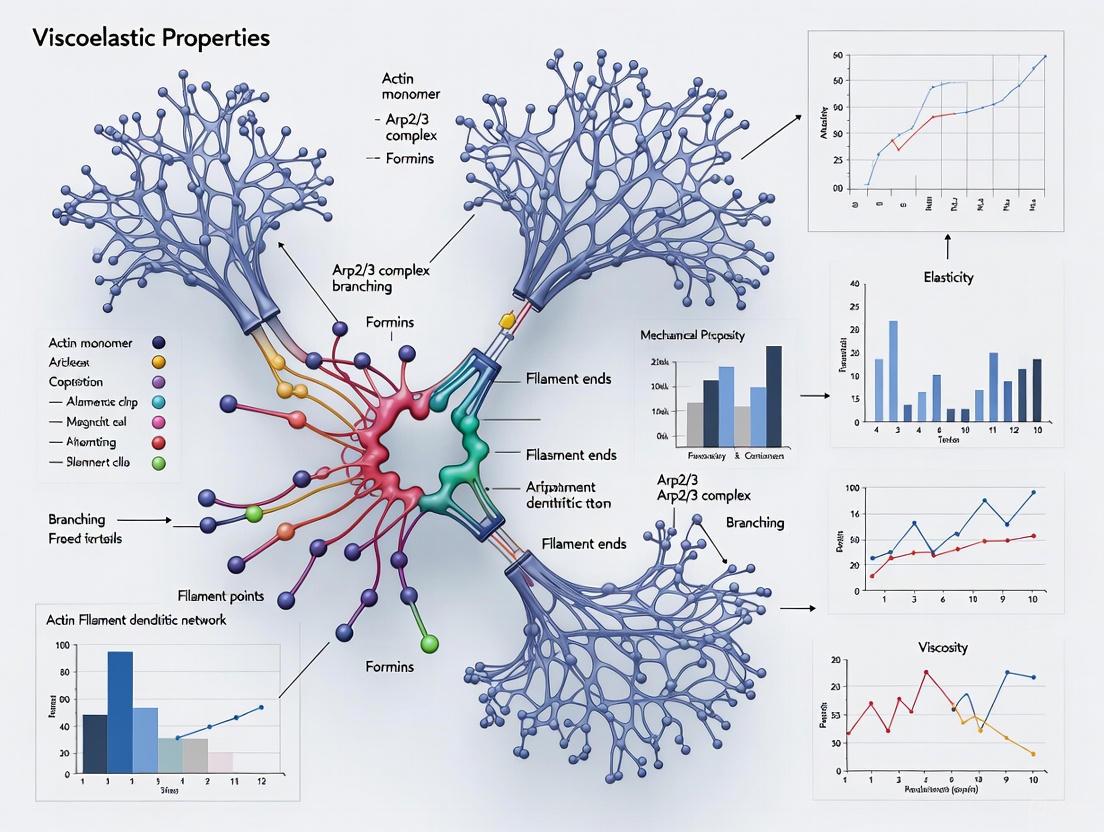
This comprehensive review explores the viscoelastic properties of actin filament dendritic networks, integrating foundational biophysics with cutting-edge methodological approaches.
Viscoelastic Properties of Actin Filament Dendritic Networks: From Molecular Mechanisms to Biomedical Applications
Abstract
This comprehensive review explores the viscoelastic properties of actin filament dendritic networks, integrating foundational biophysics with cutting-edge methodological approaches. We examine how dendritic nucleation architecture, cross-linker specificity, and geometrical constraints determine mechanical behavior across scales—from single filaments to complex networks. The article details experimental techniques like macrorheology and FRAP alongside computational models including finite-element analysis and Cytosim simulations. We address optimization challenges in network design, compare mechanical performance across network types, and validate models against experimental data. Finally, we discuss emerging biomedical applications in drug development, neurological disorders, and cytoskeleton-targeted therapies, providing researchers and drug development professionals with a multidisciplinary framework for understanding and manipulating these essential biological structures.
Architecture and Mechanical Principles of Dendritic Actin Networks
Frequently Asked Questions (FAQs) & Troubleshooting Guides
Network Architecture and Stability
Q1: My reconstituted actin network fragments into small, disconnected domains instead of forming a single, connected structure. What could be causing this?
- Potential Cause: Elevated concentrations of the Arp2/3 complex. Computational studies using stochastic simulations have demonstrated that high Arp2/3 levels (10 nM and above) increase the network treadmilling rate and can cause a connected actin domain to fragment into multiple, smaller dynamic domains [1].
- Troubleshooting:
- Titrate Arp2/3 Concentration: Systematically vary the concentration of Arp2/3 complex in your assay. Lower concentrations (below 10 nM) promote the formation of a single, contractile domain [1].
- Verify Nucleation-Promoting Factor (NPF) Activity: Ensure your NPF (e.g., N-WASP) is correctly activated. Use supported lipid bilayers with purified components to precisely control the presentation and activation of NPFs [2].
- Check Monomer Availability: Confirm that your G-actin concentration is sufficient to support sustained polymerization across a larger network. Local depletion of monomers can exacerbate fragmentation.
Q2: The branched actin network I grow from functionalized surfaces has inconsistent geometry and does not replicate the intended pattern.
- Potential Cause: Inefficient or uneven spatial activation of actin polymerization on the micropatterned surface.
- Troubleshooting:
- Validate Surface Functionalization: Use quality control measures to ensure your nucleation-promoting factors (NPFs) are properly attached to the lipid bilayer or passivated surface in the desired pattern [3].
- Control Polymerization Spatiotemporally: Consider using protein photoactivation methods for transient, illumination-controlled activation of actin monomers or motors, which can offer more dynamic control over network formation compared to static micropatterns [3].
- Confirm Buffer Conditions: Ensure that your polymerization buffer contains essential components like ATP and Mg²⁺, and that the pH is stable, as these factors are critical for robust actin dynamics [2].
Force Generation and Measurement
Q3: The force generated by my actin bundles is much lower than theoretical predictions. Why is the measured stall force so small?
- Potential Cause: This is a fundamental characteristic of small parallel actin bundles. Direct force measurements using optical traps have shown that the growth of a bundle of approximately eight filaments stalls at a load force (~1 pN) expected to stall a single filament [4].
- Troubleshooting:
- Understand the Limitation: Recognize that in this geometry, force generation is limited by a dynamic instability where typically only the longest filament in the bundle is in contact with the barrier at any given time. The filaments do not cooperate to generate higher forces [4].
- Introduce Actin-Associated Factors: To generate substantial, sustained forces, cells use other actin-binding proteins. Incorporate factors like fascin or other bundling proteins that can suppress this dynamic instability and enhance mechanical coherence between filaments in the bundle.
- Increase Filament Number: Theoretically, larger bundles with more filaments can generate higher forces. However, overcoming the single-filament instability may still require cross-linking proteins.
Q4: How does the geometry of the load affect force measurements in actin polymerization assays?
- Answer: The experimental geometry is critical for interpreting force measurements.
- Rigid Barrier vs. Compliant Load: Assays using a rigid barrier (like in the keyhole optical trap) measure the ultimate stall force of polymerization [4].
- Network-level vs. Single-filament: Measurements from densely branched networks pushing against flexible microneedles or cantilevers report the bulk force of the network (in nN/μm²), which is an emergent property of the interconnected filament architecture and cannot be easily extrapolated to single-filament behavior [4].
Viscoelastic Properties
Q5: The linear elastic response (G′) of my cross-linked actin network is not significantly enhanced upon adding a cross-linker. Is this normal?
- Answer: Yes, for certain cross-linkers. The effect on linear elasticity is highly dependent on the specific actin-binding protein used. For example, adding filamin has been shown to have a very small effect on the network's linear storage modulus (G′), in contrast to other cross-linkers like heavy meromyosin (HMM), which cause a strong increase [5].
- Troubleshooting:
- Characterize Your Cross-linker: Review the known mechanical effects of your specific cross-linking protein. Filamin, for instance, is known for inducing drastic nonlinear stress stiffening rather than a large increase in linear elasticity [5].
- Check for Bundle Formation: Use confocal microscopy to verify the microstructure of your network. Filamin can induce a transition from a cross-linked filamentous network to a bundled network at specific concentration ratios, which will alter the mechanical output [5].
- Ensure Full Polymerization: Confirm that actin polymerization has reached completion before conducting rheological measurements [5].
Q6: What factors dominate the viscoelastic response of a cross-linked actin network under mechanical stress?
- Answer: The dominant factors depend on the level of prestrain (prestress) in the network. Computational analyses identify three key regimes [6]:
- Low Prestrain: The response is dominated by the bending of actin filaments.
- Medium Prestrain: The bending of the cross-linking proteins themselves (e.g., the flexible hinges of filamin) becomes dominant.
- High Prestrain (e.g., >55%): The response is dominated by the stretching of actin filaments and cross-linkers. In this regime, only a small subset of the network, termed the "supportive framework," bears the majority of the load [6].
Quantitative Data Tables
Table 1: Experimentally Measured Actin Polymerization Forces
This table summarizes key quantitative findings from direct measurements of actin polymerization forces under different geometries.
| Measurement Type | Experimental System | Key Quantitative Finding | Implication | Source |
|---|---|---|---|---|
| Stall Force of Small Bundles | Optical trap; ~8 filaments growing from acrosome | Stall force ~ 1 pN (for 2-4 µM G-actin) | Force generation is limited by single-filament dynamics, not cooperative pushing. | [4] |
| Theoretical Maximum Stall Force (Single Filament) | Thermodynamic model (Eq. 1) | ~9 pN (estimated for in vivo conditions with ~100 µM G-actin) | Sets the upper thermodynamic limit for a single filament. | [4] |
| Network Stall Pressure | Branched networks deflecting microneedles | Several nN/µm² | Highlights the collective force-generating capacity of dense, cross-linked networks. | [4] |
| Filament Length Fluctuation (Diffusivity, D) | Electron microscopy of acrosomal bundles | D increases with G-actin concentration (e.g., from 0.2 to 0.8 monomers²/s between 1-4 µM actin) | Indicates large stochastic length fluctuations, contributing to dynamic instability in bundles. | [4] |
Table 2: Structural and Viscoelastic Parameters of Cross-Linked Actin Networks
This table compiles data on how different cross-linking proteins influence actin network microstructure and mechanics.
| Parameter | Cross-linked Network (e.g., with ACPC) | Bundled Network (e.g., with Filamin/ACPB) | Source |
|---|---|---|---|
| Effect on Linear Elasticity (G′) | Strong increase with cross-linker density. Power-law exponent at low frequency decreases to near zero. | Can be very small; the main effect is often on nonlinear properties. | [5] [6] |
| Nonlinear Response | Stress-stiffening behavior. | Extreme stress hardening; nonlinear stiffness can be tuned over orders of magnitude with prestress. | [5] |
| Dominant Microstructure | Orthogonal, cross-linked mesh. | Branched and merged bundle clusters; structural polymorphism depends on actin and cross-linker concentration. | [5] |
| Critical Cross-linker Ratio (R*) | Not Applicable | Decreases with increasing actin concentration (ca). Purely bundled networks form above R*. | [5] |
| Structural Saturation | Not Applicable | Observed at high filamin concentrations (R#fil); network structure becomes insensitive to further cross-linker addition. | [5] |
Experimental Protocols
Protocol 1: Reconstituting Actin Polymerization on Supported Lipid Bilayers
This protocol outlines the methodology to study Arp2/3-dependent actin polymerization from membrane-associated protein clusters, adapted from current reconstitution approaches [2].
Key Research Reagent Solutions:
| Reagent/Material | Function/Explanation in the Assay |
|---|---|
| Supported Lipid Bilayer (SLB) | Mimics the plasma membrane; provides a fluid surface for protein mobility and cluster formation. |
| 16:0-18:1 PC (POPC) | The primary phospholipid component of the SLB. |
| 18:1 DGS-NTA(Ni) | Lipids with Ni²⁺-chelating headgroups used to attach His-tagged proteins (e.g., Nephrin cytoplasmic domain) to the bilayer. |
| Fluorescently Labeled Actin | Allows for visualization of polymerized networks via TIRF microscopy. Rhodamine-labeled actin is commonly used. |
| Arp2/3 Complex | The core complex that nucleates new actin filaments as branches from the sides of existing filaments. |
| Capping Protein | Binds to filament barbed ends to prevent elongation, helping to create a short, branched network typical of lamellipodia. |
| Glucose Oxidase/Catalase Oxygen Scavenging System | Protects fluorescent probes from photobleaching and oxygen-derived damage during prolonged microscopy. |
Methodology:
- SLB Preparation: Create SLBs in a glass-bottom 96-well plate. A typical lipid composition is 95% POPC, 4% DGS-NTA(Ni), and 1% PEG5000 PE (to reduce non-specific binding). Lipids mixed in chloroform are dried, desiccated, and rehydrated in PBS to form multilamellar vesicles (MLVs). MLVs are then extruded and deposited on clean glass to form a planar bilayer [2].
- Protein Clustering: Incubate the SLB with the His-tagged cytoplasmic domain of a transmembrane protein (e.g., nephrin). Add the adaptor proteins (e.g., N-WASP) in solution. Weak, multivalent interactions will drive the formation of liquid-like, phase-separated protein condensates on the membrane [2].
- Actin Polymerization Assay: Prepare the actin polymerization mix containing purified G-actin (e.g., 1-4 µM, with 10-20% fluorescently labeled), Arp2/3 complex (e.g., 10-50 nM), and capping protein in an appropriate buffer (e.g., with MgCl₂, KCl, ATP, TROL-based antifade system) [2].
- Imaging and Data Acquisition: Flow the actin mix into the well containing the SLB with pre-formed clusters. Immediately image the sample using TIRF microscopy to observe the nucleation and growth of actin filaments from the membrane-associated condensates.
Protocol 2: Direct Force Measurement of Actin Bundles using an Optical Trap
This protocol describes the core steps for measuring polymerization forces against a rigid barrier, based on the pioneering work in [4].
Methodology:
- Sample Preparation: Use Limulus sperm acrosomal bundles or synthetic beads coated with an actin nucleator (e.g., formin or the Arp2/3 activator complex) as the foundation for actin filament growth [4].
- Assembly in Flow Cell: Attach the acrosomal bundle or bead to a polystyrene bead that can be captured by an optical trap. Introduce the sample into a flow cell featuring a microfabricated rigid wall that serves as a barrier.
- Initiation of Polymerization: Place the trapped bead/bundle assembly near the barrier. Introduce a solution of G-actin (1-4 µM) with a 5-fold molar excess of profilin. Profilin suppresses spontaneous nucleation and directs polymerization primarily to the barbed ends of the acrosomal bundle [4].
- Force Measurement: As actin filaments polymerize from the bundle, they push against the rigid barrier. This push displaces the bead from the center of the optical trap. The trap acts as a linear spring, and the force exerted is calculated as the product of the trap stiffness and the bead's displacement (F = k * Δx).
- Data Analysis: The force trace over time is analyzed to determine the stall force—the plateau force where polymerization can no longer push against the barrier. The number of filaments in the bundle is typically quantified post-experiment using electron microscopy [4].
Mechanism and Workflow Visualizations
Diagram 1: Dendritic Nucleation Mechanism
Diagram 2: Supported Lipid Bilayer Actin Assay
Troubleshooting Guides
Guide 1: Addressing Inefficient Actin Branch Formation in Reconstituted Networks
Problem: Low yield of actin filament branches despite the presence of Arp2/3 complex and NPFs.
- Question: Why are my reconstituted actin networks forming fewer branches than expected?
- Investigation Steps:
- Verify Branching Efficiency: Recognize that branch formation is inherently inefficient. Only approximately 1% of Arp2/3 complexes that bind to a mother filament successfully nucleate a daughter filament, even in the presence of saturating (300 nM) VCA domains [7]. A low yield may reflect the natural process rather than an error.
- Check NPF Concentration and Type: Ensure you are using an adequate concentration of a Nucleation Promoting Factor (NPF) like WASP/VCA. Test different concentrations (e.g., 0 nM vs. 300 nM) and confirm the NPF's activity, as VCA is known to increase both the rate of Arp2/3 complex binding to filaments and the fraction of bound complexes that successfully nucleate [7].
- Confirm Mother Filament Integrity: Use freshly polymerized, non-aged actin filaments for experiments. Older filaments that have hydrolyzed their ATP may be less effective substrates for branch formation [8].
- Inspect Buffer Conditions: Ensure the presence of ATP and appropriate divalent cations (Mg²⁺) in your reaction buffer, as ATP binding to Arp2 and Arp3 is essential for the conformational change required for nucleation [9].
Guide 2: Resolving Issues with Actin Network Viscoelasticity Measurements
Problem: Unexpected or inconsistent results when measuring the mechanical properties of cross-linked actin networks.
- Question: My rheology measurements on cross-linked actin networks are not reproducible. What could be wrong?
- Investigation Steps:
- Control Cross-linker Density: Precisely quantify the molar ratio (R) of your cross-linker (e.g., rigor-HMM) to actin. Viscoelastic moduli are highly sensitive to this ratio [10] [11]. Inconsistencies in preparation can lead to large variations.
- Standardize Filament Length: Use a capping protein like gelsolin to control the average length of actin filaments. For reproducible networks, an average length of 21 μm has been used in rheology studies [10]. Uncontrolled length distributions lead to variable network structures.
- Confirm Cross-linker Functionality: Verify the activity of your cross-linking protein. For example, rigor-HMM must be in the nucleotide-free state to form stable cross-links. The presence of residual ATP can prevent proper binding [11].
- Check for Network Bundling: If your cross-linker is intended to create orthogonal networks (like rigor-HMM) but you observe bundled structures, this indicates a problem with the cross-linker type or purity. This can drastically alter mechanical properties from a soft gel to a stiffer bundle [6].
Frequently Asked Questions (FAQs)
FAQ 1: What is the primary function of the Arp2/3 complex in actin networks? The Arp2/3 complex is a seven-subunit protein that nucleates new actin filaments and branches them from the sides of pre-existing "mother" filaments. It creates the characteristic branched, dendritic networks that generate pushing forces in processes like cell migration and endocytosis [12] [9].
FAQ 2: At what angle do Arp2/3-generated branches form? The Arp2/3 complex typically generates new "daughter" filaments at a 70-degree angle relative to the mother filament [9]. In motile cells, this leads to a self-organized network where filament orientations are bimodally distributed, peaked at approximately ±35 degrees relative to the direction of membrane protrusion [8].
FAQ 3: How do cross-linking proteins influence actin network mechanics?
Cross-linking proteins determine the viscoelastic properties of actin networks. They control whether the network is elastic or viscous at a given timescale. The key parameters are the cross-linker off-rate (k_off) and the characteristic bond length (Δx). A lower k_off and a shorter Δx (shorter distance to the transition state) generally lead to a more solid-like, elastic response [10].
FAQ 4: Why is the dendritic nucleation model important for understanding network viscoelasticity? The dendritic nucleation model explains how the actin network at the leading edge of a cell is both dynamically assembled and mechanically structured. The continuous, Arp2/3-mediated branching creates a dense network that can resist compression and generate force. The model provides a framework for understanding how polymerization kinetics, filament orientation, and cross-linking together determine the overall viscoelastic performance of the cytoskeleton [8] [13].
FAQ 5: How does VCA/WASP activate the Arp2/3 complex? Nucleation Promoting Factors (NPFs) like WASP family proteins (via their VCA domain) activate the Arp2/3 complex through a multi-step mechanism:
- They increase the association rate of Arp2/3 complex with the side of mother filaments (approximately 2.2-fold) [7].
- They increase the nucleation efficiency (
f_B), meaning a higher fraction of filament-bound complexes successfully start a new branch (from 0.4% without VCA to 1.3% with VCA) [7]. - They induce a large-scale conformational change in the complex, bringing Arp2 and Arp3 together to mimic an actin dimer, thus creating a new nucleation site [9].
Table 1: Key Kinetic Parameters of Arp2/3 Complex Branching
| Parameter | Value (-VCA) | Value (+300 nM VCA) | Description | Source |
|---|---|---|---|---|
| Branch Formation Rate Constant | 2,500 ± 700 M⁻¹s⁻¹μm⁻¹ | 9,700 ± 2,900 M⁻¹s⁻¹μm⁻¹ | Rate of branch formation per unit length of mother filament. | [7] |
| Binding Rate Constant | 1.4 ± 0.3 × 10³ M⁻¹s⁻¹ | 3.0 ± 0.7 × 10³ M⁻¹s⁻¹ | Filament-specific binding rate constant of Arp2/3 per F-actin subunit. | [7] |
Nucleation Efficiency (f_B) |
0.4 ± 0.2% | 1.3 ± 0.4% | Fraction of mother filament-bound Arp2/3 complexes that yield a daughter filament. | [7] |
Characteristic Activation Time (<t_a>) |
3 ± 2 s | 5 ± 2 s | Average delay between Arp2/3 binding and the initiation of daughter filament elongation. | [7] |
Table 2: Structural and Mechanical Properties of Actin Networks
| Parameter | Value / Observation | Description / Significance | Source |
|---|---|---|---|
| Branch Angle | ~70° | Characteristic angle between mother and daughter filaments. | [9] |
| Network Orientation | Peaked at ±35° | Self-organized filament orientation in lamellipodia, resulting from 70° branching. | [8] |
Profilin Binding Affinity (K_d) |
7 μM | Affinity of profilin for the Arp2/3 complex, intermediate between its affinity for actin monomers and filament barbed ends. | [14] |
| Power Law Exponent of G' | Decreases from 0.75 to near 0 | Change in the frequency dependence of the storage modulus (G') as cross-link density increases in orthogonal networks. |
[6] |
Experimental Protocols
Protocol 1: Purification of Arp2/3 Complex fromAcanthamoeba castellanii
This protocol is adapted from affinity chromatography methods used in foundational studies [14].
- Cell Homogenization: Homogenize Acanthamoeba cells in sucrose extraction buffer (10 mM Tris-HCl, pH 8.0, 11.6% sucrose, 1 mM EGTA, 1 mM ATP, 1 mM DTT, and protease inhibitors).
- Ion-Exchange Chromatography: Load the extract onto a DEAE-cellulose column. Collect the flow-through, which contains the Arp2/3 complex.
- Affinity Chromatography: Load the DEAE flow-through onto a poly-L-proline Sepharose column.
- Elution:
- Elute the bound Arp2/3 complex with 0.4 M MgCl₂ in 10 mM Tris-HCl (pH 7.5), 100 mM NaCl, 100 mM glycine, and 1 mM DTT.
- Elute profilin with 8 M urea in a subsequent step.
- Dialysis and Storage: Dialyze the purified Arp2/3 complex into a storage buffer (e.g., 10 mM imidazole pH 7.5, 150 mM NaCl, 0.2 mM MgCl₂, 0.2 mM ATP, 1.0 mM DTT), concentrate, and store on ice.
Protocol 2: In Vitro Viscoelasticity Measurement of Cross-linked Actin Networks
This protocol outlines the procedure for bulk rheology measurements of actin networks cross-linked with rigor-HMM [10] [11].
- Sample Preparation:
- Use lyophilized rabbit skeletal muscle actin. Dissolve and dialyze against G-Buffer (2 mM Tris, 0.2 mM ATP, 0.2 mM CaCl₂, 0.2 mM DTT, pH 8.0).
- Polymerize actin by adding 10x F-Buffer (20 mM Tris, 2 mM ATP, 20 mM MgCl₂, 1 M KCl, pH 7.5).
- Add gelsolin to control the average filament length (e.g., to 21 μm).
- Mix actin with rigor-HMM at a specific molar ratio (R = cHMM / cactin). Typical ratios used are in the range of R=0.1 for dense cross-linking.
- Rheometry:
- Load approximately 500 μL of the polymerized network into a stress-controlled rheometer with a plate-plate geometry (e.g., 50-mm diameter, 160-μm gap).
- To ensure linear response, apply small oscillating torques (e.g., ≈0.5 μN·m).
- Data Acquisition:
- Perform frequency sweep measurements over a range (e.g., 0.1 to 100 Hz) to record the storage modulus (
G') and loss modulus (G"). - The transition of HMM to the rigor state upon ATP depletion can be monitored by following
G'at a fixed frequency (e.g., 0.5 Hz) over time.
- Perform frequency sweep measurements over a range (e.g., 0.1 to 100 Hz) to record the storage modulus (
Conceptual Diagrams
Actin Branching Mechanism
Network Viscoelasticity Determination
Dendritic Network Self-Organization
The Scientist's Toolkit: Research Reagent Solutions
Table 3: Essential Reagents for Actin Network Studies
| Reagent | Function / Description | Key Use-Case |
|---|---|---|
| Arp2/3 Complex | Seven-subunit complex that nucleates actin filaments and forms branches. | Core component for reconstituting dendritic actin networks in motility assays [12] [9]. |
| Profilin | Actin monomer binding protein; also interacts with Arp2/3 complex. | Used in affinity purification of Arp2/3 complex; regulates actin monomer pool for polymerization [14]. |
| NPFs (WASP/VCA) | Nucleation Promoting Factors that activate the Arp2/3 complex. | Essential for stimulating the nucleation activity of Arp2/3 in vitro [7] [15]. |
| Rigor-HMM | A truncated, nucleotide-free myosin II that acts as a rigid cross-linker. | Creating homogeneous, isotropically cross-linked (non-bundled) actin networks for rheology studies [10] [11]. |
| Gelsolin | Actin filament severing and capping protein. | Standardizing the average length of actin filaments for reproducible network mechanics [10]. |
| Poly-L-Proline Sepharose | Affinity chromatography resin that binds profilin-actin complexes. | Standard method for purifying the Arp2/3 complex from cell extracts [14]. |
This technical support guide is framed within a research thesis investigating the viscoelastic properties of actin filament dendritic networks. The actin cytoskeleton is a dynamic, semi-flexible polymer network that provides mechanical stability to cells and is essential for numerous cellular processes, including migration, division, and force sensation [11] [6]. Its viscoelastic character means it exhibits both solid-like (elastic) and fluid-like (viscous) properties, which are quantified by the storage modulus (G′) and loss modulus (G″), respectively. Furthermore, these networks often display stress hardening or stress stiffening, a non-linear property where the network becomes stiffer under increasing strain or stress [11] [5]. This behavior is critical for cellular mechanics, as cells in the body are constantly subjected to mechanical forces. Reconstituted in vitro actin networks, cross-linked with proteins like filamin or heavy meromyosin (HMM), serve as essential model systems for understanding the more complex cellular environment [11] [5]. This document provides troubleshooting guidance for researchers measuring these fundamental properties, with a focus on the pitfalls specific to actin dendritic networks.
Frequently Asked Questions (FAQs)
Q1: What do the storage (G′) and loss (G″) moduli tell me about my actin network? The storage modulus (G′) represents the elastic, energy-storing component of your network, reflecting its solid-like character. The loss modulus (G″) represents the viscous, energy-dissipating component. In stable, solid-like cross-linked actin networks, you typically expect G′ to be greater than G″ (G′ > G″) across a wide frequency range. A high G′ indicates a well-connected, elastic network. If G″ is dominant or very close to G′, it may suggest insufficient cross-linking, network degradation, or that the measurement is occurring in a fluid-like regime [11] [6].
Q2: Why is my actin network not exhibiting the expected stress-stiffening behavior? Stress-stiffening is a hallmark of many biopolymer networks. Its absence can be due to several factors:
- Insufficient Cross-linking: The density or strength of the cross-links may be too low to transmit stress effectively through the network. Ensure your cross-linker (e.g., filamin, α-actinin) concentration is appropriate for your actin concentration [5].
- Network Topology: The architecture of the network matters. Networks with more rigid, orthogonal cross-links show different stiffening responses compared to those that form parallel bundles. Check if your cross-linker is creating the intended network structure [6].
- Filament Length: Very short filaments can prevent the formation of a continuous network that can support and redistribute stress. Control filament length using proteins like gelsolin [5].
Q3: My rheological data is inconsistent between preparations. What could be the cause? Actin networks can be kinetically trapped, meaning their structure (and thus mechanics) depends on the assembly pathway.
- Polymerization Protocol: Always polymerize actin in situ in your rheometer under a consistent and well-defined protocol. Variations in temperature, time, or mixing during polymerization can lead to different final network structures [5].
- Sample History: These networks can exhibit history-dependent properties. Applying pre-strain or large stresses before a measurement can alter the network, leading to irreproducible results. Develop a standardized loading and pre-conditioning protocol [6].
Troubleshooting Guide: Common Experimental Issues
| Problem | Potential Causes | Recommended Solutions |
|---|---|---|
| Low Storage Modulus (G′) | 1. Low cross-linker density.2. Actin filaments too short.3. Partial depolymerization of actin.4. Measurement in non-linear regime. | 1. Titrate cross-linker concentration and use molar ratios for consistency [5].2. Control filament length with gelsolin; verify length via microscopy [5].3. Use fresh actin; include stabilizing agents (e.g., phalloidin) if appropriate [3].4. Perform a strain sweep to identify and use the linear viscoelastic region [11]. |
| High Loss Modulus (G″) | 1. Network is not fully polymerized.2. Cross-linker dynamics are too fast (weak bonds).3. High fluid phase viscosity. | 1. Ensure sufficient polymerization time before measurement; verify rheologically [5].2. Use a more stable cross-linker (e.g., HMM in rigor state) or increase concentration [11].3. Consider background solvent contribution, especially in crowded conditions. |
| Variable Stress-Stiffening Response | 1. Inconsistent network topology (bundles vs. orthogonal networks).2. Variable internal pre-stress.3. Cross-linker type and mechanics (flexible vs. rigid). | 1. Use cross-linkers known to produce specific architectures (e.g., ACPC for orthogonal networks) [6].2. Allow the network to fully equilibrate after loading to relax internal stresses [5].3. Understand your cross-linker; flexible linkers like filamin enable large stiffening [5]. |
| Unusual Power-Law Frequency Dependence | 1. Non-affine deformations dominating.2. Instrument inertia at high frequencies.3. Network heterogeneities. | 1. This may be a feature of semi-flexible networks. Compare with non-affine microsphere models [11].2. Perform inertia correction on the rheometer.3. Use confocal microscopy to correlate structure with mechanics [5]. |
Table 1: Representative Viscoelastic Moduli for Different Cross-Linked Actin Networks (from [5])
| Actin Concentration (μM) | Cross-linker (Molar Ratio) | Storage Modulus, G′ (Pa) | Loss Modulus, G″ (Pa) | Key Structural Feature |
|---|---|---|---|---|
| 0.95 - 24 | Filamin (R~fil~ = 0.001) | Low (Baseline) | Low (Baseline) | Cross-linked filaments |
| 0.95 - 24 | Filamin (R~fil~ > R*) | Increased significantly | Moderately increased | Bundled network |
| 12.1 (simulated) | Orthogonal Cross-linker (High R) | High (~100s) | Low | Homogeneous, cross-linked network [6] |
Table 2: Factors Influencing Stress-Stiffening Response (compiled from [11] [5] [6])
| Factor | Impact on Stress-Stiffening | Mechanism |
|---|---|---|
| Cross-linker Density | Increases onset stress and maximum stiffness | Creates more load-bearing pathways. |
| Cross-linker Type | Determines the dynamic range of stiffening | Flexible cross-linkers (e.g., filamin) allow for large stiffening; rigid cross-linkers (e.g., scruin) show less effect. |
| Prestrain | Dramatically enhances elastic response and G′ | Shifts network response from bending-dominated to stretching-dominated filament mechanics [6]. |
| Network Topology | Alters the sensitivity to stress | Bundling vs. orthogonal cross-linking creates different architectural reinforcement under load [6]. |
Detailed Experimental Protocols
Protocol: Bulk Rheology of Cross-Linked Actin Networks
This protocol is adapted from methods used to characterize actin/filamin and actin/HMM networks [11] [5].
Key Research Reagent Solutions:
- G-actin Solution: Purified monomeric actin (e.g., from rabbit skeletal muscle) stored in G-buffer (2 mM Tris, 0.2 mM ATP, 0.2 mM CaCl₂, 0.2 mM DTT, pH 8.0) at 4°C [5].
- 10x F-buffer: For polymerization (200 mM Tris, 50 mM ATP, 200 mM MgCl₂, 20 mM CaCl₂, 1 M KCl, 20 mM DTT, pH 7.5). Mg²⁺ and K⁺ are essential for polymerization.
- Cross-linker Solution: Purified protein (e.g., filamin, heavy meromyosin) in an appropriate stable buffer.
- Gelsolin (Optional): For controlling the average length of actin filaments [5].
Methodology:
- Sample Preparation: On ice, mix G-actin solution with the cross-linker at the desired molar ratio (R~ABP~ = c~ABP~/c~actin~). Include gelsolin if filament length control is needed.
- Initiate Polymerization: Add 1/10 volume of 10x F-buffer to the mixture to initiate actin polymerization. Mix gently but thoroughly by pipetting.
- Load Rheometer: Quickly transfer ~480 μL of the solution to the rheometer plate (e.g., 50-mm plate-plate geometry with a ~160-μm gap). Carefully lower the upper plate to avoid air bubbles and trap the sample.
- In-Situ Polymerization: Allow the actin network to polymerize completely in situ at a constant temperature (e.g., 25°C). This typically takes 1-2 hours. Monitor the time evolution of G′ and G″ to confirm polymerization has reached a plateau.
- Strain Sweep: Perform an oscillatory strain sweep (e.g., at 1 Hz) to determine the linear viscoelastic region (LVR). Identify the maximum strain amplitude where G′ and G″ remain constant.
- Frequency Sweep: Within the LVR, perform a frequency sweep (e.g., 0.1 to 100 rad/s) to measure the fundamental viscoelastic moduli, G′(ω) and G″(ω).
- Non-Linear Characterization (LAOS): To probe stress-stiffening, use large amplitude oscillatory shear (LAOS) outside the LVR or apply a steady shear ramp to measure the differential modulus, dσ/dγ [11].
Workflow Visualization
The following diagram illustrates the logical workflow for conducting these experiments and diagnosing results, integrating both experimental and computational approaches.
The Scientist's Toolkit: Research Reagent Solutions
Table 3: Essential Materials for Actin Network Viscoelasticity Research
| Item | Function in Experiment | Example & Notes |
|---|---|---|
| Monomeric (G-) Actin | The core building block of the network. | Rabbit skeletal muscle is a common source. Must be kept in G-buffer on ice to prevent spontaneous polymerization [5]. |
| Actin Cross-linking Proteins (ACPs) | Define network architecture and mechanics. | Filamin: Induces bundling and large stress-stiffening [5]. Heavy Meromyosin (HMM): Creates orthogonal networks without bundling [11]. α-Actinin: Can lead to kinetically trapped structures [5]. |
| Filament Length Control | Ensures network reproducibility. | Gelsolin: Severs filaments to control average length. Critical for standardizing mechanics [5]. |
| Fluorescent Label | Enables structural visualization. | Phalloidin-TRITC: Binds tightly and stabilizes F-actin, allowing confocal microscopy to correlate structure with rheology [5]. |
| Rheometer | Measures viscoelastic moduli. | Stress-controlled rheometer with plate-plate geometry is standard. Requires temperature control and a solvent trap to prevent evaporation [11] [5]. |
The actin cytoskeleton is a primary determinant of cellular mechanical properties, fulfilling essential roles in cell stability, shape changes, and motility. A profound understanding of its viscoelastic properties is therefore critical for research in cell mechanics, disease modeling, and drug development. The dendritic nucleation model describes a key mechanism where the Arp2/3 complex nucleates new actin filaments at a characteristic 70° angle from existing "mother" filaments, creating a branched, dendritic network. This network's mechanical output is not solely defined by its biochemical composition but is exquisitely sensitive to its microstructural architecture—including filament orientation, cross-linker density, and network geometry. This technical support center provides targeted guidance on measuring and interpreting these complex relationships, enabling researchers to troubleshoot common experimental challenges and deepen their mechanistic insights.
Frequently Asked Questions (FAQs) and Troubleshooting
FAQ 1: Why does my reconstituted actin network not exhibit the predicted bimodal filament orientation (peaked at ±35°)?
- Potential Cause: Incorrect ratio between filament elongation velocity and network retrograde flow/edge protrusion rate.
- Solution: The ±35° orientation pattern is a self-organized state, not a molecularly pre-set one. It emerges and is stable only when the critical angle φ, defined by cos(φ) = vrel / vpol (where vrel is the sum of membrane protrusion velocity and retrograde flow rate, and vpol is the filament elongation velocity), is smaller than the Arp2/3 branching angle of ~70° [8]. If your network shows a 70°/0°/-70° pattern instead, it suggests vrel / vpol is too small. To correct this:
- Experimentally modulate protrusion velocity (vmem) or retrograde flow (vretro).
- Adjust polymerization velocity (v_pol) by varying the concentration of profilin-actin available for barbed-end elongation.
- Technical Check: Ensure that branching is biased towards the leading edge or obstacle in your experimental setup, as this is necessary for the self-organization of the ±35° pattern [8].
FAQ 2: Why do I observe significant variability in force-velocity measurements of my actin networks?
- Potential Cause: The relationship between opposing force and network growth velocity is highly dependent on specific network organizational parameters.
- Solution: Force-velocity curves can be convex or concave depending on the system's organization [8]. This shape is influenced by:
- Filament and Membrane Elasticity: Softer membranes or more flexible filaments can alter the force transduction mechanism.
- Network Organization: Denser networks with more filaments in contact with an obstacle can exhibit a concave force-velocity relationship, where velocity is weakly dependent on force [8].
- Presence of Tethers: The force-velocity curve can shift from concave to convex if filaments are tethered to a surface [8].
- Troubleshooting Step: Characterize and report the detailed microstructure (density, orientation) of your network alongside force-velocity measurements to enable correct interpretation.
FAQ 3: The linear elastic modulus (G′) of my cross-linked actin network is lower than expected. What could be wrong?
- Potential Cause 1: The network may not be fully equilibrated or may be kinetically trapped.
- Solution: Certain cross-linked networks, like those with filamin, are known to be history-dependent and can develop internal stresses [5]. Adhere to a strict and reproducible preparation protocol to ensure comparability between experiments.
- Potential Cause 2: Insufficient or excessive cross-linker concentration.
- Solution: Refer to the structural state diagram for your specific cross-linker. For filamin, a transition from a cross-linked filamentous network to a bundled network occurs above a critical ratio R*_fil, which itself decreases with increasing actin concentration [5]. Ensure your cross-linker ratio is appropriate for your target microstructure.
- Potential Cause 3: Degradation of actin monomers.
- Solution: Use fresh, gel-filtered ATP-actin. Storing monomers without frequent buffer changes containing fresh ATP and DTT, or improper freezing/thawing, can alter actin properties and increase G′ by more than an order of magnitude [16].
FAQ 4: How do I interpret a minimum in the loss modulus (G″) at intermediate frequencies in my rheology data?
- Explanation: This is a characteristic feature of transiently cross-linked networks and results from the competition between two dissipation mechanisms [10].
- Interpretation: At low frequencies, dissipation is dominated by the unbinding and rebinding of cross-links. At high frequencies, dissipation is dominated by the internal bending fluctuations of the filaments. The minimum occurs at the transition between these two regimes [10].
- Action: The position and depth of this minimum are sensitive to the cross-linker's off-rate (k_off). You can use this feature to extract kinetic information about your cross-linking protein from macroscopic rheological measurements.
Table 1: Key Parameters from Actin Network Mechanical Models
| Parameter | Description | Typical Value / Range | Context and Impact |
|---|---|---|---|
| Branching Angle | Angle between mother and daughter filament. | ~70° | Set by Arp2/3 complex biochemistry [8]. |
| Peaked Orientation | Self-organized filament angles in lamellipodia. | ±35° | Emerges when cos(φ) = vrel/vpol and φ < 70° [8]. |
| Critical Ratio (R*_fil) | Molar ratio of filamin to actin for bundle formation. | Decreases with increasing actin concentration [5] | Defines transition from cross-linked to bundled network microstructure. |
| Power Law Exponent (n) | Exponent in G′ ∝ fⁿ at low frequency. | ~0.75 to near 0 | ~0.75 reflects filament fluctuations; near 0 indicates crosslink-dominated, solid-like behavior [6]. |
| Persistence Length | Length over which actin filament remains straight. | ~17 µm | Determines whether filaments behave as semi-flexible (entropic) or rigid (enthalpic) rods in the network [6]. |
Table 2: Experimental Storage Modulus (G′) of Actin Networks
| Network Type | Actin Concentration | Conditions | Storage Modulus G′ | Reference |
|---|---|---|---|---|
| Pure F-actin | ~1 mg/ml (≈23.8 µM) | Polymerized in EGTA & Mg²⁺ | ~1 Pa (at 0.1-1 Hz) | [16] |
| Pure F-actin | ~1 mg/ml (≈23.8 µM) | Polymerized in KCl with Ca²⁺ & Mg²⁺ | Slightly higher than 1 Pa | [16] |
| Cross-linked (simulated) | 12.1 µM | With orthogonal crosslinkers (ACPC) | Increases with crosslink density | [6] |
| Cross-linked (simulated) | 12.1 µM | With bundling crosslinkers (ACPB) | G′ increases less than with ACPC | [6] |
Detailed Experimental Protocols
Protocol: Bulk Rheology of Reconstituted Actin/ABP Networks
This protocol is adapted from methodologies detailed in [5] [10] for measuring the linear viscoelastic response of cross-linked actin gels.
I. Sample Preparation
- G-actin Solution: Dissolve lyophilized G-actin from rabbit skeletal muscle in deionized water and dialyze against G-Buffer (2 mM Tris, 0.2 mM ATP, 0.2 mM CaCl₂, 0.2 mM DTT, 0.005% NaN₃, pH 8.0). Keep at 4°C and use within 7-10 days [5] [10].
- Filament Length Control: To control the average filament length to a specific value (e.g., 21 µm), add gelsolin at an appropriate molar ratio to G-actin prior to polymerization [5] [10].
- Cross-linker Addition: Mix the G-actin solution with the actin-binding protein (ABP; e.g., filamin, HMM) at the desired molar ratio R = cABP / cactin.
- Polymerization Initiation: Initiate polymerization by adding 1/10th volume of 10× F-buffer (final concentration: 2 mM Tris, 1 mM ATP, 2 mM MgCl₂, 0.2 mM CaCl₂, 100 mM KCl, 0.2 mM DTT, pH ~7.5). Mix gently.
II. Rheometry Measurement
- Loading: Within 1 minute of polymerization initiation, load approximately 500 µL of the sample onto the plate of a stress-controlled rheometer (e.g., Physica MCR 301). Use a plate-plate geometry with a gap setting of ~160 µm.
- In-Situ Polymerization: Allow the actin to polymerize fully in situ on the rheometer stage. This ensures the network forms under quiescent conditions and minimizes handling artifacts.
- Linear Viscoelasticity Test: Prior to frequency sweep, perform a stress or strain sweep to determine the linear response regime.
- Frequency Sweep: Apply a small oscillatory torque (e.g., ~0.5 µN·m) to measure the storage (G′) and loss (G″) moduli over a frequency range of typically 0.01 to 100 Hz.
Troubleshooting Note: The linear moduli for pure actin can vary by up to a factor of two between different actin preparations. For accurate measurement of the cross-linker's effect, compare networks prepared with the same actin batch [5].
Protocol: Computational Analysis of Network Viscoelasticity
This protocol outlines the method for performing Brownian dynamics simulations of cross-linked actin networks, as described in [6].
I. Network Generation
- Initialization: Start with a uniform distribution of actin monomers and randomly dispersed ACPs within a defined 3D volume.
- Polymerization Simulation: Allow the network to polymerize stochastically within the simulation, following Brownian dynamics rules, until a high percentage (e.g., 99%) of monomers are incorporated into filaments.
- Coarse-Graining (Optional): Apply a coarse-graining procedure to the resulting network to increase the system size to a computationally manageable scale while preserving network morphology.
II. Defining Mechanics
- Filament Properties: Assign mechanical properties to actin filaments, treating them as semi-flexible polymers with defined persistence length, and specify bending and extensional stiffnesses.
- Cross-linker Properties: Define ACPs with specific properties. Two primary types are:
- ACPC (Orthogonal Crosslinker): Equilibrium crosslinking angle of π/2.
- ACPB (Bundling Crosslinker): Equilibrium crosslinking angle of 0.
- Steric Exclusion: Implement a repulsive potential to account for volume exclusion between filaments.
III. Rheology Probing (Two Methods)
- Bulk Rheology: Apply an oscillatory shear strain to the network boundaries. Calculate the stress response from the forces and displacements of all elements within the network to compute G′ and G″.
- Segment-Tracking Rheology: Analyze the thermal fluctuations (mean-square displacement) of individual actin segments within the network to extract local viscoelastic properties.
Diagram 1: Computational workflow for simulating actin network mechanics.
The Scientist's Toolkit: Research Reagent Solutions
Table 3: Essential Materials for Actin Network Research
| Reagent / Material | Function in Experiment | Key Considerations |
|---|---|---|
| G-Actin (from rabbit muscle) | Monomeric actin building block for network assembly. | Use fresh, gel-filtered ATP-actin. Purity and storage conditions drastically affect polymerization and mechanics [16]. |
| Arp2/3 Complex | Nucleates new filaments at ~70° from existing filaments. | Essential for creating dendritic network architecture. Activation often occurs near membranes or obstacles [8]. |
| Filamin | Actin cross-linking and bundling protein. | Induces bundle formation above critical ratio R*_fil. Networks can be history-dependent and exhibit internal stress [5]. |
| Rigor Heavy Meromyosin (HMM) | Transiently cross-links actin filaments. | Forms isotropic networks. Ideal for studying the effect of cross-linker kinetics (k_off) on viscoelasticity [10]. |
| Gelsolin | Severs actin filaments to control average length. | Critical for standardizing filament length distribution, a key parameter affecting network elasticity [5] [10]. |
| Profilin | Binds G-actin, promotes addition to barbed ends. | Regulates filament elongation velocity (v_pol), a key parameter in orientation pattern selection [8]. |
| Capping Protein | Binds filament barbed ends to halt elongation. | Controls the density and average length of filaments in the network by preventing further polymerization [8]. |
Diagram 2: Relating biochemistry and microstructure to network mechanics.
The actin cytoskeleton is organized into structurally and functionally distinct filamentous (F-actin) pools, primarily characterized by their differential dynamics and molecular composition. The two principal pools are the dynamic actin pool, consisting of rapidly treadmilling filaments, and the stable, cross-linked actin pool, comprising filaments bundled by cross-linking proteins. These pools are not static; they exist in a dynamic equilibrium and can be rapidly interconverted in response to cellular signals. This balance is fundamental to the actin cytoskeleton's ability to confer a wide range of mechanical properties to the cell, from fluid-like deformability to solid-like elasticity [17] [18].
In the context of dendritic spines, which are small, actin-rich protrusions that receive excitatory signals in neurons, the regulation of these pools is particularly critical. Changes in the shape and size of dendritic spines are correlated with synaptic strength and heavily depend on the remodeling of the underlying actin cytoskeleton. Emerging evidence indicates that signaling pathways linking synaptic activity to spine morphology influence local actin dynamics, making the mechanisms of actin regulation integral to synaptic plasticity, learning, and memory [17]. Furthermore, alterations in the stable actin pool have been implicated in long-term potentiation (LTP), a cellular model for memory, where an increase in stable filaments can persist for hours, potentially serving as a "synaptic tag" [18].
Frequently Asked Questions (FAQs)
Q1: What are the defining characteristics of the dynamic and stable actin pools?
A1: The dynamic actin pool is characterized by rapid treadmilling, where filaments undergo continuous polymerization at their barbed ends and depolymerization at their pointed ends. This pool is highly responsive to cellular signals and is enriched with proteins like ADF/cofilin, which sever existing filaments and accelerate turnover. It is predominant in structures like the lamellipodia, where rapid remodeling is required for cell protrusion [18] [19].
In contrast, the stable, cross-linked actin pool consists of filaments that are bundled by cross-linking proteins such as α-actinin, filamin, and drebrin. These cross-linkers significantly slow down filament treadmilling, creating a more persistent structural scaffold. This pool is essential for reinforcing cellular structures, such as the core of dendritic spines and stress fibers, and provides long-term mechanical stability [18] [5].
Q2: During in vitro experiments, my actin network fails to form a coherent gel and instead remains a solution of rigid bundles. What could be the cause?
A2: This issue often arises from an imbalance between the kinetics of filament elongation and network gelation. If the filament elongation rate is too low, the system favors the formation of rigid bundles through diffusion-mediated aggregation before a space-spanning network can be established.
- Primary Cause: Insufficient filament elongation rate.
- Solution: Increase the filament elongation rate. This can be achieved by:
- Using higher concentrations of profilin-actin complexes.
- Employing formin proteins (e.g., mDia1, Cdc12) that processively associate with barbed ends to prevent capping and promote rapid elongation.
- A faster elongation rate accelerates dynamic arrest and promotes the integration of bundles into a mechanically coherent gel, even with a minimal concentration of polymerized actin [20].
Q3: The architecture of my reconstituted actin networks is inconsistent between experiments, even when using biochemically identical samples. How can I improve reproducibility?
A3: Inconsistencies often stem from the kinetically trapped nature of actin network assembly. The final architecture is not solely determined by thermodynamics but is highly dependent on the assembly kinetics.
- Key Factors to Control:
- Nucleation Rate: A low nucleation rate promotes the formation of a sparse network of thick bundles, while a high nucleation rate results in a denser network of thinner bundles. Use nucleating proteins (e.g., formins, Arp2/3 complex) at consistent, defined concentrations to control the number of filaments [20] [21].
- Onset of Dynamic Arrest: Bundle formation only occurs in a fluid-like microenvironment where filaments are mobile. As polymerization proceeds, entanglements and cross-links arrest filament mobility, halting large-scale architectural changes. Ensure consistent preparation protocols (e.g., pipetting speed, order of reagent addition, incubation times) to achieve reproducible kinetic trapping [21].
- Cross-linker Addition: Add cross-linkers like α-actinin simultaneously with or immediately after initiating polymerization to ensure they are present during the critical window of bundle formation [21].
Q4: How can I quantitatively distinguish between the dynamic and stable actin pools in living cells?
A4: Fluorescence Recovery After Photobleaching (FRAP) is a standard and powerful technique for this purpose.
- Protocol Outline:
- Transfert cells with a fluorescently tagged actin (e.g., GFP-Actin).
- Select a Region of Interest (ROI), such as a dendritic spine or lamellipodium.
- Use a high-intensity laser to bleach the fluorescence in the ROI.
- Monitor the recovery of fluorescence into the bleached area over time.
- Data Interpretation: The recovery kinetics reflect the mobility of actin subunits.
- Fast-recovering fraction: Corresponds to the dynamic pool (high turnover, rapid treadmilling).
- Slow-recovering or non-recovering fraction: Represents the stable, cross-linked pool. These filaments are immobile on the timescale of the experiment, as cross-linking prevents their exchange [18].
- Application: This method was used to show that chemical LTP (cLTP) induction leads to a 2-3 fold increase in the stable actin fraction that persists for hours [18].
Troubleshooting Guides
Problem: Inability to Induce Long-Lasting Changes in Actin Network Structure
Problem: Attempts to mimic long-term stabilization of actin structures, such as during L-LTP, fail. The initial changes in actin dynamics and network structure decay within minutes rather than persisting for hours.
| Possible Cause | Investigation Method | Proposed Solution |
|---|---|---|
| Missing stable pool component. | Review experimental recipe; check for inclusion of cross-linkers (e.g., α-actinin, filamin). | Ensure the presence of physiological cross-linking proteins in your reconstitution assay. |
| Insufficient cross-linker concentration or activity. | Perform a co-sedimentation assay to verify F-actin binding efficiency of the cross-linker. | Titrate the cross-linker concentration. Enhance cross-linker activity by ensuring proper buffer conditions (e.g., Ca²⁺/Mg²⁺ levels for α-actinin). |
| Lack of sustained biochemical signal. | Use biosensors to monitor the duration of signaling pathways (e.g., CaMKII activation) that promote cross-linker recruitment/stability. | Include constitutively active components of the signaling pathway (e.g., CaMKII) or use slow-release cAMP/cGMP analogs to prolong the stimulus [18]. |
Problem: Network Exhibits Excessive Softening or Failure Under Strain
Problem: The cross-linked actin network does not exhibit the expected strain-stiffening behavior and instead softens or breaks under applied mechanical stress.
| Possible Cause | Investigation Method | Proposed Solution |
|---|---|---|
| Sparse network with low cross-linking density. | Image the network via confocal microscopy to assess bundle thickness and connectivity. | Increase the molar ratio of cross-linker to actin (R~ABP~). Use a more processive cross-linker like filamin, which allows greater network connectivity. |
| Cross-linker has a high dissociation rate. | Measure the frequency-dependent viscoelastic moduli; a high viscous loss modulus (G″) at low frequencies suggests transient binding. | Switch to a cross-linker with lower dissociation rate (e.g., from α-actinin to filamin or scruin) for more permanent, elastic networks [22]. |
| Filaments are too short. | Analyze filament length by fluorescence microscopy or SDS-PAGE after gel sedimentation. | Reduce the concentration of severing proteins (e.g., cofilin) or capping proteins. Use gelsolin to precisely control and extend average filament length [5]. |
Table 1: Mechanical Properties of F-Actin Networks with Different Cross-Linkers
This table summarizes how different cross-linking proteins influence the macroscopic mechanical properties of reconstituted actin networks. The concentration of both actin and cross-linker are critical determinants of the resulting microstructure and mechanics [22] [5].
| Cross-Linking Protein | Typical Molar Ratio (R~ABP~) | Linear Elastic Modulus (G′) | Nonlinear Response (Stress Stiffening) | Resulting Network Architecture |
|---|---|---|---|---|
| α-Actinin | 1:300 to 1:2 (c~ABP~:c~Actin~) | Tunable from 0.1 to 100 Pa | Moderate stiffening (factor of ~2) | Meshworks, heterogeneous bundles |
| Filamin | 1:1000 to 1:1 (c~ABP~:c~Actin~) | Moderate increase | Extreme stiffening (factor of up to 100) | Highly branched, bundled networks |
| Heavy Meromyosin (HMM) | N/A | Very strong increase | Not Specified | Elastic solid networks |
| Scruin / Biotin-Avidin | N/A | Tunable from 0.03 to >300 Pa | Not Specified | Predominantly elastic solids |
Table 2: Actin Pool Dynamics Measured by FRAP in Dendritic Spines
Data derived from FRAP experiments in dendritic spines reveal the relative proportions and dynamics of actin pools under baseline conditions and following the induction of chemical Long-Term Potentiation (cLTP), a model for synaptic strengthening [18].
| Condition | Dynamic Pool (Fast Recovery) | Stable Pool (Slow/Immobile Fraction) | Approximate Recovery Half-time (Dynamic Pool) | Key Regulators Affected |
|---|---|---|---|---|
| Baseline | ~70% | ~30% | Seconds | Cofilin, Capping Protein |
| After cLTP (30-150 min) | ~40% | ~60% (2-3 fold increase) | Seconds | CaMKIIβ, Drebrin, Cortactin |
Experimental Protocols
Protocol: In Vitro Assembly of α-Actinin Cross-Linked Actin Networks for Architectural Analysis
This protocol is adapted from studies investigating how kinetic parameters determine the architecture of cross-linked F-actin networks [20] [21].
Key Research Reagent Solutions:
| Reagent | Function | Typical Working Concentration |
|---|---|---|
| Mg-ATP-G-actin (from skeletal muscle) | Monomeric actin building block for polymerization. | 2 - 5 μM |
| 10X F-buffer | Initiates actin polymerization (contains salts and ATP). | 1X final concentration |
| α-Actinin (smooth muscle) | Actin cross-linking protein. | 0.1 - 5 μM |
| Profilin | Actin monomer binding protein, regulates elongation. | 0 - 5 μM |
| Formin (FH1FH2 domain) | Nucleates linear filaments and promotes elongation. | 1 - 50 nM |
| Alexa Fluor 488 Phalloidin | Fluorescent F-actin stain for visualization. | 1:20 molar ratio to actin |
| Glucose Oxidase/Catalase Mix | Oxygen scavenging system to reduce photobleaching. | As per standard recipes |
Methodology:
- Sample Preparation:
- Prepare a master mix containing all non-actin components in the following order: F-buffer (to 1X final), glucose oxidase/catalase mix, α-actinin, profilin, formin, and Alexa Fluor 488 phalloidin.
- Gently mix by pipetting. Avoid introducing air bubbles.
- Initiation of Polymerization:
- Add monomeric Mg-ATP-G-actin to the master mix to start the reaction. Gently pipette up and down 3 times to ensure homogeneous mixing.
- The time from actin addition to the start of imaging is critical for reproducibility; keep it consistent (e.g., 45-85 seconds).
- Imaging and Data Acquisition:
- Immediately load the sample into an imaging chamber (e.g., a sealed chamber with a volume of 5–10 μL).
- Transfer the chamber to a confocal microscope. Acquire time-lapse images (e.g., every 10-30 seconds) using a 20x or higher magnification objective. Take images ~50 μm above the coverslip to minimize surface effects.
- Architectural Analysis:
- Bundle Density: Quantify by performing successive line scans across confocal images and counting the number of intensity peaks above a set threshold (e.g., corresponding to bundles of >15 filaments) per unit length.
- Structure Factor (S(q)): Calculate from the 2D Fourier transform of images to quantify the emergence of long-range order and bundle spacing during network assembly.
Protocol: Analyzing Actin Pool Dynamics using FRAP in Cultured Neurons
This protocol is used to measure the relative sizes of the dynamic and stable actin pools in cellular compartments like dendritic spines [18].
Methodology:
- Cell Culture and Transfection:
- Culture hippocampal neurons (e.g., from E18 rats) for 13-15 days in vitro (DIV) to ensure maturity and spine development.
- Transfect neurons with a plasmid encoding GFP-actin using an appropriate method (e.g., calcium phosphate, lipofection).
- FRAP Experiment:
- Use a confocal microscope with a FRAP module. Select healthy, mature neurons with clear dendritic spines.
- Define a Region of Interest (ROI) encompassing a single dendritic spine. Acquire a few pre-bleach images.
- Bleach the GFP fluorescence within the ROI using a high-intensity laser pulse (e.g., 100% power of a 488 nm laser).
- Immediately after bleaching, acquire post-bleach images at a low laser power at regular intervals (e.g., every 1-5 seconds) for 3-10 minutes to monitor fluorescence recovery.
- Data Analysis:
- Measure the mean fluorescence intensity within the bleached ROI and a nearby unbleached background region over time.
- Normalize the intensity values to correct for general photobleaching during acquisition.
- Plot the normalized recovery curve and fit it with an appropriate exponential or double-exponential model.
- The fast-recovering component corresponds to the dynamic actin pool, while the slow or non-recovering fraction represents the stable, cross-linked actin pool.
Signaling Pathways and System Workflows
Actin Pools in Spine Plasticity
FRAP Experimental Workflow
The Scientist's Toolkit: Research Reagent Solutions
Table 3: Essential Reagents for Actin Cytoskeleton Research
A curated list of key proteins, chemicals, and tools used to study distinct actin pools and their functions in vitro and in live cells.
| Reagent / Tool | Category | Primary Function in Research | Example Application |
|---|---|---|---|
| Profilin | Actin Monomer Binding Protein | Binds G-actin, inhibits nucleation, promotes formin-mediated elongation. | Controlling filament elongation rate in in vitro network assembly [20]. |
| Formins (mDia1, Cdc12) | Actin Nucleator | Nucleates unbranched filaments, remains associated with barbed end to promote elongation. | Generating linear filaments for bundle formation; studying effects of elongation kinetics [23] [20]. |
| α-Actinin | Cross-linking Protein | Bundles actin filaments in anti-parallel or parallel orientation with medium spacing. | Reconstituting stable actin bundles and networks; studying stress-stiffening [5] [21]. |
| Filamin | Cross-linking Protein | Creates high-angle, flexible cross-links, leading to highly elastic networks that show extreme stress stiffening. | Engineering networks with high mechanical resilience and unique viscoelastic properties [22] [5]. |
| ADF/Cofilin | Severing Protein | Severs and depolymerizes actin filaments, accelerating dynamics and treadmilling. | Probing the dynamic actin pool; inducing network turnover [18] [19]. |
| Phalloidin (Fluorescent) | F-actin Stain | Stabilizes and labels existing F-actin. Does not bind G-actin. | Visualizing actin architecture in fixed cells or in real-time in vitro [20] [21]. |
| GFP-/RFP-Actin | Live-Cell Probe | Tagged actin incorporated into filaments, allowing live-cell dynamics imaging. | FRAP experiments to measure actin turnover and pool dynamics [18]. |
| CaMKII | Signaling Kinase | Key postsynaptic enzyme; can directly cross-link F-actin and stabilize the stable pool upon activation. | Investigating molecular links between synaptic signaling and actin stabilization during LTP [18]. |
Experimental Characterization and Computational Modeling Approaches
This technical support center provides methodologies and troubleshooting for researchers investigating the viscoelastic properties of actin filament dendritic networks, which are essential for cellular processes like protrusion and force generation during migration [22]. Rheology, the study of material deformation and flow, is crucial for quantifying these properties. Viscoelastic materials like actin networks exhibit both solid-like (elastic) and liquid-like (viscous) characteristics, and their mechanical response depends on the time or frequency scale of the measurement [22] [24].
This guide focuses on two complementary approaches: macrorheology, which measures the bulk response of a sample, and microrheology, which uses microscopic probes to determine local properties. Understanding both linear viscoelasticity (where stress and strain are proportional) and nonlinear viscoelasticity (where this relationship breaks down, leading to phenomena like stress-stiffening) is critical for a complete mechanical picture of actin cytoskeleton dynamics [22] [25].
Key Concepts and Measurement Techniques
Comparison of Macrorheology and Microrheology
The choice between macrorheology and microrheology depends on research goals, sample availability, and the required spatial resolution. The table below summarizes their core characteristics.
Table 1: Comparison of Macrorheology and Microrheology Techniques
| Feature | Macrorheology | Microrheology |
|---|---|---|
| Sample Volume | Milliliter (mL) scale [26] | Microliter (µL) scale; as low as 12 µL [27] [26] |
| Spatial Resolution | Bulk, average measurement [26] | Local, micrometer-scale resolution; can detect inhomogeneities [28] [26] |
| Frequency Range | Typically mHz to tens of Hz [26] | Broad range; e.g., 10⁻⁶ to 10 seconds [27] |
| Primary Output | Bulk viscoelastic moduli (G', G") | Mean-squared displacement (MSD) of probes, converted to moduli [29] [28] |
| Best For | Homogeneous samples, large-scale material characterization | Precious/limited samples, heterogeneous materials (like cells), high-frequency dynamics [27] [26] |
Understanding Linear and Nonlinear Viscoelasticity
- Linear Viscoelasticity (LVE): In the LVE regime, the stress-strain relationship is linear and time-dependent, following the Boltzmann superposition principle. This means the response to a combined load is the sum of the responses to individual loads, and the material's response is time-invariant [25]. LVE is typically observed at small deformations and is characterized by material functions like the creep compliance or stress relaxation modulus that are independent of the stress or strain amplitude [24].
- Nonlinear Viscoelasticity (NLVE): The NLVE regime is entered when at least one of the conditions for linearity is violated. This occurs at larger stresses or strains and is common in biological networks. Actin networks, for instance, can exhibit dramatic stress-stiffening, where their elastic modulus increases significantly under strain [22]. Constitutive models for NLVE are complex, often involving multiple integrals or stress-dependent material parameters [25].
Table 2: Common Viscoelastic Phenomena in Actin Networks
| Phenomenon | Description | Relevance to Actin Networks |
|---|---|---|
| Creep | Increasing strain under constant stress [24] | Reflects the long-term flow and remodeling capacity of the cytoskeleton. |
| Stress Relaxation | Decreasing stress under constant strain [24] | Indicates how internal stresses dissipate over time through filament and cross-linker rearrangements. |
| Nonlinear Stiffening | Increase in elastic modulus with increasing stress or strain [22] | Observed in dense, cross-linked networks; allows cells to tune stiffness rapidly, e.g., via myosin activity [22]. |
| Softening | Decrease in modulus at very large strains [22] | Precedes network failure and rupture. |
Experimental Protocols and Workflows
Passive Microrheology via Particle Tracking
This protocol details the determination of local viscoelastic properties by tracking the Brownian motion of embedded micron-sized tracer particles in an actin network [29] [28].
- Sample Preparation: Incorporate chemically inert, spherical probe particles (0.1 - 1 µm in diameter) into your actin network solution. For studies inside live cells, particles can be introduced via natural uptake or microinjection [28]. Ensure the particle surface is functionalized (e.g., carboxylated) to minimize specific interactions with the sample.
- Imaging and Data Acquisition: Transfer a small volume (e.g., 12 µL) of the sample to a microscopy chamber [27]. Use high-resolution video microscopy (e.g., 30 frames per second) to record the motion of the particles. Focus on a plane away from the chamber surfaces to avoid boundary effects [28].
- Particle Tracking: Analyze the video sequence using particle-tracking software (e.g., in MATLAB) to determine the trajectories of each particle with nanometer resolution [28].
- Calculate Mean-Squared Displacement (MSD): For each particle trajectory, compute the time-averaged MSD,
<Δr²(τ)>, which represents the average distance a particle moves over a time lag, τ [29] [28]. - Apply Generalized Stokes-Einstein Relation (GSER): Relate the MSD to the frequency-dependent complex shear modulus,
G*(ω), using the GSER [28] [30]. This algebraic transformation provides the elastic storage modulus (G') and the viscous loss modulus (G").
Macrorheology of Actin Gels via Oscillatory Shear
This protocol measures the bulk viscoelastic moduli of an actin network by applying a controlled oscillatory strain.
- Sample Loading: Load a milliliter-scale volume of your purified actin network into the measuring geometry of a stress-controlled or strain-controlled rheometer (e.g., cone-plate or parallel-plate) [22].
- Strain Sweep Test: Perform an amplitude sweep at a fixed frequency to determine the limit of the Linear Viscoelastic (LVE) regime. Identify the critical strain where the moduli become strain-dependent, marking the onset of nonlinear behavior [22] [25].
- Frequency Sweep Test: Within the LVE regime (determined in step 2), conduct a frequency sweep. Apply a small, constant oscillatory strain and measure the material's stress response over a range of frequencies (e.g., 0.01 - 100 Hz) [26].
- Data Analysis: From the oscillatory data, calculate the elastic storage modulus (
G'), which represents the solid-like, energy-storing component, and the viscous loss modulus (G"), which represents the liquid-like, energy-dissipating component. The phase angle (δ) between the stress and strain waveforms quantifies the viscoelastic character [24]. - Nonlinear Tests (Optional): To probe nonlinear response, conduct tests such as constant shear rate (to observe shear thinning) or large amplitude oscillatory shear (LAOS) outside the LVE regime [22] [25].
Troubleshooting and FAQs
Frequently Asked Questions
Q1: My microrheology and macrorheology results on the same actin sample disagree by orders of magnitude. What could be wrong? A: This is a known challenge [31]. First, verify your microrheology setup. Ensure tracked particles are truly residing at the interface or within the network and are not aggregated. For microrheology, use two-point microrheology where correlated motion between particle pairs is analyzed, as this technique is less sensitive to local inhomogeneities and particle-sample interactions [29]. Second, confirm that your macrorheology measurement is not suffering from artifacts like wall slip. The disagreement could also be real, as the techniques probe different length scales; microrheology reflects the local environment of the probe, which may be softer than the bulk network if the probe is smaller than the mesh size [31] [30].
Q2: My actin network shows a weak power-law response in microrheology. Is this expected?
A: Yes, this is common and informative. The mean-squared displacement (MSD) in complex fluids often follows a power-law, <Δr²(τ)> ~ τ^α. The exponent α reveals the mode of motion:
α = 1: Simple diffusion in a viscous liquid.0 < α < 1: Subdiffusion, indicative of viscoelasticity and caged motion within a network.α > 1: Superdiffusion, which in a biological context may indicate active, motor-driven transport [28]. A weak power-law (α significantly less than 1) is characteristic of the constrained dynamics in a polymer network like F-actin.
Q3: How does my choice of cross-linker affect the nonlinear viscoelastic response of my in vitro actin network? A: The cross-linker type is critical. Static cross-linkers (e.g., scruin, biotin-avidin) create predominantly elastic, solid-like networks with a large, tunable modulus. Dynamic cross-linkers (e.g., α-actinin, filamin) have a finite binding affinity and dissociation rate, which introduces a viscous component and tunes the timescale of stress relaxation [22]. Furthermore, the nonlinear stiffening response is highly cross-linker dependent. For example, networks cross-linked with filamin A can stiffen by a factor of 100 under strain, a response linked to the intrinsic elasticity of the cross-linking protein itself [22].
Q4: I have a very precious biological sample (e.g., decellularized ECM). Which technique should I use? A: Microrheology is ideally suited for this scenario. Its primary advantage is the ability to make measurements on very small sample volumes (as low as 12 µL), making it practical for rare or precious materials that are impractical for macrorheology [27].
Troubleshooting Guide
Table 3: Common Experimental Issues and Solutions
| Problem | Possible Causes | Solutions |
|---|---|---|
| Large discrepancy between micro- and macrorheology data | 1. Particle not properly embedded in network [31].2. Sample heterogeneity.3. Wall slip in macrorheology. | - Use two-point microrheology [29].- Verify particle location and sample homogeneity.- Use roughened rheometer geometries. |
| No nonlinear stiffening observed in actin gel | 1. Strain amplitude too low.2. Cross-linker concentration too low.3. Network density too low. | - Perform a strain sweep to find the critical strain (typically 5-30%) [22].- Optimize cross-linker and actin concentration. |
| High noise in particle tracking | 1. Poor video resolution or frame rate.2. Collective drift from thermal currents. | - Use higher-sensitivity camera and appropriate optics.- Subtract average drift motion from all trajectories [26]. |
| Violation of time-temperature superposition | 1. Material undergoing a phase transition.2. Chemical changes during measurement. | - Confirm thermal stability.- Use microrheology for rapid measurement of evolving systems [26]. |
The Scientist's Toolkit
Research Reagent Solutions
Table 4: Essential Materials for Actin Rheology Studies
| Reagent/Material | Function | Example Use Case |
|---|---|---|
| Tracer Particles | Probes for microrheology; their motion is tracked to infer local viscoelasticity. | Carboxylated polystyrene or silica beads (0.1-1 µm) incorporated into actin networks or inside live cells [28]. |
| Static Cross-linkers (e.g., Scruin, Biotin-Avidin) | Form permanent, high-affinity links between actin filaments, creating solid-like gels. | Used to create highly elastic, stable model networks for studying tunable stiffness [22]. |
| Dynamic Cross-linkers (e.g., α-Actinin, Filamin) | Form transient links with finite binding/unbinding rates, enabling stress relaxation. | Modeling the dynamic, reorganizing nature of the cellular cytoskeleton and its time-dependent mechanics [22]. |
| Myosin II Motor Proteins | Consume ATP to generate force and slide actin filaments, creating active, non-equilibrium networks. | Reconstituting the contractile cortex of cells to study active stiffening and network contractility [22]. |
| Nucleating Proteins (e.g., Arp2/3 complex) | Initiate branched actin filament growth, forming dendritic networks. | Creating the lamellipodium-like branched network structures found at the leading edge of migrating cells [22]. |
Workflow of an Active Actin Network Study
This diagram illustrates the process of creating and mechanically probing a reconstituted active actin network, a model for the cell cortex.
Troubleshooting Guides and FAQs
This technical support center addresses common challenges in advanced microscopy techniques, specifically tailored for research on the viscoelastic properties of actin filament dendritic networks.
Fluorescence Recovery After Photobaching (FRAP)
FAQ: My FRAP signal never recovers to a plateau due to significant photobleaching during time-lapse imaging. What can I do?
This is a common issue, particularly in live-cell imaging. Several strategies can help mitigate photobleaching:
- Reduce Laser Power and Exposure: The most direct approach is to lower the laser power and exposure time. While this reduces signal intensity, the data may still be quantifiable if the signal-to-noise ratio is sufficient [32].
- Post-Processing Correction: You can correct for photobleaching in your acquired data. Measure the intensity decrease over time in a non-bleached region of your image. This decay is often exponential:
Intensity(t) = Intensity(t₀) * exp(-t/Tau). You can then multiply all pixels in your stack byexp(t/Tau)to correct for the bleaching effect [32]. - Optimize Imaging Media: Consider modifying your imaging media. Omitting riboflavin and pyridoxal and adding antioxidants like rutin has been reported to reduce fluorescent protein photobleaching [32].
- Hardware Optimization: Use the most sensitive detectors available (e.g., GaAsP or Hybrid detectors) and ensure your imaging objective's refractive index is matched to your sample (e.g., silicone objectives for brain tissue) [32].
FAQ: How do I properly analyze my FRAP data to account for overall photobleaching during acquisition?
A standard analysis method involves normalizing your FRAP recovery signal to the general bleaching occurring in the entire field of view. Here is a robust workflow [32]:
- Measure Mean Intensities:
- FRAP ROI: The region where you performed the photobleaching.
- Background ROI (Bck): A region with no fluorescence.
- Bleaching Control ROI: A region that was not bleached but was exposed to imaging light.
- Background Subtraction:
FRAP' = FRAP mean - Bck meanBleaching Control' = Bleaching Control mean - Bck mean
- Correct for Global Bleaching:
FRAPcorrected = FRAP' / Bleaching Control'
This normalized data can then be plotted and fitted to a recovery model. Using the median instead of the mean can sometimes be more robust to pixel variation [32].
Experimental Protocol: Basic FRAP Experiment for Actin Dynamics
This protocol is adapted for studying actin-binding proteins like filamin in dendritic networks.
- Sample Preparation: Use purified actin filaments (e.g., from rabbit skeletal muscle) labeled with a fluorescent dye like phalloidin-TRITC. Polymerize actin with the protein of interest (e.g., filamin) in F-buffer to form the network [5].
- Microscope Setup: A confocal microscope (e.g., Leica TCS SP5) with a high-sensitivity detector is recommended. For GFP-tagged proteins, use a 488 nm argon laser for acquisition.
- Defining ROIs: Identify a region within the actin network for bleaching. Define control ROIs for background and bleaching correction.
- Acquisition & Bleaching:
- Pre-bleach: Acquire 5-10 frames to establish baseline fluorescence.
- Bleaching: Illuminate the ROI with high-intensity laser light (e.g., 100% laser power for 7 iterations). The exact parameters require optimization [33].
- Post-bleach: Rapidly acquire images immediately after bleaching (e.g., 60 frames at 1-second intervals), followed by a longer period of slower acquisition (e.g., frames every 5-30 seconds) to track full recovery [33].
- Data Analysis: Correct for sample drift using algorithms like Linear Stack Alignment with SIFT in Fiji [33]. Then, apply the normalization procedure outlined above.
FRAP Experimental Workflow
Fluorescence Anisotropy / Polarization
FAQ: What is the difference between "fluorescence anisotropy" and "fluorescence polarization," and which should I use?
The terms are mathematically related and often used interchangeably, as they convey the same information. The difference is primarily in convention and field of use [34].
- Fluorescence Polarization (P) is more common in clinical chemistry and when describing the overall technology.
- Fluorescence Anisotropy (r) is preferred in biophysics and biochemistry. The choice depends on your field's standard practice. The conversions are:
- Anisotropy (r) = (I₍VV₎ - I₍VH₎) / (I₍VV₎ + 2I₍VH₎) [35] [36] [34]
- Polarization (P) = (I₍VV₎ - I₍VH₎) / (I₍VV₎ + I₍VH₎) [34]
FAQ: I am not observing a significant change in anisotropy when I expect two proteins to be interacting. What could be wrong?
This lack of signal can have several causes:
- Insufficient Molecular Size Change: Fluorescence anisotropy is sensitive to changes in rotational speed. If the complex formed is not significantly larger than the individual labeled protein (e.g., two large proteins binding), the change in anisotropy may be too small to detect reliably. The technique is ideal for monitoring a small labeled molecule binding to a much larger partner [36] [34].
- Fluorophore Lifetime Mismatch: For accurate measurement, the fluorophore's fluorescence lifetime should be comparable to the rotational correlation time of the molecule being studied. A fluorophore with a short lifetime (e.g., fluorescein, ~4 ns) is excellent for tracking small molecules binding to large complexes but may be less sensitive for interactions between very large proteins [36].
- Non-Specific Labeling: If the fluorophore is conjugated to multiple sites on the protein, it can create a heterogeneous population of labeled molecules, complicating the signal. Using site-specific labeling strategies (e.g., the 4-cysteine Flash tag system) can resolve this [36].
Experimental Protocol: Studying Protein-Protein Interactions with Anisotropy
This protocol outlines how to study an interaction, such as between actin and a filamin fragment.
- Protein Labeling: Purify the smaller interaction partner (e.g., an actin-binding domain of filamin). Use a site-specific tag (like the C-terminal Flash tag) for clean labeling with a dye like 4',5'-bis(1,3,2-dithioarsolan-2-yl)fluorescein (FIAsH) [36].
- Instrument Setup: Use a plate reader or fluorometer capable of fluorescence polarization/anisotropy measurements. It must be equipped with polarizers in both the excitation and emission paths. A high-sensitivity instrument like a PHERAstar FSX is preferred for low signals [34].
- Sample Preparation: Prepare a constant concentration of the labeled protein in a suitable buffer. Titrate in the unlabeled binding partner (e.g., actin filaments).
- Measurement: For each titration point, excite the sample with vertically polarized light and measure the emitted light intensity in both the vertical (I₍VV₎) and horizontal (I₍VH₎) planes. The G-factor should be determined to correct for instrument polarization bias [35].
- Data Analysis: Calculate anisotropy (r) for each point and plot against the concentration of the titrated protein. Fit the binding curve to determine the dissociation constant (Kd).
Fluorescence Anisotropy Binding Principle
Super-Resolution Microscopy (e.g., STED, SIM)
FAQ: Which super-resolution technique is best for live-cell imaging of actin network dynamics?
The choice involves a trade-off between resolution, speed, and phototoxicity.
- STED (Stimulated Emission Depletion Microscopy): Provides high resolution (can reach 50-60 nm, and down to 29 nm with optimized dyes) and is a purely optical method, meaning no mathematical processing is required. This allows for real-time imaging. However, high STED laser power can cause significant photobleaching and phototoxicity, limiting long-term live-cell observations [37].
- SIM (Structured Illumination Microscopy): Offers more modest resolution improvement (~100 nm, up to 60 nm with new algorithms) but is generally gentler on samples due to lower light intensities. Its wide-field nature also allows for faster imaging speeds, making it a very popular choice for live-cell dynamics. However, it is susceptible to reconstruction artifacts, especially if the sample moves during acquisition [37].
For long-term observation of delicate dynamics like actin network remodeling in a live cell, SIM is often the preferred starting point due to its lower phototoxicity. For fixed samples or when the highest resolution in live cells is required and phototoxicity can be managed, STED is superior.
FAQ: How can I reduce photobleaching and phototoxicity in STED imaging?
- Use Advanced STED Modalities: Implement time-gated STED (gSTED) or adaptive illumination methods like DyMIN-STED. DyMIN-STED modulates the STED laser power, applying high power only when necessary, which significantly reduces the total light dose and photodamage [37].
- Employ Superior Fluorophores: The development of new, more photostable dyes is critical. For example, silicon rhodamine (SiR)-based probes, such as SiR-actin, are bright, cell-permeable, and exceptionally photostable, making them ideal for live-cell STED imaging [37].
Table 1: Characteristic Properties and Requirements of Featured Microscopy Techniques
| Technique | Typical Resolution | Key Measurable Parameters | Primary Artifacts & Challenges | Best Suited for Measuring in Actin Networks |
|---|---|---|---|---|
| FRAP | Diffraction-limited | Recovery half-time (t₁/₂), Mobile fraction | Photobleaching, Sample drift | Protein binding/unbinding kinetics, diffusion coefficients [5] |
| Fluorescence Anisotropy | N/A (Bulk measurement) | Anisotropy (r), Dissociation Constant (Kd) | Insufficient size change, Fluorescent background | Molecular binding affinities, interaction stoichiometry [36] [34] |
| STED | ~50-60 nm (up to ~29 nm) | Spatial distribution, Cluster size | Photobleaching, Phototoxicity | Nanoscale organization of actin, and cross-linkers like filamin [37] |
| SIM | ~100 nm (up to ~60 nm) | Spatial distribution, Network morphology | Reconstruction artifacts, Motion blur | Long-term, high-speed dynamics of network deformation [37] |
Table 2: Key Reagents for Actin Filament Network Studies [5]
| Reagent / Material | Function in Experiment | Example from Literature |
|---|---|---|
| G-Actin (from muscle) | Monomeric actin building block for polymerizing filaments in vitro. | Rabbit skeletal muscle actin, dialyzed in G-buffer [5]. |
| Phalloidin-TRITC | Fluorescent dye that stabilizes and labels F-actin for visualization. | Used for confocal imaging of actin/filamin network structures [5]. |
| Gelsolin | Actin-severing protein to control the average length of actin filaments. | Used at specific ratios to actin to obtain filaments with an average length of 21 µm [5]. |
| Filamin | Actin-cross-linking and bundling protein inducing network formation. | Purified from chicken gizzard; concentration ratio to actin (R_fil) determines network structure [5]. |
| Silicon Rhodamine-Actin (SiR-Actin) | Photostable, cell-permeable live-cell probe for super-resolution imaging. | Used for STED imaging to characterize actin distribution in live neurons [37]. |
Actin Network Study Approach
## Technical Support Center
Troubleshooting Guides
Common FEA Setup and Execution Errors
| Problem Category | Specific Symptoms & Error Indicators | Likely Causes | Recommended Solutions & Verification Steps |
|---|---|---|---|
| Model Definition & Objectives |
|
Unclear analysis goals before modeling begins [38]. | |
| Boundary Conditions (BCs) |
|
Incorrect assumptions when defining displacements or loads [38]. | |
| Mesh & Convergence |
|
Mesh is too coarse to capture critical stress or geometric features [38]. | |
| Solution Type Selection |
|
Using a linear solution for a nonlinear problem (e.g., involving large deformations or contact) [38]. | |
| Contact Modeling |
|
Small parameter changes in contact definitions cause large changes in system response [38]. | |
| Unit System Consistency |
|
Inconsistent use of units for input data (e.g., material properties, loads) [38]. |
|
| UQ Engine Failure |
|
Issues with UQ Engine setup, Python environment, or input file settings [40]. |
Actin Network-Specific Experimental Issues
| Problem Category | Specific Symptoms & Error Indicators | Likely Causes | Recommended Solutions & Verification Steps |
|---|---|---|---|
| Network Architecture Control |
|
Lack of spatiotemporal control over actin polymerization initiation [3]. | |
| Component Depletion Effects |
|
Global limitation of available proteins (actin monomers, regulators) in a confined volume [3]. |
|
| Membrane-Network Interactions |
|
Failure to properly functionalize the membrane with activators [3]. |
|
Frequently Asked Questions (FAQs)
Q1: What are the most effective ways to visualize FEA stress results for my actin network model? The most effective visualizations combine several methods [39]:
- Contour Plots: Use color to represent the distribution of stress, strain, or displacement across the structure [39].
- Deformation Plots: Show how the structure deforms under load; animating these can provide dynamic insight [39].
- Von Mises Stress Plots: Specifically highlight areas of high stress concentration and potential failure [39].
- Multiple Views & Sections: Create views in different planes or use section cuts to reveal internal stresses and strains [39].
Q2: Which color map should I use for my contour plots to ensure accuracy and accessibility? Avoid the traditional Rainbow color map. It has uneven color representation, a non-intuitive order, and is inaccessible for those with color vision deficiencies (CVDs) [41]. Instead, use perceptually uniform, sequential color maps [41]:
- For general stress distribution: Viridis, Inferno, or Batlow [41].
- For data with positive and negative values (e.g., tensile/compressive stress): Roma or Cork (diverging color maps) [41]. These maps provide a more accurate representation of underlying data and are CVD-friendly.
Q3: My FEA simulation failed. What is the first thing I should check? First, examine the error logs. For simulations using uncertainty quantification (UQ) engines like Dakota:
- Look for a
dakota.errfile in the temporary working directory (tmp.SimCenter) [40]. - If the file exists and contains error messages, these will guide you to the problem (e.g., unset variables) [40].
- If the file is empty, the UQ engine started but failed during simulation; try running a single realization from a
workdirfolder from the command line to see specific errors [40].
Q4: How can I validate that my actin network FEA model is producing physically realistic results?
- Reality Check: Always examine displacement plots first. Ask: "Is the model deforming in the expected direction and mode shape?" This builds confidence in boundary conditions and overall model setup [39].
- Hand Calculation: Before complex modeling, perform a simple hand calculation using classical equations to have a rough expectation for forces, stresses, or deflections. This provides a benchmark [39].
- Convergence Study: Ensure your mesh is sufficiently refined by performing a mesh convergence study in regions of interest [38].
Q5: What common mistake should I be most aware of when starting an FEA? A frequent and critical mistake is not understanding the real-world physics and structural behavior of the system you are modeling. Do not use FEA to predict how your system behaves; use your engineering knowledge to build a model that reflects the understood real behavior. This is the only way to produce a reliable simulation [38].
Quantitative Data for FEA Visualization
Color Map Performance for FEA Results Interpretation
The table below summarizes key characteristics of different color maps, based on studies of their effectiveness for representing FEA data [41]. The "ΔS vs. ΔE Correlation" is a measure of accuracy, where a higher correlation means the perceived color difference better represents the actual difference in stress values.
| Color Map | Type | Perceptually Uniform? | CVD Accessibility | Recommended Use Case | Performance Notes |
|---|---|---|---|---|---|
| Rainbow | Spectral | No | Poor (fails with red-green blindness) [41] | Not Recommended | Perceived non-uniform transitions can simulate false sharp gradients [41]. |
| Viridis | Sequential | Yes [41] | Good | General-purpose von Mises stress [41] | High discriminative power; performs well across stress types. |
| Batlow | Sequential | Yes [41] | Good | Complex morphologies, general stress [41] | Perceptually uniform and accessible. |
| Inferno | Sequential | Yes [41] | Good | Highlighting high-stress regions | Good discriminative power, especially at high end of scale. |
| Roma | Diverging | Yes [41] | Good | Tensile (positive) and compressive (negative) stresses [41] | Effective for interval data with a critical zero point. |
| Turbo | Spectral | No | Moderate improvement over Rainbow [41] | Legacy scenarios requiring a rainbow-like map | More uniform luminance than Rainbow, but not perceptually uniform [41]. |
Experimental Protocols
Protocol 1: Reconstituting Actin Networks on Micropatterns for Controlled 2D Architecture
Objective: To spatiotemporally control the formation of branched actin networks into specific 2D shapes, enabling the study of how network architecture influences mechanical properties [3].
Materials:
- Purified actin monomers.
- Purified Arp2/3 complex.
- Purified Nucleation-Promoting Factor (NPF, e.g., WASP).
- Passivated glass surfaces (e.g., with PEG).
- Micropatterning setup (e.g., laser to "burn" spots on the passivated surface) [3].
Methodology:
- Surface Preparation: Create a passivated surface that resists protein adsorption.
- Patterning: Use the micropatterning tool to define specific shapes (e.g., circles, squares) on the passivated surface. This process locally removes the passivation and creates activated "spots" [3].
- Protein Coating: Adsorb the NPF onto the activated micropatterns. The NPF will be permanently and statically localized to these shapes [3].
- Assembly Reaction: Introduce a solution containing actin monomers, the Arp2/3 complex, and other necessary proteins (e.g., capping protein, profilin).
- Imaging: Use fluorescence microscopy (e.g., TIRF) to observe the growth of actin networks exclusively from the NPF-coated micropatterns. The resulting network architecture will conform to the pre-defined shape [3].
Protocol 2: Encapsulating Actin Networks in Vesicles for 3D Confinement and Component Limitation
Objective: To study actin network dynamics and mechanics within a closed, cell-like environment where the amount of available components is limited, mimicking cellular conditions [3].
Materials:
- Phospholipids for liposome formation.
- Purified proteins (actin, Arp2/3, NPF, etc.).
- Buffer solutions.
- Equipment for vesicle formation (e.g., electroformation, emulsion transfer) [3].
Methodology:
- Vesicle Formation: Create giant unilamellar vesicles (GUVs) using a standard method like electroformation. The internal volume of these vesicles will define the confined reaction space [3].
- Protein Encapsulation: Co-encapsulate the mixture of purified proteins required for actin network assembly inside the vesicles. This can be challenging and requires optimization for reproducibility [3].
- Initiation: Trigger actin polymerization. This can be done by activating NPFs on the inner membrane of the vesicle or by introducing a polymerization initiator after encapsulation.
- Observation: Use confocal microscopy to visualize the 3D growth and organization of the actin network inside the vesicle over time. The limited volume will lead to global depletion of monomers and regulators, affecting network maintenance and dynamics [3].
Workflow and Pathway Diagrams
FEA-Actin Network Integration Workflow
Reconstitution and FEA Feedback Loop
The Scientist's Toolkit: Research Reagent Solutions
Essential Materials for Actin Network Reconstitution and FEA
| Reagent / Material | Function in Experiment | Key Considerations for FEA Context |
|---|---|---|
| Actin Monomers (G-Actin) | The fundamental building block for filament polymerization. | Concentration (typically 10-150 µM in cells [3]) is a critical input for material property modeling. |
| Arp2/3 Complex | Nucleates new actin filaments from the sides of existing filaments, creating branched, dendritic networks [3]. | Essential for simulating the specific architecture of a branched network. Branch density influences network viscoelasticity. |
| Nucleation-Promoting Factors (NPFs e.g., WASP) | Activate the Arp2/3 complex. Often used coated on beads, vesicles, or micropatterns to spatially control network formation [3]. | Defines the location and geometry of network growth, which directly informs the boundary conditions in the FEA model. |
| Formins | Promote the formation of unbranched, linear actin filaments. | Used to create alternative network architectures (linear bundles) for comparative biomechanical studies. |
| Capping Protein | Binds to filament ends to halt elongation. Controls filament length. | Filament length is a key parameter affecting network cohesion and mechanics in the continuum model. |
| Cross-linking Proteins (e.g., Filamin, α-Actinin) | Connect filaments to form a cohesive, viscoelastic network gel. | The type and density of cross-linkers are major determinants of the network's elastic modulus and failure behavior in the simulation. |
| Micropatterned Surfaces | Provide static, permanent spatial control over where actin polymerization is activated [3]. | Allows creation of networks with defined 2D shapes, simplifying the FEA geometry and enabling direct correlation between structure and mechanics. |
| Liposomes / Vesicles | Provide a closed, biomimetic environment with 3D confinement [3]. | Mimics the component limitation and boundary constraints of a cell, a critical factor for simulating in vivo-like network properties. |
| Abaqus, ANSYS, COMSOL | Industry-standard FEA software packages for solving continuum mechanical problems [42]. | These tools implement the solvers and material models needed to simulate the viscoelastic response of the reconstituted networks. |
Technical Support Center: Troubleshooting Guides and FAQs
This section addresses common challenges researchers face when using Cytosim to simulate geometrically constrained actin assembly, a key methodology for investigating the viscoelastic properties of dendritic networks.
Frequently Asked Questions (FAQs)
Q1: My simulated actin networks do not form the experimentally observed bundled architectures. Which parameters should I investigate first?
A1: The formation of parallel versus antiparallel bundles is highly sensitive to the mechanical properties of actin filaments and the efficiency of nucleation [43] [44]. First, calibrate the steric interaction parameters between filaments. In Cytosim, these are often defined by a repulsive force at short distances and an attractive force at medium range, characterized by stiffness constants (Kpush and Kpull) [43]. Second, verify your nucleator geometry and density, as the spatial constraint of nucleation is a primary factor controlling emergent architecture [43] [44].
Q2: How can I accurately represent the mechanical properties of actin bundles, rather than single filaments, in my model?
A2: In Cytosim, simulated filaments can represent individual actin filaments or pre-existing bundles of several crosslinked filaments [44]. The mechanical response is determined by the flexural rigidity (bending stiffness) parameter. Remember that the bending persistence length of a tightly coupled bundle scales quadratically with the number of filaments, unlike single filaments [45]. Adjust the persistence_length parameter for your fibers accordingly to model bundle rigidity.
Q3: What are the best practices for designing the nucleation geometry in my simulation to replicate in-vitro like structures?
A3: The design of your nucleation zone is critical [46].
- Width: A very large nucleation region may require multiple primer events to trigger full coverage, impacting timing and network homogeneity. A very thin zone might not be covered reproducibly [46].
- Spacing: When using repeated motifs, ensure the distance between them is large enough (typically 100–800 μm) to prevent actin growth from one pattern influencing its neighbor and to avoid rapid depletion of protein resources [46].
Q4: How can I simulate the effect of crosslinking proteins like filamin or α-actinin, and why would I observe structural saturation?
A4: Incorporate crosslinkers as dynamic binding agents with specific on/off rates. The network structure is highly dependent on the molar ratio of the crosslinker to actin (R_fil) [5]. At high crosslinker concentrations, you may observe structural saturation, where further increases in crosslinker concentration have minimal effect on network microstructure [5]. This is often associated with an insensitivity in the nonlinear viscoelastic network properties.
Advanced Troubleshooting Guide
| Problem Area | Specific Issue | Potential Cause | Recommended Solution |
|---|---|---|---|
| Network Organization | Filaments form isotropic networks instead of peripheral shells or rings under confinement. | Insufficient filament-filament attraction or crosslinking; Filament length much shorter than confinement diameter [47]. | Increase the effective attraction potential between filaments (e.g., adjust Kpull). Increase crosslinker residence time or use longer filaments [47]. |
| Network Organization | Rings form instead of the expected shells. | Excessive crosslinking and bundling efficacy; Long residence time of crosslinkers on filaments [47]. | Reduce the crosslinker's binding affinity or unbinding time to decrease its residence time on filaments [47]. |
| Simulation Performance | Simulation runs prohibitively slow with thousands of filaments. | Small time step required for numerical stability; High density of objects leading to frequent interaction checks. | Use Cytosim's 2D model if your experimental setup is largely 2D (e.g., filaments constrained near a glass surface) [43] [44]. Gradually increase system complexity to find a balance between accuracy and speed. |
| Parameter Calibration | Uncertainty in parameter values for steric interactions. | Parameters like Kpush and Kpull are effective and not directly measurable. |
Calibrate by matching simulation output to a simple control experiment, such as actin organization growing from a rectangular bar of nucleating factor [43]. Use image analysis metrics like intensity distribution to quantify the match [43]. |
Experimental Protocols for Key Studies
This section provides detailed methodologies for key experiments that can be modeled using Cytosim, focusing on the context of actin viscoelasticity.
Protocol: Geometrically Controlled Actin Assembly on Micropatterned Surfaces
This protocol enables the in vitro reconstitution of branched, parallel, and antiparallel actin organizations by controlling nucleation geometry [46].
Key Research Reagent Solutions:
| Reagent/Material | Function in the Experiment |
|---|---|
| PLL-PEG | Forms a repellent layer on the glass surface to prevent actin nucleation outside desired patterns. |
| Nucleation Promoting Factor (NPF) e.g., pWA | Coated on the micropattern to trigger actin filament assembly via the Arp2/3 complex. |
| Arp2/3 Complex | Nucleates new (daughter) filaments from existing (mother) filaments, creating branched networks. |
| G-Actin (from rabbit muscle) | The monomeric building block of actin filaments. |
| 10× KMEI Buffer | Provides the ionic conditions (KCl, MgCl₂, EGTA, imidazole) necessary for actin polymerization. |
Detailed Methodology:
- Surface Patterning:
- Clean glass coverslips rigorously by sonication in acetone, followed by incubation in 2% Hellmanex solution [46].
- Activate the cleaned slides in an O₂ plasma cleaner.
- Immediately incubate the coverslips with a 0.1 mg/mL solution of PLL-PEG in Hepes buffer (pH 7.4) for 30 minutes to create a uniform repellent layer [46].
- Use deep UV lithography through a fused silica photomask to create specific geometric patterns (e.g., bars, circles) by degrading the PLL-PEG in exposed areas.
- Incubate the patterned coverslips with the selected Nucleation Promoting Factor (NPF), which will bind only to the exposed glass regions.
Actin Polymerization Assay:
- Prepare the polymerization mixture containing G-Actin, Arp2/3 complex, and other necessary proteins (e.g., capping protein, profilin) in 1× KMEI buffer.
- Apply the mixture to the patterned coverslip and incubate in a humidified chamber at room temperature for the desired polymerization time (typically 5-30 minutes).
- Fix the sample or image directly using TIRF or confocal microscopy.
Image Analysis:
- Quantify network organization using metrics such as the ratio of filament density at pattern corners to the total density, or the standard deviation of intensity around the pattern to measure bundling [43].
Protocol: Analyzing Actin/Filamin Network Viscoelasticity
This protocol correlates the microstructure of actin/filamin networks with their macromechanical properties [5].
Detailed Methodology:
- Sample Preparation:
- Prepare G-Actin solutions from lyophilized actin and dialyze against G-buffer.
- Control the average actin filament length to a specific value (e.g., 21 μm) by adding the actin-severing protein gelsolin at a calculated molar ratio [5].
- Purify filamin from tissue (e.g., chicken gizzard).
- Polymerize actin by adding 10× F-buffer to the G-actin solution. For crosslinked networks, add filamin at the desired molar ratio (
R_fil = c_fil / c_actin) before polymerization.
Macrorheology:
- Load the sample (~480 μL) into a stress-controlled rheometer using a plate-plate geometry.
- Allow actin polymerization to complete in situ.
- Measure the frequency-dependent viscoelastic moduli (storage modulus G' and loss modulus G") over a range of frequencies (e.g., 0.1-100 Hz) while applying a small, linear-regime torque [5].
Structural Analysis:
- For confocal microscopy, label F-actin with phalloidin-TRITC.
- Acquire images of the network to create a structural state diagram as a function of actin and filamin concentrations [5].
- Use bright-field microscopy and image analysis to determine bundle thickness distributions and cluster sizes in bundled networks [5].
Table 1: Key Parameters for Cytosim Simulations of Actin Networks
| Parameter | Description | Typical Value / Range | Impact on Network Organization |
|---|---|---|---|
| Persistence Length | Bending stiffness of a filament; length over which it remains straight. | ~17 μm for single F-actin [45]. | Determines filament flexibility and response to compression/buckling. Higher stiffness promotes alignment. |
Steric Interaction (Kpush) |
Stiffness constant for short-range repulsion between filaments [43]. | Model-dependent (e.g., 0.001-0.1 pN/μm) [43]. | Prevents filament overlap. Lower values allow denser packing. |
Steric Interaction (Kpull) |
Stiffness constant for medium-range attraction between filaments [43]. | Model-dependent (e.g., 0-0.01 pN/μm) [43]. | Promotes bundling. A value of zero results in no bundling [43]. |
| Nucleator Density | Number of fixed nucleators per unit area in the patterned zone. | System-dependent. | Higher density leads to denser initial network, affecting the fraction of parallel vs. antiparallel bundles [43] [44]. |
| Crosslinker Residence Time | Average time a crosslinker remains bound to a filament. | Kinetic parameter (e.g., varied in [47]). | Longer residence times promote stable bundling and ring formation; shorter times favor shell-like networks [47]. |
Table 2: Structural and Mechanical Properties of Actin/Filamin Networks
| Actin Concentration (cₐ) | Molar Ratio (R_fil) | Observed Microstructure | Linear Elasticity (G') | Nonlinear Behavior (Stress Stiffening) |
|---|---|---|---|---|
| 0.95 - 24 μM | < R*_fil | Cross-linked network of single filaments [5]. | Moderate increase with R_fil [5]. | Not pronounced. |
| 0.95 - 24 μM | > R*_fil | Bundled network; branched and merged bundles [5]. | Enhanced compared to cross-linked state [5]. | Significant macroscopic stress hardening [5]. |
| High cₐ | High R_fil | Bundle clusters [5]. | -- | Structural saturation; nonlinear properties become insensitive to R_fil [5]. |
Visualization of Signaling Pathways and Workflows
Diagram 1: Workflow for geometrically controlled actin assembly.
Diagram 2: Logic of simulation calibration against experimental data.
The Scientist's Toolkit: Essential Research Reagents
Table 3: Key Reagents for Actin Assembly and Simulation Research
| Category | Item | Critical Function |
|---|---|---|
| Core Proteins | G-Actin (Monomeric Actin) | Fundamental building block for filament polymerization. |
| Arp2/3 Complex | Nucleates new filaments as branches from existing filaments. | |
| Crosslinking Proteins | Filamin | Crosslinks and bundles actin filaments; induces stress hardening [5]. |
| α-Actinin | Crosslinks actin filaments into bundles and networks. | |
| Simulation Software | Cytosim | Open-source agent-based simulation platform for cytoskeletal networks [43] [47]. |
| Surface Patterning | PLL-PEG | Creates a non-fouling, repellent surface background [46]. |
| Nucleation Promoting Factor (NPF) | Activates Arp2/3 complex to initiate actin nucleation on specific patterns [43] [46]. | |
| Buffers & Reagents | KMEI Buffer | Standard buffer providing ionic conditions for actin polymerization [46]. |
| G-Buffer | Low-ionic-strength buffer for storing G-Actin [5]. |
Frequently Asked Questions (FAQs) & Troubleshooting
FAQ 1: My actin network reconstructions in silico do not match the mechanical properties observed in vitro. What could be the cause?
Answer: A common cause is the omission of key mechanical regulators like filament severing and branching bias in your model. The foundational model for filament mechanics is the Worm-Like Chain (WLC), which describes the bending rigidity of a semiflexible polymer. The persistence length (λp), a key parameter in the WLC model, is the length scale over which a filament remains approximately straight. It is defined as λp = βf / kBT, where βf is the filament's bending stiffness, kB is Boltzmann's constant, and T is the temperature [48].
- Troubleshooting Guide:
- Issue: Network is too soft.
- Potential Cause: Neglecting the stiffening effect of actin-binding proteins like gelsolin.
- Solution: Incorporate binding events that alter filament mechanics. Experimental data shows that gelsolin binding can significantly stiffen actin filaments by reducing their thermal fluctuations [49].
- Issue: Network architecture is incorrect under compression.
- Potential Cause: Ignoring the mechanosensitive branching of the Arp2/3 complex.
- Solution: Implement a curvature-dependent branching rule. The Arp2/3 complex has a strong bias (up to 99% higher probability) to nucleate new branches on the convex face of a bent mother filament. This bias reinforces networks against compressive forces [50].
FAQ 2: How can I accurately predict the polypharmacology of a novel kinase inhibitor when bioactivity data is sparse?
Answer: Leverage 3D structural information and machine learning to infer the full target landscape. The sparsity of experimental kinase-inhibitor data (only ~3.0% of possible interactions are measured) makes this challenging [51].
- Troubleshooting Guide:
- Issue: My 2D molecular fingerprint model has poor predictive power for new scaffolds.
- Potential Cause: 2D fingerprints lack the spatial information critical for binding.
- Solution: Use a 3D-convolutional neural network (3D-CNN) pipeline like 3D-KINEssence. This method generates 3D structural fingerprints (3D FPs) of kinases and matches them to inhibitor features, achieving a prediction error of around 0.8 log units of bioactivity, even for densely interacting compounds [51].
- Issue: I need to predict interactions for a new kinase structure.
- Potential Cause: Traditional methods rely on sequence similarity.
- Solution: 3D FPs derived from structural data outperform classical protein descriptors (e.g., z-scales) and can be applied to any kinase with a solved or modeled 3D structure [51].
FAQ 3: My drug-drug interaction (DDI) model performs poorly on newly designed drugs with novel scaffolds. How can I improve generalization?
Answer: This is a classic "cold start" problem. Avoid training and testing on drugs with similar scaffolds, which leads to over-optimistic results. Instead, use a scaffold-based cold start setting [52].
- Troubleshooting Guide:
- Issue: Model accuracy drops significantly for new molecular frameworks.
- Potential Cause: The model has not learned fundamental 3D chemical principles, only memorized scaffolds from the training set.
- Solution: Implement a 3D graph neural network (3DGNN) with few-shot learning, such as Meta3D-DDI. This approach uses continuous filters to model atomic interactions at arbitrary positions, creating representations that are invariant to molecular rotation and translation. This alleviates "spatial confusion" and improves adaptability to new scaffolds [52].
- Issue: Limited data is available for the new drug.
- Potential Cause: Standard models require large amounts of data.
- Solution: A bilevel optimization strategy in few-shot learning captures meta-knowledge from existing drugs and rapidly transfers it to prediction tasks for new drugs with only a few samples [52].
Quantitative Data Tables
Table 1: Influence of pH and Gelsolin on Actin Filament Properties
Data derived from TIRF microscopy and AFM imaging experiments [49].
| Experimental Condition | Severing Efficiency | Impact on Filament Stiffness | Filament Half-Pitch (AFM) |
|---|---|---|---|
| Neutral pH (~7.0-7.5) | Baseline | Baseline | Baseline |
| Acidic pH (~6.0) | Enhanced | Not Reported | Not Reported |
| Gelsolin Binding (Neutral pH) | N/A | Filament Stiffening | Induced Conformational Change |
| Gelsolin + Acidic pH | Significantly Enhanced | Not Reported | Not Reported |
Table 2: Performance Metrics of Computational Prediction Models
Comparison of model performance on different prediction tasks [51] [52].
| Model Name | Prediction Task | Key Input Feature | Performance Metric | Value |
|---|---|---|---|---|
| 3D-KINEssence | Kinase-Inhibitor Bioactivity | Kinase 3D Structure | RMSE (Sparse Set) | 0.68 [51] |
| 3D-KINEssence | Kinase-Inhibitor Bioactivity | Kinase 3D Structure | RMSE (Dense Set) | 0.80 [51] |
| Meta3D-DDI | Drug-Drug Interaction | Molecular 3D Conformation | AUC / F1 (Scaffold Cold Start) | SOTA Performance [52] |
Experimental Protocols
Protocol 1: Quantifying Actin Filament Severing and Mechanics via TIRF Microscopy
This protocol details the method for assessing the effects of proteins like gelsolin on actin filament dynamics and bending mechanics [49].
1. Sample Preparation:
- Actin Purification: Purify actin from rabbit skeletal muscle. Fluorescently label a portion of the actin with rhodamine or Alexa-488 dyes for visualization.
- Polymerization: Initiate actin polymerization by adding 1/10 volume of 10X KMI buffer (100 mM imidazole, 500 mM KCl, 20 mM MgCl₂, 3 mM CaCl₂, 10 mM ATP, 10 mM DTT, pH adjusted to 7.5 or 6.0) to 1-2 µM G-actin. Incubate for 1-2 hours at room temperature.
2. Imaging and Treatment:
- Flow Cell Assembly: Functionalize a coverslip with N-ethylmaleimide (NEM)-inactivated myosin to immobilize actin filaments.
- Data Acquisition: Dilute polymerized actin filaments and introduce them into the flow cell. Add gelsolin (at a molar ratio of 1:100 to 1:134 gelsolin:actin). For time-lapse experiments, add an oxygen-scavenging system (glucose oxidase, catalase, glucose) to minimize photobleaching.
- Image Acquisition: Use a TIRF microscope (e.g., Nikon Eclipse Ti) with a 100x oil immersion objective. Capture images at set time intervals (e.g., 0, 1, 5, 10, 20, 30 minutes) after gelsolin addition.
3. Analysis:
- Filament Length: Measure filament lengths from images using software like ImageJ and Persistence. Fit the change in average length over time to an exponential decay function:
y = A1 * e^(-x/t1) + y0, wheret1is the decay time constant inversely related to severing rate. - Bending Mechanics: Analyze filament thermal fluctuations from time-lapse images to determine the persistence length (λp) and quantify changes in filament stiffness upon gelsolin binding.
Protocol 2: Surface-Based Assay for Actin Branching Direction Bias
This protocol is used to measure the effect of mother filament curvature on the direction of branch nucleation by the Arp2/3 complex [50].
1. Immobilization of Mother Filaments:
- Pre-polymerize and fluorescently label F-actin (e.g., with one color, "red").
- Immobilize these "mother" filaments sparsely on a treated glass surface.
2. Branch Nucleation Reaction:
- Incubate the immobilized filaments with a solution containing the Arp2/3 complex, a Nucleation-Promoting Factor (NPF), and monomeric actin (G-actin) that is fluorescently labeled with a different color (e.g., "green").
3. Imaging and Quantification:
- Image Acquisition: Acquire high-resolution fluorescence images of both channels to visualize the mother filaments (red) and the newly formed branches (green).
- Curvature Calculation: Use a spline-based algorithm to trace each mother filament and calculate the local curvature at numerous points along its length. Curvature (κ) is defined as the reciprocal of the radius of curvature (κ = 1/R).
- Branch Assignment: For each branch, determine the sign of the curvature at the branch point. Assign negative curvature to branches on the convex face and positive curvature to branches on the concave face.
- Statistical Analysis: Compare the distribution of curvatures at random points on the mother filaments to the distribution of curvatures at actual branch points. A significant shift towards negative curvatures indicates a bias for branching on the convex face.
Pathway and Workflow Visualizations
Actin Branching Mechanosensing
3D Predictive Modeling Workflow
The Scientist's Toolkit: Research Reagent Solutions
Table 3: Essential Reagents for Actin Cytoskeleton Research
| Reagent / Material | Function / Application | Key Characteristics / Notes |
|---|---|---|
| Gelsolin | Actin-binding protein that severs, caps, and nucleates actin filaments. Key for studying network remodeling [49]. | Calcium-dependent and pH-sensitive. Enhanced severing efficiency at acidic pH [49]. |
| Arp2/3 Complex | Protein complex that nucleates new actin filaments as branches from existing mother filaments [50]. | Central to dendritic network formation. Its binding is mechanosensitive, biased toward convex faces of curved filaments [50]. |
| Rhodamine/Alexa-488 Labeled Actin | Fluorescently labeled actin for visualization of filaments and networks using fluorescence microscopy (e.g., TIRF) [49]. | Enables quantitative analysis of filament length, dynamics, and bending fluctuations. |
| Poly-L-lysine Coated Coverslips / NEM-Myosin | Surface treatments for immobilizing actin filaments for microscopy. | Prevents filament drift during time-lapse imaging, allowing for accurate mechanical and dynamic measurements [49] [50]. |
| ATP & EGTA | ATP provides energy for actin polymerization. EGTA chelates calcium ions, allowing control over calcium-dependent proteins like gelsolin. | Essential for maintaining biochemical conditions in in vitro reconstitution experiments [49]. |
Controlling Network Properties Through Cross-linking and Geometrical Constraints
The actin cytoskeleton is a dynamic network essential for cell shape, adhesion, and motility. Its mechanical properties are largely determined by actin-binding proteins (ABPs) that cross-link filaments into specific architectures. Among these, filamin and α-actinin play crucial but distinct roles. Filamin creates orthogonal, gel-like networks by cross-linking actin filaments at wide angles, while α-actinin forms tightly bundled, parallel arrays. Understanding their specific effects on network mechanics is critical for research in cell biophysics, disease mechanisms, and drug development. This guide provides troubleshooting resources for researchers investigating the viscoelastic properties of actin networks cross-linked by these proteins.
Frequently Asked Questions (FAQs) & Troubleshooting
Q1: Why does my actin/filamin network appear more viscous than elastic in rheological measurements, and how can I confirm this is correct?
- Problem: Researchers often expect cross-linked actin networks to behave as pure elastic solids. However, filamin-cross-linked networks can exhibit dominant viscous behavior (loss modulus, G'' > storage modulus, G') under certain conditions, leading to concerns about experimental error.
- Solution: This is likely correct behavior for specific filamin structures. Filamin can induce the formation of branched bundle networks. In such bundled architectures, the viscous modulus can dominate because bundles can slide past one another. Furthermore, the influence of nonlocal hydrodynamic interactions is more pronounced in bundled networks, significantly lowering resistance to shear.
- Troubleshooting Steps:
- Verify Network Morphology: Use confocal microscopy to check if your network has a bundled structure. A homogeneous mesh is expected to be more elastic.
- Check Timescales: Perform frequency-sweep oscillatory rheology. Filamin networks are often mostly elastic on short timescales (from cross-link elasticity) and viscous on long timescales (due to cross-linker detachment and filament turnover).
- Confirm Cross-linker Dynamics: Ensure your experiment accounts for the dynamic (transient) binding and unbinding of filamin, which is a key source of viscous dissipation [53].
- Troubleshooting Steps:
Q2: My response to mechanical stimulation in cell studies is impaired. Could this be linked to a specific actin cross-linker?
- Problem: In mechanotransduction studies, an impaired cellular response to shear flow or substrate stiffness may point to a defect in the cytoskeletal machinery, but the specific component is unknown.
- Solution: Evidence strongly implicates filamin as a key player in mechanosensing. Unlike α-actinin, filamin is directly involved in sensing and/or transmitting mechanical stimuli that drive directed migration.
- Troubleshooting Steps:
- Analyze Initial Signaling: Use spatiotemporal analysis of Ras GTPase activation as a readout following acute mechanical stimulation (e.g., 2s shear flow). A significantly reduced response suggests a filamin-specific defect [54].
- Check for Specificity: Confirm that the impaired response is specific to mechanical stimuli by testing chemotaxis to a soluble chemoattractant. Random migration is often comparable between cells with or without filamin, pointing specifically to a mechanosensing defect [54].
- Investigate Filamin Mutations: Consider if your cell line or model contains mutations in the filamin A actin-binding domain (ABD), particularly in the CH1 domain, which are known to cause loss-of-function and disrupt F-actin binding [55].
- Troubleshooting Steps:
Q3: How does the choice between filamin and α-actinin affect the structure of my reconstituted actin network in vitro?
- Problem: The same actin concentration can yield vastly different network structures depending on the cross-linker used, affecting the interpretation of mechanical data.
- Solution: The structural outcome is determined by the inherent cross-linking geometry of the protein and the molar ratio to actin (R~fil~ or R~α-actinin~).
- Troubleshooting Steps:
- For Filamin: At low molar ratios (R~fil~), filamin forms cross-linked networks. Above a critical ratio (R*~fil~), it induces branched and merged bundle networks. At high concentrations, purely bundled networks with clusters are formed [5].
- For α-Actinin: It is a more promiscuous cross-linker, connecting filaments over a wide range of angles. However, at high concentrations, it can also lead to bundle formation and even mesoscopic, star-shaped heterogeneities [5] [56].
- Characterize Systematically: Always correlate mechanical measurements with structural data (e.g., confocal microscopy) across a range of cross-linker concentrations to build a structural state diagram for your specific conditions [5].
- Troubleshooting Steps:
Comparative Data Analysis
The table below summarizes the key differences between filamin and α-actinin based on current research. This quantitative data is essential for experimental design and interpretation.
Table 1: Key Characteristics of Filamin and α-Actinin
| Characteristic | Filamin | α-Actinin |
|---|---|---|
| Cross-linking Geometry | Orthogonal, forming gel-like networks [54] | Parallel, forming tight bundles [54] |
| Structural Outcome | Branched and merged bundle networks [5] | Actin bundles (can be promiscuous over angles) [56] |
| Role in Mechanosensing | Essential for sensing shear flow; required for signal transduction network activation [54] | Not required for initial response to mechanical stimulation [54] |
| Effect of Deletion on Shear Flow-Induced Ras Activation | Significantly reduced response [54] | No reduction; slightly improved response [54] |
| Linear Elasticity (G') | Moderate increase with concentration [5] [53] | Strong increase with concentration; can lead to solid-like behavior [53] |
| Nonlinear Behavior (Strain-Stiffening) | Drastic macroscopic stress hardening [5] | Transition from elastic to viscous behavior with bundling [53] |
| Binding Dynamics | Dynamic, transient cross-links contributing to viscoelasticity [53] | Can form stable cross-links; bundles persist for long durations [56] |
Table 2: Structural and Mechanical Transitions in Actin/Filamin Networks
| Actin Concentration (c~a~) | Filamin Molar Ratio (R~fil~) | Observed Microstructure | Linear Stiffness | Nonlinear Stiffness |
|---|---|---|---|---|
| Low (e.g., 0.95 μM) | Low (e.g., < 0.001) | Cross-linked filaments | Low | Moderate |
| Low to Medium | > R*~fil~ | Formation of bundles | Enhanced | Enhanced |
| High (e.g., 24 μM) | High (e.g., > 0.4) | Purely bundled networks with clusters | High (saturates) | High (becomes insensitive to R~fil~) [5] |
Essential Experimental Protocols
Protocol 1: Reconstituting Actin Networks for Rheology
This protocol is adapted from methods used to characterize the viscoelastic properties of actin/filamin networks [5].
- Sample Preparation:
- Obtain G-actin from skeletal muscle (e.g., rabbit) and store lyophilized at -21°C.
- Prepare G-actin solution by dissolving in deionized water and dialyzing against G-buffer (2 mM Tris, 0.2 mM ATP, 0.2 mM CaCl~2~, 0.2 mM DTT, 0.005% NaN~3~, pH 8) at 4°C.
- Control the average filament length by adding gelsolin at a specific molar ratio to actin.
- Mix actin and filamin (or α-actinin) at the desired molar ratio (R~fil~) and actin concentration (c~a~) in a tube.
- Polymerization and Loading:
- Initiate polymerization by adding 1/10 volume of 10× F-buffer (20 mM Tris, 5 mM ATP, 20 mM MgCl~2~, 2 mM CaCl~2~, 1 M KCl, 2 mM DTT, pH 7.5).
- Immediately load approximately 480 μL of the sample into a stress-controlled rheometer (e.g., Physica MCR 301) using a plate-plate geometry (e.g., 50-mm diameter, 160-μm gap).
- Allow polymerization to proceed in situ for 1-2 hours before measurement.
- Data Acquisition:
- Perform small-amplitude oscillatory shear measurements to remain in the linear viscoelastic regime.
- Apply a small torque (e.g., ~0.5 μNm) and measure the storage (G') and loss (G") moduli over a frequency range (e.g., 0.01 to 100 Hz).
Protocol 2: Testing Mechanotransduction in Cells via Shear Flow
This protocol is based on experiments investigating the role of filamin in directional migration [54].
- Cell Preparation:
- Use Dictyostelium discoideum cells or an appropriate mammalian cell model (e.g., leukocytes, cancer cells).
- For knockout/rescue experiments, use filamin-null cells and cells rescued with wild-type filamin.
- Shear Flow Stimulation:
- Expose cells to a brief, acute shear flow stimulus (e.g., 2 seconds) in a flow chamber.
- Alternatively, for migration assays, subject cells to continuous flow.
- Signal Transduction Readout:
- Immediate Response: Fix cells rapidly after the 2s shear stimulus. Use immunofluorescence or a biosensor (e.g., RBD-GFP) to spatiotemporally quantify the activation of the small GTPase Ras. A robust, transient activation at the cell cortex is expected in mechanoresponsive cells.
- Directional Migration: Track cells over time under continuous flow. Efficient upstream migration indicates proper mechanotransduction, which is filamin-dependent.
Signaling and Experimental Pathways
Diagram 1: Filamin in mechanotransduction.
Diagram 2: Network reconstitution workflow.
The Scientist's Toolkit: Research Reagent Solutions
Table 3: Essential Reagents for Actin Cross-linking Studies
| Reagent / Tool | Function / Description | Key Consideration |
|---|---|---|
| G-Actin (from rabbit muscle) | Monomeric actin; the building block for filaments. | Must be stored and handled correctly to prevent denaturation and spontaneous polymerization [5]. |
| Filamin (from chicken gizzard) | Actin cross-linking protein that forms orthogonal networks. | Purification is complex; commercial sources may vary in activity. Concentration dictates network structure (cross-linked vs. bundled) [5]. |
| α-Actinin | Actin cross-linking protein that forms parallel bundles. | A promiscuous cross-linker; its concentration can trigger a transition from elastic to viscous behavior [53] [56]. |
| Gelsolin | Actin-severing protein to control filament length. | Critical for standardizing experiments by producing F-actin of a defined, uniform length (e.g., 21 μm) [5]. |
| F-Buffer (10X Concentrate) | Contains salts (KCl, MgCl~2~) and ATP to induce actin polymerization. | Must be added to G-actin to initiate the formation of filaments (F-actin) [5]. |
| Phalloidin-TRITC | Fluorescent dye that binds and stabilizes F-actin. | Used for visualizing network microstructure via confocal microscopy [5]. |
| BS³ (Bis(sulfosuccinimidyl)suberate) | Homobifunctional, amine-reactive cross-linker for protein interaction studies. | Used in cross-linking/mass spectrometry to capture protein-protein interactions and spatial proximity [57] [58]. |
| Sulfo-SMCC | Heterobifunctional cross-linker (amine-to-sulfhydryl reactive). | Allows for sequential, controlled conjugation of proteins, minimizing self-polymerization [57]. |
Frequently Asked Questions & Troubleshooting Guides
This technical support resource addresses common experimental challenges in controlling the architecture of reconstituted actin filament networks, a critical aspect of research into dendritic network viscoelastic properties.
Why is my reconstituted actin network structure inconsistent between preparations?
Answer: Inconsistent network structures often result from kinetic trapping and a failure to account for the history-dependent nature of network assembly. Biochemically identical samples can form different architectures based on assembly kinetics [21].
- Root Cause: The competition between bundle formation and dynamic arrest during polymerization. Bundle formation only occurs in fluid microenvironments with high filament mobility, but becomes arrested as entanglements and cross-links form [21].
- Solution: Standardize actin polymerization kinetics precisely across experiments. The onset of dynamic arrest controls the time window available for bundle formation.
Table: Troubleshooting Network Inconsistencies
| Problem | Possible Cause | Verification Method | Solution |
|---|---|---|---|
| Variable bundle density between identical preparations | Differences in actin polymerization kinetics | Monitor pyrene fluorescence actin polymerization assay | Standardize protein sources, buffer conditions, and polymerization temperatures |
| Heterogeneous structures within same sample | Kinetic trapping during network formation | Time-lapse confocal microscopy during assembly [21] | Control filament length using gelsolin or capping protein [5] |
| Network architecture changes over time | Metastable network configurations | Compare structure immediately after polymerization vs. hours later [59] | Ensure consistent measurement timing after polymerization |
How do I control whether my actin network forms a cross-linked meshwork or bundled architecture?
Answer: The transition between cross-linked and bundled networks is controlled by the critical concentration ratio (R*) between cross-linking proteins and actin, which itself depends on absolute actin concentration [5].
- Key Parameters: Both the molar ratio of cross-linker to actin (RABP = cABP/ca) AND the absolute actin concentration (ca) determine the resulting microstructure [5].
- Experimental Control: For filamin, below a critical ratio Rfil, networks form cross-linked meshworks. Above Rfil, bundles form. This critical ratio decreases as actin concentration increases [5].
Table: Structural State Transitions for Actin/Filamin Networks [5]
| Actin Concentration (μM) | Low Rfil (Cross-linked) | Critical R*fil | High Rfil (Bundled) | Very High Rfil |
|---|---|---|---|---|
| 0.95 | Single filaments, cross-linked | ~0.1 | Branched/merged bundles | Structural saturation |
| 4.8 | Single filaments, cross-linked | ~0.05 | Branched/merged bundles | Bundle clusters |
| 24 | Single filaments, cross-linked | ~0.02 | Branched/merged bundles | Extensive bundle clusters |
Why do my actin networks show inadequate mechanical reinforcement despite adding cross-linkers?
Answer: Mechanical properties depend fundamentally on network architecture. Simply adding cross-linkers does not guarantee improved mechanics, as different architectures provide distinct mechanical advantages [5] [59].
- Cross-linked Networks: Provide moderate increase in linear elasticity through percolated meshwork [5].
- Bundled Networks: Can lead to either strengthening or weakening depending on bundle organization. Isolated stiff bundles embedded in a meshwork strengthen the network, while fractal bundle clusters weaken overall elasticity [59].
Table: Mechanical Signatures of Different Actin Network Architectures
| Network Architecture | Linear Elasticity (G′) | Nonlinear Response | Structural Features |
|---|---|---|---|
| Cross-linked Meshwork | Moderate | Mild stiffening | Homogeneous filament distribution |
| Embedded Bundles | Enhanced | Significant stress-stiffening | Stiff bundles in filament meshwork |
| Bundle Clusters | Weakened | Altered viscoelastic response | Material concentration in localized spots |
Experimental Protocols & Methodologies
Materials Preparation:
- G-actin: Obtain from rabbit skeletal muscle, store lyophilized at -21°C
- Filamin: Isolate from chicken gizzard, purify as in Shizuta et al.
- Polymerization Buffer (10× F-buffer): 20 mM Tris, 5 mM ATP, 20 mM MgCl₂, 2 mM CaCl₂, 1 M KCl, 2 mM DTT, pH 7.5
- G-buffer (for actin storage): 2 mM Tris, 0.2 mM ATP, 0.2 mM CaCl₂, 0.2 mM DTT, 0.005% NaN₃, pH 8.0
Network Assembly Procedure:
- Dissolve lyophilized actin in deionized water and dialyze against G-buffer at 4°C
- Use actin solution within 10 days, maintaining at 4°C
- Control filament length by adding gelsolin ( molar ratio to achieve ~21 μm filaments)
- Initiate polymerization by adding 10% volume 10× F-buffer to actin/cross-linker mixture
- Load sample quickly (~480 μL within 1 min) into rheometer for mechanical testing
- Perform polymerization in situ and measure after full polymerization completion
Procedure for Visualizing Kinetic Trapping:
- Prepare sample chamber for confocal microscopy
- Initiate polymerization directly on microscope stage
- Acquire images beginning at 60-second post-initiation
- Capture single optical sections (0.5 μm) at 30 fps for dynamic processes
- Continue imaging until structure stabilizes (typically 10-60 minutes)
- Quantify bundle density using intensity thresholding (15-30 filaments minimum)
Research Reagent Solutions
Table: Essential Materials for Actin Network Studies
| Reagent/Chemical | Source/Isolation | Function in Experiments | Key Considerations |
|---|---|---|---|
| Skeletal Muscle G-actin | Rabbit muscle, lyophilized [5] | Primary filament network component | Use within 10 days of dialysis; maintain at 4°C |
| Filamin | Chicken gizzard purification [5] | Cross-linking and bundling protein | Induces bundle formation above critical ratio |
| α-actinin | Smooth muscle purification [21] | Cross-linking protein | Forms composite structures at intermediate concentrations |
| Gelsolin | Bovine plasma serum [5] | Filament length control | Critical for standardizing network architecture |
| Phalloidin-TRITC | Commercial (Sigma-Aldrich) [5] | Actin filament staining | Use for confocal microscopy visualization |
| Polystyrene Beads (1μm) | Commercial [21] | Microrheology probes | Track microenvironment fluidity during assembly |
Experimental Workflow Visualization
Structural State Diagram
Within the cell, actin networks are fundamental mechanical elements, providing structural support and generating forces for processes like cell migration and division. The viscoelastic properties of these actin filament dendritic networks are not merely intrinsic but can be actively tuned by the cell. Prestress—the application of an initial, internal tension—is a key biological strategy for regulating this mechanical behavior. This technical support center explores how controlled prestress can be used as an experimental tool to optimize the linear and nonlinear stiffness of reconstituted actin networks, providing researchers with methodologies to mimic and investigate this core cellular principle.
FAQ: Core Concepts and Definitions
Q1: What is the fundamental difference between linear and nonlinear stiffness in the context of actin networks?
In linear elasticity, stiffness is a single, well-defined value because the relationship between applied force and network deformation is linear and independent of the load level. However, actin networks are typically non-linear elastic structures, meaning their stiffness depends on the deformation state. For non-linear systems, stiffness is not unique [60]:
- Secant Stiffness: Represents the average stiffness, calculated as the slope of a line from the origin to a point on the force-displacement curve. Optimizing for this is equivalent to minimizing displacement for a given load [60].
- Tangent Stiffness: Represents the instantaneous, local stiffness, calculated as the slope of the tangent to the force-displacement curve at a specific load. This is crucial for understanding stability, especially near collapse points [60].
Q2: How does prestress tune the mechanical properties of a network?
Applying prestress places the network under initial tension, which fundamentally alters its response to subsequent loads.
- In linear regimes, prestress primarily increases the initial stiffness by pre-tensioning the structural elements.
- In non-linear regimes, prestress can shift the operating point on the force-displacement curve, enhancing the tangent stiffness at a given load and delaying the onset of network softening or collapse. In engineered systems, this can mitigate failure modes like debonding [61].
Q3: Why are macroscopic, network-level reconstitutions critical for studying prestress?
The behavior of actin-binding proteins is highly dependent on the architecture of the network they interact with [3]. Bulk or single-filament assays cannot capture these emergent mechanical properties. Network-level reconstitutions in confined environments (e.g., microwells, water-in-oil droplets, or vesicles) are essential because they [3]:
- Mimic the crowded, micrometer-scale reaction space of the cell.
- Allow for the application of controlled global forces.
- Enable the study of how limited component availability affects network size, dynamics, and mechanics.
Troubleshooting Guides
Problem 1: Premature Failure or Debonding in Network Anchoring
Issue: The reconstituted network or its connection to the boundary (e.g., a functionalized bead or chamber wall) fails before the desired prestress level is achieved or under expected operational loads.
Solutions:
- Implement Mechanical Anchorage: Use anchoring methods to restrain slip and prevent debonding. In FRP-strengthened concrete, U-strip anchors effectively prevent premature debonding failure [61].
- Apply Prestress: Prestressing the network can actively counteract tensile stresses that lead to debonding. Experimental studies show that prestressing, more than anchoring alone, significantly enhances bond performance and load capacity [61].
- Verify Bond Integrity: Ensure a perfect bond forms during prestress application. Use strain gauges or similar validation tools to monitor the prestress level and ensure it is maintained, indicating no interfacial slip [61].
Problem 2: Network Instability Under Large Deformations
Issue: The network model becomes unstable and fails to converge in simulations, particularly when simulating large deformations or high prestress levels.
Solutions:
- Use an Incremental Load Approach: Apply the load in small, linear steps instead of a single step. This prevents large imbalances between internal and external forces that cause divergence. The formula for incremental load is:
Applied_Load_i = (i / N) * Total_Load, whereiis the step andNis the total number of increments [62]. - Employ a Newton-Raphson Solver: This method iteratively solves the non-linear structural problem by linearizing it around the current displacement state and solving for the displacement increment until convergence is reached [62].
- Monitor Convergence Criteria: Set and monitor multiple convergence criteria, such as the log of the norms of the displacement vector (
RMS_UTOL), residual vector (RMS_RTOL), and energy (RMS_ETOL). A typical convergence value is-8.0[62].
Problem 3: Inconsistent Network Properties Due to Uncontrolled Confinement
Issue: Experimental results are not reproducible due to variations in the physical confinement of the actin network, which affects component availability and mechanical constraints.
Solutions:
- Standardize Encapsulation Methods: Choose a confinement method suitable for your needs. Microwells offer precise geometric control and easy wall functionalization. Vesicles provide a biomimetic lipid bilayer boundary. Water-in-oil droplets are easier to create and fill but lack a biological interface [3].
- Account for Component Depletion: In confined volumes, the global depletion of monomers (G-actin) and regulatory proteins can impact network growth and maintenance. Design experiments to quantify and account for this effect [3].
Experimental Protocols & Data Presentation
Protocol 1: Applying Prestress with a Bead Motility Assay
This protocol details how to generate and prestress a dendritic actin network using NPF-coated beads.
- Step 1 - Surface Preparation: Functionalize polystyrene or glass beads with a Nucleation-Promoting Factor (NPF) such as WASP.
- Step 2 - Protein Mixture: Incubate the beads in a purified protein mixture containing actin (G-actin), Arp2/3 complex, profilin, and capping protein. A biochemical ATP-regeneration system is essential for sustained polymerization.
- Step 3 - Network Growth and Prestress: As the actin network polymerizes from the bead surface, it generates its own prestress, which can propel the bead forward. The bead's movement is a direct readout of the network's force generation [3].
- Step 4 - Tuning Prestress: The prestress level can be tuned by altering the concentration of regulatory proteins (e.g., higher capping protein concentration limits network growth and reduces force) or by changing the density of NPF on the bead surface [3].
Protocol 2: Computational Modeling of a Prestressed Network
This protocol outlines the setup for a finite-element simulation of a non-linear, prestressed structure, adaptable for actin networks.
- Step 1 - Define Material Model: Select a material model suitable for large deformations. For biological networks, a Neo-Hookean model is often a good starting point [62].
- Step 2 - Set Geometric and Solver Conditions:
GEOMETRIC_CONDITIONS = LARGE_DEFORMATIONSMATERIAL_MODEL = NEO_HOOKEANNONLINEAR_FEM_SOLUTION_METHOD = NEWTON_RAPHSONINNER_ITER = 15(Maximum non-linear sub-iterations) [62]
- Step 3 - Apply Prestress and Loads:
- Define clamped/pinned boundary conditions (
MARKER_CLAMPED). - Apply a follower pressure load, which changes direction with the deforming surface normals (
MARKER_PRESSURE) [62].
- Define clamped/pinned boundary conditions (
- Step 4 - Implement Incremental Loading (if needed for convergence):
INCREMENTAL_LOAD = YESNUMBER_INCREMENTS = 25INCREMENTAL_CRITERIA = (2.0, 2.0, 2.0)[62]
Table 1: Key Stiffness Definitions for Non-Linear Actin Networks
| Stiffness Type | Definition | Physical Interpretation | Optimization Goal |
|---|---|---|---|
| Secant Stiffness | Slope of the line from the origin to a point on the force-displacement curve. | Average stiffness up to a given deformation. | Minimize displacement for a given load [60]. |
| Tangent Stiffness | Slope of the tangent to the force-displacement curve at a specific point. | Instantaneous, local stiffness and resistance to further deformation. | Maximize stability and resistance to collapse at operational loads [60]. |
| Strain Energy | Total area under the force-displacement curve. | Total energy absorbed by the network during deformation. | Maximize energy dissipation or toughness. |
Table 2: Comparison of Prestress Application Methods
| Method | Principle | Advantages | Limitations |
|---|---|---|---|
| Bead Motility Assay | Actin polymerization generates internal pressure. | Direct biological relevance; self-generating prestress; real-time force readout (movement) [3]. | Prestress level is indirectly controlled via biochemistry. |
| Easy Prestressing Machine (EPM) | Manual mechanical stretching of a reinforcing layer. | Simple, lightweight equipment; precise strain control via gauges [61]. | Requires a physical attachment point; limited maximum force from manual operation [61]. |
| Incremental Load in FEM | Numerical application of load in small steps. | Excellent control and predictability; allows for simulation of complex geometries and large strains [62]. | Requires accurate material models; results are only as good as the model and its parameters. |
The Scientist's Toolkit: Research Reagent Solutions
Table 3: Essential Materials for Actin Network Reconstitution
| Reagent / Material | Function in the Experiment |
|---|---|
| G-Actin (Monomer) | The fundamental building block for filament polymerization. |
| Arp2/3 Complex | Nucleates new actin filaments as branches from existing filaments, creating dendritic networks [3]. |
| NPF-coated Beads | (e.g., WASP) Serve as artificial activators to locally nucleate actin networks and generate prestress [3]. |
| Profilin | Binds actin monomers, promotes elongation, and prevents spontaneous nucleation. |
| Capping Protein | Binds to filament barbed ends, regulating length and architecture of the network. |
| ATP-Regeneration System | Provides chemical energy for sustained actin polymerization. |
| Micropatterned Surfaces | Allows for spatial control of network formation by localizing nucleation factors [3]. |
Experimental Workflow and Signaling Pathways
Actin Network Prestress Workflow
The following diagram illustrates the logical workflow for designing an experiment to tune actin network stiffness via prestress.
Computational Modeling Logic
The following diagram outlines the decision-making process for successfully implementing a non-linear finite element simulation of a prestressed structure.
Frequently Asked Questions (FAQs) and Troubleshooting Guide
FAQ 1: What are the fundamental principles of geometrical control in actin networks?
Geometrical control in actin networks refers to the phenomenon where the spatial confinement of nucleation events alone is sufficient to determine the emergent large-scale architecture of the actin network. Instead of being solely dictated by biochemical composition, the physical shape and layout of the nucleation-promoting factor (NPF) patterns directly govern whether the resulting network forms branched structures, parallel bundles, or antiparallel bundles. This occurs because the nucleation geometry influences the steric interactions, mechanical constraints, and available growth paths for actin filaments, ultimately defining the network's functional organization [43] [46].
FAQ 2: Why does my reconstituted actin network not form the expected architecture on micropatterns?
Several parameters can lead to a mismatch between the expected and actual actin network architecture. The table below summarizes common issues, their potential causes, and solutions.
| Problem | Possible Cause | Troubleshooting Solution |
|---|---|---|
| No network formation on pattern | • Incorrect surface passivation• Low NPF activity/coverage | • Ensure rigorous glass cleaning and uniform PLL-PEG coating [46].• Verify NPF concentration and functionalization protocol. |
| Network architecture is disordered | • Nucleation region too large• Excessive interface flexibility | • Redesign patterns with features of optimal width (e.g., ~3 µm) to ensure homogeneous nucleation [46].• Tune the structural rigidity of nucleators [63]. |
| Filaments do not organize into distinct bundles | • Low cross-linker concentration• Inadequate nucleation efficiency | • Titrate cross-linker concentration (e.g., α-actinin, HMM) [43] [11].• Adjust the density of active nucleators on the pattern [43]. |
| Network grows into adjacent repellent areas | • Protein depletion in confined systems• Filaments too long | • Increase distance between patterned motifs (100–800 µm) to prevent crosstalk [46].• Incorporate capping protein to limit filament length. |
FAQ 3: How do mechanical properties and nucleation efficiency influence the type of actin bundles formed?
The mechanical properties of actin filaments and the efficiency of nucleation are key determinants in whether parallel or antiparallel bundles form. Simulations and experiments show that stiffer filaments and higher nucleation efficiency favor the formation of parallel bundles. In contrast, more flexible filaments or bundles, coupled with lower nucleation efficiency, promote the formation of antiparallel bundles. This is because these factors control how filaments interact and align sterically as they grow from spatially constrained nucleation sites [43].
FAQ 4: Why is the ±35-degree filament orientation in lamellipodia considered optimal, and what parameters maintain it?
The ±35-degree orientation is a self-organized, emergent property of the dendritic nucleation model that allows for efficient protrusive force generation against the membrane. This pattern is not a pre-set angle but arises from an autocatalytic branching process where new filaments are nucleated at a ~70-degree angle from existing mother filaments. The stability of this pattern relies on a specific set of parameters, as detailed in the table below [64].
| Parameter | Role in Maintaining ±35° Orientation | Typical Value / Condition |
|---|---|---|
| Branching Angle | A mean branch angle of ~70 degrees is essential for generating the complementary ±35-degree families. | ≈70 degrees [64] |
| Capping Protection | A protective zone at the leading edge where barbed ends are safe from capping is required for pattern formation. | A small zone (e.g., 5.4 nm) [64] |
| Filament Flexibility | The pattern is robust with relatively rigid filaments. Very flexible filaments can lead to different orientation patterns (e.g., +70/0/-70). | Persistence length of ~10 µm; pattern breaks down with very flexible filaments (~100 nm effective length) [64] |
| Protrusion Velocity | The pattern is maintained when the network velocity is a significant fraction of the free polymerization rate. | Pattern is stable at velocities < ≈20% of free polymerization rate [64] |
Experimental Protocols for Geometrically Controlled Actin Assembly
Protocol 1: Micropatterning Surfaces for Actin Nucleation
This protocol details the creation of glass surfaces with defined geometric patterns to spatially control actin assembly [46].
Key Research Reagent Solutions:
| Item | Function in the Experiment |
|---|---|
| Glass Coverslips | The substrate for micropatterning and imaging. |
| PLL-PEG (Poly-L-lysine-polyethylene glycol) | Forms a repellent layer to prevent protein and filament adhesion outside desired patterns. |
| Nucleation Promoting Factor (NPF) | (e.g., pWA). Trigger actin filament nucleation when patterned onto the surface. |
| KMEI Buffer | Provides the ionic conditions (KCl, MgCl2, EGTA, Imidazole) necessary for actin polymerization. |
| Hellmanex | A specialized cleaning solution for removing all organic residues from glass. |
| Photomask | A chrome or quartz mask with transparent features that defines the geometry of nucleation. |
Methodology:
- Surface Cleaning: Sonicate coverslips in acetone for 30 minutes, followed by incubation in ethanol. Perform a final rigorous 2-hour incubation in a 2% Hellmanex solution, with extensive MilliQ water washes between each step [46].
- Plasma Activation: Expose the cleaned, dried coverslips to O2 plasma for 3 minutes to activate the glass surface [46].
- PLL-PEG Passivation: Immediately after plasma treatment, incubate each coverslip with 100 µL of a 0.1 mg/mL PLL-PEG solution in Hepes buffer (pH 7.4) for 30 minutes at room temperature. This creates a uniform, non-adhesive surface [46].
- Micropatterning: Place a photomask with the desired geometries (e.g., bars, circles) in tight contact with the PLL-PEG-coated coverslip. Expose the assembly to deep UV light. The UV light degrades the PLL-PEG in the transparent regions of the mask, creating precise, activated patterns [46].
- NPF Coating: Incubate the patterned coverslip with the chosen NPF, which will bind exclusively to the UV-exposed, activated areas [46].
- Actin Polymerization Assay: Introduce the solution of actin monomers (G-actin) and other necessary proteins (Arp2/3 complex, profilin, cofilin, capping protein) in KMEI buffer to the patterned surface to initiate geometrically controlled network assembly [46].
Protocol 2: In Silico Modeling of Actin Organization with Cytosim
This protocol outlines the use of the Cytosim simulation platform to model and predict actin organization based on nucleation geometry and mechanical properties [43].
Methodology:
- Parameter Calibration: Begin by simulating a simple nucleation geometry (e.g., a rectangular bar). Calibrate key parameters by matching the simulation output to known experimental results. Critical parameters include:
- Steric Interactions: Define the repulsive and attractive forces between filaments to mimic bundle formation [43].
- Filament Mechanics: Set the bending rigidity (persistence length) of the actin filaments.
- Nucleation Efficiency: Adjust the rate and location of new filament nucleation.
- Simulation Execution: Run simulations for more complex nucleation patterns. Cytosim will stochastically simulate the growth, movement, and interaction of thousands of individual filaments over time [43].
- Output Analysis: Analyze the resulting simulation data to quantify the emergent architecture. Key metrics can include:
- The overall network shape and density.
- The ratio of parallel to antiparallel bundles.
- Filament orientation distributions.
Workflow and Relationship Diagrams
Actin Network Self-Organization Workflow
The diagram below illustrates the logical progression from an initial nucleation pattern to the final emergent actin network architecture, highlighting the key controlling parameters and possible outcomes.
Technical Support Center
Frequently Asked Questions (FAQs)
FAQ 1: What does "turnover rate" refer to in the context of the actin dendritic network? In our research context, "turnover Rate" is a quantitative measure of the dynamic instability of actin filaments within the dendritic network. It describes the net balance between the addition of actin monomers (polymerization) at the barbed ends and the removal (depolymerization) at the pointed ends. This regulated, continuous cycle is essential for maintaining the network's functional viscoelastic properties, allowing it to behave like a solid on short timescales to maintain structure and like a liquid over longer periods to permit remodeling [65] [66].
FAQ 2: My reconstituted network lacks the expected viscoelastic strength. What could be causing this? This is often a symptom of an imbalanced turnover rate, typically where depolymerization is outpacing nucleation and polymerization. Primary factors to investigate include:
- Insufficient Nucleation: Check the concentration and activity of the Arp2/3 complex, which is the primary nucleator of the branched dendritic network [65].
- Excessive Severing: High activity of severing proteins like cofilin can lead to an overabundance of pointed ends, accelerating disassembly and weakening the network structure [65].
- Incorrect Buffering Conditions: Ensure your ATP/G-actin concentrations and pH are optimal for polymerization. Inadequate ATP-actin can stall filament growth.
FAQ 3: I am observing abnormally slow network remodeling in my TIRF assays. How can I troubleshoot this? Slow remodeling suggests a turnover rate that is too low, making the network overly stable and rigid. Focus on these areas:
- Cofilin Activity: Cofilin is a key promoter of disassembly. Verify you have an adequate concentration of active cofilin to sever older filaments and generate new pointed ends for depolymerization [65].
- Profilin:ATP-Actin Ratio: Profilin catalyzes the exchange of ADP for ATP on actin monomers, replenishing the pool of polymerization-competent G-actin. An imbalance here can limit the rate of new filament growth.
- Inhibitory Factors: Check for potential contamination or the presence of stabilizing proteins that might be capping filament ends and preventing disassembly.
FAQ 4: How can I quantitatively measure the viscoelastic properties of my actin network? A common methodology involves bulk rheology. Spherical cell aggregates or a reconstituted network in a buffer can be mechanically compressed between two plates while measuring the force response.
- Protocol: The network is subjected to a constant strain (deformation), and the resulting stress (force) is measured over time. The relaxation curve is then fitted with a generalized Kelvin viscoelastic model, which provides quantitative parameters for the elastic (energy storage) and viscous (energy dissipation) moduli, as well as characteristic relaxation times [67]. This directly informs on whether your network behaves more as an elastic solid or a viscous liquid under specific conditions.
FAQ 5: My FRAP (Fluorescence Recovery After Photobleaching) data is inconsistent. What are the critical experimental parameters? Inconsistent FRAP data often stems from poor control over the network assembly phase or imaging conditions.
- Pre-assembly Stability: Ensure your network is fully assembled and has reached a steady state before beginning the FRAP experiment. Polymerization times can vary.
- Laser Power Calibration: Use the minimum laser power required for effective photobleaching to avoid permanent damage to the network and non-physiological recovery curves.
- Temperature Control: Maintain a consistent temperature throughout the experiment, as actin dynamics are highly temperature-sensitive.
Troubleshooting Guides
Problem: Low Network Stiffness (Elastic Modulus)
- Symptom: The network fails to resist deformation under small strains; behaves more like a liquid than a solid.
- Possible Cause 1: Inadequate branching density.
- Solution: Titrate the concentration of the Arp2/3 complex and its activators (e.g., NPFs like WASP/WAVE). Confirm activity of all protein components.
- Possible Cause 2: Excessive severing activity.
- Solution: Titrate down the concentration of cofilin. Ensure the assay pH is not optimal for cofilin if its activity is too high (cofilin activity is pH-sensitive).
- Possible Cause 3: Filament length is too short.
- Solution: Reduce the concentration of capping proteins that terminate filament growth.
Problem: High Network Viscosity / Slow Relaxation
- Symptom: The network does not flow or remodel effectively over experimentally relevant timescales.
- Possible Cause 1: Insufficient disassembly and severing.
- Solution: Increase the concentration of active cofilin to promote filament severing and generate more depolymerization sites [65].
- Possible Cause 2: Low monomer recycling rate.
- Solution: Optimize the concentration of profilin, which is essential for regenerating a pool of ATP-actin ready for polymerization.
- Possible Cause 3: Filaments are overly stabilized.
- Solution: Check for the presence of endogenously or exogenously introduced stabilizing proteins (e.g., tropomyosin) and remove them from your system.
Quantitative Data and Material Properties
Table 1: Key Viscoelastic Parameters of Biological Materials
| Material | Elastic Modulus (G') | Viscous Modulus (G") | Characteristic Relaxation Time | Key Determinants |
|---|---|---|---|---|
| Living Embryonic Tissue [67] | Measurable via compression | Measurable via compression | Seconds to Minutes | Cell-cell adhesion, cytoskeleton |
| Actin Dendritic Network [65] [66] | Variable (kPa-MPa range) | Variable (kPa-MPa range) | Seconds | Actin concentration, crosslinkers, Arp2/3, cofilin |
| Viscous Fluid (Newtonian) [66] | ~0 | Dominant | N/A | Viscosity |
| Elastic Solid (Hookean) [66] | Dominant | ~0 | N/A | Stiffness |
Table 2: Research Reagent Solutions for Actin Network Studies
| Reagent / Material | Function in Experiment |
|---|---|
| Arp2/3 Complex | The primary nucleation factor that creates new actin filaments as branches on existing filaments, forming the characteristic dendritic network [65]. |
| Cofilin / ADF | Actin-binding protein that severs aged ADP-actin filaments and promotes depolymerization from pointed ends, driving filament turnover [65]. |
| Profilin | Actin-binding protein that catalyzes the exchange of ADP for ATP on G-actin, replenishing the pool of polymerization-competent monomers and inhibiting spontaneous nucleation. |
| Formins (e.g., mDia1/mDia2) | Nucleation factors that processively elongate unbranched actin filaments; can also stabilize microtubules [65]. |
| Capping Protein (CapZ) | Binds to the barbed ends of actin filaments, preventing both addition and loss of subunits, thereby controlling filament length. |
| Spectrin | A cytoskeletal protein that forms a periodic lattice with actin, contributing to membrane stability and mechanical integrity [65]. |
Experimental Workflows and Regulatory Pathways
Actin Network Experiment Workflow
Actin Network Turnover Regulation
Model Validation and Comparative Analysis Across Biological Systems
Frequently Asked Questions
Why is there a mismatch between the viscoelastic properties predicted by my simulation and those derived from experimental data? This common issue often stems from an inaccurate representation of the actin network's microstructure in the computational model. The simulated network's architecture (e.g., filament density, crosslinker type, and concentration) must mirror the experimental conditions. For instance, simulations show that networks with orthogonal crosslinking proteins (ACPs) have a significantly higher storage modulus (G') than those with parallel bundling ACPs [68]. Even with the same ACP, the power-law exponent of G' can vary with crosslink density, and the network's response changes dramatically under different prestrains [68]. Ensure your simulated network geometry matches the morphology of your experimental samples, which can be quantified using graph-based analysis from confocal images [69].
My experimental actin network images are noisy, making it difficult to extract a clear network structure for model validation. How can I improve them? Image enhancement is a crucial preprocessing step. You can use contrast enhancement techniques to maximize the amount of visual information. One effective method is to treat enhancement as an optimization problem, using algorithms like Particle Swarm Optimization (PSO) to find the best parameters for an intensity transformation function, which improves contrast and brightness [70]. Alternatively, standard spatial domain techniques include contrast adjustment to redistribute pixel values and histogram equalization to spread intensities evenly, revealing hidden details [71]. For local variations, apply local thresholding algorithms (e.g., Bernsen, Sauvola) that dynamically calculate the threshold for each pixel based on its surrounding area, which helps separate filaments from a variable background [72].
How can I quantitatively compare the morphology of an experimental F-actin network to my simulated network? A robust approach is to represent both networks as graphs, where filaments are edges and crosslinking points are nodes. You can then extract and compare quantitative graph-derived features [69]. These metrics include:
- Network Topology: How filaments are interconnected.
- Connectivity: The number of branches and endpoints.
- Filament Organization: Statistics on filament length and orientation. For example, in the cell lamellipodia, F-actins are often oriented at ±35°, consistent with Arp2/3 complex-induced branching [73]. Comparing these orientation patterns between your experimental graphs and simulated graphs provides a direct, quantitative validation method.
What is a "supportive framework" in the context of actin network mechanics, and how does it affect my model? In computational studies, a "supportive framework" refers to a subset of the full actin network that bears the majority of the mechanical stress under high prestrain (e.g., 55%) [68]. This framework consists of actin filaments connected via highly stressed crosslinking proteins. Your model's accuracy, especially under large deformation, depends on correctly identifying and modeling this critical load-bearing sub-structure, rather than treating the entire network as uniformly bearing the load. The viscoelastic response is dominated by the stretching of these few, highly stressed elements rather than the bending of all filaments [68].
Troubleshooting Guides
Issue: Low Contrast in Experimental Images Obscures Filament Details
Problem: Actin filaments in fluorescence microscopy images are faint, and the contrast between filaments and the background is low, preventing accurate structural analysis.
Solution: Apply an image contrast enhancement algorithm.
Protocol: Improved Particle Swarm Optimization for Contrast Enhancement [70]
- Image Representation: For color images, represent the three R, G, and B channels using a quaternion matrix.
- Define Transformation Function: Select a parametric intensity transformation function (e.g., based on local and global image information).
- Set Fitness Function: Construct a fitness function that combines image contrast, edge information, and brightness. This function will guide the optimization algorithm.
- Optimize Parameters: Use an Improved Particle Swarm Optimization (PSO) algorithm to find the parameters that maximize the fitness function.
- The improved PSO uses individual, local, and global optimization to adjust particle direction.
- A sparse penalty term is added to adjust the sparsity of the solution and speed up convergence.
- Apply Transformation: Use the optimized parameters to transform the original image, resulting in a contrast-enhanced output.
This method has been shown to increase performance indicators by at least 5% compared to other evolutionary algorithms [70].
Issue: Discrepancy in Viscoelastic Properties at Low Frequencies
Problem: Your computational model shows a different power-law behavior for the storage modulus (G') at low frequencies compared to experimental microrheology data.
Solution: Reconcile the power-law exponent by checking crosslink density and prestrain.
Protocol: Calibrating Network Models with Bulk Rheology [68]
- Characterize Crosslinks: In your simulation, ensure the type (orthogonal vs. bundling) and density of Actin Crosslinking Proteins (ACPs) match your experimental biochemical conditions.
- Measure the Exponent: Calculate the power-law exponent of G' as a function of oscillation frequency from your simulation results.
- Compare and Adjust:
- If the simulated exponent is too high (closer to 0.75), it indicates the network behavior is dominated by the transverse thermal motion of filaments, suggesting insufficient crosslinking [68]. Increase the ACP density in your model.
- Aim for an exponent closer to zero at low frequencies, which is characteristic of a fully crosslinked, elastic solid.
- Account for Prestress: Apply a physiological level of prestrain (e.g., 5-10%) to your simulated network. This shifts the dominant mechanism from filament bending to crosslinker and filament stretching, making the network more elastic and aligning better with typical experimental conditions [68].
Experimental & Computational Protocols
Protocol 1: Graph-Based Analysis of Cytoskeletal Morphology from Confocal Images [69]
This protocol quantitatively analyzes the morphology of F-actin cytoskeleton from confocal fluorescence microscopy images.
- Image Acquisition: Acquire high-resolution 2D or 3D images of actin filaments in cells using confocal fluorescence microscopy.
- Preprocessing: Enhance images using contrast adjustment or histogram equalization to improve filament clarity [71].
- Skeletonization and Binarization: Convert the grayscale image into a binary image and then reduce filaments to a one-pixel-wide skeleton.
- Graph Construction: Represent the skeletonized network as a graph.
- Nodes: Filament junctions and endpoints.
- Edges: Actin filaments between nodes.
- Feature Extraction: Calculate quantitative graph metrics for analysis.
- Network branch length
- Network connectivity
- Number of cycles (loops)
- Filament orientation angles
Table: Key Graph Metrics for Cytoskeletal Morphology [69]
| Metric | Description | Biological Significance |
|---|---|---|
| Branch Length | Average length of edges between nodes. | Related to network stability and the distance between crosslinks. |
| Connectivity | Number of edges connected to a node. | Indicates crosslinking density; higher connectivity often correlates with higher rigidity. |
| Number of Cycles | Count of closed loops in the network. | A higher number of cycles can contribute to network elasticity and resilience. |
| Orientation Angle | Angular direction of filaments relative to a reference. | Reveals organizational patterns, e.g., ±35° for Arp2/3 branching in lamellipodia [73]. |
Protocol 2: Computational Analysis of Viscoelasticity using Brownian Dynamics [68]
This protocol outlines a method for simulating the viscoelastic response of crosslinked actin networks.
- Network Generation: Construct a 3D network of actin filaments with specified physical properties (persistence length, diameter) and populate it with ACPs at a defined concentration and type.
- Apply Boundary Conditions: Set periodic boundary conditions to simulate a bulk material.
- Choose Rheology Method: Select a method to measure viscoelasticity.
- Bulk Rheology: Apply a sinusoidal shear strain to the network and measure the resulting stress response.
- Segment-Tracking Rheology: Analyze the thermal fluctuations of individual actin segments within the network.
- Calculate Viscoelastic Moduli: From the stress-strain data (bulk) or mean-squared displacement (segment-tracking), compute the storage modulus (G') and loss modulus (G'').
- Identify the Supportive Framework: Under high prestrain, identify the subset of filaments and crosslinks that are under the highest mechanical stress, as this "supportive framework" is primarily responsible for the network's elasticity [68].
Workflow Visualization
The Scientist's Toolkit
Table: Research Reagent Solutions for Actin Network Studies
| Item | Function in Experiment |
|---|---|
| Actin Protein (G-Actin) | The monomeric building block that polymerizes to form Filamentous Actin (F-actin), the primary structural component of the network. |
| Crosslinking Proteins (ACPs) | Proteins that bind actin filaments together. The type (e.g., filamin for orthogonal crosslinks vs. fascin for parallel bundles) critically determines network architecture and mechanical properties [68]. |
| Polymerization Buffers | Chemical solutions containing salts (e.g., KCl, MgCl₂) and ATP that provide the ionic conditions necessary for G-actin to polymerize into F-actin. |
| Pharmacological Agents (e.g., Cytochalasin) | Compounds used to perturb the actin cytoskeleton. Cytochalasin caps filament ends, inhibiting polymerization, and is used to test network robustness and simulate pathological conditions [69]. |
| Fluorescent Phalloidin | A high-affinity toxin that binds and stabilizes F-actin, used for labeling filaments for visualization in fluorescence microscopy. |
Technical Support & Troubleshooting Hub
This section addresses frequently encountered experimental challenges in the reconstitution and mechanical analysis of actin networks.
FAQ 1: My reconstituted actin network lacks the mechanical stiffness predicted by literature. What are the potential causes?
Several factors related to your sample preparation and experimental conditions can lead to reduced network stiffness:
- Cross-linker Concentration: The mechanical stiffness of actin networks is highly sensitive to cross-linker concentration. A sub-stoichiometric amount of cross-linker can result in a network that is too soft. It is crucial to perform a concentration series to establish the optimal ratio for your specific protein batch and desired mechanical properties [74] [11].
- Network Architecture: Confirm the formed architecture matches your intent. Cross-linked networks (e.g., with heavy meromyosin in its rigor form) should form a homogeneous, non-bundled meshwork. Contamination from cationic buffers or crowding agents can inadvertently induce bundling, which dramatically alters mechanics [11] [75].
- Protein Activity and Purity: Ensure your actin and cross-linking proteins are fresh, properly stored, and functionally active. Inactive cross-linkers will fail to form a resilient network. Always include a positive control in your experiment, such as a known concentration of a commercial cross-linker like fascin [76].
- Polymerization and Incubation Time: Allow sufficient time for both actin polymerization and cross-linker binding to reach equilibrium before mechanical testing. Incomplete network formation will yield softer materials.
FAQ 2: How does the choice of cross-linking protein specifically influence the viscoelastic response of my actin network?
The molecular properties of the cross-linker dictate the network's linear and nonlinear mechanics:
- Cross-linker Size and Flexibility: Proteins with long, flexible domains between actin-binding sites (e.g., α-actinin) form softer networks that can accommodate large strains. In contrast, small, rigid cross-linkers (e.g., fascin) create stiffer, more brittle bundles [76] [75].
- Binding Kinetics: Cross-linkers with fast on/off rates create more dynamic and fluid-like networks (higher loss modulus, G''). Those with slow off-rates form solid-like, elastic networks (higher storage modulus, G') that exhibit strong strain-stiffening [11].
- Cross-linker Type: The protein's inherent function determines the network architecture. Fascin and espin form tight, parallel bundles with high rigidity. α-Actinin can form looser, antiparallel networks that are more compliant and often associated with contractile functions via myosin II [76].
FAQ 3: I am observing inconsistent network formation in confined environments like microfluidic chambers. How can I improve reproducibility?
Confinement introduces effects of limited component availability and surface interactions.
- Surface Passivation: Ensure all surfaces (glass, PDMS) are thoroughly passivated with a neutral polymer like PEG or BSA to prevent non-specific protein adsorption, which depletes key components and nucleates aberrant actin structures [3].
- Control Component Availability: In confined volumes, the local depletion of monomers or regulators can halt network growth. Consider using higher protein concentrations in the loading solution or designing larger chambers to mitigate this "depletion zone" effect [3] [77].
- Define Nucleation Sites: To control network architecture, use defined nucleation sites. Coat surfaces with micropatterned lipid bilayers containing nucleation-promoting factors (NPFs) or use NPF-coated beads to initiate polymerization from a specific location [3].
The following tables consolidate key mechanical and structural parameters for different actin networks, providing a reference for expected experimental outcomes.
Table 1: Mechanical Properties of Actin Networks and Bundles
| Network/Bundle Type | Elastic Modulus (G') | Persistence Length (Lp) | Bending Stiffness (κ) | Critical Stress (σc) |
|---|---|---|---|---|
| Cross-linked Network (HMM) | Fitted via model [11] | N/A | N/A | Model-dependent [11] |
| Bundles (Fascin) | ~8.5 ± 0.8 Pa [75] | ~35–170 μm [75] | ~0.4–10 pN·μm² [75] | N/A |
| Bundles (α-Actinin) | ~44 ± 2 Pa [75] | ~18 μm [75] | ~0.2–10 pN·μm² [75] | N/A |
| Bundles (Cation-induced, Mg²⁺) | ~0.01–0.1 Pa [75] | ~15–45 μm [75] | N/A | N/A |
| Bundles (Depletion-induced, PEG) | ~0.1–1 Pa [75] | N/A | ~1–10 pN·μm² [75] | N/A |
Table 2: Structural Characteristics of Physiological Actin Bundles
| Cellular Structure | Typical Length | Typical Diameter | Filament Polarity | Key Bundling Proteins |
|---|---|---|---|---|
| Filopodia | ≤10 μm | 20–200 nm | Parallel | Fascin, α-actinin, plastin [76] |
| Microvilli | 100 nm – 2 μm | 50–100 nm | Parallel | Espin, plastin, villin [76] |
| Stereocilia | 1.5–15 μm | ~200 nm | Parallel | Fascin, espin, plastin [76] |
| Stress Fibers | ≥2 μm | Varies | Mixed/Antiparallel | α-Actinin, fascin, filamin [76] |
Core Experimental Protocols
Protocol: Reconstituting a Cross-linked Actin Network for Rheology
This protocol details the creation of a well-defined, cross-linked actin network for bulk rheological measurements, based on the methodology of [11].
Key Reagents:
- Purified G-actin (from rabbit muscle, >99% pure).
- Purified cross-linking protein (e.g., heavy meromyosin (HMM) in rigor state, fascin, or α-actinin).
- 10X Polymerization Buffer (500 mM KCl, 20 mM MgCl₂, 10 mM ATP, pH 7.0-7.5).
- 1X Rheology Assay Buffer.
Workflow:
- Preparation: Keep G-actin on ice. Pre-cool all buffers and equipment. Prepare a stoichiometric mixture of G-actin and your chosen cross-linker in a low-ionic-strength buffer (e.g., G-Buffer) to prevent premature polymerization.
- Initiation: Transfer the protein mixture to the rheometer plate pre-equilibrated to the measurement temperature (e.g., 25°C).
- Polymerization & Cross-linking: Immediately add 1/10 volume of 10X Polymerization Buffer to initiate simultaneous actin polymerization and cross-linking. Quickly lower the rheometer geometry to minimize evaporation.
- Incubation: Allow the network to assemble and stabilize for 30-60 minutes before commencing mechanical testing.
- Mechanical Testing:
- Perform an oscillatory time sweep to monitor the evolution of G' and G'' until they plateau.
- Conduct a frequency sweep (e.g., 0.1-100 rad/s) at a fixed strain within the linear viscoelastic region to characterize the network's viscoelastic moduli.
- Perform a strain amplitude sweep to identify the critical strain for strain-stiffening and eventual network failure.
Protocol: Spatiotemporal Control of Actin Networks using Micropatterns
This protocol describes the use of micropatterned surfaces to control the location and geometry of actin network assembly, as established by [3].
Key Reagents:
- Glass coverslips functionalized with a passivating layer (e.g., PEG-silane).
- Lithography equipment or a commercial micropatterned substrate.
- Lipid mixture containing biotinylated lipids.
- Streptavidin and biotinylated Nucleation-Promoting Factor (NPF, e.g., WASP).
Workflow:
- Surface Patterning: Create defined "spots" on a passivated glass surface using UV lithography or use a pre-patterned commercial substrate.
- Bilayer Formation: Form a supported lipid bilayer (SLB) over the entire surface, including the patterns. The bilayer should contain a small fraction of biotinylated lipids.
- Protein Functionalization: Incubate the SLB with streptavidin, which will bind to the biotinylated lipids. Subsequently, incubate with a biotinylated NPF. The NPF will be selectively presented on the patterned spots.
- Network Reconstitution: Flow in a mixture of purified proteins (G-actin, Arp2/3 complex, cofactors) to initiate actin polymerization specifically from the NPF-decorated patterns.
- Imaging: Use fluorescence microscopy (e.g., TIRF) to visualize the growth and architecture of the actin network confined to the predefined shapes.
Research Reagent Solutions
This table lists essential reagents for reconstituting actin networks and their primary functions in experiments.
Table 3: Essential Reagents for Actin Network Reconstitution
| Reagent / Material | Function in Experiment | Key Characteristics |
|---|---|---|
| G-actin (Monomeric) | Core building block for filament polymerization. | >99% purity, stored in low-ionic-strength buffer (G-Buffer). |
| Nucleation Promoters (Arp2/3) | Initiates branched actin networks from existing filaments or NPFs. | Critical for mimicking cellular structures like lamellipodia. |
| Cross-linkers (Fascin) | Binds actin filaments into tight, parallel bundles. | Small, rigid; produces stiff bundles found in filopodia [76]. |
| Cross-linkers (α-Actinin) | Forms looser, antiparallel networks/bundles. | Dimeric, flexible spacer; allows myosin incorporation for contraction [76]. |
| Formins (mDia1) | Promotes linear, unbranched actin filament elongation. | Processive capping protein; protects barbed ends. |
| Micropatterned Substrates | Defines spatial geometry for network assembly. | Allows control over network shape and size [3]. |
| Supported Lipid Bilayers | Mimics the cytoplasmic face of the plasma membrane. | Functionalizable with NPFs; enables study of actin-membrane interactions [3]. |
Network Mechanics and Architecture
The mechanical behavior of actin structures is a direct consequence of their architecture, which is determined by the type of cross-linking protein and environmental factors.
Diagram: Determinants of Actin Network Mechanics
This diagram illustrates how different cross-linking strategies and environmental factors lead to distinct actin network architectures with unique mechanical properties.
Environmental conditions such as macromolecular crowding and cation interactions (e.g., Mg²⁺) act as non-specific bundling agents by generating depletion forces or screening electrostatic repulsion between filaments [75]. When combined with specific cross-linkers like fascin, these factors can further modulate bundle organization, diameter, and ultimate stiffness. Furthermore, physical confinement in chambers or vesicles can force the reorganization of cross-linked networks, promoting the formation of highly aligned bundles along the elongated axis of the system [3] [77]. Understanding these interactions is crucial for designing experiments that accurately mimic the intracellular environment.
Frequently Asked Questions (FAQs)
FAQ 1: How does the choice of actin-binding protein (ABP) specifically affect the viscoelastic properties of my reconstituted actin network? The specific ABP used dramatically influences both the microstructure and mechanical properties of the resulting actin network. For instance, filamin induces the formation of both cross-links and bundles, leading to networks that exhibit significant macroscopic stress hardening—where applying prestress can tune nonlinear stiffness over several orders of magnitude while maintaining moderate linear elasticity [5]. In contrast, heavy meromyosin (HMM) in its rigor form creates cross-linked networks without bundling, resulting in a very strong increase in the network's linear elasticity [5] [11]. The network architecture, and consequently its viscoelastic response, is therefore directly determined by the type of cross-linker [78] [11].
FAQ 2: My actin/filamin network results are inconsistent. What could be the cause? Inconsistency in actin/filamin networks is a known challenge due to their history-dependent nature and potential for kinetic trapping [5]. To ensure reproducibility, adhere strictly to a standardized preparation protocol, including well-defined polymerization times and controlled conditions for in-situ polymerization in the rheometer [5]. Using actin from a single preparation for a complete series of experiments that vary filamin concentration is critical, as different actin preparations can introduce significant variability [5].
FAQ 3: Why is the linear viscoelasticity of my actin/filamin network not changing much, even when I increase the cross-linker concentration? This is a characteristic feature of actin/filamin networks. At high filamin concentrations, the network structure reaches a state of structural saturation within the purely bundled phase [5]. In this regime, the microstructure and, consequently, the linear viscoelastic properties become largely insensitive to further increases in filamin concentration. The actin concentration itself often has a stronger influence on the network structure in this bundled regime [5].
FAQ 4: How can I model the nonlinear viscoelastic behavior of my cross-linked actin network for finite-element analysis? You can use a microstructurally motivated, nonlinear viscoelastic continuum model. This involves combining a worm-like chain model to describe the force-extension relationship of a single filament with a non-affine microsphere model to integrate the filaments three-dimensionally [11]. The viscous contribution can be implemented using a generalized Maxwell model. This combined approach has been successfully used to fit both linear oscillatory data and nonlinear large-amplitude oscillatory shear (LAOS) data, and has been implemented in finite-element programs to simulate complex experiments like micropipette aspiration [11].
Troubleshooting Guides
Table 1: Common Experimental Issues and Solutions
| Problem Area | Specific Issue | Potential Cause | Recommended Solution |
|---|---|---|---|
| Network Structure | Unexpected bundle formation instead of a homogeneous cross-linked network. | Use of a bundling cross-linker (e.g., filamin) at or above its critical ratio (R*fil) [5]. | Confirm the cross-linker's inherent functionality. For a pure cross-link, use HMM (rigor form) [11]. Reduce Rfil below the critical threshold [5]. |
| Formation of bundle clusters or aster-like structures. | Aggregation-controlled growth process, often seen with high actin and cross-linker concentrations [5]. | Optimize actin (ca) and cross-linker molar ratio (RABP). Refer to a structural state diagram to avoid concentration regimes that promote clustering [5]. | |
| Mechanical Properties | Lack of stress hardening (nonlinear stiffening) in the network. | Network may be dominated by entanglement or cross-linked by a rigid ABP that does not allow for filament reorientation [5]. | Use a flexible cross-linker like filamin. Ensure the network is sufficiently cross-linked and apply a prestress to activate the stiffening response [5]. |
| Low network stiffness and failure under small strain. | Insufficient cross-linking, short filament length, or degradation of actin or ABP [5] [11]. | Check protein quality and activity. Increase cross-linker concentration (ensuring it is below bundling threshold if needed). Control filament length using gelsolin [5]. | |
| Data & Reproducibility | High variability in rheological measurements between sample preparations. | History-dependent network formation; variability in actin polymerization between different protein preparations [5]. | Use a strict, standardized preparation protocol. For a concentration series, use a single actin preparation to minimize inter-preparation variability [5]. |
| Discrepancy between model simulation and experimental rheology data. | Model parameters may not be calibrated for your specific network (ABP type, concentration) [11]. | Fit your model parameters (e.g., filament stiffness, cross-link density, viscous timescales) directly to your experimental oscillatory and LAOS data [11]. |
Table 2: Quantitative Data for Actin/Filamin Networks
This table summarizes key quantitative findings from the literature to serve as a benchmark for your experiments. Values are approximate.
| Parameter | Condition 1 (Cross-linked) | Condition 2 (Bundled) | Condition 3 (Bundled w/ Clusters) | Notes / Reference |
|---|---|---|---|---|
| Actin Concentration (ca) | 0.95 - 24 µM | 0.95 - 24 µM | ~4.8 µM and above | [5] |
| Molar Ratio (Rfil) | Low (below R*fil) | Above R*fil | High (e.g., Rfil = 0.4) | R*fil decreases with increasing ca [5] |
| Critical R*fil | Varies with ca | Varies with ca | Not Applicable | See structural state diagram [5] |
| Linear Elasticity (G') | Moderate increase | Enhanced compared to cross-linked | Similar to bundled regime | Saturation at high Rfil [5] |
| Nonlinear Stiffness | Tunable over orders of magnitude | Enhanced | Similar to bundled regime | Insensitive to Rfil in bundle regime [5] |
| Filament Length | 21 µm (controlled by gelsolin) | 21 µm (controlled by gelsolin) | 21 µm (controlled by gelsolin) | Average length used in [5] |
Detailed Experimental Protocols
Protocol 1: Reconstitution and Rheology of Actin/Filamin Networks
This protocol is adapted from methods used to characterize the structural and viscoelastic properties of actin/filamin networks [5].
Materials:
- G-actin from rabbit skeletal muscle.
- Muscle filamin (purified from chicken gizzard).
- Gelsolin (for controlling filament length).
- G-buffer: 2 mM Tris, 0.2 mM ATP, 0.2 mM CaCl₂, 0.2 mM DTT, 0.005% NaN₃, pH 8.
- 10x F-buffer: 20 mM Tris, 5 mM ATP, 20 mM MgCl₂, 2 mM CaCl₂, 1 M KCl, 2 mM DTT, pH 7.5.
- Stress-controlled rheometer (e.g., Physica MCR 301).
Method:
- G-actin Preparation: Dissolve lyophilized G-actin in deionized water and dialyze against G-buffer at 4°C. Use the solution within 10 days [5].
- Filament Length Control: To control the average length of actin filaments to ~21 µm, add gelsolin to the G-actin solution at a specific molar ratio prior to polymerization [5].
- Sample Preparation: Mix G-actin and filamin at the desired molar ratio (Rfil = cfil/ca) and actin concentration (ca). Initiate polymerization by adding one-tenth volume of 10x F-buffer [5].
- Rheometry: Immediately load approximately 480 µL of the sample into the rheometer using a plate-plate geometry (e.g., 50-mm diameter, 160-µm gap). Allow polymerization to occur in situ for 1-2 hours [5].
- Measurement: After full polymerization, measure the frequency-dependent viscoelastic moduli (G' and G") over a frequency range (e.g., 0.1 to 100 rad/s) by applying a small, linear-regime torque (≈0.5 µNm) [5]. For nonlinear characterization, perform large-amplitude oscillatory shear (LAOS) tests [11].
Protocol 2: Correlative Microscopy and Morphological Analysis of Dendritic Spines
This protocol is adapted from studies investigating activity-dependent formation and pruning of dendritic spines in cultured hippocampal neurons [79].
Materials:
- Cultured hippocampal neurons (e.g., from postnatal rat pups).
- Standard recording medium: 129 mM NaCl, 4 mM KCl, 1 mM MgCl₂, 2 mM CaCl₂, 10 mM glucose, 10 mM HEPES, pH 7.4.
- Conditioning medium (CM): Standard medium without Mg²⁺, plus 1 µM glycine.
- NMDA receptor antagonist (e.g., APV).
- Fluorescent dyes: Calcein (for filling neurons), FM4-64 (for labeling presynaptic terminals).
- Confocal laser-scanning microscope.
Method:
- Cell Culture: Prepare dissociated hippocampal cultures plated on polylysine-coated coverslips with a glial feeder layer. Maintain cultures in serum-containing medium [79].
- Dye Loading: Transfer cultures to a recording chamber with standard medium. Impale individual neurons with a sharp micropipette and inject calcein (20 mM) to fill the cell. Allow 30 minutes for dye distribution [79].
- Baseline Imaging: Acquire 3D images of selected dendrites using a confocal microscope. Confirm spine stability by repeated imaging over 30-60 minutes [79].
- Conditioning Stimulus: Perfuse the culture with the Conditioning Medium (CM) for 2-10 minutes (a 4-minute pulse is common) to activate NMDA receptors. Follow with a wash using the standard recording medium [79].
- Post-Stimulation Imaging: Re-image the same dendrites at intervals (e.g., every 30 minutes for up to 3 hours) after CM application [79].
- Presynaptic Labeling (Optional): To label active presynaptic terminals, apply FM4-64 (2 µM) in a high-K⁺ (90 mM) medium for 1 minute, followed by extensive washing. Image using two channels to visualize both the spine (calcein) and the terminal (FM4-64) [79].
- Morphological Analysis: Categorize and count dendritic protrusions (spines with head, spines without head, stubby spines, filopodia) in successive dendritic segments from the acquired images. A double-blind procedure is recommended for reliability [79].
The Scientist's Toolkit
Table 3: Key Research Reagent Solutions
| Item | Function / Role in Research | Example / Specification |
|---|---|---|
| Filamin | A flexible actin-binding protein (ABP) that cross-links and bundles actin filaments. Key for creating networks with strong stress-stiffening behavior [5]. | Purified from chicken gizzard or recombinant [5]. |
| Heavy Meromyosin (HMM) | A truncated myosin II that, in its rigor state, acts as a point-like cross-linker, creating networks without bundles [11]. | Used to study the effect of cross-linking without bundling [11]. |
| Gelsolin | An actin-severing protein used to control the average length of actin filaments in reconstituted networks, a critical parameter for mechanics [5]. | From bovine plasma serum; used at a specific molar ratio to actin [5]. |
| Phalloidin-TRITC | A high-affinity phallotoxin that stabilizes and fluorescently labels F-actin for visualization by confocal microscopy [5]. | Used to visualize network microstructure [5]. |
| FM4-64 | A styryl dye that labels presynaptic terminals through activity-dependent uptake and release, allowing correlation of spine morphology with presynaptic innervation [79]. | Used in live-cell imaging to mark active synapses [79]. |
| Conditioning Medium (CM) | A Mg²⁺-free, glycine-supplemented medium used to transiently activate NMDA receptors, inducing long-term functional and morphological plasticity in neurons [79]. | Used to stimulate spine formation and pruning [79]. |
| APV (DL-2-amino-7-phosphonovalerate) | A selective NMDA receptor antagonist. Used as a control to block NMDA receptor activity and confirm the specificity of its role in structural plasticity [79]. | Added to culture and recording media in control experiments [79]. |
Experimental and Analytical Workflows
Diagram 1: Actin Network Reconstitution & Characterization Workflow
Diagram 2: Dendritic Spine Plasticity Assay Workflow
Virtual Cell Technical Support & FAQs
This section addresses common technical and methodological questions for researchers using the Virtual Cell (VCell) modeling environment in cytoskeletal research.
Frequently Asked Questions
Q1: What are the first steps to model actin dynamics in VCell? Start by defining the system "Physiology," which is your core biological hypothesis. This includes creating compartments (e.g., Cytosol, Membrane) and defining molecular species (e.g., G-Actin, F-Actin). Then, specify the interactions between these species, such as biochemical reactions for polymerization/depolymerization and molecular fluxes. VCell automatically generates the underlying mathematical framework from this physiological description [80] [81].
Q2: How can I incorporate realistic cell geometry into my spatial model? VCell allows you to import experimental image data, such as 3D confocal microscope stacks. Use the built-in geometry tools to segment the image into different biological regions (e.g., nucleus, cytosol, extracellular space). The platform will then automatically generate a computational mesh from this geometry for running spatial simulations that account for diffusion and other transport phenomena [82] [81].
Q3: My simulation fails to converge. What should I check? Simulation convergence issues are often related to the numerical solver settings. First, ensure your initial conditions and parameters are physically realistic. For spatial models, try refining the computational mesh. You can also switch to a different solver; VCell offers a choice of six ODE solvers for non-spatial models and two PDE solvers for spatial models. For models involving low-copy-number species, consider using a stochastic solver instead of a deterministic one [82] [81].
Q4: How do I share my model with a collaborator? VCell provides robust data management through its central database. You can set access permissions for your models to keep them private, share them with specific collaborators, or make them fully public. The platform also supports model export in standard formats like SBML and CellML, facilitating collaboration with researchers who may use other software tools [82].
Q5: What is the difference between a "Physiology" and an "Application" in VCell? The Physiology is the fundamental, abstract description of your biological system—the components and their interactions. An Application is a concrete instantiation of that physiology for a specific "virtual experiment." In the Application, you define the geometry, initial conditions, and boundary conditions. A single Physiology can be used to create multiple Applications, testing the same biological mechanism under different experimental scenarios [81].
Actin Dynamics Experimental Protocols
This section provides detailed methodologies for key experiments investigating actin dynamics, enabling the generation of quantitative data for modeling.
Fluorescence Recovery After Photobleaching (FRAP) for Actin Turnover
Purpose: To quantify the turnover rate and mobile fraction of actin in cellular structures like dendritic spines [83].
Detailed Workflow:
- Cell Preparation: Transfect primary neuronal cultures with LifeAct-GFP, a fluorescent probe that labels filamentous actin (F-Actin) [83].
- Image Acquisition: Use a confocal microscopy system to acquire a time-lapse series of images of the region of interest (e.g., a dendritic spine).
- Photobleaching: Briefly illuminate a single spine with a high-intensity laser pulse to quench the GFP fluorescence within that region.
- Recovery Imaging: Continue time-lapse imaging immediately after photobleaching to capture the fluorescence recovery over time (typically for about 100 seconds, acquiring 65 time points) [83].
- Data Normalization: Normalize the fluorescence intensity measurements from the bleached spine over time.
Quantitative Analysis: Fit the normalized recovery data to a one-phase association model using a nonlinear mixed-effects model to account for the nested data structure (spine/neuron/culture). The key parameters obtained are:
- Mobile Fraction (Asym - R0): The fraction of actin molecules that are dynamic and free to diffuse.
- Half-Maximal Recovery Time (t₁/₂): The time required for the fluorescence to recover to half of its maximum level, which reflects the kinetics of actin treadmilling [83].
Esotaxis Assay for Topography-Guided Actin Dynamics
Purpose: To measure how nanoscale surface topography guides and influences the direction and speed of actin wave propagation [84].
Detailed Workflow:
- Substrate Patterning: Use substrates patterned with parallel nanoridges (e.g., 1.5 µm spacing) alongside flat control regions.
- Cell Plating: Plate cells expressing LifeAct-GFP (e.g., MCF10A epithelial cells or HL60 neutrophil-like cells) onto the patterned substrate.
- Live-Cell Imaging: Perform time-lapse confocal microscopy to capture actin dynamics on both the nanoridged and flat regions.
- Kymograph Analysis: Generate kymographs (space-time plots) along axes parallel and perpendicular to the nanoridges to visualize and qualitatively assess the directionality and persistence of actin structures [84].
Quantitative Analysis with Optical Flow:
- Apply Optical Flow Algorithm: Use the Horn-Schunck or Lucas-Kanade optical flow method on the time-lapse image series. This computer vision technique calculates the velocity vector of actin movement for each pixel by analyzing changes in pixel intensities between frames [84].
- Cluster Velocity Vectors: Group the optical flow vectors into regions moving in similar directions.
- Quantify Wave Parameters: Calculate the speed and direction of actin waves from the clustered vector fields. This allows for micron and submicron scale quantification of how topography biases actin dynamics [84].
Experimental Workflows & Model Generation
The diagram below illustrates the integrated experimental and computational pipeline for modeling actin dynamics.
Research Reagent Solutions
This table lists key reagents and computational tools used in the featured experiments for studying actin dynamics.
Key Research Reagents & Tools
| Item Name | Function/Description | Application in Actin Research |
|---|---|---|
| LifeAct-GFP | A 17-amino-acid peptide that binds to F-actin, fused to Green Fluorescent Protein for visualization. | Used to fluorescently label and visualize actin dynamics in live cells during FRAP and esotaxis experiments [84] [83]. |
| Nanopatterned Substrates | Surfaces with controlled nanoscale topographies (e.g., parallel ridges with 1.5 µm spacing). | Used to study how extracellular physical cues guide actin wave directionality (esotaxis) in cells [84]. |
| VCell Modeling Framework | An open-source software platform for computational modeling of cell biological processes. | Used to build, simulate, and analyze quantitative models of actin turnover and dynamics, integrating experimental data [80] [82] [81]. |
| Optical Flow Algorithm | A computer vision method (e.g., Horn-Schunck) that calculates motion vectors between image frames. | Quantifies the direction and speed of actin wave propagation from time-lapse microscopy data with submicron precision [84]. |
| Nonlinear Mixed-Effects Model | A statistical model for analyzing hierarchical data (e.g., spine/neuron/culture). | Provides a rigorous method for analyzing FRAP recovery curves, accounting for data dependence and increasing statistical power [83]. |
Simulation Parameters & Quantitative Data
The tables below summarize key parameters for modeling and analysis derived from experimental studies.
Table 1: FRAP Recovery Model Parameters
These parameters are derived from fitting the one-phase association model to fluorescence recovery data, crucial for validating computational models of actin turnover [83].
| Parameter | Symbol | Description | Biological Interpretation |
|---|---|---|---|
| Initial Intensity | R₀ | Normalized fluorescence intensity immediately after photobleaching (at time 0). | Represents the baseline after photobleaching. |
| Asymptote | Asym | The plateau of the recovered normalized fluorescence intensity over time. | Represents the maximum possible recovery. |
| Mobile Fraction | Asym - R₀ | The difference between the asymptote and the initial intensity. | The fraction of actin molecules that are dynamic and free to diffuse [83]. |
| Half-Time | t₁/₂ | The time required for the intensity to reach half of its maximal recovery. t₁/₂ = ln(2) / exp(lrc) | Directly related to the kinetics of actin treadmilling; a shorter t₁/₂ indicates faster turnover [83]. |
Table 2: Actin Dynamics Experimental Configurations
This table compares the two primary experimental protocols for generating quantitative data on actin dynamics.
| Experimental Aspect | FRAP Protocol [83] | Esotaxis Protocol [84] |
|---|---|---|
| Primary Readout | Fluorescence recovery over time in a bleached region. | Direction and speed of actin wave propagation. |
| Key Measured Parameters | Mobile fraction, Half-time (t₁/₂) of recovery. | Wave velocity vector (speed and direction). |
| Cell Type Examples | Neuronal dendritic spines. | MCF10A, HL60 cells. |
| Quantitative Method | Nonlinear mixed-effects modeling of recovery curves. | Optical flow analysis and vector clustering. |
| Modeling Input | Provides kinetic parameters for actin turnover rates. | Provides spatial constraints for wave guidance. |
Troubleshooting Guides and FAQs
FAQ: How does actin network connectivity influence its contractile behavior in a neurological context?
The contractile response of an actin network is not determined solely by its biochemical composition but is fundamentally governed by its architecture and connectivity [85]. In reconstituted systems, the same actin filament crosslinkers can either enhance or inhibit contractility depending on the specific organization of the actin filaments [85]. The concept of "network connectivity" is key; when the degree of connectivity is considered, the contractions of distinct actin architectures can be described by the same master curve, allowing researchers to predict the dynamic response of these structures to transient changes [85]. Depending on the connectivity and architecture, contraction is dominated by either sarcomeric-like or buckling mechanisms [85]. This is crucial for understanding processes like growth cone advancement in neurons, where mechanical forces are central to network formation and function [86].
FAQ: Why is my reconstituted dendritic actin network failing to produce sustained propulsion in a microfluidic confinement assay?
Sustained dynamics in a confined environment require careful consideration of component availability, which mimics the limited reaction space of a cell. The failure of sustained propulsion can often be traced to the global depletion of key proteins from the solution [3]. In a confined compartment, such as a microwell or vesicle, the number of actin monomers and regulatory proteins (like the Arp2/3 complex, capping protein, and ADF/cofilin) is finite. As the network assembles, local depletion can occur, halting polymerization and disassembly cycles. Ensure your system is supplied with an adequate reservoir of proteins or employs a means of continuous replenishment to maintain dynamics over extended time periods [3]. Furthermore, confirm the activity of your ADF/cofilin preparation, as its severing activity is essential for recycling old filaments and providing a pool of monomers for new rounds of assembly [8].
FAQ: What could cause an aberrant actin network orientation pattern in my in vitro reconstitution?
The self-organization of a dendritic actin network into a characteristic bimodal orientation pattern (peaked at ±35°) is a hallmark of a healthy, motile system [8]. Aberrant patterns can arise from an imbalance between the key kinetic and mechanical parameters that govern this self-organization. The Maly-Borisy model provides a critical framework for troubleshooting this issue, as the orientation pattern depends on the relationship between the filament elongation velocity (v_pol) and the relative extension rate (v_rel), which is the sum of the protrusion velocity and the actin network retrograde flow [8]. A pattern will only be stable if its angle is smaller than a critical angle φ, where cos(φ) = v_rel / v_pol [8]. You should experimentally measure or control these parameters. A pattern that does not stabilize at ±35° may indicate that your v_rel / v_pol ratio is too high or too low. Adjusting the concentrations of proteins that control polymerization speed (e.g., profilin) or those that influence retrograde flow (e.g., myosin motors) can help correct the pattern.
FAQ: How can I spatiotemporally control actin network assembly to study its specific interaction with cellular membranes?
Spatiotemporal control is essential for probing mechanisms of actin-membrane interaction. The current methodological toolkit offers several robust approaches [3]:
- Micropatterned Surfaces: You can create permanent, static "spots" of activation by patterning a lipid bilayer or directly immobilizing a Nucleation-Promoting Factor (NPF like WASP) on a passivated surface [3]. This allows you to generate branched actin networks of defined shapes in 2D or 3D, mimicking activation at a membrane [3].
- Protein Photoactivation: For transient and highly localized activation, you can use caged actin monomers or caged motor proteins that are activated by a pulse of light [3]. The timing, size, and shape of the activated area are controllable via the illumination.
- Beads and Vesicles: Coating microbeads or lipid vesicles with an NPF and incubating them with a purified protein mixture is a classic method to reconstitute actin comet tails and study propulsion [3]. The movement of the bead or deformation of the vesicle provides a direct readout of actin-driven forces on a membrane-bound object [3].
Troubleshooting Common Experimental Issues
| Problem | Possible Cause | Suggested Solution |
|---|---|---|
| Network collapse or over-contraction | Excessive myosin motor activity or high network connectivity leading to buckling [85]. | Titrate the concentration of myosin II and use crosslinkers that allow for network fluidity. |
| Poor branch formation & low network density | Low activity or concentration of the Arp2/3 complex; insufficient NPF activation [8]. | Freshly prepare the Arp2/3 complex, use constitutively active NPF fragments, and include GTP-loaded Cdc42 in assays. |
| Rapid network disassembly | Imbalance in severing/disassembly factors (e.g., cofilin) versus stabilizing factors (e.g., tropomyosin) [8]. | Optimize the cofilin to actin ratio and consider including profilin to promote monomer recycling. |
| Unidirectional network orientation | Lack of the self-sustaining ±35° branching pattern due to a high v_rel / v_pol ratio [8]. |
Reduce retrograde flow by lowering myosin activity or increase polymerization rate by adding more G-actin/profilin. |
The Scientist's Toolkit: Research Reagent Solutions
| Essential Material | Function in Actin Network Research |
|---|---|
| Arp2/3 Complex | The central nucleator that generates branched actin networks by forming new "daughter" filaments at a ~70° angle from existing "mother" filaments [8] [87]. |
| Nucleation-Promoting Factor (NPF) | Activates the Arp2/3 complex. WASP/WAVE family proteins are essential for initiating dendritic network assembly in processes like growth cone motility [3] [87]. |
| Adenomatous Polyposis Coli (APC) | A key linker protein found at microtubule tips that can trigger the assembly of a branched actin network, crucial for neuronal growth cone navigation and turning [87]. |
| Formins (mDia1/2) | Processive actin nucleators that promote the formation of unbranched (linear) actin filaments, which can serve as precursors or structural elements within mixed networks [87]. |
| Capping Protein (CapZ) | Binds to the barbed ends of actin filaments to halt elongation, controlling filament length and, consequently, network architecture and density [8]. |
| ADF/Cofilin | Severing protein that disassembles old, ADP-actin filaments, thereby recycling monomers for new rounds of polymerization and maintaining network turnover [8]. |
| α-Actinin / Filamin | Actin crosslinking proteins that control the mechanical rigidity and connectivity of the network, directly influencing its viscoelastic and contractile properties [85]. |
| Profilin | Actin-binding protein that promotes the exchange of ADP for ATP on G-actin, facilitating the replenishment of polymerization-competent actin monomers [8]. |
Experimental Protocols for Key Assays
Protocol: Reconstituting Actin Comet Tails on NPF-Coated Beads
Objective: To generate a polarized, dendritic actin network that propels a bead, mimicking the force generation seen in cellular protrusions and pathogen motility [3].
Detailed Methodology:
- Bead Preparation: Incubate carboxylated polystyrene beads (0.5 - 2.0 µm diameter) with a constitutively active fragment of a Nucleation-Promoting Factor (e.g., N-WASP VCA domain) using a standard carbodiimide coupling chemistry. Block any remaining reactive groups with BSA.
- Protein Mix Preparation: On ice, prepare a 20 µL reaction mixture containing the following purified components in a suitable buffer (e.g., KMI buffer: 50 mM KCl, 1 mM MgCl2, 1 mM EGTA, 10 mM Imidazole pH 7.0):
- 5 µM G-actin (from rabbit skeletal muscle, >99% pure, with a portion labeled with a fluorophore like Alexa 488 or rhodamine for visualization).
- 50 nM Arp2/3 complex (purified from bovine brain or recombinant).
- 100 nM Capping Protein (CapZ).
- 1 µM ADF/Cofilin.
- 2 µM Profilin.
- An ATP-regenerating system (e.g., 1 mM ATP, 20 mM Creatine Phosphate, 0.1 mg/mL Creatine Kinase).
- Initiation: Add the NPF-coated beads to the protein mix and gently pipette to mix. Avoid introducing air bubbles.
- Imaging: Immediately transfer 5 µL of the reaction to a glass slide, cover with a coverslip, and seal with valap. Image using a TIRF or confocal microscope at room temperature. Actin comet tails and bead motility should be visible within 2-10 minutes.
Protocol: Micropatterning Actin Nucleation to Study Architecture-Dependent Contractility
Objective: To define the geometry of actin assembly and quantitatively measure how different network architectures respond to myosin-induced contraction [85].
Detailed Methodology:
- Surface Patterning:
- Use deep UV lithography or a commercial micropatterning system to create defined geometric patterns (e.g., lines, stars, circles) on a glass coverslip functionalized with a PEG-silane passivation layer.
- Incubate the patterned coverslip with a biotinylated lipid bilayer or directly with a biotinylated NPF.
- Assemble the coverslip into a flow chamber.
- Network Assembly:
- Flow in a solution of streptavidin to bind to the biotinylated patterns.
- Flow in the actin polymerization mixture, which contains:
- 4 µM G-actin (10% fluorescently labeled).
- 50 nM Arp2/3 complex.
- 100 nM Capping Protein.
- 2 µM Profilin.
- 0.5 µM α-Actinin (or another crosslinker of interest).
- Allow the actin network to assemble on the patterned NPF for 10-15 minutes.
- Inducing Contraction:
- Gently flow in a solution containing myosin II motors (e.g., HMM or full-length myosin filaments, 50-200 nM).
- Immediately begin time-lapse imaging to capture the contraction dynamics. The degree and symmetry of network shrinkage can be quantified by tracking the displacement of the pattern edges over time.
Signaling Pathways and Experimental Workflows
Actin Network Assembly Logic
Experimental Troubleshooting Workflow
Table 1: Key Parameters for Actin Network Self-Organization [8]
| Parameter | Symbol | Typical Range/Value | Biological Significance |
|---|---|---|---|
| Filament Elongation Velocity | v_pol |
0.1 - 2 µm/s | Speed of network growth; depends on G-actin and profilin concentration. |
| Relative Extension Rate | v_rel |
v_mem + v_retro |
Sum of membrane protrusion velocity and actin retrograde flow. |
| Critical Angle | φ | arccos(v_rel / v_pol) |
Determines which filament orientations remain attached to the leading edge. |
| Branching Angle | ~70° | 70° | Characteristic angle set by the Arp2/3 complex when creating a new branch. |
| Stable Orientation Pattern | N/A | ±35° | Self-sustaining bimodal pattern for intermediate v_rel / v_pol ratios. |
Table 2: Actin-Binding Proteins and Their Functional Impact [85] [8]
| Protein | Concentration Range * | Primary Function | Effect on Network Mechanics |
|---|---|---|---|
| Arp2/3 Complex | 50 - 500 nM | Nucleates branched filaments | Creates dense, dendritic networks; increases connectivity. |
| Capping Protein | 50 - 300 nM | Caps barbed ends | Controls filament length, limits growth, promotes disassembly. |
| ADF/Cofilin | 0.5 - 5 µM | Severs ADP-F-actin | Promotes turnover, recycles monomers, softens the network. |
| α-Actinin | 0.1 - 2 µM | Crosslinks filaments | Increases connectivity and contractile strength. |
| Profilin | 2 - 20 µM | Recharges ADP-G-actin to ATP-G-actin | Enhances polymerization rate and monomer recycling. |
| Myosin II | 10 - 200 nM | Motor protein, generates contractile force | Drives network contraction; effect depends on architecture. |
*Note: Concentrations are approximate and highly context-dependent. Titration is required for specific experimental setups.
Conclusion
The viscoelastic properties of actin filament dendritic networks emerge from complex interactions between molecular components, network architecture, and geometrical constraints. Foundational principles reveal how dendritic branching geometry and cross-linker specificity determine mechanical behavior, while advanced methodologies enable multiscale characterization from single filaments to functional networks. Optimization strategies demonstrate precise control through cross-linker selection, prestress application, and geometrical patterning. Validated computational models now successfully predict network organization and mechanics, bridging in vitro and in vivo observations. These integrated insights offer promising avenues for biomedical applications, particularly in neurological disorders where actin dynamics in dendritic spines underlie synaptic plasticity and cognitive function. Future research should focus on developing dynamic models that incorporate real-time network reorganization, creating targeted interventions for cytoskeleton-related pathologies, and engineering biomimetic materials inspired by these versatile biological networks.
References
- 1. Nucleation causes an actin network to fragment into ... [https://www.sciencedirect.com/science/article/pii/S0006349522006087]
- 2. Reconstitution of Phase-Separated Signaling Clusters and ... [https://pmc.ncbi.nlm.nih.gov/articles/PMC9361016/]
- 3. Reconstituted systems for studying the architecture and ... [https://pmc.ncbi.nlm.nih.gov/articles/PMC12203972/]
- 4. Direct measurement of force generation by actin filament ... [https://pmc.ncbi.nlm.nih.gov/articles/PMC1892916/]
- 5. Structural and Viscoelastic Properties of Actin/Filamin ... [https://pmc.ncbi.nlm.nih.gov/articles/PMC2711384/]
- 6. Computational Analysis of Viscoelastic Properties of ... [https://journals.plos.org/ploscompbiol/article?id=10.1371/journal.pcbi.1000439]
- 7. Pathway of actin filament branch formation by Arp2/3 complex ... [https://pmc.ncbi.nlm.nih.gov/articles/PMC3557048/]
- 8. Building a dendritic actin filament network branch by branch [https://pmc.ncbi.nlm.nih.gov/articles/PMC6297084/]
- 9. Arp2/3 complex [https://en.wikipedia.org/wiki/Arp2/3_complex]
- 10. Viscoelastic Properties are Determined by the Microscopic ... [https://pmc.ncbi.nlm.nih.gov/articles/PMC2711496/]
- 11. Viscoelasticity of cross-linked actin networks: Experimental ... [https://www.sciencedirect.com/science/article/abs/pii/S1742706113001268]
- 12. Structure and function of the Arp2/3 complex [https://pubmed.ncbi.nlm.nih.gov/10322212/]
- 13. Review Actin Dynamics: Growth from Dendritic Branches [https://www.sciencedirect.com/science/article/pii/S096098220500429X]
- 14. Arp2/3 Complex from Acanthamoeba Binds Profilin and Cross ... [https://pmc.ncbi.nlm.nih.gov/articles/PMC25311/]
- 15. Interactions with Actin Monomers, Actin Filaments, and ... [https://www.sciencedirect.com/science/article/pii/S0021925820373609]
- 16. Mechanical Properties of Actin Filament Networks Depend ... [https://www.sciencedirect.com/science/article/pii/S0006349598779792]
- 17. Actin in dendritic spines: connecting dynamics to function - PMC [https://pmc.ncbi.nlm.nih.gov/articles/PMC2872912/]
- 18. Long-term potentiation-induced changes in actin dynamics ... [https://www.nature.com/articles/s42003-025-08459-0]
- 19. F Actin - an overview [https://www.sciencedirect.com/topics/pharmacology-toxicology-and-pharmaceutical-science/f-actin]
- 20. Actin Assembly Factors Regulate the Gelation Kinetics and ... [https://pmc.ncbi.nlm.nih.gov/articles/PMC3628567/]
- 21. Assembly kinetics determine the architecture of α-actinin ... [https://www.nature.com/articles/ncomms1862]
- 22. Mechanics of the F-actin Cytoskeleton - PMC [https://pmc.ncbi.nlm.nih.gov/articles/PMC2813332/]
- 23. Actin cable distribution and dynamics arising from cross- ... [https://pmc.ncbi.nlm.nih.gov/articles/PMC4230589/]
- 24. Viscoelasticity [https://en.wikipedia.org/wiki/Viscoelasticity]
- 25. Nonlinear Viscoelasticity - an overview [https://www.sciencedirect.com/topics/materials-science/nonlinear-viscoelasticity]
- 26. Interfacial microrheology: Particle tracking and related ... [https://www.sciencedirect.com/science/article/abs/pii/S1359029410000300]
- 27. Dynamic Light Scattering Microrheology Reveals Multiscale ... [https://pubmed.ncbi.nlm.nih.gov/29296670/]
- 28. Bio-Microrheology: A Frontier in Microrheology - PMC [https://pmc.ncbi.nlm.nih.gov/articles/PMC1635658/]
- 29. Microrheology - Weitz Lab [https://weitzlab.seas.harvard.edu/2025/07/05/microrheology/]
- 30. Microrheology - an overview [https://www.sciencedirect.com/topics/physics-and-astronomy/microrheology]
- 31. Micro and macrorheology at fluid–fluid interfaces [https://pubs.rsc.org/en/content/articlelanding/2014/sm/c4sm00646a]
- 32. Problems with photobleaching and FRAP analysis [https://forum.image.sc/t/problems-with-photobleaching-and-frap-analysis/94394]
- 33. Correcting drift in FRAP experiments [https://imagej.net/tutorials/correcting-drift-in-frap-experiments]
- 34. 荧光偏振检测 - BMG LABTECH [https://www.bmglabtech.cn/fluorescence-polarization/]
- 35. 什么是荧光各向异性? [https://www.horiba.com/chn/scientific/technologies/fluorescence-spectroscopy/what-is-fluorescence-anisotropy-or-fluorescence-polarization/]
- 36. 荧光各向异性作为一种工具来研究蛋白质相互作用 [https://www.jove.com/cn/t/54640/fluorescence-anisotropy-as-tool-to-study-protein-protein]
- 37. Frontiers and development in live-cell super-resolution ... [https://pmc.ncbi.nlm.nih.gov/articles/PMC9989764/]
- 38. 15 Common Mistakes in FEA - FEA Academy [https://fea-academy.com/index.php/component/content/article/27-blog/fea-generalities/70-15-common-mistakes-in-fea?Itemid=101]
- 39. How to Visualize FEA Results for Structural Engineering [https://www.linkedin.com/advice/0/what-most-effective-ways-visualize-fea-results]
- 40. 7. Troubleshooting — Quantified Uncertainty with Optimization ... [https://nheri-simcenter.github.io/quoFEM-Documentation/common/user_manual/troubleshooting/desktop/troubleshooting.html]
- 41. colour maps for finite-element analysis in palaeontological ... [https://pmc.ncbi.nlm.nih.gov/articles/PMC8596014/]
- 42. Visualization and interaction of finite element analysis in ... [https://www.sciencedirect.com/science/article/abs/pii/S0010448516301300]
- 43. Geometrical and Mechanical Properties Control Actin Filament ... [https://journals.plos.org/ploscompbiol/article?id=10.1371/journal.pcbi.1004245]
- 44. Geometrical and Mechanical Properties Control Actin Filament ... [https://pmc.ncbi.nlm.nih.gov/articles/PMC4446331/]
- 45. Actin Mechanics and Fragmentation - PMC - PubMed Central [https://pmc.ncbi.nlm.nih.gov/articles/PMC4498053/]
- 46. Geometrical Control of Actin Assembly and Contractility [https://www.sciencedirect.com/science/article/abs/pii/B9780124171367000021]
- 47. Kinetic trapping organizes actin filaments within liquid-like ... [https://www.nature.com/articles/s41467-024-46726-6]
- 48. Form and function in biological filaments: A physicist's review [https://arxiv.org/html/2502.12731v2]
- 49. Gelsolin-mediated actin filament severing, mechanics, and ... [https://www.frontiersin.org/journals/soft-matter/articles/10.3389/frsfm.2025.1530439/full]
- 50. Actin filament curvature biases branching direction - PMC [https://pmc.ncbi.nlm.nih.gov/articles/PMC3286980/]
- 51. Predicting the target landscape of kinase inhibitors using 3D ... [https://pmc.ncbi.nlm.nih.gov/articles/PMC10508635/]
- 52. 3D graph neural network with few-shot learning for ... [https://www.sciencedirect.com/science/article/abs/pii/S0893608023002836]
- 53. Simulations of dynamically cross-linked actin networks [https://pmc.ncbi.nlm.nih.gov/articles/PMC8675935/]
- 54. Differential Roles of Actin Crosslinking Proteins Filamin ... [https://pmc.ncbi.nlm.nih.gov/articles/PMC8415421/]
- 55. Structural basis of the filamin A actin-binding domain ... [https://pmc.ncbi.nlm.nih.gov/articles/PMC6173970/]
- 56. Actin Cross-link Assembly and Disassembly Mechanics for ... [https://www.sciencedirect.com/science/article/pii/S0021925820596002]
- 57. Chemistry of Crosslinking | Thermo Fisher Scientific - ES [https://www.thermofisher.com/us/en/home/life-science/protein-biology/protein-biology-learning-center/protein-biology-resource-library/pierce-protein-methods/chemistry-crosslinking.html]
- 58. Cross-linking/mass spectrometry and modelling of proteins ... [https://pmc.ncbi.nlm.nih.gov/articles/PMC3043253/]
- 59. Structural polymorphism in heterogeneous cytoskeletal ... [https://pubs.rsc.org/en/content/articlelanding/2009/sm/b814555p]
- 60. Stiffness optimization of non-linear elastic structures [https://www.sciencedirect.com/science/article/abs/pii/S0045782517307089]
- 61. Easy Prestressing of FRP for Strengthening RC Beams [https://pmc.ncbi.nlm.nih.gov/articles/PMC12196799/]
- 62. Non-linear Elasticity - SU2 [https://su2code.github.io/tutorials/Nonlinear_Elasticity/]
- 63. Interface flexibility controls the nucleation and growth of ... [https://pmc.ncbi.nlm.nih.gov/articles/PMC11882452/]
- 64. Self-organization of actin filament orientation in the ... [https://pmc.ncbi.nlm.nih.gov/articles/PMC1855413/]
- 65. Dendritic Actin Cytoskeleton: Structure, Functions, and ... [https://pubmed.ncbi.nlm.nih.gov/28572759/]
- 66. Viscoelastic Material - an overview [https://www.sciencedirect.com/topics/materials-science/viscoelastic-material]
- 67. Viscoelastic properties of living embryonic tissues [https://pmc.ncbi.nlm.nih.gov/articles/PMC1299566/]
- 68. Computational analysis of viscoelastic properties of ... - PubMed [https://pubmed.ncbi.nlm.nih.gov/19609348/]
- 69. Image-Based Graph Analysis to Capture F-actin Cytoskeleton ... [https://proceedings.science/sbbf-2025/papers/image-based-graph-analysis-to-capture-f-actin-cytoskeleton-morphological-changes?lang=en]
- 70. A color image contrast enhancement method based on ... [https://pmc.ncbi.nlm.nih.gov/articles/PMC9910741/]
- 71. Image Processing 101 Chapter 2.1: Image Enhancement [https://www.dynamsoft.com/blog/insights/image-processing/image-processing-101-image-enhancement/]
- 72. Advise filters to improve text visibility on photo [https://stackoverflow.com/questions/35276538/advise-filters-to-improve-text-visibility-on-photo]
- 73. Machine learning-guided reconstruction of cytoskeleton ... [https://www.sciencedirect.com/science/article/pii/S2589004224021321]
- 74. Elastic behavior of cross-linked and bundled actin networks [https://pubmed.ncbi.nlm.nih.gov/15166374/]
- 75. Regulation of Actin Bundle Mechanics and Structure by ... [https://pmc.ncbi.nlm.nih.gov/articles/PMC8376200/]
- 76. Actin Bundles Dynamics and Architecture - PMC [https://pmc.ncbi.nlm.nih.gov/articles/PMC10046292/]
- 77. Organization and dynamics of cross-linked actin filaments ... [https://www.sciencedirect.com/science/article/pii/S0006349522038620]
- 78. Differential regulation of GUV mechanics via actin network ... [https://www.sciencedirect.com/science/article/pii/S0006349522009420]
- 79. Functional Plasticity Triggers Formation and Pruning of ... [https://pmc.ncbi.nlm.nih.gov/articles/PMC6762420/]
- 80. Introduction [https://vcell.org/webstart/VCell_Tutorials/VCell_Help/topics/ch_1/Introduction/GeneralOverview.html]
- 81. The Virtual Cell Modeling and Simulation Software Environment [https://pmc.ncbi.nlm.nih.gov/articles/PMC2711391/]
- 82. Virtual Cell [https://en.wikipedia.org/wiki/Virtual_Cell]
- 83. Nonlinear mixed-effects models to analyze actin dynamics ... [https://www.nature.com/articles/s41598-025-87154-w]
- 84. Quantifying topography-guided actin dynamics across ... [https://pmc.ncbi.nlm.nih.gov/articles/PMC7521856/]
- 85. Article Architecture and Connectivity Govern Actin Network ... [https://www.sciencedirect.com/science/article/pii/S0960982216000543]
- 86. Mechanics in the nervous system: From development to ... [https://www.sciencedirect.com/science/article/pii/S0896627323007596]
- 87. Branched actin networks are assembled on microtubules by ... [https://pmc.ncbi.nlm.nih.gov/articles/PMC7480092/]