Unlocking Actomyosin Mechanics: A Comprehensive QCM-D Guide for Biomolecular Research and Drug Discovery
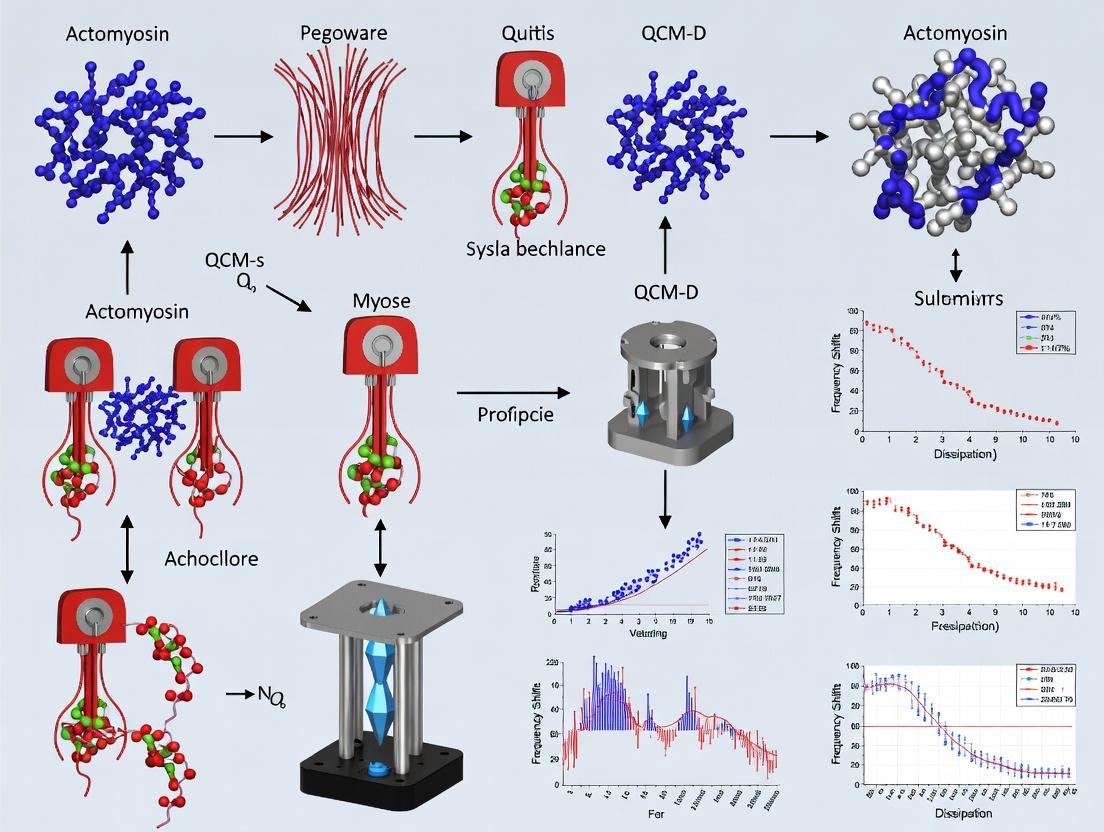
This article provides a complete methodological framework for using Quartz Crystal Microbalance with Dissipation Monitoring (QCM-D) to study actomyosin dynamics, the fundamental motor system of muscle and non-muscle cells.
Unlocking Actomyosin Mechanics: A Comprehensive QCM-D Guide for Biomolecular Research and Drug Discovery
Abstract
This article provides a complete methodological framework for using Quartz Crystal Microbalance with Dissipation Monitoring (QCM-D) to study actomyosin dynamics, the fundamental motor system of muscle and non-muscle cells. Aimed at researchers and drug development professionals, we cover foundational principles from protein immobilization strategies to interpreting viscoelastic data. We detail robust experimental protocols for monitoring contraction, stiffness, and drug interactions. The guide includes critical troubleshooting for common pitfalls in sample preparation and data analysis and validates QCM-D against complementary techniques like AFM and TIRF. This synthesis offers actionable insights for advancing research in cytoskeletal mechanics, cardiac function, and screening novel therapeutics targeting myosin motors.
Understanding Actomyosin and QCM-D: Principles, Interactions, and Key Research Questions
Application Notes: The Actomyosin Complex in Cellular Mechanics & QCM-D Research
The actomyosin complex, composed of filamentous actin (F-actin) and myosin motor proteins, is the fundamental contractile machinery in eukaryotic cells. Its activity drives essential processes including muscle contraction, cytokinesis, cell migration, and force-sensitive signaling. In the context of quartz crystal microbalance with dissipation monitoring (QCM-D) research, the complex serves as an ideal model system for studying real-time, label-free biomechanics and molecular interactions at interfaces.
Core Principles for QCM-D Studies: QCM-D measures changes in resonance frequency (Δf) and energy dissipation (ΔD) of a sensor crystal upon molecular adsorption and subsequent interactions. For actomyosin studies:
- Δf Shifts: Primarily relate to the coupled mass (including hydrodynamically coupled water) of the protein layers.
- ΔD Shifts: Reflect the viscoelastic properties and structural rigidity of the adhered protein film. The binding of rigid filaments (e.g., F-actin) typically causes low ΔD, while the formation of disordered, soft layers increases ΔD.
Key Research Applications in QCM-D:
- In vitro motility assay surface development: Monitoring the formation of functional, oriented actin filament beds.
- Myosin binding kinetics: Quantifying the affinity, stoichiometry, and rates of myosin binding to immobilized actin.
- Drug discovery screening: Assessing the impact of small molecules (e.g., myosin inhibitors, actin stabilizers) on actomyosin binding dynamics.
- Viscoelastic modeling of cytoskeletal networks: Using ΔD responses to infer mechanical changes upon myosin-driven contraction.
Quantitative Data Summary: Representative QCM-D Parameters for Actomyosin Components
| Protein/Complex | Immobilization Method | Buffer Conditions | Typical Δf per layer (Hz, 3rd overtone) | Typical ΔD per layer (10⁻⁶, 3rd overtone) | Interpreted Outcome |
|---|---|---|---|---|---|
| Biotinylated BSA | Passive adsorption | PBS, pH 7.4 | -25 ± 5 | 0.1 ± 0.5 | Baseline inert layer. |
| Streptavidin | Binding to biotin-BSA | PBS, pH 7.4 | -30 ± 5 | 0.5 ± 0.3 | High-affinity linker layer. |
| Biotinylated F-actin | Binding to streptavidin | F-buffer (Mg²⁺, KCl, ATP) | -15 ± 3 | 1.0 ± 0.5 | Formation of a semi-flexible, oriented filament layer. |
| Myosin II (S1 or HMM) | Binding to F-actin | Assay Buffer (low ATP) | -8 ± 2 | 0.5 ± 0.3 | Rigid binding of motor heads, low dissipation. |
| ATP-induced Release | Perfusion of 2mM ATP | Assay Buffer | +6 ± 2 | -0.3 ± 0.2 | Myosin detachment, mass decrease, layer stiffening. |
Experimental Protocols
Protocol 1: Preparation of Biotinylated Actin Filaments for QCM-D Immobilization
Objective: To generate stable, surface-ready F-actin filaments functionalized with biotin for streptavidin-based capture on sensor chips.
Materials:
- G-actin (lyophilized, from rabbit muscle)
- Biotin-XX linker (e.g., maleimide-PEG2-biotin)
- G-Buffer (2 mM Tris-HCl pH 8.0, 0.2 mM CaCl₂, 0.2 mM ATP, 0.5 mM DTT)
- F-Buffer (10 mM Tris-HCl pH 7.5, 50 mM KCl, 2 mM MgCl₂, 1 mM ATP, 1 mM DTT)
- PD-10 desalting columns
- Ultracentrifuge with TLA-100 rotor
Procedure:
- G-actin Preparation: Resuspend lyophilized G-actin in G-buffer to 1 mg/mL. Clarify by centrifugation at 150,000 x g for 1 hour at 4°C. Use supernatant.
- Labeling: Add a 5-10 molar excess of biotin-XX linker (dissolved in DMSO) to G-actin. Incubate on ice for 2 hours.
- Removal of Free Biotin: Pass the reaction mixture through a PD-10 column equilibrated with G-buffer to separate labeled actin from unreacted biotin.
- Polymerization: Add 1/10 volume of 10X F-buffer to the collected G-actin fraction to initiate polymerization. Incubate at room temperature for 1 hour.
- Filament Stabilization & Storage: Add phalloidin (1:1 molar ratio to actin) to stabilize filaments. Store at 4°C for up to 1 week. For long-term storage, flash-freeze in liquid nitrogen and store at -80°C.
Protocol 2: QCM-D Experiment for Real-Time Monitoring of Myosin Binding and ATP-Driven Detachment
Objective: To characterize the kinetics and mechanics of myosin binding to surface-immobilized actin and its subsequent ATP-dependent release.
Materials:
- QCM-D instrument (e.g., Q-Sense Analyzer)
- Gold or silica sensor chips with pre-adsorbed biotin-BSA/streptavidin
- Biotinylated F-actin (from Protocol 1)
- Myosin subfragment 1 (S1) or heavy meromyosin (HMM)
- Assay Buffer: 25 mM Imidazole pH 7.4, 25 mM KCl, 4 mM MgCl₂, 1 mM EGTA
- ATP Solution: Assay Buffer + 2 mM ATP
- Regeneration Solution: Assay Buffer + 2 M KCl
Procedure:
- Instrument & Baseline Setup: Mount the streptavidin-coated sensor in the QCM-D flow module. Start temperature control at 25°C. Perfuse Assay Buffer at 50 µL/min until stable Δf and ΔD baselines are achieved (drift < 1 Hz/hour). Record this as Baseline (B).
- Actin Immobilization: Perfuse biotinylated F-actin (0.1 µM in F-buffer) for 20-30 minutes. Wash with Assay Buffer for 15 minutes to remove unbound filaments. Record the final Δf/ΔD values as the Actin Reference State (A).
- Myosin Binding: Perfuse myosin S1 (50 nM in Assay Buffer) for 15-20 minutes. Observe the negative Δf shift (mass increase) and small ΔD change. Wash with Assay Buffer. Record the final state (M).
- ATP-Induced Detachment: Perfuse ATP Solution for 10 minutes. Observe the positive Δf shift (mass decrease) as myosin detaches. Wash with Assay Buffer. The signal should return close to state (A), confirming specific, ATP-sensitive binding.
- Surface Regeneration: Perfuse Regeneration Solution to remove all proteins. Re-equilibrate with Assay Buffer. The baseline (B) should be nearly recovered.
- Data Analysis: Calculate specific binding signals: Δfmyosin = fM - fA; Δfrelease = fpostATP - fM. Analyze kinetics using appropriate models (e.g., Langmuir adsorption).
Visualization Diagrams
QCM-D Actomyosin Binding Assay Workflow
Interpreting QCM-D Signals for Actomyosin
The Scientist's Toolkit: Essential Reagents & Materials
| Item | Function in Actomyosin/QCM-D Research | Key Notes for Use |
|---|---|---|
| Quartz Sensor Chips (Gold/SiO₂) | Piezoelectric substrate for mass and viscoelasticity measurement. | Gold chips allow thiol-based chemistry; SiO₂ is hydrophilic. Pre-cleaning is critical. |
| Biotin-XX Polyethylene Glycol Linker | Spacer to biotinylate actin, providing mobility and reducing steric hindrance. | The PEG spacer enhances accessibility for streptavidin and myosin binding. |
| Streptavidin | High-affinity bridge between biotinylated sensor surface and biotinylated actin. | Forms a robust, oriented capture layer. Commercial purity >95% recommended. |
| Phalloidin/Phalloidin Derivatives | Toxin that stabilizes F-actin, prevents depolymerization. | Essential for long experiments. Fluorescent conjugates enable correlative microscopy. |
| Myosin Subfragment 1 (S1) | Proteolytic fragment containing the motor head and actin-binding site. | Lacks tail domain; ideal for studying fundamental motor mechanics without filament formation. |
| Adenosine 5'-triphosphate (ATP), Mg²⁺ salt | Native substrate for myosin; induces conformational change and actin detachment. | Use high-purity, >99%. Prepare fresh solutions in assay buffer to prevent hydrolysis. |
| ATP-regeneration System (e.g., PK/LDH) | Maintains constant [ATP] during long perfusion experiments. | Crucial for sustained motility assays or studying multiple ATP cycles. |
| QCM-D Flow Module & Peristaltic Pump | Provides precise, pulse-free liquid handling for kinetic studies. | Minimize tubing dead volume. Always degas buffers to prevent bubble formation in the module. |
Quartz Crystal Microbalance with Dissipation monitoring (QCM-D) is a pivotal technique in biophysical research, enabling real-time, label-free analysis of interactions at surfaces. Within a thesis focused on actomyosin mechanics, QCM-D provides a unique window into the viscoelastic and mass-binding properties of myosin motors interacting with actin filaments, either in immobilized or polymerized states. This allows researchers to probe kinetic rates, binding affinities, structural changes, and the energy dissipation associated with myosin's power stroke, all critical for understanding muscle contraction, cytoskeletal dynamics, and drug effects on these processes.
Core Principles: From Δf and ΔD to Viscoelasticity
Fundamental Piezoelectric Response
A QCM-D sensor consists of a thin quartz crystal disk sandwiched between two electrodes. Applying an AC voltage induces a shear oscillation. The crystal's resonant frequency (f) decreases linearly with the mass of a rigid, evenly deposited film (Sauerbrey equation). However, biological layers are viscoelastic, causing energy loss or Dissipation (D).
Key Parameters
- Frequency Shift (Δf): Primarily related to the oscillating mass (including hydrodynamically coupled solvent). A negative Δf indicates mass increase.
- Dissipation Shift (ΔD): Measures the energy loss per oscillation cycle. A positive ΔD indicates increased viscoelasticity or structural softness.
- Overtone Dependence: The sensor excites the fundamental frequency (~5 MHz) and several odd overtones (e.g., 3rd, 5th, 7th...15 MHz). The dependence of Δf and ΔD on overtone number is a critical fingerprint of the adlayer's viscoelastic properties.
Modeling: From Shifts to Material Properties
For soft, hydrated films like actomyosin networks, the Sauerbrey mass is inaccurate. Viscoelastic modeling (e.g., using Voigt or Maxwell models) of multi-overtone data is required. This modeling extracts:
- Thickness (d)
- Shear Elastic Modulus (μ'): Storage modulus (elastic component)
- Shear Viscosity (η): Loss modulus (viscous component, μ'' = 2πfη)
- Density (ρ)
Table 1: Interpretation of QCM-D Parameter Changes in Actomyosin Studies
| Observation (Δf, ΔD) | Possible Physicochemical Interpretation | Actomyosin Context Example |
|---|---|---|
| Large Δf ↓, Small ΔD ↑ | Formation of a thin, rigid layer. Sauerbrey mass applicable. | Tight binding of globular myosin heads to surface-immobilized actin. |
| Moderate Δf ↓, Large ΔD ↑ | Formation of a thick, soft, and hydrated layer. | Polymerization of actin filaments into a gel; formation of a disordered myosin filament scaffold. |
| Δf ↑, ΔD ↓ | Mass removal or layer stiffening/compaction. | Proteolytic cleavage of actin; contractile force generation stiffening the network. |
| Complex, time- & overtone-dependent shifts | Viscoelastic changes, structural rearrangements. | Myosin-driven sliding and buckling of actin filaments; network contraction. |
Title: From QCM-D Signal to Material Properties
Application Notes for Actomyosin Research
Experimental Configurations
- Actin-First: Actin is immobilized or polymerized on the sensor. Myosin (or its S1 fragments) is flowed in to study binding kinetics and mechanics.
- Myosin-First: Myosin filaments are immobilized. Actin/ATP are flowed in to study motility and force generation events.
- Co-Assembly: Actin and myosin are co-assembled on the sensor to form a minimal contractile unit.
Table 2: Key QCM-D Experimental Outputs in Actomyosin Mechanics
| Experiment Type | Primary Readout | Quantifiable Parameters |
|---|---|---|
| Myosin Binding to Actin | Δf and ΔD vs. time | Association/dissociation rates (kon, koff), affinity (K_D), bound mass, structural change on binding. |
| Actin Polymerization | Δf and ΔD kinetics | Polymerization rate, final gel viscoelasticity (μ', η). |
| ATP-Driven Turnover | Δf and ΔD changes on ATP injection | Cycle kinetics, work output per cycle (linked to dissipation). |
| Drug Modulation | Altered binding/viscoelastic signatures | Inhibitor/activator efficacy (IC50/EC50), mechanism of action (e.g., stabilizer vs. disruptor). |
Title: QCM-D Protocol for Myosin-Actin Binding & Turnover
Detailed Experimental Protocols
Protocol 4.1: Measuring Myosin S1 Binding Kinetics to Immobilized Actin
Objective: Determine kinetic rates (kon, koff) and dissipation changes for myosin head binding.
Materials: See "Scientist's Toolkit" below.
Procedure:
- Sensor Preparation: Mount a SiO2-coated QCM-D sensor in the flow module. Set temperature to 25°C.
- Baseline Establishment: Flow in Actomyosin Buffer (AB: 25 mM Imidazole, 25 mM KCl, 1 mM EGTA, 4 mM MgCl2, pH 7.4) at 100 μL/min until stable Δf (overtone 7) and ΔD are achieved (< 0.5 Hz/min drift).
- Actin Immobilization:
- Inject 0.2 mg/mL NEM-myosin in 0.1 M Acetate buffer (pH 5.0) for 20 min to create an adhesive layer. Rinse with AB.
- Inject 0.025 mg/mL F-actin in AB for 30 min. Rinse thoroughly.
- Expected Result: A negative Δf shift of ~ -25 Hz and a positive ΔD shift of ~ 1-2 x 10^-6.
- Myosin S1 Binding Assay:
- Establish a new baseline in AB.
- Inject a range of Myosin S1 concentrations (e.g., 10, 25, 50, 100 nM) in AB for 10 min each, followed by a dissociation phase in AB for 15 min. Record Δf and ΔD at overtones 3, 5, 7, 9, 11.
- Data Analysis:
- Fit the Δf (overtone 7) binding curve for each concentration to a 1:1 Langmuir binding model to obtain kon and koff.
- Calculate KD = koff/k_on.
- Plot final ΔD vs. Δf for each concentration to assess rigidity of the bound layer.
Protocol 4.2: Monitoring Actin Polymerization and Myosin-Induced Contraction
Objective: Characterize actin network formation and its subsequent viscoelastic modification by myosin.
Procedure:
- Seed Immobilization: Immobilize actin seeds (e.g., stabilized short filaments) on a poly-L-lysine coated sensor.
- Initiate Polymerization: Flow in G-actin (2 μM) in polymerization buffer (AB + 1 mM ATP). Monitor Δf and ΔD for 60-90 min.
- Expected Result: Δf decreases sharply then slowly, ΔD increases sharply, indicating gel formation.
- Network Stabilization: Rinse with AB + stabilizing agents (e.g., phalloidin).
- Myosin Addition: Inject myosin II filaments (10-50 nM) in AB. Observe initial binding (Δf ↓).
- Induce Contraction: Inject contraction buffer (AB + 1 mM ATP). Monitor changes.
- Expected Result for Contraction: Δf may increase (mass decoupling) and ΔD decrease (network stiffening) as myosin compacts the network.
The Scientist's Toolkit
Table 3: Key Research Reagent Solutions for QCM-D Actomyosin Studies
| Item | Function & Rationale |
|---|---|
| SiO2-coated QCM-D Sensors | Standard surface for protein adsorption; hydrophilic, biocompatible. |
| N-ethylmaleimide (NEM)-Myosin | Inactive myosin used as a "glue" to efficiently bind F-actin filaments to the sensor surface. |
| G-Actin (Lyophilized) | Monomeric actin. Stored in G-buffer (low salt). Used for polymerization experiments. |
| Phalloidin / Jasplakinolide | Actin filament stabilizing drugs. Used to freeze polymerized networks for stable baselines. |
| Myosin II (Skeletal/Cardiac) | Full-length myosin for contraction studies. Must be freshly filamented in high-salt buffer. |
| Myosin Subfragment-1 (S1) | Single-headed, soluble proteolytic fragment. Ideal for simplified binding kinetics studies. |
| Adenosine 5'-triphosphate (ATP) | The substrate for myosin motors. Injection triggers detachment and mechanical cycling. |
| Actomyosin Buffer (AB) | Standard ionic strength and pH buffer mimicking physiological conditions for actomyosin function. |
| Q-Sense Dfind/ QTools Software | Essential for acquiring multi-overtone data and performing viscoelastic modeling. |
Thesis Context: QCM-D in Actomyosin Mechanics Research
Within the broader thesis investigating actomyosin contractile machinery, Quartz Crystal Microbalance with Dissipation monitoring (QCM-D) emerges as a pivotal tool. It provides a unique biointerface to probe the real-time formation, structural integrity, and viscoelastic response of actomyosin networks non-invasively. This enables direct correlation between biochemical stimuli (e.g., ATP addition, drug intervention) and mechanical output, a core objective in mechanobiology research.
Application Notes
Real-Time Monitoring of Actomyosin Complex Assembly
QCM-D tracks the stepwise adsorption and interaction of actin filaments (F-actin) and myosin motors on the sensor surface. The frequency (Δf) decrease correlates with coupled mass, while the dissipation (ΔD) increase reports on the viscoelasticity of the forming protein layer.
Table 1: Typical QCM-D Responses During Actomyosin Assembly
| Experimental Step | Δf (3rd overtone, Hz) | ΔD (3rd overtone, 1e-6) | Interpretation |
|---|---|---|---|
| 1. Actin Filament Adsorption | -25 ± 5 | 2.0 ± 0.5 | Formation of a soft, hydrated filament layer. |
| 2. Myosin (HMM/S1) Binding | -12 ± 3 | 1.5 ± 0.4 | Added mass and cross-linking, increased rigidity. |
| 3. Buffer Wash | -2 ± 1 | -0.2 ± 0.1 | Removal of loosely bound material. |
| 4. ATP Addition (1mM) | +15 ± 4 | -3.0 ± 0.8 | Motor cycling, complex disassembly, and softening. |
Dissipation Shifts Reveal ATP-Dependent Rheological Changes
The ΔD parameter is critical for assessing network stiffness. A high ΔD indicates a lossy, soft structure; a low ΔD suggests a rigid, elastic film. ATP-induced actomyosin dissociation causes a pronounced negative ΔD shift, signaling a more rigid, detached layer before eventual mass loss.
Table 2: Rheological States Inferred from Normalized ΔD/Δf
| System State | Typical ΔD/Δf Ratio | Structural Interpretation |
|---|---|---|
| F-actin only layer | High (~0.4 x10^-6/Hz) | Flexible, dissipative filament mesh. |
| Rigor Actomyosin | Low (~0.1 x10^-6/Hz) | Cross-linked, stiff, elastic network. |
| Post-ATP Addition | Intermediate (~0.2 x10^-6/Hz) | Partial dissociation, altered viscoelasticity. |
Experimental Protocols
Protocol 1: Substrate Preparation & Actin Immobilization
Objective: Create a stable, oriented F-actin substrate for myosin interaction.
- Sensor Functionalization: Use SiO2-coated QCM-D sensors. Clean in 2% SDS, rinse with Milliq water, dry with N2, and treat with UV/Ozone for 10 min.
- NHS-ester Activation: Flow 0.2 mg/mL N-hydroxysuccinimide (NHS) and 0.1 mg/mL 1-ethyl-3-(3-dimethylaminopropyl)carbodiimide (EDC) in MES buffer (pH 6.0) for 10 min.
- Phalloidin Coupling: Flow 0.1 mg/mL phalloidin in PBS (pH 7.4) for 30 min. Block unreacted sites with 1M ethanolamine (pH 8.5) for 10 min.
- Actin Filament Immobilization: Dilute pre-polymerized, rhodamine-phalloidin stabilized F-actin (0.5 µM) in assay buffer (25 mM KCl, 25 mM Imidazole, 4 mM MgCl2, 1 mM EGTA, pH 7.4). Flow at 50 µL/min until frequency stabilizes (~20-30 min). Rinse with assay buffer.
Protocol 2: Myosin Binding & ATP-Driven Displacement Assay
Objective: Quantify myosin binding affinity and monitor ATP-induced dissociation kinetics.
- Baseline Establishment: Establish a stable baseline with assay buffer at 23°C.
- Myosin Motor Incubation: Introduce myosin II subfragment (S1 or HMM) at a range of concentrations (10-200 nM) in assay buffer. Monitor Δf and ΔD until saturation is reached (~30 min).
- Rigor Complex Formation: Wash with assay buffer to remove unbound myosin. The stable signal represents the rigor actomyosin complex.
- ATP Challenge: Introduce assay buffer containing 1 mM ATP and an ATP-regenerating system (e.g., 2 mM creatine phosphate, 0.1 mg/mL creatine kinase). Monitor the rapid Δf increase (mass loss) and ΔD decrease (rigidity change).
- Data Analysis: Fit the Δf binding curve to derive adsorption kinetics. Use the Sauerbrey and Voigt models for mass and viscoelasticity analysis.
The Scientist's Toolkit: Research Reagent Solutions
Table 3: Essential Materials for QCM-D Actomyosin Studies
| Reagent/Material | Function & Rationale |
|---|---|
| SiO2-coated QCM-D Sensors | Standard hydrophilic surface for protein adsorption via phalloidin linkage. |
| Phalloidin, Tetramethylrhodamine conjugate | Stabilizes F-actin and provides a primary amine for covalent sensor coupling. |
| G-actin from rabbit muscle (>99% pure) | Monomeric actin for polymerization into filaments. Purity is critical for reproducible assembly. |
| Myosin II Subfragment 1 (S1) or HMM | The motor domain; eliminates confounding effects of myosin filament assembly. |
| Adenosine 5'-triphosphate (ATP), Mg²⁺ salt | The biochemical fuel to drive myosin detachment; use high-purity grade. |
| ATP-Regenerating System (Creatine Phosphate/Creatine Kinase) | Maintains constant [ATP] during prolonged experiments, preventing depletion. |
| Assay Buffer (with EGTA & Mg²⁺) | Controls ionic strength, pH, and provides essential divalent cations while chelating Ca²⁺. |
Visualization: Experimental Workflow & Data Interpretation
Diagram 1: QCM-D Actomyosin Assay Workflow
Diagram 2: From QCM-D Signals to Rheological Parameters
Application Notes
Quartz Crystal Microbalance with Dissipation (QCM-D) is a powerful, label-free technique that simultaneously measures changes in mass (via frequency, Δf) and viscoelastic properties (via energy dissipation, ΔD) on a sensor surface. In the context of actomyosin mechanics research, it provides unique real-time insights into biomolecular interactions and their functional consequences at the interface of biochemistry and cellular biophysics. This note details key applications.
1. Binding Kinetics and Affinity of Actin-Myosin Interactions QCM-D enables the precise quantification of myosin binding to actin filaments immobilized on the sensor. By flowing purified motor domains (e.g., S1 or HMM) at varying concentrations, one can derive association (kon) and dissociation (koff) rates, and thus the equilibrium dissociation constant (K_D), from the Δf response. The ΔD signal further informs on the structural rearrangement or rigidity of the formed actin-myosin layer.
2. Real-Time Monitoring of Actomyosin Contraction Upon co-immobilization of actin and the addition of functional myosin motors in the presence of ATP, QCM-D can detect large-scale network rearrangements. A characteristic coupled shift in Δf and ΔD signals indicates contraction and densification of the composite protein layer, a direct readout of myosin's mechanochemical activity.
3. Stiffness Changes in Reconstituted Networks The ratio -ΔD/Δf is empirically related to the layer's rigidity. For actomyosin networks, an increase in this ratio suggests a more viscous, fluid-like state (e.g., upon ATP addition and motor walking), while a decrease indicates a stiffer, more elastic solid (e.g., in rigor bonds or upon cross-linking). This allows dynamic tracking of network mechanical properties.
4. Quantitative Assessment of Drug Effects Small molecules or drug candidates that target the actomyosin system (e.g., myosin inhibitors like blebbistatin, ATP analogs, actin stabilizers/destabilizers) induce distinct QCM-D signatures. The technique can profile compound efficacy, mechanism of action (inhibition of binding vs. prevention of contraction), and kinetics of effect.
Table 1: Representative QCM-D Data from Actomyosin Studies
| Experimental Condition | Typical Δf Shift (3rd overtone) | Typical ΔD Shift (3rd overtone) | Interpreted Biological Event |
|---|---|---|---|
| Actin Filament Adsorption | -25 to -35 Hz | < 0.5 x 10^-6 | Formation of a rigid, saturated actin layer |
| Myosin S1 Binding (Rigor) | -10 to -15 Hz | 0.5 to 1.5 x 10^-6 | Additional mass loading with slight viscoelastic increase |
| ATP Perfusion over Acto-S1 Layer | +8 to +12 Hz | -0.3 to -0.8 x 10^-6 | Myosin detachment, mass loss, and layer stiffening (rigor-to-ATP transition) |
| Contraction (HMM + ATP) | Positive then Negative | Large Increase (> 5 x 10^-6) | Initial loosening followed by network contraction & densification |
| Blebbistatin Addition | Attenuates Δf/ΔD shifts | Attenuates Δf/ΔD shifts | Inhibition of myosin II motor activity |
Experimental Protocols
Protocol 1: Measuring Myosin Binding Kinetics to Immobilized Actin
Objective: Determine the kinetic rate constants for the binding of myosin subfragments to actin.
Materials: See "Research Reagent Solutions" below. Steps:
- Sensor Preparation: Clean a SiO2-coated QCM-D sensor chip in a 2% SDS solution, rinse with water, dry under N2, and treat with UV/Ozone for 10 min.
- Actin Immobilization:
- Mount the sensor in the QCM-D chamber. Flow in PBS buffer (pH 7.4) at 100 µL/min until stable baselines are achieved.
- Introduce 0.2 mg/mL N-ethylmaleimide (NEM)-modified myosin in PBS for 10 min. This forms a hydrophobic, sticky base layer.
- Rinse with PBS.
- Flow in 0.5 µM F-actin (stabilized with phalloidin) in PBS for 20-30 min until a stable Δf shift of ~ -30 Hz is achieved.
- Rinse thoroughly with assay buffer (25 mM Imidazole, 25 mM KCl, 4 mM MgCl2, 1 mM EGTA, pH 7.4).
- Kinetic Measurement:
- Establish a stable baseline with assay buffer.
- Switch to a series of myosin S1 or HMM solutions in assay buffer (e.g., 10, 25, 50, 100 nM). Flow each concentration for 10-15 min (association phase), followed by assay buffer for 20-30 min (dissociation phase).
- Record Δf and ΔD for all overtones.
- Data Analysis: Fit the Δf (7th or 5th overtone) vs. time data for each concentration using a 1:1 Langmuir binding model in the QCM-D analysis software to extract kon, koff, and calculate KD = koff/k_on.
Protocol 2: Monitoring Actomyosin Contraction and Drug Inhibition
Objective: Observe ATP-driven contraction of an actomyosin network and assess the inhibitory effect of blebbistatin.
Steps:
- Form a Composite Actomyosin Layer:
- Immobilize F-actin as in Protocol 1, Step 2.
- Flow in 50 nM myosin II filaments (or HMM) in assay buffer without ATP for 15 min to form rigor bonds.
- Rinse with assay buffer to remove unbound myosin.
- Baseline Acquisition: Achieve stable baselines in assay buffer without ATP.
- Induce Contraction: Switch to assay buffer containing 2 mM ATP. Monitor Δf and ΔD for 15-20 minutes. A signature of contraction is a substantial increase in ΔD (network softening/restructuring) often accompanied by a subsequent negative Δf shift (densification).
- Drug Testing:
- Repeat Steps 1-2 to regenerate a fresh actomyosin rigor layer.
- Pre-incubate the 2 mM ATP solution with 50 µM blebbistatin.
- Flow the ATP+blebbistatin solution and monitor signals. The characteristic contraction signature will be absent or severely attenuated.
Visualizations
QCM-D Actomyosin Experiment Workflow
Drug Effect Pathways on Actomyosin Mechanics
The Scientist's Toolkit: Research Reagent Solutions
| Item | Function in QCM-D Actomyosin Research |
|---|---|
| SiO2-coated QCM-D Sensors | Standard substrate for protein adsorption; provides a negatively charged, hydrophilic surface for anchoring layers. |
| G-Actin from Muscle (e.g., Rabbit skeletal) | Monomeric actin precursor. Polymerized into F-actin filaments, the essential structural component of the network. |
| Myosin II (or subfragments S1/HMM) | The motor protein. S1/HMM are used for binding studies; full-length myosin II (filaments) for contraction assays. |
| Phalloidin (Fluorescent/Non-fluorescent) | Toxin that stabilizes F-actin filaments, preventing depolymerization during long experiments. |
| Adenosine Triphosphate (ATP) | The substrate hydrolyzed by myosin to fuel the mechanochemical cycle. Trigger for detachment and motility. |
| Blebbistatin | Specific, reversible inhibitor of myosin II ATPase activity. Key negative control for contraction experiments. |
| NEM-Myosin | Chemically modified myosin used as an inert, hydrophobic layer to facilitate the stable adsorption of F-actin. |
| Assay Buffer (Low Ionic Strength) | Typically contains Imidazole (pH buffer), KCl, MgCl2 (essential cofactor), and EGTA (chelates Ca2+). Optimizes motor function. |
Within the context of a QCM-D (Quartz Crystal Microbalance with Dissipation monitoring) study of actomyosin mechanics, establishing a robust and reproducible experimental foundation is paramount. This involves the purification of core proteins (actin and myosin) and their subsequent reconstitution into functional filaments suitable for surface-based biophysical assays. These protocols ensure the highest data quality for investigating motor function, drug effects on contractility, and filament mechanics.
Research Reagent Solutions & Essential Materials
| Item | Function in Experiment |
|---|---|
| Rabbit skeletal muscle acetone powder | Source for bulk purification of actin and myosin II. |
| G-actin Buffer (G-Buffer: 2 mM Tris, 0.2 mM CaCl₂, 0.2 mM ATP, 0.5 mM DTT, pH 8.0) | Maintains monomeric (globular) actin in a stable, polymerization-competent state. |
| F-actin Buffer (F-Buffer: 10 mM imidazole, 2 mM MgCl₂, 50 mM KCl, 1 mM ATP, 1 mM DTT, pH 7.4) | Induces and stabilizes actin polymerization into filaments. |
| High Salt Buffer (0.6 M KCl, 40 mM Imidazole, 5 mM MgCl₂, 5 mM ATP, 1 mM DTT, pH 7.0) | Used for myosin extraction from muscle powder. |
| Low Salt Buffer (20 mM KCl, 20 mM Imidazole, 2 mM MgCl₂, 1 mM DTT, pH 7.0) | Induces myosin filament formation for pelleting. |
| Quartz Crystal Microbalance (QCM-D) Sensor (SiO₂ or Gold coated) | Piezoelectric sensor for real-time measurement of adsorbed mass (Δf) and viscoelasticity (ΔD). |
| NHS/EDC or Sulfo-SMCC crosslinkers | For covalent surface functionalization to attach capture molecules (e.g., NEM-myosin). |
| N-ethylmaleimide (NEM)-modified myosin (HMM or S1) | Non-motile myosin fragment used to firmly anchor actin filaments to the QCM-D sensor surface. |
Application Notes & Protocols
Protocol 1: Purification of Monomeric Actin (G-Actin) from Rabbit Muscle
Principle: Actin is extracted from acetone powder in a low-ionic-strength G-Buffer, polymerized via salt addition, purified by ultracentrifugation cycles, and finally depolymerized and clarified.
Detailed Methodology:
- Extraction: Stir 1g acetone powder in 20 mL cold G-Buffer for 30 min at 4°C. Centrifuge at 10,000 x g for 30 min. Filter supernatant through cheesecloth.
- Polymerization: Add KCl to 50 mM and MgCl₂ to 2 mM to the filtrate. Incubate for 1 hour at 4°C to form F-actin.
- Sedimentation: Ultracentrifuge polymerized actin at 100,000 x g for 3 hours. Discard supernatant.
- Depolymerization: Resuspend pellet in cold G-Buffer. Homogenize gently and dialyze against 2L G-Buffer for 48 hours (2 buffer changes) to depolymerize F-actin back to G-actin.
- Clarification: Centrifuge dialyzed solution at 100,000 x g for 1 hour. Collect supernatant containing pure G-actin.
- Quantification & Storage: Determine concentration via absorbance at 290 nm (ε = 26,600 M⁻¹cm⁻¹). Snap-freeze in liquid N₂ and store at -80°C. Typical yield: ~5-10 mg per gram of powder.
Protocol 2: Purification of Myosin II and Preparation of NEM-Myosin Fragments
Principle: Myosin is extracted in high-salt buffer, purified by repeated cycles of dilution-induced filament pelleting, and enzymatically cleaved to produce heavy meromyosin (HMM) or subfragment-1 (S1) for surface immobilization.
Detailed Methodology:
- Extraction: Stir 1g acetone powder in 20 mL High Salt Buffer for 30 min on ice. Centrifuge at 6,000 x g for 15 min. Retain supernatant.
- Filament Pelleting: Dilute supernatant 10-fold with cold Low Salt Buffer to induce myosin filament formation. Incubate for 30 min. Pellet filaments by centrifugation at 5,000 x g for 10 min.
- Repeat: Resuspend pellet in High Salt Buffer and repeat the dilution-pelleting cycle twice.
- Final Dialysis: Dialyze final purified myosin against storage buffer (0.5 M KCl, 20 mM Imidazole, 1 mM DTT, pH 7.0). Determine concentration via absorbance at 280 nm (A280 of 0.54 for 0.1% = 1 mg/mL).
- Proteolytic Cleavage: Digest myosin with α-chymotrypsin (1:100 w/w) to generate HMM, or papain to generate S1. Stop reaction with specific inhibitors (e.g., PMSF).
- NEM Treatment: Incubate HMM/S1 with 1 mM N-ethylmaleimide (NEM) for 15 min on ice to inhibit ATPase activity. Quench with 5 mM DTT. Dialyze to remove excess reagents.
Protocol 3: Reconstitution of Actin Filaments and Surface Assembly for QCM-D
Principle: Purified G-actin is polymerized into filaments, which are then specifically anchored to a functionalized QCM-D sensor surface via NEM-myosin, creating a well-defined, oriented actin filament layer.
Detailed Methodology:
- Actin Polymerization: Mix G-actin with 1/10 volume of 10x F-Buffer. Incubate at room temperature for 1 hour to form F-actin. Stabilize with equimolar phalloidin if needed.
- QCM-D Sensor Functionalization: a. Clean sensor with UV/Ozone or SC-1 solution. b. For a SiO₂ surface: Inject a solution of 0.1 mg/mL NEM-myosin (HMM/S1) in low-salt buffer. Allow adsorption until frequency shift (Δf) stabilizes (~ -25 Hz). c. Alternatively, use a crosslinker chemistry (e.g., NHS/EDC) to covalently attach NEM-myosin to an amine-reactive surface.
- Actin Filament Attachment: a. Inject 0.5-1.0 µM phalloidin-stabilized F-actin (in F-Buffer) into the QCM-D flow chamber. b. Allow filaments to bind to the NEM-myosin lawn for 20-30 minutes. Monitor Δf (mass increase) and ΔD (structural/viscoelastic change). c. A successful attachment is indicated by a Δf of -15 to -30 Hz and a concomitant small increase in ΔD (1-5 x 10⁻⁶), signifying a hydrated, filamentous layer.
- Wash: Rinse with several volumes of assay buffer (e.g., F-Buffer with an oxygen scavenger system) to remove unbound filaments.
Data Presentation: Typical QCM-D Response During Actin Filament Layer Formation
The following table summarizes expected QCM-D parameter changes during key steps of surface reconstitution.
| Experimental Step | Expected Δf (3rd overtone) | Expected ΔD (3rd overtone) | Interpretation |
|---|---|---|---|
| NEM-HMM Adsorption | -20 to -30 Hz | +0.5 to 2 x 10⁻⁶ | Formation of a rigid protein monolayer. |
| Buffer Wash/Stabilization | < ±2 Hz shift | < ±0.1 x 10⁻⁶ shift | Stable baseline achieved. |
| F-Actin Injection & Binding | -15 to -30 Hz | +1 to 5 x 10⁻⁶ | Formation of a viscoelastic actin filament network. |
| Final Buffer Wash | < -5 Hz loss | < +1 x 10⁻⁶ loss | Layer stability; weakly bound filaments removed. |
Mandatory Visualizations
Diagram 1: Workflow for Actin Reconstitution on QCM-D Sensor
Diagram 2: Myosin Fragment Preparation for Surface Immobilization
Step-by-Step QCM-D Protocols for Actomyosin Assembly, Contraction, and Drug Screening
Thesis Context: This document provides detailed application notes and protocols for the functionalization of Quartz Crystal Microbalance with Dissipation (QCM-D) sensor surfaces for the specific immobilization of actin filaments or myosin motor proteins. These protocols are essential foundational steps for a broader thesis investigating actomyosin contractile mechanics, motor processivity, and the effects of pharmaceutical compounds using QCM-D technology.
The choice of strategy depends on the biological question, the protein to be immobilized (actin or myosin), and the required orientation and activity.
Table 1: Comparison of Functionalization Strategies
| Strategy | Target Protein | Chemical Mechanism | Key Advantage | Key Consideration |
|---|---|---|---|---|
| Streptavidin-Biotin | Actin (biotinylated) | High-affinity non-covalent bond (Kd ~10⁻¹⁴ M) | Stable, oriented immobilization; widely used. | Requires biotinylation of protein; potential for multipoint attachment. |
| NHS-Ester Amine Coupling | Myosin (via lysines) | Covalent amide bond formation with primary amines. | Robust, permanent attachment. | Random orientation can hinder motor activity; requires neutral pH. |
| Maleimide-Thiol Coupling | Myosin (via engineered cysteine) | Covalent thioether bond with free thiols. | Site-specific, oriented immobilization. | Requires cysteine mutation or reduction of native disulfides. |
| Ni-NTA / His-Tag | His-tagged Actin or Myosin | Coordinate chemistry between Ni²⁺ and polyhistidine. | Gentle, reversible, oriented. | Requires His-tagged protein; metal chelation can be sensitive to buffers. |
| Antibody Capture | Either (specific epitope) | High-specificity antigen-antibody binding. | Highly specific, native protein. | Antibody must be first immobilized; potential for low density. |
Detailed Protocols
General Notes: All steps are performed at room temperature (22-25°C) unless specified. Use ultrapure water (18.2 MΩ·cm) and analytical grade reagents. QCM-D sensors (typically SiO₂-coated) must be thoroughly cleaned prior to functionalization.
Protocol 2.1: Base Cleaning of SiO₂ QCM-D Sensors
- Place sensors in a 2% (v/v) Hellmanex III solution for 10 minutes.
- Rinse extensively with ultrapure water.
- Dry under a stream of nitrogen or argon.
- Treat with UV/Ozone for 15 minutes to create a hydrophilic, clean surface.
- Mount immediately in the QCM-D flow module.
Protocol 2.2: Streptavidin-Biotin Strategy for Actin Immobilization Objective: To immobilize biotinylated actin filaments in a controlled density for myosin binding studies. Workflow Diagram Title: Streptavidin-Biotin Actin Immobilization Workflow
Procedure:
- Neutral Polymer Backfill: Flow a mixture of PLL-g-PEG (0.1 mg/mL) and PLL-g-PEG-biotin (0.01 mg/mL in PBS, pH 7.4) over the sensor for 30 minutes to form a non-fouling monolayer with biotin handles.
- Rinse: Rinse with 3 mL of PBS buffer to remove excess polymer.
- Streptavidin Capture: Flow streptavidin solution (0.1 mg/mL in PBS) for 10 minutes. Rinse with PBS.
- Monomeric Actin Binding: Dilute biotinylated G-actin (e.g., from Cytoskeleton Inc.) to 0.2 µM in G-buffer (2 mM Tris pH 8.0, 0.2 mM CaCl₂, 0.2 mM ATP). Flow over the surface for 5 minutes. Rinse with G-buffer.
- On-Surface Polymerization: Switch to F-buffer (G-buffer supplemented with 2 mM MgCl₂ and 50 mM KCl) and flow for 10-15 minutes. Monitor Δf and ΔD in QCM-D for stabilization, indicating filament formation.
Protocol 2.3: Ni-NTA Strategy for His-Tagged Myosin Immobilization Objective: To orient and immobilize His-tagged myosin VI or V fragments for actin filament gliding assays. Workflow Diagram Title: Ni-NTA His-Myosin Immobilization Workflow
Procedure:
- Silanization: Use vapor-phase deposition of (3-Aminopropyl)triethoxysilane (APTES, 2% in anhydrous toluene) for 2 hours to create an amine-terminated surface. Cure at 110°C for 15 min.
- NTA Linker Coupling: React the amine surface with a heterobifunctional linker (e.g., NHS-PEG12-NTA, 2 mM in 0.1 M borate buffer, pH 8.5) for 1 hour. Rinse with water.
- Nickel Charging: Flow 10 mM NiSO₄ solution for 10 minutes. Rinse with assay buffer (e.g., BRB80: 80 mM PIPES pH 6.9, 1 mM MgCl₂, 1 mM EGTA).
- Myosin Immobilization: Dilute His-tagged myosin to 20 nM in assay buffer supplemented with 1-5 mM imidazole (to reduce non-specific binding). Flow over the Ni-NTA surface for 15 minutes. Rinse with assay buffer containing 20-30 mM imidazole to remove loosely bound protein.
The Scientist's Toolkit: Essential Research Reagent Solutions
Table 2: Key Reagents and Materials
| Item | Function/Description | Example Supplier/Catalog |
|---|---|---|
| SiO₂-coated QCM-D Chips | Gold standard sensor for biomolecular adsorption studies in liquid. | Biolin Scientific, Q-Sense. |
| Biotinylated G-Actin | Monomeric actin with biotin conjugated, ready for streptavidin capture and polymerization. | Cytoskeleton Inc., AB07. |
| PLL-g-PEG and PLL-g-PEG-biotin | Polymers that form anti-fouling monolayers on oxides; biotin derivative provides specific binding sites. | SuSoS AG. |
| Streptavidin, Recombinant | High-purity tetrameric protein for binding up to four biotin molecules with extreme affinity. | Thermo Fisher Scientific, 43-4301. |
| NHS-PEG-NTA Linker | Heterobifunctional crosslinker for conjugating NTA groups to amine-coated surfaces for His-tag binding. | BroadPharm, BP-25816. |
| His-Tagged Myosin Construct | Recombinant myosin motor domain (e.g., myosin V or VI) with a terminal polyhistidine tag for oriented binding. | Custom expression or Cytoskeleton Inc. (Myosin V, MY05). |
| ATP, Ultra Pure | Essential nucleotide fuel for myosin motor activity. Critical for kinetic experiments. | Roche, 10127523001. |
| Hellmanex III | Specialized alkaline cleaning concentrate for thorough removal of organic contaminants from sensors. | Hellma Analytics. |
| BRB80 Buffer | Standard actin/myosin biochemistry buffer providing pH and ionic strength stability. | 80 mM PIPES, 1 mM MgCl₂, 1 mM EGTA, pH 6.9 with KOH. |
Validation & QCM-D Metrics: Successful functionalization is validated in real-time by monitoring the frequency shift (Δf, related to mass) and dissipation shift (ΔD, related to viscoelasticity). A large ΔD upon actin polymerization indicates the formation of a soft, hydrated filament layer. A small Δf and ΔD upon myosin binding to actin confirms rigid attachment.
Within quartz crystal microbalance with dissipation monitoring (QCM-D) studies of actomyosin mechanics, the biochemical buffer is not merely a solvent but a critical determinant of molecular behavior. This protocol details the formulation and application of physiologically mimetic buffers essential for reconstituting authentic actin-myosin interactions, filament sliding kinetics, and force generation metrics in vitro. Accurate emulation of the cellular milieu is foundational for extracting mechanistically relevant data from QCM-D sensors.
The Physiological Buffer Framework
The ideal buffer sustains protein stability while replicating the ionic strength, pH, redox potential, and energy currency (ATP/Mg²⁺) of the cytoplasm. Key parameters and their physiological ranges are summarized below.
Table 1: Core Physiological Parameters for Actomyosin Studies
| Parameter | Physiological Range (Cytosol) | Common In Vitro Target | Critical Function in Actomyosin System |
|---|---|---|---|
| pH | 7.0 - 7.4 | 7.4 | Myosin ATPase activity, actin polymerization. |
| Ionic Strength | 150 - 200 mM KCl equivalent | 150 mM (adjusted) | Screen electrostatic interactions, control filament rigidity & motor binding. |
| [Mg²⁺] | 0.5 - 2 mM | 1 - 2 mM | ATP hydrolysis cofactor, stabilizes ATP and ADP states of myosin. |
| [K⁺] | ~140 mM | 25 - 150 mM (as KCl) | Major cation for charge balance; affects actin structure. |
| [ATP] | 1 - 10 mM | 2 mM (w/ regeneration) | Energy substrate for myosin cycling. |
| Redox Potential | Maintained by GSH/GSSG | 2-10 mM DTT or TCEP | Prevents oxidation of cysteine residues in myosin and actin. |
| Osmolarity | ~290 mOsm/kg | 290 ± 10 mOsm/kg | Maintains protein conformational stability. |
Key Research Reagent Solutions
Table 2: Essential Reagents for Physiologic Actomyosin QCM-D Assays
| Reagent | Function & Rationale | Example Formulation/Product |
|---|---|---|
| ATP Regeneration System | Maintains constant [ATP]; prevents ADP inhibition. | 2 mM ATP, 10 mM Creatine Phosphate, 0.1 mg/mL Creatine Kinase. |
| Reducing Agent | Maintains sulfhydryl groups in reduced state. | 1-5 mM DTT (fresh) or 0.5-2 mM TCEP (more stable). |
| Protease Inhibitor Cocktail | Prevents sample degradation during long assays. | EDTA-free cocktail (e.g., Roche cOmplete). |
| BSA or Casein | Passivates surfaces, reduces non-specific binding. | 0.1 - 1 mg/mL in final buffer. |
| High-Purity Water | Minimizes trace metal contamination. | Ultrapure, 18.2 MΩ·cm, filtered (0.22 µm). |
| Phosphocreatine/Creatine Kinase | Core components of ATP regeneration. | See "ATP Regeneration System" above. |
Detailed Protocol: Assembling a Physiomimetic QCM-D Experiment
Protocol 1: Preparation of "KMg50" Physiomimetic Buffer
This buffer is a standard foundation for actomyosin motility assays.
- Materials: KCl, MgCl₂·6H₂O, EGTA, DTT, Imidazole, KOH, Sucrose, ATP, Creatine Phosphate, Creatine Kinase.
- Procedure:
- Prepare 500 mL of Base Buffer (4°C): 25 mM Imidazole, 25 mM KCl, 4 mM MgCl₂, 1 mM EGTA. Adjust to pH 7.4 using KOH.
- Adjust Osmolarity: Add sucrose to achieve ~290 mOsm/kg. Verify with an osmometer.
- Add Critical Components Fresh: Just before the experiment, add DTT (to 1 mM), ATP (to 2 mM), Creatine Phosphate (to 10 mM), and Creatine Kinase (to 0.1 mg/mL).
- Filter: Sterile-filter (0.22 µm) and keep on ice. Use within 4 hours.
Protocol 2: QCM-D Sensor Functionalization for Actin Immobilization
- Materials: SiO₂-coated QCM-D sensors, 2% (v/v) Hellmanex III, Ethanol, Milli-Q water, (3-Aminopropyl)triethoxysilane (APTES), 2.5% glutaraldehyde, 1 mg/mL NHS-PEG-Biotin, 0.5 mg/mL Streptavidin, 0.1 mg/mL Biotinylated Phalloidin, G-actin (lyophilized).
- Procedure:
- Sensor Cleaning: Sonicate sensors in 2% Hellmanex for 10 min, rinse in water, then ethanol, dry under N₂ stream.
- Aminosilanzation: Expose sensors to APTES vapor (80°C) for 1 hour in a desiccator.
- Crosslinking: Incubate sensors in 2.5% glutaraldehyde in PBS for 30 min at RT. Rinse with water.
- PEG-Biotin Coating: Incubate sensors with 1 mg/mL NHS-PEG-Biotin in 50 mM borate buffer (pH 8.5) for 2 hours. Rinse.
- Streptavidin Capture: Flow 0.5 mg/mL Streptavidin in PBS through QCM-D chamber until frequency shift (Δf) stabilizes (~ -25 Hz). Rinse with buffer.
- Biotin-Phalloidin Capture: Flow 0.1 mg/mL biotinylated phalloidin in KMg50 buffer for 10 min. Rinse.
- Actin Polymerization & Immobilization: Polymerize G-actin (10 µM) in KMg50 buffer (no ATP) for 1 hour at RT. Dilute to 1 µM in assay buffer and flow over sensor until stable filament layer forms (Δf ~ -15 to -20 Hz, ΔD < 0.5e-6).
Protocol 3: QCM-D Assay for Myosin-Driven Actin Dynamics
- Materials: Functionalized sensor with actin, purified myosin (e.g., Myosin II, Myosin V), KMg50 assay buffer (with ATP regeneration), control buffer (no ATP).
- Procedure:
- Baseline: Establish a stable baseline in KMg50 buffer without ATP at 23°C.
- Myosin Binding: Introduce 50-100 nM myosin in no-ATP buffer. Observe frequency (Δf) and dissipation (ΔD) shifts indicative of binding.
- Initiate Motility: Switch flow to complete KMg50 assay buffer with ATP and regeneration system. The real-time Δf and ΔD responses report on myosin detachment, stepping, and collective filament displacement/strain.
- Control Experiment: Repeat with buffer containing a non-hydrolyzable ATP analog (e.g., AMP-PNP) to confirm ATP-dependence.
- Data Analysis: Correlate Δf (mass/viscoelasticity) and ΔD (structural rigidity/softness) transients with kinetic models of actomyosin duty cycle and ensemble force.
Visualization of Workflows and Pathways
Diagram Title: QCM-D Actomyosin Assay Workflow
Diagram Title: Actomyosin ATPase Cycle & Force Production
This protocol details the application of Quartz Crystal Microbalance with Dissipation monitoring (QCM-D) for real-time, label-free analysis of actin polymerization and filament (F-actin) formation. Within the broader thesis on QCM-D studies of actomyosin mechanics, this methodology provides the foundational data on actin filament assembly kinetics, rigidity, and viscoelastic properties. These parameters are critical for subsequent investigations into myosin motor function, cross-linking protein effects, and drug-mediated perturbations of cytoskeletal dynamics relevant to cell motility, division, and contractility.
Key Principles of QCM-D for Actin Polymerization
QCM-D measures changes in resonance frequency (Δf) and energy dissipation (ΔD) of a sensor crystal upon mass adsorption and subsequent changes in the viscoelastic properties of the adlayer. During actin polymerization from globular actin (G-actin), the shift from a low-viscosity monomeric solution to a structured, viscoelastic filamentous network is detected as characteristic changes in Δf (mass/rigidity) and ΔD (layer softness/damping).
Experimental Protocol
Materials and Reagent Preparation
Buffers:
- G-Buffer (Monomer Storage Buffer): 2 mM Tris-HCl (pH 8.0), 0.2 mM CaCl₂, 0.2 mM ATP, 0.5 mM DTT. Store at 4°C.
- 10X Polymerization Buffer (F-Buffer): 200 mM HEPES-KOH (pH 7.5), 1 M KCl, 20 mM MgCl₂, 10 mM EGTA. Filter sterilize (0.22 µm). Store at 4°C.
- Running Buffer: 1X F-Buffer (diluted from 10X stock in ultrapure water), supplemented with 0.2 mM ATP and 0.5 mM DTT fresh daily.
Actin Preparation:
- Lyophilized G-actin Reconstitution: Reconstitute lyophilized rabbit skeletal muscle G-actin (e.g., Cytoskeleton Inc. #AKL99) in chilled G-Buffer to a stock concentration of 2-4 mg/mL (≈46-92 µM).
- Clarification: Centrifuge at 14,000 x g for 30 minutes at 4°C to remove aggregates.
- Aliquoting & Storage: Aliquot supernatant, snap-freeze in liquid nitrogen, and store at -80°C. Avoid repeated freeze-thaw cycles.
QCM-D Sensor Surface Preparation
- Sensor Choice: Use silica-coated (SiO₂) QCM-D sensors for non-specific, electrostatic adsorption of initial actin nuclei/seeds.
- Cleaning: Clean sensors sequentially in 2% SDS, Millipore water, and absolute ethanol for 10 minutes each in a sonication bath. Dry under a stream of nitrogen.
- Plasma Treatment: Treat sensors in an oxygen plasma cleaner for 2-5 minutes to ensure a hydrophilic, clean surface.
- Mounting: Mount the sensor immediately in the QCM-D flow module under running buffer flow.
Baseline Establishment and Actin Adsorption
- System Equilibration: Flow running buffer at a constant rate (e.g., 50 µL/min) until a stable baseline for Δf (7th overtone, f₇/7) and ΔD is achieved (typically 15-30 min, Δf drift < 0.5 Hz/min).
- Initial Actin Seed Layer Formation: Dilute G-actin stock in G-buffer to 0.1-0.2 mg/mL (≈2.3-4.6 µM) in a low-ionic-strength condition. Inject this solution over the sensor for 5-10 minutes. This results in the adsorption of G-actin monomers or small oligomers, forming a nucleation-prone surface. Wash with running buffer to remove non-adsorbed protein.
Real-Time Polymerization Assay
- Initiation of Polymerization: Switch the inlet to a solution of G-actin (diluted in running buffer to final concentration of 0.5-2 µM) to simultaneously provide monomers and initiate polymerization via the introduction of KCl and Mg²⁺.
- Data Acquisition: Monitor Δf and ΔD across multiple overtones (e.g., 3rd, 5th, 7th, 9th, 11th) for a minimum of 60-90 minutes. The experiment is performed at a constant temperature (e.g., 25°C) maintained by the instrument.
- Termination & Wash: Once signals stabilize, flush the chamber with running buffer to stop the reaction and remove any non-filamentous material.
Data Analysis and Interpretation
- Δf Shift: A negative Δf indicates increased effective mass (including hydrodynamically coupled water). The rate of Δf decrease correlates with polymerization elongation rate.
- ΔD Shift: A positive ΔD indicates the formation of a soft, dissipative layer. The relationship between ΔD and Δf provides insights into filament network rigidity.
- Saturation Point: The plateau in Δf and ΔD signals indicates the end of net filament growth or a steady-state of assembly/disassembly.
Summarized Quantitative Data from Representative Experiments
Table 1: Typical QCM-D Response Parameters for Actin Polymerization from Surface Nuclei.
| G-Actin Concentration | Final Δf (Hz, f₇/7) | Final ΔD (10⁻⁶ units) | Time to 50% Δf shift (min) | Apparent Layer Viscoelasticity (from ΔD/Δf) |
|---|---|---|---|---|
| 0.5 µM | -25.5 ± 3.2 | 2.1 ± 0.3 | 22.4 ± 2.1 | Low/Soft |
| 1.0 µM | -45.8 ± 5.1 | 5.8 ± 0.7 | 12.7 ± 1.5 | Medium |
| 2.0 µM | -68.3 ± 6.9 | 12.4 ± 1.2 | 6.5 ± 0.8 | High/Dissipative |
Table 2: Effect of Pharmacological Perturbations on Actin Polymerization Kinetics (1 µM G-actin).
| Compound (Condition) | Final Δf (% of Control) | Final ΔD (% of Control) | Effect on Polymerization Rate | Proposed Mechanism |
|---|---|---|---|---|
| Control (DMSO vehicle) | 100% | 100% | Baseline | -- |
| Latrunculin A (1 µM) | 15% ± 5% | 10% ± 4% | Severely Inhibited | Binds G-actin, prevents addition to barbed end |
| Phalloidin (1 µM) | 120% ± 8% | 85% ± 6% | Stabilized (No Depolymerization) | Binds/stabilizes F-actin filaments |
| Cytochalasin D (1 µM) | 55% ± 7% | 130% ± 10% | Slowed, Altered Morphology | Caps barbed ends, induces branching/severing? |
The Scientist's Toolkit: Key Research Reagent Solutions
Table 3: Essential Materials for QCM-D Actin Polymerization Studies.
| Item / Reagent | Supplier Examples | Function in Protocol |
|---|---|---|
| Quartz Crystal Microbalance-D | Biolin Scientific, Q-Sense | Core instrument for real-time, label-free mass and viscoelasticity sensing. |
| SiO₂-coated QCM-D Sensors | Biolin Scientific | Standard sensor surface for actin adsorption and nucleation. |
| Purified Rabbit Muscle Actin | Cytoskeleton Inc., Hypermol | High-purity G-actin source for reproducible polymerization kinetics. |
| HEPES, KCl, MgCl₂, EGTA | Sigma-Aldrich | Components of polymerization (F) buffer to control ionic strength and cation switching. |
| ATP (Adenosine triphosphate) | Roche, Sigma-Aldrich | Essential nucleotide bound to G-actin; required for polymerization energy and stability. |
| DTT (Dithiothreitol) | Thermo Fisher | Reducing agent to maintain actin cysteine residues in reduced state. |
| Latrunculin A / Phalloidin | Cayman Chemical, Merck | Pharmacological tool compounds to inhibit or stabilize actin polymerization, respectively. |
| Precision Syringe Pumps/Tubing | Cetoni, Kloehn | For precise, pulse-free delivery of actin and buffer solutions to the sensor chamber. |
Diagram 1: QCM-D Actin Polymerization Workflow & Signals (87 chars)
Diagram 2: Protocol Context in Actomyosin Thesis (65 chars)
This application note details a Quartz Crystal Microbalance with Dissipation (QCM-D) protocol for the quantitative analysis of actomyosin interactions. Within the broader thesis on QCM-D studies of actomyosin mechanics, this protocol specifically enables researchers to measure the binding kinetics of myosin to actin filaments, characterize steady-state attachment under load, and detect force-induced rigidification events. The method provides real-time, label-free data on mass adsorption and viscoelastic properties, crucial for understanding muscle contraction, cytoskeletal dynamics, and for screening potential therapeutics targeting motor protein dysfunction.
The mechanical interplay between actin and myosin is fundamental to cellular motility and muscle contraction. Traditional biochemical assays often lack the sensitivity to detect subtle changes in binding affinity, attachment lifetime, and structural stiffening under force. QCM-D technology overcomes these limitations by simultaneously monitoring changes in resonance frequency (Δf), related to adsorbed mass, and energy dissipation (ΔD), related to film viscoelasticity. This protocol applies this principle to dissect the three key phases of actomyosin engagement: initial binding, sustained attachment, and the structural transition to a rigor-like state, which can be induced or modulated by mechanical force or pharmaceutical agents.
Research Reagent Solutions Toolkit
| Reagent/Material | Function in Protocol |
|---|---|
| QCM-D Sensor Chips (SiO2-coated) | Provides a hydrophilic, biocompatible surface for actin filament immobilization. |
| Biotinylated G-Actin | Monomeric actin modified with biotin for specific attachment to a NeutrAvidin-functionalized surface. |
| NeutrAvidin | Forms a stable bridge between the biotinylated sensor surface and biotinylated actin. |
| Purified Myosin II S1 Fragment | The soluble, catalytic head domain of myosin used for binding studies to avoid filament formation. |
| ATP, ADP, AMP-PNP (non-hydrolyzable analog) | Nucleotides to probe myosin’s chemomechanical cycle. ATP induces detachment, ADP stabilizes weak binding, AMP-PNP mimics pre-hydrolysis state. |
| Blebbistatin (and derivatives) | Specific myosin II inhibitor used as a control and to study drug effects on binding kinetics. |
| Rigor Buffer (no nucleotide) | Induces the strong-binding, force-bearing state of myosin to actin. |
| Low Ionic Strength Buffer | Promotes stable actin filament (F-actin) formation and binding. |
| Flow Module (Peristaltic Pump) | Enforces controlled shear flow across the sensor surface, applying precise mechanical force to attached complexes. |
Experimental Protocols
A. Sensor Surface Preparation & Actin Immobilization
- Surface Functionalization: Mount a SiO2-coated QCM-D sensor in the flow module. Flow in 0.1 mg/mL NeutrAvidin in PBS for 30 minutes, followed by a 10-minute PBS wash. This creates a uniform capture layer.
- Actin Polymerization & Attachment: Dilute biotinylated G-actin to 0.2 mg/mL in low ionic strength F-buffer (5 mM Tris-HCl, pH 8.0, 50 mM KCl, 2 mM MgCl2, 1 mM ATP). Incubate for 1 hour at room temperature to form F-actin. Dilute the F-actin solution 1:10 in running buffer and flow over the NeutrAvidin surface for 20 minutes. A stable frequency shift (Δf ~ -25 Hz for the 7th harmonic) indicates successful filament immobilization.
- Surface Blocking: Flow in a 1 mg/mL solution of casein in buffer for 15 minutes to block any non-specific binding sites.
B. Protocol 2.1: Measuring Myosin Binding Kinetics
- Baseline Establishment: Establish a stable baseline with running buffer (20 mM MOPS, pH 7.0, 25 mM KCl, 5 mM MgCl2) at a constant flow rate of 50 μL/min.
- Myosin Injection: Inject a series of purified myosin S1 fragment solutions at increasing concentrations (e.g., 10, 25, 50, 100 nM) in running buffer. Record Δf and ΔD for each injection until a plateau is reached.
- Dissociation Phase: Switch back to running buffer without myosin to monitor complex dissociation.
- Data Analysis: Fit the binding curves (Δf vs. time) for each concentration using a 1:1 Langmuir binding model to extract the association (kon) and dissociation (koff) rate constants. The equilibrium dissociation constant (KD) is calculated as koff/kon.
C. Protocol 2.2: Characterizing Steady-State Attachment
- Nucleotide Modulation: After myosin binding reaches saturation, sequentially introduce buffers containing different nucleotides: first 2 mM ATP (to induce detachment, establishing a baseline), then 2 mM ADP (to stabilize the actomyosin-ADP complex), and finally a rigor buffer (no nucleotide).
- Dissipation Monitoring: Pay close attention to the ΔD signal. A low ΔD relative to Δf indicates a rigid, tightly attached layer. A high ΔD indicates a soft, viscoelastic layer with greater internal mobility.
- Attachment Lifetime: In the presence of ADP, the stability of the Δf signal over time reflects the steady-state attachment lifetime. Perform this step at varying ionic strengths to probe electrostatic contributions.
D. Protocol 2.3: Probing Force-Induced Rigidification
- Rigor State Formation: First, establish a dense, rigid actomyosin layer by flowing rigor buffer over the actin-bound myosin.
- Application of Shear Force: Systematically increase the buffer flow rate in steps (e.g., 50, 100, 200, 400 μL/min). The resulting fluid shear stress applies a tangential force on the actomyosin bonds.
- Detection of Rigidification: Monitor ΔD. A decrease in dissipation (ΔD becomes more negative) at constant or increasing mass (Δf) indicates a force-induced structural compaction or stiffening of the protein complex—a hallmark of rigidification.
Data Presentation
Table 1: Myosin S1 Binding Kinetics to Immobilized F-Actin
| [Myosin] (nM) | Δf at Plateau (Hz, 7th harmonic) | ΔD at Plateau (10^-6) | Calculated kon (M^-1s^-1) | Calculated koff (s^-1) | Derived KD (nM) |
|---|---|---|---|---|---|
| 10 | -4.2 ± 0.3 | 0.8 ± 0.2 | 1.2 x 10^5 ± 0.2 x 10^5 | 0.015 ± 0.005 | 125 ± 45 |
| 25 | -8.1 ± 0.5 | 1.5 ± 0.3 | 1.1 x 10^5 ± 0.1 x 10^5 | 0.014 ± 0.003 | 127 ± 30 |
| 50 | -13.5 ± 0.7 | 2.1 ± 0.3 | 1.0 x 10^5 ± 0.1 x 10^5 | 0.016 ± 0.004 | 160 ± 40 |
| 100 | -18.8 ± 1.0 | 2.9 ± 0.4 | 0.9 x 10^5 ± 0.1 x 10^5 | 0.017 ± 0.003 | 189 ± 35 |
Table 2: Steady-State Attachment & Rigidification Parameters
| Experimental Condition | Normalized Δf/Δf_max | Normalized ΔD/ΔD_max | Interpretation |
|---|---|---|---|
| Myosin + ADP (Weak Binding) | 0.65 ± 0.05 | 0.90 ± 0.10 | High mass, high dissipation = soft, dynamic attachment. |
| Rigor Buffer (Strong Binding) | 1.00 ± 0.02 | 0.40 ± 0.05 | High mass, low dissipation = rigid, static attachment. |
| Rigor + High Shear (400 μL/min) | 1.00 ± 0.03 | 0.25 ± 0.05 | Force-induced decrease in dissipation = structural rigidification. |
| Rigor + 50 μM Blebbistatin | 0.30 ± 0.10 | 0.80 ± 0.15 | Reduced mass binding, softer layer = inhibitor prevents strong binding. |
Visualization of Experimental Workflow
Diagram Title: QCM-D Actomyosin Binding and Rigidification Protocol Workflow
Diagram Title: Actomyosin States and QCM-D Signal Interpretation
Application Notes Within QCM-D studies of actomyosin mechanics, this protocol is critical for probing the dynamic, energy-dependent contractile behavior of reconstituted actomyosin networks. The addition of adenosine triphosphate (ATP) initiates myosin II motor activity, leading to network contraction, consolidation, and dissipation changes measurable via frequency (Δf) and dissipation (ΔD) shifts. This enables the quantification of contractile kinetics, work output, and the effects of pharmaceutical interventions (e.g., blebbistatin, Rho-kinase inhibitors) on non-muscle myosin II. The protocol is foundational for research into cell mechanics, cytokinesis, and drug discovery targeting the actomyosin cytoskeleton in diseases like cancer and hypertension.
Experimental Protocol
1. Surface Preparation & Actomyosin Reconstitution
- Materials: Clean QCM-D sensor (SiO2 or similar), 1x Assay Buffer (25 mM Imidazole, 25 mM KCl, 1 mM EGTA, 4 mM MgCl2, pH 7.4).
- Procedure:
- Mount sensor in the QCM-D flow module. Equilibrate with 1x Assay Buffer at a constant flow rate (e.g., 50 µL/min) until stable Δf and ΔD baselines are achieved (typically >30 min).
- Actin Filament Adsorption: Introduce 0.5-1.0 µM pre-polymerized, phalloidin-stabilized F-actin (in assay buffer) into the flow chamber. Flow for 30-40 min, followed by a 15-minute buffer wash. Record the Δf decrease (mass adsorption) and ΔD increase (viscoelastic layer formation).
- Myosin II Incorporation: Introduce purified non-muscle myosin II filaments (or heavy meromyosin, HMM) at 10-50 nM in assay buffer. Flow for 20-30 min. A further Δf decrease indicates binding. Wash with buffer for 10 min.
2. ATP-Induced Contraction Assay
- Materials: 1x Assay Buffer, 2 mM ATP/Mg²⁺ solution in assay buffer (freshly prepared), Inhibitor solutions (e.g., 50 µM blebbistatin in DMSO).
- Procedure:
- Baseline Recording: After myosin incorporation, continue buffer flow until Δf and ΔD stabilize. Record this as the pre-contraction baseline.
- ATP Addition: Switch the inflow to assay buffer containing 2 mM ATP. Maintain flow for 2-3 minutes to ensure complete introduction, then stop flow for a static incubation period of 10-15 minutes to allow contraction. Monitor Δf and ΔD in real-time.
- Post-Contraction Wash: Resume flow with ATP-free assay buffer for 15 minutes to wash out ATP and halt motor activity.
- Optional Inhibition Control: In a separate experiment on a fresh sensor, pre-treat the formed actomyosin network with an inhibitor (e.g., 50 µM blebbistatin) for 10 min before ATP addition. Then introduce ATP in the continued presence of the inhibitor.
3. Data Acquisition & Quantification
- Use the QCM-D software to record Δf (3rd, 5th, 7th overtones) and ΔD (5th overtone) throughout.
- Key Metrics:
- Δfmax: The maximum positive frequency shift upon ATP addition, indicative of mass consolidation/rigidification.
- ΔDmin: The maximum negative dissipation shift, indicating reduced viscoelastic loss.
- Contraction Rate: Initial slope of the Δf increase after ATP addition (Hz/min).
- Work Index (WI): Approximated by the integrated area under the Δf curve during the contraction phase.
Data Presentation
Table 1: QCM-D Parameters During Actomyosin Network Formation & Contraction
| Experimental Phase | Δf (5th overtone) | ΔD (5th overtone) | Interpretation |
|---|---|---|---|
| F-actin Adsorption | -25 ± 5 Hz | + (3.0 ± 0.8) x 10⁻⁶ | Formation of a hydrated, viscoelastic filament layer. |
| Myosin Binding | -8 ± 2 Hz | + (0.5 ± 0.3) x 10⁻⁶ | Additional mass load, slight viscoelasticity increase. |
| ATP Addition (Contraction) | +12 ± 3 Hz | - (2.5 ± 0.7) x 10⁻⁶ | Network consolidation, water expulsion, increased rigidity. |
| ATP Washout | Stabilizes at ~ +10 Hz | Stabilizes at ~ -2.2 x 10⁻⁶ | Permanent contractile state; motors locked. |
| ATP + Blebbistatin | +1 ± 0.5 Hz | - (0.2 ± 0.1) x 10⁻⁶ | Inhibition of myosin ATPase ablates contraction. |
Table 2: Calculated Contractility Metrics
| Metric | Formula/Description | Typical Value (This Protocol) |
|---|---|---|
| Max Contraction (Δf_max) | Peak Δf after ATP addition. | +12 ± 3 Hz |
| Contraction Rate | d(Δf)/dt in first 2 min post-ATP. | 5.8 ± 1.5 Hz/min |
| Work Index (WI) | ∫ Δf(t) dt over 10 min contraction. | ~ 550 Hz·s |
Visualization
Diagram 1: Experimental workflow for ATP-induced actomyosin contraction on QCM-D.
Diagram 2: Signaling pathway from ATP addition to QCM-D detectable contraction.
The Scientist's Toolkit
Table 3: Essential Research Reagents & Materials
| Item | Function in Protocol |
|---|---|
| QCM-D Instrument (e.g., Biolin/Q-Sense) | Measures real-time changes in frequency (Δf, mass/rigidity) and energy dissipation (ΔD, viscoelasticity). |
| SiO2-coated QCM-D Sensors | Standard hydrophilic surface for protein adsorption and actomyosin reconstitution. |
| Purified G-actin (from muscle or non-muscle) | Monomeric actin for polymerizing into stable F-actin filaments. |
| Phalloidin | Toxin that stabilizes F-actin, preventing depolymerization during flow and experiments. |
| Non-muscle Myosin II (or HMM) | The molecular motor protein; forms bipolar filaments to generate contractile force on actin. |
| Adenosine Triphosphate (Mg²⁺ salt) | The biochemical fuel that activates myosin's ATPase and motor activity. |
| Assay Buffer (Imidazole, KCl, MgCl₂, EGTA) | Provides ionic strength, pH buffering, and Mg²⁺ for ATPase, while chelating Ca²⁺. |
| Blebbistatin | Specific, reversible inhibitor of non-muscle myosin II ATPase; key negative control. |
| Peristaltic or Syringe Pump | Provides precise, pulse-free fluid handling for sample introduction and washing. |
Within a broader QCM-D (Quartz Crystal Microbalance with Dissipation monitoring) thesis on actomyosin mechanics, this application note details protocols for employing QCM-D as a primary tool for screening pharmacological agents. The thesis posits that real-time, label-free monitoring of the viscoelastic properties of reconstituted actomyosin networks can quantify the mechanical impact of small molecules, providing superior insight compared to traditional biochemical endpoints. This approach is critical for discovering drugs targeting diseases of cytoskeletal dysregulation, such as hypertension, cancer metastasis, and cardiomyopathies.
Key Principles & QCM-D Readouts
QCM-D measures changes in resonance frequency (Δf) and energy dissipation (ΔD) of a sensor crystal upon molecular adsorption and subsequent network formation. For actomyosin systems:
- Δf (Hz): Primarily related to adsorbed mass (including hydrodynamically coupled water). A decrease indicates increased mass/rigidity.
- ΔD (1e-6): Related to the viscoelasticity or "softness" of the adsorbed layer. An increase indicates a more dissipative, less elastic structure.
- The Δf vs. ΔD Signature: The trajectory and endpoint when plotting ΔD against Δf for a forming network provides a mechanical fingerprint. Drug-induced changes in this fingerprint indicate modulation of crosslinking, contraction, or stability.
Table 1: QCM-D Response Signatures for Actomyosin States
| Actomyosin State | Typical Δf (7th Overtone) | Typical ΔD (7th Overtone) | Mechanical Interpretation |
|---|---|---|---|
| Actin Filament Adsorption | Moderate decrease (-25 ± 5 Hz) | Small increase (+1 ± 0.5e-6) | Formation of a thin, semi-rigid layer. |
| Myosin II (Non-Muscle) Binding | Further decrease (-35 ± 10 Hz) | Increase (+3 ± 1e-6) | Added mass & increased viscoelastic coupling. |
| ATP-Induced Contraction (Control) | Large decrease (-50 ± 15 Hz) | Decrease (-2 ± 1e-6 relative to peak) | Network compaction, increased rigidity. |
| Drug-Inhibited Contraction | Attenuated Δf shift (-30 ± 10 Hz) | Sustained high ΔD (+5 ± 2e-6) | Failed compaction, network remains soft/disordered. |
| Drug-Enhanced Contraction | Exaggerated Δf decrease (-65 ± 20 Hz) | Exaggerated ΔD decrease (-4 ± 1.5e-6) | Hyper-compaction, very rigid network. |
Detailed Protocols
Protocol 3.1: QCM-D Sensor Surface Functionalization for Actin Attachment
Objective: Create a positively charged surface on SiO2 QCM-D sensors for electrostatic binding of negatively charged actin filaments. Materials: SiO2-coated QCM-D sensors, 2% Hellmanex III, Milli-Q water, Ethanol (absolute), 0.1 M NaOH, (3-Aminopropyl)triethoxysilane (APTES), anhydrous Toluene, Nitrogen stream. Procedure:
- Cleaning: Sonicate sensors in 2% Hellmanex for 10 min. Rinse with water and ethanol. Dry with N2.
- Plasma Clean: Treat sensors in oxygen plasma for 5 minutes.
- Silanization: Prepare 2% (v/v) APTES in anhydrous toluene. Incubate sensors in this solution for 1 hour at room temperature under inert atmosphere.
- Rinsing: Rinse sensors sequentially with toluene, ethanol, and water to remove unbound silane.
- Curing: Bake sensors at 110°C for 15 min. Store under N2 until use. Valid for 1 week.
Protocol 3.2: Reconstituted Actomyosin Network Formation & Drug Screening Assay
Objective: Form a contractile actomyosin network on the QCM-D sensor and test the modulatory effect of small molecules. Buffers: F-buffer (5 mM Tris-HCl pH 7.4, 50 mM KCl, 1 mM MgCl2, 1 mM ATP, 0.1 mM CaCl2, 0.2 mM EGTA), G-buffer (5 mM Tris-HCl pH 7.4, 0.2 mM ATP, 0.1 mM CaCl2, 0.2 mM DTT). Proteins: Lyophilized rabbit skeletal muscle G-actin, recombinant human non-muscle myosin IIB (or S1 fragment). Instrument: QCM-D (e.g., QSense Analyzer, Biolin Scientific). Procedure:
- Baseline: Mount APTES-functionalized sensor in chamber. Flow F-buffer (without ATP) at 50 μL/min until stable Δf/ΔD baseline is achieved (≥20 min). Maintain at 25°C.
- Actin Polymerization & Adsorption: Polymerize G-actin (final 2 μM) in F-buffer (no ATP) for 1 hour. Flow this F-actin solution over the sensor for 30-40 min. Observe Δf decrease and ΔD increase plateauing.
- Myosin Binding: Dilute myosin II (or S1) in F-buffer (no ATP) to 50 nM. Flow over the actin-coated surface for 20 min. Observe further Δf/ΔD shifts.
- Drug Pre-Incubation (Alternative): For drug testing, pre-incubate myosin with the candidate molecule for 10 min before step 3.
- Contraction Trigger & Drug Effect: Switch flow to F-buffer WITH 1 mM ATP. This triggers myosin motor activity and network contraction. For post-addition drug tests, after 5 min of ATP flow, introduce ATP buffer containing the drug candidate.
- Data Acquisition: Monitor Δf and ΔD for at least 40-60 min after ATP addition. The key readout is the final steady-state Δf and ΔD values and the kinetic trajectory to reach them.
- Analysis: Normalize data to the point of ATP addition. Compare the final Δf/ΔD values and the area under the ΔD curve of drug-treated samples to vehicle controls.
Table 2: Example Quantitative Screening Data for Reference Compounds
| Compound (10 μM) | Target | Final Δf_n (Hz) | Final ΔD_n (1e-6) | % Inhibition of Δf Shift* | % Inhibition of ΔD Drop* | Proposed Effect |
|---|---|---|---|---|---|---|
| Vehicle (DMSO) | -- | -25.5 ± 2.1 | 4.8 ± 0.7 | 0% | 0% | Normal Contraction |
| Blebbistatin | Myosin II ATPase | -12.1 ± 1.8 | 8.9 ± 0.9 | 52% | -85% | Complete Inhibition |
| Y-27632 | ROCK Kinase | -18.3 ± 2.3 | 6.5 ± 0.8 | 28% | -40% | Partial Inhibition |
| Calyculin A | Myosin Phosphatase | -31.2 ± 3.5 | 2.1 ± 0.5 | -22% | 67% | Enhanced Contraction |
Calculated relative to vehicle control's ATP-induced shift. *Negative value indicates ΔD increased vs. decreased.
The Scientist's Toolkit: Key Research Reagent Solutions
Table 3: Essential Materials for QCM-D Actomyosin Screening
| Item | Function & Rationale |
|---|---|
| SiO2-coated QCM-D Sensors | Standard surface for functionalization; provides hydroxyl groups for silane chemistry. |
| APTES (Aminosilane) | Creates a stable, positively charged monolayer to anchor negatively charged actin filaments. |
| Purified G-Actin (Lyophilized) | Building block of filaments; muscle or non-muscle sources dictate baseline mechanics. |
| Non-Muscle Myosin IIB (full length or S1) | The cellular motor protein; full-length allows filament assembly and contraction. |
| ATP (Adenosine Triphosphate) | Critical trigger; its introduction initiates myosin motor activity and network dynamics. |
| Blebbistatin (Control Inhibitor) | Specific myosin II ATPase inhibitor; serves as a benchmark for complete contraction blockade. |
| QSense/ QCM-D Flow Modules | Temperature-controlled modules with precise fluid handling for sequential reagent addition. |
| Data Analysis Software (e.g., QTools, Dfind) | Essential for modeling viscoelastic properties (e.g., Sauerbrey, Voigt) from Δf/ΔD overtones. |
Visualizations
Diagram 1 Title: QCM-D Screening Protocol Workflow
Diagram 2 Title: Drug Targets in Actomyosin Contraction Pathway
Solving Common QCM-D Challenges in Actomyosin Studies: Data Artifacts and Interpretation
Troubleshooting Non-Specific Adsorption and Improving Surface Specificity
Within a broader thesis investigating actomyosin mechanics using Quartz Crystal Microbalance with Dissipation monitoring (QCM-D), controlling surface interactions is paramount. The primary challenge is ensuring that the observed frequency (Δf) and dissipation (ΔD) shifts result specifically from the binding of target proteins (e.g., actin, myosin, regulatory complexes) and not from non-specific adsorption (NSA) of other solution components. NSA compromises data integrity, leading to erroneous conclusions about binding kinetics, affinity, and structural changes. These Application Notes detail protocols to diagnose, mitigate, and prevent NSA, thereby improving surface specificity for robust biophysical studies.
Diagnosing Non-Specific Adsorption
Key Indicators in QCM-D Data
NSA often presents with distinct signatures in the QCM-D response. The following table summarizes diagnostic criteria:
Table 1: Differentiating Specific Binding from Non-Specific Adsorption in QCM-D
| Parameter | Specific Binding Typical Signature | Non-Specific Adsorption Typical Signature | Diagnostic Experiment |
|---|---|---|---|
| ΔD vs. Δf Plot (Slope) | Well-defined, consistent trajectory; often low slope for rigid layers. | Irregular, high variability; often steeper slope indicating soft, dissipative layers. | Continuous in-situ measurement during association. |
| Reversibility | Full or partial reversal upon introduction of buffer or specific competitor. | Little to no reversal upon buffer rinse; often irreversible. | Rinse with running buffer post-association. |
| Surface Saturation | Clear saturation plateau at expected surface coverage. | Poor or no saturation, continuous mass accumulation. | Concentration series experiments. |
| Protein Concentration Dependence | Follows a binding isotherm (e.g., Langmuir). | Often linear or non-cooperative increase with concentration. | Inject increasing analyte concentrations. |
| Dissipation Response | Low ΔD relative to Δf (rigid film) or characteristic viscoelastic profile. | High, erratic ΔD relative to Δf. | Monitor multiple overtones (3rd, 5th, 7th, etc.). |
Control Experiments Protocol
Protocol 1: Baseline NSA Assessment with Non-Target Proteins Objective: To quantify the inherent non-specificity of the functionalized sensor surface.
- Surface Preparation: Functionalize gold QCM-D sensors as per your standard protocol (e.g., with a passivating layer like biotin-PEG-thiol).
- Establish Baseline: Mount sensor in the QCM-D chamber. Flow running buffer (e.g., BRB80 for actomyosin studies: 80 mM PIPES, 1 mM MgCl2, 1 mM EGTA, pH 6.9) until stable Δf and ΔD baselines are achieved.
- Inject Negative Control: Inject a solution of a protein at a concentration equal to or higher than your target analyte but known not to interact specifically (e.g., Bovine Serum Albumin (BSA) at 1 mg/mL in running buffer). Flow for 10-15 minutes.
- Monitor & Rinse: Record Δf/ΔD. Initiate buffer rinse for at least 15 minutes. The residual Δf shift post-rinse is a direct measure of irreversible NSA.
- Analyze: Calculate adsorbed mass using the Sauerbrey or viscoelastic model. An acceptable surface should show negligible (< 10 ng/cm²) irreversible mass after the rinse.
Strategies and Protocols for Improving Surface Specificity
The Surface Functionalization Toolkit
Table 2: Research Reagent Solutions for Surface Specificity
| Reagent / Material | Function / Explanation |
|---|---|
| Gold-coated QCM-D Sensors | Standard substrate for biofunctionalization via thiol-gold chemistry. |
| Alkanethiol-PEG Compounds (e.g., HS-C11-EG6-OH) | Forms a dense, hydrophilic self-assembled monolayer (SAM) that drastically reduces NSA by creating a hydration barrier and steric repulsion. |
| Biotin-PEG-Alkanethiol (e.g., Biotin-PEG-SH) | Provides specific binding sites for streptavidin/neutravidin within a PEG passivation background. Essential for capturing biotinylated proteins (e.g., biotin-actin). |
| Streptavidin / Neutravidin | Tetrameric protein that binds to biotin-PEG surfaces, providing a stable, specific docking layer for biotinylated biomolecules. Neutravidin has lower pI, reducing NSA via electrostatic interactions. |
| Casein or Bovine Serum Albumin (BSA) | Blocking agents used to passivate any remaining adhesive sites after primary functionalization. Use at 0.1-1% w/v. |
| Carboxyalkanethiols (e.g., 11-Mercaptoundecanoic acid) | Used with EDC/NHS chemistry for direct covalent coupling of amine-containing ligands, offering an alternative to biotin-streptavidin. |
| Zwitterionic polymers (e.g., SBMA) | Emerging as superior passivants, forming ultra-low fouling surfaces via strong hydration. Applied via grafting or SAMs. |
Optimized Protocol for Actomyosin Studies
Protocol 2: PEG-Biotin/Neutravidin-Based Surface for Actin Immobilization Objective: Create a surface with minimal NSA for specific capture of biotinylated actin filaments.
- Sensor Cleaning: Sonicate sensors in 2% SDS, ethanol, and Milli-Q water. Dry under N₂ stream. Treat with UV/ozone for 10 minutes.
- SAM Formation: Incubate sensors overnight at 4°C in a 1:100 molar ratio solution of Biotin-PEG-SH and backfiller PEG-SH (total thiol concentration ~0.2 mM in ethanol). This mixed SAM ensures biotin presentation amidst a passivating PEG matrix.
- Rinse & Mount: Rinse thoroughly with ethanol and water. Mount sensor in QCM-D chamber.
- Neutravidin Capture: Flow Neutravidin solution (0.1 mg/mL in running buffer) until a frequency shift of ~-25 Hz is achieved (~5-10 min). Rinse with buffer.
- Blocking: Flow a 0.5% w/v casein (in running buffer) solution for 20 minutes to block any non-specific sites. Rinse thoroughly.
- Actin Filament Immobilization: Introduce 0.1-0.5 µM biotinylated, phalloidin-stabilized F-actin (pre-polymerized) in running buffer. Flow slowly (e.g., 10 µL/min) for 15-20 minutes. A successful, specific immobilization shows a stable Δf shift after buffer rinse.
- Validation: Perform Protocol 1 using a high concentration of non-target protein (e.g., BSA) to confirm the surface resists NSA post-actin immobilization.
In-Situ Passivation Protocol
Protocol 3: Co-Injection/Additive Strategy for Complex Samples Objective: Minimize NSA from crude lysates or complex biological mixtures during association phases.
- Prepare Running Buffer with Additive: Supplement your standard running buffer with a non-interacting blocking agent. For actomyosin studies, 0.1 mg/mL BSA or 0.05% Tween-20 is often effective.
- Prepare Analyte Solution: Dilute your target analyte (e.g., myosin motor domain) into the supplemented running buffer.
- Perform Binding Experiment: Conduct the association/dissociation experiment as usual. The additive in solution competes for non-specific sites on the sensor and chamber in real-time.
- Post-Hoc Rinse: After dissociation, rinse with the supplemented buffer, followed by standard buffer, to assess reversibility.
Title: Troubleshooting Decision Tree for NSA in QCM-D
Data Interpretation and Validation
When NSA is minimized, QCM-D data for actomyosin interactions should yield interpretable binding kinetics. For example, the binding of myosin II to an actin filament layer should show concentration-dependent saturation. Analyze the initial binding rates or equilibrium responses to construct a binding isotherm.
Table 3: Expected QCM-D Response Ranges for Actomyosin Interactions
| Interaction (on Actin Surface) | Expected Sauerbrey Mass (ng/cm²)* | Expected ΔD/Δf (7th overtone) Characteristic |
|---|---|---|
| Phalloidin-Stabilized Actin Immobilization | 300 - 600 | Low (< 0.2e-6/Hz), rigid layer |
| Myosin II (S1) Binding (Saturation) | 150 - 300 | Moderate increase, indicating added viscoelasticity |
| Non-Specific Protein (BSA) Control | < 20 | Variable, often high if adsorption occurs |
Note: Mass values are approximate and depend on surface coverage and protein size.
Title: Optimized Surface Prep Workflow for Actomyosin QCM-D
Abstract: In quartz crystal microbalance with dissipation (QCM-D) studies of actomyosin mechanics, the integrity of protein function over extended experimental timelines is paramount. Sample degradation—through protein aggregation, denaturation, or enzymatic inactivity—compromises data reproducibility and biological relevance. This Application Note details protocols and reagent solutions to stabilize actin, myosin, and associated regulatory proteins for QCM-D experiments lasting several hours, ensuring robust kinetic and mechanical data acquisition.
Table 1: Efficacy of Stabilization Agents on Actomyosin Component Half-Life in QCM-D Buffer (25°C)
| Stabilization Agent | Target Protein | Concentration | Half-Life (Control) | Half-Life (Treated) | Key Measured Parameter (QCM-D) |
|---|---|---|---|---|---|
| Dithiothreitol (DTT) | Myosin II (S1) | 1 mM | ~45 minutes | >180 minutes | ∆D (Dissipation) stability |
| Trolox (Antioxidant) | F-actin | 1 mM | ~90 minutes | >240 minutes | ∆f (Frequency) drift rate |
| Casein (Passivating Agent) | N/A (Surface) | 0.5 mg/mL | N/A | N/A | Non-specific binding reduction |
| ATP (with Regeneration System) | Myosin ATPase | 2 mM ATP | ~60 minutes | >300 minutes | Steady-state ∆f slope |
| Glycerol (Cryoprotectant) | Actin/Myosin | 10% v/v | ~120 minutes | >300 minutes | Functional decay constant |
Table 2: Impact of Sample Handling on QCM-D Data Quality
| Variable | Standard Protocol | Optimized Protocol | Effect on QCM-D Measurement (∆f/∆D) |
|---|---|---|---|
| Sample Chamber Temperature | 25°C (Ambient) | 20°C (Precise) | Reduced ∆D noise by ~40% |
| Buffer Exchange Frequency | None | Every 60 minutes | Maintained baseline within ±0.5 Hz |
| Protein Aliquot Use | Multiple freeze-thaw | Single-use aliquots | Improved replicate R² from 0.78 to 0.96 |
| Assay Duration Viability | 1-2 hours | 4-6 hours | Consistent kinetic rate derivation |
Detailed Experimental Protocols
Protocol 2.1: Preparation of Stabilized Actin Filaments (F-actin) for Long-Duration QCM-D
Objective: Generate and stabilize Rhodamine-phalloidin-labeled F-actin resistant to depolymerization and fragmentation.
- Thawing: Rapidly thaw a 50 µL aliquot of G-actin (10 µM in G-buffer: 5 mM Tris-HCl pH 8.0, 0.2 mM CaCl₂, 0.2 mM ATP, 1 mM DTT) on ice.
- Polymerization: Add 10X F-buffer (500 mM KCl, 20 mM MgCl₂, 10 mM ATP, 100 mM Tris-HCl pH 7.5) to a final 1X concentration. Incubate for 1 hour at 25°C.
- Stabilization & Labeling: Add Rhodamine-phalloidin (1:1 molar ratio to actin) and Trolox (1 mM final concentration from a 100 mM stock in water). Incubate 30 minutes, protected from light.
- Ultracentrifugation: Pellet filaments at 100,000 x g for 30 minutes at 4°C. Resuspend gently in fresh F-buffer supplemented with 1 mM Trolox and 10% (v/v) glycerol.
- Storage: Keep at 4°C, protected from light. Use within 48 hours. Do not re-freeze.
Protocol 2.2: QCM-D Flow-Cell Setup for Long-Term Actomyosin Mechanics
Objective: Establish a stable baseline and surface for actomyosin interaction studies.
- Surface Cleaning: Flush QCM-D sensor (SiO2 or gold) with 2% Hellmanex III, followed by copious Milli-Q water, then ethanol. Dry under N₂ stream.
- Surface Functionalization (for myosin immobilization): Inject 0.1 mg/mL NHS-PEG-biotin in PBS for 20 mins. Rinse with PBS. Inject 0.2 mg/mL NeutrAvidin for 10 mins. Rinse.
- Passivation: Flush with 0.5 mg/mL casein in assay buffer (AB: 25 mM Imidazole pH 7.4, 25 mM KCl, 4 mM MgCl₂, 1 mM EGTA) for 30 minutes to block non-specific sites.
- Myosin Immobilization: Dilute biotinylated myosin or HMM in AB + 1 mM DTT. Inject until frequency shift (Δf7) of -25 ± 5 Hz is achieved, indicating a dense monolayer. Rinse thoroughly.
- ATP Regeneration System: Prepare fresh AB containing 2 mM ATP, 2.5 mM Phosphocreatine, and 0.1 mg/mL Creatine Phosphokinase. This maintains constant [ATP] for >6 hours.
Protocol 2.3: Sustained Kinetic Measurement of Actin-Myosin Binding
Objective: Monitor repeated binding and unbinding cycles over 4+ hours.
- Baseline Establishment: Flow ATP-regeneration buffer (see 2.2, step 5) through the cell at 50 µL/min until a stable ∆f/∆D baseline is established (~15-20 mins).
- Actin Binding Cycle: Introduce stabilized, phalloidin-bound F-actin (10 nM in ATP-regeneration buffer) for 5 minutes.
- Rigor Formation: Switch to ATP-free buffer (AB only) for 3 minutes to induce strong binding (rigor complex formation). Note the ∆f/∆D shift.
- Actin Detachment: Re-introduce ATP-regeneration buffer for 5 minutes to induce myosin cycling and actin detachment. Monitor return to near baseline.
- Iteration & Monitoring: Repeat steps 2-4. After every 3 cycles, flush with fresh ATP-regeneration buffer to replenish substrates. Record any baseline drift in ∆f7.
The Scientist's Toolkit: Essential Research Reagents & Materials
| Item/Category | Specific Example(s) | Function & Rationale |
|---|---|---|
| Antioxidants | Dithiothreitol (DTT), Trolox | Reduces oxidative damage to cysteine residues and fluorescent labels. |
| ATP-Regeneration System | ATP, Phosphocreatine, Creatine Phosphokinase | Maintains constant, low-nanomolar to micromolar ATP levels for motor protein cycling. |
| Stabilizing Polymers | Casein, Bovine Serum Albumin (BSA) | Passivates surfaces and solution to prevent non-specific protein adhesion. |
| Cryoprotectants | Glycerol, Sucrose | Stabilizes protein conformation during storage and reduces aggregation in solution. |
| Protease Inhibitors | Leupeptin, Pepstatin A (broad-spectrum cocktails) | Prevents proteolytic cleavage of actomyosin components, especially in long assays. |
| Biolayer Functionalization | NHS-PEG-biotin, NeutrAvidin | Creates a stable, oriented, and spaced immobilization layer for myosin motors. |
| Filament Stabilizer | Phalloidin (Rhodamine, AlexaFluor conjugates) | Blocks depolymerization and severing of F-actin filaments. |
| Precision Temperature Control | Peltier-based In-Line Chiller/Heater | Maintains assay temperature within ±0.1°C, critical for kinetic reproducibility. |
Visualized Workflows & Pathways
Diagram Title: Sample Prep and QCM-D Workflow for Long Experiments
Diagram Title: Degradation Pathways and Stabilization Countermeasures
Within a broader thesis on Quartz Crystal Microbalance with Dissipation (QCM-D) studies of actomyosin mechanics, interpreting frequency (Δf) and dissipation (ΔD) shifts is fundamental. Δf relates to adsorbed mass (including hydrodynamically coupled solvent), while ΔD reflects the viscoelasticity of the adlayer. In ideal, rigid, and thin films, Δf and ΔD trends are coupled and predictable (e.g., a negative Δf shift with a minimal ΔD increase indicates rigid mass deposition). However, in complex biological systems like actomyosin networks, trends often become non-ideal or counterintuitive, complicating data interpretation. This document provides application notes and protocols for decoupling these complex signals, focusing on scenarios relevant to cytoskeletal mechanics and drug interaction studies.
Key Non-Ideal Scenarios & Data Interpretation
The following table summarizes common non-ideal Δf/ΔD responses in actomyosin studies and their potential structural interpretations.
Table 1: Interpretation of Non-Ideal QCM-D Responses in Actomyosin Studies
| Observed Trend (Δf vs. ΔD) | Typical Scenario in Actomyosin Systems | Proposed Structural/Molecular Interpretation | Key Confounding Factors |
|---|---|---|---|
| Δf decreases (more negative), ΔD decreases | Myosin-induced actin network contraction, drug-induced stiffening (e.g., phalloidin). | Formation of a denser, more rigid structure; water expulsion from the film. | Film may be undergoing consolidation beyond simple adsorption. |
| Δf increases (less negative), ΔD increases | Actin depolymerization (e.g., latrunculin A), myosin-driven catastrophic disruption. | Mass loss coupled with a transition to a more dissipative, possibly fragmented, residual layer. | Adsorbed debris or loosely attached fragments remaining on the sensor. |
| Δf stable, ΔD increases significantly | Myosin II generating internal stress without net mass change. | Internal restructuring, molecular straining, or swelling without mass adsorption/desorption. | Energy dissipation due to motor activity within a trapped network. |
| Counter-oscillations in Δf and ΔD | Cyclic actomyosin contraction-relaxation, processive myosin walks. | Periodic mass displacement and viscoelastic changes driven by mechanochemical cycles. | Must be distinguished from instrumental drift or bulk fluid fluctuations. |
Detailed Experimental Protocols
Protocol 3.1: Differentiating Contraction from Simple Adsorption
Aim: To determine if a negative Δf shift is due to mass adsorption or myosin-driven contraction of a pre-formed actin network. Materials: See "Scientist's Toolkit" (Section 6). Workflow:
- Baseline: Establish stable baseline in measurement buffer (e.g., F-buffer) across multiple overtones (n=3, 5, 7).
- Actin Network Formation: Introduce G-actin in polymerization buffer. Allow adsorption and polymerization (Δf decreases, ΔD rises initially then may stabilize). Rinse.
- Contraction Trigger: Introduce Mg-ATP and myosin II (or HMM).
- Key Measurement: Monitor Δf and ΔD on multiple overtones simultaneously.
- Data Analysis: Use the ΔD vs. Δf plot (for a single overtone). Contraction is indicated by a trajectory with a negative slope (Δf decreases, ΔD decreases or increases only slightly). Simple adsorption typically shows a positive slope.
Protocol 3.2: Probing Drug-Induced Stabilization/Destabilization
Aim: To assess whether a drug (e.g., a myosin inhibitor) stabilizes or softens the actomyosin network. Materials: Pre-formed actin or actomyosin coating on sensor, drug candidate in DMSO/carrier, control buffer. Workflow:
- Control Layer: Form a consistent actomyosin network as per Protocol 3.1, steps 1-3. Record reference Δf/ΔD.
- Drug Addition: Introduce drug at therapeutic concentration. Monitor shifts for ≥30 min.
- Rinse Step: Perform a gentle buffer rinse. A stable signal post-rinse indicates strong stabilization/binding.
- Interpretation:
- Stabilization: Post-addition: Δf decrease, ΔD decrease. Post-rinse: Little change.
- Destabilization: Post-addition: Δf increase, ΔD increase. Post-rinse: Large Δf increase (mass loss).
- Control: Run parallel experiment with carrier-only (e.g., DMSO) to subtract non-specific effects.
Visualization of Signaling Pathways & Workflows
Diagram 1: QCM-D Actomyosin Experiment Decision Path
Diagram 2: Logic Flow for Decoupling Complex QCM-D Data
Data Presentation: Representative Quantitative Analysis
Table 2: Simulated QCM-D Response to Different Actomyosin Interventions
| Intervention | Δf Shift (7th overtone) | ΔD Shift (7th overtone) | ΔD/Δf Slope (approx.) | Interpreted Film Property Change |
|---|---|---|---|---|
| Actin Polymerization | -25.0 Hz | +2.5e-6 | -0.10 | Formation of a soft, hydrated network. |
| Myosin Binding (no ATP) | -12.5 Hz | +0.2e-6 | -0.016 | Addition of rigid mass to network. |
| ATP-Induced Contraction | -8.0 Hz | -0.5e-6 | +0.063 | Network densification, water expulsion. |
| Phalloidin (Stabilizer) | -3.0 Hz | -0.8e-6 | +0.27 | Significant stiffening of existing film. |
| Latrunculin A (Disruptor) | +15.0 Hz | +3.0e-6 | +0.20 | Mass loss leaving dissipative remnants. |
The Scientist's Toolkit
Table 3: Key Research Reagent Solutions for QCM-D Actomyosin Mechanics
| Item | Function / Purpose | Example/Notes |
|---|---|---|
| SiO2-coated QCM-D Sensors | Substrate for protein adsorption. Standard for biomolecular studies. | QSX 303, Biolin Scientific. Provides a hydrophilic, negatively charged surface. |
| G-Actin (Lyophilized) | Building block for filamentous (F-actin) network formation. | Purified from rabbit muscle or recombinant. Store in G-buffer (low ionic strength). |
| Myosin II or HMM | Molecular motor to induce contraction and force generation. | Heavy meromyosin (HMM) is soluble and commonly used. |
| ATP, Mg²⁺-containing Buffer | Biochemical fuel to drive myosin motor activity. | Mg-ATP is the physiological substrate. |
| Polymerization Buffer (F-Buffer) | Induces actin polymerization. Contains KCl, MgCl₂, ATP. | 50 mM KCl, 2 mM MgCl₂, 1 mM ATP, 1 mM DTT, 10 mM Tris pH 7.5. |
| Stabilizing Drug (Control) | Positive control for stiffening. | Phalloidin, a toxin that binds and stabilizes F-actin. |
| Destabilizing Drug (Control) | Positive control for disruption. | Latrunculin A, severs actin filaments. |
| Viscoelastic Modeling Software | Extends Sauerbrey equation to extract film parameters. | QTM (Biolin), Dfind (KSV), or custom MATLAB/Python scripts. |
Within quartz crystal microbalance with dissipation (QCM-D) studies of actomyosin mechanics, data quality is paramount for deriving accurate kinetic and structural insights. This application note details critical protocols for optimizing flow rate, temperature stability, and baseline management, which are essential for studying the interaction of actin filaments with myosin motors in real-time. These parameters directly influence the measurement of mass adsorption, viscoelastic properties, and the detection of subtle mechanical states.
Key Parameter Optimization: Protocols and Data
Flow Rate Optimization Protocol
Objective: To establish a flow rate that ensures sufficient analyte delivery while minimizing shear forces that could disrupt weakly bound actomyosin complexes. Materials: QCM-D instrument with flow modules (e.g., Q-Sense Analyzer), peristaltic or syringe pump, actomyosin buffer (e.g., 25 mM Imidazole, 25 mM KCl, 4 mM MgCl2, 1 mM EGTA, pH 7.4), purified G-actin, myosin II or motor domain. Method:
- Mount appropriate sensor (e.g., gold or silica) in the flow chamber.
- Establish a stable baseline with running buffer for at least 10-15 minutes at the experimental temperature (e.g., 25°C).
- Prepare a fixed concentration of actin (e.g., 0.1 µM) in buffer. For myosin surface immobilization, first flow over a surface functionalization (e.g., NTA for His-tagged myosin).
- Introduce the actin solution at sequentially increasing flow rates (e.g., 25, 50, 100 µL/min), monitoring the frequency (Δf) and dissipation (ΔD) shifts on multiple overtones (3rd, 5th, 7th, 11th).
- Allow for dissociation and surface regeneration between trials.
- Analyze the initial binding rate (slope of Δf vs. time) and the final adsorbed mass (using Sauerbrey or viscoelastic model) as a function of flow rate. Data Interpretation: Identify the flow rate where the binding rate plateaus, indicating mass-transport limitation is overcome, but before excessive shear causes anomalous dissipation increases.
Table 1: Exemplar Flow Rate Optimization Data for Actin Binding to Surface-Immobilized Myosin
| Flow Rate (µL/min) | Initial Binding Rate (Hz/min) | Final Δf, 7th overtone (Hz) | Final ΔD, 7th overtone (10⁻⁶) | Inferred Outcome |
|---|---|---|---|---|
| 25 | -2.1 ± 0.3 | -12.5 ± 1.2 | 0.8 ± 0.2 | Diffusion-limited |
| 50 | -3.8 ± 0.4 | -14.0 ± 0.9 | 1.0 ± 0.1 | Optimal delivery |
| 100 | -4.0 ± 0.3 | -13.8 ± 1.0 | 2.5 ± 0.5 | High shear impact |
Temperature Stability Protocol
Objective: To maintain a constant temperature (±0.02°C) to prevent baseline drift and ensure reproducible actomyosin kinetics. Materials: QCM-D instrument with precision temperature control, external water bath or Peltier unit, calibrated thermometer, insulated tubing. Method:
- Calibrate the instrument's internal temperature sensor against a NIST-traceable probe at the sensor surface.
- Set the desired experimental temperature (e.g., 20°C, 25°C, 30°C for studying temperature-dependent myosin kinetics).
- Equilibrate the system with buffer for a minimum of 30-60 minutes, monitoring the baseline frequency drift on the 7th overtone.
- Target a drift rate of < 0.5 Hz/hour post-equilibration.
- For experiments involving ATP-induced actin detachment (myosin working stroke studies), pre-equilibrate all solutions to the exact experimental temperature in a heat block.
- Use insulated sleeves for all fluidic lines entering and exiting the chamber. Data Interpretation: Stable temperature minimizes thermal stress on the crystal and fluid density changes, which are critical for detecting small frequency shifts associated with myosin's conformational changes during the ATPase cycle.
Baseline Management Protocol
Objective: To achieve a stable, low-noise baseline prior to experiment initiation, crucial for detecting small mass changes in actomyosin interactions. Materials: Sensor cleaning solutions (Hellmanex, (3-Aminopropyl)triethoxysilane, Sulfo-Chromium), UV-Ozone cleaner, precision syringe pump. Method: A. Sensor Preparation & Cleaning:
- Clean sensors in 2% Hellmanex for 30 min, rinse with copious Milli-Q water.
- Dry under N₂ stream.
- Treat with UV-Ozone for 15-20 minutes. B. In-Situ Stabilization:
- Mount cleaned sensor and start buffer flow at the experimental flow rate.
- Monitor frequency and dissipation until stable for at least 15 minutes. Criteria: Δf (15 min) < 1 Hz, ΔD (15 min) < 0.2 x 10⁻⁶.
- If stability is not achieved, perform an in-situ clean with a mild surfactant (e.g., 0.1% SDS) followed by extensive buffer rinse.
- For functionalized surfaces (e.g., lipid bilayers or polymer brushes), ensure the surface architecture is fully equilibrated in buffer before establishing the final baseline. Data Interpretation: A stable baseline ensures that subsequent signal changes are attributable solely to biomolecular interactions, not instrumental or surface drift.
Integrated Experimental Workflow for Actomyosin QCM-D
Diagram Title: QCM-D Actomyosin Experiment Workflow
The Scientist's Toolkit: Research Reagent Solutions
Table 2: Essential Materials for Actomyosin QCM-D Studies
| Item | Function & Rationale |
|---|---|
| Gold or Silica QCM-D Sensors | Gold for thiol-based chemistry; Silica for direct electrostatic adsorption or silane coupling. |
| His-Tagged Myosin Construct | Allows for oriented immobilization via NTA-functionalized surfaces, preserving motor activity. |
| Purified Muscle or Non-Muscle Actin | The filamentous (F-actin) form is the track for myosin movement. Requires polymerization buffer. |
| ATP (Adenosine Triphosphate) | The substrate whose hydrolysis fuels myosin's mechanochemical cycle. Used in detachment assays. |
| NTA (Nitrilotriacetic acid) Thiol | Forms a self-assembled monolayer on gold for capturing His-tagged proteins via Ni²⁺/Co²⁺ ions. |
| Supported Lipid Bilayer (SLB) Kit | Creates a biomimetic membrane surface on silica sensors for studying membrane-associated motors. |
| Temperature-Controlled Fluidic System | External bath or in-line heater for maintaining ±0.02°C stability, critical for kinetics. |
| Precision Syringe Pump | Provides pulseless, accurate flow for controlled analyte delivery and shear management. |
| Data Modeling Software (e.g., QTM, Dfind) | Enables fitting of Δf/ΔD data to viscoelastic models for accurate mass & rigidity quantification. |
Signaling Pathways in Actomyosin Force Generation
Diagram Title: Myosin ATPase Cycle & Power Stroke
Within a broader thesis investigating actomyosin mechanics using QCM-D (Quartz Crystal Microbalance with Dissipation monitoring), a critical challenge arises when studying soft, hydrated biological layers such as in vitro reconstructed actomyosin networks or cellular cortices. These viscoelastic structures do not behave as rigid masses, violating the core assumption of the Sauerbrey equation. This application note details advanced modeling protocols to extract meaningful quantitative data (e.g., shear modulus, viscosity) from QCM-D responses of such systems, enabling the study of cytoskeletal mechanics and drug effects on contractility.
Core Models: From Sauerbrey to Viscoelasticity
Table 1: Comparison of QCM-D Models for Biological Layers
| Model | Key Assumption | Applicable Layer Type | Output Parameters | Key Limitation for Soft Layers |
|---|---|---|---|---|
| Sauerbrey | Rigid, thin, evenly adsorbed mass. | Rigid films (ΔD << Δf/n). | Areal mass density (ng/cm²). | Fails for hydrated, dissipative layers; overestimates mass. |
| Kelvin-Voigt (Voinova) | Homogeneous, isotropic, viscoelastic film. | Soft, hydrated layers (ΔD significant). | Film thickness (m), shear elasticity μ (Pa), shear viscosity η (Pa·s). | Assumes film is much softer than crystal; single relaxation time. |
| Extended/Stratified Models | Multiple viscoelastic layers with different properties. | Complex stratified systems (e.g., membrane + cortex). | Parameters for each sub-layer. | Increased complexity; more fitting parameters required. |
Experimental Protocols for Actomyosin Studies
Protocol 3.1: QCM-D Measurement of Reconstituted Actomyosin Networks
Objective: To monitor formation and viscoelastic properties of a hydrated actomyosin layer on a sensor surface. Materials: See "Scientist's Toolkit" below. Procedure:
- Sensor Functionalization: In flow module, introduce 0.1 mg/mL N-ethyl-N'-(3-dimethylaminopropyl)carbodiimide / N-hydroxysuccinimide (EDC/NHS) in MES buffer, pH 6.0, for 10 min to activate COOH-coated sensor.
- G-Actin Immobilization: Flow over 50 µg/mL G-actin in G-buffer (2 mM Tris, 0.2 mM CaCl₂, 0.2 mM ATP, 1 mM DTT, pH 8.0) for 20 min. Quench with 1 M ethanolamine-HCl for 10 min.
- Network Assembly: Rinse with F-buffer (G-buffer + 2 mM MgCl₂ + 50 mM KCl) to initiate actin polymerization for 1 hour. Introduce 100 nM heavy meromyosin (HMM) in F-buffer, allow binding for 30 min.
- ATP-Induced Mechanics: Introduce F-buffer containing 2 mM ATP. Observe rapid shifts in frequency (Δf) and dissipation (ΔD) corresponding to myosin walking and network fluidization.
- Data Acquisition: Record Δf and ΔD for at least 3 overtones (e.g., n=3, 5, 7) throughout.
Protocol 3.2: Viscoelastic Modeling with Kelvin-Voigt Fitting
Objective: To derive shear elastic modulus and shear viscosity from QCM-D data of a soft actomyosin layer. Procedure:
- Data Preprocessing: Export Δf and ΔD for overtones n=3, 5, 7. Normalize Δf by overtone number (Δf/n).
- Model Selection: Use a software suite (e.g., QSense Dfind, QTools) with an embedded Kelvin-Voigt model for a uniform film.
- Initial Parameter Input: Set bulk liquid density to 1000 kg/m³, viscosity 0.001 Pa·s. Set initial film density guess to ~1100 kg/m³ (hydrated protein).
- Constrained Fitting: Fix the film thickness based on an independent measurement (e.g., AFM, ~100-200 nm for a dense network). Alternatively, fit thickness if unknown.
- Iterative Fitting: Fit Δf/n and ΔD curves simultaneously across multiple overtones to solve for shear stiffness (μ) and shear viscosity (η). Ensure a consistent fit quality (low χ²) across overtones.
- Validation: Confirm that the derived μ and η values are physically plausible (μ: 10³-10⁵ Pa for actomyosin; η: 10⁻³-10⁻¹ Pa·s).
Data Presentation and Analysis
Table 2: Example QCM-D Output and Fitted Viscoelastic Parameters for an Actomyosin Network
| Experimental Condition | Δf₇ / 7 (Hz) | ΔD₇ (10⁻⁶) | Fitted Thickness (nm) | Shear Elasticity, μ (kPa) | Shear Viscosity, η (mPa·s) | Notes |
|---|---|---|---|---|---|---|
| Polymerized Actin Layer | -25.2 ± 1.5 | 2.1 ± 0.3 | 120 ± 20 | 85 ± 10 | 15 ± 3 | Rigid network, low dissipation. |
| + HMM (No ATP) | -32.7 ± 2.1 | 4.5 ± 0.5 | 130 ± 20 | 120 ± 15 | 25 ± 5 | Cross-linking increases μ. |
| + 2 mM ATP | -18.5 ± 2.0 | 12.8 ± 1.2 | 110 ± 20 | 35 ± 8 | 85 ± 10 | Network fluidization; η increases, μ decreases. |
| + Drug Y-27632 (Rho inhibitor) | -21.0 ± 1.8 | 5.5 ± 0.7 | 115 ± 20 | 45 ± 8 | 20 ± 4 | Reduced contractility, intermediate state. |
Diagrams
Title: QCM-D Data Analysis Decision Workflow
Title: Kelvin-Voigt Model Relation to QCM-D Data
The Scientist's Toolkit
Table 3: Essential Research Reagents and Materials for QCM-D Actomyosin Mechanics
| Item | Function/Description | Example Product/Catalog |
|---|---|---|
| QCM-D Sensor Chips (SiO₂ or COOH-coated) | Piezoelectric quartz crystal providing the resonant sensing surface. Functional groups enable biomolecule immobilization. | QSX 303 (SiO₂), QSX 305 (COOH) from Biolin Scientific. |
| Purified G-Actin | Globular actin monomer for in vitro network formation. Must be kept in Ca²⁺-ATP buffer to prevent polymerization. | Cytoskeleton, Inc. (AKL99) or purify from muscle. |
| Heavy Meromyosin (HMM) | Proteolytic fragment of myosin II containing the motor head and hinge region. Used to generate contractile forces on actin. | Purified from rabbit muscle or commercial (e.g., Cytoskeleton, Inc.). |
| Nucleotides (ATP, ADP, AMP-PNP) | ATP induces myosin stepping and network contraction/fluidization. Non-hydrolyzable analogs (AMP-PNP) lock rigor binding. | Sigma-Aldridge (A2383, A2754, A2647). |
| Pharmacological Agents (e.g., Y-27632, Blebbistatin) | Inhibitors of actomyosin contractility (Rho-kinase and myosin II, respectively) used to perturb system mechanics. | Tocris Bioscience (1254, 1858). |
| Viscoelastic Modeling Software | Essential for fitting Δf and ΔD data to physical models (Kelvin-Voigt). | QTools (Biolin), Dfind (KSV NIMA), or custom scripts in MATLAB/Python. |
Validating QCM-D Data: Cross-Technique Correlations and Establishing Best Practices
Application Notes
Integrating Quartz Crystal Microbalance with Dissipation (QCM-D) monitoring with traditional biochemical assays provides a powerful, multi-parametric framework for studying actomyosin mechanics. While biochemical assays like ATPase activity and co-sedimentation quantify bulk solution properties, QCM-D offers real-time, label-free insights into mass deposition, structural remodeling, and viscoelastic properties of the actomyosin cortex assembled on a sensor surface. This correlation is central to a thesis investigating the molecular kinetics and force-generation mechanisms of myosin motors.
Key Correlative Insights:
- QCM-D Frequency (Δf) & Co-sedimentation: A strong negative Δf shift correlates with actin filament (F-actin) binding and myosin thick filament formation. This surface-bound mass can be directly compared to the percent of myosin co-sedimenting with F-actin in a low-speed centrifugation assay. Discrepancies can indicate non-specific adsorption or the formation of weak, transient complexes that pellet but do not stably integrate into the surface-bound network.
- QCM-D Dissipation (ΔD) & Network Architecture: A high ΔD shift indicates the formation of a soft, dissipative layer, characteristic of a fully formed, cross-linked actomyosin network. This state should correlate with maximal ATPase activity stimulated by F-actin, as multiple myosin heads are effectively engaged with the filament.
- QCM-D Kinetics & ATPase Cycles: The temporal response of Δf/ΔD to ATP injection (rapid dissipation increase due to network disassembly, followed by recovery) provides rate constants for actomyosin dissociation and reformation. These kinetic parameters (koff, kon) can be mathematically related to the Michaelis-Menten constants (Km, Vmax) derived from steady-state ATPase assays, offering a bridge between surface mechanics and solution biochemistry.
Quantitative Correlation Data:
Table 1: Correlation between QCM-D Steady-State Metrics and Biochemical Assay Outputs for Skeletal Muscle Myosin II
| Experimental Condition | QCM-D Δf 7th Overtone (Hz) | QCM-D ΔD 7th Overtone (1e-6) | Co-sedimentation (% Myosin in Pellet) | Actin-Activated ATPase Activity (s⁻¹ head⁻¹) |
|---|---|---|---|---|
| F-actin alone (control) | -25 ± 3 | 1 ± 0.5 | 3 ± 2 | 0.01 ± 0.005 |
| Myosin II alone | -12 ± 2 | 0.8 ± 0.3 | N/A | 0.05 ± 0.01 |
| Myosin II + F-actin (rigor) | -62 ± 5 | 12 ± 2 | 85 ± 5 | < 0.01 |
| Myosin II + F-actin + 2mM ATP | -35 ± 4 | 5 ± 1 | 15 ± 4 | 10.2 ± 1.5 |
| Myosin II + F-actin + 10μM Blebbistatin | -28 ± 3 | 2 ± 0.8 | 20 ± 6 | 0.8 ± 0.2 |
Experimental Protocols
Protocol 1: Integrated QCM-D & ATPase Activity Experiment
Objective: To simultaneously measure the viscoelastic changes of an actomyosin network upon ATP addition and correlate the kinetics with ATP hydrolysis rates.
Materials: (See "The Scientist's Toolkit" below). Method:
- Sensor Preparation: Mount a silica-coated QCM-D sensor in the flow module. Prime the system with assay buffer (BRB80: 80 mM PIPES pH 6.9, 1 mM MgCl₂, 1 mM EGTA).
- Actin Immobilization: Flow in 0.2 mg/mL N-ethylmaleimide (NEM)-myosin in buffer for 10 min to create a hydrophobic binding layer. Rinse.
- Actin Filament Attachment: Flow in 1 μM F-actin (stabilized with phalloidin) for 20 min. Rinse thoroughly to remove unbound filaments. Record stable Δf/ΔD baselines.
- Myosin Binding: Flow in 0.1 μM myosin II filaments (in high-salt buffer) for 15-20 min to form the rigor complex. Observe a large negative Δf and positive ΔD shift. Rinse.
- ATPase Measurement & Kinetic Correlation:
- Prepare an ATP-regenerating mix: 2 mM ATP, 3 mM MgCl₂, 0.5 mM DTT, 2.5 mM phospho(enol)pyruvate, 50 U/mL pyruvate kinase, 100 U/mL lactate dehydrogenase, and 0.2 mM NADH in assay buffer.
- Inject the mix while continuously recording QCM-D data and monitoring absorbance at 340 nm (for NADH depletion) in a coupled spectrophotometer.
- The initial rapid increase in ΔD (network softening) corresponds to the actomyosin dissociation phase. The subsequent recovery rate (ΔD decrease) correlates with the steady-state ATPase turnover rate.
- Calculate ATPase rate from the linear slope of NADH absorbance decay.
Protocol 2: QCM-D Experiment Parallelized with Co-sedimentation Assay
Objective: To correlate the mass of myosin bound to surface-immobilized actin (QCM-D) with the mass of myosin co-sedimenting with actin in solution.
Method: Part A: QCM-D Measurement of Myosin Binding
- Perform steps 1-4 from Protocol 1 to create a sensor with immobilized F-actin.
- Titrated Myosin Binding: Using a fresh sensor for each concentration, flow in increasing concentrations of myosin II filaments (e.g., 0, 25, 50, 100, 200 nM) in rigor buffer.
- Record the steady-state Δf value for each concentration after rinsing. Convert Δf to bound mass using the Sauerbrey equation (for rigid layers) or a viscoelastic model.
- Plot bound mass vs. myosin concentration to generate a binding isotherm.
Part B: Parallel Co-sedimentation Assay
- In microcentrifuge tubes, prepare identical mixtures of F-actin (1 μM) with the same range of myosin II filament concentrations used in Part A, in rigor buffer.
- Incubate for 30 min at 25°C.
- Centrifuge at 100,000 x g for 20 min at 4°C to pellet F-actin and bound myosin.
- Carefully separate the supernatant. Resuspend the pellet in an equal volume of buffer.
- Analyze both supernatant and pellet fractions by SDS-PAGE. Quantify band intensity (e.g., for myosin heavy chain) via densitometry.
- Calculate the percentage of myosin co-sedimenting with actin for each concentration.
Correlation: Plot QCM-D derived surface mass density (ng/cm²) against the solution-phase co-sedimentation percentage. A linear relationship validates the QCM-D model for specific binding. Deviations at high myosin concentrations may indicate non-specific aggregation detected by QCM-D but not in co-sedimentation.
Diagrams
The Scientist's Toolkit: Essential Research Reagents & Materials
Table 2: Key Reagents for Correlative Actomyosin Mechanics Studies
| Item | Function/Description | Example Product/Catalog # |
|---|---|---|
| QCM-D Instrument | Measures frequency (Δf, mass) and dissipation (ΔD, viscoelasticity) shifts of a sensor crystal in real-time. | Biolin Scientific QSense Analyzer. |
| Silica-coated QCM-D Sensors | Standard sensor surface for protein adsorption and biomimetic studies. | QSX 303, Biolin Scientific. |
| Purified Actin (from muscle) | Polymerizes into F-actin filaments, the structural scaffold for myosin. | Rabbit skeletal muscle actin, Cytoskeleton Inc. APHL99. |
| Purified Myosin II | The motor protein that binds actin and hydrolyzes ATP to generate force. | Rabbit skeletal muscle myosin II, Cytoskeleton Inc. MY02. |
| Phalloidin | Toxin that stabilizes F-actin, preventing depolymerization during flow. | Phalloidin, Tetramethylrhodamine conjugate, Sigma-Aldrich P1951. |
| ATP (Adenosine Triphosphate) | The substrate hydrolyzed by myosin to fuel the mechanical cycle. | ATP, disodium salt, Roche 10127523001. |
| ATP-Regenerating System | Maintains constant [ATP] during long assays; couples ADP to NADH oxidation. | PK/LDH enzymes, PEP, and NADH from Sigma-Aldrich. |
| Blebbistatin | Specific, reversible inhibitor of myosin II ATPase activity; used as a negative control. | (±)-Blebbistatin, Sigma-Aldrich B0560. |
| Assay Buffer (BRB80) | Standard rigor buffer for actomyosin work: 80 mM PIPES pH 6.9, 1 mM MgCl₂, 1 mM EGTA. | Lab-prepared. |
| Microcentrifuge (Ultra-high speed) | Required for co-sedimentation assays to pellet F-actin and bound proteins. | Beckman Coulter Optima MAX-TL. |
This application note is framed within a broader thesis on Quartz Crystal Microbalance with Dissipation monitoring (QCM-D) studies of actomyosin mechanics. Understanding the nanoscale dynamics of actomyosin—the motor protein system fundamental to muscle contraction and cellular motility—requires techniques that probe interactions across different scales. QCM-D provides ensemble-averaged data on mass and viscoelastic changes, while single-molecule techniques like Atomic Force Microscopy (AFM) force spectroscopy and Optical Tweezers (OT) resolve discrete, piconewton-scale forces and stepwise motions. This document compares these complementary techniques, providing current protocols and resources for researchers in biophysics and drug development targeting myosin motors.
Core Technique Comparison: Principles and Quantitative Data
Table 1: Comparative Overview of Techniques for Actomyosin Mechanics
| Parameter | QCM-D (Quartz Crystal Microbalance with Dissipation) | AFM Force Spectroscopy | Optical Tweezers |
|---|---|---|---|
| Primary Measurable | Frequency shift (Δf, mass/rigidity); Dissipation shift (ΔD, viscoelasticity) | Force (pN to nN); Distance (nm); Stiffness (pN/nm) | Force (0.1 – 100 pN); Displacement (nm); Stiffness (0.001 – 1 pN/nm) |
| Typical Resolution | Mass: ~0.5 ng/cm²; ΔD: < 0.1e-6 | Force: ~1-10 pN; Spatial: ~0.1 nm | Force: ~0.1 pN; Spatial: ~0.1-1 nm |
| Timescale | Milliseconds to hours | Microseconds to minutes | Microseconds to hours |
| Sample Environment | Liquid, label-free, surface-bound | Liquid, can require surface tethering | Liquid, requires bead handles |
| Throughput | High (ensemble, average) | Low (serial single molecules) | Low (serial single molecules / few molecules) |
| Information Scale | Ensemble average, interfacial layer | Single molecule to molecular complexes | Single molecule to few molecules |
| Key Output for Actomyosin | Binding kinetics, layer formation, viscoelastic changes during ATP cycles | Unbinding forces, mechanical properties of single proteins, step sizes | Single-molecule force-velocity relationships, sub-step motions, stall forces |
Table 2: Representative Actomyosin Mechanochemical Data from Each Technique
| Technique | Experimental Observation | Typical Quantitative Output |
|---|---|---|
| QCM-D | Myosin-coated surface interaction with F-actin +/- ATP | Δf = -25 ± 5 Hz (actin binding); ΔD = 2 ± 0.5e-6 (soft film); Reversible shift with ATP (dissociation) |
| AFM Force Spectroscopy | Rupture force of myosin-actin bond | Unbinding force: 20 – 150 pN, depending on nucleotide state (e.g., ADP, rigor) |
| Optical Tweezers | Myosin-V walking on actin | Step size: 36 ± 5 nm; Stall force: 2 – 3 pN per head; Dwell time analysis yields ATPase kinetics |
Detailed Application Notes & Protocols
Protocol 2.1: QCM-D for Monitoring Actomyosin Binding and ATP-Induced Dissociation
Objective: To measure the ensemble binding kinetics and viscoelastic changes associated with actomyosin interaction on a sensor surface.
Research Reagent Solutions:
- QCM-D Sensor Chips (SiO2-coated): Provides a hydrophilic, negatively charged surface for protein immobilization.
- NHS/EDC Coupling Kit: For covalent immobilization of myosin or actin via amine groups.
- Recombinant Myosin (e.g., Myosin II S1 or HMM): The motor protein of interest.
- Purified F-actin (from rabbit muscle or recombinant): Filamentous actin stabilized in F-buffer.
- ATP Solution (1-100 μM in assay buffer): To induce actomyosin dissociation.
- Running Buffer (e.g., 25 mM Imidazole, 25 mM KCl, 4 mM MgCl2, 1 mM EGTA, pH 7.4): Mimics physiological ionic conditions.
Procedure:
- Baseline Establishment: Mount a SiO2 sensor in the QCM-D chamber. Flow running buffer at 50-100 μL/min until stable frequency (f) and dissipation (D) baselines are achieved (typically harmonics 3, 5, 7).
- Myosin Immobilization: Using a continuous flow, introduce EDC/NHS to activate the surface carboxyl groups. Flush with buffer. Inject myosin solution (10-50 μg/mL in low-salt buffer, pH ~6). Monitor Δf and ΔD until saturation. Deactivate remaining esters with ethanolamine-HCl.
- Actin Binding: Introduce F-actin solution (50-100 nM in filaments) in running buffer. Observe a negative Δf (mass increase) and positive ΔD (formation of a dissipative, viscoelastic layer). Continue flow until signal stabilizes.
- ATP Challenge: Introduce running buffer containing ATP (e.g., 1 mM). Observe a positive Δf and negative ΔD as actin filaments dissociate from the myosin-coated surface.
- Data Analysis: Use the Sauerbrey model (for rigid layers) or viscoelastic modeling (e.g., Kelvin-Voigt) to calculate adsorbed mass and film properties. Plot Δf/ΔD vs. time to extract kinetic parameters.
Protocol 2.2: AFM Force Spectroscopy for Single Actomyosin Unbinding Force Measurement
Objective: To measure the rupture force required to separate a single myosin motor from an actin filament.
Research Reagent Solutions:
- AFM Cantilevers (Si3N4, 0.01-0.1 N/m): Soft cantilevers for pN force detection.
- PEG Crosslinkers (e.g., NHS-PEG-NHS): Flexible tether to prevent non-specific attachment and allow correct orientation.
- Functionalization Reagents: APTES, glutaraldehyde for tip/ substrate chemistry.
- Purified Myosin S1 or HMM: Single-headed or double-headed motor fragments.
- F-actin: Immobilized on a mica or functionalized glass substrate.
- Nucleotide Solutions (e.g., ADP, ATPγS, AMP-PNP): To trap specific biochemical states.
Procedure:
- Probe Functionalization: Cantilevers are cleaned and amino-silanized. They are then reacted with heterobifunctional PEG linkers, followed by incubation with myosin S1/HMM, which attaches via exposed lysines.
- Substrate Preparation: A mica disk is coated with poly-L-lysine or nitrocellulose. F-actin filaments are adsorbed onto this surface in assay buffer.
- Force-Ramp Experiment: The functionalized AFM tip is brought into contact with an actin filament at a set velocity (e.g., 400 nm/s). Upon retraction, the tether extends until the myosin-actin bond ruptures, detected as a sudden drop in force.
- Data Collection: Perform 100s-1000s of force-extension cycles across different filament locations.
- Data Analysis: Plot force vs. tip-sample separation. Extract rupture forces from the retraction curve "jumps." Construct a histogram of rupture forces; fit with a model (e.g., Bell-Evans) to determine the kinetic off-rate at zero force and the width of the energy barrier.
Protocol 2.3: Dual-Trap Optical Tweezers for Myosin Stepping Mechanics
Objective: To resolve the stepwise motion and stall force of a single processive myosin (e.g., Myosin V) moving along an actin filament.
Research Reagent Solutions:
- Polystyrene or Silica Beads (0.5 – 2 μm diameter): Handles for trapping and manipulation.
- Biotin-/Digoxigenin-labeled F-actin: Allows specific tethering between beads.
- Streptavidin and Anti-Digoxigenin: For bead coating.
- Processive Myosin (e.g., Myosin V HMM): Dimeric, double-headed motor.
- Flow Cell (Passivated): To reduce non-specific sticking (e.g., BSA-, casein-coated).
- Oxygen Scavenger and ATP Regeneration System: To maintain motor activity during prolonged experiments.
Procedure:
- Bead and Actin Preparation: One bead type is coated with streptavidin, another with anti-digoxigenin. Biotin- and digoxigenin-labeled F-actin is prepared. Myosin is attached to the streptavidin-coated bead via a biotin tag on the myosin tail.
- Optical Trap Assembly: Two laser traps are created and aligned in a passivated flow cell. A streptavidin bead (with myosin) is captured in one trap, and an anti-digoxigenin bead in the other.
- Actin Dumbbell Formation: The labeled actin filament is attached between the two beads to form a suspended "dumbbell." The actin tension is adjusted to ~2-3 pN.
- Stepping Assay: The trap holding the myosin bead is brought close to the suspended actin. In the presence of ATP, the dimeric myosin walks along actin, pulling the bead from the trap center. The opposing trap measures the displacement and force.
- Data Acquisition & Analysis: Record bead position with nm and ms resolution. Using a force clamp or passive mode, collect traces of displacement over time. Use step-finding algorithms to identify 36 nm steps and measure dwell times. Stall force is measured by gradually increasing load until stepping ceases.
Visualizations of Experimental Workflows
Diagram Title: QCM-D Actomyosin Binding Assay Protocol
Diagram Title: AFM Single-Molecule Unbinding Force Protocol
Diagram Title: Optical Tweezers Myosin Stepping Assay Protocol
Integrating QCM-D with Fluorescence Microscopy (TIRF) for Complementary Spatial and Kinetic Data
This application note details the integrated use of Quartz Crystal Microbalance with Dissipation monitoring (QCM-D) and Total Internal Reflection Fluorescence (TIRF) microscopy to study actomyosin mechanics. The combination provides simultaneous, real-time data on quantitative mass changes and dissipation (QCM-D) with high-resolution spatial distribution and dynamics of fluorescently labeled proteins (TIRF). This is critical for dissecting the complex, multistep process of actomyosin network formation and contraction, offering insights for drug development targeting neuromuscular disorders.
Within a broader thesis on QCM-D studies of actomyosin mechanics, this protocol addresses the need to correlate binding kinetics with ultrastructural organization. QCM-D measures adsorbed mass (including hydrodynamically coupled water) and viscoelastic properties in real-time but lacks spatial information. TIRF microscopy visualizes the dynamics of fluorescently labeled components (e.g., actin, myosin, regulatory proteins) within a thin evanescent field (~100-200 nm), matching the penetration depth of the QCM-D shear wave. Their integration on a single platform allows direct correlation of structural assembly with kinetic and mechanical readouts.
Table 1: Typical QCM-D Response Parameters During Actomyosin Layer Formation
| Experiment Phase | Δf (7th Overtone) [Hz] | ΔD (7th Overtone) [1e-6] | Interpreted Change |
|---|---|---|---|
| Actin Filament Adsorption | -25 ± 5 | 1.0 ± 0.3 | Rigid layer formation |
| Myosin II (Non-motile) Binding | -15 ± 3 | 3.5 ± 1.0 | Increased viscoelasticity |
| ATP Addition (Contraction) | +10 ± 4 | -2.0 ± 0.8 | Mass release & stiffening |
| Drug Inhibition (e.g., Blebbistatin) | Δf & ΔD change inhibited >90% | Motor activity blocked |
Table 2: Complementary TIRF Microscopy Metrics
| Metric | Typical Value/Observation | Correlation with QCM-D |
|---|---|---|
| Actin Network Density (Intensity/µm²) | Increases during adsorption, plateaus | Correlates with initial Δf decrease |
| Myosin Puncta Formation | Foci appear upon myosin addition | Correlates with ΔD increase |
| Contraction Velocity (nm/s) | 50-300 nm/s upon ATP addition | Correlates with rate of Δf increase |
| Spatial Rearrangement | Network compaction into bundles | Correlates with negative ΔD shift |
Experimental Protocols
Protocol 1: Substrate Preparation for Combined QCM-D/TIRF
Objective: Create a functionalized, optically clear sensor surface suitable for TIRF imaging and protein binding.
- Materials: SiO₂-coated QCM-D sensor (AT-cut quartz, 5 MHz fundamental frequency), piranha solution (3:1 H₂SO₄:H₂O₂ CAUTION), (3-aminopropyl)triethoxysilane (APTES), PEG-based crosslinker (e.g., NHS-PEG-Maleimide), bovine serum albumin (BSA)-biotin, streptavidin.
- Procedure: a. Clean sensor in piranha solution for 5 min, rinse extensively with Milli-Q water, dry under N₂ stream. b. Vapor-phase silanize with APTES for 1 hour at 70°C to create amine-terminated surface. c. Incubate with 2 mM NHS-PEG-Maleimide in PBS (pH 7.4) for 2 hours to create a bioinert PEG layer with maleimide functional groups. d. Incubate with 0.2 mg/mL BSA-biotin in PBS for 1 hour, followed by 0.1 mg/mL streptavidin for 30 min. Rinse. e. Final functionalization with 10 µg/mL biotinylated poly-L-lysine in PBS for 15 min to promote actin filament alignment.
Protocol 2: Integrated QCM-D/TIRF Experiment on Actomyosin Contraction
Objective: Simultaneously record kinetic/mechanical data and spatial dynamics during actomyosin network formation and ATP-induced contraction.
- Materials: G-actin from rabbit muscle (lyophilized), rhodamine-phalloidin (for actin labeling), skeletal muscle myosin II, HMM (heavy meromyosin) or non-muscle myosin IIb, ATP, motility buffer (25 mM Imidazole, 25 mM KCl, 4 mM MgCl₂, 1 mM EGTA, pH 7.4), oxygen scavenging system (glucose oxidase, catalase, glucose).
- QCM-D Setup: Mount functionalized sensor in flow module. Establish baseline flow (50 µL/min) of motility buffer at 25°C. Monitor frequency (f) and dissipation (D) at multiple overtones (3rd, 5th, 7th, 9th, 11th).
- TIRF Setup: Align 561 nm laser for rhodamine excitation. Use a 60x or 100x TIRF objective. Set camera acquisition to 1 frame/5 sec for kinetics.
- Experimental Workflow: a. Actin Polymerization & Adsorption: Flow in 1 µM G-actin + 0.2 µM rhodamine-phalloidin in motility buffer. Allow to incubate without flow for 10 min to form and adsorb filaments. QCM-D Output: Δf decrease, small ΔD increase. TIRF Output: Appearance of fluorescent filamentous network. b. Myosin Binding: Flow in 0.5 µM myosin II (or HMM) in motility buffer. Incubate 5-10 min. QCM-D Output: Further Δf decrease and significant ΔD increase. TIRF Output: Myosin (can be labeled with a different fluorophore, e.g., Alexa 488) co-localizes with actin, forming puncta. c. ATP-Induced Contraction: Introduce motility buffer containing 2 mM ATP and oxygen scavengers. QCM-D Output: Rapid Δf increase (mass release) followed by a ΔD decrease (network stiffening/compaction). TIRF Output: Observation of network contraction, bundling, and movement of myosin puncta. d. Inhibition Control: Repeat experiment pre-incubating myosin with 50 µM Blebbistatin before introduction. Both QCM-D and TIRF should show inhibition of contraction dynamics.
Diagrams
Integrated QCM-D and TIRF Experimental Workflow
Complementary Data from QCM-D and TIRF
The Scientist's Toolkit: Key Research Reagent Solutions
Table 3: Essential Materials for Integrated QCM-D/TIRF Actomyosin Studies
| Item | Function & Specification | Key Consideration |
|---|---|---|
| SiO₂-coated QCM-D Sensors | Piezoelectric substrate for mass sensing; SiO₂ allows surface chemistry and optical clarity for TIRF. | Must be optically flat for high-quality TIRF. Pre-cleaned grades recommended. |
| Biotin-PEG-Lysine | Creates a bioinert, specifically binding surface for aligning actin filaments via streptavidin-biotin linkage. | PEG length (e.g., 3.4kDa) controls spacing and reduces non-specific binding. |
| Rhodamine-Phalloidin | Fluorophore that binds and stabilizes F-actin, enabling TIRF visualization. | Use at sub-stoichiometric ratios to minimize perturbation of mechanics. |
| Heavy Meromyosin (HMM) | Soluble, double-headed fragment of myosin II containing motor domain. Used for simplified binding studies. | More soluble than full myosin, suitable for flow-based systems. |
| Non-Muscle Myosin IIb (e.g., human) | The physiologically relevant myosin isoform for non-muscle cell contractility studies. | Often used with regulatory light chains; activity is Ca²⁺/calmodulin dependent. |
| ATP (Adenosine Triphosphate) | Hydrolyzable fuel that induces myosin conformational changes and network contraction. | Include in "motility buffer" with Mg²⁺. Purity >99% required. |
| Blebbistatin | Specific, reversible inhibitor of myosin II ATPase activity. Serves as a key negative control. | Light-sensitive; requires handling in dim light and fresh preparation. |
| Oxygen Scavenging System | (Glucose Oxidase/Catalase/Glucose) prolongs fluorophore lifetime and prevents phototoxicity. | Critical for longer TIRF timelapse experiments to maintain protein activity. |
Benchmarking Against Traditional Bulk Rheology for Macroscopic Mechanical Properties
Application Notes
Within the context of a broader thesis on QCM-D (Quartz Crystal Microbalance with Dissipation) studies of actomyosin mechanics, this protocol details the benchmarking of QCM-D-derived mechanical parameters against traditional bulk rheology. The primary aim is to establish QCM-D as a validated tool for quantifying the macroscopic, frequency-dependent viscoelastic properties of reconstituted actomyosin networks and similar soft biological materials. QCM-D operates at high frequencies (~5-50 MHz fundamental), probing the nanometer-scale interfacial region, whereas bulk rheology measures at lower frequencies (0.01-100 Hz) in the bulk material. Correlating data from these techniques bridges the gap between nanoscale interfacial mechanics and macroscale material behavior, crucial for drug development targeting cytoskeletal mechanics.
Key Application: Validating QCM-D as a high-throughput, microliter-volume alternative for screening compounds that modulate actomyosin contractility and network mechanics, with direct relevance to cardiovascular drug development and cancer metastasis research.
Protocols
Protocol 1: Sample Preparation for Cross-Technique Benchmarking
Objective: Prepare identical, reproducible samples of reconstituted actomyosin networks for parallel analysis via QCM-D and bulk rheology.
Materials:
- Purified rabbit skeletal muscle G-actin (Cytoskeleton, Inc.)
- Purified rabbit skeletal muscle myosin II (Cytoskeleton, Inc.)
- Polymerization buffer (5 mM Tris-HCl pH 7.5, 50 mM KCl, 2 mM MgCl2, 1 mM ATP, 1 mM DTT)
- ATP regeneration system (0.1 mg/mL creatine kinase, 5 mM creatine phosphate)
- QCM-D sensor crystals (SiO2-coated, Biolin Scientific)
- Rheometer parallel plate geometry (8-20 mm diameter, steel)
Procedure:
- Actin Polymerization: Thaw G-actin on ice. Initiate polymerization by adding 1/10 volume of 10X polymerization buffer. Incubate for 60 minutes at 25°C to form F-actin.
- Network Formation: Add myosin II (final concentration 0.5-2 µM) to the F-actin solution (final concentration 10-50 µM). Immediately add the ATP regeneration system.
- QCM-D Loading: Pipette 100 µL of the actomyosin mixture onto a SiO2 sensor mounted in the QCM-D flow module. Allow adsorption and network formation for 30 minutes at 25°C in a humidified chamber.
- Rheology Loading: Load ~50 µL of the identical actomyosin mixture onto the rheometer bottom plate. Lower the upper parallel plate to a 150 µm gap, trimming excess material.
Protocol 2: QCM-D Measurement and Viscoelastic Modeling
Objective: Acquire frequency (f) and energy dissipation (D) shifts and model to extract shear moduli.
Procedure:
- Baseline: Establish a stable baseline in polymerization buffer (without ATP) at 25°C.
- Measurement: Introduce the actomyosin + ATP regeneration mixture. Monitor shifts in resonant frequency (Δfn/n) and dissipation (ΔDn) for at least the 3rd, 5th, 7th, and 9th overtones (n=3,5,7,9).
- Modeling: Fit the multi-overtone Δf and ΔD data using a Voigt-based viscoelastic model (e.g., in QSense Dfind or equivalent software). The model approximates the adsorbed film as a homogeneous, viscoelastic layer.
- Output: Extract the frequency-independent (within the QCM-D bandwidth) shear storage modulus (G') and shear loss modulus (G'') of the film, along with thickness and viscosity.
Protocol 3: Bulk Rheology Frequency Sweep
Objective: Measure the frequency-dependent viscoelastic moduli of the bulk actomyosin gel.
Procedure:
- Conditioning: After loading, allow sample to equilibrate for 10 minutes at 25°C.
- Strain Amplitude Sweep: Perform an oscillatory strain sweep (0.1% - 10% strain at 1 Hz) to determine the linear viscoelastic region (LVR).
- Frequency Sweep: Conduct an oscillatory frequency sweep from 0.1 Hz to 10 Hz at a fixed strain within the LVR (typically 0.5-1%).
- Output: Record G'(ω) and G''(ω) as a function of angular frequency (ω).
Protocol 4: Data Correlation and Benchmarking Analysis
Objective: Directly compare the absolute values and frequency trends of moduli obtained from both techniques.
Procedure:
- Convert QCM-D-derived G' and G'' (assumed constant over QCM-D frequency range) to the same units as rheology data (typically Pa).
- Plot bulk rheology G'(ω) and G''(ω) on a log-log scale.
- Overlay the QCM-D-derived G' and G'' values as horizontal lines on the same plot, acknowledging they represent an effective average at high frequency (~MHz).
- Analyze the trend: If the low-frequency rheology data, when extrapolated via a power-law fit (G' ~ ω^α), approaches the QCM-D values, it suggests a continuous mechanical response across scales. Significant discrepancies may indicate surface-specific effects or model limitations.
Data Presentation
Table 1: Benchmarking Viscoelastic Parameters of an Actomyosin Network
| Parameter | QCM-D Measurement (Avg. over 5-25 MHz) | Bulk Rheology at 1 Hz | Bulk Rheology at 10 Hz | Notes |
|---|---|---|---|---|
| Storage Modulus, G' (Pa) | 1250 ± 180 | 15.2 ± 3.1 | 22.7 ± 4.5 | QCM-D probes high-frequency, glassy dynamics. |
| Loss Modulus, G'' (Pa) | 220 ± 45 | 8.5 ± 1.9 | 12.1 ± 2.3 | |
| Loss Tangent (tan δ = G''/G') | 0.18 ± 0.04 | 0.56 ± 0.08 | 0.53 ± 0.07 | Indicates more elastic behavior at MHz frequencies. |
| Power-law Exponent (α) | Not Applicable | 0.15 ± 0.02 | Derived from G' ~ ω^α fit across 0.1-10 Hz. | |
| Sample Volume | < 100 µL | ~50 µL (min.) | Highlights QCM-D's advantage for scarce materials. |
Diagrams
Title: Experimental Workflow for Benchmarking QCM-D vs. Rheology
Title: Conceptual Bridge Between Low and High Frequency Techniques
The Scientist's Toolkit
Table 2: Key Research Reagent Solutions for Actomyosin Mechanics Benchmarking
| Item | Function in Experiment | Key Consideration |
|---|---|---|
| Quartz Crystal Microbalance with Dissipation (QCM-D) | Measures adsorbed mass and viscoelasticity via frequency/dissipation shifts of a resonating sensor. | SiO2-coated sensors are standard for protein adsorption. Temperature control is critical. |
| Rotational Rheometer (with Peltier plate) | Applies controlled shear stress/strain to measure bulk viscoelastic moduli (G', G''). | Requires small-volume geometries (cone/plate, parallel plate) for precious biological samples. |
| Purified G-actin / Myosin II | Core structural and motor proteins to form reconstituted, motile networks. | Protein purity and activity (ATPase rate for myosin) are paramount for reproducibility. |
| ATP Regeneration System | Maintains constant [ATP] during experiments, preventing network rigidification due to ATP depletion. | Essential for sustaining myosin motor activity over typical experiment durations (>30 min). |
| Viscoelastic Modeling Software (e.g., QTools, Dfind) | Converts raw QCM-D (Δf, ΔD) data into quantitative mechanical parameters (G', G'', viscosity). | Choice of model (Voigt, Maxwell) and fitting constraints significantly impacts results. |
Quartz Crystal Microbalance with Dissipation monitoring (QCM-D) has emerged as a pivotal tool for investigating the mechanical dynamics of actomyosin systems. This review synthesizes published studies that utilize QCM-D to probe actomyosin contractility, filament assembly, and drug interactions, with a critical focus on their validation frameworks. Within a thesis on QCM-D actomyosin mechanics, this analysis highlights how the technique bridges biochemical assays and macroscopic force measurements.
Key Reviewed Studies:
- Bäckström et al. (2020): Investigated myosin-induced actin network stiffness changes on lipid bilayers.
- Jönsson et al. (2018): Characterized actin polymerization dynamics and the effect of cross-linking proteins.
- Müller et al. (2022): Studied the inhibitory effects of small molecules on actomyosin contractility.
Table 1: Summary of QCM-D Parameters from Reviewed Actomyosin Studies
| Study (First Author, Year) | Experimental Focus | Key QCM-D Parameters Measured | Reported Δf (Hz) Range | Reported ΔD (1e-6) Range | Inferred Stiffness/Viscoelasticity Trend |
|---|---|---|---|---|---|
| Bäckström, 2020 | Myosin II motor activity on actin networks | Δf (7th harmonic), ΔD (7th harmonic) | -25 to -35 Hz | +0.5 to +2.0 | Increased dissipation (ΔD↑) indicates network fluidization; subsequent frequency drop (Δf↓) suggests re-stiffening. |
| Jönsson, 2018 | Actin polymerization & α-actinin crosslinking | Δf (3rd, 5th, 7th harmonics), ΔD | -30 to -50 Hz (polymerization) | +1.0 to +4.0 (polymerization) | Polymerization: Large Δf↓ & ΔD↑ (soft film). Crosslinking: Δf↓ & ΔD↓ (formation of stiffer, more elastic network). |
| Müller, 2022 | Drug inhibition of non-muscle myosin IIA | Δf (fundamental), ΔD | Baseline shift: +5 to +15 Hz (inhibition) | Baseline shift: -0.5 to -2.0 (inhibition) | Drug treatment reduced contractile dissipation changes (ΔD↓) and increased Δf, indicating suppressed mechanical activity. |
Table 2: Validation Methods Correlated with QCM-D Findings
| QCM-D Observation | Primary Validation Technique | Correlation Outcome | Reference Study |
|---|---|---|---|
| Actin network softening/fluidization by myosin | Fluorescence microscopy (F-actin staining) | Visual confirmation of network restructuring and contraction. | Bäckström et al. (2020) |
| Formation of crosslinked, elastic actin gel | Rheology (bulk storage modulus G') | Direct mechanical correlation; QCM-D ΔD decrease matched increase in G'. | Jönsson et al. (2018) |
| Dose-dependent inhibition of contractility | ATPase activity assay (biochemical) | IC50 values from QCM-D correlated with IC50 from ATPase inhibition. | Müller et al. (2022) |
Detailed Experimental Protocols
Protocol 3.1: QCM-D Measurement of Myosin-Driven Actin Network Contractility (Adapted from Bäckström et al., 2020)
Objective: To monitor real-time changes in actin network viscoelasticity induced by myosin II motor activity on a supported lipid bilayer.
Materials: See "Scientist's Toolkit" (Section 5). Instrument: QCM-D with temperature control (e.g., QSense Analyzer).
Procedure:
- Sensor Preparation: Gold-coated QCM-D sensors are cleaned via UV-ozone treatment for 10 minutes.
- Bilayer Formation: Vesicle fusion method is used to form a POPC lipid bilayer in the measurement chamber. Stabilization is monitored by stable Δf and ΔD.
- Actin Network Formation: The chamber is perfused with actin buffer (pH 7.4). A solution of G-actin (2 µM), phalloidin (stabilizer), and gelsoin (nucleator) is introduced and incubated for 60-90 min, forming a thin, crosslinked actin layer on the bilayer.
- Baseline Acquisition: Actin buffer is flowed to establish a stable baseline (Δf, ΔD).
- Myosin Activation: A solution containing heavy meromyosin (HMM, 0.1-0.5 µM) and ATP (2 mM) in actin buffer is introduced. Data is recorded for 30-60 minutes.
- Data Analysis: Changes in Δf (mass/rigidity) and ΔD (viscoelasticity) are analyzed. A characteristic increase in ΔD indicates myosin-induced network fluidization, followed by a decrease in Δf/ΔD indicating contraction and stiffening.
Protocol 3.2: Validating QCM-D Data with Fluorescence Microscopy
Objective: To visually confirm actin network morphological changes corresponding to QCM-D signatures.
Procedure:
- Parallel Sample Preparation: Repeat Protocol 3.1 on a QCM-D sensor compatible with post-experiment imaging OR use a parallel flow cell with an identical substrate.
- Fixation: At the key time points identified by QCM-D (e.g., peak dissipation, final steady state), flush the chamber with 4% paraformaldehyde in buffer for 15 min.
- Staining: Permeabilize with 0.1% Triton X-100, then stain F-actin with Alexa Fluor 488-phalloidin (1:200 dilution) for 30 min.
- Imaging: Image using a confocal or epifluorescence microscope. Correlate the network density and morphology (e.g., pores, clusters) with the concurrent QCM-D Δf and ΔD values.
Visualizations
Diagram 1: QCM-D workflow for actomyosin contractility study.
Diagram 2: Interpreting QCM-D parameters in actomyosin studies.
The Scientist's Toolkit: Research Reagent Solutions
Table 3: Essential Materials for QCM-D Actomyosin Mechanics Research
| Item | Function in Experiment | Example/Specification |
|---|---|---|
| QCM-D Instrument | Core measurement device. Provides real-time Δf and ΔD data. | Biolin Scientific QSense Analyzer, KSV Naino QCM-Z500. |
| Gold-coated Sensors | Piezoelectric crystals with gold surface for oscillation and biomolecule attachment. | Fundamental frequency of 5 MHz, AT-cut quartz. |
| G-actin (Monomeric) | Building block for forming F-actin networks on the sensor surface. | Lyophilized protein, >99% pure, from rabbit muscle or recombinant. |
| Myosin Fragment | Motor protein providing contractile force. Heavy meromyosin (HMM) is commonly used. | Purified from muscle tissue or expressed (e.g., non-muscle myosin IIA HMM). |
| ATP (Adenosine Triphosphate) | Biochemical fuel source for myosin motor activity. | High-purity disodium salt, prepared fresh in buffer to prevent hydrolysis. |
| Supported Lipid Bilayer Kit | Creates a biomimetic, fluid surface for protein assembly. | POPC (1-palmitoyl-2-oleoyl-glycero-3-phosphocholine) vesicles. |
| Actin Stabilizers/Modifiers | Control polymerization and network architecture. | Phalloidin: Stabilizes F-actin. Gelsolin: Severs and caps filaments. α-Actinin: Crosslinks filaments. |
| Biocompatible Buffer System | Maintains protein activity and pH. | Typically contains: 20-50 mM HEPES (pH 7.4), 50-100 mM KCl, 2-5 mM MgCl2. |
| Validation Reagents | For correlative techniques. | Fluorescence: Alexa Fluor-phalloidin. Biochemistry: ATPase assay kit, SDS-PAGE reagents. |
Conclusion
QCM-D has emerged as a uniquely powerful and versatile tool for dissecting the complex, dynamic mechanics of the actomyosin system. By providing real-time, label-free insights into mass changes, structural rearrangements, and viscoelastic properties, it bridges the gap between molecular biochemistry and functional mechanics. Mastering the foundational principles, robust methodologies, and troubleshooting approaches outlined here enables researchers to design conclusive experiments, from basic mechanistic studies to applied drug discovery campaigns. Future directions will involve more sophisticated multi-parametric analyses, integration with microfluidics for high-throughput compound screening, and the study of increasingly complex, cell-derived systems. As the field advances, QCM-D is poised to play a central role in developing novel therapies for conditions ranging from cardiovascular diseases to cancer metastasis, where actomyosin mechanics are fundamentally dysregulated.