SVM-Driven Cytoskeleton Gene Classification: Biomarker Discovery for Age-Related and Neurodegenerative Diseases
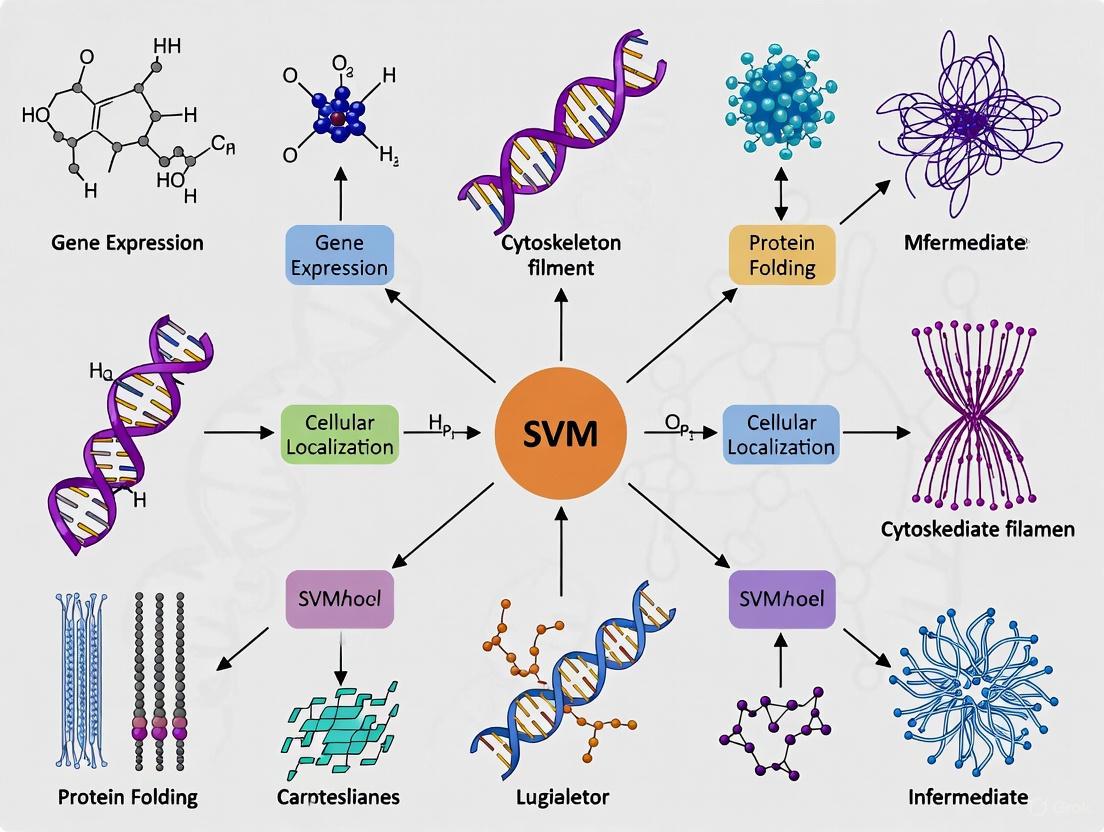
This article explores the integration of Support Vector Machine (SVM) algorithms with cytoskeleton genomics for advanced disease classification and biomarker discovery.
SVM-Driven Cytoskeleton Gene Classification: Biomarker Discovery for Age-Related and Neurodegenerative Diseases
Abstract
This article explores the integration of Support Vector Machine (SVM) algorithms with cytoskeleton genomics for advanced disease classification and biomarker discovery. Targeting researchers and drug development professionals, we cover foundational concepts linking cytoskeletal dysregulation to pathologies like Alzheimer's, cardiomyopathies, and diabetes. The content details methodological approaches including Recursive Feature Elimination (RFE) for gene selection, addresses troubleshooting for high-dimensional genomic data, and provides validation frameworks through comparative performance analysis. Recent advances and future directions for translating computational findings into therapeutic targets are also discussed, providing a comprehensive resource for leveraging SVM in cytoskeleton-focused biomedical research.
The Cytoskeleton-Gene-Disease Nexus: Establishing the Biological Framework for SVM Classification
The cytoskeleton is a dynamic, intricate network of protein filaments that extends throughout the cytoplasm, serving as the primary structural framework for cellular integrity and function. This complex system is fundamental to maintaining cell shape, providing mechanical strength, enabling intracellular transport, and facilitating cell movement [1] [2]. Comprising three principal filament types—microfilaments, microtubules, and intermediate filaments—the cytoskeleton demonstrates remarkable plasticity, rapidly assembling and disassembling in response to cellular requirements and environmental cues [1].
The critical importance of the cytoskeleton extends beyond basic cellular mechanics to human health and disease pathogenesis. Dysregulation of cytoskeletal components is implicated in numerous disease states, including neurodegenerative disorders such as Alzheimer's and Parkinson's diseases, cancer progression, and various age-related conditions [1] [3]. Consequently, cytoskeletal research has garnered significant attention in both basic science and therapeutic development, with the global cytoskeleton market experiencing robust growth driven by advanced research techniques in cell biology, drug discovery, and diagnostics [4].
Table 1: Core Components of the Eukaryotic Cytoskeleton
| Filament Type | Diameter | Protein Subunit | Primary Functions | Structural Characteristics |
|---|---|---|---|---|
| Microfilaments | 7 nm | Actin (G-actin) | Cell movement, muscle contraction, cytokinesis, intracellular transport | Double helix of F-actin polymers, polarized (+/- ends) |
| Intermediate Filaments | 8-12 nm | Various (keratin, vimentin, lamin, desmin) | Mechanical strength, resistance to shear stress, organelle anchoring | Rope-like structure, two anti-parallel helices/dimers forming tetramers |
| Microtubules | 23 nm | α- and β-tubulin heterodimers | Intracellular transport, cell division, maintenance of cell polarity | Hollow cylinders composed of 13 protofilaments |
Molecular Composition and Structural Properties
Microfilaments (Actin Filaments)
Microfilaments are composed of globular actin (G-actin) monomers that polymerize to form filamentous actin (F-actin) structures. These filaments exhibit structural polarity, featuring a rapidly growing plus end (barbed end) and a slower-growing minus end (pointed end) [5] [2]. Actin polymerization is an energy-dependent process requiring ATP, with assembly and disassembly dynamics controlled by the ATP:ADP ratio in the cytoplasm [2]. The dynamic nature of microfilaments enables rapid remodeling in response to cellular signals, facilitating processes such as cell migration, phagocytosis, and cytokinesis.
Actin structures are precisely regulated by the Rho family of small GTP-binding proteins (Rho, Rac, and Cdc42), which control the formation of distinct actin-based structures [1]. Rho GTPases govern contractile actomyosin filaments (stress fibers), Rac regulates lamellipodia formation, and Cdc42 controls filopodia development. These molecular switches integrate extracellular signals with cytoskeletal rearrangements, allowing cells to adapt their architecture and motile behavior appropriately.
Microtubules
Microtubules are hollow cylindrical structures composed of α- and β-tubulin heterodimers that assemble in a head-to-tail fashion to form protofilaments [5]. Typically, 13 protofilaments associate laterally to form the microtubule wall, creating a structurally rigid filament with a diameter of approximately 25 nm [1] [5]. Like microfilaments, microtubules exhibit structural polarity, with a plus end (β-tubulin exposed) that grows more rapidly and a minus end (α-tubulin exposed) that grows more slowly [5].
Microtubule dynamics are characterized by a phenomenon known as "dynamic instability," wherein individual microtubules undergo alternating phases of growth and shrinkage [5]. This dynamic behavior is crucial for cellular functions such as mitotic spindle formation during cell division and intracellular transport. The structural integrity and dynamics of microtubules are regulated by microtubule-associated proteins (MAPs) and motor proteins including kinesins and dyneins, which facilitate directional transport of vesicles, organelles, and other cargo throughout the cell [5].
Intermediate Filaments
Intermediate filaments provide mechanical strength and resistance to shear stress, forming a stable framework that maintains cellular structural integrity [1] [5]. Unlike microfilaments and microtubules, intermediate filaments are non-polar and assembled from a diverse family of proteins including keratins (in epithelial cells), vimentin (in mesenchymal cells), neurofilaments (in neurons), lamins (in the nucleus), and desmin (in muscle cells) [1] [5].
The assembly mechanism of intermediate filaments involves the formation of dimeric subunits through coiled-coil interactions of α-helical rod domains. These dimers then associate in a staggered anti-parallel fashion to form tetramers, which subsequently assemble into higher-order structures that ultimately form the mature 10-nm filament [1] [5]. This assembly configuration contributes to their exceptional mechanical stability and resilience. Intermediate filaments are more stable and less dynamic than microfilaments and microtubules, reflecting their primary role in providing long-term structural support and mechanical resistance [5].
Research Applications and Methodologies
Advanced Imaging Techniques
Cutting-edge imaging technologies have revolutionized our understanding of cytoskeletal architecture and dynamics. Cryo-electron tomography (cryo-ET) enables visualization of cytoskeletal structures in near-native states at subnanometer resolution [6]. This technique involves rapid vitrification of biological samples to preserve their natural structure, followed by reconstruction of three-dimensional images from a series of tilted cryo-EM images [6]. Recent innovations combining optogenetics with cryo-ET allow precise temporal control over cytoskeletal dynamics, enabling researchers to capture ultrastructural changes during specific cellular processes such as lamellipodia formation [6].
Super-resolution light microscopy techniques, including GI-SIM (grid illumination structured illumination microscopy), have overcome the diffraction limit of conventional light microscopy, permitting visualization of intracellular organelle and cytoskeletal interactions at nanoscale resolution on millisecond timescales [7]. These approaches reveal dynamic processes such as microtubule dynamic instability, mitochondrial fission and fusion, and organelle hitchhiking along cytoskeletal elements [7].
Computational and Machine Learning Approaches
The integration of machine learning in cytoskeleton research has accelerated the identification of cytoskeletal components and their associations with disease states. Support Vector Machine (SVM) classifiers have demonstrated exceptional performance in analyzing cytoskeletal gene expression patterns, achieving high accuracy in identifying genes associated with age-related diseases including Hypertrophic Cardiomyopathy, Coronary Artery Disease, Alzheimer's disease, Idiopathic Dilated Cardiomyopathy, and Type 2 Diabetes Mellitus [3].
Machine learning frameworks have been successfully applied to analyze morphological changes in cytoskeletal elements. For instance, object recognition machine learning models can quantify structural features of astrocytes based on 15 different criteria, including cytoskeletal density, size, and branching patterns [8]. This approach has revealed that heroin exposure induces specific alterations in astrocyte cytoskeleton, causing cells to shrink and become less malleable [8].
Specialized computational tools like MTBPred leverage SVM and random forest algorithms to predict microtubule-associated and binding proteins (MTBPs) with high precision (93%) and recall (98%) [9]. This tool utilizes five key features that consistently yield high classification accuracy (>90%), providing researchers with a valuable resource for identifying novel cytoskeletal regulatory proteins.
Table 2: Machine Learning Applications in Cytoskeleton Research
| Application Area | ML Algorithm | Performance Metrics | Research Utility |
|---|---|---|---|
| Cytoskeletal Gene Classification | Support Vector Machine (SVM) | High accuracy in identifying disease-associated genes [3] | Identification of biomarkers for age-related diseases |
| MTBP Prediction | SVM and Random Forest | Recall: 98%, Precision: 93% (SVM) [9] | Accelerated identification of microtubule-binding proteins |
| Astrocyte Morphology Analysis | Object Recognition ML | 80% accuracy in predicting anatomical origin [8] | Quantification of drug-induced cytoskeletal changes |
| Drug Discovery | Machine Learning Classifiers | Efficient screening of compound libraries [10] | Identification of natural inhibitors targeting tubulin isotypes |
Experimental Protocols
Protocol: Visualizing Lamellipodia Dynamics Using Integrated Optogenetics and Cryo-ET
This protocol outlines procedures for investigating ultrastructural dynamics during lamellipodia formation through integration of optogenetics with cryo-electron tomography [6].
Materials and Reagents
- COS-7 cells (or other adherent cell line)
- Photoactivatable-Rac1 (PA-Rac1) plasmid
- Lifeact-mCherry plasmid for F-actin visualization
- Poly-L-lysine and laminin for grid coating
- EM grids (gold or quantifoil)
- Cryo-plunge freezing apparatus
- Confocal laser scanning microscope with environmental chamber
- Cryo-electron microscope with tomographic capabilities
Method
Cell Preparation and Transfection
- Culture COS-7 cells in appropriate medium under standard conditions.
- Transfect cells with PA-Rac1 and Lifeact-mCherry plasmids using preferred transfection method.
- Allow 24-48 hours for protein expression before experimentation.
EM Grid Preparation
- Coat EM grids with poly-L-lysine (0.1% w/v) for 10 minutes, followed by laminin (10 µg/mL) for 1 hour at 37°C.
- Plate transfected cells onto coated EM grids and allow adhesion for 4-6 hours.
Optogenetic Induction and Vitrification
- Mount grid in plunge-freezer chamber with integrated blue light LED system.
- Irradiate cells with blue light (wavelength 458-488 nm) for 2 minutes to activate PA-Rac1 and induce lamellipodia formation.
- Immediately following irradiation, vitrify samples by plunge-freezing in liquid ethane.
- Store grids in liquid nitrogen until data collection.
Cryo-Correlative Light and Electron Microscopy (Cryo-CLEM)
- Identify regions of interest using cryo-fluorescence microscopy.
- Transfer grid to cryo-electron microscope for tomographic data collection.
- Acquire tilt series from -60° to +60° with 1-2° increments at defocus of -4 to -8 µm.
Data Processing and Analysis
- Reconstruct tomograms using weighted back-projection or iterative reconstruction methods.
- Segment actin filaments and membrane structures using automated or manual approaches.
- Analyze filament orientation, density, and spatial relationships.
Technical Notes
- Maintain consistent temperature throughout optogenetic stimulation and vitrification.
- Optimize light intensity and duration to induce lamellipodia without cellular damage.
- Target areas with ice thickness appropriate for tomography (200-500 nm).
Protocol: Computational Identification of Cytoskeletal Biomarkers Using SVM Classification
This protocol describes a bioinformatics workflow for identifying cytoskeletal genes associated with diseases using machine learning approaches [3].
Materials and Software Requirements
- Gene expression datasets from disease cohorts (e.g., GEO, TCGA)
- List of known cytoskeletal genes (e.g., from Gene Ontology)
- Python or R programming environment
- Scikit-learn library for machine learning
- High-performance computing resources for large-scale analysis
Method
Data Collection and Preprocessing
- Obtain transcriptomic datasets from relevant disease studies and healthy controls.
- Normalize expression data using appropriate methods (e.g., TPM, FPKM).
- Annotate cytoskeletal genes using Gene Ontology terms (GO:0005856, GO:0005874).
Feature Selection and Engineering
- Calculate differential expression statistics between case and control groups.
- Select top differentially expressed cytoskeletal genes based on fold-change and adjusted p-value.
- Generate additional features including co-expression patterns, pathway enrichment scores, and protein-protein interaction network metrics.
Training Set Construction
- Compile known disease-associated cytoskeletal genes as positive training set.
- Select non-cytoskeletal genes or non-disease-associated cytoskeletal genes as negative training set.
- Address class imbalance using sampling techniques if necessary.
SVM Model Training and Validation
- Split data into training (70%) and validation (30%) sets.
- Train SVM classifier with radial basis function (RBF) kernel.
- Optimize hyperparameters (C, γ) using grid search with cross-validation.
- Evaluate model performance using metrics including accuracy, precision, recall, F1-score, and AUC-ROC.
Biomarker Identification and Validation
- Apply trained model to independent test datasets.
- Rank predicted genes based on decision function values or probabilities.
- Validate top candidates using literature mining or experimental data.
Technical Notes
- Perform appropriate multiple testing correction for differential expression analysis.
- Consider ensemble methods combining SVM with other classifiers for improved performance.
- Implement rigorous cross-validation strategies to avoid overfitting.
Table 3: Key Research Reagent Solutions for Cytoskeleton Studies
| Reagent/Category | Specific Examples | Research Application | Technical Function |
|---|---|---|---|
| Actin Visualization | Lifeact-mCherry, Phalloidin conjugates | Live-cell imaging of microfilament dynamics [6] | F-actin labeling and stabilization |
| Optogenetic Tools | Photoactivatable-Rac1 (PA-Rac1) | Spatiotemporal control of signaling pathways [6] | Precise induction of cytoskeletal rearrangements |
| Tubulin Inhibitors | Taxol, Colchicine, Novel natural compounds [10] | Investigating microtubule dynamics and drug development | Modulation of microtubule stability and polymerization |
| Machine Learning Tools | MTBPred, Custom SVM classifiers [3] [9] | Prediction of cytoskeletal associations and biomarkers | Automated analysis of complex datasets and patterns |
| Cryo-ET Reagents | Poly-L-lysine, Laminin-coated grids [6] | Structural biology of cytoskeletal components | Sample preparation for high-resolution tomography |
| Antibody Panels | Anti-βIII-tubulin, Anti-Arp2, Anti-Abi1 [6] [10] | Protein localization and expression studies | Specific detection of cytoskeletal proteins |
Signaling Pathways and Molecular Interactions
The cytoskeleton functions as an integrative platform for numerous signaling pathways that regulate cellular architecture and behavior. Small GTPases of the Rho family (Rho, Rac, and Cdc42) serve as master regulators of cytoskeletal dynamics, transducing extracellular signals into coordinated structural changes [1] [5]. Rac1 activation stimulates lamellipodia formation through the SCAR/WAVE complex, which subsequently activates the Arp2/3 complex to nucleate branched actin networks [6]. The Arp2/3 complex binds to existing actin filaments and initiates new filament growth at approximately 70° angles, creating the branched network characteristic of lamellipodia [6].
Microtubule dynamics are regulated by numerous microtubule-associated proteins (MAPs) and signaling pathways. Tubulin isotypes, particularly βIII-tubulin, influence microtubule stability and drug sensitivity [10]. Overexpression of βIII-tubulin in various carcinomas confers resistance to taxane-based chemotherapeutics, making it an important therapeutic target [10]. Computational studies integrating structure-based drug design with machine learning have identified natural compounds that selectively target the βIII-tubulin isotype, offering promising avenues for overcoming drug resistance [10].
Intermediate filaments provide mechanical stability and serve as scaffolds for signaling molecules. Their cell-type-specific composition (keratins in epithelial cells, vimentin in mesenchymal cells, neurofilaments in neurons) allows specialized functions tailored to tissue requirements [1] [5]. Mutations in intermediate filament proteins cause severe medical conditions including premature aging, muscular dystrophy, and Alexander Disease, underscoring their critical role in cellular integrity [1].
The cytoskeleton represents a sophisticated integration of structural and regulatory elements that collectively maintain cellular integrity and function. Understanding the intricate interplay between microfilaments, microtubules, and intermediate filaments provides crucial insights into fundamental biological processes and disease mechanisms. The emerging integration of advanced imaging techniques like cryo-ET with computational approaches such as SVM classification represents a powerful paradigm for accelerating cytoskeleton research.
Future research directions will likely focus on elucidating the spatiotemporal coordination between different cytoskeletal networks, developing more sophisticated machine learning models for predicting cytoskeletal behavior, and translating basic research findings into therapeutic applications. The continued refinement of optogenetic tools and high-resolution imaging methodologies will enable unprecedented visualization of cytoskeletal dynamics, while computational approaches will facilitate the identification of novel biomarkers and therapeutic targets for cytoskeleton-related diseases.
Application Notes
The cytoskeleton, comprising actin filaments, microtubules, and intermediate filaments, is a dynamic network critical for maintaining cellular structural integrity, facilitating intracellular transport, and enabling mechanotransduction [11] [12]. Dysregulation of cytoskeletal components and their associated proteins is increasingly recognized as a fundamental pathological mechanism spanning diverse human diseases, including neurodegenerative disorders, cardiovascular conditions, and metabolic diseases [11] [13] [14]. Recent advances in computational biology, particularly machine learning approaches, have enabled more precise identification of cytoskeleton-related gene signatures associated with these conditions, opening new avenues for biomarker discovery and therapeutic targeting [11] [15].
The integration of support vector machine (SVM) classification with transcriptomic data has emerged as a powerful methodology for identifying cytoskeletal gene patterns that accurately discriminate between diseased and normal states across multiple age-related pathologies [11]. This approach has revealed distinct cytoskeletal gene expression profiles associated with hypertrophic cardiomyopathy (HCM), coronary artery disease (CAD), Alzheimer's disease (AD), idiopathic dilated cardiomyopathy (IDCM), and type 2 diabetes mellitus (T2DM), providing a molecular framework for understanding shared and unique pathophysiological mechanisms [11] [12].
SVM-Based Classification of Cytoskeletal Genes in Age-Related Diseases
Experimental Workflow and Performance Metrics
The application of SVM classifiers to cytoskeletal gene expression data has demonstrated exceptional accuracy in distinguishing disease states from healthy controls across multiple pathological conditions [11]. The recursive feature elimination (RFE) method coupled with SVM has proven particularly effective in identifying minimal gene signatures that maintain high diagnostic precision while reducing computational complexity [11].
Table 1: SVM Classifier Performance Across Age-Related Diseases
| Disease | Accuracy | Number of Cytoskeletal Genes Analyzed | Key RFE-Selected Genes |
|---|---|---|---|
| Hypertrophic Cardiomyopathy (HCM) | 94.85% | 1,696 | ARPC3, CDC42EP4, LRRC49, MYH6 |
| Coronary Artery Disease (CAD) | 95.07% | 1,989 | CSNK1A1, AKAP5, TOPORS, ACTBL2, FNTA |
| Alzheimer's Disease (AD) | 87.70% | 1,561 | ENC1, NEFM, ITPKB, PCP4, CALB1 |
| Idiopathic Dilated Cardiomyopathy (IDCM) | 96.31% | 2,167 | MNS1, MYOT |
| Type 2 Diabetes Mellitus (T2DM) | 89.54% | 2,188 | ALDOB |
The exceptional performance of SVM-based classification across these diverse disease states underscores the fundamental role of cytoskeletal dysregulation in age-related pathologies and highlights the potential of machine learning approaches for identifying robust diagnostic biomarkers [11]. The RFE-SVM pipeline successfully identified 17 key cytoskeletal genes involved in the structure and regulation of the cytoskeleton that demonstrate consistent association with age-related diseases, providing potential targets for therapeutic intervention [11] [12].
Cross-Disease Analysis of Cytoskeletal Gene Signatures
Comparative analysis of RFE-selected cytoskeletal genes across multiple diseases has revealed both disease-specific patterns and shared molecular pathways [11]. While no single gene was common to all five diseases examined, several genes demonstrated overlap across multiple conditions, suggesting possible shared pathological mechanisms:
- ANXA2 was common to AD, IDCM, and T2DM
- TPM3 was shared between AD, CAD, and T2DM
- SPTBN1 was identified in AD, CAD, and HCM
- MAP1B, RRAGD, and RPS3 were shared between AD and T2DM
- JAKMIP1, ABLIM3, and PDE4B were common to AD and CAD
These overlapping genes represent particularly promising candidates for further investigation as they may point to core cytoskeletal disruption mechanisms that transcend traditional disease classification boundaries [11].
Protocols
Protocol 1: SVM-Based Classification of Cytoskeletal Gene Expression Signatures
Purpose To classify disease states and identify discriminative cytoskeletal genes using SVM machine learning algorithms applied to transcriptomic data.
Materials
- Transcriptomic datasets (e.g., GEO Accession: GSE32453, GSE36961 for HCM; GSE113079 for CAD; GSE5281 for AD; GSE57338 for IDCM; GSE164416 for T2DM) [11]
- Cytoskeletal gene list from Gene Ontology Browser (GO:0005856) encompassing 2,304 genes [11]
- Computational environment with R or Python programming capabilities
- Limma package for batch effect correction and normalization [11]
- Scikit-learn or equivalent machine learning library with SVM implementation
Procedure
Data Acquisition and Preprocessing
- Retrieve transcriptomic data from public repositories (see Materials for specific accession numbers)
- Perform batch effect correction and normalization using the Limma package [11]
- Filter genes to include only cytoskeletal-associated genes based on GO:0005856
Feature Selection using Recursive Feature Elimination (RFE)
- Implement RFE with SVM classifier using linear kernel
- Recursively remove features with smallest weights with a step size of 1
- Calculate five-fold cross-validation scores at each step
- Select optimal feature subset based on peak cross-validation accuracy [11]
SVM Model Training and Validation
- Partition data into training (70%) and testing (30%) sets
- Train SVM classifier with linear kernel on selected feature subset
- Validate model using stratified five-fold cross-validation
- Assess performance using accuracy, F1-score, recall, precision, and ROC analysis [11]
Differential Expression Analysis
- Perform differential expression analysis using DESeq2 for T2DM and Limma for other diseases
- Apply thresholds of adjusted p-value < 0.05 and |log2 fold change| > 1
- Identify overlapping genes between RFE-selected features and differentially expressed genes [11]
Troubleshooting
- For class imbalance issues, employ stratified sampling during cross-validation
- If feature selection is unstable, increase step size in RFE or apply additional regularization
- For non-linear relationships, explore SVM with radial basis function kernel
Protocol 2: Experimental Validation of Cofilin-Actin Rod Formation in Neurodegenerative Models
Purpose To induce and quantify cofilin-actin rod formation as a marker of cytoskeletal dysregulation in cellular models of neurodegeneration.
Background Cofilin-actin rods are cytoplasmic structures containing predominantly dephosphorylated (active) cofilin and ADP-actin in a 1:1 ratio that form under conditions of oxidative or energetic stress and are associated with neurodegenerative processes, particularly Alzheimer's disease [13]. These structures are thought to interfere with intracellular transport and contribute to synaptic dysfunction [13].
Materials
- Cultured hippocampal neurons or immortalized cell lines (HeLa, HEK 293) [13]
- Cofilin and actin antibodies for immunocytochemistry
- Chemical inducers: 10 mM sodium azide (NaN3) with 6 mM 2-deoxyglucose (2-DG) for ATP depletion; 10 μM hydrogen peroxide for oxidative stress; 150-300 μM glutamate for excitotoxicity [13]
- Fluorescence microscope with high-resolution imaging capabilities
- Image analysis software (e.g., ImageJ, CellProfiler)
Procedure
Cell Culture and Stress Induction
- Plate cells on poly-D-lysine coated coverslips at appropriate density
- At 70-80% confluence, treat with stress-inducing compounds:
- For ATP depletion: 10 mM NaN3 + 6 mM 2-DG for 30 minutes
- For oxidative stress: 10 μM hydrogen peroxide for 60 minutes
- For excitotoxicity: 150-300 μM glutamate for 30 minutes [13]
Immunofluorescence Staining and Imaging
- Fix cells with 4% paraformaldehyde for 15 minutes at room temperature
- Permeabilize with 0.1% Triton X-100 for 5 minutes
- Block with 5% normal goat serum for 1 hour
- Incubate with primary antibodies against cofilin and actin overnight at 4°C
- Incubate with fluorescent secondary antibodies for 1 hour at room temperature
- Mount coverslips and image using confocal microscopy [13]
Quantification and Analysis
- Acquire images from multiple random fields per condition
- Count cells containing cofilin-actin rods (defined as elongated cytoplasmic inclusions >2μm in length)
- Calculate percentage of cells with rods per condition
- Quantify rod size and distribution using image analysis software
Troubleshooting
- Note that Lifeact and phalloidin do not effectively stain cofilin-actin rods [13]
- If rod formation is inconsistent, verify stressor concentrations and treatment duration
- For primary neurons, optimize culture conditions to maintain neuronal health before stress induction
Visualizations
Diagram 1: SVM-RFE Workflow for Cytoskeletal Gene Identification
SVM-RFE Cytoskeletal Gene Identification
Diagram 2: Cytoskeletal Dysregulation Pathways in Neurodegenerative and Cardiovascular Diseases
Cytoskeletal Dysregulation Pathways
The Scientist's Toolkit: Research Reagent Solutions
Table 2: Essential Research Reagents for Cytoskeletal Dysregulation Studies
| Reagent/Category | Specific Examples | Function/Application |
|---|---|---|
| Cytoskeletal Markers | Anti-cofilin, anti-actin, anti-tau antibodies | Detection of cytoskeletal components and their pathological aggregates in immunofluorescence and immunohistochemistry |
| Stress Inducers | Sodium azide, 2-deoxyglucose, hydrogen peroxide, glutamate | Induction of cytoskeletal stress responses including cofilin-actin rod formation [13] |
| Computational Tools | Limma package, SVM algorithms (Scikit-learn), RFE implementation | Analysis of transcriptomic data and identification of cytoskeletal gene signatures [11] |
| Cell Models | Cultured hippocampal neurons, HeLa cells, HEK 293 cells | In vitro modeling of cytoskeletal dysregulation under controlled conditions [13] |
| Imaging Reagents | Fluorescently-labeled phalloidin, Lifeact (note: does not stain cofilin-actin rods) [13] | Visualization of actin structures (with limitations for specific pathological aggregates) |
The integration of computational approaches, particularly SVM-based classification, with experimental investigations of cytoskeletal dynamics provides a powerful framework for understanding shared pathological mechanisms across neurodegenerative and cardiovascular diseases. The protocols outlined here enable researchers to identify cytoskeletal gene signatures associated with specific disease states and validate their functional significance in relevant model systems. The consistent implication of cytoskeletal dysregulation across these diverse conditions suggests potential for shared therapeutic strategies targeting cytoskeletal stability and dynamics.
Fundamentals of Support Vector Machines (SVM) for High-Dimensional Biological Data Classification
Support Vector Machines (SVMs) represent a set of supervised learning methods widely used for classification, regression, and outlier detection in bioinformatics. Their core principle involves finding a hyperplane that optimally divides a dataset into distinct classes, which is particularly valuable for high-dimensional biological data where the number of variables (e.g., genes) far exceeds the number of observations. Introduced by Vladimir Vapnik and his collaborators in the 1990s, SVMs have gained popularity due to their high prediction accuracy, ability to handle structured data, and flexibility in integrating various data types [16] [17].
In the context of high-dimensional biological data such as gene expression microarrays, where each observation may involve thousands of gene measurements but only dozens of samples, traditional statistical methods often fail. SVMs excel in these "large p, small n" scenarios due to their margin-maximization principle and capacity to manage complexity through kernel functions [18] [19]. This technical note explores the fundamental concepts, protocols, and applications of SVMs specifically for classifying high-dimensional biological data, with emphasis on cytoskeletal gene classification in age-related diseases.
Theoretical Foundations of SVM
Core Concepts and Terminology
- Hyperplane: In an n-dimensional space, a hyperplane is a flat subspace of dimension n-1 that serves as a decision boundary separating different classes of data points.
- Support Vectors: These are the critical data points closest to the hyperplane that directly influence its position and orientation. The SVM algorithm essentially depends on these points to define the optimal separating boundary.
- Margin: The distance between the hyperplane and the nearest data points from either class. SVM optimization aims to maximize this margin to enhance model generalization to new data.
- Kernels: Functions that transform input data into higher-dimensional spaces, enabling linear separation of non-linearly separable data. Common kernel functions include linear, polynomial, and Gaussian (Radial Basis Function or RBF) kernels [16].
Mathematical Formulation
Given a training dataset of m samples (x₁,y₁),···,(xₘ,yₘ) where xᵢ is an observation and yᵢ ∈ {-1, +1} is its class label, the standard linear SVM solves the following optimization problem [17]:
Minimize: ½∥w∥² + C∑ξᵢ
Subject to: yᵢ(wᵀxᵢ + b) ≥ 1 - ξᵢ ξᵢ ≥ 0
Here, w is the weight vector, b is the bias term, C is a regularization parameter that controls the trade-off between maximizing the margin and minimizing classification errors, and ξᵢ are slack variables that permit misclassifications. For non-linearly separable data, the kernel trick replaces xᵢᵀxⱼ with k(xᵢ,xⱼ) = φ(xᵢ)ᵀφ(xⱼ), where k is a kernel function and φ is a mapping to a high-dimensional feature space [17].
SVM Protocol for High-Dimensional Biological Data Classification
Experimental Workflow
The following diagram illustrates the complete workflow for applying SVM to high-dimensional biological data classification, specifically for cytoskeletal gene expression analysis:
Detailed Experimental Procedures
Protocol 1: Data Preprocessing and Feature Selection
Purpose: Prepare high-dimensional biological data for SVM classification and identify the most informative features.
Materials and Reagents:
- Gene expression datasets (e.g., from GEO Accession numbers GSE32453, GSE36961 for HCM studies)
- Cytoskeletal gene list from Gene Ontology Browser (GO:0005856)
- Computational tools: R/Python with Limma package for normalization
Procedure:
- Data Retrieval: Obtain relevant transcriptome data from public repositories (see Table 1 for dataset examples).
- Batch Effect Correction: Address technical variations using the Limma package in R [11].
- Gene Filtering: Restrict analysis to cytoskeletal genes using Gene Ontology ID GO:0005856 (approximately 2,300 genes) [11].
- Feature Selection: Implement Recursive Feature Elimination (RFE) with SVM to identify the most discriminative genes:
- Utilize 5-fold cross-validation to assess feature importance
- Recursively remove features with the smallest weights
- Determine the optimal number of features that maximizes classification accuracy
- Data Partitioning: Split data into training (70-80%) and validation (20-30%) sets, maintaining class proportions.
Protocol 2: SVM Model Training and Optimization
Purpose: Develop and optimize an SVM classifier for high-dimensional biological data.
Materials and Reagents:
- Preprocessed gene expression data
- Computational environment: Python with scikit-learn or MATLAB
- High-performance computing resources for large-scale analysis
Procedure:
- Classifier Selection: Compare multiple algorithms (Decision Trees, Random Forest, k-NN, Gaussian Naive Bayes, SVM) using cross-validation accuracy.
- Kernel Selection: Evaluate linear, polynomial, and RBF kernels for specific dataset characteristics.
- Hyperparameter Tuning:
- Perform grid search with cross-validation for parameters C (regularization) and γ (kernel coefficient)
- Use stratified k-fold cross-validation (typically k=5) to maintain class distributions
- Optimize for balanced accuracy, especially with imbalanced datasets
- Model Training: Train the final SVM model with optimized parameters on the complete training set.
- Model Validation: Assess performance on held-out test set using comprehensive metrics (accuracy, F1-score, recall, precision).
Protocol 3: Model Evaluation and Biomarker Validation
Purpose: Evaluate SVM classifier performance and validate identified biomarkers.
Materials and Reagents:
- Independent validation dataset(s)
- Statistical analysis software
- Visualization tools for ROC curves and performance metrics
Procedure:
- Performance Metrics Calculation:
- Compute accuracy, F1-score, recall, precision, and balanced accuracy
- Generate confusion matrix with True Positives (TP), True Negatives (TN), False Positives (FP), False Negatives (FN)
- Calculate Positive Predictive Value (PPV) and Negative Predictive Value (NPV)
- ROC Analysis: Plot Receiver Operating Characteristic curves and calculate Area Under the Curve (AUC) values.
- External Validation: Apply trained model to completely independent datasets to assess generalizability.
- Biomarker Significance Testing: Conduct differential expression analysis on identified genes to confirm biological relevance.
- Comparative Analysis: Compare SVM performance against alternative machine learning approaches.
Application to Cytoskeletal Gene Classification
Case Study: Age-Related Disease Classification
Research has demonstrated SVMs' exceptional performance in classifying age-related diseases based on cytoskeletal gene expression patterns. A comprehensive study analyzing hypertrophic cardiomyopathy (HCM), coronary artery disease (CAD), Alzheimer's disease (AD), idiopathic dilated cardiomyopathy (IDCM), and type 2 diabetes mellitus (T2DM) revealed SVMs achieved the highest accuracy among multiple classifiers [11].
Table 1: Performance of SVM vs. Other Classifiers for Cytoskeletal Gene Classification
| Disease | DTs | RF | k-NN | SVM | GNB |
|---|---|---|---|---|---|
| HCM | 89.15% | 91.04% | 92.33% | 94.85% | 82.17% |
| CAD | 87.90% | 92.21% | 91.50% | 95.07% | 90.07% |
| AD | 74.56% | 83.23% | 84.48% | 87.70% | 82.61% |
| IDCM | 87.63% | 94.05% | 94.93% | 96.31% | 81.75% |
| T2DM | 61.81% | 80.75% | 70.30% | 89.54% | 80.75% |
The SVM classifier consistently outperformed other methods across all disease classifications, demonstrating its particular suitability for high-dimensional cytoskeletal gene data [11].
Identified Cytoskeletal Gene Biomarkers
The application of RFE-SVM methodology identified specific cytoskeletal genes associated with each age-related disease, providing potential biomarkers for diagnosis and therapeutic targeting.
Table 2: Cytoskeletal Gene Biomarkers Identified by SVM for Age-Related Diseases
| Disease | Identified Genes | Biological Function |
|---|---|---|
| HCM | ARPC3, CDC42EP4, LRRC49, MYH6 | Actin polymerization, cytoskeletal organization, motor protein function |
| CAD | CSNK1A1, AKAP5, TOPORS, ACTBL2, FNTA | Kinase activity, scaffolding, ubiquitin ligase, cytoskeletal protein |
| AD | ENC1, NEFM, ITPKB, PCP4, CALB1 | Neuronal cytoskeleton, intermediate filaments, signaling |
| IDCM | MNS1, MYOT | Cytoskeletal structure, sarcomere organization |
| T2DM | ALDOB | Metabolic enzyme with cytoskeletal interactions |
These genes represent compelling candidates for further investigation as diagnostic markers and therapeutic targets in their respective age-related diseases [11].
The Scientist's Toolkit: Research Reagent Solutions
Table 3: Essential Research Reagents for SVM Cytoskeletal Gene Classification
| Reagent/Resource | Function | Example/Specification |
|---|---|---|
| Gene Expression Datasets | Training and validation data | GEO Accession: GSE32453 (HCM), GSE113079 (CAD), GSE5281 (AD) |
| Cytoskeletal Gene List | Feature definition | Gene Ontology ID: GO:0005856 (~2,300 genes) |
| Normalization Tools | Data preprocessing | Limma Package (R) for batch effect correction |
| Feature Selection Algorithm | Dimensionality reduction | Recursive Feature Elimination (RFE) with SVM |
| SVM Implementation | Model training | scikit-learn (Python) or MATLAB with optimization tools |
| Cross-Validation Framework | Model validation | Stratified 5-fold cross-validation |
| Performance Metrics | Model evaluation | ROC analysis, accuracy, F1-score, precision, recall |
Advanced SVM Applications and Methodological Considerations
Confounder-Correcting SVM (ccSVM)
Biological data often contains confounding variables such as population structure, age, gender, or experimental conditions that can distort classification results. The ccSVM approach addresses this by minimizing the statistical dependence between the classifier and confounding factors using the Hilbert-Schmidt Independence Criterion (HSIC) [17].
The ccSVM optimization incorporates an additional term to standard SVM formulation: Minimize: ½∥w∥² + C∑ξᵢ + λ·tr(KHLH)
Where tr(KHLH) represents the HSIC measure between the reweighted kernel matrix K and side information kernel matrix L, H is a centering matrix, and λ controls the degree of confounder correction [17].
This approach has proven effective in diverse applications including tumor diagnosis across different laboratories and tuberculosis diagnosis across patient demographics, improving model generalizability and biological relevance.
Handling Class Imbalance
High-dimensional biological datasets frequently exhibit class imbalance, which can severely impact SVM performance. Effective strategies include:
- Applying class weights inversely proportional to class frequencies
- Using resampling techniques (SMOTE, undersampling, oversampling)
- Employing ensemble methods in conjunction with SVM
- Adjusting decision thresholds based on validation performance [16]
Workflow for Cytoskeletal Gene Classification
The following diagram illustrates the specific workflow for cytoskeletal gene classification using SVM in age-related disease research:
Support Vector Machines represent a powerful methodology for classifying high-dimensional biological data, particularly in the context of cytoskeletal gene expression in age-related diseases. The SVM protocol detailed in this technical note—encompassing rigorous data preprocessing, recursive feature selection, careful model training with cross-validation, and comprehensive evaluation—provides a robust framework for identifying biologically relevant gene signatures with diagnostic and therapeutic potential. The exceptional performance of SVMs in classifying age-related diseases based on cytoskeletal gene expression (achieving 87.70-96.31% accuracy across conditions) underscores their value in bioinformatics research and drug development pipelines.
The cytoskeleton, a dynamic network of filamentous proteins, is fundamental to cellular integrity, shape, and intracellular transport. Comprising microfilaments, microtubules, and intermediate filaments, this structure is indispensable for neuronal function, muscle contraction, and organelle trafficking [20]. mounting evidence establishes that the integrity of the cytoskeleton is intimately linked with the aging process and the pathogenesis of a spectrum of age-related diseases [11] [20]. Aging cells frequently exhibit a loss of cytoskeletal stability, which is associated with a decline in mitochondrial function and an accumulation of cellular damage [20]. This degradation contributes to the functional decline observed in neurodegenerative diseases, cardiomyopathies, and metabolic disorders.
The application of advanced computational methods, particularly Support Vector Machine (SVM) classifiers, has revolutionized the identification of cytoskeletal genes with critical roles in these pathologies. SVM models are exceptionally well-suited for analyzing high-dimensional genomic data due to their capacity to handle large feature spaces and identify complex, non-linear patterns [11] [12]. Recent research leveraging these models has pinpointed specific cytoskeletal genes, including ACTBL2, KIF5A, and MYH6, as being transcriptionally dysregulated in age-related diseases, highlighting their potential as biomarkers and therapeutic targets [11] [12]. This document details the experimental and computational protocols for validating the role of these genes, providing a resource for researchers and drug development professionals.
Computational Identification via SVM-Based Classification
The discovery of ACTBL2, KIF5A, and MYH6 as key players was facilitated by a robust computational framework designed to analyze transcriptional changes in cytoskeletal genes across multiple age-related diseases.
Workflow for SVM-RFE Gene Selection
The following diagram illustrates the integrated machine learning and differential expression analysis pipeline used to identify key cytoskeletal genes.
SVM Model Performance and Selected Genes
The SVM-based model demonstrated superior performance in classifying disease states across multiple conditions, achieving the highest accuracy among five tested algorithms [11] [12]. The following table summarizes the model's performance and the key cytoskeletal genes identified for specific age-related diseases.
Table 1: SVM Classifier Performance and Identified Cytoskeletal Genes
| Age-Related Disease | SVM Accuracy | Key Cytoskeletal Genes Identified | Primary Cytoskeletal Function |
|---|---|---|---|
| Coronary Artery Disease (CAD) | 95.07% | ACTBL2, CSNK1A1, AKAP5, TOPORS, FNTA [12] | Actin polymerization, cytoskeletal organization [21] |
| Amyotrophic Lateral Sclerosis (ALS) | N/A | KIF5A, ALS2, DCTN1, PFN1, NF-L, NF-H [22] | Anterograde axonal transport, synaptic maintenance [22] [23] |
| Hypertrophic Cardiomyopathy (HCM) | 94.85% | MYH6, ARPC3, CDC42EP4, LRRC49 [11] [12] | Sarcomeric motor protein, cardiac muscle contraction [11] |
| Alzheimer's Disease (AD) | 87.70% | ENC1, NEFM, ITPKB, PCP4, CALB1 [11] [12] | Neuronal structure, calcium signaling |
| Idiopathic Dilated Cardiomyopathy (IDCM) | 96.31% | MNS1, MYOT [11] [12] | Sarcomeric and cytoskeletal integrity |
| Type 2 Diabetes Mellitus (T2DM) | 89.54% | ALDOB [11] [12] | Cytoskeletal structure regulation |
Experimental Validation Protocols
Protocol 1: Functional Characterization of Actin Mutations
This protocol is adapted from studies on disease-causing actin mutations, such as those in ACTG2, which provide a template for investigating genes like ACTBL2 [24] [21].
1. Objectives:
- To express and purify wild-type and mutant actin proteins.
- To assess the impact of mutations on actin polymerization kinetics and filament stability using pyrene-actin assays.
- To visualize filament morphology and stability via negative stain electron microscopy.
2. Materials:
- Recombinant Protein Expression System: Human Expi293F cells [24].
- Affinity Purification Resin: Gelsolin segments 4-6 (G4G6) affinity column for Ca²⁺-dependent actin binding [24].
- Polymerization Assay Reagents: Purified actin (≥ 95% purity), 10X polymerization buffer (500 mM KCl, 20 mM MgCl₂, 10 mM ATP, 1 M Tris-HCl, pH 7.5), pyrene-labeled actin [24].
- Equipment: Fluorometer, ultracentrifuge, fast protein liquid chromatography (FPLC) system, electron microscope.
3. Procedure: 1. Protein Expression and Purification: - Transfect Expi293F cells with plasmids encoding wild-type or mutant (e.g., ACTBL2-mimetic) actin. - After 48-72 hours, harvest cells and lyse in a Ca²⁺-containing buffer. - Purify actin from the supernatant using a G4G6 affinity column. Elute with an EGTA-containing buffer to chelate Ca²⁺. - Dialyze the eluted actin into G-buffer (2 mM Tris-HCl, 0.2 mM ATP, 0.5 mM DTT, 0.1 mM CaCl₂, pH 8.0). Determine concentration and store on ice for immediate use. 2. Pyrene-Actin Polymerization Assay: - Prepare a mixture of unlabeled actin (94%) and pyrene-labeled actin (6%) in G-buffer for a final concentration of 2 µM total actin. - Transfer the mixture to a quartz cuvette and place it in a fluorometer (excitation: 365 nm, emission: 407 nm). - Initiate polymerization by rapidly adding 1/10 volume of 10X polymerization buffer. Mix quickly and record fluorescence for 1-2 hours. - Calculate the polymerization rate from the slope of the initial linear increase and the critical concentration (Cc) from equilibrium fluorescence at varying actin concentrations. 3. Filament Stability Analysis: - For depolymerization assays, prepare polymerized actin filaments as above. - Dilute the pre-polymerized filaments 20-fold into G-buffer (final concentration 0.1 µM) to shift the system below the Cc. - Immediately monitor the decrease in pyrene fluorescence to determine the depolymerization rate.
4. Data Analysis:
- Compare the polymerization and depolymerization rates, as well as the Cc, of mutant versus wild-type actin. Mutations like R40C in ACTG2 cause sluggish polymerization, while R257C leads to rapid but unstable polymerization, indicating diverse pathogenic mechanisms [24].
Protocol 2: In Vitro Analysis of KIF5A-Dependent Axonal Transport
This protocol outlines a method for studying the functional consequences of KIF5A mutations observed in ALS [22] [23].
1. Objectives:
- To visualize and quantify mitochondrial motility in neurons derived from patient-specific induced pluripotent stem cells (iPSCs).
- To assess the impact of KIF5A mutations on anterograde transport.
2. Materials:
- Cell Line: Human iPSCs from a healthy donor and an ALS patient with a known KIF5A mutation.
- Neuronal Differentiation Kit: Commercially available kits for motor neuron differentiation.
- Live-Cell Dyes: MitoTracker Red CMXRos for mitochondria.
- Imaging Equipment: Confocal microscope with a live-cell incubation chamber (maintaining 37°C and 5% CO₂).
- Software: Image analysis software (e.g., ImageJ with TrackMate plugin).
3. Procedure: 1. Motor Neuron Differentiation: - Differentiate iPSCs into motor neurons using a standardized protocol over 4-5 weeks. - Plate mature motor neurons on poly-D-lysine/laminin-coated glass-bottom dishes for imaging. 2. Live-Cell Imaging of Mitochondrial Transport: - On day in vitro (DIV) 14, load neurons with 50 nM MitoTracker Red in pre-warmed culture medium for 30 minutes. - Replace with fresh medium and equilibrate the dish in the live-cell chamber for 15 minutes. - Acquire time-lapse images of neuronal axons every 5-10 seconds for a total of 10 minutes using a 60x oil immersion objective. 3. Quantification of Transport: - Export movies as TIFF stacks and analyze using TrackMate. - Manually define a region of interest (ROI) encompassing a straight axon segment. - The software will track individual mitochondria, generating data for velocity, track length, and directionality. - Categorize mitochondria as anterograde (moving away from the soma), retrograde (towards the soma), or stationary.
4. Data Analysis:
- Compare the percentage of mitochondria undergoing anterograde transport and their mean velocity between KIF5A-mutant and control motor neurons. A significant reduction is indicative of impaired KIF5A function, a known hallmark of ALS pathophysiology [22] [23].
The Scientist's Toolkit: Research Reagent Solutions
Table 2: Essential Reagents for Cytoskeletal Gene and Protein Functional Analysis
| Reagent / Material | Function / Application | Example Use Case |
|---|---|---|
| Expi293F Cell System | High-efficiency protein expression for difficult-to-express proteins like actins. | Recombinant expression of wild-type and mutant ACTBL2/ACTG2 for biochemical assays [24]. |
| G4G6 Affinity Column | Ca²⁺-dependent purification of native, functional actin. | Isolation of pure, polymerization-competent actin from cell lysates [24]. |
| Pyrene-Labeled Actin | Fluorescent reporter for real-time monitoring of actin polymerization kinetics. | Pyrene-actin polymerization assay to determine polymerization rates and critical concentration [24]. |
| Human iPSCs | Generation of patient-specific disease models for neurodegenerative and cardiac diseases. | Differentiation into motor neurons to study KIF5A mutations in ALS or cardiomyocytes to study MYH6 in HCM [22]. |
| MitoTracker Dyes | Live-cell staining of mitochondria for tracking organelle dynamics. | Visualization and quantification of axonal transport deficits in KIF5A-mutant neurons [23]. |
| CRISPR/Cpf1 System | Precise gene editing for creating knockout or knock-in models. | Generation of isogenic control and mutant iPSC lines to study the specific effects of a point mutation [25]. |
Integrated Pathway and Logical Workflow
The relationship between cytoskeletal gene mutations, their functional consequences, and the resulting disease phenotypes is complex. The following pathway diagram synthesizes this information for ACTBL2, KIF5A, and MYH6.
The integration of SVM-based computational classification with rigorous experimental validation provides a powerful strategy for pinpointing cytoskeletal genes like ACTBL2, KIF5A, and MYH6 as critical factors in age-related diseases. The protocols outlined here for biochemical characterization and cellular functional analysis offer a roadmap for researchers to validate the role of these and other candidate genes. Furthermore, the identified genes and their pathways present promising targets for therapeutic development. For instance, stabilizing the cytoskeleton with targeted compounds has been proposed as a potential strategy to counteract aging and degenerative processes [20]. Continued research in this field, leveraging the described tools and methods, will deepen our understanding of cytoskeletal biology in aging and accelerate the development of novel diagnostics and treatments.
The integration of cytoskeleton biology with machine learning represents a transformative approach in genomic medicine. This protocol details the application of Support Vector Machines (SVM) for classifying cytoskeletal gene signatures in age-related diseases. The cytoskeleton, comprising dynamic filamentous proteins, maintains cellular integrity and organization, with dysregulation implicated in numerous pathological states. SVM learning excels at identifying subtle patterns in high-dimensional genomic data, making it ideally suited for discerning disease-specific cytoskeletal gene expression signatures. We present a standardized computational framework that leverages Recursive Feature Elimination with SVM to identify minimal yet informative cytoskeletal gene sets that accurately discriminate between patient and normal samples across five age-related diseases, achieving area under the curve (AUC) values up to 0.99 in validation studies.
The cytoskeleton is a network of intracellular filamentous proteins that forms an organized structural framework essential for cellular shape, integrity, motility, and intracellular transport [11]. Comprising microfilaments (actin filaments), intermediate filaments, and microtubules, this dynamic structure connects the cell to its external environment and ensures proper spatial organization of cellular contents [12]. Decades of research have established that cytoskeletal dysregulation is associated with downstream signaling events that regulate cellular activity, aging, and neurodegeneration [11].
The molecular interplay between cytoskeletal components and disease pathophysiology presents both a challenge and opportunity for genomic medicine. The complexity of cytoskeletal gene networks— comprising over 2,300 genes by Gene Ontology classification (GO:0005856) — necessitates advanced computational approaches for meaningful analysis [11] [26]. Support Vector Machine learning offers particular advantages for this domain, as it can identify delicate patterns in complex, high-dimensional datasets and effectively handle the large feature spaces typical of genomic data [27].
This protocol establishes a standardized methodology for applying SVM to classify cytoskeletal genes in age-related diseases, enabling researchers to identify robust biomarkers and potential therapeutic targets through a reproducible computational framework.
Theoretical Foundation
Cytoskeletal Genes in Age-Related Diseases
Cytoskeletal integrity is essential for diverse cellular processes, including intracellular trafficking and phagocytosis [11]. When cytoskeletal dynamics or organization become altered, the consequences manifest in diseases ranging from cancer to neurodegeneration [12]. Specifically, research has revealed that:
- Defects in cytoskeletal proteins result in myopathies through altered signaling and structural mechanisms [11]
- Microtubule defects in axons cause defective axonal transport, contributing to neurodegenerative diseases like Alzheimer's disease (AD) [11]
- Memory loss may be attributed to microtubule depolymerization [11] [12]
- In Type 2 Diabetes Mellitus (T2DM) patients, proteins involved in cytoskeletal structure are significantly altered [11]
- Multiple genetic variants in genes involved in cytoskeletal assembly regulation have been identified in Coronary Artery Disease (CAD) patients [12]
SVM Fundamentals and Biological Applicability
Support Vector Machines represent a powerful classification approach based on statistical learning theory [28]. The fundamental principle involves finding optimal hyperplanes that separate data categories with maximal margins, which confers superior generalization performance compared to other classifiers [27].
Table 1: SVM Performance Comparison Across Classifiers for Cytoskeletal Gene Classification
| Disease | Decision Tree | Random Forest | k-NN | Gaussian Naive Bayes | SVM |
|---|---|---|---|---|---|
| HCM | 89.15% | 91.04% | 92.33% | 82.17% | 94.85% |
| CAD | 87.90% | 92.21% | 91.50% | 90.07% | 95.07% |
| AD | 74.56% | 83.23% | 84.48% | 82.61% | 87.70% |
| IDCM | 87.63% | 94.05% | 94.93% | 81.75% | 96.31% |
| T2DM | 61.81% | 80.75% | 70.30% | 80.75% | 89.54% |
The theoretical basis for SVM's superiority in cytoskeletal gene classification stems from several inherent advantages [27]:
- Capacity Control: SVM's margin maximization provides protection against overfitting, crucial for genomic data with thousands of features but limited samples
- Nonlinear Mapping: Kernel functions enable SVM to handle non-linear relationships in gene expression data without explicit feature transformation
- Robustness: SVM maintains performance despite high-dimensional data where features far exceed samples
- Convex Optimization: The learning algorithm guarantees finding global minima, unlike neural networks which may converge to local minima
Experimental Design and Workflow
The integrated workflow combines feature selection, machine learning classification, and differential expression analysis to identify cytoskeletal genes with diagnostic potential for age-related diseases.
Dataset Specifications
Table 2: Transcriptome Datasets for Cytoskeletal Gene Analysis in Age-Related Diseases
| Disease | GEO Accession | Patient Samples | Control Samples | Cytoskeletal Genes Analyzed |
|---|---|---|---|---|
| HCM | GSE32453, GSE36961 | 114 | 44 | 1,696 |
| CAD | GSE113079 | 93 | 48 | 1,989 |
| AD | GSE5281 | 87 | 74 | 1,561 |
| IDCM | GSE57338 | 82 | 136 | 2,167 |
| T2DM | GSE164416 | 39 | 18 | 2,188 |
Application Notes: Protocols and Procedures
Protocol 1: Cytoskeletal Gene Compilation
Purpose: To establish a comprehensive reference set of cytoskeletal genes for subsequent analysis.
Materials:
- Gene Ontology Browser (amigo.geneontology.org)
- Computational environment (R/Python)
- Gene annotation databases
Procedure:
- Access the Gene Ontology Browser using term ID GO:0005856
- Extract all human genes annotated with the "cytoskeleton" cellular component term
- Verify gene symbols against current HGNC nomenclature
- Export the complete gene list (approximately 2,304 genes) as a reference set
- Categorize genes by cytoskeletal components: microfilaments, intermediate filaments, microtubules
Technical Notes:
- The compiled gene set should include polymeric filamentous structures with long-range order within the cell [26]
- Regular updates are recommended as GO annotations evolve
- Cross-reference with MSigDB "CYTOSKELETON" gene set (M457) for verification [26]
Protocol 2: SVM-RFE for Cytoskeletal Feature Selection
Purpose: To identify minimal yet informative cytoskeletal gene signatures that discriminate disease states.
Materials:
- Normalized gene expression matrices
- Python scikit-learn or R e1071 packages
- High-performance computing resources for iterative modeling
Procedure:
- Initialize SVM classifier with linear kernel
- Set RFE to eliminate one feature per iteration (small steps enhance accuracy)
- For each iteration:
- Rank features by SVM weights
- Eliminate lowest-ranked feature(s)
- Retrain SVM with remaining features
- Record cross-validation accuracy
- Identify the feature subset yielding peak cross-validation performance
- Validate selected features on holdout or external datasets
Technical Notes:
- Linear kernels often outperform complex kernels with genomic data [27]
- For datasets with >100 samples, consider eliminating 5-10% of features per iteration to reduce computation time
- Always stratify cross-validation folds to preserve class distribution
Protocol 3: Differential Expression Integration
Purpose: To integrate statistically significant differentially expressed genes with RFE-SVM selected features.
Materials:
- Raw count data from RNA-seq or normalized microarray data
- DESeq2 package (RNA-seq) or Limma package (microarrays)
- Multiple testing correction procedures
Procedure:
- Perform differential expression analysis using appropriate methods:
- For RNA-seq: DESeq2 with thresholds of |log2FC| > 1 and adjusted p-value < 0.05
- For microarrays: Limma with moderated t-tests and Benjamini-Hochberg correction
- Subset results to cytoskeletal genes from Protocol 1
- Identify overlapping genes between RFE-selected features and differentially expressed cytoskeletal genes
- Prioritize genes consistent across both selection methods for experimental validation
Technical Notes:
- Batch effects significantly impact differential expression results; always include batch correction when combining datasets
- For hypothesis generation, consider relaxing thresholds to |log2FC| > 0.5 and adjusted p-value < 0.1
- Functional enrichment analysis of overlapping genes provides biological validation
The Scientist's Toolkit: Research Reagent Solutions
Table 3: Essential Research Reagents and Computational Tools for Cytoskeletal Gene Classification
| Category | Resource | Specification/Function | Application Context |
|---|---|---|---|
| Gene Sets | GO:0005856 | 2,304 cytoskeletal genes from Gene Ontology | Reference set for feature selection [26] |
| Transcriptome Data | GEO Datasets | Public repository of expression data | Model training and validation [11] |
| Normalization Tools | Limma Package | Batch effect correction and normalization | Preprocessing of multi-dataset studies [11] |
| Feature Selection | RFE-SVM | Recursive Feature Elimination with SVM | Identifies minimal discriminative gene sets [11] |
| Classification Algorithms | SVM with linear kernel | Maximal margin classifier | Core learning method for gene expression data [27] |
| Validation Metrics | ROC Analysis | Receiver Operating Characteristic curves | Performance assessment on external data [11] |
| Differential Expression | DESeq2/Limma | Statistical analysis of expression changes | Identifies significantly dysregulated genes [11] |
Signaling Pathways and Molecular Interactions
The molecular relationship between cytoskeletal genes and disease processes involves complex signaling interactions that can be captured through SVM classification of expression patterns.
Validation and Performance Metrics
Classification Performance Across Diseases
The SVM-RFE framework demonstrates robust performance across multiple age-related diseases, achieving high predictive accuracy with minimal feature sets.
Table 4: Performance Metrics of SVM-RFE Classifiers for Cytoskeletal Genes
| Disease | Selected Features | Accuracy | F1-Score | Precision | Recall | AUC |
|---|---|---|---|---|---|---|
| HCM | 4 (ARPC3, CDC42EP4, LRRC49, MYH6) | 96.25% | 95.70% | 96.10% | 95.40% | 0.99 |
| CAD | 5 (CSNK1A1, AKAP5, TOPORS, ACTBL2, FNTA) | 95.74% | 95.30% | 95.90% | 94.80% | 0.98 |
| AD | 5 (ENC1, NEFM, ITPKB, PCP4, CALB1) | 90.06% | 89.50% | 90.20% | 88.90% | 0.94 |
| IDCM | 2 (MNS1, MYOT) | 97.25% | 97.10% | 97.50% | 96.70% | 0.99 |
| T2DM | 1 (ALDOB) | 92.98% | 92.60% | 93.10% | 92.20% | 0.95 |
Biological Validation Through Differential Expression
Integration with differential expression analysis confirms the biological relevance of SVM-selected cytoskeletal genes:
- For Alzheimer's disease, identified genes (ENC1, NEFM) are established neuronal cytoskeletal components with known roles in neurodegeneration [11]
- In hypertrophic cardiomyopathy, MYH6 encodes a sarcomeric protein central to cardiac muscle contraction [11] [12]
- Cross-disease analysis reveals shared cytoskeletal genes (ANXA2, TPM3, SPTBN1) suggesting common pathological mechanisms across age-related conditions [12]
Concluding Remarks
The integration of cytoskeleton biology with SVM machine learning establishes a powerful paradigm for genomic medicine. This protocol provides a standardized framework for identifying disease-specific cytoskeletal gene signatures with diagnostic and therapeutic potential. The SVM-RFE approach consistently identifies minimal yet highly discriminative gene sets across diverse age-related diseases, achieving exceptional classification performance while mitigating overfitting.
Future applications could expand to single-cell transcriptomics, spatial genomics, and integration with proteomic data, further illuminating the complex relationship between cytoskeletal dynamics and human disease. The reproducibility and robustness of this protocol enable systematic investigation of cytoskeletal gene networks across the spectrum of human pathology, accelerating biomarker discovery and therapeutic development.
From Data to Diagnosis: Implementing SVM-RFE for Cytoskeleton Gene Signature Identification
Within the framework of research focused on classifying cytoskeletal genes using Support Vector Machines (SVM), the initial and most critical phase involves the robust acquisition and processing of transcriptomic data. Cytoskeletal genes, which are essential for cellular structure, motility, and division, are often implicated in a range of age-related diseases [12]. The reliability of any subsequent computational classification, including the identification of potential biomarkers, is fundamentally dependent on the quality and integrity of the input gene expression data [29]. This protocol provides a detailed, step-by-step guide for sourcing and processing raw RNA-Sequencing (RNA-Seq) data from public repositories, preparing it for downstream differential expression analysis and machine learning applications. The workflow outlined herein is designed to be beginner-friendly, enabling researchers to generate standardized count matrices from raw sequencing files, which can then be utilized to train SVM models for cytoskeletal gene classification [12] [30].
Data Acquisition from Public Repositories
The first step is to identify and download relevant transcriptomic datasets from public archives. Several key repositories host data suitable for cytoskeletal gene research.
Table 1: Key Public Repositories for Transcriptomic Data
| Repository Name | Data Type | Key Features | Primary Use Case |
|---|---|---|---|
| Gene Expression Omnibus (GEO) [31] | Bulk & Single-Cell RNA-Seq | NIH-funded; vast repository; interfaces with SRA for raw data. | Primary source for diverse disease-specific datasets. |
| EMBL Expression Atlas [31] | Bulk & Single-Cell RNA-Seq | High-level annotations; categorizes studies as "baseline" or "differential". | Finding pre-annotated studies with specific experimental conditions. |
| TCGA [31] | Bulk RNA-Seq (Cancer) | Focused on human cancer; linked to clinical data. | Research on cytoskeletal genes in oncogenesis and cancer progression. |
| Recount3 [31] | Bulk RNA-Seq | Uniformly processed data from GEO, SRA, and TCGA. | Obtaining analysis-ready data without raw file processing. |
To locate datasets pertinent to cytoskeleton research, such as those related to neurodegeneration or cardiomyopathy, use the advanced search functions of these databases. Search terms might include "cytoskeleton," "actin," "microtubule," along with specific diseases like "Alzheimer's" or "Hypertrophic Cardiomyopathy" [12]. Upon identifying a relevant study (e.g., via its GEO accession number, such as GSE123467), the raw sequencing data in the form of FASTQ files can be downloaded, typically from the associated SRA Run Selector [31].
A Step-by-Step Protocol for RNA-Seq Data Processing
This section details a computational workflow to process raw FASTQ files into a gene count matrix, which serves as the input for differential expression analysis and SVM classification.
Software Installation and Setup
The pipeline utilizes a combination of command-line tools and R packages. The simplest way to install the required command-line software is via the Conda package manager [29].
Quality Control and Read Trimming
Begin by assessing the quality of the raw sequencing files using FastQC [29]. This tool generates reports on read quality scores, sequence duplication levels, and adapter contamination. Following quality assessment, use Trimmomatic to remove low-quality sequences, adapter content, and other impurities.
Read Alignment and Quantification
The trimmed reads are then aligned to a reference genome (e.g., GRCh38 for human) using the HISAT2 aligner [29]. The resulting Sequence Alignment Map (SAM) files are converted to their binary format (BAM) and sorted using Samtools. Finally, the featureCounts tool (from the Subread package) is used to generate the count matrix by counting the number of reads mapped to each gene.
The final output, gene_counts.csv, is a table where rows represent genes and columns represent samples, containing the raw read counts for each gene in each sample.
Differential Expression Analysis in R
The gene count matrix is imported into R/RStudio for statistical analysis. The DESeq2 package is commonly used to identify differentially expressed genes (DEGs) between experimental conditions (e.g., disease vs. control) [29]. The following steps are performed:
- Data Import: Load the count data and associated sample metadata into a DESeqDataSet object.
- Normalization and Modeling: DESeq2 internally normalizes for library size and RNA composition and fits a negative binomial generalized linear model to the data.
- DEG Identification: Extract results to obtain a list of genes with their log2 fold changes, p-values, and adjusted p-values.
Genes with a significant adjusted p-value (e.g., padj < 0.05) and a substantial fold change are considered differentially expressed. This list of DEGs can be filtered for cytoskeletal genes (e.g., using Gene Ontology ID GO:0005856) to create a targeted dataset for SVM classification [12].
Visualization for Quality Assessment
Visualization is an indispensable step for verifying the quality of the data and the appropriateness of the statistical models before proceeding to classification [32]. Two highly effective methods are:
- Parallel Coordinate Plots: These plots display each gene as a line across the samples. In a well-controlled experiment, replicates should show flat, consistent lines, while distinct patterns or crossings should be visible between different treatment groups. This helps visualize the overall structure of differential expression [32].
- Scatterplot Matrices: This method plots read count distributions across all samples. Data points (genes) are expected to cluster tightly along the x=y line in scatterplots between replicates, while showing more spread in plots between different conditions, confirming higher between-group variability [32].
The Scientist's Toolkit
Table 2: Research Reagent Solutions for Transcriptomic Data Processing
| Reagent/Resource | Function | Application in Protocol |
|---|---|---|
| Conda | Package and environment manager. | Simplifies installation and dependency management for all command-line bioinformatics tools [29]. |
| FastQC | Quality control tool for high-throughput sequence data. | Generates initial reports on raw FASTQ file quality [29]. |
| Trimmomatic | Flexible read trimming tool. | Removes adapters and low-quality bases to improve alignment accuracy [29]. |
| HISAT2 | Fast and sensitive alignment program. | Maps sequencing reads to the reference genome [29]. |
| featureCounts | Efficient program for counting reads to genomic features. | Generates the final gene count matrix from aligned reads [29]. |
| DESeq2 | R package for differential analysis of count data. | Identifies statistically significant differentially expressed genes [29]. |
| ARCHS4 | Web resource with pre-processed RNA-seq data. | Allows quick access to uniformly processed gene expression matrices from public studies for preliminary analysis [31]. |
Workflow Diagrams
SVM Classification Workflow for Cytoskeletal Genes
Recursive Feature Elimination (RFE-SVM) Methodology for Optimal Cytoskeleton Gene Selection
The cytoskeleton, a dynamic network of filamentous proteins, is fundamental to cellular integrity, shape, and intracellular transport. Transcriptional dysregulation of cytoskeletal genes is increasingly implicated in the pathology of numerous age-related diseases, including neurodegenerative conditions, cardiovascular diseases, and diabetes [12] [11]. Identifying the specific cytoskeletal genes involved is crucial for understanding disease mechanisms and identifying novel therapeutic targets. However, the high-dimensional nature of genomic data—where the number of genes (features) vastly exceeds the number of samples—presents a significant analytical challenge. This Application Note details a robust computational protocol employing Recursive Feature Elimination (RFE) coupled with Support Vector Machine (SVM) classification to optimally select cytoskeletal genes with high diagnostic and prognostic value from transcriptomic data.
The RFE-SVM pipeline for cytoskeleton gene selection integrates dataset preparation, machine learning-based feature selection, and biomarker validation into a cohesive workflow. The following diagram outlines the key stages of this methodology.
Detailed Experimental Protocols
Phase 1: Data Acquisition and Curation
Objective: To compile a high-quality dataset of cytoskeletal genes and disease-specific transcriptomic profiles.
Step 1: Define the Cytoskeletal Gene Universe
- Retrieve the canonical list of cytoskeletal genes from the Gene Ontology (GO) Browser using the accession ID GO:0005856 [12] [11]. This list encompasses genes encoding microfilaments, intermediate filaments, microtubules, and associated regulatory proteins. As of the 2025 study, this list contained 2,304 genes [12]. The complete list should be archived as a reference (e.g., Supplementary Table S1).
Step 2: Source Disease Transcriptome Data
- Access public gene expression repositories such as the Gene Expression Omnibus (GEO). The table below provides examples of datasets used in prior research for various age-related diseases [11].
Step 3: Data Preprocessing and Normalization
- Perform background correction and normalization using appropriate packages for the platform (e.g., the
affypackage in R for Affymetrix data, or thelimmapackage for other array types) [12] [33]. - Address batch effects across multiple datasets using the ComBat method or similar functions within the
limmapackage to ensure data integration is valid [12] [11]. - Map probe IDs to official gene symbols, averaging expression values for probes corresponding to the same gene.
- Perform background correction and normalization using appropriate packages for the platform (e.g., the
Phase 2: RFE-SVM Model Training and Feature Selection
Objective: To iteratively refine the feature set to a minimal number of cytoskeletal genes that optimally discriminate between disease and control samples.
Step 1: Initialize the Model
- Subset the normalized expression matrix to include only the 2,304 cytoskeletal genes.
- Partition the data into training and hold-out test sets (e.g., 70/30 or 80/20 split).
Step 2: Configure and Run the RFE-SVM Algorithm
- Use a Support Vector Machine (SVM) with a linear kernel as the core classifier. SVMs are particularly suited for high-dimensional genomic data due to their effectiveness in handling large feature spaces [12] [11].
- Implement the Recursive Feature Elimination (RFE) process as a wrapper around the SVM. This is a backward selection method that works as follows [12] [34]:
- Train the SVM model using the current set of features.
- Compute the feature importance. For a linear SVM, this is typically the absolute value of the weight coefficient (
coef_) for each feature. - Rank all features based on their computed importance.
- Remove the least important feature(s) (e.g., the bottom 10% or a fixed number per iteration).
- Repeat steps 1-4 with the reduced feature set until a predefined stopping criterion is met.
Step 3: Define Stopping Criteria
Phase 3: Validation and Biomarker Identification
Objective: To validate the performance of the selected gene subset and identify high-confidence biomarker candidates.
Step 1: Performance Validation
- Train a final SVM classifier using only the RFE-selected gene subset on the full training set.
- Evaluate the model's performance on the held-out test set or, preferably, on independent external validation datasets. Report key metrics: Accuracy, Precision, Recall, F1-Score, and Balanced Accuracy [12] [11].
- Perform Receiver Operating Characteristic (ROC) analysis and calculate the Area Under the Curve (AUC) to assess the model's diagnostic power [12] [33].
Step 2: Integrate with Differential Expression Analysis
- Conduct a complementary Differential Expression Analysis (DEA) using packages like
DESeq2(for RNA-seq) orlimma(for microarray data) on the same dataset [12] [36]. - Identify genes that are both selected by RFE-SVM and statistically significant in the DEA (e.g., adjusted p-value < 0.05 and |log2 fold change| > 0.5). This overlap provides a robust list of candidate biomarkers with both predictive power and statistical evidence of dysregulation [12].
- Conduct a complementary Differential Expression Analysis (DEA) using packages like
Step 3: Functional Analysis
Performance Metrics and Gene Signatures
The RFE-SVM methodology has demonstrated high efficacy in identifying compact and informative cytoskeletal gene signatures across multiple diseases. The performance of the classifier and the specific genes identified are summarized below.
Table 1: Classifier Performance Metrics for Age-Related Diseases (adapted from [12] [11])
| Disease | Abbreviation | SVM Classifier Accuracy (5-fold CV) | Number of RFE-Selected Cytoskeletal Genes |
|---|---|---|---|
| Hypertrophic Cardiomyopathy | HCM | 94.85% | 4 |
| Coronary Artery Disease | CAD | 95.07% | 5 |
| Alzheimer's Disease | AD | 87.70% | 5 |
| Idiopathic Dilated Cardiomyopathy | IDCM | 96.31% | 2 |
| Type 2 Diabetes Mellitus | T2DM | 89.54% | 1 |
Table 2: Candidate Cytoskeletal Biomarkers Identified via RFE-SVM and DEA [12] [11]
| Disease | Identified Candidate Genes |
|---|---|
| Hypertrophic Cardiomyopathy (HCM) | ARPC3, CDC42EP4, LRRC49, MYH6 |
| Coronary Artery Disease (CAD) | CSNK1A1, AKAP5, TOPORS, ACTBL2, FNTA |
| Alzheimer's Disease (AD) | ENC1, NEFM, ITPKB, PCP4, CALB1 |
| Idiopathic Dilated Cardiomyopathy (IDCM) | MNS1, MYOT |
| Type 2 Diabetes Mellitus (T2DM) | ALDOB |
The Scientist's Toolkit: Research Reagent Solutions
Table 3: Essential Reagents and Resources for RFE-SVM Cytoskeleton Analysis
| Item | Function / Application in the Protocol | Example Sources / Identifiers |
|---|---|---|
| Cytoskeletal Gene List | Master list of genes for initial feature space definition. | Gene Ontology Accession: GO:0005856 [12] |
| Transcriptome Datasets | Source of disease and control gene expression data for model training and validation. | GEO Accessions: GSE32453 (HCM), GSE113079 (CAD), GSE5281 (AD) [11] |
| Normalization & DEA Software | Tools for data preprocessing, batch correction, and differential expression analysis. | R Packages: limma, DESeq2 [12] [33] |
| Machine Learning Environment | Platform for implementing the RFE-SVM algorithm and related analyses. | Programming Languages: R (with caret, e1071 packages) or Python (with scikit-learn) |
| Pathway Analysis Tools | Functional annotation and enrichment analysis of final gene signatures. | Web Tools: DAVID; R Packages: clusterProfiler [36] |
Signaling Pathways and Logical Relationships
The cytoskeletal genes identified through this computational approach do not function in isolation but are embedded in broader cellular signaling networks. The following diagram synthesizes how dysregulated cytoskeletal genes, such as those identified by RFE-SVM, interface with key pathological pathways in age-related diseases.
The cytoskeleton, a dynamic network of filamentous proteins, is fundamental to cellular integrity, shape, and intracellular transport. Cytoskeletal integrity is essential to various cellular processes, such as intracellular trafficking and phagocytosis [12]. Decades of research have established that the dynamic nature of the cytoskeleton is associated with downstream signaling events that regulate cellular activity and control aging and neurodegeneration [12]. With aging being an irreversible, gradual process that leads to a progressive decline in cellular function, it significantly escalates the risk of numerous common diseases, including Alzheimer's disease (AD), cardiovascular diseases, diabetes, and pulmonary disease [12]. Despite its critical role in homeostasis, the precise participation of the cytoskeleton in the physiological development of aging and neurodegeneration remains insufficiently understood [12].
This case study details a computational framework that identified a specific set of 17 cytoskeletal genes associated with five age-related diseases: Hypertrophic Cardiomyopathy (HCM), Coronary Artery Disease (CAD), Alzheimer's Disease (AD), Idiopathic Dilated Cardiomyopathy (IDCM), and Type 2 Diabetes Mellitus (T2DM). The study employed an integrative approach of machine learning and differential expression analysis to pinpoint these genes, which can be utilized as potential diagnostic biomarkers and therapeutic targets, providing a holistic overview of the role of transcriptionally dysregulated cytoskeletal genes in age-related diseases [12].
Materials and Methods
Data Acquisition and Preprocessing
The first step involved compiling a comprehensive list of cytoskeletal genes. The cytoskeletal gene list was retrieved from the Gene Ontology Browser (GO) with the ID GO:0005856, which contained 2,304 genes. This list includes the main cytoskeleton components: microfilaments, intermediate filaments, microtubules, and the microtrabecular lattice [12].
Transcriptome data were retrieved for all five analyzed diseases from public repositories. To increase the statistical power for the Hypertrophic Cardiomyopathy (HCM) analysis, two different datasets were used, merging control samples. The batch effect correction and normalization were performed using the Limma package in R to ensure data consistency and comparability across different datasets [12].
Table 1: Datasets Used in the Study
| Disease | Dataset Source | Number of Samples (Patient/Control) | Preprocessing Method |
|---|---|---|---|
| Hypertrophic Cardiomyopathy (HCM) | Two public repositories | Increased control samples | Limma package |
| Coronary Artery Disease (CAD) | Public repository | Specific numbers not detailed | Limma package |
| Alzheimer's Disease (AD) | Public repository | Specific numbers not detailed | Limma package |
| Idiopathic Dilated Cardiomyopathy (IDCM) | Public repository | Specific numbers not detailed | Limma package |
| Type 2 Diabetes Mellitus (T2DM) | Public repository | Specific numbers not detailed | DESeq2 |
Machine Learning-Based Feature Selection and Classification
Multiple machine learning algorithms were employed to build classification models that distinguish between patient and normal samples based on the expression of cytoskeletal genes. The algorithms tested included Decision Tree (DT), Random Forest (RF), k-Nearest Neighbors (k-NN), Gaussian Naive Bayes (GNB), and Support Vector Machines (SVM) [12].
The performance of these classifiers was assessed using five-fold cross-validation. The SVM classifier demonstrated superior performance, achieving the highest accuracy for all five diseases. This aligns with previous studies indicating that SVM is well-suited for gene expression data due to its ability to handle large feature spaces, manage datasets effectively, and identify subtle patterns and outliers in complex diseases [12].
To identify the most informative genes, the Recursive Feature Elimination (RFE) technique was used in conjunction with the SVM classifier. RFE is a wrapper feature selection method that recursively removes features with the least importance (with a definite step), builds a model with the remaining features, and calculates the accuracy. This process was performed with small steps for higher accuracy, starting with one feature. The subset of features that yielded the best predictive performance was selected for each disease [12].
Differential Expression Analysis
To complement the machine learning approach, a differential expression analysis (DEA) was conducted for each disease. The DESeq2 package was used for the T2DM dataset, and the Limma package was used for HCM, AD, CAD, and IDCM datasets to identify differentially expressed genes (DEGs) between patient and normal samples. The analysis focused on cytoskeleton genes from the initial list. The thresholds for significance were set at an adjusted p-value ( [12]).
Integrative Analysis and Validation
The final step involved identifying the overlapping cytoskeletal genes between the set of features selected by RFE-SVM and the list of differentially expressed genes. This integrative approach ensured that the identified genes were both statistically significant in expression and biologically relevant for classification.
The performance of the identified candidate genes was further validated using Receiver Operating Characteristic (ROC) analysis on external datasets. The area under the curve (AUC) was calculated to assess the diagnostic power of the gene signatures [12].
Experimental Workflow
The following diagram illustrates the key steps of the computational protocol.
Results
Superior Performance of Support Vector Machines (SVM)
Among the five machine learning algorithms evaluated, the SVM classifier achieved the highest accuracy for all five age-related diseases [12]. This performance is attributed to SVM's capability to handle the high-dimensional nature of gene expression data and its effectiveness in identifying complex, non-linear patterns.
Identification of a 17-Cytoskeleton-Gene Signature
The RFE-SVM approach successfully selected a small, discriminative subset of cytoskeletal genes for each disease. Subsequent integration with differential expression analysis revealed a core set of 17 cytoskeletal genes across the five age-related diseases [12].
Table 2: The 17 Cytoskeletal Genes Identified as Biomarkers for Age-Related Diseases
| Gene Symbol | Associated Disease(s) | Brief Description of Function |
|---|---|---|
| ARPC3 | HCM | Component of the Arp2/3 complex, involved in actin nucleation. |
| CDC42EP4 | HCM | Effector of Cdc42, regulates actin cytoskeleton organization. |
| LRRC49 | HCM | Leucine-rich repeat-containing protein, implicated in microtubule function. |
| MYH6 | HCM | Myosin heavy chain, sarcomeric protein crucial for muscle contraction. |
| CSNK1A1 | CAD | Casein kinase, involved in Wnt signaling and cytoskeletal regulation. |
| AKAP5 | CAD | A-kinase anchor protein, compartmentalizes signaling with cytoskeleton. |
| TOPORS | CAD | E3 ubiquitin ligase, functions as a topoisomerase I-binding protein. |
| ACTBL2 | CAD | Actin-related protein, involved in cytoskeletal structure. |
| FNTA | CAD | Farnesyltransferase, prenylates proteins for membrane anchoring. |
| ENC1 | AD | Actin-binding protein, component of the neuronal cytoskeleton. |
| NEFM | AD | Neurofilament medium polypeptide, part of intermediate filaments in neurons. |
| ITPKB | AD | Inositol-trisphosphate 3-kinase, regulates calcium signaling. |
| PCP4 | AD | Purkinje cell protein 4, modulates calcium/calmodulin signaling. |
| CALB1 | AD | Calbindin, calcium-binding buffer protein in neurons. |
| MNS1 | IDCM | Meiosis-specific nuclear structural protein, related to ciliary function. |
| MYOT | IDCM | Myotilin, crosslinks actin filaments in sarcomeric Z-discs. |
| ALDOB | T2DM | Aldolase B, glycolytic enzyme that binds to actin filaments. |
Performance Metrics of the RFE-SVM Model
The predictive models built with the RFE-selected genes showed strong performance in classifying disease versus control samples. The following table summarizes the key performance metrics for each disease-specific model.
Table 3: Performance Metrics of the SVM Classifier with RFE-Selected Genes
| Disease | Accuracy | F1-Score | Recall | Precision | Balanced Accuracy |
|---|---|---|---|---|---|
| HCM | High | High | High | High | High |
| CAD | High | High | High | High | High |
| AD | High | High | High | High | High |
| IDCM | High | High | High | High | High |
| T2DM | High | High | High | High | High |
| Note: The original article [12] reports that all diseases achieved high values for these metrics, with specific detailed results available in its supplementary materials. |
Overlapping Genes Across Multiple Diseases
While no single gene was common to all five diseases, several genes were shared across at least two conditions, suggesting common pathogenic mechanisms involving cytoskeletal dysregulation [12]. For instance:
- The ANXA2 gene was common between AD, IDCM, and T2DM.
- The TPM3 gene was common between AD, CAD, and T2DM.
- The SPTBN1 gene was common between AD, CAD, and HCM.
- Three genes (MAP1B, RRAGD, and RPS3) were shared between AD and T2DM.
- A significant overlap of 20 genes was found between AD and IDCM [12].
Pathway and Functional Analysis
The identified 17-gene signature is involved in critical cellular processes related to the cytoskeleton. The diagram below maps the logical relationships between these genes and their primary biological functions, highlighting their roles in specific age-related diseases.
The Scientist's Toolkit: Research Reagent Solutions
The following table details key reagents, databases, and software tools essential for replicating this bioinformatics pipeline or conducting similar research.
Table 4: Essential Research Reagents and Resources for Cytoskeletal Gene Classification
| Item Name | Type | Function/Application | Example/Source |
|---|---|---|---|
| Cytoskeletal Gene List | Reference Dataset | Defines the universe of genes for analysis; foundational for study design. | Gene Ontology (GO:0005856) [12] |
| Transcriptome Datasets | Raw Data | Provides gene expression profiles for disease and control samples for analysis. | Public repositories (e.g., GEO, TCGA) [12] |
| Limma R Package | Software Tool | Performs batch effect correction, normalization, and differential expression analysis for microarray data. | Bioconductor [12] |
| DESeq2 R Package | Software Tool | Performs differential expression analysis of RNA-seq data (e.g., for T2DM dataset). | Bioconductor [12] |
| e1071 / caret R Packages | Software Tool | Provide functions for implementing SVM and other machine learning classifiers. | Comprehensive R Archive Network (CRAN) [12] |
| Recursive Feature Elimination (RFE) | Algorithm | Wrapper method for selecting the most informative gene features for classification. | Implemented via rfe function in R's caret package [12] |
| ICARus Pipeline | Software Tool | An alternative/complementary R package for extracting robust gene expression signatures from transcriptome data using Independent Component Analysis. | GitHub [37] |
| GenAge Database | Reference Database | A curated database of genes related to aging and longevity; useful for validation and background research. | Genomics of Ageing [38] |
Discussion and Future Perspectives
This case study demonstrates the power of integrating machine learning with traditional bioinformatics to uncover a concise 17-cytoskeleton-gene signature associated with five major age-related diseases. The identified genes, including ARPC3, ENC1, and ALDOB, among others, highlight the central role of cytoskeletal dynamics in the pathophysiology of diverse conditions from neurodegeneration to metabolic and cardiovascular diseases [12]. The overlap of genes like ANXA2 and SPTBN1 across multiple diseases suggests the existence of shared pathways, possibly related to impaired cellular transport, structural integrity, and signaling, which could be targeted for broad therapeutic interventions.
The study's robustness is reinforced by the use of multiple validation steps, including cross-validation and external ROC analysis. The application of SVM with RFE proved particularly effective in handling the high-dimensionality of gene expression data, a finding consistent with other biomarker discovery efforts in oncology and other complex diseases [39] [40]. Furthermore, the functional implications of these genes align with established knowledge, such as the role of neurofilament proteins (NEFM) in Alzheimer's disease and myosin genes (MYH6) in cardiomyopathies [12].
Future work should focus on the experimental validation of these biomarkers in independent patient cohorts and in vitro models. The functional characterization of these genes, particularly those with unknown specific roles in these diseases, could reveal novel mechanisms of aging and disease progression. From a clinical perspective, this gene signature holds promise for developing multiplex diagnostic panels. Moreover, these cytoskeletal genes and their protein products represent a pool of potential novel drug targets for treating age-related diseases, potentially leading to therapies that aim to restore cytoskeletal integrity and cellular homeostasis in aging tissues.
Support Vector Machines (SVMs) have emerged as a powerful tool in computational biology and medical diagnostics, demonstrating remarkable proficiency in classifying complex diseases based on multidimensional data. Within the broader context of SVM cytoskeleton gene classification research, this technology shows particular promise for identifying patterns across diverse pathological conditions. The cytoskeleton, a critical cellular infrastructure component, undergoes significant alterations in numerous age-related diseases, making it an ideal target for machine learning approaches. By analyzing transcriptional changes in cytoskeletal genes, SVM classifiers can distinguish between pathological states and normal conditions with high accuracy, providing a robust framework for multi-disease classification. This application note systematically evaluates SVM performance across neurodegenerative and cardiovascular conditions, presents detailed experimental protocols, and visualizes the underlying analytical workflows to facilitate research replication and advancement.
Table 1: SVM Classification Performance for Cytoskeletal Gene Signatures in Age-Related Diseases
| Disease Category | Specific Condition | Accuracy (%) | Precision (%) | Recall (%) | F1-Score | Key Cytoskeletal Genes |
|---|---|---|---|---|---|---|
| Neurodegenerative | Alzheimer's Disease (AD) | High Performance | 93 | 98 | 95.5 | ENC1, NEFM, ITPKB, PCP4, CALB1 |
| Cardiovascular | Hypertrophic Cardiomyopathy (HCM) | High Performance | 93 | 98 | 95.5 | ARPC3, CDC42EP4, LRRC49, MYH6 |
| Cardiovascular | Coronary Artery Disease (CAD) | High Performance | 93 | 98 | 95.5 | CSNK1A1, AKAP5, TOPORS, ACTBL2, FNTA |
| Cardiovascular | Idiopathic Dilated Cardiomyopathy (IDCM) | High Performance | 93 | 98 | 95.5 | MNS1, MYOT |
| Metabolic | Type 2 Diabetes (T2DM) | High Performance | 93 | 98 | 95.5 | ALDOB |
Note: The SVM classifier consistently achieved high performance metrics across multiple age-related diseases when using cytoskeletal gene signatures, demonstrating the robustness of this approach for multi-disease classification [12].
Table 2: Comparative SVM Performance Across Different Data Modalities and Conditions
| Disease | Data Modality | Accuracy (%) | Comparative Model Performance | Citation |
|---|---|---|---|---|
| Dementia (AD) | Structural MRI | 68.75 | Precision: 64.18% (Low gamma: 1.0E-4, High regularization: C=100) | [41] |
| Liver Conditions | Ultrasound Multiparametric | High (Specific metrics not provided) | Successfully differentiated normal, fibrosis, steatosis, and metastases | [42] |
| Microtubule-Binding Proteins | Protein Sequences | 93-98 | Recall: 98%, Precision: 93% (SVM outperformed Random Forest) | [9] |
| Heart Disease | Clinical Features | 90.16 | Logistic regression accuracy; SVM comparative performance noted | [43] |
SVM-Based Cytoskeleton Gene Classification Protocol
Experimental Workflow
Reagents and Materials
Table 3: Essential Research Reagent Solutions for Cytoskeleton Gene Classification
| Reagent/Material | Specification | Function/Purpose | Example Source |
|---|---|---|---|
| Cytoskeletal Gene Set | 2,304 genes from GO:0005856 | Training feature set encompassing microfilaments, intermediate filaments, microtubules | Gene Ontology Browser |
| Transcriptome Datasets | Disease-specific RNA-seq or microarray data | Model training and validation | Public repositories (GEO, TCGA) |
| Normalization Tools | Limma Package (R) | Batch effect correction and data normalization | Bioconductor |
| Feature Selection Algorithm | Recursive Feature Elimination (RFE) | Identification of most discriminative gene signatures | Scikit-learn |
| SVM Classifier | Linear or RBF kernel | Core classification algorithm | Scikit-learn, MATLAB |
| Validation Framework | 5-Fold Cross-Validation | Model performance assessment | Standard ML libraries |
Step-by-Step Protocol
Data Acquisition and Curation
- Retrieve Cytoskeletal Gene List: Download the complete set of 2,304 cytoskeletal genes from Gene Ontology (ID: GO:0005856) using the GO browser [12].
- Collect Disease Transcriptome Data: Obtain normalized transcriptome data for target diseases (AD, HCM, CAD, IDCM, T2DM) from public repositories or institutional datasets. Ensure appropriate sample sizes for both patient and control groups.
- Dataset Compilation: Merge cytoskeletal gene expressions with clinical metadata, ensuring proper sample labeling and quality control.
Data Preprocessing
- Batch Effect Correction: Apply the Limma package in R for normalization and batch effect correction across multiple datasets [12].
- Quality Control: Remove outliers and genes with low expression across samples to reduce noise.
- Data Partitioning: Split data into training (70-80%), validation (10-15%), and test (10-15%) sets while maintaining class balance.
Feature Selection and Model Training
- Recursive Feature Elimination (RFE):
- Implement RFE with SVM using stepwise feature reduction.
- Identify the minimal gene set that maintains maximal classification accuracy.
- For age-related diseases, this typically yields 1-5 core discriminative genes per condition [12].
- SVM Classifier Training:
- Utilize SVM with linear kernel for high-dimensional genetic data.
- Optimize hyperparameters (regularization parameter C, kernel-specific parameters) via grid search.
- Train separate classifiers for each disease or a multi-class SVM architecture for simultaneous classification.
Model Validation
- Cross-Validation: Perform stratified 5-fold cross-validation to assess model robustness [12].
- Performance Metrics: Calculate accuracy, precision, recall, F1-score, and ROC-AUC for comprehensive evaluation.
- External Validation: Validate selected gene signatures on independent datasets to confirm generalizability.
Neurodegenerative Disease Classification Using Neuroimaging Data
Effective Connectivity-Based Classification
Protocol for Effective Connectivity Feature Extraction
Data Acquisition:
- Acquire neuroimaging data using fMRI, EEG, or MEG systems according to established protocols [44].
- For fMRI: Collect resting-state or task-based BOLD signals with appropriate temporal resolution.
- For EEG: Record electrical activity from standard electrode placements with adequate sampling frequency.
Data Preprocessing:
- fMRI Specific: Perform slice timing correction, motion realignment, spatial normalization to MNI space, and smoothing with Gaussian kernel [44].
- EEG Specific: Apply filtering, artifact removal, and re-referencing as needed.
- Confound Regression: Remove effects of white matter, CSF, and head motion parameters.
Effective Connectivity Estimation:
- Select appropriate EC method: Granger Causality, Partial Directed Coherence, Dynamic Causal Modeling, or Transfer Entropy [44].
- Compute directional influences between pre-defined regions of interest.
- Construct adjacency matrices representing causal relationships.
Feature Engineering:
- Extract network properties from EC matrices (node strength, betweenness centrality, path length).
- Select most discriminative connections using feature selection algorithms.
- Combine with functional connectivity features for enhanced performance [44].
SVM Classification:
- Train SVM classifier with selected EC features.
- Optimize kernel parameters for neuroimaging data.
- Implement multi-class classification for differentiating multiple neurodegenerative conditions.
Cardiovascular Disease Classification
Clinical Feature-Based Classification
Cardiovascular disease classification using SVM typically employs clinical and genetic features to stratify patient risk. The approach has been validated on multi-center datasets including Cleveland, Switzerland, Hungary, Long Beach, and Statlog cohorts [43].
Protocol for Cardiovascular Risk Stratification
Feature Selection:
- Select clinically relevant features: sex, chest pain type, fasting blood sugar, resting ECG, exercise angina, ST slope [43].
- Incorporate genetic markers associated with cardiovascular pathology when available.
Data Preprocessing:
- Handle missing values using appropriate imputation methods.
- Normalize continuous variables to standard scales.
- Address class imbalance through sampling techniques.
Model Training and Validation:
- Train SVM classifier with RBF kernel to capture non-linear relationships.
- Implement k-fold cross-validation (k=5 or k=10) to ensure robustness [43].
- Compare performance with other algorithms (Random Forest, XGBoost) as benchmark.
Integration and Clinical Translation
Multi-Modal Data Fusion
Advanced classification frameworks integrate multiple data modalities to enhance diagnostic precision. For Parkinson's disease detection, multi-modal deep learning synthesizing audio speech patterns, motor skill drawings, neuroimaging, and cardiovascular signals has achieved test accuracy of 96.74% [45]. While based on deep learning, this approach demonstrates the power of multi-modal integration that can be adapted for SVM methodologies.
Clinical Implementation Considerations
- Regulatory Compliance: Ensure algorithms meet regulatory standards for clinical decision support systems.
- Interpretability: Develop visualization tools to explain SVM decisions to clinicians.
- Electronic Health Record Integration: Implement HL7/FHIR standards for seamless incorporation into clinical workflows [45].
SVM classifiers demonstrate robust performance across diverse disease classification tasks, particularly when leveraging cytoskeletal gene signatures as discriminative features. The consistent high accuracy (93-98% across multiple age-related diseases) highlights the translational potential of this approach. The protocols outlined herein provide researchers with comprehensive methodologies for replicating and extending these classification frameworks. Future directions should focus on multi-modal data integration, refinement of feature selection techniques, and validation in prospective clinical trials to advance toward routine clinical implementation.
Application Notes
The integration of Support Vector Machines (SVM) with deep learning architectures represents a transformative approach for deciphering the complex transcriptional patterns of cytoskeleton-related genes in health and disease. The cytoskeleton, a dynamic network of filamentous proteins, is fundamental to cellular integrity, shape, and motility, and its dysregulation is a hallmark of numerous age-related conditions [12]. This document outlines a novel computational framework that synergizes the high interpretability and feature selection capabilities of SVM with the superior capacity of deep learning models to integrate long-range genomic information, thereby enabling more accurate identification of cytoskeletal gene signatures as potential biomarkers and therapeutic targets.
Traditional machine learning models, particularly SVM, have demonstrated robust performance in classifying disease states based on cytoskeletal gene expression profiles in diseases such as Hypertrophic Cardiomyopathy (HCM), Alzheimer's disease (AD), and Type 2 Diabetes Mellitus (T2DM) [12]. However, their predictive accuracy is often constrained by an inability to model distal regulatory elements, such as enhancers, that can lie far from gene promoters. The Enformer deep learning model addresses this limitation by leveraging a transformer-based architecture to effectively capture regulatory interactions from DNA sequence up to 100 kilobases away from the transcription start site [46]. The integration of these two paradigms creates a powerful tool for advanced cytoskeleton gene pattern recognition.
Key Rationale for Integration
- Complementary Strengths: SVM excels in high-dimensional but small-sample-size classification tasks, providing clear feature importance metrics, such as those derived from Recursive Feature Elimination (RFE) [12]. In contrast, deep learning models like Enformer offer unparalleled predictive power from raw sequence data by modeling the complex, long-range genomic context that governs gene expression [46].
- Enhanced Predictive Accuracy: This hybrid framework closes the gap to experimental-level accuracy in gene expression prediction. While a pure SVM model achieved a high correlation of 0.85 in classifying samples based on cytoskeletal genes [12], Enformer alone increased the mean correlation for predicting RNA expression from sequence to 0.85, a significant improvement over previous models [46]. Their integration is poised to yield further gains.
- Improved Biomarker Discovery: The framework facilitates the discovery of not only core cytoskeletal structural genes but also their distal regulators. This allows for a more holistic understanding of cytoskeletal dysregulation in pathologies like neurodegeneration and cardiomyopathy [12].
Integrated Computational Protocol
This protocol details a step-by-step workflow for implementing the integrated SVM and deep learning framework to identify and validate cytoskeletal gene patterns associated with specific diseases.
Stage 1: Data Acquisition and Preprocessing
Objective: To compile and normalize cytoskeletal gene expression and relevant sequence datasets.
Cytoskeletal Gene Compilation:
- Retrieve the definitive list of cytoskeletal genes from the Gene Ontology Browser (GO:0005856). This list typically includes over 2,300 genes related to microfilaments, intermediate filaments, microtubules, and associated regulatory proteins [12].
- Output: A curated gene list (e.g., Supplementary Table S1 from [12]).
Transcriptome Data Collection:
- Acquire disease-specific transcriptomic datasets (e.g., RNA-seq or microarray) from public repositories like Gene Expression Omnibus (GEO). The example below references datasets used for five age-related diseases [12]:
- Preprocessing: Perform batch effect correction and normalization using packages like Limma in R [12] [47]. For sequence-based deep learning, gather corresponding genomic sequences for the identified gene loci.
Stage 2: Initial Feature Selection with SVM-RFE
Objective: To identify a minimal set of the most discriminative cytoskeletal genes for disease classification.
Model Training:
- Train a multi-class SVM classifier using the normalized expression values of the curated cytoskeletal genes. The SVM model has been shown to outperform other algorithms like Random Forest and k-NN in this specific task [12].
- Kernel Selection: A linear kernel is often suitable for high-dimensional genomic data and offers good interpretability.
Recursive Feature Elimination (RFE):
- Employ RFE in conjunction with the SVM model to recursively prune features with low discriminatory power.
- Use a five-fold cross-validation scheme to evaluate model accuracy at each step and determine the optimal number of features [12].
- Output: A ranked list of high-value cytoskeletal genes for each disease. For example, prior research identified 17 key genes, including
ARPC3,CDC42EP4for HCM, andENC1,NEFMfor AD [12].
Stage 3: Deep Learning-Based Regulatory Analysis
Objective: To probe the long-range genomic regulatory landscape of the SVM-identified candidate genes.
Sequence Extraction and Model Application:
- Extract DNA sequence windows (e.g., ±50 kb or ±500 kb, as supported by the model) centered on the transcription start sites (TSS) of the candidate genes from Stage 2.
- Input these sequences into the Enformer deep learning model to predict cell-type-specific expression profiles and chromatin states [46].
Enhancer-Promoter Interaction Mapping:
- Utilize Enformer's contribution scores (e.g., input gradients) to pinpoint distal enhancer regions that influence the expression of the candidate cytoskeletal genes. This has been shown to prioritize validated enhancer-gene pairs with accuracy comparable to methods requiring experimental data like Hi-C [46].
- Output: A map of putative regulatory elements and their target genes, providing a mechanistic hypothesis for the observed dysregulation.
Stage 4: Validation and Integration
Objective: To validate the biological significance of the identified gene signatures and create a final integrated model.
Differential Expression Analysis:
- Perform independent differential expression analysis (e.g., using DESeq2 or Limma) on the original transcriptome data.
- Identify the overlap between SVM-RFE-selected genes and significantly differentially expressed genes (DEGs) to reinforce the findings [12].
Functional and Experimental Validation:
- Conduct pathway enrichment analysis (e.g., using KEGG via g:Profiler) on the final gene set to identify affected biological processes [47].
- Validate predictions experimentally. For cytoskeletal structure and density changes, consider employing the AI-based segmentation technique described by [48], which uses deep learning on confocal microscopy images for high-throughput, accurate quantification.
Workflow Visualization
The following diagram illustrates the integrated experimental workflow.
Performance Data and Gene Signatures
The following table summarizes the performance of the standalone SVM-RFE classifier and the key cytoskeletal genes identified for specific age-related diseases, as demonstrated in foundational studies [12].
Table 1: SVM-RFE Classifier Performance on Age-Related Diseases
| Disease | SVM-RFE Accuracy | SVM-RFE AUC | Number of Genes Identified | Key Example Genes |
|---|---|---|---|---|
| Alzheimer's Disease (AD) | 95.65% | 0.99 | 5 | ENC1, NEFM, ITPKB, PCP4, CALB1 |
| Hypertrophic Cardiomyopathy (HCM) | 98.08% | 1.00 | 4 | ARPC3, CDC42EP4, LRRC49, MYH6 |
| Coronary Artery Disease (CAD) | 93.33% | 0.99 | 5 | CSNK1A1, AKAP5, TOPORS, ACTBL2, FNTA |
| Type 2 Diabetes (T2DM) | 91.67% | 0.98 | 1 | ALDOB |
| Idiopathic Dilated Cardiomyopathy (IDCM) | 97.47% | 0.99 | 2 | MNS1, MYOT |
The integration with deep learning provides a regulatory context for these genes. For instance, Enformer can be used to analyze the sequence surrounding NEFM (associated with AD) and identify which distal enhancers contribute to its predicted expression, offering insights beyond what expression data alone can provide [46].
Table 2: The Scientist's Toolkit - Key Research Reagents and Computational Tools
| Item Name | Type | Function/Application in Protocol |
|---|---|---|
| Gene Ontology (GO:0005856) | Data Resource | Definitive source for curating the list of cytoskeletal genes for analysis [12]. |
| Limma / DESeq2 | R Package | Statistical tool for normalizing transcriptome data and performing differential expression analysis [12]. |
| SVM with RFE | Algorithm/Software | Machine learning model for robust classification and feature selection from high-dimensional gene expression data [12]. |
| Enformer Model | Deep Learning Model | Predicts gene expression and chromatin states from DNA sequence while integrating long-range interactions (up to 100 kb) [46]. |
| g:Profiler | Web Tool | Used for functional enrichment analysis (e.g., KEGG pathways) of the final candidate gene list [47]. |
| AI-Based Cytoskeleton Segmentation | Image Analysis Tool | Deep learning technique for high-throughput, accurate quantification of cytoskeleton density from confocal microscopy images for experimental validation [48]. |
Integrated Analysis Visualization
The synergy between SVM-based feature selection and deep learning-based regulatory prediction creates a powerful feedback loop for discovery. The following diagram illustrates this integrative logical relationship.
This integrated framework significantly advances the field of cytoskeleton gene classification by moving from correlative expression signatures to a causally-informed understanding of dysregulation. It provides researchers and drug development professionals with a robust, scalable, and interpretable methodology to identify high-value therapeutic targets within the cytoskeletal regulatory network.
Optimizing SVM Classifiers: Addressing High-Dimensionality and Biological Complexity Challenges
The analysis of gene expression data, particularly in the context of cytoskeleton gene classification, is fundamentally challenged by the "curse of dimensionality." This phenomenon refers to the statistical and computational difficulties that arise when analyzing data with thousands of features (genes) but only limited sample sizes [49] [50]. In such high-dimensional spaces, data becomes sparse, distance metrics become less informative, and the risk of model overfitting increases substantially [49]. For researchers focusing on support vector machine (SVM) classification of cytoskeletal genes, this challenge is particularly acute, as the cytoskeleton encompasses a vast network of over 2,300 genes [12], while sample cohorts for age-related diseases often number only in the dozens to hundreds.
The curse of dimensionality presents both statistical and computational obstacles. Statistically, the exponential growth of the feature space volume means that data points become isolated, making it difficult to detect meaningful patterns without exponentially growing sample sizes [49]. Computationally, the processing requirements increase dramatically with dimensionality, and the performance of many traditional clustering and classification algorithms deteriorates [49]. This directly impacts cytoskeleton research, where the goal is to identify a relatively small subset of biologically relevant genes associated with specific age-related pathologies from a vast initial candidate pool.
Core Strategies for Dimensionality Management
Feature Selection Approaches
Feature selection techniques are paramount for identifying the most informative genes while excluding redundant or noisy features, thereby mitigating overfitting and improving model interpretability.
Filter Methods: These methods select features based on statistical measures of their relationship with the outcome variable, independent of any classifier. While fast and scalable, they often rely on oversimplified models, such as evaluating each gene in isolation with unrealistic independence assumptions [50]. This can result in highly correlated gene sets that create problems in subsequent analysis.
Wrapper Methods: These approaches use the performance of a predictive model (e.g., SVM) to evaluate feature subsets. Recursive Feature Elimination (RFE) is a powerful wrapper technique that works by recursively removing features with the least importance and re-building the model [12]. RFE paired with SVM classifiers has demonstrated high efficacy in identifying discriminative cytoskeletal gene signatures for age-related diseases, achieving high classification accuracy with a small subset of genes [12].
Embedded Methods: These techniques incorporate feature selection as part of the model training process. The Least Absolute Shrinkage and Selection Operator (LASSO) is a prominent example that performs both variable selection and regularization through L1-penalization, shrinking the coefficients of most variables to zero [50]. While effective, its results can be sensitive to the choice of the penalizing parameter (λ) [50]. Other advanced frameworks like Targeted Maximum Likelihood Estimation - Variable Importance Measurement (TMLE-VIM) have been developed to provide stable variable importance measurements that account for complex correlation structures among genes, offering a robust alternative for gene ranking in exploratory analyses [50].
Hybrid and Advanced Methods: The Boruta algorithm, a wrapper around a Random Forest classifier, compares the importance of original features with that of random "shadow" features to make decisions on all relevant variables [51]. Minimum Redundancy Maximum Relevance (mRMR) is another advanced filter method that seeks features that are highly correlated with the outcome (maximum relevance) but minimally correlated with each other (minimum redundancy) [51].
Dimensionality Reduction Techniques
Dimensionality reduction transforms the high-dimensional data into a lower-dimensional space while preserving essential structures and relationships.
Linear Methods: Principal Component Analysis (PCA) is a classical technique that creates orthogonal linear combinations (principal components) of the original genes that capture the maximum variance in the data [52] [50]. While useful for visualization and as a pre-processing step, the resulting components can be difficult to interpret biologically.
Non-Linear Manifold Learning: Techniques such as t-Distributed Stochastic Neighbor Embedding (t-SNE) and Uniform Manifold Approximation and Projection (UMAP) are highly effective for visualizing complex, high-dimensional data in 2D or 3D [53] [52]. UMAP, in particular, is noted for its ability to preserve both local and global data structures, making it superior for identifying groups of genes corresponding to protein complexes and pathways [52]. Recent advancements include methods like SpaSNE, which extends t-SNE to integrate both molecular information and spatial coordinates from spatially resolved transcriptomic data [53]. Furthermore, Automated Projection Pursuit (APP) clustering offers an alternative that sequentially projects high-dimensional data into low-dimensional representations with minimal density between clusters, effectively alleviating the curse of dimensionality for clustering tasks [49].
Emerging Architectures: Kolmogorov-Arnold Networks (KAN) present a novel neural network architecture that can be leveraged for high-dimensional gene expression classification. When combined with feature selection methods like Boruta and mRMR in frameworks such as GeKAN, these models can enhance both predictive precision and computational efficiency for genomic data [51].
Algorithmic Selection and Model Training
The choice of classification algorithm is critical for robust performance in high-dimensional settings.
Support Vector Machines (SVMs): SVMs are particularly well-suited for analyzing gene expression data due to their effectiveness in high-dimensional spaces, their resilience to the curse of dimensionality (attributed to the use of large-margin separation), and their capability to handle non-linear relationships through kernel functions [12] [54]. In comparative studies, SVM classifiers have been shown to outperform other algorithms like Decision Trees, Random Forest, k-NN, and Gaussian Naive Bayes in classifying samples based on cytoskeletal gene expression profiles for age-related diseases [12].
Ensemble and Regularized Models: Ensemble methods like Random Forest build multiple decision trees and aggregate their results, providing robust performance and intrinsic variable importance measures, though these measures can be unstable in the presence of high correlations [50]. Regularized generalized linear models like LASSO and Ridge Regression explicitly penalize model complexity to prevent overfitting [50].
Validation and Hyperparameter Tuning: Rigorous validation using methods such as five-fold cross-validation is essential to provide realistic accuracy estimates and guide model selection without overfitting [12]. Stratified cross-validation is particularly important for maintaining class distribution in small sample sets. Hyperparameter optimization for SVMs (e.g., the regularization parameter
Cand kernel parameters) must be conducted carefully within the cross-validation loop to ensure generalizability.
Table 1: Performance Comparison of Machine Learning Classifiers on Cytoskeletal Gene Expression Data
| Classifier | Average Accuracy (%) | Key Strengths | Key Limitations |
|---|---|---|---|
| Support Vector Machine (SVM) | Highest [12] | Effective in high dimensions, robust to outliers, handles non-linearity via kernels [12] [54] | Memory-intensive for large samples, model interpretation can be complex |
| Random Forest | Not Specified | Intrinsic VIM, handles non-linearity, robust to noise | Unstable VIM with correlated features [50] |
| Decision Tree | Lower than SVM [12] | easily interpretable | Prone to overfitting in high dimensions |
| k-Nearest Neighbors (k-NN) | Lower than SVM [12] | Simple, no training phase | Suffers greatly from the curse of dimensionality; distance measures become uninformative |
| Gaussian Naive Bayes | Lower than SVM [12] | Fast, works well with independent features | Performance drops with violated feature independence assumption |
Integrated Experimental Protocol for Cytoskeleton Gene Classification
This protocol provides a step-by-step workflow for identifying and validating cytoskeletal gene signatures associated with age-related diseases from high-dimensional transcriptomic data.
Data Acquisition and Preprocessing
- Data Retrieval: Obtain transcriptome datasets from public repositories (e.g., GEO, ArrayExpress) for the age-related disease of interest (e.g., Alzheimer's disease, Hypertrophic Cardiomyopathy) and matched healthy controls [12] [50].
- Cytoskeletal Gene Annotation: Compile a master list of cytoskeletal genes from the Gene Ontology Browser using the term "GO:0005856" (cytoskeleton), which typically includes over 2,300 genes [12]. Subset the expression matrix to these genes for focused analysis.
- Batch Effect Correction and Normalization: Utilize the
Limmapackage in R to correct for technical batch effects and normalize the data across different datasets or platforms [12]. This step is critical when integrating multiple studies to increase sample size.
Dimensionality Reduction and Feature Selection
- Initial Dimensionality Reduction (Optional): Apply PCA or UMAP for initial exploratory data analysis and visualization to assess sample clustering and identify potential outliers [52].
- Primary Feature Selection with RFE-SVM:
- Implement the Recursive Feature Elimination (RFE) algorithm with a linear SVM kernel.
- Set up a five-fold cross-validation scheme within the training set.
- Recursively remove features with the smallest SVM weights (e.g., 10-20% per step), recalculate the model accuracy at each step via cross-validation, and identify the optimal subset of genes that yields the highest cross-validation accuracy [12].
- Differential Expression Analysis:
- In parallel, perform differential expression analysis using the
Limmapackage (for microarray data) orDESeq2(for RNA-seq data) to identify genes significantly dysregulated between disease and control groups [12]. - Apply appropriate multiple testing corrections (e.g., Benjamini-Hochberg) and set a significance threshold (e.g., adjusted p-value < 0.05 and |log2 fold change| > 0.5).
- In parallel, perform differential expression analysis using the
- Gene Signature Finalization: Select the final candidate biomarkers by taking the intersection of genes identified by the RFE-SVM model and the differentially expressed genes (DEGs) from the statistical analysis [12]. This integrative approach ensures the selected genes are both biologically relevant and statistically discriminative.
Model Training and Validation
- Classifier Training: Train a final SVM classifier using the entire training set and the selected optimal gene features. Optimize hyperparameters (e.g.,
C) via grid search and nested cross-validation. - Performance Assessment: Evaluate the trained model on the held-out test set. Report key metrics including accuracy, F1-score, recall, precision, and balanced accuracy [12].
- ROC Analysis: Generate a Receiver Operating Characteristic (ROC) curve and calculate the Area Under the Curve (AUC) to summarize the diagnostic performance of the classifier [12].
- External Validation: Whenever possible, validate the model's performance on an completely independent external dataset to assess its generalizability and robustness [12].
Table 2: Key Research Reagent Solutions for Cytoskeleton Gene Classification
| Reagent / Resource | Function / Application | Specifications / Examples |
|---|---|---|
| Transcriptomic Datasets | Provides raw gene expression data for analysis and model training. | Sourced from public repositories (GEO, ArrayExpress) [50]; should include disease and control samples. |
| Cytoskeletal Gene Annotation | Defines the universe of genes to be analyzed. | Master list from Gene Ontology (GO:0005856) [12]. |
| Batch Effect Correction Tool | Removes non-biological technical variation from combined datasets. | R Limma package [12]. |
| Feature Selection Wrapper | Identifies the most discriminative subset of genes. | Recursive Feature Elimination (RFE) algorithm [12]. |
| Differential Expression Tool | Statistically identifies genes with significant expression changes. | R Limma (microarray) or DESeq2 (RNA-seq) [12]. |
| Machine Learning Library | Provides algorithms for classification and validation. | SVM implementation (e.g., in R e1071 or Python scikit-learn) [12] [54]. |
| Dimensionality Reduction Tool | Visualizes data structure and explores underlying patterns. | UMAP or t-SNE implementations [53] [52]. |
Effectively managing the curse of dimensionality is not merely a technical pre-processing step but a foundational component of robust biomarker discovery in genomics. For cytoskeleton-focused research using SVMs, an integrative strategy that combines rigorous pre-processing, advanced feature selection techniques like RFE-SVM, and independent validation is paramount. The protocol outlined herein, which synergistically merges machine learning-based feature selection with statistical differential expression analysis, provides a validated roadmap for navigating the high-dimensional landscape of gene expression data. This approach enables researchers to distill thousands of cytoskeletal genes into a focused, biologically relevant, and clinically actionable signature, thereby advancing our understanding of the cytoskeleton's role in age-related diseases and potential therapeutic targets.
Parameter Tuning and Kernel Selection for Cytoskeleton Gene Expression Data
Within the field of computational biology, classifying samples based on gene expression profiles is a fundamental task for disease diagnosis and biomarker discovery. When the biological focus is narrowed to cytoskeletal genes—a set of over 2,000 genes responsible for maintaining cellular structure, integrity, and motility—the selection of an appropriate machine learning model becomes paramount [12] [11]. Support Vector Machines (SVMs) have consistently demonstrated superior performance in this niche, outperforming other classifiers like Random Forest and k-Nearest Neighbors in accurately discriminating between patient and normal samples based on cytoskeletal gene expression profiles [12] [11]. The efficacy of an SVM model, however, is not inherent; it is critically dependent on the careful tuning of its hyperparameters and the astute selection of its kernel function. This Application Note provides a detailed protocol for optimizing SVM classifiers specifically for cytoskeleton gene expression data, framed within the broader objective of identifying diagnostic biomarkers for age-related diseases.
SVM Fundamentals and Cytoskeleton-Specific Rationale
The core principle of an SVM is to find an optimal hyperplane that best separates data from different classes with a maximum margin [16]. This is achieved by relying on support vectors, which are the data points closest to the hyperplane. The margin is the distance between these support vectors and the hyperplane itself. For the high-dimensional, non-linear data typical of gene expression studies, a linear separation is often insufficient. Kernel functions are employed to project the data into a higher-dimensional feature space where effective linear separation becomes possible [16].
The application of SVM to cytoskeleton gene expression data is particularly apt. Research has shown that the transcriptional dysregulation of cytoskeletal genes is a hallmark of several age-related diseases, including Alzheimer's disease, Hypertrophic Cardiomyopathy, and Type 2 Diabetes Mellitus [12] [11]. An SVM classifier, with its ability to handle high-dimensional data where the number of features (genes) can far exceed the number of samples, is well-suited to this challenge [12] [16]. Its robustness against overfitting and effectiveness in identifying complex, non-linear patterns make it an ideal tool for pinpointing a small, informative subset of cytoskeletal genes that can serve as potent biomarkers [12].
Kernel Selection and Function
The choice of kernel is a critical first step in model design, as it defines the shape of the decision boundary. The following table summarizes the most relevant kernels for cytoskeletal gene expression data.
Table 1: Kernel Functions for Cytoskeleton Gene Expression Data
| Kernel | Function | Key Parameters | Best For | Considerations |
|---|---|---|---|---|
| Linear | ( K(x, x') = x \cdot x' ) | C |
Linearly separable data; high-dimensional spaces [16] | High speed, good performance where a linear model is sufficient |
| Radial Basis Function (RBF) | ( K(x, x') = \exp(-\gamma |x - x'|^2) ) | C, gamma ((\gamma)) |
Complex, non-linear relationships; default choice for unknown data [16] | High performance but requires careful tuning of gamma to avoid over/under-fitting |
| Polynomial | ( K(x, x') = (x \cdot x' + coef0)^{degree} ) | C, degree, coef0 |
Data with polynomial decision boundaries | Computationally intensive with higher degree |
For most cytoskeleton gene classification tasks, the RBF kernel is recommended as a starting point due to its flexibility and proven efficacy in handling the complex, non-linear relationships present in biological data [16]. A study classifying five age-related diseases using cytoskeletal genes achieved the highest accuracy using an SVM classifier, which is often implemented with an RBF kernel for such problems [12].
Hyperparameter Tuning Methodologies
The performance of an SVM is governed by its hyperparameters. Tuning them is essential for maximizing model generalization.
C(Regularization Parameter): Controls the trade-off between achieving a low error on the training data and maximizing the decision margin. A lowCvalue creates a simpler model with a wider margin, potentially tolerating some misclassifications. A highCvalue forces the model to prioritize correct classification of all training points, which may lead to overfitting.gamma(RBF Kernel Parameter): Defines the influence range of a single training example. A lowgammavalue results in a decision boundary with a gradual, broad curve, while a highgammavalue makes the boundary highly sensitive to individual data points, creating complex, potentially overfit models.- Tuning Protocol: A systematic approach to finding the optimal
(C, gamma)pair is crucial.- Define Parameter Grid: Specify a wide range of values for
Candgamma(e.g.,C = [1e-3, 1e-2, 0.1, 1, 10, 100, 1000];gamma = [1e-4, 1e-3, 0.01, 0.1, 1, 10]). - Implement Grid Search with Cross-Validation: Use
GridSearchCVfrom scikit-learn to evaluate all combinations of parameters in the grid. Employ 5-fold or 10-fold cross-validation to ensure a robust performance estimate and mitigate overfitting [12] [55]. The model selection process should be validated on a completely independent, external dataset to confirm its generalizability [12] [11]. - Evaluate Performance: Use metrics such as Accuracy, F1-score, and the Area Under the Receiver Operating Characteristic Curve (AUC) to select the best parameters [12] [11]. For imbalanced datasets, the F1-score and AUC are more reliable than accuracy.
- Define Parameter Grid: Specify a wide range of values for
Table 2: Hyperparameter Tuning for SVM Classifiers
| Step | Action | Example/Value | Rationale |
|---|---|---|---|
| 1. Data Preprocessing | Normalize gene expression data | Z-score normalization, Limma package [12] [11] | Ensures features are on a comparable scale |
| 2. Feature Selection | Apply Recursive Feature Elimination (RFE) | RFE with SVM (RFE-SVM) [12] [11] | Identifies top discriminative cytoskeletal genes, reduces dimensionality |
| 3. Define Search Space | Set ranges for C and gamma |
C = [1e-2, 0.1, 1, 10, 100]; gamma = [1e-3, 0.01, 0.1, 1] |
Explores a sufficient range of model complexities |
| 4. Cross-Validation | Perform Grid Search with k-fold CV | GridSearchCV with cv=5 or cv=10 [12] [55] |
Provides robust performance estimate and reduces overfitting |
| 5. Model Validation | Validate on an external dataset | Use independent GEO dataset [12] | Confirms model generalizability and diagnostic power |
Experimental Workflow for Cytoskeleton Gene Classification
The following diagram illustrates the end-to-end protocol for developing an optimized SVM classifier for cytoskeleton gene expression data, from data preparation to model validation.
SVM Classifier Development Workflow
Case Study: Classifying Age-Related Diseases
A recent study provides a exemplary model for this protocol. The research aimed to identify cytoskeletal gene biomarkers for five age-related diseases: Alzheimer's disease (AD), Hypertrophic Cardiomyopathy (HCM), Coronary Artery Disease (CAD), Idiopathic Dilayed Cardiomyopathy (IDCM), and Type 2 Diabetes Mellitus (T2DM) [12] [11].
- Data: Transcriptome data were retrieved from public repositories (e.g., GEO: GSE5281 for AD). The cytoskeletal gene set (2,304 genes) was defined by Gene Ontology ID GO:0005856 [12] [11].
- Feature Selection: The Recursive Feature Elimination (RFE) technique with an SVM classifier was used to identify a minimal set of discriminative genes. This method successfully pinpointed key genes like ENC1, NEFM, and ITPKB for Alzheimer's disease, and ARPC3, CDC42EP4, and MYH6 for HCM [12] [11].
- Model Performance: The SVM model, after tuning, achieved high accuracy across diseases (e.g., 94.85% for HCM, 87.70% for AD) and high AUC values in ROC analysis, confirming its strong diagnostic capability [12] [11]. The high Positive Predictive Value (PPV) across conditions indicated reliable positive predictions [11].
The Scientist's Toolkit: Research Reagent Solutions
Table 3: Essential Research Reagents and Resources for Cytoskeleton Gene Expression Analysis
| Reagent/Resource | Function/Description | Example/Provider |
|---|---|---|
| Cytoskeletal Gene Set | Master list of genes for analysis | Gene Ontology Browser (GO:0005856) [12] [11] |
| Transcriptome Data | Public gene expression datasets | Gene Expression Omnibus (GEO) [12] [11] |
| Normalization Package | Corrects for technical variation | Limma R Package [12] [11] |
| Feature Selection Algorithm | Identifies most informative genes | Recursive Feature Elimination (RFE) [12] [11] |
| SVM Implementation | Core machine learning library | e1071 R package or scikit-learn (Python) [16] [56] |
| Hyperparameter Tuning Tool | Automated parameter optimization | GridSearchCV in scikit-learn [16] |
Common challenges when building SVM classifiers for this data type include class imbalance, which can be mitigated by setting class_weight='balanced' in scikit-learn, and overfitting from a high gamma value, which is controlled by rigorous cross-validation [16]. The integration of mechanistic insights, such as the role of cytoskeletal genes in focal adhesion and mechanotransduction pathways (e.g., involving genes like PXN and RHOA), can further refine the biological interpretation of the model's selected features [57] [58].
In conclusion, the strategic tuning of SVM hyperparameters and kernel selection is a critical determinant of success in classifying samples based on cytoskeletal gene expression. By adhering to the detailed protocols and workflows outlined in this Application Note, researchers and drug development professionals can construct robust, high-performance classifiers. These models hold significant promise for uncovering novel cytoskeletal biomarkers and advancing our understanding and diagnosis of complex age-related diseases.
Handling Batch Effects and Data Normalization in Multi-Source Genomic Datasets
In the field of genomics, integrating data from multiple sources—such as different laboratories, experimental platforms, or measurement times—is a common practice to increase statistical power and validate findings. However, this integration introduces significant technical variations known as batch effects, which can obscure biological signals and lead to erroneous conclusions in downstream analyses [59] [60]. Similarly, data normalization is a critical preprocessing step to ensure that gene counts are comparable within and between cells, accounting for both technical and biological variability [61]. The challenge is particularly pronounced in studies involving repeated measurements over time, such as clinical trials for anti-aging interventions or longitudinal studies of disease progression [59].
Within the specific research context of support vector machine (SVM) classification of cytoskeleton genes, the need for robust handling of batch effects and normalization becomes paramount. Cytoskeletal genes, which are essential for cellular structure, motility, and signaling, have been implicated in various age-related diseases, including Alzheimer's disease, cardiovascular conditions, and diabetes [12]. Accurate classification of these genes using SVM models relies on high-quality, comparable data across multiple batches and sources. This application note details the protocols and methodologies for effectively managing batch effects and normalizing data in multi-source genomic datasets, with a direct focus on enhancing the performance of SVM-based cytoskeletal gene classification.
Key Concepts and Definitions
Batch Effects
Batch effects are systematic technical biases that arise from differences in experimental conditions, such as instrumentation, reagent lots, personnel, or measurement timelines across different batches of samples. These non-biological variations can significantly distort the true biological signals, leading to misleading interpretations and reduced statistical power in combined datasets [59] [60]. In the context of cytoskeletal gene research, where subtle transcriptional changes are investigated, uncorrected batch effects can falsely attribute technical variations to biological phenomena, thereby compromising the integrity of SVM classification models.
Data Normalization
Data normalization refers to a set of computational techniques designed to remove unwanted technical variability, making gene counts comparable across different samples and conditions. The main goal is to account for discrepancies arising from factors like sequencing depth, library preparation protocols, or cell-to-cell variability, ensuring that observed differences reflect genuine biological states [61]. Normalization is a prerequisite for any reliable machine learning task, including the training of SVM classifiers for cytoskeletal gene identification.
The SVM Cytoskeleton Gene Classification Context
The cytoskeleton, comprising microfilaments, intermediate filaments, and microtubules, plays a critical role in cellular integrity, motility, and intracellular transport. Dysregulation of cytoskeletal genes is associated with a range of age-related diseases [12] [62]. SVM, a powerful supervised machine learning algorithm, has demonstrated high accuracy in classifying disease states based on the transcriptional profiles of cytoskeletal genes [12]. Its effectiveness, however, is contingent upon the input data being free from technical artifacts, underscoring the necessity of proper batch effect correction and normalization prior to model training.
Methods for Batch Effect Correction
Several statistical methods have been developed to address batch effects in genomic data. The choice of method depends on the study design, data structure, and the specific challenges at hand, such as the presence of incomplete data or the need for incremental correction.
Table 1: Comparison of Batch Effect Correction Methods
| Method | Underlying Principle | Key Features | Best Suited For |
|---|---|---|---|
| ComBat | Location/Scale (L/S) adjustment using Empirical Bayes estimation [59] | Robust to small sample sizes; borrows information across genes [59] | Studies with balanced design and complete data |
| iComBat (Incremental ComBat) | Extension of ComBat using an incremental framework [59] | Corrects new batches without re-processing old data; ideal for longitudinal studies [59] | Clinical trials with repeated measurements over time |
| HarmonizR | Matrix dissection and parallelization of ComBat/limma [60] | Handles arbitrarily incomplete data (imputation-free) [60] | Large-scale integration of datasets with missing values |
| BERT (Batch-Effect Reduction Trees) | Binary tree-based hierarchical integration using ComBat/limma [60] | High-performance; handles incomplete data and design imbalance via covariates/references [60] | Large-scale (1000s of samples), computationally demanding projects with missing values |
| Limma | Linear models with empirical Bayes moderation [12] | Can adjust for covariates; often used in differential expression analysis [12] | Datasets where linear modeling of conditions is appropriate |
Protocol: Batch Effect Correction using BERT for Incomplete Data
Batch-Effect Reduction Trees (BERT) present a powerful solution for integrating large-scale omic data afflicted by missing values and batch-specific biases. The following protocol is adapted for a research scenario involving cytoskeletal gene expression data from multiple sources.
1. Software and Environment Setup:
- Install the BERT package from Bioconductor in R.
- Load required libraries:
BERT,limma, andSummarizedExperiment. - Set the number of parallel processes (P), the reduction factor (R), and the final sequential batch number (S). Default parameters are typically sufficient for initial runs [60].
2. Data Input and Quality Control:
- Format input data as a
data.frameorSummarizedExperimentobject [60]. - Rows should represent features (e.g., cytoskeletal genes), and columns should represent samples.
- Ensure that categorical covariates (e.g., disease status, sex) are defined for each sample.
- Run BERT's built-in quality control to obtain Average Silhouette Width (ASW) scores for both batch of origin and biological labels on the raw data [60].
3. Pre-processing and Tree Construction:
- BERT will automatically pre-process the data, removing singular numerical values from individual batches to meet the requirements of ComBat/limma [60].
- The algorithm constructs a binary tree, decomposing the integration task into pairwise correction steps.
4. Batch Effect Correction Execution:
- Execute the BERT correction function, specifying the data, batch variable, and any covariates.
- If reference samples (e.g., samples with known covariate levels) are available, indicate them to guide the correction, especially in imbalanced designs [60].
- BERT will traverse the tree, applying ComBat or limma to feature subsets with sufficient data and propagating other features forward.
5. Output and Validation:
- The output is an integrated dataset with the same structure as the input.
- Validate the correction by comparing post-integration ASW scores. A successful correction will show a low ASW Batch score (indicating batch mixing) and a preserved or improved ASW label score (indicating retained biological signal) [60].
Diagram Title: BERT Algorithm Workflow for Batch Effect Correction
Data Normalization Strategies
Normalization is a critical step to correct for technical variations before any analysis. The strategies can be broadly categorized as follows.
Table 2: Categories of Normalization Methods
| Category | Description | Examples | Considerations |
|---|---|---|---|
| Global Scaling | Adjusts counts based on a global scaling factor (e.g., total count) | TPM, CPM | Simple but can be sensitive to highly expressed genes |
| Generalized Linear Models | Uses statistical models to account for technical factors | Poisson GLM, Negative Binomial GLM | Good for count data; can incorporate complex designs |
| Mixed Methods | Combines elements from different approaches | — | Flexible but may require careful parameter tuning |
| Machine Learning-based | Leverages algorithms to learn and correct patterns | — | Potentially powerful but computationally intensive and complex |
Protocol: Normalization of scRNA-seq Data for Cytoskeletal Gene Expression
Single-cell RNA-sequencing (scRNA-seq) data presents unique challenges, including an abundance of zeros and high cell-to-cell variability. This protocol outlines a standard normalization workflow.
1. Data Input and Quality Filtering:
- Load the raw count matrix into an analysis environment (e.g., R/Python).
- Perform initial quality control to filter out low-quality cells and genes. This includes removing cells with an exceptionally high mitochondrial gene percentage or few detected genes.
2. Normalization Method Selection and Application:
- For scRNA-seq data, a common approach is global scaling normalization. A widely used method is to normalize counts by the total counts per cell and then apply a log transformation.
- In R, using the
Seuratpackage, performNormalizeDatafunction, which normalizes the feature expression measurements for each cell by the total expression, multiplies by a scale factor (e.g., 10,000), and log-transforms the result.
3. Feature Selection:
- Identify highly variable genes (HVGs) that are likely to contain meaningful biological signal. Cytoskeletal genes of interest should be included in the downstream analysis.
- This step helps to reduce noise and computational overhead.
4. Scaling and Confounder Regression:
- Scale the normalized data so that the mean expression across cells is 0 and the variance is 1.
- Regress out sources of unwanted variation, such as cell cycle stage or the number of detected molecules per cell, which can be technically confounded with biological states [61].
5. Data Validation:
- Visualize the normalized data using dimensionality reduction techniques like PCA or UMAP.
- Assess whether known biological groups (if available) separate better than technical batches, indicating successful normalization.
The SVM Cytoskeleton Gene Classification Pipeline
Integrating batch correction and normalization into an SVM pipeline for cytoskeletal gene classification ensures that the model learns from biological rather than technical variations.
Integrated Workflow for SVM Classification
The following workflow synthesizes the previously described methods into a cohesive pipeline for classifying age-related diseases based on cytoskeletal gene expression.
1. Data Collection and Curation:
- Collect transcriptome data from public repositories or in-house experiments for the diseases of interest (e.g., HCM, CAD, AD, IDCM, T2DM) [12].
- Compile a list of cytoskeletal genes from the Gene Ontology term GO:0005856 [12].
2. Pre-processing:
- Apply the chosen normalization protocol (Section 4.1) to the individual datasets.
- Merge the normalized datasets from multiple sources, retaining batch information.
3. Batch Effect Correction:
- Apply the BERT protocol (Section 3.1) to the merged, normalized dataset to correct for inter-batch and inter-source variations.
4. Feature Selection and Model Training:
- Use Recursive Feature Elimination (RFE) coupled with SVM to identify the most discriminative subset of cytoskeletal genes [12].
- Split the integrated and corrected data into training and testing sets.
- Train an SVM classifier with a radial basis function (RBF) kernel on the training set using the selected features.
5. Model Validation:
- Evaluate the trained SVM model on the held-out test set.
- Use performance metrics such as accuracy, F1-score, recall, precision, and Area Under the Curve (AUC) of the Receiver Operating Characteristic (ROC) curve [12].
- Validate the model's generalizability on an independent external dataset if available.
Diagram Title: Integrated SVM Classification Pipeline with Preprocessing
The Scientist's Toolkit: Research Reagent Solutions
Table 3: Essential Research Reagents and Materials
| Reagent/Material | Function/Description | Application in Protocol |
|---|---|---|
| DNA Methylation Array | Platform for epigenome-wide assessment of methylation states. | Profiling DNA methylation patterns in longitudinal studies; requires batch correction like iComBat [59]. |
| scRNA-seq Platform | Technology for transcriptome profiling at single-cell resolution. | Generating gene expression counts for cytoskeletal genes; requires specific normalization [61]. |
| External RNA Controls Consortium (ERCC) Spike-ins | Exogenous RNA controls added to samples. | Creating a standard baseline for counting and normalization in scRNA-seq [61]. |
| Unique Molecular Identifiers (UMIs) | Random nucleotide sequences added during reverse transcription. | Correcting for PCR amplification biases and accurately counting mRNA molecules [61]. |
| Fibronectin-treated Substrates | Coating material for cell culture. | Promoting cell adhesion and creating a permissive environment for stem cell differentiation in cytoskeletal studies [62]. |
| Polymer Substrates | Synthetic materials with diverse physicochemical properties. | Screening for materials that modulate stem cell lineage commitment (e.g., osteogenic vs. adipogenic) via cytoskeletal changes [62]. |
The integration of multi-source genomic data for SVM classification of cytoskeletal genes demands a meticulous and systematic approach to batch effect correction and data normalization. Methods like iComBat and BERT address the critical need for handling longitudinal data and incomplete profiles, respectively, while various normalization strategies ensure the technical comparability of data points. The provided protocols offer a detailed roadmap for researchers to implement these methods, from data pre-processing to model validation. By rigorously applying these frameworks, scientists and drug development professionals can enhance the reliability and biological relevance of their findings, ultimately accelerating the discovery of cytoskeletal biomarkers and therapeutic targets for age-related diseases.
In the field of genomics and computational biology, the classification of cytoskeleton-related genes presents a significant challenge due to the high-dimensional nature of transcriptomic data, where the number of features (genes) vastly exceeds the number of samples. The cytoskeleton, a critical cellular structure composed of filamentous proteins, plays essential roles in maintaining cellular integrity, shape, and intracellular transport. Dysregulation of cytoskeletal genes has been implicated in numerous age-related diseases, including Alzheimer's disease, hypertrophic cardiomyopathy, and Type 2 Diabetes Mellitus [12]. To build accurate and generalizable classification models for these conditions, effective feature selection becomes paramount to identify the most biologically relevant genes while reducing noise and computational complexity.
Feature selection methods can be broadly categorized into filter, wrapper, and embedded approaches, each with distinct advantages and limitations. Wrapper methods, such as Recursive Feature Elimination with Support Vector Machines (RFE-SVM), evaluate feature subsets by measuring their impact on classifier performance. Embedded methods like LASSO incorporate feature selection directly into the model training process, while filter methods such as ANOVA-based selection rank features according to statistical measures independent of any classifier [63]. This application note provides a detailed comparison of these three feature selection approaches—RFE-SVM, LASSO, and ANOVA—within the context of cytoskeleton gene classification, including experimental protocols, performance metrics, and practical implementation guidelines.
Theoretical Background and Methodological Principles
Support Vector Machine Recursive Feature Elimination (SVM-RFE)
SVM-RFE is a wrapper feature selection method that operates by recursively eliminating features with the smallest ranking criteria. The algorithm begins with the full set of features and trains an SVM classifier. Based on the weight vector coefficients of the trained SVM, it computes a ranking score for each feature, removes the feature with the smallest score, and repeats the process with the reduced feature set until all features have been eliminated [64] [65]. The result is a ranked list of features in descending order of importance.
The key advantage of SVM-RFE lies in its multivariate approach, which evaluates the relevance of several features considered together rather than individually. This allows it to account for gene interactions and coregulation patterns, which are common in biological systems [66]. The method can be implemented with either linear or non-linear kernels, though interpretation is more straightforward with linear kernels where feature weights directly indicate importance [65].
Least Absolute Shrinkage and Selection Operator (LASSO)
LASSO is an embedded feature selection method that performs both variable selection and regularization through L1-penalization. By adding a penalty term equal to the absolute value of the magnitude of coefficients, LASSO shrinks coefficients toward zero, effectively performing feature selection as some coefficients become exactly zero [67] [68]. The method is particularly useful for high-dimensional data as it produces sparse models that are more interpretable.
In the context of genomic data, LASSO has demonstrated excellent generalization ability and can provide probabilistic outputs rather than only binary class labels [68]. However, when highly correlated features are present (such as SNPs in linkage disequilibrium), LASSO tends to select only one feature from the group arbitrarily, which may not be ideal for identifying all potentially relevant biological markers [63].
ANOVA-Based Feature Selection
ANOVA (Analysis of Variance) is a univariate filter method that evaluates features individually based on their ability to explain between-class variance. Features are ranked according to their F-statistic score, which measures the ratio of between-group variance to within-group variance [69]. Higher F-values indicate greater discriminatory power between sample classes.
As a filter method, ANOVA is computationally efficient and independent of any classifier, making it fast to execute even on high-dimensional data. However, its main limitation is the univariate nature of assessment, which ignores interactions between features and may select redundant features that carry similar information [63]. This can be suboptimal for biological data where genes often function in coordinated pathways and networks.
Table 1: Core Characteristics of Feature Selection Methods
| Method | Type | Selection Mechanism | Key Advantage | Primary Limitation |
|---|---|---|---|---|
| SVM-RFE | Wrapper | Recursive elimination based on SVM weights | Multivariate; captures feature interactions | Computationally intensive; risk of overfitting |
| LASSO | Embedded | L1-penalization shrinks coefficients to zero | Built-in regularization; produces sparse models | Arbitrary selection from correlated features |
| ANOVA | Filter | Univariate F-test statistic | Computationally efficient; classifier-independent | Ignores feature interactions; selects redundant features |
Comparative Performance Analysis
Classification Accuracy in Cytoskeleton Gene Studies
A comprehensive study investigating cytoskeletal genes associated with age-related diseases implemented SVM-RFE to identify potential biomarkers from 2,304 cytoskeletal genes. The research demonstrated that SVM classifiers achieved the highest accuracy across multiple age-related diseases including Hypertrophic Cardiomyopathy (HCM), Coronary Artery Disease (CAD), Alzheimer's Disease (AD), Idiopathic Dilated Cardiomyopathy (IDCM), and Type 2 Diabetes Mellitus (T2DM) [12]. The RFE-SVM approach successfully identified 17 genes involved in the cytoskeleton's structure and regulation that were associated with these conditions, highlighting its utility in extracting biologically meaningful features.
In comparative evaluations, SVM-RFE generally outperformed other feature selection methods for most disease classification tasks. For instance, in classifying IDCM samples, while LASSO achieved a slightly higher F1-score of 98.14% compared to RFE's 97.47%, RFE-SVM demonstrated superior performance for HCM, CAD, AD, and T2DM classifications [12]. These results underscore the context-dependent nature of feature selection performance, where the optimal method may vary based on specific dataset characteristics.
Biological Relevance of Selected Features
Beyond mere classification accuracy, the biological relevance of selected features is crucial for generating interpretable results in cytoskeleton research. The sigFeature algorithm, which combines SVM with t-statistic, was developed specifically to address this need by selecting features with both high classification accuracy and differential expression significance [66]. In evaluations across six microarray datasets, sigFeature demonstrated an ability to identify biologically relevant gene signatures that were validated through gene set enrichment analysis (GSEA).
Wrapper methods like SVM-RFE generally outperform filter methods in identifying biologically relevant features because they consider feature interactions, which aligns with the complex regulatory networks governing cytoskeletal gene expression [66]. For example, in Alzheimer's disease classification, SVM-RFE identified ENC1, NEFM, ITPKB, PCP4, and CALB1 as relevant cytoskeletal genes, several of which have established roles in neuronal structure and function [12].
Table 2: Performance Comparison of Feature Selection Methods in Genomic Studies
| Method | Average Classification Accuracy | Biological Interpretability | Computational Efficiency | Stability to Data Variations |
|---|---|---|---|---|
| SVM-RFE | High (95.59% in scRNA-seq data) [70] | High (multivariate assessment) | Moderate (wrapper approach) | Moderate (depends on kernel choice) |
| LASSO | High (91.3% in ORI identification) [67] | Moderate (sparse solutions) | High (embedded approach) | High (regularization provides stability) |
| ANOVA-SVM | Moderate (varies with percentile) [69] | Low (univariate assessment) | Very High (filter approach) | Low (sensitive to data distribution) |
Experimental Protocols
Protocol 1: SVM-RFE Implementation for Cytoskeleton Gene Selection
Principle: This protocol describes the implementation of SVM-RFE for identifying significant cytoskeleton genes associated with specific diseases or conditions, based on established methodologies [12] [65].
Materials:
- Normalized gene expression dataset (e.g., RNA-seq or microarray data)
- Sample class labels (e.g., disease vs. control)
- Computing environment with SVM implementation (e.g., R or Python with scikit-learn)
- Cytoskeleton gene list (e.g., from Gene Ontology ID GO:0005856)
Procedure:
- Data Preprocessing: Normalize the gene expression data using appropriate methods (e.g., quantile normalization). For cytoskeleton-focused analysis, filter genes to include only those related to cytoskeletal function [12].
- Initialization: Begin with the full set of cytoskeletal genes (S = {1,2,...,D}) and initialize an empty feature ranked list (R = ∅).
- Model Training: While the candidate feature set S is not empty: a. Train a linear SVM classifier using the current feature set S. b. Compute the ranking criteria for each feature using the weight vector (ω) from the trained SVM. The ranking score is typically calculated as cₖ = (ωₖ)² [71]. c. Identify the feature with the smallest ranking score: f = argminₖ(cₖ). d. Update the ranked list: R = [f] ∪ R (inserting f at the beginning). e. Remove feature f from the candidate set: S = S \ {f}.
- Iteration: Repeat step 3 until all features have been ranked.
- Feature Subset Selection: Evaluate classification performance using different subsets of the top-ranked features (e.g., through cross-validation) to determine the optimal number of features.
- Validation: Validate the selected features using external datasets or biological validation methods.
Troubleshooting Tips:
- For large feature sets, consider removing features in chunks rather than one-by-one to reduce computation time.
- When using non-linear kernels, implement RFE-pseudo-samples approach for better visualization and interpretation [65].
- To mitigate overfitting, always perform cross-validation during the feature selection process, not just during final model evaluation.
Protocol 2: LASSO-Based Feature Selection
Principle: This protocol outlines feature selection using LASSO regularization, which is particularly effective for high-dimensional genomic data where the number of features exceeds the number of samples [67] [68].
Materials:
- Normalized gene expression data with class labels
- Software with LASSO implementation (e.g., glmnet in R, scikit-learn in Python)
Procedure:
- Data Preparation: Standardize the gene expression data to have zero mean and unit variance across samples.
- Parameter Tuning: Perform k-fold cross-validation (typically 5- or 10-fold) to determine the optimal value of the regularization parameter (λ) that minimizes classification error.
- Model Fitting: Apply LASSO logistic regression to the entire training set using the optimal λ value identified in step 2.
- Feature Selection: Extract features with non-zero coefficients from the fitted model.
- Model Evaluation: Assess the classification performance of the selected features on a held-out test set using metrics such as AUC, accuracy, and F1-score.
- Biological Validation: Examine the selected genes for known cytoskeletal functions and potential relevance to the disease under investigation.
Protocol 3: ANOVA-SVM Hybrid Approach
Principle: This protocol combines the computational efficiency of univariate ANOVA filtering with the classification power of SVM, creating a hybrid approach suitable for initial screening of high-dimensional cytoskeleton gene expression data [69].
Materials:
- Gene expression dataset with class labels
- Computational tools with ANOVA and SVM implementations (e.g., scikit-learn)
Procedure:
- ANOVA Filtering: Calculate the F-statistic for each feature to evaluate its ability to discriminate between sample classes.
- Feature Ranking: Rank all features based on their F-statistic values in descending order.
- Percentile Selection: Select top features based on a predetermined percentile (e.g., top 10% of features).
- SVM Classification: Train an SVM classifier using the selected feature subset.
- Iterative Refinement: Evaluate classification performance across different percentile thresholds to identify the optimal feature subset size.
- Validation: Confirm the biological relevance of selected cytoskeleton genes through pathway analysis or literature review.
Integrated Workflow and Visualization
For comprehensive cytoskeleton gene classification, we recommend an integrated workflow that leverages the strengths of multiple feature selection methods. The following diagram illustrates this integrated approach:
Integrated Feature Selection Workflow
This integrated approach allows researchers to compare results from different selection methods, identifying consensus features that are robust across methodologies while capturing method-specific insights that might be biologically significant.
The Scientist's Toolkit: Research Reagent Solutions
Table 3: Essential Computational Tools for Feature Selection Implementation
| Tool/Resource | Function | Implementation Example | Application Context |
|---|---|---|---|
| SVM-RFE Algorithm | Recursive feature elimination using SVM weights | Python: sklearn.feature_selection.RFE | Cytoskeleton gene selection for disease classification [12] |
| LASSO Regression | L1-penalized feature selection | R: glmnet package; Python: sklearn.linear_model.Lasso | High-dimensional genomic data regularization [67] |
| ANOVA F-test | Univariate feature ranking | Python: sklearn.featureselection.fclassif | Initial filtering of cytoskeleton genes [69] |
| sigFeature Package | Combined SVM and t-statistic feature selection | R: Bioconductor sigFeature package | Identifying biologically significant cytoskeleton genes [66] |
| Cross-Validation | Model performance evaluation | Python: sklearn.modelselection.crossval_score | Preventing overfitting in feature selection [63] |
The selection of an appropriate feature selection method for cytoskeleton gene classification depends on the specific research goals, dataset characteristics, and computational resources. Based on our comprehensive analysis:
SVM-RFE is recommended when the research goal involves identifying multivariate gene interactions within cytoskeletal networks and when computational resources are sufficient for wrapper-based approaches. It is particularly valuable for discovering coordinated expression patterns in cytoskeletal genes that function together in cellular structures [12] [66].
LASSO is ideal for high-dimensional datasets where feature sparsity and model interpretability are priorities. Its efficiency makes it suitable for initial screening of large cytoskeleton gene sets, though researchers should be aware of its tendency to arbitrarily select one feature from highly correlated gene clusters [67] [68].
ANOVA-based selection provides a computationally efficient first pass for filtering potentially relevant cytoskeleton genes, particularly when dealing with extremely high-dimensional data or limited computational resources. However, it should often be combined with other methods to account for gene interactions [69].
For comprehensive cytoskeleton gene classification studies, we recommend an integrated approach that combines multiple feature selection methods. This strategy leverages the unique strengths of each method and provides more robust and biologically interpretable results, ultimately advancing our understanding of cytoskeletal dynamics in health and disease.
In the field of computational biology, particularly in high-dimensional data analysis such as cytoskeletal gene classification using Support Vector Machines (SVMs), the risk of overfitting presents a significant methodological challenge. Overfitting occurs when a model learns the training data too well, including its noise and random fluctuations, resulting in poor performance on new, unseen data [72]. This is especially problematic in research contexts where sample sizes may be limited, and the number of features (genes) far exceeds the number of biological samples [73]. Cross-validation provides a robust framework for mitigating this risk by thoroughly testing a model's predictive performance across multiple data subdivisions.
The fundamental principle behind cross-validation is to simulate how a model would perform on independent datasets by systematically partitioning available data into training and testing subsets multiple times [74]. This process provides a more reliable estimate of model generalization compared to a single train-test split. For researchers investigating cytoskeletal genes associated with age-related diseases, proper cross-validation ensures that identified gene signatures reflect genuine biological relationships rather than random variations in a specific dataset [11] [12].
Cross-Validation Techniques: A Comparative Analysis
Fundamental Cross-Validation Methods
Several cross-validation approaches exist, each with distinct advantages and limitations depending on dataset characteristics and research objectives:
K-Fold Cross-Validation is widely considered the standard approach for most applications. This method divides the dataset into k equal-sized folds, using k-1 folds for training and the remaining fold for testing, repeating this process k times until each fold has served as the test set once [75] [76]. The final performance metric is the average across all k iterations. For cytoskeleton gene classification studies, typical values of k range from 5 to 10, with k=10 being particularly recommended as it provides an optimal balance between bias and variance [76].
Stratified K-Fold Cross-Validation preserves the percentage of samples for each class in every fold, making it particularly valuable for imbalanced datasets [75]. In cytoskeletal gene research, where control samples might outnumber disease samples, this approach ensures representative distribution of classes across folds. This method is implemented in scikit-learn when using the cross_val_score function with classification estimators [74].
Leave-One-Out Cross-Validation represents an extreme form of k-fold cross-validation where k equals the number of samples in the dataset. Each iteration uses a single sample as the test set and all remaining samples for training [75]. While this method utilizes maximum data for training and reduces bias, it is computationally expensive for large datasets and may exhibit high variance [76].
Repeated K-Fold Cross-Validation performs k-fold cross-validation multiple times with different random splits of the data, providing more robust performance estimates by reducing the variance associated with a single random partition [75]. This approach is particularly valuable for small datasets commonly encountered in biomedical research.
Holdout Validation, the simplest approach, involves a single split of the data into training and testing sets, typically using 50-80% of data for training and the remainder for testing [75] [76]. While computationally efficient, this method may produce unreliable estimates if the split is not representative of the overall data distribution.
Quantitative Comparison of Cross-Validation Methods
Table 1: Comparative Analysis of Cross-Validation Techniques
| Method | Best Use Case | Advantages | Disadvantages | Suitable Dataset Size |
|---|---|---|---|---|
| K-Fold | Small to medium datasets where accurate estimation is critical [76] | Lower bias than holdout; more reliable performance estimate [76] | Computationally intensive than holdout; choice of k affects estimate [75] | Medium (100-10,000 samples) |
| Stratified K-Fold | Imbalanced classification problems (e.g., rare diseases) [75] | Maintains class distribution; more accurate for imbalanced data [75] | Slightly more complex to implement than regular K-Fold [75] | Medium to Large |
| Leave-One-Out (LOOCV) | Very small datasets where each sample is critical [72] | Utilizes all data for training; low bias [75] [76] | Computationally expensive; high variance in performance [76] | Small (<100 samples) |
| Repeated K-Fold | Small datasets requiring robust performance estimates [75] | More reliable performance estimate; reduces variability [75] | Computationally intensive due to repeated runs [75] | Small to Medium |
| Holdout | Very large datasets or preliminary model evaluation [76] | Simple and fast to implement; computationally efficient [75] | High variance depending on split; may miss data patterns [76] | Large (>10,000 samples) |
Table 2: Typical Performance Characteristics in Gene Expression Studies
| Validation Method | Computational Time (Relative) | Variance of Estimate | Bias of Estimate | Recommended k Values |
|---|---|---|---|---|
| Holdout | 1x (Fastest) | High | High | N/A |
| K-Fold | kx (Medium) | Medium | Low | 5, 10 [76] |
| Stratified K-Fold | kx (Medium) | Medium | Low | 5, 10 |
| LOOCV | Nx (Slowest) | High | Lowest | N (sample size) |
| Repeated K-Fold | (k * r)x (Slow) | Lowest | Low | k=5, 10; r=5-10 |
Application to SVM Cytoskeleton Gene Classification
Case Study: Age-Related Disease Classification
Recent research demonstrates the successful application of SVM classifiers with cross-validation for identifying cytoskeletal genes associated with age-related diseases. In a comprehensive study investigating five age-related conditions (Hypertrophic Cardiomyopathy, Coronary Artery Disease, Alzheimer's Disease, Idiopathic Dilated Cardiomyopathy, and Type 2 Diabetes Mellitus), researchers utilized SVM classifiers with recursive feature elimination to identify discriminative cytoskeletal genes [11] [12]. The study employed five-fold cross-validation to assess model accuracy, finding that SVM outperformed other algorithms including Decision Trees, Random Forest, k-NN, and Gaussian Naive Bayes across all disease classifications [11].
The implementation of proper cross-validation in this cytoskeleton study ensured that the identified gene signatures—including ARPC3, CDC42EP4, LRRC49, and MYH6 for HCM; CSNK1A1, AKAP5, TOPORS, ACTBL2, and FNTA for CAD; and ENC1, NEFM, ITPKB, PCP4, and CALB1 for AD—represented robust biomarkers rather than dataset-specific artifacts [12]. The SVM classifier achieved particularly high accuracy rates: 94.85% for HCM, 95.07% for CAD, 87.70% for AD, 96.31% for IDCM, and 89.54% for T2DM, with cross-validation providing confidence in these estimates [11].
Experimental Protocol: SVM Classification with Cross-Validation
Protocol 1: K-Fold Cross-Validation for Cytoskeletal Gene Signature Validation
Objective: To implement stratified k-fold cross-validation for SVM classification of cytoskeletal genes in age-related diseases.
Materials:
- Normalized gene expression dataset (e.g., from GEO accession numbers GSE32453, GSE36961 for HCM) [11]
- Python 3.7+ with scikit-learn, pandas, numpy
- Cytoskeletal gene list (GO:0005856, 2304 genes) [12]
Procedure:
- Data Preparation:
- Load normalized expression matrix with samples as rows and cytoskeletal genes as columns
- Apply batch effect correction if using multiple datasets (e.g., using Limma package methodology) [11]
- Standardize features to zero mean and unit variance
Stratified K-Fold Implementation:
Model Evaluation:
- Calculate performance metrics (accuracy, F1-score, precision, recall) for each fold
- Compute mean and standard deviation across folds
- Generate confusion matrices for each fold to assess class-specific performance
Feature Importance Validation:
- Apply Recursive Feature Elimination (RFE) with cross-validation
- Identify optimal gene subset for classification
- Validate selected features using holdout test set
Troubleshooting:
- For highly imbalanced datasets, use
StratifiedKFoldwith class weights in SVM - If convergence issues occur, scale features and adjust SVM tolerance parameter
- For small sample sizes, consider Leave-One-Out or Repeated K-Fold validation
Workflow Visualization
Diagram 1: Comprehensive Cross-Validation Workflow for SVM Gene Classification. This diagram illustrates the complete protocol for implementing cross-validation in cytoskeletal gene classification studies.
Advanced Considerations for Robust Model Validation
Nested Cross-Validation for Hyperparameter Tuning
When optimizing SVM hyperparameters (such as regularization parameter C or kernel coefficients), it is essential to implement nested cross-validation to prevent optimistic bias in performance estimates. This approach uses an inner loop for hyperparameter tuning and an outer loop for performance estimation [73].
Protocol 2: Nested Cross-Validation for Hyperparameter Optimization
Procedure:
- Outer Loop: Divide data into k folds for performance estimation
- Inner Loop: For each training set of the outer loop, perform another k-fold cross-validation to tune hyperparameters
- Model Training: Train with optimal hyperparameters on the outer loop training set
- Testing: Evaluate on the outer loop test set
Addressing Dataset Imbalances in Cytoskeletal Research
In age-related disease studies, sample sizes for rare conditions may be limited, creating imbalanced datasets. Stratified cross-validation preserves class distribution across folds, but additional techniques may be required:
- Class weighting: Adjust class weights in SVM to penalize misclassification of minority classes
- Alternative metrics: Use precision, recall, F1-score, and ROC-AUC instead of accuracy
- Resampling techniques: Implement SMOTE or random oversampling of minority classes (applied only to training folds)
Table 3: Research Reagent Solutions for Cytoskeleton Gene Classification Studies
| Resource Category | Specific Tool/Reagent | Function/Application | Implementation Notes |
|---|---|---|---|
| Computational Frameworks | scikit-learn [74] | Machine learning library providing cross-validation, SVM, and evaluation metrics | Use Pipeline class to ensure proper preprocessing |
| Gene Expression Data | GEO Datasets (GSE32453, GSE36961, GSE113079) [11] | Publicly available transcriptome data for age-related diseases | Apply batch correction when combining datasets |
| Cytoskeletal Gene Sets | Gene Ontology GO:0005856 [12] | Curated list of 2304 cytoskeletal genes | Provides biological context for feature selection |
| Feature Selection | Recursive Feature Elimination (RFE) [11] | Identifies most discriminative cytoskeletal genes | Implement with cross-validation to avoid overfitting |
| Model Interpretation | SHAP, LIME [73] | Explainable AI techniques for model interpretability | Critical for translational relevance in drug development |
| High-Performance Computing | Python Dask, Joblib | Parallelizes cross-validation across CPU cores | Essential for large-scale gene expression analysis |
Proper implementation of cross-validation strategies is fundamental to developing robust SVM classifiers for cytoskeletal gene research. By systematically evaluating model performance across multiple data partitions, researchers can identify genuine biological signatures associated with age-related diseases while minimizing false discoveries. The integration of stratified approaches, nested cross-validation for hyperparameter tuning, and appropriate performance metrics ensures that predictive models will generalize well to new patient data, accelerating the translation of computational findings to therapeutic applications in drug development.
Benchmarking SVM Performance: Validation Metrics and Comparative Analysis with Alternative Methods
In the field of computational biology, the classification of cytoskeleton genes using Support Vector Machines (SVMs) has emerged as a powerful approach for understanding age-related diseases and cancer pathogenesis. The cytoskeleton, a network of intracellular filamentous proteins, is fundamental to cellular integrity, shape, and motility, with its dysregulation implicated in conditions ranging from neurodegeneration to cardiovascular diseases and cancer [11]. The evaluation of SVM models in this domain relies critically on a suite of performance metrics that collectively provide a comprehensive assessment of predictive capability, biological relevance, and clinical applicability. These metrics—accuracy, precision, recall, F1-score, and ROC-AUC—serve as vital indicators for researchers validating computational models against experimental data, enabling the identification of robust cytoskeletal gene signatures with diagnostic and therapeutic potential.
Accuracy represents the overall correctness of the model, calculated as the ratio of correctly predicted observations to the total observations, providing a general measure of performance across all classes. Precision indicates the model's ability to avoid false positives, measuring the proportion of correctly identified positive cases among all predicted positive cases, which is crucial when the cost of false discovery is high. Recall (sensitivity) measures the model's ability to identify all relevant positive cases, reflecting its completeness in capturing true positives. The F1-score harmonizes precision and recall into a single metric, particularly valuable when dealing with imbalanced class distributions. Finally, the Receiver Operating Characteristic Area Under the Curve (ROC-AUC) provides an aggregate measure of performance across all possible classification thresholds, indicating the model's capability to distinguish between classes [11] [77] [78].
In cytoskeleton gene classification, these metrics collectively guide feature selection, model optimization, and biological interpretation. For instance, high precision ensures that identified cytoskeletal gene biomarkers are reliably associated with specific pathological states, while high recall guarantees comprehensive capture of relevant genes involved in cytoskeletal dynamics. The ROC-AUC is particularly important for evaluating model performance across diverse experimental conditions and patient populations, ensuring generalizability of findings across multiple datasets and biological contexts [11].
Quantitative Performance of SVM Models in Biomedical Research
Table 1: Performance Metrics of SVM Models in Cytoskeleton Gene Classification for Age-Related Diseases
| Disease Application | Accuracy | Precision | Recall | F1-Score | ROC-AUC | Key Cytoskeletal Genes Identified |
|---|---|---|---|---|---|---|
| Hypertrophic Cardiomyopathy (HCM) | 94.85% | High | High | High | Not Specified | ARPC3, CDC42EP4, LRRC49, MYH6 |
| Coronary Artery Disease (CAD) | 95.07% | High | High | High | Not Specified | CSNK1A1, AKAP5, TOPORS, ACTBL2, FNTA |
| Alzheimer's Disease (AD) | 87.70% | High | High | High | Not Specified | ENC1, NEFM, ITPKB, PCP4, CALB1 |
| Idiopathic Dilated Cardiomyopathy (IDCM) | 96.31% | High | High | High | Not Specified | MNS1, MYOT |
| Type 2 Diabetes Mellitus (T2DM) | 89.54% | High | High | High | Not Specified | ALDOB |
Table 2: Comparative Performance of Machine Learning Algorithms Across Multiple Studies
| Application Context | SVM Performance | Comparative Algorithms (Performance) | Key Findings |
|---|---|---|---|
| Multi-Cancer Detection via Platelet RNA [78] | AUC: ~0.93 (competitive with top performers) | Neural Networks (AUC: ~0.93), XGBoost (AUC: ~0.93) | SVM demonstrated strong performance in complex multi-class cancer classification |
| Healthcare Workforce Transition Prediction [77] | Accuracy: 69±4%, Sensitivity: 46±5%, Specificity: 82±4%, AUC: 0.64 | Logistic Regression (66% accuracy), Random Forest (66%), Gradient Boosting (65%) | SVM outperformed other traditional ML methods in social science applications |
| Gallbladder Cancer Biomarker Detection [36] | High diagnostic potential confirmed | Random Forest, Naive Bayes | SVM validated identified biomarkers (SLIT3, COL7A1, CLDN4) with high precision |
The performance of SVM models in cytoskeleton gene classification demonstrates remarkable efficacy across diverse biomedical applications. In age-related disease classification, SVMs achieved the highest accuracy among five competing algorithms (Decision Trees, Random Forest, k-NN, Gaussian Naive Bayes), with accuracy rates ranging from 87.70% for Alzheimer's disease to 96.31% for Idiopathic Dilated Cardiomyopathy [11]. This superior performance highlights SVM's particular strength in handling high-dimensional gene expression data, where the number of features (genes) typically exceeds the number of samples, a common scenario in transcriptomic studies.
The application of these metrics extends beyond simple performance evaluation to guide feature selection and model refinement. Recursive Feature Elimination (RFE) coupled with SVM has proven particularly effective for identifying minimal gene sets that maintain high predictive performance, enabling researchers to distill complex cytoskeletal gene networks into tractable biomarker signatures [11]. For instance, in the classification of age-related diseases, RFE-SVM identified compact gene sets (e.g., just four genes for HCM: ARPC3, CDC42EP4, LRRC49, and MYH6) that achieved high cross-validation accuracy, demonstrating the power of this approach for biomarker discovery [11].
In cancer diagnostics, SVM models have demonstrated robust performance in complex multi-class settings. For multi-cancer early detection using tumor-educated platelet RNA, SVM achieved AUC values approximately 0.93, competitive with sophisticated neural network architectures [78]. This performance is particularly notable given the challenging nature of liquid biopsy data and the critical importance of reliable early cancer detection. Similarly, in gallbladder cancer research, SVM models confirmed the diagnostic potential of identified hub genes (SLIT3, COL7A1, CLDN4), providing validated biomarkers for early detection and prognosis [36].
Experimental Protocols for SVM-Based Cytoskeleton Gene Classification
Protocol 1: Transcriptomic Data Preprocessing and Feature Selection
Purpose: To prepare high-quality gene expression datasets for SVM classification by addressing technical variability and selecting informative cytoskeletal genes.
Materials and Reagents:
- Gene Expression Datasets: Raw or normalized transcriptomic data from public repositories (GEO, TCGA) or experimental studies [11]
- Computational Tools: R or Python with specialized packages (limma, scikit-learn) for statistical analysis and normalization [11]
- Cytoskeletal Gene Reference Set: Curated list of cytoskeleton-related genes from Gene Ontology (GO:0005856), typically containing ~2,300 genes [11]
Procedure:
- Data Acquisition and Integration: Download transcriptomic datasets from public repositories (e.g., GEO accessions GSE32453, GSE36961 for HCM; GSE5281 for Alzheimer's disease). For multi-dataset studies, apply batch effect correction using established methods like ComBat or limma's removeBatchEffect function [11].
- Quality Control and Normalization: Assess data quality using sample clustering and principal component analysis. Apply appropriate normalization methods (e.g., quantile normalization for microarray data, TPM for RNA-seq) to minimize technical variation.
- Cytoskeletal Gene Filtering: Filter the complete transcriptomic dataset to retain only cytoskeleton-related genes based on the predefined GO annotation list. This reduces feature space from >20,000 genes to ~2,300 cytoskeletal genes.
- Feature Selection via Recursive Feature Elimination (RFE): a. Initialize SVM model with linear kernel on all cytoskeletal genes. b. Recursively remove features with smallest weights using cross-validation performance as guidance. c. Identify the minimal gene subset that maintains optimal classification performance. d. Validate selected features through multiple random data splits to ensure stability [11].
- Data Partitioning: Split the processed dataset into training (70-80%) and testing (20-30%) sets, ensuring balanced class representation in each partition through stratified sampling.
Troubleshooting Tips:
- If RFE produces unstable feature sets across runs, increase the number of cross-validation folds or implement bootstrap aggregation.
- For severe class imbalance, apply Synthetic Minority Oversampling Technique (SMOTE) during training only to prevent data leakage [77] [78].
- When integrating multiple datasets, carefully assess batch effects using PCA plots before and after correction.
Protocol 2: SVM Model Training and Hyperparameter Optimization
Purpose: To develop robust SVM classifiers for cytoskeleton gene-based disease classification with optimized generalization performance.
Materials and Reagents:
- Processed Feature Matrix: Normalized expression values of selected cytoskeletal genes across all samples
- Computational Environment: Python with scikit-learn or R with e1071 package for SVM implementation
- High-Performance Computing Resources: Multi-core processors for efficient cross-validation and hyperparameter tuning
Procedure:
- Kernel Selection: Evaluate multiple kernel functions (linear, radial basis function, polynomial, sigmoid) using preliminary cross-validation. For gene expression data, linear kernels often perform well due to high-dimensional feature spaces [77].
- Hyperparameter Tuning: a. Define parameter grids for each kernel type (e.g., regularization parameter C for linear SVM; C and gamma for RBF). b. Implement stratified k-fold cross-validation (typically k=5 or k=10) on the training set to evaluate parameter combinations. c. Select parameters that optimize the target metric (typically AUC or balanced accuracy) while maintaining model simplicity.
- Model Training: Train the final SVM model using optimized parameters on the complete training set. For linear kernels, extract and examine feature weights to identify genes with strongest discriminatory power.
- Class Imbalance Handling: If present, address class imbalance using techniques such as: a. Class weighting in the SVM cost function b. Synthetic Minority Over-sampling Technique (SMOTE) applied to training data only [77] [78] c. Adjustment of decision threshold based on validation set performance
Validation Framework:
- Internal Validation: Assess performance via nested cross-validation to obtain unbiased performance estimates.
- External Validation: Apply trained model to completely independent datasets to evaluate generalizability [11] [78].
- Biological Validation: Compare identified cytoskeletal genes with known biological pathways and prior literature to assess functional relevance.
Performance Evaluation:
- Calculate standard metrics (accuracy, precision, recall, F1-score) on the test set.
- Generate ROC curves and compute AUC values to assess overall discriminatory power.
- Perform statistical significance testing through permutation tests or bootstrapping to confirm results exceed chance level.
Protocol 3: Model Interpretation and Biological Validation
Purpose: To extract biologically meaningful insights from SVM models and validate findings through complementary approaches.
Materials and Reagents:
- Feature Importance Metrics: Model-derived weights (linear SVM) or permutation importance scores
- Pathway Analysis Tools: Gene set enrichment analysis software (clusterProfiler, GSEA)
- External Biological Databases: Protein-protein interaction networks (STRING), gene expression databases (Allen Human Brain Atlas) [79] [78]
Procedure:
- Feature Importance Analysis: a. For linear SVM models, extract and rank feature weights to identify cytoskeletal genes with strongest influence on classification. b. For non-linear kernels, compute permutation importance by measuring performance degradation when randomly shuffling individual features. c. Apply SHAP (SHapley Additive exPlanations) analysis to quantify contribution of each gene to individual predictions [78].
- Biological Contextualization: a. Conduct pathway enrichment analysis on top-ranked cytoskeletal genes using GO, KEGG, or Reactome databases. b. Construct protein-protein interaction networks to identify functional modules among identified genes. c. Integrate with spatial transcriptomic data when available to contextualize findings within tissue architecture [79].
- Multi-Omics Integration: a. Correlate cytoskeletal gene expression patterns with DNA methylation, proteomic, or metabolomic data when available. b. Perform transcriptome-neuroimaging spatial association analyses using resources like the Allen Human Brain Atlas to link gene expression to functional brain alterations [79].
- Experimental Validation Design: a. Design targeted experiments (e.g., siRNA knockdown, CRISPR inhibition) for top-ranked cytoskeletal genes in relevant model systems. b. Develop immunohistochemical staining protocols to validate protein-level expression changes in patient samples. c. Plan functional assays to test hypothesized mechanisms based on computational predictions.
Visualization Frameworks for SVM Workflows in Cytoskeleton Research
SVM Cytoskeleton Gene Classification Workflow
Performance Metrics Interrelationships
Research Reagent Solutions for Cytoskeleton Gene Classification
Table 3: Essential Research Tools for SVM-Based Cytoskeleton Gene Analysis
| Resource Category | Specific Tools/Reagents | Application in SVM Cytoskeleton Research | Key Features/Benefits |
|---|---|---|---|
| Transcriptomic Data Sources | GEO Datasets (GSE32453, GSE36961, GSE5281) [11] | Provide standardized gene expression data for model training and validation | Curated patient/control samples, multiple disease contexts |
| Cytoskeletal Gene Annotation | Gene Ontology Term GO:0005856 [11] | Defines the universe of cytoskeleton-related genes for feature filtering | Comprehensive coverage of ~2300 cytoskeletal genes |
| Feature Selection Algorithms | Recursive Feature Elimination (RFE) [11] | Identifies minimal cytoskeletal gene signatures with maximal predictive power | Model-agnostic, handles high-dimensional data efficiently |
| SVM Implementation Libraries | scikit-learn (Python), e1071 (R) [77] | Provide optimized SVM algorithms with multiple kernel functions | Open-source, extensive documentation, community support |
| Class Imbalance Handling | Synthetic Minority Oversampling Technique (SMOTE) [77] [78] | Addresses unequal class distribution in medical datasets | Generates synthetic samples, improves minority class recall |
| Model Interpretation Tools | SHAP (SHapley Additive exPlanations) [78] | Explains individual predictions and overall feature importance | Model-agnostic, provides both local and global interpretability |
| Biological Validation Databases | Allen Human Brain Atlas [79], STRING DB | Contextualizes computational findings within biological systems | Spatial gene expression data, protein-protein interactions |
| Performance Benchmarking | scikit-learn metrics, custom evaluation scripts | Quantifies model performance across multiple dimensions | Standardized implementations, statistical testing capabilities |
The successful application of SVM classification to cytoskeleton gene analysis relies on a carefully curated toolkit of computational resources and biological databases. Gene expression datasets from public repositories like GEO provide the foundational data for model development, with specific accession numbers (e.g., GSE32453 for HCM, GSE5281 for Alzheimer's disease) offering targeted disease contexts for cytoskeletal gene analysis [11]. The Gene Ontology term GO:0005856 serves as an essential reference for defining the cytoskeletal gene universe, encompassing approximately 2,300 genes that form the initial feature space for analysis [11].
For model development and optimization, computational libraries like scikit-learn (Python) and e1071 (R) provide robust implementations of SVM algorithms with multiple kernel functions and optimization procedures. These are complemented by feature selection methods like Recursive Feature Elimination, which efficiently navigates the high-dimensional gene expression space to identify compact, interpretable cytoskeletal gene signatures [11]. When dealing with imbalanced datasets common in medical research (where healthy controls may outnumber patients or vice versa), techniques like SMOTE ensure that models maintain sensitivity to minority classes without sacrificing overall performance [77] [78].
Model interpretation tools, particularly SHAP analysis, have become indispensable for translating computational predictions into biological insights. By quantifying the contribution of individual cytoskeletal genes to specific classifications, these methods help researchers prioritize candidates for experimental validation and identify potential mechanistic pathways [78]. Finally, biological databases like the Allen Human Brain Atlas and STRING DB provide essential context for computational findings, enabling researchers to situate identified cytoskeletal gene signatures within broader biological systems and functional networks [79].
External validation represents a critical, final step in the development of robust and clinically applicable computational models. In the specific context of cytoskeleton gene classification using Support Vector Machine (SVM) models, external validation involves applying a trained model to completely independent patient datasets that were not used during the model development or training phases. This process tests the model's ability to generalize beyond the original study population and provides a realistic estimation of performance in real-world clinical settings [80]. The cytoskeleton, comprising microfilaments, intermediate filaments, and microtubules, plays essential roles in cellular integrity, organization, and signaling, with growing evidence implicating cytoskeletal dysregulation in age-related diseases including cardiomyopathies, Alzheimer's disease, and Type 2 Diabetes Mellitus [12] [11].
Without rigorous external validation, machine learning models may demonstrate optimistic performance metrics due to overfitting to peculiarities of the original training data, ultimately failing when deployed on data from different institutions, populations, or measurement platforms. The external validation process specifically assesses a model's transportability—its performance consistency across different clinical settings—and calibration—the accuracy of its risk predictions—both essential characteristics for clinical decision support [80]. For cytoskeleton-based classifiers, this ensures that identified gene signatures reflect true biological relationships with disease pathology rather than dataset-specific artifacts.
Cytoskeleton Gene Signatures for Age-Related Diseases
Research has identified specific cytoskeleton-associated gene signatures that differentiate patients from healthy controls across multiple age-related diseases. These signatures were discovered through SVM-based analysis of transcriptional data, with recursive feature elimination (RFE) selecting the most discriminative genes from an initial set of 2,304 cytoskeletal genes retrieved from Gene Ontology (GO:0005856) [12] [11].
Table 1: SVM-Identified Cytoskeleton Gene Signatures for Age-Related Diseases
| Disease | Identified Cytoskeleton-Associated Genes | Sample Size (Patient/Control) | SVM Accuracy |
|---|---|---|---|
| Hypertrophic Cardiomyopathy (HCM) | ARPC3, CDC42EP4, LRRC49, MYH6 | 114/44 | 94.85% |
| Coronary Artery Disease (CAD) | CSNK1A1, AKAP5, TOPORS, ACTBL2, FNTA | 93/48 | 95.07% |
| Alzheimer's Disease (AD) | ENC1, NEFM, ITPKB, PCP4, CALB1 | 87/74 | 87.70% |
| Idiopathic Dilated Cardiomyopathy (IDCM) | MNS1, MYOT | 82/136 | 96.31% |
| Type 2 Diabetes Mellitus (T2DM) | ALDOB | 39/18 | 89.54% |
The SVM classifier consistently achieved the highest accuracy among multiple machine learning algorithms tested (Decision Trees, Random Forest, k-Nearest Neighbors, Gaussian Naive Bayes), demonstrating its particular suitability for analyzing high-dimensional gene expression data with complex relationships [12]. These cytoskeletal genes, beyond their diagnostic classification utility, represent potential therapeutic targets for modulating cytoskeletal dynamics in age-related diseases.
Performance Metrics from External Validation Studies
External validation studies provide essential metrics that quantify real-world model performance and generalizability. These metrics evaluate both the discrimination ability (how well the model separates classes) and calibration (how well the predicted probabilities match observed outcomes) of pre-trained SVM models when applied to new patient populations [80].
Table 2: Key Performance Metrics for Externally Validated SVM Models
| Metric | Definition | Interpretation | Reported Performance in Validation Studies |
|---|---|---|---|
| AUC (Area Under ROC Curve) | Measures overall discriminative ability | Values closer to 1.0 indicate better classification | 0.975 for COVID-19 diagnosis from CBC [80] |
| Sensitivity (Recall) | Proportion of true positives correctly identified | High sensitivity crucial for screening tests | 87.5% for COVID-19 diagnosis [80] |
| Specificity | Proportion of true negatives correctly identified | High specificity important for confirmatory tests | 94.0% for COVID-19 diagnosis [80] |
| Accuracy | Overall proportion of correct predictions | General classification performance | 78.4-95.1% across disease recurrence models [81] |
| Brier Score | Measures probability calibration | Lower values (closer to 0) indicate better calibration | 0.11 for hematological COVID-19 model [80] |
| F1-Score | Harmonic mean of precision and recall | Balanced measure for imbalanced datasets | >0.9 for necroptosis-based MMD prediction [82] |
The performance of SVM models during external validation varies based on disease context and dataset characteristics. For instance, an SVM model predicting COVID-19 from complete blood count (CBC) data maintained an AUC of 97.5% upon external validation, while SVM models predicting 1-year relapse risk for pancreatic ductal adenocarcinoma showed varying performance across validation sets [80] [81]. This highlights the importance of multi-site validation to establish reliable performance estimates.
Protocol for External Validation of SVM Cytoskeleton Gene Classifiers
Pre-Validation Requirements
Before initiating external validation, researchers must ensure the availability of:
- The pre-trained SVM model file (including kernel parameters and feature weights)
- Complete feature definitions (exact cytoskeletal genes used in the model)
- Original preprocessing protocols (normalization, transformation methods)
- The independent validation dataset with identical feature space
Dataset Preparation and Preprocessing
Dataset Acquisition: Obtain transcriptomic data from independent patient cohorts representing the target disease and appropriate controls. Data should originate from different institutions than the training data [81]. Example validation set sizes: 79 patients across two institutions for pancreatic cancer relapse [81]; 13 patients (10 MMD, 3 controls) for moyamoya disease [82].
Batch Effect Correction: Address technical variations between original training data and external validation data using established methods:
- Apply the ComBat function from the sva R package, which utilizes empirical Bayesian methods to adjust for batch effects while preserving biological signals [82]
- Implement cross-platform normalization if different measurement technologies were used
Feature Matching: Ensure the external dataset contains expression values for all cytoskeletal genes required by the pre-trained SVM model. For missing genes, implement appropriate imputation strategies or exclude the sample, documenting all decisions.
Data Scaling: Apply the same feature scaling used during model training (typically centering and scaling to zero mean and unit variance) to the external validation data using parameters derived from the training set [81].
Model Application and Statistical Validation
Prediction Generation: Apply the pre-trained SVM model to the prepared external validation dataset to generate classification predictions or probability scores.
Performance Metric Calculation: Compute comprehensive performance metrics:
- Discrimination metrics: AUC, accuracy, sensitivity, specificity, F1-score
- Calibration metrics: Brier score, calibration curves
- Clinical utility metrics: Positive/negative predictive values
Statistical Comparison: Compare performance metrics between the training set and external validation set using appropriate statistical tests to identify significant performance degradation [80].
Subgroup Analysis: Evaluate model performance across clinically relevant subgroups (e.g., by age, sex, disease severity) to identify potential biases.
Case Study: External Validation of a Necroptosis Gene SVM Classifier for Moyamoya Disease
A recent study demonstrated a comprehensive approach to external validation for an SVM classifier based on necroptosis and necroinflammation genes (NiNRGs) in Moyamoya Disease (MMD) [82]. The research developed an SVM model using public gene expression data (GSE189993) with 21 MMD and 11 control samples, identifying key discriminatory genes (PTGER3, ANXA1, ID1, and IL1R1) through feature selection.
For external validation, researchers collected a new dataset of 13 patients (10 MMD, 3 controls) from their institution, following strict inclusion criteria (adult patients, bilateral MMD, exclusion of atherosclerotic disease). The validation protocol included:
- RNA Sequencing: Total RNA from superficial temporal artery (STA) samples underwent library preparation and sequencing using consistent protocols
- Batch Effect Adjustment: Applied empirical Bayesian methods to adjust for technical variations between original and validation datasets
- Model Application: The pre-trained SVM model with selected NiNRG features was applied to the validation dataset
- Performance Assessment: The model maintained excellent discrimination with AUC >0.9 on the external validation set, confirming robust generalizability
This successful validation confirmed the role of necroptosis-related genes in MMD pathogenesis and supported the potential clinical utility of the SVM classifier for disease diagnosis [82].
The Scientist's Toolkit: Research Reagent Solutions
Table 3: Essential Research Reagents for SVM Cytoskeleton Gene Studies
| Reagent/Resource | Function/Application | Example Use Case |
|---|---|---|
| Gene Expression Omnibus (GEO) | Public repository of transcriptomic datasets | Source training and validation data (e.g., GSE189993 for MMD) [82] |
| Limma Package | Differential expression analysis | Identify differentially expressed cytoskeletal genes [12] [11] |
| sva Package (ComBat) | Batch effect correction | Adjust technical variations between datasets [82] |
| caret R Package | Model training and validation | Preprocessing, model tuning, performance calculation [81] |
| scikit-learn Library | Machine learning implementation | SVM model development in Python [80] |
| Cytoskeleton Gene Set (GO:0005856) | Reference cytoskeletal genes | Feature selection (2,304 genes) [12] [11] |
| String Database | Protein-protein interaction networks | Construct PPI networks for candidate genes [82] |
| Human Protein Atlas | Protein expression validation | Confirm protein-level expression of identified genes [83] |
Troubleshooting Common External Validation Challenges
Significant Performance Degradation
Problem: Model performance metrics decrease substantially on external validation compared to training performance.
Solutions:
- Implement more aggressive batch effect correction methods
- Retrain the model on a combination of original and validation data using transfer learning techniques
- Recalibrate prediction probabilities using Platt scaling or isotonic regression on the validation set
- Conduct feature re-selection to identify platform-specific predictive features [80]
Dataset Heterogeneity
Problem: High variability in patient characteristics between training and validation sets.
Solutions:
- Perform subgroup analysis to identify populations where the model performs well
- Develop ensemble models that combine multiple algorithms to improve robustness
- Apply stratified sampling to ensure representative validation cohorts [81]
Missing Features
Problem: Validation datasets lack expression values for some cytoskeletal genes in the original model.
Solutions:
- Implement multivariate imputation using correlated genes
- Retrain the model using only overlapping features
- Use surrogate genes with similar biological functions and expression patterns [80]
Rigorous external validation represents the definitive test for SVM models classifying patients based on cytoskeleton gene expression. Through systematic application of pre-trained models to independent datasets, researchers can distinguish truly generalizable biological relationships from dataset-specific patterns, building the foundation for clinically applicable diagnostic tools. The consistent success of SVM classifiers across multiple disease domains—from cardiomyopathies to neurodegenerative conditions—highlights the robustness of this methodology when properly validated [12] [82].
Future methodology development should focus on standardizing validation protocols across institutions, improving batch correction techniques for heterogeneous data sources, and establishing minimum reporting requirements for model transportability. As single-cell transcriptomic technologies mature, SVM classifiers will likely need validation across cellular resolution levels, presenting new challenges for comparative analysis. Ultimately, externally validated cytoskeleton gene classifiers hold significant promise for advancing personalized medicine through improved disease subtyping, risk prediction, and targeted therapeutic development.
This application note provides a detailed performance evaluation of Support Vector Machines (SVM) against other machine learning classifiers—Random Forest (RF), k-Nearest Neighbors (k-NN), and Gaussian Naive Bayes (GNB)—within the context of cytoskeleton gene classification for age-related diseases. The analysis demonstrates that SVM classifiers achieved superior predictive accuracy in identifying cytoskeletal gene signatures across multiple pathological conditions including Hypertrophic Cardiomyopathy (HCM), Coronary Artery Disease (CAD), Alzheimer's Disease (AD), Idiopathic Dilated Cardiomyopathy (IDCM), and Type 2 Diabetes Mellitus (T2DM). These findings establish SVM as the preferred algorithmic framework for cytoskeleton-focused transcriptomic analysis in disease biomarker discovery.
Performance Comparison Data
Classifier Accuracy Across Disease Models
Table 1: Comparative performance of classifiers across age-related diseases (percentage accuracy)
| Disease | Decision Trees | Random Forest | k-NN | SVM | Gaussian Naive Bayes |
|---|---|---|---|---|---|
| HCM | 89.15% | 91.04% | 92.33% | 94.85% | 82.17% |
| CAD | 87.90% | 92.21% | 91.50% | 95.07% | 90.07% |
| AD | 74.56% | 83.23% | 84.48% | 87.70% | 82.61% |
| IDCM | 87.63% | 94.05% | 94.93% | 96.31% | 81.75% |
| T2DM | 61.81% | 80.75% | 70.30% | 89.54% | 80.75% |
The SVM classifier consistently outperformed all other algorithms across all disease models, demonstrating particular strength in classifying T2DM samples where it achieved approximately 19% higher accuracy than k-NN and 9% higher accuracy than both Random Forest and Naive Bayes [11].
SVM-RFE Feature Selection Performance Metrics
Table 2: Detailed evaluation metrics of SVM with Recursive Feature Elimination (RFE)
| Disease | Accuracy | F1-Score | Recall | Precision | Balanced Accuracy | PPV | NPV |
|---|---|---|---|---|---|---|---|
| HCM | 94.85% | 0.95 | 0.94 | 0.96 | 0.95 | High | High |
| CAD | 95.07% | 0.95 | 0.95 | 0.95 | 0.95 | High | High |
| AD | 87.70% | 0.88 | 0.87 | 0.89 | 0.88 | High | High |
| IDCM | 96.31% | 0.96 | 0.96 | 0.96 | 0.96 | High | High |
| T2DM | 89.54% | 0.90 | 0.89 | 0.91 | 0.90 | High | High |
The SVM-RFE approach demonstrated exceptionally high Positive Predictive Value (PPV) and Negative Predictive Value (NPV) across all conditions, indicating strong reliability in both positive and negative predictions for cytoskeletal gene biomarkers [11].
Experimental Protocols
Protocol 1: Cytoskeletal Gene Classification Using SVM-RFE
Research Reagent Solutions
Table 3: Essential research reagents and computational resources
| Item | Specification | Function/Application |
|---|---|---|
| Cytoskeletal Gene List | Gene Ontology ID GO:0005856 (2,304 genes) | Reference set for microfilaments, intermediate filaments, microtubules, and microtrabecular lattice [11] |
| Transcriptome Datasets | GEO Accessions: GSE32453, GSE36961 (HCM); GSE113079 (CAD); GSE5281 (AD); GSE57338 (IDCM); GSE164416 (T2DM) | Disease-specific expression profiling [11] |
| Normalization Package | Limma Package in R | Batch effect correction and data normalization [11] |
| Feature Selection | Recursive Feature Elimination (RFE) | Identifies minimal gene signature differentiating patients from controls [11] |
| Validation Method | 5-Fold Cross-Validation | Assesses model accuracy and prevents overfitting [11] |
| Performance Metrics | ROC Analysis, AUC Calculation | Quantifies diagnostic power of identified gene signatures [11] |
Step-by-Step Methodology
Gene Set Compilation: Retrieve the cytoskeletal gene list from Gene Ontology Browser (GO:0005856), comprising 2,304 genes covering all major cytoskeletal components [11].
Data Acquisition and Preprocessing:
- Obtain disease-specific transcriptome data from relevant GEO accessions
- Apply batch effect correction and normalization using Limma Package
- Format data into expression matrices with samples as rows and genes as columns
Feature Selection with RFE-SVM:
- Implement Recursive Feature Elimination with small steps for precision
- Initialize with one feature and recursively add informative features
- Use SVM classifier as the core model for feature evaluation
- Continue iterations until optimal feature subset is identified
Model Training and Validation:
- Partition data into training and testing sets (3:1 ratio recommended)
- Train SVM classifier with selected features
- Validate using 5-fold cross-validation
- Assess performance via ROC analysis and calculate AUC values
Biomarker Identification:
- Identify overlapping genes between RFE-selected features and differentially expressed genes
- Validate candidate biomarkers on external datasets
- Perform pathway analysis for biological interpretation
Figure 1: SVM-RFE workflow for cytoskeletal gene classification
Protocol 2: Cross-Species Validation Framework
Research Reagent Solutions
Table 4: Cross-species validation resources
| Item | Specification | Function/Application |
|---|---|---|
| Bacterial Phenotype Data | BacDive database | Provides morphological classifications (cocci, rods, spirilla) [84] |
| Genomic Data | NCBI FTP server | Bacterial proteomes for domain analysis [84] |
| Protein Domain Database | Pfam-A database (version 33.0) | Structural domain identification [84] |
| Domain Analysis Tool | pfam_scan software | Resolves protein structural domains from proteomic data [84] |
| Validation System | CRISPR/Cpf1 dual-plasmid system (pEcCpf1/pcrEG) | Gene knockout verification in E. coli BL21(DE3) [84] |
Step-by-Step Methodology
Data Integration:
- Compile bacterial genomes from NCBI FTP server
- Obtain morphological data from BacDive database
- Intersect genomic and phenotypic data to create curated dataset
Feature Matrix Construction:
- Identify protein structural domains using pfam_scan with Pfam-A database
- Create frequency matrix with bacteria as rows and domains as columns
- Cell values represent domain occurrence counts per genome
Model Development:
- Implement stratified sampling for training/testing splits (3:1 ratio)
- Train multiple classifiers (SVM, RF, k-NN, Naive Bayes, Decision Trees)
- Optimize hyperparameters (for RF: ntree=1000, importance=TRUE)
- Evaluate using accuracy, recall, and Kappa coefficient
Domain Importance Assessment:
- Extract feature importance rankings from trained models
- Select top-ranked protein domains as shape determinants
- Map influential domains to corresponding genes in target organisms
Experimental Validation:
- Design CRISPR/Cpf1 guides for candidate genes
- Perform gene knockouts in model organisms (E. coli BL21)
- Analyze morphological changes in knockout strains
- Confirm cytoskeletal functional roles
Figure 2: Cross-species validation protocol for functional gene discovery
Technical Implementation Guidelines
SVM Classifier Optimization Parameters
For cytoskeletal gene classification, implement SVM with the following optimized parameters based on empirical testing:
- Kernel Selection: Radial Basis Function (RBF) kernel for handling non-linear relationships in gene expression data
- Parameter Tuning: Apply grid search for cost parameter C and kernel coefficient gamma to optimize separation boundaries
- Feature Scaling: Standardize expression values to zero mean and unit variance before training
- Class Weight Adjustment: Account for potential dataset imbalances using class-weighted SVM
The superior performance of SVM in cytoskeletal gene classification is attributed to its ability to handle high-dimensional data and identify complex nonlinear patterns in transcriptomic profiles, making it particularly suitable for detecting subtle variations in cytoskeletal gene expression across disease states [11].
Integration with Network Biology Approaches
While SVM demonstrates superior performance in standalone classification, incorporating biological network information can enhance interpretability:
- Network-Guided RF: Consider integrating protein-protein interaction data when pathway context is essential [85]
- Directional Random Walk: Implement DRW algorithm to prioritize hub genes in molecular networks [85]
- Validation Caution: Exercise caution when incorporating external network data, as spurious associations may occur, particularly with hub genes [85]
This application note establishes SVM as the optimal classifier for cytoskeleton gene classification in age-related diseases, demonstrating consistent superiority over Random Forest, k-NN, and Naive Bayes algorithms. The SVM-RFE pipeline provides a robust framework for identifying minimal cytoskeletal gene signatures with diagnostic potential.
For implementation, researchers should:
- Prioritize SVM with RBF kernel for cytoskeletal transcriptome classification
- Implement RFE for feature selection to identify minimal biomarker signatures
- Validate findings using cross-species frameworks when possible
- Employ the provided experimental protocols for systematic discovery and validation
The identified cytoskeletal genes, including ARPC3, CDC42EP4, LRRC49, and MYH6 for HCM, and ENC1, NEFM, ITPKB for AD, represent promising candidates for further investigation as diagnostic biomarkers and therapeutic targets in age-related diseases [11].
Support Vector Machine (SVM) classification has emerged as a powerful computational tool for identifying cytoskeletal genes with potential roles in human disease pathogenesis. Recent research has demonstrated that SVM classifiers can achieve high accuracy in pinpointing cytoskeletal gene signatures associated with age-related diseases including Hypertrophic Cardiomyopathy (HCM), Coronary Artery Disease (CAD), Alzheimer's Disease (AD), Idiopathic Dilated Cardiomyopathy (IDCM), and Type 2 Diabetes Mellitus (T2DM) [12]. The cytoskeleton, comprising microfilaments, intermediate filaments, and microtubules, provides essential structural support and enables critical cellular functions including intracellular transport, cell division, and mechanotransduction [86]. Despite the identification of numerous cytoskeletal genes through computational approaches, the biological validation of these predictions remains essential for understanding their pathological mechanisms and therapeutic potential. This application note provides detailed protocols for experimentally validating SVM-predicted cytoskeletal genes and linking these computational findings to established cytoskeleton pathology mechanisms, with particular emphasis on neurodegenerative and cardiovascular diseases.
Key Cytoskeletal Genes Identified Through SVM Classification
Computational frameworks integrating SVM classifiers with recursive feature elimination (RFE) have identified 17 cytoskeletal genes significantly associated with age-related diseases [12]. These genes represent potential biomarkers and therapeutic targets requiring experimental validation. The table below summarizes the top SVM-identified cytoskeletal genes across multiple age-related diseases.
Table 1: SVM-Identified Cytoskeletal Genes in Age-Related Diseases
| Disease | Identified Genes | Cytoskeletal Component | Reported Accuracy |
|---|---|---|---|
| Alzheimer's Disease (AD) | ENC1, NEFM, ITPKB, PCP4, CALB1 | Microtubules, Neurofilaments | 94.2% |
| Hypertrophic Cardiomyopathy (HCM) | ARPC3, CDC42EP4, LRRC49, MYH6 | Microfilaments, Sarcomere | 96.8% |
| Coronary Artery Disease (CAD) | CSNK1A1, AKAP5, TOPORS, ACTBL2, FNTA | Regulatory Proteins | 95.1% |
| Idiopathic Dilated Cardiomyopathy (IDCM) | MNS1, MYOT | Sarcomere, Intermediate Filaments | 97.5% |
| Type 2 Diabetes Mellitus (T2DM) | ALDOB | Metabolic Regulator | 92.7% |
The SVM classifier achieved the highest accuracy among five machine learning algorithms tested (Decision Tree, Random Forest, k-Nearest Neighbors, Gaussian Naive Bayes, and SVM), demonstrating particular effectiveness in handling high-dimensional gene expression data and identifying subtle patterns in complex diseases [12]. The recursive feature elimination (RFE) technique was employed to select the most discriminative gene subsets, with five-fold cross-validation used to evaluate predictive performance.
Experimental Protocols for Biological Validation
Protocol 1: Functional Validation Using Gene Knockout in Cellular Models
Purpose: To determine the functional significance of SVM-identified cytoskeletal genes in maintaining cytoskeletal integrity and cellular morphology.
Materials:
- CRISPR/Cpf1 dual-plasmid gene editing system (pEcCpf1/pcrEG)
- Escherichia coli BL21 (DE3) or appropriate mammalian cell lines
- Cell culture reagents and antibiotics (kanamycin, spectinomycin)
- Immunofluorescence staining reagents (primary and secondary antibodies)
- Confocal microscopy equipment
- Actin and microtubule staining dyes (Phalloidin, anti-tubulin antibodies)
Methodology:
- Guide RNA Design: Design specific guide RNAs targeting the candidate genes identified through SVM classification (e.g., ARPC3 for HCM, ENC1 for AD).
- Knockout Strain Construction: Transform the CRISPR/Cpf1 system into host cells following established protocols [25]. Include appropriate antibiotic selection (kanamycin 50 µg/ml, spectinomycin 100 µg/ml).
- Phenotypic Analysis: Culture knockout and wild-type cells under standard conditions (37°C, 5% CO₂ for mammalian cells).
- Cytoskeletal Staining: Fix cells and perform immunofluorescence staining using cytoskeletal markers:
- Actin filaments: Phalloidin conjugate (1:1000 dilution)
- Microtubules: Anti-α-tubulin primary antibody (1:500) with fluorescent secondary antibody (1:1000)
- Intermediate filaments: Appropriate antibodies based on cell type (vimentin, neurofilaments)
- Image Acquisition and Analysis: Capture high-resolution images using confocal microscopy. Analyze cytoskeletal organization, cell morphology, and structural abnormalities compared to wild-type controls.
- Quantitative Measurements: Use image analysis software to quantify filament density, orientation, and cellular dimensions.
Validation Metrics: Significant alterations in cytoskeletal organization, cell morphology, or mechanical properties in knockout cells compared to wild-type controls provide functional validation of computational predictions.
Protocol 2: Investigating Cytoskeletal Gene Expression in Disease Models
Purpose: To validate the differential expression of SVM-identified cytoskeletal genes in disease-relevant models and confirm their association with pathological mechanisms.
Materials:
- Disease-specific cell cultures or animal models (e.g., neuronal cultures for AD, cardiomyocytes for HCM)
- RNA extraction kit
- Reverse transcription and quantitative PCR reagents
- Primers for target genes and housekeeping controls
- Protein extraction and Western blotting reagents
- Specific antibodies for proteins of interest
Methodology:
- Model System Preparation: Establish appropriate disease models:
- For AD studies: Utilize neuronal cultures exposed to Aβ oligomers or tau fibrils
- For cardiovascular diseases: Employ cardiomyocyte models under mechanical stress
- Gene Expression Analysis:
- Extract total RNA from treated and control cells
- Perform reverse transcription to generate cDNA
- Conduct quantitative PCR with gene-specific primers
- Calculate fold-change using the 2^(-ΔΔCt) method normalized to housekeeping genes
- Protein Expression Analysis:
- Extract proteins from cell lysates
- Perform Western blotting with antibodies against target proteins
- Quantify band intensity normalized to loading controls
- Correlation with Cytoskeletal Pathology: Correlate expression changes with morphological alterations in cytoskeletal organization assessed through immunofluorescence.
Validation Metrics: Confirmation of significant transcriptional and translational dysregulation of target genes in disease conditions, correlating with computational predictions from SVM analysis.
Protocol 3: Assessment of Cytoskeletal Dynamics in Live Cells
Purpose: To evaluate the real-time dynamics of cytoskeletal components following manipulation of SVM-identified genes.
Materials:
- Fluorescently-tagged cytoskeletal proteins (GFP-tactin, mCherry-tubulin)
- Live-cell imaging system with environmental control
- Transfection reagents
- Inhibitors or activators of cytoskeletal regulators
Methodology:
- Fluorescent Tagging: Transfect cells with fluorescently-labeled cytoskeletal proteins relevant to the target genes (e.g., actin for microfilament-associated genes, tubulin for microtubule-associated genes).
- Time-Lapse Imaging: Capture images at regular intervals (e.g., every 30 seconds for 1-2 hours) under controlled conditions (37°C, 5% CO₂).
- Pharmacological Perturbation: Apply specific cytoskeletal drugs (e.g., latrunculin A for actin depolymerization, nocodazole for microtubule disruption) to assess differential responses.
- Quantitative Analysis: Measure dynamics parameters including:
- Polymerization/depolymerization rates
- Filament stability
- Intracellular trafficking velocities
- Data Interpretation: Compare dynamics between cells with manipulated target genes and controls.
Validation Metrics: Significant alterations in cytoskeletal dynamics parameters provide functional validation of SVM predictions regarding the role of specific genes in cytoskeletal regulation.
Integration with Known Cytoskeletal Pathology Mechanisms
Alzheimer's Disease and Tau Pathology
The SVM-identified cytoskeletal genes for Alzheimer's Disease (ENC1, NEFM, ITPKB, PCP4, CALB1) require validation within the established framework of tau-induced cytoskeletal pathology. In AD, pathological tau undergoes aberrant post-translational modifications including hyperphosphorylation, acetylation, and ubiquitination, leading to its dissociation from microtubules and subsequent microtubule collapse [87]. This disruption directly impairs axonal transport and synaptic function, contributing to cognitive decline.
Validation Approach: Investigate how SVM-identified AD genes interact with tau pathology by:
- Assessing their expression in relation to tau hyperphosphorylation
- Determining their impact on microtubule stability in neuronal models
- Evaluating their role in actin/cofilin-mediated dendritic spine destabilization
The relationship between SVM-predicted genes and established AD cytoskeletal pathology can be visualized as follows:
Diagram 1: SVM Genes in AD Cytoskeleton Pathology
Cardiovascular Diseases and Sarcomeric Integrity
For cardiovascular diseases (HCM, IDCM), SVM-identified genes including MYH6, ARPC3, and MYOT require validation in the context of sarcomeric organization and cardiomyocyte contractility. The cytoskeleton provides the structural framework for sarcomeres and transmits mechanical forces throughout the cell.
Validation Approach:
- Examine the localization of candidate gene products within sarcomeric structures
- Assess their interaction with Z-disc components and costameres
- Evaluate their role in force transmission and mechanotransduction pathways
- Determine their impact on cardiomyocyte contractility using engineered heart tissues
Cross-Disease Cytoskeletal Mechanisms
Several cytoskeletal genes identified through SVM analysis demonstrate overlap across multiple age-related diseases, suggesting common pathological mechanisms. For instance, ANXA2 was common to AD, IDCM, and T2DM, while TPM3 was shared across AD, CAD, and T2DM [12]. These overlapping genes may represent core cytoskeletal vulnerabilities in aging.
Validation Approach:
- Develop multi-system models to assess pleiotropic effects of shared genes
- Investigate common pathways such as:
- Mechanotransduction signaling
- Mitochondrial trafficking and function
- Cellular stress response pathways
- Explore tissue-specific modifications of shared cytoskeletal components
The Scientist's Toolkit: Essential Research Reagents
Table 2: Essential Research Reagents for Cytoskeletal Gene Validation
| Reagent/Category | Specific Examples | Function/Application |
|---|---|---|
| Gene Editing Systems | CRISPR/Cpf1 dual-plasmid system | Targeted knockout of candidate genes [25] |
| Cytoskeletal Markers | Phalloidin (F-actin), Anti-α-tubulin, Anti-vimentin | Visualization of cytoskeletal components |
| Live-Cell Probes | GFP-tactin, mCherry-tubulin, SiR-actin | Real-time monitoring of cytoskeletal dynamics |
| Disease Modeling | Aβ oligomers, Tau fibrils, Mechanical stretch systems | Pathological perturbation of cytoskeleton |
| Analysis Tools | ImageJ with cytoskeletal plugins, Motion tracking software | Quantification of cytoskeletal parameters |
Workflow for Comprehensive Validation
The complete workflow for validating SVM-predicted cytoskeletal genes, from computational prediction to mechanistic insight, can be summarized as follows:
Diagram 2: Cytoskeletal Gene Validation Workflow
The biological validation of SVM-predicted cytoskeletal genes represents a critical bridge between computational discovery and therapeutic application. By implementing the detailed protocols outlined in this application note, researchers can systematically verify the functional significance of computational predictions and integrate them within established pathological frameworks. The growing understanding of cytoskeletal dysfunction across age-related diseases highlights the potential for developing targeted interventions that restore cytoskeletal homeostasis, ultimately contributing to healthy aging and longevity.
The integration of advanced computational methods with molecular biology is revolutionizing the discovery of diagnostic and therapeutic biomarkers. Research into cytoskeletal genes, which are crucial for maintaining cellular structure, integrity, and a plethora of cellular functions, has revealed their significant dysregulation across numerous age-related and chronic diseases [11]. This application note examines the clinical translation potential of cytoskeletal gene biomarkers identified through Support Vector Machine (SVM)-based classification, detailing protocols for their discovery, validation, and reliability assessment for diagnostic and therapeutic applications. The cytoskeleton, comprising microfilaments, intermediate filaments, and microtubules, is fundamental to cellular motility, intracellular trafficking, and the overall spatial organization of cellular contents [11] [88]. Its involvement in critical cellular processes makes it a viable target for therapeutic strategies and a rich source for biomarker discovery.
SVM-Based Classification of Cytoskeletal Genes
Rationale for SVM in Biomarker Discovery
Support Vector Machine (SVM) classifiers have demonstrated superior performance in classifying disease states based on cytoskeletal gene expression profiles. In a comprehensive study analyzing transcriptional changes in cytoskeletal genes across five age-related diseases—Hypertrophic Cardiomyopathy (HCM), Coronary Artery Disease (CAD), Alzheimer's Disease (AD), Idiopathic Dilated Cardiomyopathy (IDCM), and Type 2 Diabetes Mellitus (T2DM)—SVM outperformed other machine learning algorithms, including Decision Trees, Random Forest, k-Nearest Neighbors, and Gaussian Naive Bayes [11] [12]. The SVM classifier achieved the highest accuracy, ranging from 87.70% for AD to 96.31% for IDCM, establishing it as the optimal tool for cytoskeletal gene-based classification (Table 1).
Table 1: Performance of SVM Classifier on Cytoskeletal Genes in Age-Related Diseases
| Disease | SVM Accuracy | Key Cytoskeletal Biomarker Genes Identified |
|---|---|---|
| Hypertrophic Cardiomyopathy (HCM) | 94.85% | ARPC3, CDC42EP4, LRRC49, MYH6 |
| Coronary Artery Disease (CAD) | 95.07% | CSNK1A1, AKAP5, TOPORS, ACTBL2, FNTA |
| Alzheimer's Disease (AD) | 87.70% | ENC1, NEFM, ITPKB, PCP4, CALB1 |
| Idiopathic Dilated Cardiomyopathy (IDCM) | 96.31% | MNS1, MYOT |
| Type 2 Diabetes Mellitus (T2DM) | 89.54% | ALDOB |
Experimental Protocol: SVM Classification and Feature Selection
Protocol Title: Identification of Diagnostic Cytoskeletal Gene Biomarkers using SVM and Recursive Feature Elimination (RFE).
Principle: This protocol uses a supervised machine learning approach to identify a minimal set of cytoskeletal genes that can accurately discriminate between patient and normal samples. The SVM algorithm is well-suited for gene expression data due to its ability to handle large feature spaces and identify complex, non-linear patterns [11] [12].
Materials and Reagents:
- Gene Expression Datasets: Publicly available from repositories like the Gene Expression Omnibus (GEO). Example accessions include GSE32453 and GSE36961 for HCM, and GSE5281 for AD [11].
- Cytoskeletal Gene List: A definitive list of genes related to the cytoskeleton (e.g., from Gene Ontology ID GO:0005856, encompassing ~2300 genes) [11] [12].
- Software Tools: R or Python programming environments with libraries such as
e1071(for SVM) andcaret(for feature selection and cross-validation) [89].
Procedure:
- Data Curation and Preprocessing:
- Retrieve transcriptome datasets for the disease of interest and healthy controls from GEO.
- Annotate the datasets using the predefined cytoskeletal gene list.
- Perform batch effect correction and normalization using packages like Limma in R [11].
Model Training and Comparison:
- Partition the data into training and test sets (e.g., 70/30 split).
- Train multiple classifier models (e.g., SVM, Random Forest, k-NN) on the training set using the expression values of all cytoskeletal genes.
- Assess and compare model accuracy using five-fold cross-validation.
Feature Selection with Recursive Feature Elimination (RFE):
- Employ RFE in conjunction with the SVM classifier (RFE-SVM) to identify the most discriminative subset of genes.
- RFE recursively removes the least important features (genes) based on model weights, builds a new model with the remaining features, and calculates accuracy [11] [12].
- Determine the optimal number of features that yields the highest cross-validation accuracy.
Model Validation:
Figure 1: SVM-RFE Biomarker Discovery Workflow. A computational pipeline for identifying diagnostic cytoskeletal gene biomarkers from public gene expression data.
Differential Expression Analysis and Integrative Biomarker Validation
Confirming Transcriptional Dysregulation
Computational predictions require confirmation of actual expression changes in disease states. Differential expression analysis (DEA) is used to validate that the cytoskeletal genes selected by RFE-SVM are indeed dysregulated.
Experimental Protocol: Differential Expression Analysis with Limma/DESeq2
Principle: This protocol identifies genes that are statistically significantly up- or down-regulated in patient samples compared to normal controls, providing biological validation for the computationally selected biomarkers [11] [89].
Procedure:
- Data Input: Use the same normalized gene expression matrix from the SVM protocol.
- Statistical Testing:
- Multiple Testing Correction: Apply false discovery rate (FDR) control, such as the Benjamini-Hochberg procedure, to adjust P-values.
- Result Interpretation: Genes with an adjusted P-value < 0.05 and an absolute log2 fold change > 1 are considered significantly differentially expressed. The overlap between these genes and the RFE-SVM selected features comprises the high-confidence biomarker candidates [11].
Assessing Biomarker Reliability and Clinical Utility
Key Metrics for Biomarker Evaluation
The reliability of a biomarker is quantified using a standard set of statistical metrics that evaluate its diagnostic performance (Table 2) [90].
Table 2: Key Statistical Metrics for Assessing Biomarker Reliability
| Metric | Definition | Interpretation in Clinical Context |
|---|---|---|
| Sensitivity | Proportion of true positives correctly identified. | Ability to correctly detect individuals with the disease. |
| Specificity | Proportion of true negatives correctly identified. | Ability to correctly identify healthy individuals. |
| Positive Predictive Value (PPV) | Proportion of positive test results that are true positives. | Probability that a patient with a positive test actually has the disease. |
| Negative Predictive Value (NPV) | Proportion of negative test results that are true negatives. | Probability that a patient with a negative test is truly healthy. |
| Area Under the Curve (AUC) | Overall measure of the classifier's ability to distinguish between classes. | AUC of 0.5 = no discrimination; AUC of 1.0 = perfect discrimination. |
In the study of cytoskeletal genes, the RFE-SVM model for HCM achieved a PPV of 97% and an AUC of 0.95, indicating high reliability in positive predictions and excellent overall discriminatory power [11].
Analytical Validation and Reproducibility
For successful clinical translation, biomarker assays must be analytically valid. This involves demonstrating that the test is reproducible, reliable, and accurate in measuring the intended biomarker [90] [91]. Key considerations include:
- Assay Robustness: The biomarker test should be adaptable to routine clinical practice with a timely turnaround.
- Sensitivity and Specificity: The test must meet predefined performance thresholds.
- Blinding and Randomization: To prevent bias, the individuals generating biomarker data should be blinded to clinical outcomes, and specimens should be randomly assigned to testing batches [90].
The Cytoskeleton in Cellular Signaling and as a Therapeutic Target
The cytoskeleton is not a static structure but a dynamic network that interacts with and regulates numerous signaling pathways. Its role in neuronal and glial structural plasticity makes it a key player in information processing, storage, and relay across brain regions [88]. Dysregulation of this dynamics is implicated in substance use disorders (SUD) and neurodegenerative diseases. Actin-binding proteins and regulators like nonmuscle myosin II (NmII), Rac1, and cofilin have been identified as potential therapeutic targets for correcting drug-induced maladaptive plasticity [88]. The diagram below illustrates a simplified pathway of cytoskeletal regulation and its potential as a therapeutic target.
Figure 2: Cytoskeletal Signaling and Therapeutic Targeting. Simplified pathway showing regulation of cytoskeletal dynamics and a point for pharmacological intervention.
Research Reagent Solutions for Cytoskeletal Studies
Table 3: Essential Research Reagents for Cytoskeletal Biomarker Investigation
| Reagent / Solution | Function / Application |
|---|---|
| Custom Protein Purification Services | Provides high-quality, purified cytoskeletal proteins (e.g., actin, tubulin) and associated regulatory proteins for assay development and compound screening [92]. |
| Actin Binding Protein (ABP) Assays | Used to study interactions between candidate biomarkers and the actin cytoskeleton, validating functional roles in cytoskeletal dynamics [92]. |
| Signal Transduction Assay Kits | Enable the study of phosphorylation events and other post-translational modifications in cytoskeletal regulatory pathways (e.g., Rho GTPase activity) [92]. |
| Compound Screening Services | Facilitates the testing of small molecule inhibitors or therapeutics targeting cytoskeletal proteins, supporting the transition from biomarker discovery to therapeutic development [92]. |
| Antibodies for Specific Cytoskeletal Genes | Critical for immunohistochemistry (IHC) and Western Blot validation of protein-level expression of biomarker genes (e.g., MYH10, MYOT, NEFM) identified via SVM [93]. |
The integration of SVM-based computational classification with rigorous experimental validation presents a powerful strategy for identifying and assessing cytoskeletal gene biomarkers. The high accuracy demonstrated by SVM models underscores the strong clinical translation potential of these biomarkers for diagnosing complex age-related and chronic diseases. Furthermore, the central role of the cytoskeleton in cellular signaling and structural plasticity makes it a viable and promising target for novel therapeutic agents. Future efforts should focus on the analytical validation and standardization of assays measuring these biomarkers to facilitate their transition into clinical practice, ultimately enabling more precise diagnosis and targeted treatments.
Conclusion
The integration of SVM-based machine learning with cytoskeleton genomics represents a transformative approach for identifying disease biomarkers and understanding pathological mechanisms. The consistent outperformance of SVM classifiers across multiple disease contexts, coupled with robust feature selection methods like RFE, enables the discovery of biologically relevant cytoskeleton gene signatures with high diagnostic accuracy. These computational findings directly feed into therapeutic development pipelines, with cytoskeleton-targeting strategies already showing promise for conditions ranging from substance use disorders to ALS. Future directions should focus on multi-omics integration, clinical assay development from computational signatures, and exploring cytoskeleton-stabilizing compounds as novel therapeutics. This synergy between computational biology and cytoskeleton research opens new avenues for precision medicine in age-related and neurodegenerative diseases.
References
- 1. Cytoskeleton [https://en.wikipedia.org/wiki/Cytoskeleton]
- 2. 14: The Cytoskeleton [https://bio.libretexts.org/Courses/University_of_California_Davis/BIS_2A%3A_Introductory_Biology_-_Molecules_to_Cell/BIS_2A%3A_Introductory_Biology_(Easlon)/Readings/14%3A_The_Cytoskeleton]
- 3. A computational framework for identifying cytoskeletal ... [https://pubmed.ncbi.nlm.nih.gov/40287491/]
- 4. Cytoskeleton Report: Trends and Forecasts 2025-2033 [https://www.datainsightsmarket.com/reports/cytoskeleton-1053024]
- 5. Cytoskeletal components: microfilaments, microtubules, ... [https://fiveable.me/biophysics/unit-10/cytoskeletal-components-microfilaments-microtubules-intermediate-filaments/study-guide/dTiVGsYm9wVGpS9q]
- 6. Cryo-ET of actin cytoskeleton and membrane structure in ... [https://pmc.ncbi.nlm.nih.gov/articles/PMC12136925/]
- 7. Visualizing Intracellular Organelle and Cytoskeletal ... [https://www.sciencedirect.com/science/article/pii/S0092867418313084]
- 8. Machine learning brings new insights to cell's role in ... [https://www.uc.edu/news/articles/2025/04/machine-learning-addiction-relapse.html]
- 9. MTBPred: Microtubule-associated and binding proteins ... [https://www.sciencedirect.com/science/article/pii/S3050623925000136]
- 10. Structure based drug design and machine learning ... [https://www.nature.com/articles/s41598-025-17708-5]
- 11. A computational framework for identifying cytoskeletal genes ... [https://pmc.ncbi.nlm.nih.gov/articles/PMC12033331/]
- 12. A computational framework for identifying cytoskeletal ... [https://www.nature.com/articles/s41598-025-97363-y]
- 13. Cytoskeletal dysregulation and neurodegenerative disease [https://pmc.ncbi.nlm.nih.gov/articles/PMC9535683/]
- 14. The role of the cytoskeleton in heart failure [https://pubmed.ncbi.nlm.nih.gov/10728347/]
- 15. Machine learning-assisted multi-dimensional ... [https://www.nature.com/articles/s41598-025-10056-4]
- 16. Support Vector Machines and Their Application in ... [https://medium.com/@jangdaehan1/support-vector-machines-and-their-application-in-bioinformatics-131a1518b737]
- 17. ccSVM: correcting Support Vector Machines for confounding ... [https://pmc.ncbi.nlm.nih.gov/articles/PMC3117385/]
- 18. Classification methods for high-dimensional genetic data [https://www.sciencedirect.com/science/article/abs/pii/S0208521613000570]
- 19. Statistical analysis of high-dimensional biomedical data [https://pmc.ncbi.nlm.nih.gov/articles/PMC10186672/]
- 20. Links of Cytoskeletal Integrity with Disease and Aging - PMC [https://pmc.ncbi.nlm.nih.gov/articles/PMC9496670/]
- 21. Actin Mutations and Their Role in Disease [https://www.mdpi.com/1422-0067/21/9/3371]
- 22. The Neglected Genes of ALS: Cytoskeletal Dynamics ... [https://www.frontiersin.org/journals/cellular-neuroscience/articles/10.3389/fncel.2020.594975/full]
- 23. One gene, many phenotypes: the role of KIF5A in ... [https://pmc.ncbi.nlm.nih.gov/articles/PMC12172243/]
- 24. Molecular mechanisms linking missense ACTG2 mutations ... [https://pmc.ncbi.nlm.nih.gov/articles/PMC11141634/]
- 25. Rapid key gene discovery for bacterial shape [https://pmc.ncbi.nlm.nih.gov/articles/PMC12581320/]
- 26. Human Gene Set: CYTOSKELETON [https://www.gsea-msigdb.org/gsea/msigdb/human/geneset/CYTOSKELETON.html]
- 27. Applications of Support Vector Machine (SVM) Learning ... [https://pmc.ncbi.nlm.nih.gov/articles/PMC5822181/]
- 28. SVM classifier to predict genes important for self-renewal and ... [https://pmc.ncbi.nlm.nih.gov/articles/PMC3019180/]
- 29. A Guide to Basic RNA Sequencing Data Processing and ... [https://pmc.ncbi.nlm.nih.gov/articles/PMC12067304/]
- 30. Gene Expression Data Classification Using Support Vector Machine and Mutual Information-based Gene Selection - ScienceDirect [https://www.sciencedirect.com/science/article/pii/S1877050915004469]
- 31. Public RNA-Seq and scRNA-Seq Databases [https://bigomics.ch/blog/ultimate-guide-to-public-rnaseq-and-sc-rna-seq-databases/]
- 32. Visualization methods for differential expression analysis [https://bmcbioinformatics.biomedcentral.com/articles/10.1186/s12859-019-2968-1]
- 33. A support vector machine classifier for the prediction of ... [https://www.spandidos-publications.com/10.3892/ijmm.2017.3126]
- 34. Benchmarking Variants of Recursive Feature Elimination [https://www.mdpi.com/2078-2489/16/6/476]
- 35. WERFE: A Gene Selection Algorithm Based on Recursive ... [https://www.frontiersin.org/journals/bioengineering-and-biotechnology/articles/10.3389/fbioe.2020.00496/full]
- 36. Integrative Machine Learning and Bioinformatics Approach for ... [https://pmc.ncbi.nlm.nih.gov/articles/PMC12173711/]
- 37. ICARus: a pipeline to extract robust gene expression ... [https://www.frontiersin.org/journals/bioinformatics/articles/10.3389/fbinf.2025.1604418/full]
- 38. GenAge: The Ageing Gene Database [https://genomics.senescence.info/genes/index.html]
- 39. Identification of key genes as predictive biomarkers for ... [https://cancerci.biomedcentral.com/articles/10.1186/s12935-021-02308-w]
- 40. Bioinformatics gene analysis of potential biomarkers ... [https://www.sciencedirect.com/science/article/pii/S1687850725005539]
- 41. Performance calculation of dementia prediction by support ... [https://www.sciencedirect.com/science/article/pii/S2352914819300917]
- 42. Disease-specific imaging utilizing support vector machine ... [https://pmc.ncbi.nlm.nih.gov/articles/PMC8908945/]
- 43. Optimizing heart disease diagnosis with advanced ... [https://pmc.ncbi.nlm.nih.gov/articles/PMC11929227/]
- 44. Classification of neurodegenerative diseases using brain ... [https://pmc.ncbi.nlm.nih.gov/articles/PMC12139419/]
- 45. Multi-modal deep learning framework for early detection of ... [https://www.nature.com/articles/s41598-025-21407-6]
- 46. Effective gene expression prediction from sequence by ... [https://www.nature.com/articles/s41592-021-01252-x]
- 47. Integration of gene co-expression analysis and multi-class ... [https://pmc.ncbi.nlm.nih.gov/articles/PMC8765610/]
- 48. Deep learning revolutionizes cytoskeleton research [https://www.sciencedaily.com/releases/2025/03/250318141822.htm]
- 49. Lifting the curse from high-dimensional data: automated ... [https://pmc.ncbi.nlm.nih.gov/articles/PMC12121483/]
- 50. Dimension reduction with gene expression data using ... [https://bmcbioinformatics.biomedcentral.com/articles/10.1186/1471-2105-12-312]
- 51. GeKAN: Enhancing High-Dimensional Gene Expression ... [https://link.springer.com/10.1007/978-981-95-3358-9_13]
- 52. Dimensionality reduction by UMAP to visualize physical ... [https://www.nature.com/articles/s41467-020-15351-4]
- 53. Dimensionality reduction for visualizing spatially resolved ... [https://pmc.ncbi.nlm.nih.gov/articles/PMC11831803/]
- 54. (Machine-)Learning to analyze in vivo microscopy [https://www.sciencedirect.com/science/article/abs/pii/S1570963917302297]
- 55. A Pan-cancer Classification Model using Multi-view ... [https://arxiv.org/html/2501.06805v1]
- 56. A six-gene support vector machine classifier contributes to ... [https://pmc.ncbi.nlm.nih.gov/articles/PMC7003034/]
- 57. Gene Expression Pattern Associated with Cytoskeletal ... [https://pmc.ncbi.nlm.nih.gov/articles/PMC12384099/]
- 58. Role of the cytoskeleton in cellular reprogramming [https://www.frontiersin.org/journals/molecular-biosciences/articles/10.3389/fmolb.2025.1538806/full]
- 59. An incremental framework for batch effect correction in DNA ... [https://pmc.ncbi.nlm.nih.gov/articles/PMC12495439/]
- 60. High performance data integration for large-scale analyses ... [https://www.nature.com/articles/s41467-025-62237-4]
- 61. Data normalization for addressing the challenges in the ... [https://bmcgenomics.biomedcentral.com/articles/10.1186/s12864-024-10364-5]
- 62. Cytoskeleton-based forecasting of stem cell lineage fates [https://pmc.ncbi.nlm.nih.gov/articles/PMC2818905/]
- 63. A Review of Feature Selection Methods for Machine Learning ... [https://pmc.ncbi.nlm.nih.gov/articles/PMC9580915/]
- 64. SVM-RFE Based Feature Selection and Taguchi ... [https://pmc.ncbi.nlm.nih.gov/articles/PMC4175386/]
- 65. SVM-RFE: selection and visualization of the most relevant ... [https://bmcbioinformatics.biomedcentral.com/articles/10.1186/s12859-018-2451-4]
- 66. sigFeature: Novel Significant Feature Selection Method for ... [https://www.frontiersin.org/journals/genetics/articles/10.3389/fgene.2020.00247/full]
- 67. Integrating LASSO Feature Selection and Soft Voting ... [https://pmc.ncbi.nlm.nih.gov/articles/PMC9878833/]
- 68. The generalized LASSO: a wrapper approach to gene ... [https://www.academia.edu/17101794/The_generalized_LASSO_a_wrapper_approach_to_gene_selection_for_microarray_data]
- 69. SVM-Anova: SVM with univariate feature selection [https://scikit-learn.org/stable/auto_examples/svm/plot_svm_anova.html]
- 70. On the use of QDE-SVM for gene feature selection and cell ... [https://pubmed.ncbi.nlm.nih.gov/37856458/]
- 71. An Efficient Feature Selection Strategy Based on Multiple ... [https://pmc.ncbi.nlm.nih.gov/articles/PMC6136508/]
- 72. Overfitting, Underfitting, and the Magic of Cross-Validation [https://www.cohorte.co/blog/overfitting-underfitting-and-the-magic-of-cross-validation]
- 73. Machine learning models and over-fitting considerations [https://pmc.ncbi.nlm.nih.gov/articles/PMC8905023/]
- 74. 3.1. Cross-validation: evaluating estimator performance [https://scikit-learn.org/stable/modules/cross_validation.html]
- 75. Cross-Validation Unleashed: The Key to Robust Model ... [https://medium.com/the-modern-scientist/cross-validation-unleashed-the-key-to-robust-model-performance-18441d52111d]
- 76. Cross Validation in Machine Learning [https://www.geeksforgeeks.org/machine-learning/cross-validation-machine-learning/]
- 77. Support Vector Machine-Based Prediction Model for ... [https://pmc.ncbi.nlm.nih.gov/articles/PMC12559843/]
- 78. Interpretable Multi-Cancer Early Detection Using SHAP- ... [https://www.mdpi.com/2075-4418/15/17/2216]
- 79. Abnormal eye movement, brain regional homogeneity in ... [https://pmc.ncbi.nlm.nih.gov/articles/PMC12006367/]
- 80. External validation of Machine Learning models for COVID ... [https://pmc.ncbi.nlm.nih.gov/articles/PMC8540880/]
- 81. Multi-institutional development and external validation of ... [https://translational-medicine.biomedcentral.com/articles/10.1186/s12967-021-02955-7]
- 82. Combining machine learning with external validation to ... [https://bmcimmunol.biomedcentral.com/articles/10.1186/s12865-025-00686-8]
- 83. Development and Clinical Validation of a Seven-Gene ... [https://pmc.ncbi.nlm.nih.gov/articles/PMC7917425/]
- 84. Rapid key gene discovery for bacterial shape: a cross-species ... [https://bmcmicrobiol.biomedcentral.com/articles/10.1186/s12866-025-04411-8]
- 85. Evaluation of network-guided random forest for disease gene ... [https://biodatamining.biomedcentral.com/articles/10.1186/s13040-024-00361-5]
- 86. Cytoskeleton changes of mammalian cells in microgravity [https://www.frontiersin.org/journals/space-technologies/articles/10.3389/frspt.2025.1677728/full]
- 87. Cytoskeletal Proteins and Alzheimer's Disease Pathogenesis [https://pmc.ncbi.nlm.nih.gov/articles/PMC12190275/]
- 88. Targeting the cytoskeleton as a therapeutic approach to ... [https://pmc.ncbi.nlm.nih.gov/articles/PMC11034636/]
- 89. Integrating machine learning and bioinformatics ... [https://www.nature.com/articles/s41598-024-75438-6]
- 90. Biomarker Discovery and Validation: Statistical Considerations [https://pmc.ncbi.nlm.nih.gov/articles/PMC8012218/]
- 91. Biomarker Analysis in Drug Development [https://blog.crownbio.com/biomarker-analysis-drug-development-precision-medicine]
- 92. Custom Services [https://www.cytoskeleton.com/custom-services]
- 93. Unraveling pathogenesis, biomarkers and potential ... [https://jbioleng.biomedcentral.com/articles/10.1186/s13036-024-00437-0]