Improving Cytoskeletal Reconstitution Assay Reproducibility: From Foundational Principles to Robust Validation
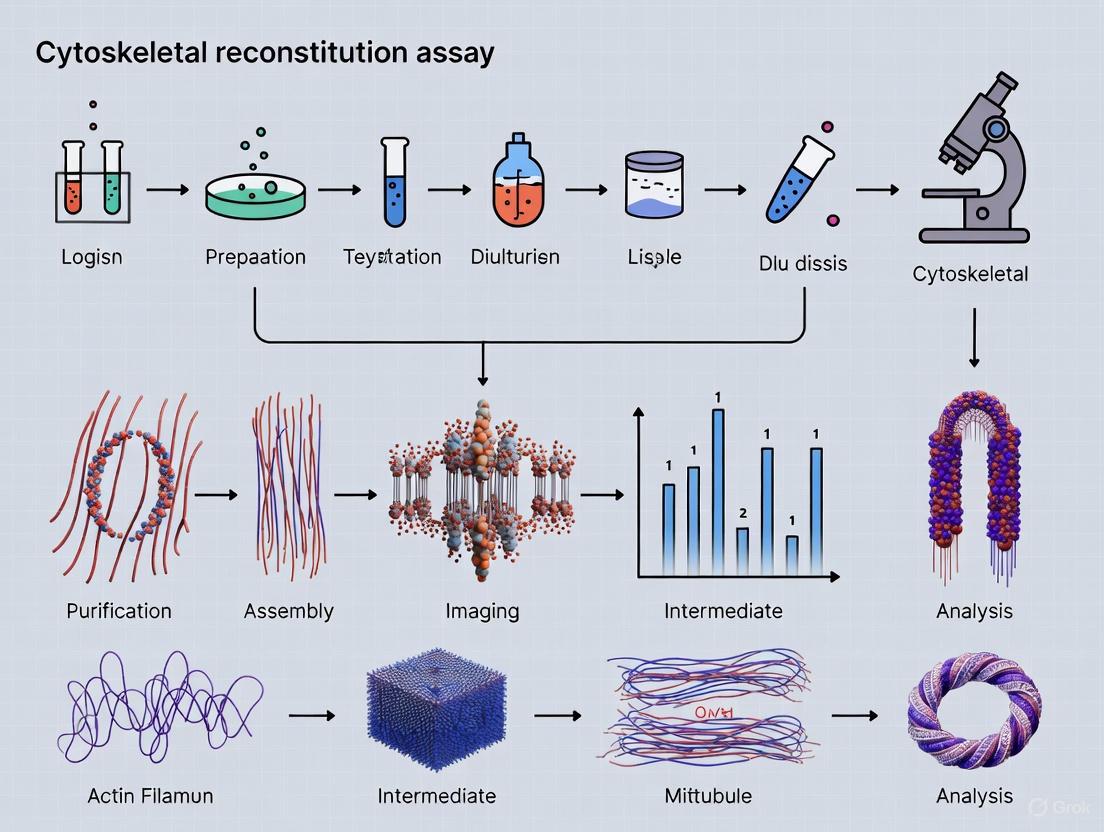
This article provides a comprehensive framework for enhancing the reproducibility of in vitro cytoskeletal reconstitution assays, essential tools for biophysical research and drug development.
Improving Cytoskeletal Reconstitution Assay Reproducibility: From Foundational Principles to Robust Validation
Abstract
This article provides a comprehensive framework for enhancing the reproducibility of in vitro cytoskeletal reconstitution assays, essential tools for biophysical research and drug development. Covering foundational principles, advanced methodological protocols, systematic troubleshooting strategies, and rigorous validation techniques, we address the critical challenge of inter-laboratory variability. By synthesizing recent advances in emergent behavior understanding, context-sensitive factor identification, and novel measurement technologies like QCM-D, this guide empowers researchers to design robust, reliable assays that bridge cell-free studies and cellular physiology for more predictive biomedical applications.
Understanding the Complexity and Reproducibility Challenges in Cytoskeletal Reconstitution
The Fundamental Role of Cytoskeletal Networks in Cellular Mechanics and Dynamics
For researchers investigating cellular mechanics, reconstituted cytoskeletal assays provide an essential window into the fundamental processes that govern cell shape, division, and movement. However, the very dynamic nature of these biopolymer networks—actin, microtubules, and intermediate filaments—presents significant challenges for experimental reproducibility. This technical support guide addresses the most common issues encountered when working with reconstituted cytoskeletal systems, providing troubleshooting guidance framed within the context of improving assay reliability for drug development and basic research. The following sections combine foundational principles with practical protocols to help standardize methodologies across laboratories.
Frequently Asked Questions (FAQs) and Troubleshooting Guides
FAQ 1: Why do my reconstituted cytoskeletal networks show inconsistent mechanical properties between experiments?
Issue: Variability in network mechanics despite using identical protein concentrations and buffer conditions.
Explanation: The mechanical properties of reconstituted cytoskeletal networks are highly dependent on their assembly history and final morphology, not just their biochemical composition. These networks often form under kinetic control and become trapped in metastable states far from thermal equilibrium [1]. The competing kinetics of filament elongation, bundling, and crosslinking can lead to dramatically different network architectures even with the same component proteins [1].
Troubleshooting Guide:
| Problem Area | Possible Cause | Verification Method | Solution |
|---|---|---|---|
| Network Assembly | Inconsistent polymerization kinetics | Dynamic light scattering or fluorescence monitoring | Standardize incubation times and temperatures; pre-polymerize filaments when appropriate |
| Crosslinking | Variable crosslinker binding efficiency | SDS-PAGE or co-sedimentation assay | Titrate crosslinker concentration; ensure consistent mixing during network formation |
| Composite Networks | Steric interference between polymer species | Confocal microscopy | Stagger polymerization times for different cytoskeletal polymers [1] |
| Motor Activity | Uncontrolled myosin activation | ATP consumption assay | Include ATP-regeneration systems; control nucleotide state precisely |
FAQ 2: How can I effectively visualize cytoskeletal structures without altering their native organization?
Issue: Limitations in imaging fidelity when observing cytoskeletal dynamics, particularly in dense networks.
Explanation: Traditional fluorescence labeling can alter filament dynamics and packing, while many label-free techniques lack the resolution for detailed structural analysis. The choice of imaging method must balance resolution, sampling speed, and minimal invasion to preserve native architecture [2] [3].
Imaging Modalities Comparison:
| Technique | Resolution | Advantages | Limitations | Best Applications |
|---|---|---|---|---|
| QWLSI Quantitative Phase Imaging [2] | ~260 nm lateral | Label-free; high-speed (up to 100 fps); works with conventional microscopes | Indirect cytoskeletal visualization | Living cell dynamics; organelle-cytoskeleton interactions |
| Super-resolution SIM [3] | ~110 nm lateral | Multicolor; live-cell compatible; lower phototoxicity | Limited resolution gain; sensitive to aberrations | Actin rings in neuronal axons (MPS); growth cone dynamics |
| Super-resolution STED [3] | ~50-60 nm lateral | High resolution without complex processing; 3D capability | High laser intensities; specific fluorophores required | Dense cytoskeletal arrays; synaptic structures |
| HS-AFM with ML [4] | Single filament | Direct molecular imaging; no labeling required | Surface-limited; specialized equipment | Individual F-actin orientation and branching analysis |
Protocol: Label-Free Cytoskeletal Imaging Using Modified QWLSI [2]
- Cell Preparation: Plate cells on 25 mm type 1.5H glass coverslips at low confluency
- Microscope Setup: Use conventional microscope with halogen Köhler transillumination
- Set illumination numerical aperture to maximum (NAill = 0.52)
- Apply λ = 527±20 nm filter to limit phototoxicity
- Use 100× objective with NAcoll = 1.49
- Image Acquisition: Employ modified Quadriwave Lateral Shearing Interferometry (QWLSI)
- Utilize sCMOS camera at frame rates up to 100 fps
- Average multiple frames to enhance signal-to-noise ratio
- Maintain focus stability with autofocus system
- Data Processing: Measure Optical Path Difference (OPD) and convert to phase information using φ = 2π×OPD/λ
FAQ 3: Why does my actomyosin system show inconsistent contractile behavior?
Issue: Unpredictable contraction patterns in reconstituted actomyosin networks.
Explanation: Actomyosin contractility depends on the precise nucleotide state of both actin and myosin, and is sensitive to the mechanical feedback between these components. Myosin II exhibits a strongly-bound state with actin in the presence of ADP and a weakly-bound state when bound to ATP, with the number of engaged myosin heads directly regulating bundle stiffness [5] [6].
Troubleshooting Guide:
| Symptom | Likely Cause | Diagnostic Test | Corrective Action |
|---|---|---|---|
| No contraction | Depleted ATP | ATP concentration assay | Fresh ATP; include regeneration system |
| Hyper-contraction | Excessive myosin heads | Myosin:actin ratio titration | Optimize to 1:10 to 1:100 molar ratios |
| Inconsistent timing | Variable nucleotide exchange | Nucleotide state monitoring | Control ADP/ATP ratios precisely |
| Network disintegration | Excessive motor forces | Vary crosslinker density | Increase actin-crosslinking protein concentration |
Protocol: QCM-D for Quantifying Actomyosin Viscoelasticity [5] [6]
- Sensor Preparation: Clean quartz crystal sensors; establish baseline frequency (f) and dissipation (D) in buffer
- Actin Immobilization: Flow in F-actin solution (0.1-1 mg/mL in appropriate buffer)
- Monitor frequency decrease (Δf) indicating mass loading
- Stabilize before proceeding (typically 30-60 minutes)
- Myosin Addition: Introduce myosin II filaments (various molar ratios to actin)
- Include required nucleotide (ATP or ADP)
- Include oxygen-scavenging system for prolonged experiments
- Data Collection: Monitor simultaneous changes in Δf (mass/rigidity) and ΔD (viscoelasticity)
- Contraction typically shows increased -Δf and decreased ΔD
- Relaxation shows opposite patterns
- Nucleotide Switching: Exchange buffer to switch between ATP and ADP states observing real-time mechanical changes
Research Reagent Solutions
Essential materials for cytoskeletal reconstitution assays:
| Reagent Category | Specific Examples | Function | Key Considerations |
|---|---|---|---|
| Cytoskeletal Polymers | G-actin, tubulin, vimentin | Network backbone structure | Source purity; polymerization competence; nucleotide state |
| Molecular Motors | Myosin II, kinesin, dynein | Force generation; network remodeling | Activity assays; head domain integrity; regulation |
| Crosslinkers | α-actinin, fascin, MAPs | Network connectivity; mechanics | Binding affinity; density optimization; size |
| Nucleotides | ATP, GTP, ADP, GDP | Polymerization dynamics; motor fuel | Purity; regeneration systems; concentration monitoring |
| Imaging Probes | Phalloidin, SiR-actin, immunolabels | Structural visualization | Labeling efficiency; perturbation effects; photostability |
| Buffer Components | Mg²⁺, K⁺, EGTA, PIPES | Ionic environment; stability | Concentration optimization; temperature sensitivity |
Experimental Design and Quality Control Workflows
Experimental Workflow for Reliable Cytoskeletal Reconstitution
Network Architecture Quality Assessment
Network Quality Assessment Parameters
Frequently Asked Questions: Core Concepts
Q1: What makes cytoskeletal reconstitution assays fundamentally challenging to reproduce? The primary challenge lies in the simultaneous control of a large number of interdependent variables. These include the precise concentrations and purity of multiple proteins (actin, tubulin, motor proteins, crosslinkers), the mechanical and chemical properties of the membrane or surface, and the maintenance of non-equilibrium conditions through energy regeneration systems. Small, often unmeasured, variations in any of these parameters can lead to significantly different experimental outcomes [7] [8].
Q2: Are challenges different for actin-based assays versus microtubule-based assays? While the core principles of reproducibility challenges are similar, the specific components and requirements differ. Actin cortex reconstitution often focuses on contractility and network mechanics, heavily influenced by actin-binding proteins, myosin motors, and membrane tethers [7] [9]. Microtubule assays frequently deal with issues of tubulin purity, post-translational modifications, and the activity of complex motors like dynein [10] [11]. Both require distinct, optimized buffers and energy systems.
Q3: What is the most common source of failure for first-time attempts? The inconsistent quality of purified proteins is a very common pitfall. The activity of proteins like actin, myosin, or tubulin can vary between preparations and is highly sensitive to purification and storage conditions. Using proteins from different purification batches without properly controlling for activity is a major source of irreproducibility [10] [9].
Q4: How can our lab improve the reproducibility of our reconstitution experiments? Implementing rigorous quality control for all components is crucial. This includes functional assays for protein activity (e.g., actin polymerization kinetics, motor ATPase activity), standardizing protocols for surface preparation (e.g., supported lipid bilayers), and using internal controls in every experiment, such as a standard condition with known expected behavior [9] [11].
Troubleshooting Guide: Common Experimental Issues
Problem 1: Inconsistent Actin or Microtubule Network Morphology
- Symptoms: Networks appear too dense, too sparse, or have variable architecture between experiments.
- Potential Causes and Solutions:
| Cause Category | Specific Issue | Troubleshooting Action |
|---|---|---|
| Protein Quality | Aged or improperly stored actin/tubulin aliquots. | Flash-freeze aliquots in liquid nitrogen and store at -80°C; avoid freeze-thaw cycles [9]. |
| Inactive or variable capping protein. | Check capping activity by quantifying actin filament length distributions in presence of the protein [9]. | |
| Concentration & Purity | Contaminants in purified protein affecting nucleation. | Use high-quality affinity purification methods (e.g., TOG affinity for tubulin) and assess purity via SDS-PAGE [10] [9]. |
| Inaccurate concentration measurements. | Use spectrophotometry with corrected extinction coefficients for each protein [9]. | |
| Assembly Conditions | Uncontrolled nucleation seed formation. | Use purified nucleation factors (e.g., Arp2/3 complex) at consistent concentrations or control filament length with capping protein [7]. |
| Oxidized or degraded nucleotides (ATP/GTP). | Always use fresh, high-purity nucleotides in buffers [5]. |
Problem 2: Lack of Expected Contractility or Motor-Driven Transport
- Symptoms: Actomyosin networks do not contract, or cargo transport by kinesin/dynein is inefficient.
- Potential Causes and Solutions:
| Cause Category | Specific Issue | Troubleshooting Action |
|---|---|---|
| Motor Function | Myosin or dynein motor activity is low. | Perform ATPase activity assays; label motors and confirm they bind to filaments [5] [11]. |
| Incorrect nucleotide state for motor binding. | Ensure proper ATP/ADP levels. Myosin II is strongly bound to actin with ADP, and weakly bound with ATP [5]. | |
| System Composition | Incorrect actin/myosin or tubulin/motor ratios. | Systematically titrate the motor protein concentration to find the optimal range for collective behavior [5]. |
| Missing essential co-factors. | For dynein, ensure the presence of dynactin and an activating adaptor (e.g., BicD2N) for full processivity [11]. | |
| Energy Supply | Depleted ATP/GTP in the system. | Include an energy regeneration system (e.g., creatine phosphate/creatine kinase) to maintain constant nucleotide levels [12]. |
Problem 3: Poor Coupling to Membranes or Surfaces
- Symptoms: Cytoskeletal filaments do not tether properly to supported lipid bilayers (SLBs) or vesicles.
- Potential Causes and Solutions:
| Cause Category | Specific Issue | Troubleshooting Action |
|---|---|---|
| Membrane Quality | SLBs are not fluid or contain defects. | Use high-quality small unilamellar vesicles (SUVs) and verify bilayer fluidity via FRAP [9]. |
| Incorrect lipid composition for tethering. | Include a specific lipid for tethering, such as DGS-NTA(Ni²⁺) for His-tagged linker proteins [9]. | |
| Linker Protein | Insufficient concentration of membrane-cytoskeleton linker. | Titrate the concentration of the linker protein (e.g., His-tagged ezrin) to find the minimum required for robust coupling [9]. |
| The linker protein itself is inactive or improperly folded. | Express and purify linker proteins with strict quality control; check function with a binding assay [9]. |
The following workflow diagram outlines the key stages and critical control points for a successful membrane-based cytoskeletal reconstitution, helping to visualize where failures often occur.
The Scientist's Toolkit: Essential Research Reagents
The following table details key materials required for cytoskeletal reconstitution assays, as cited in the literature.
| Reagent/Component | Function in the Assay | Key Considerations & Quality Controls |
|---|---|---|
| Skeletal Muscle Actin [9] | The primary building block for actin filaments; can be fluorescently labeled for visualization. | Label with maleimide dyes, not NHS-esters, to avoid non-functional actin. Determine degree of labeling via spectrophotometry. Store in small, flash-frozen aliquots at -80°C. |
| Tubulin (Mammalian Cell-Derived) [10] | The core protein subunit of microtubules. | Purification from HeLa S3 cells provides unmodified tubulin, avoiding the heterogeneity of brain-derived tubulin. Quality is key for controlled PTM studies. |
| Myosin II [5] [9] | The motor protein that generates contractile force on actin filaments. | Purify from skeletal muscle. Label with maleimide dyes. Functional activity can decrease over time; use within 6 weeks when stored at 4°C. |
| Capping Protein [9] | Binds to the barbed ends of actin filaments to control their length and architecture. | Activity must be checked empirically by measuring its effect on actin filament length distribution in a polymerization assay. |
| Membrane-Actin Linker\n(e.g., His-YFP-EzrinABD) [9] | Tethers the actin network to the supported lipid bilayer, mimicking the natural cortex. | Ensure the linker is stable and functional. Store in small aliquots with 20% glycerol at -80°C for long-term stability. |
| Lipids for SLBs\n(e.g., DOPC, DGS-NTA(Ni²⁺)) [9] | Forms the fluid supported lipid bilayer that serves as the synthetic "membrane." | DOPC provides the bilayer structure. DGS-NTA(Ni²⁺) provides binding sites for His-tagged linker proteins. Prepare fresh SUVs via extrusion. |
| Dynein/Dynactin/Adaptor Complex [11] | The complete motor machinery for minus-end-directed microtubule transport. | Full processive transport requires the tripartite complex of dynein, dynactin, and an activating adaptor like BicD2N. |
| Energy Regeneration System [5] [12] | Maintains a steady supply of ATP (or GTP) to keep the system out of equilibrium. | Critical for sustained motor activity and dynamics. Systems often use creatine phosphate and creatine kinase. |
The relationships between these components in a typical membrane-tethered actin cortex assay are illustrated below.
Troubleshooting Guides & FAQs
Frequently Asked Questions
Q1: Our encapsulated actin structures fail to condense into a single ring and instead form multiple, disorganized clusters. What could be the cause? The most common cause is insufficient membrane binding. Theoretical modeling and experimental data confirm that membrane attachment is crucial for the robust condensation into a single actin ring in spherical vesicles. Ensure you are using an effective membrane anchor system [13].
- Solution: Incorporate a biotin-neutravidin binding system. Use a lipid mixture containing 1% biotinylated lipids and include 4% biotinylated actin in your reaction mix prior to encapsulation. This provides the necessary physical linkage to guide organization [13].
Q2: Actin bundles within our GUVs appear overly stiff and kinked instead of forming smoothly curved structures that follow the membrane. How can this be improved? This is often related to the choice of actin-bundling protein. Different cross-linkers produce bundles with distinct mechanical properties [13].
- Solution: Consider switching the bundling protein. While fascin creates very straight, stiff bundles, proteins like α-actinin or the talin/vinculin combination typically form more flexible bundles that can smoothly follow the membrane curvature [13].
Q3: We observe minimal membrane deformation upon adding myosin motors to our pre-formed actomyosin rings. Why is the system not contracting effectively? This can result from weak coupling between the contractile ring and the membrane. Without a firm anchor, the force generated by myosin is dissipated instead of deforming the vesicle [13].
- Solution: Reinforce the membrane-actin linkage. The talin/vinculin bundling system also functions as a powerful membrane anchor. Using this system can significantly improve force transmission, leading to visible furrow-like deformations during contraction [13].
Q4: Our protein encapsulation efficiency in GUVs is low and inconsistent, harming experiment reproducibility. What methods can improve this? Traditional encapsulation methods are a known challenge. The field has developed advanced techniques to overcome this hurdle [13].
- Solution: Adopt the continuous droplet interface crossing encapsulation (cDICE) method. This technique has been optimized for high-yield and reproducible encapsulation of functional proteins, including complex mixtures of actin, bundling proteins, and motors, into cell-sized phospholipid vesicles [13].
Troubleshooting Common Experimental Issues
| Problem | Potential Cause | Recommended Solution |
|---|---|---|
| Low Ring Formation Probability | Ineffective actin-membrane linkage | Implement biotin-neutravidin bridge with 1% biotinylated lipid and 4% biotinylated actin [13] |
| Uncontrolled Actin Gelation | Overly dense, highly cross-linked networks | Titrate down concentrations of bundling proteins (fascin, α-actinin); optimize actin monomer to cross-linker ratio [13] |
| No Contraction with Myosin | Poor force transmission from ring to membrane | Use talin/vinculin as a combined bundling and membrane-anchoring system [13] |
| Irreproducible Network Morphologies | Inconsistent encapsulation of protein components | Utilize cDICE encapsulation methods for higher reproducibility and precision [13] [8] |
| Bundle Curvature Doesn't Match Membrane | Incorrect choice of bundling protein | Replace fascin with α-actinin, VASP, or talin/vinculin for more flexible bundles [13] |
Experimental Protocols & Data
Detailed Protocol: Reconstitution of Contractile Actomyosin Rings
This protocol outlines the methodology for forming membrane-bound actin rings and inducing their contraction within GUVs, based on the work of [13].
1. Key Research Reagent Solutions
| Reagent | Function in the Experiment | Specification / Notes |
|---|---|---|
| G-Actin | Primary structural protein | Polymerizes into filamentous networks (F-Actin) [13] |
| Biotinylated G-Actin | Links filaments to the membrane | Recommend 4% of total actin; binds to neutravidin [13] |
| Biotinylated Lipids | Provides membrane anchor points | Recommend 1% of total lipid composition; binds neutravidin [13] |
| Neutravidin | Molecular bridge | Binds biotin on both actin and lipids, creating a secure link [13] |
| Bundling Proteins | Cross-links actin filaments | Fascin, α-actinin, VASP, or Talin/Vinculin combination [13] |
| Myosin II | Motor protein for force generation | ATP-dependent, drives contraction of the ring structure [13] |
| POPC Lipids | Forms vesicle membrane | Primary lipid for GUV formation [13] |
2. Encapsulation via cDICE
- Prepare the inner aqueous phase containing G-actin (with 4% biotinylated actin), your chosen bundling protein, neutravidin, and myosin in polymerization-compatible buffer.
- Form GUVs using the continuous droplet interface crossing encapsulation (cDICE) method with a lipid film containing POPC and 1% biotinylated lipids. This method ensures efficient co-encapsulation of all components within cell-sized vesicles [13].
3. Actin Polymerization and Ring Formation
- After encapsulation, allow actin to polymerize at room temperature. In the presence of bundling proteins and membrane anchors, the actin will self-organize.
- With membrane binding, the bundles will robustly condense into a single actin ring at the vesicle periphery, a process driven by energy minimization in spherical confinement [13].
4. Induction of Contraction
- Initiate contraction by providing an ATP-containing buffer.
- Upon ATP addition, myosin motors will generate force on the membrane-bound actin ring, leading to ring contraction and local constriction of the vesicle, forming furrow-like deformations [13].
Table 1: Efficacy of Different Actin Bundling Proteins in Ring Formation
| Bundling Protein | Mechanism of Actin Binding | Typical Bundle Morphology | Probability of Single Ring Formation (with membrane anchor) |
|---|---|---|---|
| Fascin | Monomer with two actin-binding sites [13] | Straight, often kinked bundles [13] | Moderate |
| α-Actinin | Dimer that bridges two filaments [13] | Smoothly curved bundles [13] | High |
| Talin / Vinculin | Dimerize and require interaction to bundle [13] | Smoothly curved, membrane-proximal bundles [13] | Very High (Close to 100%) [13] |
| VASP | Tetramer linking up to four filaments [13] | Smoothly curved bundles [13] | High |
Table 2: Impact of Membrane Anchoring on Bundle Properties
| Experimental Condition | Primary Effect on Actin Bundles | Result on Large-Scale Organization |
|---|---|---|
| No Membrane Anchor | Bundles are straight; path is obstructed by membrane [13] | Disorganized clusters; multiple bundle orientations [13] |
| With Membrane Anchor | Bundles adopt the curvature of the membrane [13] | Condensation into a single, cohesive ring structure [13] |
Experimental Workflow Visualization
Workflow for Reconstituting Contractile Actomyosin Rings
The Impact of Assembly Kinetics and Dynamic Arrest on Network Mechanics and Reproducibility
Frequently Asked Questions (FAQs)
Q1: My reconstituted actin networks show inconsistent architecture between experiments, even when using identical biochemical compositions. What could be causing this?
A1: Inconsistent architectures are likely due to variations in assembly kinetics, not your biochemical makeup. The final network morphology is a kinetically determined structure. If the kinetics of actin polymerization vary between experiments—affecting the time window during which filaments are mobile—the resulting architecture will differ. Bundle formation occurs only during a narrow time interval when the filament microenvironment is fluid; any factor altering the speed of polymerization or the onset of dynamic arrest will change the outcome [14] [15].
Q2: Why do I observe thick actin bundles at low F-actin concentrations but only fine meshworks at high concentrations, even with the same cross-linker concentration?
A2: This is a direct consequence of dynamic arrest. Bundle formation requires a fluid microenvironment that permits filament mobility. At high F-actin concentrations (typically above 1.0 µM), the high density of filaments leads to steric entanglements and cross-linking, arresting translational and rotational diffusion. This arrest prevents the alignment and bundling processes, favoring the formation of homogeneous meshworks instead [14].
Q3: How can I control the onset of dynamic arrest in my experiments to achieve a desired network structure?
A3: Control the onset of dynamic arrest by manipulating actin assembly kinetics. The onset of arrest coincides with the point where filament length exceeds the average filament spacing. You can influence this by:
- Controlling Nucleation Density: Using nucleators (e.g., formins, Arp2/3 complex) to adjust initial filament number and length [16].
- Varying Actin Concentration: A higher monomer concentration generally leads to longer filaments and faster dynamic arrest [14].
- Altering Cross-linking Speed: The rate at which cross-linkers are added or become active can shift the balance between bundling and arrest.
Q4: What are the best methods to spatiotemporally control actin polymerization in reconstituted systems to improve reproducibility?
A4: Several methods offer high reproducibility for spatial and temporal control:
- Micropatterning: Creates permanent, static "spots" of nucleation-promoting factors (NPFs) on a passivated surface to generate actin networks of defined shapes and locations [16].
- Protein Photoactivation: Uses light to transiently activate caged actin monomers or motor proteins, offering precise temporal control within a defined illumination area [16].
- Bead-based Reconstitution: Coating beads with NPFs and incubating them with a purified protein mixture leads to reproducible actin comet tail formation, providing a reliable readout of dynamics [16].
Troubleshooting Guides
Problem: Failure to Form Actin Bundles
Issue: Experiments yield only fine meshworks or homogeneous networks instead of the expected bundled architecture.
| Possible Cause | Diagnostic Experiments | Solution |
|---|---|---|
| Overly rapid dynamic arrest | Perform time-lapse imaging to monitor filament mobility. If the fluid phase is very short, bundling may be suppressed. | Reduce the actin monomer concentration or increase nucleator density to create shorter filaments, delaying entanglement [14]. |
| Insufficient cross-linker concentration | Titrate the cross-linker (e.g., α-actinin). Bundle formation follows mass action kinetics and requires a threshold concentration. | Systematically increase cross-linker concentration. For α-actinin, bundled networks typically require >1.0 µM [14]. |
| Filament concentration too high during mixing | When using pre-polymerized F-actin, ensure the final concentration after mixing is permissive for bundling (< 0.5 µM is highly bundled; > 1.0 µM is suppressed) [14]. | Dilute the F-actin stock before adding cross-linker to ensure the final concentration is in the bundling-permissive range. |
Problem: Poor Mechanical Reproducibility in Network Rheology
Issue: Measurements of network stiffness (shear modulus) or viscoelasticity show high variability between samples.
| Possible Cause | Diagnostic Experiments | Solution |
|---|---|---|
| Uncontrolled assembly kinetics leading to different final architectures | Correlate the mechanical measurements with confocal microscopy of the network structure for the same sample. | Standardize the incubation time and temperature for polymerization across all experiments. Allow the network to fully assemble before mechanical testing [14]. |
| Variability in filament length distribution | Use TIRF microscopy to visualize and quantify filament lengths in different preparations [16]. | Use a consistent actin purification and polymerization protocol. Include a gel filtration or centrifugation step to remove aggregates before polymerization. |
Quantitative Data Reference
The following table summarizes key quantitative relationships from foundational studies, which should be used as a reference for diagnosing and troubleshooting experimental outcomes.
Table 1: Key Quantitative Parameters in Actin Network Assembly with α-actinin
| Parameter | Experimental Condition | Observed Architectural Outcome | Citation |
|---|---|---|---|
| α-actinin Concentration | < 0.6 µM | Homogeneous meshwork of entangled filaments | [14] |
| 1.5 - 2.5 µM | Heterogeneous network (bundles embedded in meshwork) | [14] | |
| > 2.5 µM | Network comprised almost entirely of thick bundles | [14] | |
| F-actin Concentration | < 0.5 µM (with 0.6 µM α-actinin) | High density of bundles | [14] |
| > 1.0 µM (with 0.6 µM α-actinin) | Sharp decrease in bundling; fine meshwork | [14] | |
| Actin Polymerization State | 15% polymerized (0.75 µM F-actin) | Maximal rate of new bundle assembly | [14] |
| 40% polymerized (2.0 µM F-actin) | Cessation of new bundle formation | [14] | |
| MSD Scaling Exponent (δ) | δ ≈ 0.8 | Fluid-like microenvironment, permissive for bundling | [14] |
| δ decreases to 0.2 | Viscoelastic solid; dynamic arrest, bundling arrested | [14] |
Standardized Experimental Protocol: Monitoring Kinetics and Architecture
This protocol provides a detailed methodology for correlating actin assembly kinetics with final network architecture, which is critical for ensuring reproducibility.
Objective: To form F-actin networks cross-linked with α-actinin and simultaneously monitor polymerization kinetics, bundle formation, and microenvironment mechanics.
Materials:
- Monomeric (G-) actin (≥ 99% pure, avoid oligomers)
- Smooth muscle α-actinin
- Polymerization buffer (e.g., 1x KMEI: 50 mM KCl, 1 mM MgCl₂, 1 mM EGTA, 10 mM Imidazole pH 7.0)
- Fluorescent phalloidin (e.g., Acti-stain Phalloidin)
- Pyrene-labeled actin (for kinetic assays)
- Polystyrene tracer beads (1 µm diameter, for microrheology)
Method:
- Preparation: Clarify all protein solutions by high-speed centrifugation to preemptively remove aggregates. Keep G-actin on ice.
- Initiation: On ice, mix 5 µM G-actin with varying concentrations of α-actinin (e.g., 0.5 µM, 2.0 µM, 3.0 µM) in polymerization buffer. Include a catalytic amount of pyrene-actin (1-5%) and a dilute suspension of tracer beads.
- Kinetics Measurement: Transfer a portion of the mixture to a spectrofluorometer cuvette. Begin monitoring pyrene fluorescence (excitation 365 nm, emission 407 nm) at 25°C to track the polymerization time course.
- Imaging and Microrheology: Simultaneously, place a droplet of the reaction on a microscope slide and image immediately using time-lapse confocal microscopy.
- Acquire images of fluorescent phalloidin every 30 seconds for at least 60 minutes to visualize bundle formation.
- Acquire high-frame-rate videos (30 fps) of the tracer beads at 60-second intervals to calculate the Mean-Squared Displacement (MSD) and the scaling exponent (δ).
- Quantification:
- From images, calculate the linear bundle density over time using a consistent intensity threshold.
- From bead videos, compute the MSD scaling exponent (δ) to quantify the fluid-to-solid transition of the microenvironment.
- Correlation: Overlay the time courses of actin polymerization (pyrene), bundle density, and MSD exponent to identify the critical window for bundle assembly.
Experimental Workflow and Logical Relationships
The diagram below illustrates the key decision points and relationships that govern the assembly of reconstituted actin networks.
The Scientist's Toolkit: Essential Research Reagents
Table 2: Key Reagent Solutions for Cytoskeletal Reconstitution
| Reagent / Tool | Function / Role | Key Consideration for Reproducibility |
|---|---|---|
| Monomeric (G-) Actin | The fundamental building block for filament polymerization. | Use high-purity, lyophilized, or pre-clarified stocks. Consistency in source and purification is critical. |
| α-actinin | A classic actin cross-linking protein that can form both bundles and meshworks. | Concentration is a primary determinant of architecture. Titrate carefully for desired outcome [14]. |
| Fluorescent Phalloidin | A high-affinity stain for F-actin used for visualization. | Can stabilize filaments and alter dynamics. Use at minimal effective concentrations for live imaging. |
| Pyrene-labeled Actin | A fluorophore-labeled actin used to monitor polymerization kinetics in bulk assays. | The label can slightly alter polymerization kinetics. Use a low, consistent molar ratio (e.g., 5%). |
| Micropatterned Surfaces | Surfaces with defined geometry functionalized with nucleators to control spatial assembly. | Eliminates stochastic nucleation, dramatically improving architectural reproducibility [16]. |
| Nucleation Promoters (e.g., Formins, NPFs) | Proteins that control the rate and location of new filament formation. | Different nucleators produce filaments of different lengths and geometries, directly impacting network mechanics [16]. |
The reconstitution of cytoskeletal processes is a fundamental approach in bottom-up synthetic biology and mechanobiology, aiming to reconstruct complex cellular functions like division and motility from minimal components in vitro [8] [1] [17]. However, these assays are notoriously prone to variability and reproducibility challenges. A primary source of this inconsistency is biological context sensitivity—the profound influence that specific experimental conditions and cellular environments exert on assay outcomes. Unlike purely chemical reactions, cytoskeletal reconstitution involves dynamic, self-organizing systems whose final state is highly dependent on the precise context of their assembly [1]. This technical support center provides targeted guidance to identify, troubleshoot, and control for these contextual variables, thereby enhancing the reliability of your cytoskeletal research.
FAQs: Understanding Core Concepts and Challenges
Q1: What is meant by "biological context sensitivity" in cytoskeletal assays?
Biological context sensitivity refers to the phenomenon where the outcome of a cytoskeletal reconstitution experiment is significantly influenced by specific, often subtle, parameters of the experimental environment. These are not simple "ingredients" but dynamic conditions. Key aspects include:
- Assembly Kinetics: The final structure and mechanical properties of a cytoskeletal network are highly dependent on the rates of filament formation, crosslinking, and bundling, which can trap the network in a non-equilibrium, metastable state [1].
- Molecular Crowding: The presence of macromolecular crowders like Ficoll 70 alters polymerization kinetics, filament persistence length, and the effective concentration of components, drastically impacting the resulting architecture [17].
- Membrane Composition: In vesicle-based reconstitutions, the charge and lipid composition of the membrane (e.g., inclusion of biotinylated or negatively charged lipids) are critical for proper protein binding and spatial patterning, such as with the MinDE system [17].
Q2: Why is my reconstituted actin network exhibiting different mechanical properties between experimental repeats?
This is a classic symptom of uncontrolled context sensitivity. The mechanics of biopolymer networks are not determined solely by their biochemical composition but are intensely sensitive to their formation history.
- Dynamic Arrest: Crosslinked networks like those formed by actin and α-actinin can become dynamically arrested before reaching equilibrium. The final network morphology and mechanics are therefore a snapshot of the kinetic competition between filament elongation and crosslinking at the moment of arrest [1].
- Competing Kinetics: The "race" between filament polymerization and bundling can lead to different structural and mechanical outcomes even with identical final concentrations of proteins [1]. Slight variations in temperature or mixing can thus lead to significant run-to-run variability.
Q3: How does spatial confinement impact cytoskeletal self-organization?
Spatial confinement in cell-sized volumes, such as inside Giant Unilamellar Vesicles (GUVs), is a major contextual factor that guides self-organization.
- Persistence Length vs. Container Size: The size of a confining environment relative to the persistence length of actin filaments influences the preferred architecture. For instance, flexible actin rings are more probable in smaller vesicles (diameter < 15 µm) as bundles assemble at the equator to minimize bending energy [17].
- Emergent Composite Behaviors: In networks with multiple filament types, steric interactions can lead to unexpected outcomes. For example, rapidly forming vimentin intermediate filaments can sterically hinder the crosslinking of slower-forming F-actin, resulting in a weaker composite network than either component alone would suggest [1].
Troubleshooting Guides
Low or No Actin Network Assembly in GUVs
| Symptom | Potential Cause | Recommended Solution |
|---|---|---|
| Poor actin polymerization inside GUVs | Suboptimal internal buffer conditions (salt, pH, ATP levels) for actin polymerization [8] [17]. | Systemically tune the internal buffer to simultaneously support actin (K+, Mg2+, ATP) and other co-encapsulated systems. Use a well-buffered system like 50 mM Tris-HCl, pH 7.5, with 1-2 mM MgCl2 and an ATP-regenerating system. |
| Inconsistent encapsulation | Inefficient loading of protein components during GUV formation [8]. | Utilize the double emulsion transfer method for more efficient and consistent encapsulation of macromolecules [17]. |
| Lack of membrane anchoring | Absence of specific lipids for protein binding. | Incorporate biotinylated lipids (e.g., DOPE-biotin) and neutravidin in the internal solution to link biotinylated actin filaments to the membrane [17]. |
Uncontrolled or Non-Reproducible Spatial Patterning
| Symptom | Potential Cause | Recommended Solution |
|---|---|---|
| Actomyosin bundles form clusters instead of equatorial rings | Lack of a spatial targeting system; bundles slip on the membrane [17]. | Co-encapsulate the bacterial MinDE protein system. MinDE oscillations can drive the diffusiophoretic transport of membrane-bound cargo (like actin) to the vesicle equator, enabling self-organized ring assembly [17]. |
| High variability in ring formation between GUVs | Inconsistent GUV size and internal composition. | Standardize GUV production parameters. Focus analysis on GUVs within a specific size range (e.g., 10-15 µm) where equatorial assembly is more probable [17]. Ensure consistent concentration of crowder (Ficoll 70) to stabilize patterns. |
Inconsistent Mechanical Readouts from Reconstituted Networks
| Symptom | Potential Cause | Recommended Solution |
|---|---|---|
| Large variation in measured network stiffness | Uncontrolled assembly kinetics leading to different dynamically arrested states [1]. | Strictly control the timing and temperature of the polymerization and crosslinking steps. Pre-polymerize actin filaments before adding crosslinkers to separate the kinetics. |
| Unaccounted-for molecular motor activity. | If using myosin II, ensure ATP concentration is well-controlled and specified, as motor activity generates internal forces that dramatically alter network mechanics [1]. | |
| Network behavior deviates from theoretical models | Overlooking emergent behaviors in composite networks. | When reconstituting multi-filament systems, perform control experiments with individual components to baseline their properties. Be aware that steric interactions can dominate over biochemical ones [1]. |
Key Experimental Protocols
Protocol: Co-reconstitution of Actomyosin and MinDE Systems in GUVs for Spatial Patterning
This protocol enables the formation of spatially controlled, contractile actomyosin rings inside lipid vesicles, a key step towards synthetic cell division [17].
Key Workflow Diagram:
Detailed Steps:
Lipid Stock Preparation: Prepare a lipid stock solution in chloroform. A typical membrane composition for this assay includes:
- POPC (1-palmitoyl-2-oleoyl-glycero-3-phosphocholine): The primary phospholipid for membrane structure.
- DOPE-biotin (1,2-dioleoyl-sn-glycero-3-phosphoethanolamine-N-(cap biotinyl)): A small percentage (0.5-1 mol%) to provide biotin handles for membrane anchoring.
- Negatively Charged Lipid (e.g., DOPG): A fraction (5-10 mol%) to facilitate MinD membrane binding and oscillation.
GUV Formation via Double Emulsion Transfer:
- Create a stable water-in-oil-in-water (W/O/W) double emulsion using microfluidic devices or gentle agitation.
- The inner aqueous phase contains the entire reaction mix to be encapsulated. The oil phase contains the dissolved lipids.
- Transfer the double emulsion across an oil-water interface to form the final GUVs in an external buffer.
Internal Solution Preparation: The inner aqueous phase must contain:
- Proteins: G-Actin (~5-10 µM), fascin (molar ratio 0.25-0.5 fascin/actin), myosin II, MinD, MinE.
- Energy and Ions: ATP (1-2 mM), MgCl₂ (1-2 mM).
- Crowding Agent: Ficoll 70 (1-2% w/v) to mimic cytoplasmic crowding and accelerate kinetics.
- Buffer: 50 mM Tris-HCl, pH 7.5, with 50 mM KCl.
Incubation and Imaging:
- Allow the encapsulated system to incubate at room temperature or 25-30°C for several hours to allow for actin polymerization and MinDE pattern formation.
- Image using confocal or fluorescence microscopy.
- Phenotype Quantification: Systematically score the resulting actin architectures (soft webs, asters, flexible rings, stiff bundles) and their correlation with GUV size and the presence of Min proteins [17].
Protocol: Building a Mechanically Robust Crosslinked Actin Network
This protocol outlines the formation of a simple crosslinked F-actin network for mechanical testing, highlighting steps to ensure reproducibility.
Key Workflow Diagram:
Detailed Steps:
Pre-polymerization of Actin: First, polymerize G-Actin (e.g., 2-4 µM) in F-buffer (e.g., 2 mM Tris-HCl, pH 8.0, 0.2 mM ATP, 0.5 mM DTT, 0.1 mM CaCl₂, 1 mM MgCl₂, 50 mM KCl) for 1 hour at room temperature. This creates a consistent starting pool of filaments.
Controlled Crosslinking: Add the crosslinker (e.g., α-actinin at a molar ratio of 1:100 to 1:10 crosslinker:actin) to the pre-polymerized F-actin. Mix gently and thoroughly by pipetting. Note: The timing of this step is critical, as network evolution halts upon crosslinking [1].
Quiescent Incubation: Allow the mixture to incubate without disturbance for a defined period (e.g., 30 minutes) at a controlled temperature. This allows the network to form and reach its dynamically arrested state.
Mechanical Testing: Load the sample into a rheometer or other mechanical testing device for characterization. Note that the network's strain-stiffening behavior is a product of its non-equilibrium structure [1].
The Scientist's Toolkit: Research Reagent Solutions
| Reagent / Material | Function in Cytoskeletal Reconstitution | Key Considerations for Robustness |
|---|---|---|
| Ficoll 70 [17] | Macromolecular crowder that mimics cytoplasmic conditions, accelerates actin polymerization, and alters MinDE oscillation dynamics. | Lot-to-lot consistency is critical. Concentration must be optimized and rigorously reported, as it directly impacts reaction kinetics and network morphology. |
| Biotinylated Lipids (e.g., DOPE-biotin) [17] | Provides anchor points in the membrane for neutravidin, which in turn binds biotinylated cytoskeletal proteins, linking the network to the membrane. | Maintain a low, consistent molar percentage (0.5-1%) in the lipid mixture. Avoid higher concentrations that might disrupt membrane fluidity or integrity. |
| Neutravidin [17] | A deglycosylated variant of avidin that forms a strong, stable bridge between biotinylated lipids on the membrane and biotinylated actin filaments. | Add from a fresh, single-use aliquot to a final concentration of ~0.1 µM. Multiple freeze-thaw cycles can reduce activity. |
| Fascin [17] | Actin-bundling protein that organizes individual actin filaments into higher-order, rigid bundles necessary for constructing ring scaffolds. | The fascin/actin molar ratio (e.g., 0.25 vs. 0.5) dictates bundle flexibility and final architecture (webs vs. rings vs. stiff bundles) and must be optimized and fixed [17]. |
| MinD / MinE Proteins [17] | A bacterial reaction-diffusion system that self-organizes on membranes. When reconstituted, it can provide spatial control for positioning membrane-bound cargo like actin rings. | Requires negatively charged membranes (e.g., with DOPG) and ATP. Oscillation patterns are sensitive to protein ratios, temperature, and crowder concentration. |
| Polydiacetylene (PDA) Fibrils [18] | A synthetic, polymerizable nanomaterial that can mimic a cytoskeleton, providing mechanical support and regulating membrane dynamics in synthetic cells. | Hydrophobicity can be tuned to position the fibrils either at the membrane lumen or in the internal lumen, dictating their functional role [18]. |
Advanced Protocols for Reproducible Cytoskeletal Network Assembly and Characterization
Engineering Tunable 3D Composite Actin-Microtubule Networks with Motor Proteins
Frequently Asked Questions & Troubleshooting Guide
This technical support resource is designed to help researchers overcome common challenges in reconstituting 3D composite cytoskeletal networks, directly supporting enhanced reproducibility in cytoskeletal reconstitution assays.
FAQ 1: My composite network collapses or fails to form a 3D structure. What could be wrong?
- Problem: The composite network lacks sufficient mechanical integrity or cross-linking.
- Solutions:
- Verify cross-linker concentration: Too few cross-linkers will not stabilize the network, while too many can make it too rigid and brittle. Perform a titration series.
- Check filament length: Short filaments may not form an interconnected network. Use high-speed centrifugation to remove short actin filaments and polymerize microtubules to a stable length.
- Confirm crowding agents: The presence of molecular crowders like Ficoll or dextran is often essential to mimic cellular conditions and promote network formation [18] [8]. A typical starting concentration is 2% w/v.
- Optimize ionic strength: Adjust the Mg²⁺ and K⁺ concentration in your buffer, as ions significantly affect filament bundling and cross-linker binding affinity.
FAQ 2: I am not observing the expected motor protein activity or cargo transport. How can I troubleshoot this?
- Problem: Motor proteins are inactive, or the network architecture hinders motility.
- Solutions:
- Validate motor protein activity: First, confirm motor function in a simple, single-filament gliding assay before moving to complex 3D networks.
- Ensure proper fuel levels: Maintain a constant ATP-regeneration system (e.g., Phosphocreatine and Creatine Phosphokinase) in your buffer to prevent ATP depletion during long experiments [19].
- Check network mesh size: A mesh size smaller than the motor protein itself can sterically hinder movement. If the network is too dense, dilute the actin/microtubule concentration. Reconstitution in cell-sized compartments can exacerbate issues with component availability, so efficient recycling of critical factors is essential [8].
- Confirm co-localization: Verify that your motor proteins are successfully binding to both filament types. Use fluorescently labeled motors to ensure they are present at actin-microtubule intersections.
FAQ 3: My network structure is highly variable between experiments, leading to poor reproducibility.
- Problem: Uncontrolled polymerization or inconsistent initial conditions.
- Solutions:
- Standardize protein quality: Use fresh or properly snap-frozen aliquots of proteins. Always perform a quality control check (e.g., SDS-PAGE, polymerization test) for each new batch.
- Control nucleation seeds: For microtubules, use stable seeds (e.g., GMPCPP-stabilized seeds) to initiate growth from a defined number of points. For actin, consider using nucleating proteins like formin or the Arp2/3 complex to control architecture.
- Pre-form filaments separately: Polymerize actin and microtubules separately under optimal conditions before gently mixing them for network assembly. This provides greater control over the initial state.
- Document buffer conditions meticulously: Small variations in pH, temperature, and reducing agents (like DTT) can drastically impact dynamics. Record all parameters.
Quantitative Parameters for Network Assembly
Table 1: Common Stock Solutions for Reconstitution Assays [19]
| Reagent | Typical Stock Concentration | Storage | Function |
|---|---|---|---|
| ATP (disodium salt hydrate) | 50 mM | -80°C | Energy source for motor proteins and actin polymerization |
| d-Glucose | 1 M (filtered) | -80°C | Component of oxygen-scavenging system |
| G-actin (unlabeled/labeled) | ≥ 48 µM | -80°C | Building block for actin filaments (F-actin) |
| Tubulin (unlabeled/labeled) | 5-10 mg/mL | -80°C | Building block for dynamic microtubules |
| Paclitaxel (Taxol) | 1-10 mM | -20°C | Stabilizes microtubules, suppresses dynamic instability |
Table 2: Ranges of Key Network Components for Tunable Properties
| Component | Typical Concentration Range | Effect of Increasing Concentration |
|---|---|---|
| Actin | 1 - 10 µM | Increases network density, decreases mesh size. |
| Microtubules | 0.5 - 5 µM (tubulin) | Adds stiffness and compressive strength. |
| Cross-linker (e.g., Spectraplakin) | 10 - 100 nM | Increases network connectivity and viscoelasticity. |
| Molecular Crowder (e.g., Ficoll 70) | 0.5 - 3% w/v | Promotes volume exclusion, enhances polymerization, and compactness. |
Experimental Protocols
Core Protocol: In Vitro Reconstitution of Dynamic Microtubules with Pre-formed Actin Networks
This protocol is adapted from established methods for studying steric interactions between cytoskeletal filaments [20] [19].
Key Reagents & Function:
- G-actin: Monomeric actin, the building block for filaments.
- Tubulin: Heterodimeric protein that polymerizes to form microtubules.
- Paclitaxel (Taxol): Microtubule-stabilizing drug.
- ATP: Energy source for actin polymerization and motor proteins.
- BRB80 Buffer: Standard buffer for microtubule work (80 mM PIPES, 1 mM MgCl₂, 1 mM EGTA, pH 6.8 with KOH).
Step-by-Step Method:
Flow Cell Preparation:
- Use thoroughly cleaned and functionalized glass coverslips. A common method is to incubate with a solution of 0.5 mg/mL biotin-BSA for 5-10 minutes, followed by a wash and incubation with 0.2 mg/mL NeutrAvidin.
- Assemble the flow cell with a spacer (e.g., double-sided tape) to create a chamber of ~10 µL volume.
Actin Network Assembly:
- Polymerize actin filaments separately by adding F-actin buffer to G-actin and incubating for 30-60 minutes at room temperature.
- To create specific actin architectures (e.g., bundled or isotropic networks), include cross-linkers like fascin during polymerization.
- Introduce the pre-formed F-actin network into the flow chamber and allow it to adsorb to the functionalized surface for 5-15 minutes.
Microtubule Polymerization & Introduction:
- Mix tubulin with a low ratio of fluorescently labeled tubulin in BRB80 buffer containing 1 mM GTP.
- Incubate the mixture on ice to prevent premature polymerization.
- Introduce the tubulin mix into the flow cell and transfer it to a heated chamber (typically 35-37°C) on the microscope stage to initiate microtubule polymerization within the actin network.
Imaging and Data Acquisition:
- Use TIRF or confocal microscopy to simultaneously image both networks using different fluorescence channels.
- Record time-lapse videos to monitor microtubule dynamic instability and its interaction with the actin network.
Workflow: Composite Network Reconstitution
Pathway: Motor Protein Interaction at Intersections
The Scientist's Toolkit: Research Reagent Solutions
Table 3: Essential Reagents for Cytoskeletal Reconstitution
| Reagent / Material | Key Function | Example & Notes |
|---|---|---|
| Biotinylated BSA & NeutrAvidin | Creates a functionalized surface in flow cells to anchor and organize filaments. | Essential for controlling network geometry and immobilization. |
| Stabilized Microtubule Seeds | Provides defined nucleation points for controlled microtubule growth. | Seeds polymerized with non-hydrolyzable GTP analogs (e.g., GMPCPP). |
| Oxygen Scavenging System | Reduces photobleaching and radical damage during fluorescence imaging. | Commonly used: Glucose Oxidase, Catalase, and d-Glucose. |
| ATP-Regeneration System | Maintains constant ATP levels for sustained motor protein and actin dynamics. | Critical for long-term experiments; uses Phosphocreatine and Creatine Phosphokinase. |
| Engineered Cross-linkers | Mediates specific interactions between actin and microtubules. | e.g., purified Spectraplakin domains or synthetic cross-linkers. |
Scientist's Toolkit: Research Reagent Solutions
Table 1: Essential reagents for cytoskeletal reconstitution in GUVs and droplets.
| Reagent Name | Function / Purpose | Key Characteristics |
|---|---|---|
| Actin Proteins [16] | Primary structural filament network formation. | Ubiquitous eukaryotic protein; polymerizes into dynamic filaments; forms various architectures with binding proteins. |
| Nucleation-Promoting Factors (NPFs) [16] | Spatially control the initiation of actin polymerization. | Often coated on beads or patterns; activate complexes like Arp2/3 to generate branched actin networks. |
| Lipids for GUVs [16] [18] | Form the primary membrane structure of Giant Unilamellar Vesicles. | Phospholipids self-assemble into a lipid bilayer, providing a biomimetic boundary. |
| Terpolymer Membrane [18] | Stabilize coacervate droplets or complex interfaces. | Forms a semi-permeable layer around coacervates, mimicking the cell membrane's barrier function. |
| Polydiacetylene (PDA) Fibrils [18] | Serve as an artificial, biomimetic cytoskeleton. | Nanometer-sized semi-flexible fibrils that form viscoelastic, entangled networks; can be functionalized. |
| Quaternized Amylose (Q-Am) [18] | Facilitate formation of crowded coacervate droplets and bundle anionic fibrils. | Positively charged polymer; used in coacervation and to aggregate negatively charged PDA fibrils via electrostatic interactions. |
Troubleshooting Guide: Frequently Asked Questions (FAQs)
FAQ 1: How can I achieve spatial control over actin network formation inside a confinement?
Answer: Achieving spatial control is crucial for mimicking cellular asymmetry. The main techniques involve patterning the activation sites for actin polymerization.
- Using Functionalized Beads: Coat microbeads with a Nucleation-Promoting Factor (NPF) and introduce them into your protein mixture. Actin comet tails will grow specifically from the bead surface, propelling it forward. This also provides a direct readout of actin dynamics [16].
- Employing Micropatterned Surfaces: Create defined "spots" of actin nucleation on a passivated surface using micropatterning. This technique localizes NPFs to generate branched actin networks of specific shapes and in controlled locations, either in 2D or 3D [16]. For membrane-proximal studies, this can be combined with lipid bilayers [16].
- Utilizing Protein Photoactivation: For transient and highly controllable activation, use photoactivatable actin monomers or motor proteins. The timing and the area of illumination define the activation, allowing for dynamic control over where the network forms [16].
FAQ 2: My encapsulated actin structures are unstable or fail to form. What are the critical parameters to check?
Answer: Instability often stems from issues with the internal environment or component availability. Focus on these parameters:
- Confirm Confinement Integrity: Ensure your GUVs or droplets are stable and do not rupture during the experiment. The membrane composition (e.g., lipid ratios, use of a stabilizing terpolymer) is critical for maintaining the encapsulated environment [18].
- Verify Component Activity and Concentration: The concentrations of actin, NPFs, and other actin-binding proteins must be optimized and verified to be active. Remember that in a confined space, the number of molecules is limited, and global depletion can significantly impact network dynamics and long-term maintenance [16].
- Mimic Cytosolic Crowding: The cell interior is highly crowded. Use crowding agents like dextran, Ficoll, or coacervates based on charged amylose derivatives (Q-Am/Cm-Am) to mimic this environment. Crowding affects diffusivity and biomolecular interactions, which is essential for proper actin network behavior [16] [18].
- Ensure Energy Availability: Actin dynamics are energy-dependent. Maintain an adequate concentration of ATP (or its regeneration system) in your buffer to fuel the polymerization and motor protein activity [16].
FAQ 3: How can I characterize the mechanical properties of the reconstituted cytoskeleton inside a confinement?
Answer: Traditional microscopy shows structure, but quantifying mechanics requires specialized techniques.
- Quartz Crystal Microbalance with Dissipation (QCM-D): This is a powerful technique to measure viscoelastic changes in reconstituted actomyosin systems in real-time. It detects changes in resonance frequency (Δf, related to mass) and energy dissipation (ΔD, related to rigidity/viscosity), allowing you to probe the network's response to perturbations like nucleotide state or binding proteins [6].
- Analysis of Bead Motility: When using NPF-coated beads, the movement itself is a readout of actin dynamics. You can quantitatively measure the speed, persistence, and size of the actin comet tail using fluorescence microscopy as indicators of network health and activity [16].
Experimental Protocols
Protocol 1: Reconstitution of an Artificial Cytoskeleton in Membrane-Stabilized Coacervates
This protocol details the creation of a biomimetic cytoskeleton using polydiacetylene (PDA) fibrils inside a synthetic cell platform [18].
1. Preparation of PDA Fibrils:
- Design: Use diacetylene (DA) monomers with carboxylate end groups to enable electrostatic uptake and bundling. Mix with a small fraction (e.g., 10%) of DA monomers functionalized with azide or DBCO groups for post-assembly scaffolding.
- Polymerization: Irradiate the DA monomer solution with ultraviolet light (λ = 254 nm) for approximately 35 minutes. Monitor the polymerization by ultraviolet-visible spectroscopy, where an increase in absorption in the visible spectrum (400–700 nm) indicates the formation of conjugated polymers. Verify fibril formation and dimensions using cryogenic Transmission Electron Microscopy (cryo-TEM).
2. Formation of Coacervate Droplets:
- Mix an excess of positively charged Quaternized Amylose (Q-Am) with negatively charged Carboxymethylated Amylose (Cm-Am) to form coacervates via complex coacervation.
3. Integration of the Artificial Cytoskeleton:
- Add the pre-formed PDA fibrils to the coacervate mixture. The negatively charged carboxylate groups on the PDA will electrostatically interact with the positively charged Q-Am, leading to the bundling of nanometre-sized fibrils into micrometre-sized entangled networks observable via Confocal Laser Scanning Microscopy (CLSM).
- To stabilize the coacervates and control PDA localization, add a terpolymer that forms a semi-permeable membrane at the coacervate interface.
4. Controlling Cytoskeleton Localization:
- For a membrane-associated cytoskeleton, use PDA fibrils co-assembled from 90% carboxylate-terminated DA and 10% DBCO-functionalized DA. The hydrophobic DBCO moiety will drive association with the terpolymer membrane.
- For a luminal/cytoplasmic cytoskeleton, use PDA fibrils co-assembled from 90% carboxylate-terminated DA and 10% azide-functionalized DA. The more hydrophilic azide groups will keep the network distributed inside the coacervate lumen.
Protocol 2: Measuring Emergent Mechanics with QCM-D
This protocol uses QCM-D to detect viscoelastic changes in a reconstituted actomyosin bundle system [6].
1. Sensor Surface Preparation:
- Clean the QCM-D sensor crystals according to manufacturer protocols. Functionalize the sensor surface to promote the attachment of actin filaments or pre-formed bundles.
2. Baseline Establishment:
- Flow an appropriate buffer through the QCM-D chamber until stable baseline readings for both frequency (f) and dissipation (D) are achieved.
3. Sample Measurement:
- Introduce the reconstituted actomyosin bundle sample into the chamber.
- Monitor the changes in frequency (Δf) and dissipation (ΔD) in real-time. A decrease in Δf indicates mass accumulation on the sensor, while an increase in ΔD indicates the formation of a more dissipative (softer, more viscous) layer.
- To probe mechanical feedback, introduce perturbations such as:
- Different nucleotide states (e.g., ATP vs. ADP).
- Varying concentrations of actin-binding or crosslinking proteins.
- Changes in ionic strength to alter network stiffness.
4. Data Interpretation:
- Correlate the Δf and ΔD shifts with the biochemical perturbations. A stiffer, more elastic network will typically show a smaller increase in dissipation for a given frequency shift, while a softer, more viscous network will show a larger dissipation increase.
Data Presentation
Table 2: Quantitative analysis of color contrast for visualization elements, based on WCAG guidelines. This ensures diagrams are accessible and legible for all users [21] [22].
| Foreground Color | Background Color | Contrast Ratio | WCAG AA Rating (Text) | WCAG AAA Rating (Text) |
|---|---|---|---|---|
| #4285F4 (Blue) | #FFFFFF (White) | 4.5:1 | Pass (Large) | Fail |
| #EA4335 (Red) | #FFFFFF (White) | 4.2:1 | Pass (Large) | Fail |
| #FBBC05 (Yellow) | #202124 (Dark Gray) | 12.4:1 | Pass | Pass |
| #34A853 (Green) | #FFFFFF (White) | 3.2:1 | Fail | Fail |
| #5F6368 (Mid Gray) | #FFFFFF (White) | 6.3:1 | Pass | Pass |
| #202124 (Dark Gray) | #F1F3F4 (Light Gray) | 12.1:1 | Pass | Pass |
Experimental Workflow and Signaling Visualization
Workflow for GUV Reconstitution
Actin-Myosin Force Feedback Mechanism
Optimizing Co-organization of Multiple Filament Systems Through Cytolinkers and Crosslinkers
Troubleshooting Guide: Common Experimental Issues and Solutions
Researchers often encounter specific challenges when reconstituting multi-filament systems. The table below outlines common problems, their potential causes, and recommended solutions to improve experimental reproducibility.
| Problem Observed | Possible Cause | Solution |
|---|---|---|
| Failed cytoskeletal co-localization | Incorrect stoichiometry of cytolinker to filament | Titrate cytolinker concentration; for anillin, use 5-50 nM as a starting range [23]. |
| Poor network formation in synthetic cells | Insufficient electrostatic driving force for bundling | Ensure presence of oppositely charged polyelectrolytes (e.g., Q-Am for anionic PDA fibrils) [18]. |
| Unspecific aggregation | Cytolinker concentration too high, leading to nonspecific oligomerization | Optimize concentration; use mass photometry to confirm cytolinker is monomeric in solution prior to introduction [23]. |
| Lack of defined cytoskeletal positioning | Missing polarity/hydrophobicity cues in artificial cytoskeleton | Functionalize fibrils with terminal groups (e.g., 10% DBCO for membrane association, 10% azide for lumen distribution) [18]. |
| Inconsistent binding or crosslinking efficiency | Uncontrolled filament dynamics or incorrect nucleotide state | Use stable GTP-state microtubule seeds (GMPCPP) or taxol-stabilized microtubules for more reliable cytolinker binding [23]. |
Frequently Asked Questions (FAQs)
Q1: What are the key advantages of using a reconstituted system to study cytolinkers like anillin?
Reconstituted systems allow for the precise study of specific cytolinker interactions without interference from the many other binding partners present in a cellular environment. This enables researchers to definitively establish direct binding capabilities, such as confirming that anillin can directly crosslink microtubules and actin filaments and mediate their sliding, independent of other cellular factors [23].
Q2: How can I control the spatial organization of an artificial cytoskeleton within a synthetic cell?
Spatial organization can be engineered by tuning the hydrophobicity of the cytoskeletal elements. For instance, polydiacetylene (PDA) fibrils functionalized with hydrophobic groups (like DBCO) will localize to the membrane of a coacervate-based synthetic cell. In contrast, fibrils with hydrophilic groups (like azide) will remain distributed throughout the internal lumen, allowing for the creation of distinct cytoskeletal architectures [18].
Q3: My cytolinker does not bundle filaments as expected. What should I check?
First, verify the presence of necessary co-factors. Some cytolinkers require the presence of a charged polymer to facilitate hierarchical assembly. For example, negatively charged PDA fibrils only form micron-sized bundles upon the addition of a positively charged polymer like Q-Am or poly(L-lysine). This bundling does not occur with neutral or negatively charged polymers [18]. Second, confirm the nucleotide state of your filaments, as some cytolinkers, like anillin, show a strong binding preference for GTP-state microtubules over GDP-state lattices [23].
Q4: What are the best practices for visualizing and quantifying interactions in these assays?
Total internal reflection fluorescence (TIRF) microscopy is a highly effective method for directly observing interactions such as diffusive binding, tip-tracking, and crosslinking in real-time [23]. To quantify encapsulation efficiency and spatial distribution within synthetic cell platforms, confocal laser scanning microscopy (CLSM) combined with line profile fluorescence measurements is recommended [18].
Experimental Protocols for Key Assays
Protocol 1: In Vitro Reconstitution of Anillin-Mediated Microtubule-Actin Crosslinking
This protocol is adapted from research demonstrating anillin's direct crosslinking function [23].
- Microscope Preparation: Passivate a glass coverslip flow chamber to prevent non-specific protein adhesion.
- Microtubule Assembly: Introduce tubulin along with stabilised GMPCPP microtubule seeds into the chamber and allow for dynamic microtubule growth.
- Filament Introduction: Introduce fluorescently labelled F-actin into the chamber.
- Initiate Crosslinking: Flow in a solution containing full-length human anillin (isoform 2, 5-50 nM) and image immediately using TIRF microscopy.
- Data Analysis: Quantify parameters such as binding frequency, diffusion coefficients, and the occurrence of actin filament sliding on microtubules.
Protocol 2: Integrating a Biomimetic Cytoskeleton into Synthetic Cells
This protocol outlines the creation of a functionalized artificial cytoskeleton inside membrane-stabilized coacervates [18].
- Fibril Polymerization: Synthesize polydiacetylene (PDA) fibrils by co-assembling diacetylene monomers (90% carboxylate-terminated, 10% azide- or DBCO-terminated) and polymerize them using UV light (254 nm) for ~35 minutes. Verify polymerization by ultraviolet-visible spectroscopy.
- Coacervate Formation: Form coacervate droplets by mixing a positively charged polymer and a negatively charged polymer.
- Cytoskeleton Integration: Incubate the pre-formed PDA fibrils with the positively charged polymer component to trigger bundle formation, then mix to form the coacervates. The fibrils will be efficiently taken up.
- Membrane Stabilization: Add a terpolymer to the coacervate solution to form a semi-permeable membrane at the interface.
- Validation: Use confocal microscopy to confirm the localization of the cytoskeleton (PDA-M at the membrane, PDA-L in the lumen).
Essential Research Reagent Solutions
The table below lists key materials used in the featured experiments for cytoskeletal reconstitution.
| Reagent / Material | Function / Application |
|---|---|
| Full-length human anillin (isoform 2) | Directly crosslinks microtubules and actin filaments; enables filament sliding and transport [23]. |
| Polydiacetylene (PDA) fibrils | Serves as a synthetic, biomimetic cytoskeleton; provides mechanical support and regulates membrane dynamics in synthetic cells [18]. |
| Carboxylate-terminated Diacetylene | Enables electrostatic uptake of fibrils into positively charged compartments and facilitates bundling via polyelectrolyte interactions [18]. |
| DBCO-functionalized Diacetylene | Provides hydrophobic handle for spatial control, localizing the artificial cytoskeleton to the synthetic cell membrane [18]. |
| Azide-functionalized Diacetylene | Provides hydrophilic handle for spatial control, maintaining the artificial cytoskeleton within the internal lumen of the synthetic cell [18]. |
| Quaternized Amylose (Q-Am) | Positively charged polyelectrolyte used in coacervate formation; also acts as a bundling agent for anionic PDA fibrils [18]. |
| GMPCPP-tubulin | Forms stabilized microtubule seeds for reconstitution assays; provides a preferred binding lattice for cytolinkers like anillin [23]. |
Experimental Workflow and Cytolinker Function
The following diagrams illustrate the core experimental workflow and mechanism of action for a key cytolinker.
Diagram 1: Core experimental workflow for in vitro reconstitution of cytolinker-mediated filament interactions.
Diagram 2: Anillin functions as a direct cytolinker, forming oligomers on microtubules to crosslink them with actin filaments [23].
Diagram 3: Controlling artificial cytoskeleton localization in synthetic cells by tuning fibril hydrophobicity [18].
Fluorescence Labeling Strategies for Multi-Spectral Visualization of Composite Dynamics
A robust and reproducible cytoskeletal reconstitution assay is foundational for research in cell mechanics, drug discovery, and synthetic biology. These assays allow researchers to dissect the complex behaviors of actomyosin networks, such as contraction and ring formation, in a controlled environment. Central to the success of these experiments is the effective use of multi-spectral fluorescence labeling, which enables the simultaneous visualization of multiple dynamic components—such as actin, myosin, cross-linkers, and membranes—within a synthetic cell. This technical support center is designed to help you overcome common challenges in labeling, thereby improving the reproducibility and quantitative output of your research. The following guides and protocols are framed within the context of advanced cytoskeletal reconstitution, drawing from cutting-edge methods in bottom-up synthetic biology [24] [18].
Research Reagent Solutions: Core Components for Reconstitution Assays
The table below details essential reagents for building and visualizing a minimal cytoskeletal system inside lipid vesicles or synthetic compartments.
Table 1: Key Reagents for Cytoskeletal Reconstitution and Visualization
| Reagent Category | Specific Example(s) | Function in the Assay | Key Considerations |
|---|---|---|---|
| Actin & Associated Proteins | G-actin, Fascin, α-Actinin, Talin/Vinculin complex, VASP | Forms the primary filamentous network; cross-linkers dictate bundle architecture (e.g., straight vs. curved bundles) [24]. | Protein purity and activity are critical. Different bundlers create structurally distinct networks. |
| Membrane Anchor System | Biotinylated lipids, Biotinylated G-actin, Neutravidin | Links the actin cytoskeleton to the lipid membrane via a high-affinity biotin-neutravidin bridge, promoting ring assembly [24]. | Optimal concentrations (e.g., 1% biotinylated lipid, 4% biotinylated actin) are key for efficient binding without disrupting polymerization. |
| Motor Proteins | Myosin II (or similar) | Generates contractile forces on actin networks, leading to ring constriction and membrane deformation [24]. | ATP concentration must be optimized to drive motor activity. |
| Fluorescent Labels | SiR-Actin/Tubulin kits, Fluorogenic HaloTag/SNAP-tag substrates (e.g., JF525, JF669), Self-labeling tags (HaloTag, SNAP-tag) | Enable specific, high-contrast visualization of target proteins. Fluorogenic probes remain dark until bound, minimizing background [25] [26]. | Match the fluorophore's photostability and wavelength to your microscopy modality (e.g., STED, live-cell tracking). |
| Encapsulation Machinery | Giant Unilamellar Vesicles (GUVs), cDICE apparatus | Provides cell-sized spherical confinement for reconstituting cytoskeletal processes [24]. | Encapsulation efficiency is a major variable; cDICE improves reproducibility. |
Experimental Protocols: Core Methodologies for Reproducible Assays
Protocol: Reconstitution of a Contractile Actomyosin Ring in GUVs
This protocol is adapted from advanced bottom-up synthetic biology approaches for studying division machinery [24].
Key Materials:
- G-actin (from commercial source, stored in G-buffer)
- Actin bundling protein (e.g., Fascin, α-Actinin, or Talin/Vinculin)
- Biotinylated G-actin (typically 4% of total actin)
- Neutravidin
- Myosin motors (e.g., Myosin II)
- Lipids: POPC with 1% biotinylated lipid
- cDICE apparatus for encapsulation
Step-by-Step Method:
- Vesicle Formation: Form Giant Unilamellar Vesicles (GUVs) from a lipid mixture of POPC and 1% biotinylated lipid using the cDICE method. This method efficiently encapsulates large biomolecules like proteins.
- Sample Preparation: In parallel, prepare the internal reaction mix containing:
- G-actin (with 4% biotinylated actin)
- Selected actin bundling protein
- Neutravidin (to bridge biotinylated actin and lipids)
- ATP and polymerization buffer components
- Encapsulation: Use the cDICE method to encapsulate the reaction mix from Step 2 within the GUVs from Step 1. The precise composition of the initial mix is crucial, as components cannot be added later.
- Polymerization and Assembly: Allow the encapsulated actin to polymerize. The combination of confinement, cross-linking, and membrane binding will promote the condensation of actin into a single ring-like structure at the vesicle membrane.
- Induction of Contraction: For contractility assays, include myosin motors in the initial reaction mix. Upon addition of ATP to the external solution (or if encapsulated), the motors will generate force, leading to the contraction of the actin ring and deformation of the vesicle.
Protocol: Multi-Spectral Labeling with Chemogenetic FRET Pairs
For multiplexed imaging of dynamics, chemogenetic FRET biosensors offer large dynamic ranges and spectral tunability [27].
Key Materials:
- ChemoG5 (or other ChemoX variants) plasmid DNA
- Cell-permeable rhodamine-based fluorophore (e.g., SiR, JF552, TMR)
- Standard cell culture and transfection reagents
Step-by-Step Method:
- Genetic Encoding: Fuse the gene of interest to the optimized chemogenetic FRET construct (e.g., ChemoG5) and express it in your cellular or synthetic cell system.
- Fluorophore Labeling: Incubate the cells/vesicles with a cell-permeable substrate for the HaloTag (e.g., SiR). The fluorophore covalently binds to the HaloTag domain.
- Image Acquisition: Perform multi-channel fluorescence imaging. The biosensor exhibits near-quantitative FRET efficiency, meaning excitation of the donor FP (e.g., eGFP in ChemoG5) results primarily in emission from the acceptor fluorophore (e.g., SiR). A change in the sensed parameter (e.g., calcium, tension) alters the FRET efficiency.
- Data Analysis: Calculate the FRET ratio (acceptor emission / donor emission) to track dynamic biological activities with high sensitivity.
Diagram 1: Workflow for using chemogenetic FRET biosensors to monitor dynamic cellular events.
Troubleshooting Guide: FAQs for Cytoskeletal Reconstitution
FAQ 1: My actin bundles do not condense into a single ring inside the vesicle. What could be wrong?
- Cause A: Lack of sufficient membrane attachment. Ring formation is strongly promoted by linking the actin cortex to the membrane [24].
- Solution: Ensure your system includes a robust membrane anchor. Use 1% biotinylated lipid in your GUV membrane and 4% biotinylated actin in your reaction mix, with neutravidin as a linker.
- Cause B: Incorrect actin-to-cross-linker ratio.
- Solution: Titrate the concentration of your bundling protein (e.g., fascin, α-actinin). Too little may prevent bundle formation, while too much may create overly rigid or multiple small networks.
FAQ 2: I am getting high fluorescent background in my live-cell imaging. How can I improve contrast?
- Cause: The presence of unbound, fluorescently labeled probes within the cytoplasm or buffer.
- Solution: Switch to fluorogenic probes. These probes are dark in aqueous solution and only become fluorescent upon binding to their target tag (e.g., HaloTag, SNAP-tag) [25]. This strategy avoids the need for extensive washing and dramatically improves signal-to-noise ratio for live-cell experiments.
FAQ 3: I want to image three components simultaneously, but my fluorophores's spectra overlap. What are my options?
- Solution: Employ spectral separation strategies.
- Use a Multispectral Microscope: Systems with multiple cameras and tailored filter sets allow simultaneous, co-registered capture of bright-field and several fluorescence channels [28].
- Leverage Tunable FRET Pairs: The ChemoX palette allows you to choose a FRET donor FP (e.g., blue, cyan, green, yellow) and pair it with a tunable acceptor fluorophore (e.g., JF525, TMR, JF669) on the HaloTag. This enables the design of multiple biosensors with distinct colors that can be imaged concurrently [27].
FAQ 4: My reconstituted actomyosin network does not contract upon ATP addition. How can I troubleshoot this?
- Cause A: The myosin motors are inactive or not properly engaged with actin filaments.
- Solution: Verify myosin activity using a gliding filament assay prior to encapsulation. Ensure the polarity of actin filaments allows for productive motor movement.
- Cause B: The network architecture is too rigid.
- Solution: Different cross-linkers create networks with different mechanical properties. Try a different bundling protein (e.g., switch from fascin to α-actinin) to create a network that allows for motor-driven sliding and contraction [24].
FAQ 5: For super-resolution imaging, what labeling strategy minimizes linkage error?
- Solution: Linkage error—the distance between the target protein and the fluorophore—becomes critical at nanoscale resolution. The smallest linkage errors are achieved with genetic code expansion, which incorporates fluorescent amino acids directly into the protein sequence [26]. As an alternative, small affinity tags (like the tetracysteine tag with fluorogenic biarsenical probes) also provide a much smaller label compared to bulky fluorescent proteins or antibodies [25] [26].
Table 2: Advanced Troubleshooting for Imaging and Labeling
| Problem | Root Cause | Solution & Recommended Technique |
|---|---|---|
| Low Labeling Efficiency | Poor permeability of fluorescent substrate; low expression of tag. | Use cell-permeable, fluorogenic dyes (e.g., SiR-based substrates for HaloTag) [25]. Optimize expression conditions. |
| Rapid Photobleaching | High illumination intensity; fluorophore with low photostability. | Use more photostable synthetic fluorophores (e.g., Janelia Fluor dyes, rhodamines) [27] [26]. For live-cell, consider reversibly switchable FPs for RESOLFT [29]. |
| Perturbation of Native Protein Function | Large label size (e.g., FP, antibody) causing steric hindrance. | Use smaller labels: affinity tags (e.g., tetracysteine), or genetic code expansion for minimal labeling [25] [26]. |
| Inability to Track Protein Turnover | Fluorescent label is permanent. | Use a pulse-chase approach with covalent, self-labeling tags (e.g., SNAP-tag). Pulse with a fluorescent substrate, then chase with a silent blocking agent [25]. |
Diagram 2: Diagnostic and solution pathway for resolving high background fluorescence, a common issue in live-cell imaging.
Microtubule Self-Assembly Technical Support
Frequently Asked Questions (FAQs)
Q: My reconstituted microtubules are depolymerizing during expansion microscopy protocols. How can I stabilize them? A: Microtubules assembled in vitro are labile and sensitive to imaging/fixation conditions, especially during expansion microscopy where samples need to be anchored to a swellable gel. Even taxol-stabilized microtubules can depolymerize when taxol cannot be replenished during anchoring and gelation. Implement a specialized preservation protocol that combines modified fixation with optimized anchoring conditions to maintain microtubule integrity throughout the expansion process. [30]
Q: What labeling strategy provides the most accurate microtubule measurements for high-resolution techniques? A: For techniques requiring high precision (up to ~10 nm), avoid conventional immunostaining with primary and secondary antibodies, which creates large apparent microtubule diameters (~60 nm). Instead, use either: (1) in vitro-assembled microtubules with fluorescently conjugated tubulin to eliminate fluorophore displacement, or (2) cellular extraction procedures followed by direct labeling of tubulin peptide chains with NHS-ester fluorophores. For lower resolution applications (20-50 nm), conventional immunostaining remains sufficient. [30]
Q: How does cytoplasmic density affect spindle assembly in reconstitution experiments? A: Cytoplasmic density significantly influences spindle architecture. Dilution of cytoplasmic content decreases free tubulin concentration, which activates CPAP (centrosomal P4.1-associated protein) to enhance centrosomal nucleation capacity. This shifts microtubule mass toward spindle poles at the expense of the spindle bulk, resulting in smaller spindles with altered architecture. Maintain consistent cytoplasmic conditions when comparing spindle assembly across different cell states. [31]
Q: Why does my bipolar spindle assembly fail in minimal reconstitution systems? A: Bipolar spindle assembly requires precise balance among multiple components. Most mixtures tend to fall apart, form non-discrete polymer arrays, or end up with unipolar architectures. Ensure proper combination and concentration of transporters (kinesin-5, kinesin-14, dynein), bundlers, and nucleators. Kinesin-5 is particularly crucial for establishing bipolarity, as its inhibition leads to monopolar spindle collapse. [32]
Troubleshooting Guide
Table: Common Microtubule Self-Assembly Issues and Solutions
| Problem | Potential Causes | Solutions | Applicable Techniques |
|---|---|---|---|
| Excessive microtubule diameter measurements | Conventional antibody immunostaining | Use nanobodies instead of secondary antibodies; switch to direct NHS-ester labeling or in vitro assembly with fluorescent tubulin | ExM, SMLM, STED [30] |
| Microtubule depolymerization during processing | Insufficient stabilization during gel anchoring | Implement specialized preservation protocol; optimize taxol concentration and refresh during critical steps | Expansion microscopy [30] |
| Failed bipolar spindle formation | Imbalanced motor protein activity | Verify kinesin-5 function and concentration; ensure proper antiparallel microtubule sliding | Minimal reconstitution assays [32] |
| Inconsistent spindle sizing | Varying cytoplasmic density/tubulin concentration | Standardize cytoplasmic conditions; monitor free tubulin concentration | Spindle reconstitution, Live-cell imaging [31] |
| Poor microtubule labeling efficiency | Fluorophore displacement from target | Use direct covalent labeling strategies instead of affinity probes | High-resolution microscopy [30] |
| Uncontrolled microtubule stabilization | Over-stabilization with chemical agents | Titrate stabilizing drugs carefully; consider hyperstabilization-induced aneuploidy | Drug response studies [33] |
Table: Quantitative Microtubule Measurement Reference Standards
| Labeling Method | Apparent Diameter (nm) | Resolution Limit | Recommended Applications |
|---|---|---|---|
| Conventional immunostaining (primary + secondary antibodies) | 57.64 ± 1.24 nm | ~50 nm | Standard ExM validation [30] |
| Nanobody immunostaining | 31.74 ± 0.59 nm | ~10 nm | High-resolution ExM [30] |
| NHS-ester direct labeling | Near-native tubulin dimensions | ~3 nm (FRC estimate) | Precision techniques [30] |
| In vitro assembly + fluorescent tubulin | Native tubulin dimensions | <10 nm | Nanoscale validation [30] |
Experimental Protocols & Workflows
Direct Microtubule Labeling via Detergent Extraction
Purpose: To enable precise microtubule imaging with minimal linkage error for high-resolution expansion microscopy.
Methodology:
- Cell Preparation: Culture HeLa cells on appropriate substrates until desired confluence
- Fixation & Extraction: Simultaneously fix and extract using modified buffer containing:
- Aldehyde fixatives for structural preservation
- Detergent for removal of membrane components and cytoplasmic proteins
- Reduced glutaraldehyde concentration to improve subsequent gel anchoring
- Direct Labeling: Apply NHS-ester fluorophores to target reactive amines on tubulin molecules
- Gel Anchoring: Treat with Acryloyl-X (Ac-X) overnight for optimal gel incorporation
- Expansion: Proceed with standard expansion microscopy protocols (X10 ExM or ONE microscopy)
Key Considerations: The extraction step is crucial for eliminating background labeling while maintaining cytoskeletal integrity. Balance between thorough extraction and structural preservation must be optimized for each cell type. [30]
In Vitro Microtubule Assembly for Validation Studies
Purpose: To generate standardized microtubule structures for technique validation without cellular constraints.
Methodology:
- Tubulin Preparation: Isolate or procure purified tubulin subunits
- Fluorescent Labeling: Covalently conjugate fluorophores directly to tubulin molecules
- Polymerization: Induce microtubule assembly using standard biochemical conditions:
- GTP supplementation
- Appropriate buffer conditions (PIPES, Mg²⁺)
- Temperature optimization
- Stabilization: Implement specialized protocol to maintain microtubules during expansion process
- Validation: Image using correlative methods to verify structural preservation
Applications: Ideal for validating techniques with resolutions better than 10 nm, where antibody displacement introduces significant measurement error. [30]
The Scientist's Toolkit: Research Reagent Solutions
Table: Essential Reagents for Microtubule Self-Assembly Research
| Reagent Category | Specific Examples | Function | Application Notes |
|---|---|---|---|
| Microtubule Stabilizers | Taxol/paclitaxel | Stabilizes microtubules against depolymerization | Cannot be replenished during gelation; requires modified protocols [30] |
| Labeling Tools | NHS-ester fluorophores | Direct covalent labeling of tubulin amines | Eliminates linkage error; requires detergent extraction [30] |
| Validation Antibodies | α-tubulin monoclonal antibodies | Microtubule immunostaining | Produces ~60 nm apparent diameter; suitable for moderate resolution [30] |
| Motor Proteins | Kinesin-5, Kinesin-14, Dynein | Microtubule sliding and organization | Kinesin-5 essential for bipolarity; inhibited motors cause monopolar collapse [32] |
| Crosslinkers | Microtubule-associated proteins (MAPs) | Structural support and bundling | 75-kD MAP forms hexagonal arrays on microtubule surfaces [34] |
| Nucleation Regulators | CPAP (centrosomal P4.1-associated protein) | Enhances centrosomal nucleation | Activated by decreased free tubulin concentration [31] |
Advanced Technical Considerations
Quantitative Analysis and Validation Standards
For rigorous validation of cytoskeletal reconstitution assays, implement these quantitative approaches:
Microtubule Diameter Analysis:
- Use multiple labeling methods to establish measurement baselines
- Compare apparent sizes across techniques to calculate linkage errors
- Employ Fourier ring correlation (FRC) for resolution estimation (can reach ~3 nm with optimal preparation)
Expansion Factor Validation:
- Calculate expansion factors based on known tubulin dimensions rather than overall microtubule size
- Account for differential expansion in protein-dense structures
- Use consistent homogenization protocols (e.g., proteinase K concentration and incubation time)
Reproducibility Enhancement Strategies
Cytoplasmic Standardization: Maintain consistent cytoplasmic density across experiments, as variations significantly impact spindle architecture. Monitor free tubulin concentration, as decreases activate CPAP and shift microtubule mass toward spindle poles. [31]
Motor Protein Balancing: Ensure proper ratios of opposing motor proteins. Kinesin-5 and kinesin-14 have complementary roles in establishing bipolarity, with kinesin-5 pushing microtubules apart while kinesin-14 clusters microtubule ends. Imbalances lead to assembly failures. [32]
Handling Microtubule Hyperstabilization: Be aware that compensatory mutations can emerge in response to microtubule hyperstabilization, particularly in tubulin genes themselves. These mutations may partially restore dynamics but rarely re-establish fully normal microtubule behavior. [33]
Identifying and Controlling Critical Factors Affecting Assay Reproducibility
Systematic Analysis of Context-Sensitive Factors in Multi-Lab Studies
Reproducibility forms the cornerstone of scientific progress, yet many fields, including cytoskeletal reconstitution research, face significant challenges in achieving consistent results across different laboratories. Multi-lab studies have emerged as a powerful methodological approach to address this crisis by systematically testing whether findings generalize across different research settings, equipment, and technical personnel [35]. In cytoskeletal research specifically, the complex nature of actin dynamics and network formation introduces substantial contextual sensitivity, where subtle variations in experimental conditions can significantly influence outcomes [16].
The reproducibility problem is quantifiable and significant. Analysis of 100 psychology studies found that only 39% could be unambiguously reproduced, with contextual sensitivity being a significant predictor of replication success even after adjusting for methodological characteristics [36]. Similarly, a systematic assessment of preclinical multilaboratory studies demonstrated that multi-lab designs consistently report smaller effect sizes (Difference in Standardized Mean Differences: 0.72) compared to single-lab studies, highlighting how single-site studies may overestimate treatment effects [37]. This evidence underscores the critical importance of systematically analyzing context-sensitive factors in cytoskeletal reconstitution assays.
Table 1: Replication Success Rates Across Research Domains
| Research Domain | Replication Rate | Contextual Sensitivity Association | Key Findings |
|---|---|---|---|
| Psychology | 39% (100 studies) | Significant predictor | Contextual sensitivity remained significant after adjusting for methodological factors [36] |
| Preclinical Multi-lab | Smaller effects vs single-lab | Implied by design | Multi-lab studies showed DSMD of 0.72 [95% CI: 0.43-1] [37] |
| Cognitive Dissonance | Choice effect not replicated | Cross-cultural variability | 39 labs, 19 countries, 4,900 participants found no choice effect [38] |
Core Concepts: Understanding Contextual Sensitivity
Defining Contextual Sensitivity in Experimental Systems
Contextual sensitivity refers to how experimental outcomes are influenced by seemingly minor variations in experimental conditions, environmental factors, or procedural details. In cytoskeletal research, this manifests when actin network formation, dynamics, or architecture respond differently to the same experimental manipulation across different laboratories due to unrecognized moderating variables [36]. The concept is elegantly captured by Lewin's equation B = f(P,E), where behavior is a function of both the person and environment, extending to experimental systems where outcomes are a function of both the experimental manipulation and the contextual environment [36].
The significance of contextual factors is not limited to psychology or cell biology - even Sir Isaac Newton encountered reproducibility challenges when contemporaries failed to replicate his color spectrum research due to differences in prism quality [36]. Similarly, in cytoskeletal reconstitution, factors such as macromolecular crowding, viscosity, energy availability, and confinement can dramatically alter actin network properties [16]. These contextual factors often operate as "hidden moderators" that become apparent only when experiments are repeated across different settings with varying unmeasured variables.
Multi-Lab Studies as a Solution
Multi-lab studies involve researchers from various regions and cultures conducting coordinated research simultaneously using the same procedures [35]. This approach provides several key advantages for assessing contextual sensitivity:
- Generalizability Testing: By conducting experiments across multiple sites, researchers can determine whether findings hold true across different technical environments, equipment, and personnel [37].
- Enhanced Methodological Rigor: Multi-lab studies demonstrate significantly better adherence to practices that reduce risk of bias compared to single-lab studies [37].
- Sample Size Efficiency: Collaboration across centers enables faster accumulation of sufficient sample sizes for robust statistical analysis [37].
- Contextual Factor Identification: Systematic variation across labs helps identify previously unrecognized contextual factors influencing results [36].
A landmark example comes from cognitive dissonance research, where a multi-lab project with 39 labs across 19 countries and 4,900 participants failed to replicate the long-established "choice effect," challenging fundamental theories in social psychology [38]. This demonstrates how multi-lab approaches can test the robustness of even well-established findings.
Technical Support Center: Troubleshooting Guides and FAQs
Frequently Asked Questions
Q1: Our cytoskeletal reconstitution assays show inconsistent actin network architecture between labs using the same purified proteins. What could explain this?
A1: Inconsistent actin network architecture typically stems from variations in physicochemical parameters that significantly influence actin dynamics. Key factors to standardize include:
- Macromolecular crowding and viscosity: These parameters dramatically affect actin assembly kinetics and network organization [16]. Use standardized crowding agents at precise concentrations.
- Energy availability: ATP/ATP-regeneration systems must be freshly prepared and concentrations rigorously controlled across labs [16].
- Confinement effects: The spatial environment profoundly influences actin organization. Implement standardized confinement methods using microwells, water-in-oil droplets, or vesicles with carefully controlled dimensions [16].
Q2: We observe variable results in actin-membrane interaction assays across different research sites. How can we improve consistency?
A2: Actin-membrane interactions are highly sensitive to multiple experimental parameters:
- Membrane composition: Standardize lipid compositions with quantitative lipid analysis between batches.
- Geometry effects: Implement micropatterns with defined shapes and sizes to control membrane curvature and geometry [16].
- Protein photoactivation protocols: Use standardized light intensities, exposure times, and activation areas when employing photoactivatable probes [16].
- Templating methods: Consistently use either beads, vesicles, or micropatterns across laboratories, as each provides different boundary conditions [16].
Q3: What strategies can help identify "hidden moderators" affecting our multi-lab cytoskeletal research?
A3: Implement systematic troubleshooting protocols:
- Repeat the experiment: Unless cost or time prohibitive, always begin by repeating the experiment to rule out simple mistakes [39].
- Evaluate appropriate controls: Include both positive and negative controls to distinguish between protocol failures and biologically meaningful results [39].
- Equipment and materials audit: Molecular biology reagents are sensitive to improper storage; verify storage conditions and batch quality [39].
- Systematic variable testing: Change only one variable at a time while holding others constant to isolate influential factors [39].
Q4: How should we document and report contextual variations in multi-lab studies?
A4: Comprehensive documentation is essential:
- Detailed lab notebooks: Record all procedural details, however minor they may seem [39].
- Variable tracking: Meticulously document how variables are changed and the corresponding outcomes [39].
- Framework analysis: Implement qualitative framework analysis techniques to systematically categorize and compare findings across labs [40].
- Matrix-based organization: Create matrices with rows representing individual experiments/labs and columns representing themes/factors to enable cross-comparison [40].
Troubleshooting Guide: Common Multi-Lab Challenges
Table 2: Troubleshooting Common Multi-Lab Reproducibility Issues
| Problem | Potential Contextual Causes | Solutions | Prevention Strategies |
|---|---|---|---|
| Variable actin polymerization kinetics | Differences in buffer composition; temperature fluctuations; reagent storage conditions | Standardize buffer preparation protocols; implement temperature monitoring; centralize reagent sourcing | Create detailed standard operating procedures; conduct joint training sessions |
| Inconsistent actin network morphology | Variations in confinement methods; differential protein batch activity; imaging parameter differences | Use standardized microfabrication for confinement; validate protein activity across batches; calibrate imaging systems | Share critical reagents across labs; establish quality control protocols |
| Divergent actin-membrane interaction results | Lipid composition variations; differential template activation; measurement timing inconsistencies | Centralize lipid source and preparation; standardize activation protocols; synchronize measurement timepoints | Implement joint protocol development; pilot test all procedures |
| Discrepant mechanical property measurements | Equipment calibration differences; data analysis variability; environmental condition effects | Cross-calibrate equipment between labs; standardize analysis pipelines; monitor laboratory environments | Create equipment maintenance schedules; use standardized analysis software |
| Inconsistent protein depletion effects | Variations in component concentrations; differential encapsulation efficiency; measurement sensitivity thresholds | Precisely control component concentrations; standardize encapsulation methods; validate measurement sensitivity | Establish concentration verification protocols; share methodological expertise |
Experimental Protocols for Context-Sensitive Factors
Protocol: Assessing Contextual Sensitivity in Actin Reconstitution
Purpose: To systematically evaluate how actin network formation is influenced by contextual factors across multiple laboratories.
Materials:
- Purified actin (from standardized source)
- Actin-binding proteins (standardized aliquots)
- Micropatterned surfaces with defined geometries [16]
- Standardized buffer system (including ATP-regeneration components)
- Confinement chambers (microwells or vesicles) [16]
- TIRF microscopy systems with cross-calibrated parameters
Methodology:
- Spatiotemporal control: Use protein photoactivation or micropatterns to precisely control actin polymerization initiation [16].
- Systematic variation: Intentionally introduce controlled variations in key parameters (crowding, viscosity, confinement) across participating laboratories.
- Parallel measurement: Conduct synchronized experiments across laboratories using shared reagents and protocols.
- Standardized imaging: Implement consistent imaging parameters, calibration standards, and analysis pipelines.
- Data integration: Collect raw data centrally for uniform processing and comparative analysis.
Expected Outcomes: Identification of which contextual factors most significantly influence actin network properties, and establishment of tolerance ranges for key experimental parameters.
Protocol: Multi-Lab Cross-Validation of Actin-Based Processes
Purpose: To validate key findings in cytoskeletal research across multiple independent laboratories.
Materials:
- Standardized reagent kits distributed to all participating labs
- Defined experimental protocols with allowable parameter ranges
- Centralized data repository and analysis platform
- Quality control standards and validation assays
Methodology:
- Protocol harmonization: Develop detailed experimental protocols through iterative testing and refinement across laboratories.
- Blinded analysis: Implement blinded assessment of outcomes where feasible to minimize cognitive biases.
- Staged implementation: Begin with pilot studies to identify potential sources of variation before full-scale experiments.
- Context monitoring: Systematically document environmental and procedural conditions at each participating site.
- Joint interpretation: Conduct collaborative data analysis sessions with representatives from all participating laboratories.
Quality Control:
- Regular cross-validation of critical reagents and equipment
- Inter-lab sample exchange and testing
- Statistical monitoring for outlier results and systematic biases
Visualization of Experimental Workflows and Relationships
Multi-Lab Study Workflow for Assessing Contextual Sensitivity
Contextual Factors Influencing Cytoskeletal Reconstitution Assays
The Scientist's Toolkit: Research Reagent Solutions
Table 3: Essential Research Reagents and Materials for Multi-Lab Cytoskeletal Studies
| Reagent/Material | Function | Multi-Lab Standardization Requirements | Context Sensitivity Notes |
|---|---|---|---|
| Purified actin | Core structural protein for network formation | Standardized source, purification protocol, concentration verification, storage conditions | Batch-to-batch variability significantly affects polymerization kinetics [16] |
| Nucleation Promoting Factors (NPFs) | Initiate actin polymerization at specific sites | Aliquoting consistency, activity assays, freezing-thawing cycles | Sensitivity to proteolytic degradation; requires activity validation across labs |
| Micropatterned surfaces | Spatial control of actin assembly | Identical fabrication methods, surface chemistry, pattern dimensions | Pattern size and shape dramatically influence network architecture [16] |
| Beads/vesicles for reconstitution | Artificial membranes for studying actin-membrane interactions | Standardized size, coating density, lipid composition | Curvature effects significantly alter actin assembly forces [16] |
| ATP-regeneration systems | Maintain energy-dependent actin dynamics | Fixed concentrations, preparation methods, storage conditions | Energy availability affects network turnover and dynamics [16] |
| Macromolecular crowding agents | Mimic intracellular environment | Molecular weight specifications, concentration accuracy, quality control | Crowding significantly alters polymerization rates and network density [16] |
| Confinement chambers (microwells, droplets) | Control reaction volume and boundary conditions | Precise dimensional tolerances, surface treatment consistency | Confinement size critically impacts network organization [16] |
| Photoactivatable probes | Spatiotemporal control of activation | Standardized activation parameters, concentration ranges | Light intensity and exposure time must be calibrated across systems [16] |
The systematic analysis of context-sensitive factors in multi-lab studies represents a paradigm shift in how we approach reproducibility in cytoskeletal research. By intentionally designing studies that account for rather than ignore contextual variability, researchers can develop more robust, reliable, and generalizable understanding of actin dynamics and network formation. The protocols, troubleshooting guides, and frameworks presented here provide concrete strategies for identifying and managing the contextual factors that frequently undermine reproducibility.
Moving forward, the field should embrace multi-lab collaboration not as a burden but as an opportunity to strengthen scientific findings. The implementation of systematic context documentation, standardized protocols with defined tolerance ranges, and coordinated reagent distribution can transform reproducibility challenges into mechanistic insights about how physicochemical parameters influence biological systems. Through these approaches, cytoskeletal research can lead the way in demonstrating how life sciences can address the reproducibility crisis with rigorous, collaborative science.
Optimizing Buffer Conditions, Nucleotide States, and Ionic Strength Effects
Troubleshooting FAQs for Cytoskeletal Reconstitution Assays
FAQ 1: My reconstituted actin networks show high variability in density and architecture between experiments. What could be the cause? Inconsistent actin network density often stems from poor spatiotemporal control over nucleation. To resolve this, implement an optogenetic nucleation system like OptoVCA for precise, light-induced recruitment of nucleation-promoting factors (NPFs) to membranes [41]. Ensure your purified G-actin is of high quality and stored in fresh, well-buffered G-buffer to maintain a monomeric state. Standardize your nucleation trigger (e.g., light intensity/duration for optogenetics, or concentration of nucleators like the Arp2/3 complex) across all experiments [16] [41].
FAQ 2: The activity of my motor proteins (e.g., myosin II) in reconstituted systems is lower than expected. This can result from inhibitory network density or incorrect nucleotide states. First, verify that your actin network density is permissive; dense networks can sterically hinder myosin filament penetration [41]. Second, ensure the proper nucleotide is present and in sufficient concentration. Myosin II is strongly bound to actin in the presence of ADP and weakly bound with ATP [5]. Use an ATP-regeneration system to maintain nucleotide states during prolonged assays and confirm the absence of contaminating nucleotidases.
FAQ 3: How do I determine and control the ionic strength in my reconstitution experiments? Accurately prepare and measure your buffer components. Use a total ionic strength adjustment buffer (TISAB) to maintain consistent ionic strength between standards and samples [42]. For direct measurement in living systems, employ genetically encoded FRET-based ionic strength sensors, such as the RD, RE, or KE probes, which contain oppositely charged helices whose attraction decreases with increasing ionic strength, leading to a measurable drop in FRET efficiency [43]. Always calibrate these sensors in vivo using ionophores for quantitative results [43].
FAQ 4: My actomyosin bundles lack contractility or show inconsistent mechanical responses. This often points to issues with the mechanical feedback loop between actin and myosin. Confirm the integrity of your myosin, particularly that it can form bipolar filaments. Check the nucleotide state; mechanical output is highly dependent on the ATP/ADP ratio [5]. Incorporate actin-binding proteins like cross-linkers to tune network mechanics and provide the mechanical resistance necessary for myosin to generate productive force [5]. Use techniques like QCM-D to sensitively monitor viscoelastic changes in real-time in response to different nucleotides [5].
Key Experimental Protocols
Protocol: Optogenetic Control of Actin Network Assembly (OptoVCA)
This protocol allows for precise spatiotemporal control of actin network density on a supported lipid bilayer (SLB) [41].
Key Reagents:
- Purified proteins: iLID (fused to a membrane anchor), SspB-VCA (OptoVCA construct), Arp2/3 complex, G-actin, and other desired ABPs.
- Supported Lipid Bilayer (SLB): Composed primarily of POPC.
- Assay buffer.
Detailed Workflow:
- SLB Preparation: Form a planar SLB in a flow chamber or on a QCM-D sensor chip.
- Protein Incubation: Introduce a mixture containing your purified actin cytoskeletal proteins (e.g., G-actin, Arp2/3 complex) to the SLB.
- Optogenetic Activation: Illuminate the SLB with a defined pattern of blue light. This induces iLID-SspB binding, recruiting SspB-VCA to the membrane and locally activating the Arp2/3 complex.
- Density Control: Systematically vary the illumination power and duration to control the local density of the VCA domain, which directly dictates the density of the resulting actin network.
- ABP Introduction: Introduce purified ABPs (e.g., myosin II, cofilin) to study their interaction with the pre-formed network of defined density.
Protocol: Measuring Emergent Mechanics with QCM-D
This protocol uses QCM-D to detect real-time viscoelastic changes in reconstituted actomyosin bundles in response to molecular perturbations [5].
Key Reagents:
- Purified F-actin and myosin II.
- QCM-D sensor chip (e.g., silica-coated).
- Assay buffer with controlled ionic strength and nucleotides (ATP, ADP).
Detailed Workflow:
- Baseline Establishment: Flow assay buffer alone over the sensor chip to establish a stable frequency (Δf) and dissipation (ΔD) baseline.
- Bundle Formation: Introduce pre-formed actomyosin bundles to the sensor surface and allow them to absorb. A decrease in Δf indicates mass loading.
- Nucleotide Perturbation: Introduce a buffer containing ATP. An increase in Δf and ΔD indicates myosin unbinding and network softening. Re-introduction of ADP will cause re-binding and stiffening (decreased ΔD).
- Ionic Strength Perturbation: Change the ionic strength of the buffer. Increased ionic strength can screen electrostatic interactions, leading to network stiffening and decreased ΔD [5].
- Data Interpretation: Correlate Δf (mass/viscoelasticity) and ΔD (energy dissipation/softness) changes to the biochemical state of the actomyosin network.
Table 1: Effects of Ionic Strength and Nucleotide State on Actomyosin Mechanics
| Perturbation | System | Key Measured Output | Quantitative Effect | Primary Interpretation |
|---|---|---|---|---|
| Increased Ionic Strength | Actomyosin Networks [5] | Network Stiffness (via QCM-D) | ↑ Stiffness | Salt-mediated stiffening via electrostatic screening |
| Increased Ionic Strength | Nucleosome Core Particle [44] | MdG Depurination Rate (kHyd) | ~6-fold decrease | Local ionic strength screens charge dispersal in transition state |
| ATP vs. ADP State | Actomyosin Bundles [5] | Dissipation (ΔD, indicates softness) | ATP: ↑ ΔD (softer)ADP: ↓ ΔD (stiffer) | Myosin strongly bound to actin with ADP, generating cross-bridges and tension |
| Increased Network Density | OptoVCA + Myosin [41] | Myosin Filament Penetration | Strictly inhibited | Steric hindrance prevents myosin access to dense networks |
Table 2: FRET-Based Ionic Strength Sensor Properties
| Sensor Name | Charged Residues | FRET Efficiency vs. Ionic Strength | Ideal In Vivo Measurement Range | Notable Characteristics |
|---|---|---|---|---|
| KE Sensor | Lysine, Glutamate | Decreases with increasing ionic strength | ~110 mM [43] | Standard sensitivity |
| RE Sensor | Arginine, Glutamate | Decreases with increasing ionic strength | ~130 mM [43] | Standard sensitivity |
| RD Sensor | Arginine, Aspartate | Decreases with increasing ionic strength | ~130 mM [43] | Least affected by non-ideal (Hofmeister) effects |
The Scientist's Toolkit: Essential Research Reagents
Table 3: Key Reagents for Cytoskeletal Reconstitution Assays
| Reagent / Tool | Core Function | Application in Troubleshooting |
|---|---|---|
| OptoVCA System [41] | Light-controlled recruitment of VCA domain to activate Arp2/3. | Achieve reproducible, spatiotemporally precise control over actin network density and architecture. |
| FRET Ionic Strength Sensors (RD, RE, KE) [43] | Genetically encoded probes to quantify effective ion concentration in vivo. | Directly measure and monitor ionic strength in real-time within confined reconstitution environments. |
| Quartz Crystal Microbalance with Dissipation (QCM-D) [5] | Label-free measurement of viscoelastic properties of biomolecular layers. | Detect emergent mechanical changes in actomyosin bundles in response to nucleotides and ionic strength. |
| Total Ionic Strength Adjustment Buffer (TISAB) [42] | Buffers to maintain consistent ionic strength and mask interfering ions. | Ensure calibration standards and samples have a matched and stable ionic background in potentiometry. |
| Arp2/3 Complex Inhibitors (CK-666) [45] [41] | Specifically inhibits branched actin nucleation. | Confirm the role of Arp2/3 in network formation and probe the functions of linear vs. branched networks. |
| Actobindin Mutants [45] | Sequester less G-actin, increasing the pool of polymerizable actin. | Experimentally increase actin polymerization and study its positive feedback on signaling (e.g., Ras). |
Experimental Workflow and Signaling Pathways
This diagram illustrates the core experimental workflow for a reproducible cytoskeletal reconstitution assay, highlighting the critical parameters of buffer conditions and nucleotide states. The key feedback loops that must be considered when interpreting results are also shown.
This diagram summarizes the key feedback loops between the cytoskeleton and signaling networks, as revealed by synthetic tool manipulation [45]. The mutually antagonistic relationship between the "front" and "back" cytoskeletal states is central to establishing stable cell polarity. STEN: Signal Transduction Excitable Network.
Within the critical field of cytoskeletal reconstitution research, the precise titration of motor protein concentration is a fundamental determinant of experimental success and reproducibility. The concentration of molecular motors such as myosin and kinesin directly governs central experimental outcomes including filament velocity, processivity, and the emergent mechanical properties of the reconstituted system. This technical support guide addresses common titration challenges through targeted troubleshooting and frequently asked questions, providing researchers with a structured framework to enhance the reliability of their in vitro motility and cytoskeletal assembly assays.
Troubleshooting Guides
Common Problems and Solutions for Concentration Titration
Table 1: Troubleshooting Guide for Motor Protein Titration Experiments
| Problem Symptom | Potential Causes | Recommended Solutions | Principle Involved |
|---|---|---|---|
| Erratic filament movement | • Motor density too low• Motor density too high• Protein aggregation | • Titrate concentration systematically (e.g., 0.1-100 µg/mL)• Include ultracentrifugation step pre-assay• Verify protein integrity | Processivity requires optimal motor spacing to prevent detachment and ensure coordinated force generation [46]. |
| Low filament velocity | • Suboptimal motor-to-filament ratio• Contaminating nucleotides• Low ATP regeneration | • Titrate actin:kinesin/myosin ratio• Include apyrase in flow cells• Add creatine phosphate/kinase system | Velocity depends on efficient ATP hydrolysis and power stroke coordination; insufficient fuel or high ADP poisons the cycle [47] [46]. |
| No filament movement | • Motor denaturation• Incorrect buffer conditions• Dead motor protein preparation | • Confirm buffer pH, salt composition, Mg²⁺• Include sucrose in storage buffers• Use fresh, validated protein preparations | Motor proteins require specific ionic and nucleotide conditions to maintain structural integrity and catalytic function [47]. |
| High experimental variability | • Inconsistent surface functionalization• Temperature fluctuations• Uncontrolled network density | • Standardize surface preparation protocol• Use temperature-controlled stage• Control actin network density via optogenetics | Emergent mechanical properties are highly sensitive to network architecture and thermal fluctuations [6] [41]. |
Advanced Troubleshooting: Conflicting Experimental Results
Table 2: Resolving Contrasting Experimental Observations in Kinesin Studies
| Contrasting Observation | Conflicting Findings | Proposed Resolution |
|---|---|---|
| ATP binding state | • Occurs in One-Head-Bound (1HB) state [46]• Occurs mainly in Two-Heads-Bound (2HB) state [46] | • Standardize labeling techniques; large tags (e.g., 40nm gold) may sterically hinder natural head coordination. |
| Velocity vs. Load relationship | • Sigmoid form (movable optical trap) [46]• Linear form (fixed optical trap) [46] | • Acknowledge technique-dependent results; movable traps provide constant load data, while fixed traps reflect progressive load. |
| Network penetration by myosin | • Efficient penetration in sparse networks [41]• Steric inhibition in dense networks [41] | • Quantify and report actin network density using standardized metrics (e.g., via OptoVCA system). |
Frequently Asked Questions (FAQs)
Q1: Why is concentration titration so critical for cytoskeletal reconstitution assays?
Motor protein concentration directly determines the fundamental behavior of reconstituted systems. At suboptimal concentrations, you may observe no movement due to insufficient force generation, while excessive concentrations can lead to overcrowding, steric hindrance, and unphysiological cooperativity. Systematic titration ensures that the stoichiometry between motors, filaments, and regulatory proteins supports the emergent mechanical properties you aim to study, thereby enhancing assay reproducibility [6] [41].
Q2: How can I determine the optimal kinesin concentration for a microtubule gliding assay?
Begin with a broad concentration range (e.g., 0.1-100 µg/mL) and systematically narrow down based on observed microtubule motility. The optimal concentration typically produces consistent, unidirectional movement with velocities approaching ~800 nm/s under unloaded conditions. Use single-molecule techniques if available to verify that your bulk concentration supports processive movement—where individual motors take multiple 8-nm steps before detaching from the microtubule track [46].
Q3: What are the key considerations for titrating myosin in actomyosin contractility assays?
For myosin, particularly myosin II, the network density of the actin substrate is a crucial co-factor. Recent research using optogenetic systems like OptoVCA has demonstrated that even modest increases in actin network density can sterically inhibit myosin filament penetration and function. Therefore, you must co-titrate both myosin concentration and actin network density, and report both parameters to ensure reproducible contractility results [41].
Q4: My motor protein preparation was active previously but now shows no activity. What should I check?
First, verify the integrity of your ATP fuel system and nucleotide contamination. Include control experiments with apyrase to hydrolyze contaminating ADP. Second, check for protein aggregation by performing a quick spin-down and using only the supernatant. Third, confirm that your storage buffer includes stabilizing agents like sucrose and that freeze-thaw cycles have been minimized. Finally, validate your surface functionalization protocol consistency, as this is a common source of variability [48] [6].
Q5: How can I reconcile conflicting results in the literature regarding motor protein kinetics?
Many apparent conflicts arise from methodological differences. Carefully examine the experimental conditions: the type of optical trap (fixed vs. movable), the size and linkage of fiducial markers for tracking, temperature, ionic conditions, and the specific motor isoform used. When reporting your results, provide exhaustive methodological details to enable proper cross-comparison with other studies [46].
Experimental Protocols & Methodologies
Detailed Protocol: Quartz Crystal Microbalance with Dissipation (QCM-D) for Emergent Mechanical Properties
Purpose: To detect viscoelastic changes in reconstituted actomyosin bundles in response to molecular-scale perturbations, including variations in motor concentration, nucleotide state, and actin-binding affinity [6].
Key Workflow Steps:
- Surface Preparation: Functionalize QCM-D sensor with appropriate surface chemistry (e.g., lipid bilayers or specific coatings) to anchor cytoskeletal components.
- Baseline Establishment: Flow in buffer to establish stable frequency (Δf) and dissipation (ΔD) baselines. Δf reflects mass loading, while ΔD indicates viscoelastic changes.
- Network Assembly: Introduce actin monomers with nucleating factors to form filaments directly on the sensor surface.
- Motor Protein Titration: Systematically introduce myosin at varying concentrations (e.g., 10-500 nM) while continuously monitoring Δf and ΔD.
- Nucleotide Cycling: Introduce ATP/ADP to initiate mechanochemical cycles and observe real-time mechanical responses.
- Data Interpretation: Correlate ΔD increases with network softening and decreases with stiffening, indicating the mechanical impact of motor engagement.
Detailed Protocol: OptoVCA for Spatiotemporal Control of Actin Network Density
Purpose: To achieve light-controlled assembly of actin networks with precisely tunable densities on supported lipid bilayers, enabling systematic study of network density effects on motor protein penetration and function [41].
Key Workflow Steps:
- SLB Formation: Prepare supported lipid bilayers (SLBs) using POPC as the main component.
- Protein Purification: Express and purify iLID (fused to membrane anchor) and SspB (fused to VCA domain) components.
- System Reconstitution: Combine SLB with iLID, SspB-VCA, Arp2/3 complex, G-actin, and auxiliary proteins in an appropriate buffer.
- Density Manipulation: Use patterned blue light illumination to locally recruit VCA domains, activating Arp2/3-mediated branching and controlling network density through illumination power, duration, and pattern.
- Motor Introduction: Add myosin II filaments at varying concentrations to assess penetration and contractile function across different network densities.
- Quantitative Imaging: Use TIRF or confocal microscopy to quantify myosin localization and actin flow generation in response to network density gradients.
Essential Diagrams and Workflows
Motor Protein Titration Experimental Workflow
Network Density Regulation of Motor Function
The Scientist's Toolkit: Research Reagent Solutions
Table 3: Essential Research Reagents and Materials for Motor Protein Studies
| Reagent/Material | Function in Experiment | Key Considerations |
|---|---|---|
| QCM-D Instrumentation | Real-time monitoring of viscoelastic changes in actomyosin networks during motor titration [6]. | Measures frequency (Δf, mass) and dissipation (ΔD, rigidity) shifts simultaneously. |
| OptoVCA System | Precise spatiotemporal control of actin network density via light-induced VCA recruitment [41]. | Enables density gradient creation to test steric effects on motor function. |
| ATLAS Software | Machine learning-enhanced analysis of actin filament motility parameters [49]. | Reduces human bias in tracking filament velocity and length across conditions. |
| Supported Lipid Bilayers (SLBs) | Biologically relevant membrane mimic for reconstructing physiological motor environments [41]. | Use POPC as main component; ensures proper protein orientation and mobility. |
| Ultra-High Resolution Structures | Molecular guidance for rational mutagenesis and functional dissection [47] [50]. | Enables residue-specific interventions based on atomic-level contact maps. |
| Single-Molecule Optical Traps | Precision measurement of motor stepping dynamics under controlled loads [46]. | Distinguish between fixed (progressive load) and movable (constant load) configurations. |
Successful titration of myosin and kinesin concentrations requires more than simple dilution series—it demands a holistic understanding of how motor density interacts with cytoskeletal architecture, nucleotide state, and mechanical constraints to produce emergent biological function. By implementing the systematic troubleshooting approaches, standardized protocols, and analytical frameworks presented in this guide, researchers can significantly enhance the reproducibility and biological relevance of their cytoskeletal reconstitution assays, ultimately advancing both basic science and drug discovery applications targeting motor protein pathologies.
Managing Filament Ratios and Crosslinker Densities in Composite Networks
Troubleshooting Common Experimental Challenges
This section addresses specific, frequently encountered problems when working with reconstituted cytoskeletal networks, providing targeted questions and solutions to improve experimental reproducibility.
FAQ 1: Why is my reconstituted actin network architecture inconsistent between experiments?
- Problem: The structure of the branched actin network (e.g., density, filament length) varies significantly from one experiment to the next, despite using similar protein batches.
- Solution: Inconsistent network architecture often stems from uncontrolled spontaneous nucleation or variable activity of the Arp2/3 complex. To gain spatiotemporal control, use micropatterned surfaces coated with nucleation-promoting factors (NPFs) like WASP. This technique localizes network formation to defined areas, generating branched networks of specific shapes and dramatically improving reproducibility [16]. Ensure your G-actin is purified and filtered to minimize spontaneous nucleation seeds.
FAQ 2: How can I prevent the depletion of monomers and other key components during an experiment?
- Problem: Network growth halts prematurely or changes dynamics partway through an observation period, potentially due to the exhaustion of actin monomers or regulatory proteins.
- Solution: This is a fundamental challenge in closed systems. Utilize confinement techniques such as microwells, water-in-oil droplets, or liposomes to mimic the limited volume of a cell and to understand the impact of global component limitation [16]. For sustained assays, consider a microfluidic system that allows for continuous perfusion of components, maintaining a steady-state concentration [16].
FAQ 3: My composite network lacks the mechanical properties reported in the literature. What could be wrong?
- Problem: The mechanical response (e.g., stiffness, elasticity) of the reconstituted network is weaker than expected.
- Solution: This frequently points to issues with crosslinker density and functionality.
- Verify crosslinker activity: Check the integrity of your crosslinking proteins (e.g., α-actinin, filamin) via gel electrophoresis or other functional assays. Ensure they are stored correctly to prevent degradation.
- Optimize ratios systemically: The filament-to-crosslinker ratio is critical. Refer to the Quantitative Guide tables in the next section and systematically titrate the crosslinker while keeping actin concentration constant. Use bulk rheology or micropipette aspiration to quantitatively measure the resulting mechanical properties.
FAQ 4: How does confinement affect the architecture and mechanics of my composite network?
- Problem: It is unclear how the physical boundaries of a cell-like environment influence the network being studied.
- Solution: Confinement is not just a physical barrier; it actively shapes the network. Studies using microfabricated chambers show that confinement can affect actin filament curvature and architecture [16]. To study this, intentionally encapsulate your network in vesicles or microfabricated chambers. The mechanical boundary conditions can significantly alter network geometry and the collective action of molecular motors, leading to contractile behaviors not seen in open volumes [16].
FAQ 5: What is the best way to co-reconstitute actin networks with lipid membranes?
- Problem: Reconstituting the physiologically critical interaction between the cytoskeleton and the plasma membrane is technically challenging.
- Solution: For studying actin-membrane interactions, use micropatterns covered with lipid bilayers or NPF-coated vesicles/beads [16]. These setups mimic the activation of actin polymerization at the membrane interface. The movement of beads propelled by an actin comet tail provides a excellent quantitative readout of actin dynamics and the forces exerted on the membrane [16].
Quantitative Guide: Filament and Crosslinker Parameters
The tables below summarize key parameters and reagents for designing and troubleshooting experiments with composite networks of actin and crosslinkers.
Table 1: Critical Parameters for Network Assembly
| Parameter | Objective | Typical Experimental Range | Troubleshooting Tip |
|---|---|---|---|
| Actin (Filament) Concentration | Determines network density and mechanical strength. | 1 - 50 µM (in vitro); can mimic cellular levels (10-150 µM) [16] | Too low: Sparse, weak network. Too high: Overly dense, difficult to image. |
| Crosslinker Concentration | Controls mesh size and network connectivity. | Varies by protein (e.g., α-actinin often 10-100 nM) | Titrate against fixed actin concentration; measure elasticity via rheology. |
| Molar Ratio (Actin:Crosslinker) | Defines the fundamental architecture of the composite network. | 50:1 to 500:1 | Start with literature values and adjust based on desired stiffness. |
| Confinement Size | Mimics cellular volume, affects network morphology and depletion. | 1 - 50 µm diameter [16] | Use vesicles or microfabricated chambers to control this variable. |
Table 2: Common Crosslinkers and Their Properties
| Crosslinker Type | Example Proteins | Key Function in Network | Consideration for Reproducibility |
|---|---|---|---|
| Bundling Crosslinkers | α-Actinin, Fascin | Parallel alignment of filaments; forms stiff bundles. | Can create heterogeneous structures of mixed bundles and single filaments. |
| Gel-Forming Crosslinkers | Filamin | Creates orthogonal, elastic networks. | Produces highly interconnected, isotropic gels. Sensitive to precise stoichiometry. |
| Dynamic Crosslinkers | Plastin, EF-1α | Calcium-sensitive bundling; regulated network remodeling. | Buffer conditions (e.g., Ca²⁺ concentration) are a critical variable. |
Standardized Experimental Protocols
Protocol 1: Reconstitution of a Branched Actin Network on Micropatterned Surfaces
This protocol provides a method for achieving spatially controlled actin network assembly, crucial for reproducible architecture [16].
- Surface Preparation: Create micropatterns on a passivated glass surface (e.g., using UV lithography or a commercial system) to define the geometry of network growth.
- Lipid Bilayer Formation: Fuse small unilamellar vesicles onto the patterned surface to form a supported lipid bilayer.
- NPF Functionalization: Introduce a His-tagged Nucleation Promoting Factor (e.g., N-WASP) into the bilayer. It will bind to Ni-NTA lipids previously incorporated into the bilayer, creating stable, geometrically defined activation sites [16].
- Protein Mixture Preparation: In a separate tube, mix the following components on ice:
- G-actin (from purified, lyophilized sources) to a final concentration of 2 µM.
- Arp2/3 complex to a final concentration of 50 nM.
- Profilin (to suppress spontaneous nucleation) to a final concentration of 1 µM.
- A regeneration system (e.g., 1 mM ATP, 50 µg/mL creatine kinase, 25 mM creatine phosphate) to fuel polymerization.
- Assembly and Imaging: Introduce the protein mixture to the prepared micropatterned chamber. Initiate polymerization by raising the temperature to 25-30°C. Image network growth using TIRF or confocal microscopy.
Protocol 2: Encapsulation of Composite Networks in Synthetic Liposomes
This protocol allows for the study of actin networks under cell-like confinement [16].
- Liposome Formation: Prepare giant unilamellar vesicles (GUVs) using electroformation or gentle hydration in a sucrose solution.
- Actin Mix Preparation: Prepare the internal actin solution containing G-actin, rhodamine-labeled actin, the Arp2/3 complex, crosslinkers, and a polymerization buffer. Include a sugar (e.g., glucose) to create an osmotic balance with the external glucose solution to stabilize the GUVs.
- Encapsulation: Use centrifugation or microfluidic techniques to encapsulate the actin mix within the pre-formed GUVs.
- Polymerization Initiation: After encapsulation, introduce the vesicles into a chamber and trigger actin polymerization by adding Mg²⁺ and ATP to the external buffer if not already present internally.
- Analysis: Use confocal microscopy to observe the 3D architecture of the encapsulated network and its interaction with the membrane.
The Scientist's Toolkit: Research Reagent Solutions
Table 3: Essential Reagents for Cytoskeletal Reconstitution
| Reagent | Function | Key Consideration |
|---|---|---|
| Purified G-Actin | The monomeric building block of filaments. | Source and purification method affect performance. Use chromatography-purified, lyophilized actin for highest reproducibility. |
| Nucleation Promoting Factors (NPFs) | Activate the Arp2/3 complex to initiate branched network formation. | WASP/VCA domain is commonly used. Can be tethered to beads, membranes, or micropatterns [16]. |
| Arp2/3 Complex | Nucleates new actin filaments as branches from existing filaments. | Purification from native tissue (e.g., bovine brain) or recombinant expression are both viable. Activity assays are recommended. |
| Profilin | Binds actin monomers, prevents spontaneous nucleation, promotes elongation. | Essential for controlling background polymerization in Arp2/3-driven assays. |
| Formins | Nucleates unbranched, linear filaments and promotes their elongation. | Used for reconstituting stress fibers, filopodia, and the contractile ring. |
| Chemical Confinement Agents | Create a cell-like crowded environment. | PEG, dextran, or Ficoll can be used to mimic cytoplasmic crowding, which affects diffusion and network dynamics [16]. |
Experimental Workflow and Decision Pathway
The following diagram illustrates the logical pathway for designing and troubleshooting a reconstitution experiment based on your research goals.
A primary challenge in modern cell biology is understanding how the cytoskeleton, a dynamic network of protein filaments, drives essential cellular processes like division, motility, and shape determination. In vitro reconstitution, which involves rebuilding these complex systems with purified components, is a powerful strategy for deciphering underlying mechanisms. A critical factor influencing these reconstituted systems is spatial confinement. The cell is a highly constrained environment, and the geometry and size of this confinement directly impact cytoskeletal architecture and dynamics. This technical support center provides targeted guidance for researchers aiming to improve the reproducibility of their cytoskeletal reconstitution assays by effectively managing these confinement effects.
Core Concepts: Confinement in Reconstitution Biology
1. Why does confinement matter? In a living cell, the available reaction space is in the micrometer range, meaning the number of molecules for any given process is limited [16]. The physical boundaries of the cell can be reached by the cytoskeletal structures being built. Reconstituting systems within confined environments is therefore not just a technical exercise; it is essential for mimicking the physicochemical parameters of the cytoplasm, such as macromolecular crowding, viscosity, and the global limitation of available components [16]. These factors profoundly influence network maintenance and the coexistence of competitive structures [16].
2. What are the key challenges? Transitioning from a standard test tube experiment to a confined, cell-sized volume introduces specific challenges that can affect reproducibility:
- Component Limitation and Depletion: In small volumes, the proteins and nucleotides required for polymerization can be rapidly consumed and not replenished, halting dynamics [16] [8].
- Inefficient Recycling: For sustained activity, proteins like actin monomers must be efficiently recycled from old filaments to new assembly sites. This recycling becomes critical in small volumes [8].
- Altered Network Architecture: Physical boundaries can direct filament growth, alter network geometry, and change mechanical properties, leading to emergent behaviors not seen in bulk experiments [16].
Frequently Asked Questions (FAQs)
Q1: My actin networks stall rapidly in microfabricated chambers. What could be causing this? Rapid stalling is typically a sign of component depletion. In a confined volume, the pool of available actin monomers and nucleotides (ATP/GTP) is finite. As polymerization occurs, these components are consumed. If the system lacks efficient recycling pathways—such as cofilin for severing old filaments and profilin for promoting nucleotide exchange on monomers—the reaction will quickly reach equilibrium and stall [8]. Ensure your system includes the necessary recycling factors and consider the total amount of each component relative to your chamber volume.
Q2: How does the geometry of my confinement system influence actin network growth? Geometry acts as a template that directs spatial organization. Studies using micropatterned surfaces show that the shape of the activated nucleation zone (e.g., circular, linear, or square) directly dictates the resultant architecture of the actin network [16]. A linear pattern will promote the formation of aligned bundles, while a circular spot can lead to the formation of an aster-like structure. The geometry of the boundary influences internal filament curvature and the transmission of mechanical forces [16].
Q3: I observe high variability in network assembly between different water-in-oil droplets. How can I improve consistency? Variability in droplet-based systems often stems from two sources:
- Uneven Protein Encapsulation: The process of creating droplets can lead to a statistical distribution of protein concentrations between individual droplets. Using microfluidic devices to generate droplets can significantly improve uniformity compared to bulk emulsification methods.
- Interfacial Effects: The oil-water interface can denature or adsorb sensitive proteins, effectively removing them from the reaction. Incorporating a protective layer of lipids or polymers at the interface can help stabilize the encapsulated proteins and improve reproducibility [16] [18].
Troubleshooting Guide
This section addresses common experimental problems related to confinement, their potential causes, and recommended solutions.
Table 1: Troubleshooting Confinement-Based Assays
| Problem | Potential Cause | Recommended Solution |
|---|---|---|
| Rapid network stalling | Depletion of monomers or ATP | Incorporate monomer recycling factors (e.g., profilin, cofilin); increase initial component concentration [8]. |
| Uncontrolled network architecture | Unstructured nucleation; inappropriate geometry | Use micropatterned surfaces or functionalized beads to spatially control nucleation [16]. |
| Low protein encapsulation efficiency | Protein adsorption to chamber/droplet walls; leakage from vesicles | Passivate surfaces with inert proteins (e.g., BSA) or lipids; optimize lipid composition for vesicle stability [16] [18]. |
| Inconsistent results between replicates | Variable component mixing; uneven droplet/chamber sizes | Switch to microfluidics for highly reproducible droplet generation and encapsulation [16]. |
| Weak or absent mechanical response | Lack of motor proteins or crosslinkers; insufficient confinement | Introduce myosin for contractility or crosslinking proteins (e.g., α-actinin); verify the degree of spatial constraint is sufficient to resist network expansion [5]. |
Experimental Protocols for Different Geometries
Protocol 1: Reconstitution in Micropatterned 2D Geometries
This protocol is designed to investigate how predefined shapes direct actin network architecture, ideal for studying cell mechanics and adhesion.
- Objective: To generate actin networks with controlled architectures by nucleating polymerization on micropatterned surfaces.
- Key Reagent Function: The Nucleation-Promoting Factor (NPF), such as a WASP-derived construct, is immobilized on the pattern to initiate branched actin assembly via the Arp2/3 complex [16].
Workflow:
- Surface Preparation: Use lithography to create a passivated glass surface with defined micron-sized patterns (e.g., lines, circles, squares).
- Protein Immobilization: Incubate the surface with a solution containing the NPF, which will bind specifically to the activated patterns.
- Assembly Reaction: Flow in a mixture containing purified proteins: G-actin (fluorescently labeled for visualization), the Arp2/3 complex, and auxiliary factors (profilin, cofilin, capping protein).
- Imaging and Analysis: Observe network growth in real-time using TIRF or confocal microscopy. Analyze the resulting architecture, growth speed, and lifetime.
The following diagram illustrates the experimental workflow for this protocol:
Protocol 2: Reconstitution in 3D Confined Systems (Liposomes/Vesicles)
This protocol mimics the closed, membrane-bound environment of a cell, perfect for synthetic cell research and studying membrane-actin interactions.
- Objective: To encapsulate actin dynamics within cell-sized liposomes and study network assembly under component-limited conditions.
- Key Reagent Function: Lipids (e.g., POPC, DOPS) form a bilayer membrane that defines the compartment and can be functionalized with NPFs to initiate cortical actin assembly [16] [18].
Workflow:
- Vesicle Formation: Prepare giant unilamellar vesicles (GUVs) using electroformation or gentle hydration. To initiate polymerization from the membrane, include lipid-conjugated NPF (e.g., NPF-His tagged bound to Ni-NTA-DGS lipids) in the lipid mixture.
- Encapsulation: Employ methods like electroformation in the presence of the protein solution or continuous droplet transfer to encapsulate the core actin machinery (G-actin, Arp2/3, profilin).
- Triggering and Observation: If necessary, initiate polymerization by introducing a key missing component via fusion with smaller vesicles or through transient permeabilization. Image using confocal microscopy.
- Data Collection: Quantify the efficiency of network formation, the deformation of the vesicle membrane, and the duration of sustained dynamics.
The diagram below outlines the key steps for creating and analyzing vesicles with encapsulated actin networks:
The Scientist's Toolkit: Research Reagent Solutions
Successful reconstitution relies on high-quality, specific reagents. The table below details essential materials for confinement experiments.
Table 2: Essential Reagents for Cytoskeletal Reconstitution in Confinement
| Reagent | Function in Experiment | Example Product Types |
|---|---|---|
| Actin (G- and F-actin) | Core structural protein; polymerizes to form filaments. | Purified monomeric actin; fluorescently labeled actin (e.g., Alexa Fluor phalloidin for staining F-actin) [51]. |
| Nucleation Factors | Initiate actin polymerization. | Arp2/3 complex (branched networks); formins (linear bundles); NPFs (e.g., WASP/WAVE) [16]. |
| Motor Proteins | Generate contractile forces and movement. | Myosin II (for contraction in actomyosin networks) [5]. |
| Regulatory Proteins | Control dynamics, turnover, and architecture. | Profilin (monomer binding), Cofilin (filament severing), Capping protein (limits elongation) [16] [8]. |
| Confinement Materials | Define the geometry and scale of the experiment. | Micropatterned surfaces; lipids for GUVs; PDMS for microfabricated chambers [16]. |
| Fluorescent Probes | Enable visualization of components and structures. | CellLight Actin-GFP/RFP (live-cell); Phalloidin conjugates (fixed F-actin); fluorescent tubulin [51]. |
Quantitative Characterization and Validation of Reconstituted Network Properties
Emergent Mechanical Property Measurement Using QCM-D Technology
Troubleshooting Guides & FAQs
Baseline Stability and Data Quality
Q1: Why is my QCM-D baseline unstable, and how can I fix it? An unstable baseline is one of the most common issues in QCM-D experiments. It can be caused by numerous physical factors, and troubleshooting should be systematic [52].
Q2: My experiment was terminated with a sloping signal. Is the data usable? Likely not for quantitative analysis. A fundamental rule for high-quality data is to not terminate the experiment too early [53]. The process on the surface must be allowed to finish. You should let the frequency (∆f) and dissipation (∆D) curves level out and become stable before rinsing and stopping the measurement. Stopping while the signal is still drifting makes it difficult to draw meaningful conclusions about the total mass adsorbed or the final state of the adsorbed layer [53].
Q3: Should I ignore the fundamental frequency (f1/D1) if it looks "ugly"? No. Always include as many harmonics as possible in your measurement and analysis [53]. While the fundamental harmonic is more sensitive to external disturbances and sometimes looks noisier or different from the overtones, it provides crucial information. For instance, a saw-tooth pattern in the fundamental frequency can indicate a small air bubble oscillating at the sensor's edge, which could later move and destroy an otherwise perfect-looking dataset from the higher harmonics [53].
Experimental Execution
Q4: How do I prepare a supported lipid bilayer (SLB) for cytoskeletal reconstitution assays? A reliable method for SLB formation is the Solvent-Assisted Lipid Bilayer (SALB) formation method, which is fast and consistent [54]. The protocol below is adapted from studies investigating protein-membrane interactions [54].
Table: Step-by-Step SALB Formation Protocol
| Step | Action | Description and Purpose |
|---|---|---|
| I | Wash | Introduce a Tris-NaCl buffer to clean and condition the sensor. |
| II | Solvent Introduction | Replace the buffer with an isopropyl alcohol (IPA) solution. |
| III | Lipid Introduction | Introduce phospholipids dissolved in IPA onto the sensor. |
| IV | Bilayer Formation | Gradually replace the IPA-lipid solution with a Tris-NaCl buffer, triggering spontaneous SLB formation. |
The success of SLB formation is indicated by a stable resonance frequency shift at the end of Step IV. It is critical to determine and use the minimal phospholipid concentration required for full sensor coverage to prevent non-specific adsorption of other reagents later in the experiment [54].
Q5: How can I use QCM-D to study actomyosin mechanics? QCM-D is a powerful technique for detecting viscoelastic changes in reconstituted cytoskeletal systems like actomyosin bundles [6]. The methodology involves:
- Sensor Preparation: A stable baseline is established in an appropriate buffer. An SLB may be formed to mimic a cellular membrane.
- Introduce Components: Introduce actin filaments and myosin II motors to the sensor surface.
- Induce Perturbations: Introduce molecular-scale perturbations to the system, such as [6]:
- Changing nucleotide state (e.g., introducing ATP vs. ADP).
- Varying protein concentration.
- Modifying actin-binding affinity.
- Monitor Real-Time Response: QCM-D sensitively detects the resulting viscoelastic changes. For example:
The Scientist's Toolkit: Key Research Reagent Solutions
Table: Essential Materials for Cytoskeletal Reconstitution Assays using QCM-D
| Reagent/Material | Function in the Experiment | Examples & Notes |
|---|---|---|
| QCM-D Sensor | The piezoelectric crystal that transduces mass and viscoelastic changes into measurable electronic signals. | Gold-coated sensors are common. Ensure proper mounting to avoid stress [52]. |
| Actin Proteins | The primary filament-forming proteins that form the structural network of the cytoskeleton. | Semi-flexible polymers that provide structural support and define mechanical properties [6]. |
| Myosin II Motors | Motor proteins that bind to actin and generate contractile forces via ATP hydrolysis. | Their binding/unbinding cycles alter network viscoelasticity [6]. |
| Supported Lipid Bilayer (SLB) | A synthetic membrane that mimics the natural cell environment for studying membrane-protein interactions. | Compositions can be tailored (e.g., E. coli lipids, EggPC) to study specific interactions [54]. |
| Nucleotides (ATP, ADP) | Used to perturb the system and study mechanoresponse. The nucleotide state governs myosin's binding affinity to actin. | Myosin is strongly bound to actin in the ADP state and weakly bound in the ATP state [6]. |
Experimental Protocols & Methodologies
Detailed Protocol: TXTL-QCMD for Membrane-Protein Interactions
This innovative protocol combines cell-free transcription-translation (TXTL) with QCM-D for rapid, dynamic, and label-free characterization of membrane-interacting proteins, as demonstrated in recent research [54].
Workflow Overview:
Key Steps:
- SLB Formation: Follow the SALB formation method described in the FAQ section to create a stable, fully-covered lipid bilayer on the sensor [54].
- Baseline Stabilization: With the SLB in place, establish a stable baseline in buffer. A stable baseline is critical for reliable data analysis [52] [53].
- Introduce TXTL Reaction: Replace the buffer with the cell-free transcription-translation reaction mixture containing the DNA template (plasmid or linear DNA) for the protein of interest.
- Real-time Monitoring: The QCM-D instrument monitors the frequency (∆f) and dissipation (∆D) shifts in real-time as the protein is synthesized and interacts with the SLB. This allows for label-free, dynamic characterization of binding and integration events [54].
Validation: This method has been shown to reconstitute known membrane-protein dependencies and was successfully applied to discover the membrane integration behavior of the Zorya anti-phage system, which is not amenable to fluorescent labeling [54].
Quantitative Data for Quality Control
Table: Acceptable Baseline Drift Thresholds for Different Experiments
| Experiment Type | Maximum Frequency Drift (∆f/h) | Maximum Dissipation Drift (∆D/h) | Criticality of Stability |
|---|---|---|---|
| General Inert Surface in Water | < 1 Hz | < 0.15 x 10⁻⁶ | High (Reference standard) [52] |
| Experiments with Large f/D Shifts | Slightly higher may be acceptable | Slightly higher may be acceptable | Medium [52] |
| Detection of Small f/D Shifts | Must be significantly less than 1 Hz | Must be significantly less than 0.15 x 10⁻⁶ | Very High [52] |
Advanced Visualization of Concepts and Workflows
Systematic Troubleshooting of Baseline Drift
When faced with baseline drift, follow this logical troubleshooting pathway to identify and address the root cause.
QCM-D Principle in Actomyosin Mechanics
QCM-D measures emergent mechanical properties in reconstituted cytoskeletal systems by tracking frequency (∆f) and dissipation (∆D) shifts. These shifts report on changes in mass and viscoelasticity resulting from actomyosin interactions and perturbations.
This technical support center provides troubleshooting and methodological guidance for researchers employing Particle Image Velocimetry (PIV) and Differential Dynamic Microscopy (DDM) in cytoskeletal reconstitution studies. These quantitative imaging techniques are essential for characterizing the dynamics and mechanics of reconstituted cytoskeletal networks, contributing to improved assay reproducibility in biophysics and drug development research.
Technical Comparison: PIV vs. DDM
Table 1: Fundamental characteristics of PIV and DDM
| Characteristic | Particle Image Velocimetry (PIV) | Differential Dynamic Microscopy (DDM) |
|---|---|---|
| Primary Function | Measures displacement and flow fields of tracer particles | Quantifies decorrelation times of density fluctuations across wave vectors |
| Data Acquisition | Time-series images of embedded tracer particles | Time-series images using various microscopy modalities |
| Analysis Domain | Real-space vector fields | Fourier-space (reciprocal space) |
| Spatial Resolution | Mesh-based analysis of displacement vectors | Wavevector-dependent dynamics across length scales |
| Tracer Requirement | Requires distinct, trackable particles | Works with labeled components or embedded tracers; no individual localization needed |
| Key Output | Velocity vector fields, displacement maps | Intermediate scattering function, decorrelation times τ(q) |
| Computational Approach | Cross-correlation of image patches (e.g., Lucas-Kanade algorithm) | Fourier analysis of image differences averaged over time |
Table 2: Application suitability for cytoskeletal research
| Parameter | PIV | DDM |
|---|---|---|
| Actin Network Contraction | Excellent | Good |
| Microtubule Dynamics | Limited | Excellent |
| Composite Network Mechanics | Good | Excellent |
| Motor-Driven Activity | Good (via tracer displacement) | Excellent (via density fluctuations) |
| Subdiffusive Motion | Limited | Excellent |
| High-Throughput Screening | Moderate | Excellent |
| Minimal Processing Requirements | Moderate | High (initial setup) |
Troubleshooting FAQs
PIV-Specific Issues
Q: My PIV analysis shows inconsistent vectors when analyzing contractile actomyosin networks. What could be causing this?
A: Disjointed vector fields in contracting networks may result from insufficient tracer particle density or network heterogeneity. Ensure uniform tracer particle distribution at appropriate density. For actomyosin composites, consider that microtubules can facilitate organized contraction - verify your network composition matches experimental goals [55]. The Lucas-Kanade algorithm used in PIV assumes flow continuity, which may be violated in highly heterogeneous biological samples [56].
Q: Can electric fields from laboratory equipment interfere with PIV measurements?
A: Yes, electromagnetic forces can affect charged tracer particles. However, research shows that with proper shielding and using neutral density particles (e.g., olive oil droplets), drag forces typically dominate in air-based systems. For aqueous cytoskeletal preparations, ensure minimal stray currents and use appropriate particle materials [57].
DDM-Specific Issues
Q: My DDM analysis shows poor fitting of the intermediate scattering function. How can I improve this?
A: Poor fitting often stems from incorrect model selection for your system's dynamics. For polydisperse samples, use a cumulant expansion model: f(q,Δt) = exp(-(Δt/τ(q)))[1 + μΔt²/2] where μ measures polydispersity. For multi-mode dynamics, use a double exponential: f(q,Δt) = αexp(-(Δt/τ₁(q))) + (1-α)exp(-(Δt/τ₂(q))) [58].
Q: DDM processing is extremely slow with my large confocal datasets. Are there optimization strategies?
A: Yes, several approaches can dramatically reduce processing time:
- Use the fastDDM software package with parallelized algorithms
- Process image subsets to validate parameters before full analysis
- Utilize GPU acceleration where available
- Optimize Fourier transform calculations through temporal methods [59]
FastDDM has demonstrated processing time reductions up to four orders of magnitude for datasets of ~10,000 frames [59].
General Experimental Issues
Q: What tracer particle characteristics are optimal for cytoskeletal dynamics studies?
A: For cytoskeletal applications, use submicron particles (0.1-1μm) with surface chemistry compatible with your network. Density should match the aqueous buffer system, and particles should be biologically inert. For active networks, ensure particles don't interfere with motor protein activity [58] [55].
Q: How do I validate that my imaging system is properly calibrated for quantitative dynamics measurements?
A: Perform control experiments with samples of known dynamics (e.g., dilute colloidal suspensions with calculable diffusion coefficients). For PIV, verify against manual tracking of distinct particles. For DDM, confirm that the image structure function D(q,Δt) follows expected forms for simple systems before progressing to complex cytoskeletal networks [58] [59].
Experimental Protocols
Standardized PIV Protocol for Cytoskeletal Networks
Sample Preparation
- Incorporate fluorescent or brightfield tracer particles (0.5μm diameter) into cytoskeletal network prior to polymerization
- Ensure homogeneous particle distribution via gentle mixing
- For active networks, add motor proteins after network formation
Image Acquisition
- Acquire time-series images at appropriate temporal resolution (typically 0.1-10 second intervals)
- Use sufficient optical sectioning to minimize out-of-plane contributions
- Maintain constant temperature throughout experiment
PIV Analysis Workflow
- Pre-process images to enhance contrast and reduce noise
- Select appropriate interrogation window size (typically 16×16 to 64×64 pixels)
- Apply cross-correlation algorithm with proper overlap
- Post-process to remove spurious vectors using median filters
- Calculate displacement fields and derived parameters [56] [55]
Standardized DDM Protocol for Cytoskeletal Dynamics
Sample Preparation and Imaging
- Prepare reconstituted cytoskeletal networks with fluorescently labeled components or embedded tracers
- Acquire image sequences using widefield, confocal, or brightfield microscopy
- Collect sufficient frames for statistical accuracy (typically thousands)
DDM Processing Workflow
- Calculate difference images: ΔI(x,y,Δt) = I(x,y,t+Δt) - I(x,y,t)
- Compute Fourier transforms of difference images
- Radially average to obtain DDM matrix: D(q,Δt) = ⟨|ΔĨ(q,Δt)|²⟩t
- Fit to model: D(q,Δt) = A(q)[1 - f(q,Δt)] + B(q)
- Extract intermediate scattering function f(q,Δt) and characteristic times τ(q) [58]
Interpretation
- Analyze wavevector dependence of decorrelation times
- Relate to underlying physical processes (diffusive, subdiffusive, ballistic)
- Compare across network compositions and conditions
The Scientist's Toolkit
Table 3: Essential research reagents for cytoskeletal reconstitution assays
| Reagent | Function | Application Notes |
|---|---|---|
| Purified Actin | Forms semiflexible filament networks | Use at 10-150μM concentrations depending on desired network density [16] |
| Purified Tubulin | Forms rigid microtubule filaments | Label with fluorophores for visualization in composite networks [55] |
| Myosin II | Motor protein generating actin contractility | Concentration tunes contractile activity in composite networks [55] |
| Kinesin | Microtubule-based motor protein | Enables active restructuring of microtubule networks [55] |
| MAP65/Ase1/PRC1 | Microtubule crosslinkers | Promotes self-organization into spindle-like assemblies [55] |
| Passive Tracer Particles | Probes for mechanical measurements | 0.1-1.0μm diameter; optimize surface chemistry for network incorporation [58] |
| ATP/ADP | Nucleotides regulating motor activity | Nucleotide state affects network viscoelasticity and dynamics [5] |
Workflow Visualization
Software Implementation
DDM Analysis with PyDDM
- PyDDM: Python package with thorough documentation and examples [58]
- fastDDM: Optimized, parallelized implementation reducing processing time significantly [59]
- MATLAB implementations: Multiple versions available with uncertainty quantification [58]
This technical support resource provides foundational guidance for implementing PIV and DDM in cytoskeletal reconstitution research. By following standardized protocols, selecting appropriate analysis techniques for specific biological questions, and applying troubleshooting solutions, researchers can enhance the reproducibility and reliability of their cytoskeletal dynamics measurements. Regular validation against control samples and careful attention to experimental parameters will ensure robust quantitative results across laboratories and experimental preparations.
Quantifying Non-Equilibrium Structure, Dynamics, and Mechanics
Troubleshooting Guide: Cytoskeletal Reconstitution Assays
FAQ 1: Why is my reconstituted actomyosin network not exhibiting expected contractility or viscoelastic response?
- Potential Cause: Inactive motor proteins (myosin II) or incorrect nucleotide conditions.
- Solution: Verify myosin II activity through ATPase assays. In QCM-D experiments, ensure proper nucleotide cycling by including an ATP-regenerating system. A decrease in dissipation (ΔD) often indicates increased cross-linking and network stiffening due to active myosin contraction [6].
- Prevention: Aliquot and flash-freeze myosin stocks to preserve activity. Always include control experiments with non-hydrolyzable ATP analogs (e.g., AMP-PNP) to confirm force generation is ATP-dependent.
FAQ 2: My QCM-D signals (Δf and ΔD) are unstable or show excessive noise. What could be wrong?
- Potential Cause: Non-specific binding to the sensor surface or protein aggregation.
- Solution: Implement rigorous surface passivation protocols. Use polyethylene glycol (PEG)-based coatings to minimize non-specific adsorption. Centrifuge all protein samples immediately before introduction to the QCM-D chamber to remove aggregates [6].
- Prevention: Characterize protein purity and monodispersity using size-exclusion chromatography and dynamic light scattering before experiments.
FAQ 3: How can I confirm that actin functions as a mechanical force-feedback sensor in my assay?
- Potential Cause: Lack of correlation between architectural changes and mechanical output.
- Solution: Combine QCM-D with simultaneous fluorescence imaging. Correlate viscoelastic changes (from ΔD) with spatial reorganization of labeled actin filaments. Perturb the system by varying actin-binding protein concentration or nucleotide state (ATP vs. ADP) to observe corresponding shifts in mechanical readouts [6].
- Prevention: Use well-characterized actin-binding proteins like fascin or α-actinin to standardize network architecture.
FAQ 4: What are the best quantitative imaging tools to correlate cytoskeletal dynamics with membrane organization?
- Potential Cause: Techniques lacking sufficient spatio-temporal resolution or that are overly perturbative.
- Solution: For live-cell studies, employ TIRF microscopy combined with fluorescence recovery after photobleaching (FRAP) or fluorescence correlation spectroscopy (FCS). These techniques allow simultaneous quantification of actin turnover and plasma membrane component diffusion at the cortex [60].
- Prevention: Use minimally invasive labels and low illumination intensities to avoid phototoxicity that disrupts native dynamics.
Experimental Protocols for Key Assays
Protocol 1: QCM-D for Probing Actomyosin Mechanics [6]
- Objective: To measure the viscoelastic changes in reconstituted actomyosin bundles in response to molecular perturbations.
Materials:
- Quartz Crystal Microbalance with Dissipation (QCM-D) instrument.
- Gold or silica sensor crystals.
- Purified G-actin (from rabbit muscle or recombinant).
- Purified myosin II (from chicken muscle or recombinant).
- ATP, ADP, and non-hydrolyzable ATP analogs.
- Assay buffer (e.g., 25 mM Imidazole, 25 mM KCl, 1 mM EGTA, 4 mM MgCl₂, pH 7.4).
Methodology:
- Surface Functionalization: Clean sensor crystals with UV-ozone or plasma. Functionalize with a biotinylated monolayer and incubate with NeutrAvidin. Bind biotinylated actin seeds to nucleate filament growth.
- Actin Network Formation: Introduce G-actin in polymerization buffer (containing Mg²⁺ and KCl) to the chamber and allow filaments to grow from the surface-anchored seeds.
- Baseline Measurement: Record stable frequency (Δf) and dissipation (ΔD) shifts after network formation. Δf relates to adsorbed mass, while ΔD reflects structural rigidity.
- Myosin Introduction: Flush in myosin II motors in the presence of ATP to initiate contractile activity.
- Perturbation: Introduce specific perturbations:
- Nucleotide State: Switch from ATP to ADP to alter myosin's binding state.
- Inhibitors: Add blebbistatin to inhibit myosin II activity.
- Ionic Strength: Alter salt concentration to modulate electrostatic interactions within the network.
- Data Analysis: Correlate the changes in Δf and ΔD with the specific perturbation. A decrease in ΔD indicates a stiffer, more solid-like network, often resulting from myosin-induced cross-linking and tension.
Protocol 2: Optical Tweezers for Single-Cell Actin Mechanics [61]
- Objective: To extract the mechanical properties of the actin cytoskeleton by stretching single cells and fitting data to a microstructural model.
Materials:
- Optical Tweezers system (e.g., BioRyx 200).
- Streptavidin-coated polystyrene beads.
- Biotin-conjugated Concanavalin A (ConA).
- Cells of interest (e.g., human Mesenchymal Stem Cells).
- Cell culture reagents.
Methodology:
- Bead Preparation: Incubate streptavidin-coated beads with biotin-ConA to form ConA-coated handles.
- Cell Handling: Add ConA-coated beads to the cell solution, allowing them to bind to the cell membrane glycoproteins.
- Optical Stretching: Load bead-bound cells into a glass-bottom dish. Use a laser trap to capture two beads attached to a single cell and move the traps apart to apply a stretching force.
- Force Calibration: Measure the applied force using the viscous drag method.
- Model Fitting: Fit the resulting force-extension curve to the actin cytoskeleton microstructural model, which treats the network as a collection of semiflexible worm-like chains (actin filaments) cross-linked by elastic springs (actin-binding proteins). This allows extraction of parameters like cross-link density and network prestress [61].
Table 1: Key Parameters from Actin Microstructural Model (from Optical Tweezers Data) [61]
| Parameter | Description | Typical Values/Impact |
|---|---|---|
| Persistence Length (Lₚ) | Bending stiffness of a single actin filament. | ~1-10 µm. A higher value indicates a stiffer filament. |
| Cross-link Density (R) | Density of actin-binding proteins (ABPs) in the network. | Increases with ABP concentration. Higher density creates a stiffer network. |
| Contour Length (L꜀) | The full length of the actin filament if straightened. | Inversely related to actin concentration (Cₐꜰ) and cross-link density. |
| Prestress (δr₀) | Pre-extension of filaments due to inherent tension. | Generated by myosin motor activity; increases overall network stiffness. |
Table 2: Interpretation of QCM-D Signatures in Actomyosin Assays [6]
| Observation | Physical Meaning | Probable Molecular Event |
|---|---|---|
| Δf decreases, ΔD decreases | Mass increase, structure becomes more rigid/solid-like. | Myosin heads binding strongly (ADP state), increasing cross-linking and tension. |
| Δf stable, ΔD increases | Little mass change, structure becomes more dissipative/liquid-like. | Network relaxation; myosin unbinding (weakly-bound ATP state) or severing of filaments. |
| Response to ATP → ADP switch | Shift in network viscoelasticity. | Confirmation of nucleotide-dependent myosin binding kinetics and force feedback. |
The Scientist's Toolkit: Research Reagent Solutions
Table 3: Essential Reagents for Cytoskeletal Reconstitution [6] [61]
| Reagent | Function in Assay | Example Use-Case |
|---|---|---|
| G-actin (Global/β-actin) | Monomeric building block of actin filaments. Forms the primary structural network. | Polymerized into F-actin for mechanical studies. β-actin expression can serve as a mechanobiological indicator [61]. |
| Myosin II | Motor protein that hydrolyzes ATP to generate mechanical force on actin filaments. | Introduced into actin networks to study contraction and emergent viscoelastic properties [6]. |
| ATP / ADP | Nucleotides that regulate myosin's mechanochemical cycle. | Used to control myosin activity (e.g., ATP for cycling, ADP for strong-binding state) [6]. |
| Blebbistatin | Specific inhibitor of myosin II ATPase activity. | Serves as a negative control to confirm that observed mechanics are myosin-driven [6]. |
| Arp2/3 Complex | Nucleates new actin filaments from the sides of existing ones, creating branched networks. | Used to reconstitute dendritic actin architectures found in lamellipodia [60]. |
| Formins (mDia1) | Nucleates linear, unbranched actin filaments and promotes their elongation. | Used to reconstitute bundled actin structures found in filopodia and stress fibers [60]. |
| α-Actinin / Fascin | Actin-binding proteins that cross-link filaments into bundles or networks. | Modifies network architecture and stiffness; used to probe structure-function relationships [6]. |
Experimental Workflow and Signaling Diagrams
Workflow for QCM-D Actomyosin Assay
Actin-Membrane Linkage via PIP2
Fluorescence Recovery After Photobloaching (FRAP) for Mobility Characterization
Frequently Asked Questions & Troubleshooting Guides
Experimental Setup & Acquisition
Q: How can I reduce photobleaching during my FRAP experiment without compromising signal?
- Problem: Excessive photobleaching prevents the recovery curve from reaching a proper plateau, making data interpretation difficult [62].
- Solutions:
- Optimize Laser Power: Use the lowest laser power that provides a sufficient signal-to-noise ratio. Even on systems where laser power is already set to a low value (e.g., 1 on a Nikon A1R+), further reduction may be possible [62].
- Consider Antioxidants: For live-cell imaging, omitting riboflavin and pyroxidol from the media and adding antioxidants like rutin can help reduce photobleaching of the fluorescent protein [62].
- Hardware Setup: Use the best possible detector available, such as a GaAsP or Hybrid detector, and ensure your imaging objective (e.g., silicone objectives for brain tissue) is matched to the refractive index of your sample [62].
- Post-Processing Correction: If photobleaching is unavoidable, it can be corrected during analysis. Measure the intensity decrease over time in a non-bleached region of your image. Fit this to an exponential decay (Intensity(t) = Intensity(t₀)*exp(-t/Tau)) and multiply all pixels in your stack by exp(t/Tau) to correct for the photobleaching effect [62].
Q: What is a good acquisition strategy for capturing both fast and slow recovery phases?
- Problem: A single, slow acquisition rate might miss rapid initial recovery, while a single, fast rate might not capture the full plateau.
- Solution: Implement a multi-rate acquisition protocol [63]. For example:
- Pre-bleach: Acquire 5 frames every 5s to establish a baseline.
- Immediately Post-bleach: Acquire 60 frames every second to capture the fast initial recovery.
- Medium Acquisition: Acquire frames every 5s for 10 minutes.
- Slow Acquisition: Acquire frames every 30s for another 10 minutes to capture the final plateau [63].
- Considerations: The duration and rates should be optimized for the specific kinetics of your protein and system.
Data Analysis & Normalization
Q: My FRAP analysis plugin is throwing a java.lang.NullPointerException error. How can I fix this?
- Problem: When using analysis plugins, such as the Stowers ImageJ Plugins, the process fails with a
NullPointerException[64]. - Solutions:
- Check Active Window: This error often suggests that the selected window is not a plot window or that something other than the plot (e.g., a table or the log window) is selected. Ensure you have the correct trajectory plot window active and selected before running the command [64].
- Macro Troubleshooting: If using a macro, include a short delay or a "wait for user" step to ensure the correct plot window is fully activated and in the foreground before the next command executes [64].
- Alternative Export: Use the "list" button on the plot window to copy the resulting data table to a spreadsheet for averaging and further analysis [64].
Q: What is the correct way to normalize my FRAP data to account for background and overall bleaching?
- Problem: Without proper normalization, the recovery curve does not accurately represent the mobility of the protein of interest.
Standard Normalization Protocol [63]:
- Measure the mean intensity from three regions:
- FRAP ROI: The region where you performed the bleach.
- Background ROI: A region with no signal.
- Control ROI: A region that was not bleached, to monitor overall photobleaching during acquisition.
- Subtract the background from all measurements:
FRAP_corrected = FRAP_mean - Background_meanControl_corrected = Control_mean - Background_mean
- Normalize the FRAP intensity to the control ROI to correct for global photobleaching during imaging:
FRAP_normalized = FRAP_corrected / Control_corrected
- Measure the mean intensity from three regions:
Critical Consideration: The order of operations (background subtraction, photobleaching correction, normalization for immobile fraction) is crucial. Applying incompatible or out-of-sequence scaling schemes can lead to erroneous results [65].
Q: How do I correct for sample drift during a long time-lapse FRAP experiment?
- Problem: Sample movement moves the bleaching ROI, making intensity measurements inaccurate.
- Solution: Use image registration (alignment) algorithms before quantitative analysis [63].
- In Fiji/ImageJ, the Linear Stack Alignment with SIFT plugin can be used. It compares each frame to the previous one and rigidly moves the whole image to compensate for movement, without altering the fluorescence intensity values [63].
- This method works best if the sample movement is not too large and there is enough signal for the algorithm to find good features for alignment.
Interpretation & Validation
Q: How can I be sure my FRAP analysis is accurate and not leading to misinterpretation?
- Problem: FRAP data are highly susceptible to misinterpretation due to model assumptions, experimental setup, and analysis choices [66].
- Solutions & Best Practices:
- Validate with Simulations: Use Monte Carlo simulations of reaction-diffusion processes to test the accuracy of your analysis method under controlled conditions, especially for complex scenarios with multiple diffusing components or binding events [66].
- Sensitivity Analysis: Employ screening methods, like the elementary effects method, to determine which parameters (e.g., bleaching spot position, compartment geometry) have the most influence on your model's output. This helps identify potential sources of error [66].
- Use Numerical Modeling in Complex Geometries: For non-idealized cell geometries or complex binding behaviors, analytical solutions may be inaccurate. Using numerical reaction-diffusion simulations (e.g., with Virtual Cell software) can help bracket diffusion coefficients and kinetic rate constants more reliably [67].
Experimental Protocols
Detailed Protocol: FRAP in Live Cells for Cytoskeletal-Associated Proteins
This protocol is adapted for studying proteins associated with the actin cytoskeleton, framed within the context of improving reproducibility in reconstitution assays [63] [68].
1. Before You Begin: Cell Preparation
- Cell Line: HeLa, MDCK, COS-7, or other suitable cell lines can be used [68] [41].
- Transfection: Transfect cells with plasmids encoding your protein of interest fused to a fluorescent tag (e.g., GFP, mCherry). Use a transfection reagent like TransIT-X2 and plate cells onto glass-bottom dishes 1-2 days before imaging [68].
- Serum-Free Buffer: Prior to imaging, replace the culture media (which can have high background fluorescence) with a pre-warmed, clear transport buffer (e.g., 20 mM HEPES, 110 mM KOAc, 5 mM NaOAc, 2 mM MgOAc, 1 mM EGTA, pH 7.3). Incubate for 30-45 minutes [68].
2. Microscope Setup
- Microscope: Confocal laser scanning microscope (e.g., Olympus FV3000, Nikon A1R+) [62] [68].
- Objective: High-NA oil immersion objective (e.g., 100x, 1.4 NA) [68].
- Laser Lines: Select appropriate laser lines for excitation (e.g., 488 nm for GFP) and bleaching [63].
- Acquisition Settings:
- Set laser power for acquisition to a low level (e.g., 1-10% of laser output) to minimize bleaching during imaging [62] [63].
- Set pinhole to achieve an optical slice of 1-2 µm [63].
- Adjust gain to maximize signal without saturation.
- Set image resolution (e.g., 512x512 pixels) and zoom to adequately resolve the structure of interest [63].
3. Photobleaching and Acquisition
- Define ROIs: Draw three regions in your acquisition software:
- Bleach ROI: The specific dendritic spine or cytoskeletal region to be bleached.
- Control ROI: An unbleached region with similar fluorescence, to monitor overall photobleaching.
- Background ROI: An area with no cells.
- Pre-bleach Acquisition: Acquire 5-10 images at a slow rate (e.g., one every 5 seconds) to establish the baseline fluorescence (F_i) [63].
- Bleaching: Use high-intensity laser power (100%) from both the acquisition laser and potentially a second, faster-blanking laser (e.g., a 405 nm diode) to rapidly bleach the ROI. The number of iterations (e.g., 1-10) must be optimized to achieve a 50-70% bleach depth without damaging the sample [63].
- Post-bleach Acquisition: Immediately start time-lapse acquisition using the multi-rate strategy outlined in the FAQ above. The total duration should be long enough for the recovery to plateau [63].
4. Data Analysis Workflow
FRAP Data Analysis Workflow
- Drift Correction: If sample movement occurred, use the SIFT alignment in Fiji before measuring intensities [63].
- Intensity Measurement: Use Fiji to plot the mean intensity over time for the FRAP, control, and background ROIs. Export the data.
- Background Subtraction: Subtract the background intensity from the FRAP and control intensities at every time point.
- Normalization: Normalize the background-corrected FRAP intensity to the background-corrected control intensity:
I_norm(t) = (FRAP(t) - Bck(t)) / (Control(t) - Bck(t)). - Fitting and Parameter Extraction: Fit the normalized recovery curve to an appropriate mathematical model (e.g., for simple diffusion or reaction-diffusion) to extract the diffusion coefficient (D) and mobile fraction (M_f) [65].
Table 1: Key Parameters for FRAP Experimental Setup
| Parameter | Typical Range / Value | Function / Impact | Reference |
|---|---|---|---|
| Laser Power (Acquisition) | 1-10% of maximum | Minimizes photobleaching during monitoring; must be balanced with sufficient signal. | [62] [63] |
| Laser Power (Bleaching) | 50-100% of maximum | Achieves sufficient bleach depth (50-70%) for a clear recovery signal. | [63] |
| Bleaching Iterations | 1-10 iterations | Determines the extent of bleaching; must be optimized for each protein/system. | [63] |
| Pixel Resolution | 512x512 | Provides a good balance between spatial resolution and acquisition speed. | [63] |
| Pre-bleach Frames | 5-10 frames | Establishes a stable baseline fluorescence (F_i). | [63] |
| Post-bleach Acquisition (Fast) | 1 frame/second for 60s | Captures the critical initial phase of rapid recovery. | [63] |
| Tool / Resource Name | Platform | Primary Function | Key Features / Notes | Reference |
|---|---|---|---|---|
| EasyFRAP | Web-based | FRAP analysis | A helpful web-based tool for analysis. | [62] |
| Stowers ImageJ Plugins | Fiji/ImageJ | FRAP analysis | A suite of plugins; can be sensitive to window selection. | [64] |
| Linear Stack Alignment with SIFT | Fiji/ImageJ | Drift Correction | Corrects for sample movement without altering intensity values. | [63] |
| Virtual Cell | Standalone | Numerical Modeling | Models FRAP in complex geometries using reaction-diffusion simulations. | [67] |
| Monte Carlo Simulations | Custom Code | Method Validation | Used to test analysis accuracy and parameter susceptibility. | [66] |
The Scientist's Toolkit: Key Research Reagent Solutions
Table 3: Essential Reagents and Materials for FRAP Experiments
| Reagent / Material | Function / Role in Experiment | Example / Specification | |
|---|---|---|---|
| Fluorescently Tagged Protein | The molecule whose mobility is being characterized. | SEP-tagged recombinant protein, GFP-/mCherry-fused actin binders. | [62] [41] |
| Cell Culture Media | Maintains cell health during live-cell imaging. | DMEM high glucose, GlutaMAX, 10% FBS, 1% Pen/Strep. | [68] |
| Imaging Buffer | Provides a clear, pH-stable environment with low background fluorescence. | HEPES-based transport buffer (e.g., 20 mM HEPES, 110 mM KOAc). | [68] |
| Transfection Reagent | Introduces plasmid DNA encoding the fluorescent protein into cells. | TransIT-X2 Dynamic Transfection Reagent. | [68] |
| Supported Lipid Bilayer (SLB) | For in vitro reconstitution: Provides a biologically relevant membrane surface. | POPC-based lipid bilayer. | [41] |
| Arp2/3 Complex & NPFs | For cytoskeletal assays: Initiates actin network assembly on membranes. | Purified VCA domain of WAVE1. | [41] |
| Antioxidants | Can be added to media to reduce photobleaching of the fluorescent tag. | Rutin. | [62] |
Technical Support Center
Troubleshooting Guide: Cytoskeletal Reconstitution Assays
This guide addresses common experimental challenges in cytoskeletal research, bridging cell-free and live-cell studies. The solutions are designed to enhance assay reproducibility and validate findings against physiological benchmarks.
Frequently Asked Questions
Q1: My reconstituted actomyosin networks lack mechanical responsiveness. What parameters should I verify?
The mechanical properties of actomyosin networks are highly sensitive to molecular conditions. You should systematically verify the following parameters, as they are common failure points:
- Nucleotide State Verification: Ensure proper nucleotide conditions. Myosin II exhibits a strongly-bound state with actin in the presence of ADP, leading to increased crosslinking and network stiffness. In contrast, the ATP-bound state is weakly bound, leading to network softening [6]. Contamination or degradation of nucleotides in your buffers can significantly alter mechanics.
- Motor Protein Activity Assay: Check myosin II activity. The number of engaged myosin heads governs the number of actin-myosin cross-bridges, which directly regulates bundle stiffness in real-time [6]. Use an ATPase activity assay to confirm your motor proteins are functional.
- Ionic Environment: Changes in ionic strength can dramatically alter actomyosin network stiffness through salt-mediated stiffening and resculpting mechanisms [6]. Precisely control and document salt concentrations in all buffers.
Q2: When transitioning from cell-free reconstitution to live-cell validation, what label-free techniques can I use to monitor cytoskeletal dynamics without perturbation?
Label-free techniques are crucial for observing cytoskeletal dynamics in live cells without the phototoxicity or perturbation associated with fluorescent labels. The choice of technique depends on the required readout and available instrumentation [69].
Table 1: Comparison of Label-Free Live-Cell Imaging Modalities
| Technique | Working Principle | Key Advantages | Key Disadvantages | Best for Cytoskeletal Readouts |
|---|---|---|---|---|
| Brightfield Microscopy [69] | Visualizes light absorption by the specimen. | Simple, cheap, and ubiquitous; compatible with standard tissue culture vessels. | Low contrast for semi-transparent cells; limited morphological detail. | Basic cell confluency, migration, and proliferation tracking. |
| Phase Contrast Microscopy (ZPCM) [69] | Converts optical path length differences into intensity changes. | High contrast for subcellular structures; compatible with standard vessels. | Halation artifacts can obscure details. | Monitoring cell shape, division (mitosis), and gross morphological changes. |
| Differential Interference Contrast (DIC) [69] | Visualizes optical path length gradients, giving a pseudo-3D effect. | Reduced halo artifacts compared to phase contrast; excellent optical sectioning. | Not compatible with plastic tissue culture vessels due to birefringence; can create confusing topographies. | Detailed visualization of membrane protrusions, organelle movement, and overall cell topography. |
| Electrical Cell Impedance Sensing (ECIS) [69] | Measures electrical impedance across cell bodies. | Sensitive to dynamic changes like proliferation, apoptosis, and differentiation. | No visual image; requires specialized culture vessels and hardware. | Real-time, high-throughput monitoring of cell barrier function and morphological changes. |
Q3: How can I design an artificial cytoskeleton for synthetic biology studies that accurately mimics mechanical properties of natural networks?
Designing a functional artificial cytoskeleton requires emulating the hierarchical and mechanical properties of natural systems. A recent approach using polydiacetylene (PDA) fibrils provides a robust blueprint [18].
- Core Design Principle: Utilize nanometre-sized semi-flexible fibrils that can form micrometre-sized bundles through physical entanglement and specific interactions (e.g., electrostatic), creating a viscoelastic network [18].
- Spatial Control: The localization of the artificial cytoskeleton can be engineered.
- Membrane-Associated Cytoskeleton: Incorporate hydrophobic moieties (e.g., DBCO) into the fibrils. These will interact with the hydrophobic domain of a membrane, providing mechanical support and regulating membrane dynamics [18].
- Cytoplasmic Cytoskeleton: Use hydrophilic moieties (e.g., azide groups) to keep the fibril network evenly distributed in the lumen, providing internal structural resilience [18].
- Functionalization: Include clickable units (e.g., azides) in the fibril design to allow for post-assembly scaffolding of functional cargo molecules, mimicking the role of the cytoskeleton in spatial organization [18].
The following workflow illustrates the design and integration process for an artificial cytoskeleton:
Experimental Protocols for Key Techniques
Protocol 1: Using QCM-D to Probe Actomyosin Mechanics
Quartz Crystal Microbalance with Dissipation Monitoring (QCM-D) is a powerful technique for detecting viscoelastic changes in reconstituted cytoskeletal systems in real-time [6].
- Principle: QCM-D measures changes in resonance frequency (Δf) and energy dissipation (ΔD) of a sensor surface. A decrease in Δf indicates mass accumulation, while an increase in ΔD reflects a more viscoelastic, less rigid film [6].
- Workflow:
- Sensor Functionalization: Immobilize actin filaments or nucleating factors on the QCM-D sensor surface.
- Baseline Establishment: Flow in assay buffer to establish a stable baseline for Δf and ΔD.
- Network Assembly: Introduce myosin II motors and other binding proteins to form the actomyosin network on the sensor. Observe the Δf and ΔD shifts.
- Applied Perturbation: Introduce the molecule of interest (e.g., ATP, ADP, actin-binding proteins, drugs).
- Data Interpretation: A shift towards more negative Δf and a concurrent large increase in ΔD indicates the formation of a soft, viscoelastic layer. A decrease in ΔD suggests stiffening of the network [6].
The following diagram illustrates the experimental setup and data interpretation:
Protocol 2: Label-Free Live-Cell Tracking for Validation
This protocol uses brightfield or phase-contrast microscopy to validate cytoskeletal-related phenotypes observed in cell-free systems.
- Principle: Transmitted light images of live cells are analyzed by computer vision algorithms for instance segmentation (recognizing each cell) and tracking [69].
- Workflow:
- Cell Seeding: Plate cells on an appropriate imaging-grade culture vessel.
- Image Acquisition: Acquire time-lapse images using a microscope with an environmental chamber (to maintain 37°C and 5% CO₂).
- Computer Vision Analysis:
- Instance Segmentation: Use algorithms (e.g., convolutional neural networks) to identify and create a mask for each cell in every frame [69].
- Cell Tracking: Link the segmented cells across frames to generate trajectories and genealogy.
- Multi-Modal Readout Extraction:
- Single Timepoint: Cell morphology (size, shape, perimeter), texture features, and confluency.
- Multiple Timepoints: Migration speed, proliferation rate, lineage information, and differentiation status [69].
The Scientist's Toolkit: Research Reagent Solutions
Table 2: Essential Reagents for Cytoskeletal Reconstitution and Study
| Reagent / Material | Function in Research | Example Application |
|---|---|---|
| Actin Proteins [6] | Core structural filament protein. Forms the primary network that motor proteins act upon. | Reconstitution of actin networks for mechanical studies using QCM-D or TIRF microscopy [6]. |
| Myosin II Motors [6] | Motor protein that generates contractile force on actin filaments via ATP hydrolysis. | Investigating collective motor behavior, force generation, and emergent network contractility [6]. |
| Nucleotides (ATP/ADP) [6] | Regulate the binding state and energy cycle of motor proteins. | Probing mechanoresponsiveness; ATP induces myosin's weakly-bound state, ADP promotes the strongly-bound state [6]. |
| Quartz Crystal Microbalance (QCM-D) [6] | Instrument for label-free, real-time measurement of viscoelastic properties and mass of surface-bound films. | Sensitively detecting mechanical changes in actomyosin bundles in response to molecular perturbations [6]. |
| Polydiacetylene (PDA) Fibrils [18] | Synthetic nanofibers for constructing an artificial cytoskeleton. | Providing mechanical support and regulating membrane dynamics in synthetic cells and coacervates [18]. |
Conclusion
Achieving robust reproducibility in cytoskeletal reconstitution assays requires integrated approaches spanning fundamental understanding of emergent network behaviors, standardized yet flexible methodological protocols, systematic identification of context-sensitive variables, and rigorous multi-modal validation. The convergence of advanced techniques—from emulsion encapsulation and tunable composite networks to QCM-D mechanical profiling—provides an unprecedented toolkit for creating predictive in vitro models. Future progress hinges on developing standardized reference materials, establishing community-wide benchmarking protocols, and creating FAIR data standards that capture critical experimental confounders. These advances will accelerate the translation of cytoskeletal research into clinical applications, particularly in drug development for cancer metastasis, developmental disorders, and regenerative medicine where cytoskeletal dynamics play pivotal roles.
References
- 1. Mechanics and dynamics of reconstituted cytoskeletal ... [https://pmc.ncbi.nlm.nih.gov/articles/PMC4671776/]
- 2. Fast Label-Free Cytoskeletal Network Imaging in Living ... [https://pmc.ncbi.nlm.nih.gov/articles/PMC4008798/]
- 3. Super-resolution imaging of the neuronal cytoskeleton [https://www.nature.com/articles/s44303-024-00054-y]
- 4. Machine learning-guided reconstruction of cytoskeleton ... [https://www.sciencedirect.com/science/article/pii/S2589004224021321]
- 5. Measuring emergent mechanical changes in cytoskeletal ... [https://www.frontiersin.org/journals/cell-and-developmental-biology/articles/10.3389/fcell.2025.1616969/full]
- 6. Measuring emergent mechanical changes in cytoskeletal ... [https://pmc.ncbi.nlm.nih.gov/articles/PMC12368615/]
- 7. Benefits and challenges of reconstituting the actin cortex [https://pubmed.ncbi.nlm.nih.gov/38520148/]
- 8. Reconstitution of actin-based cellular processes [https://www.sciencedirect.com/science/article/pii/S0171933523000833]
- 9. Reconstitution of Membrane-tethered Minimal Actin Cortices ... [https://pmc.ncbi.nlm.nih.gov/articles/PMC7616522/]
- 10. Purification, Fluorescent Labeling, and Detyrosination of ... [https://pubmed.ncbi.nlm.nih.gov/40650557/]
- 11. A High Throughput Cellular Screening Assay for Small ... [https://pmc.ncbi.nlm.nih.gov/articles/PMC7116108/]
- 12. Building a Synthetic Cell Together [https://www.nature.com/articles/s41467-025-62778-8]
- 13. Reconstitution of contractile actomyosin rings in vesicles [https://www.nature.com/articles/s41467-021-22422-7]
- 14. Assembly Kinetics Determine the Architecture of α-actinin ... [https://pmc.ncbi.nlm.nih.gov/articles/PMC3563296/]
- 15. Assembly kinetics determine the architecture of α-actinin ... [https://pubmed.ncbi.nlm.nih.gov/22643888/]
- 16. Reconstituted systems for studying the architecture and ... [https://pmc.ncbi.nlm.nih.gov/articles/PMC12203972/]
- 17. Self-organized spatial targeting of contractile actomyosin ... [https://pmc.ncbi.nlm.nih.gov/articles/PMC11607352/]
- 18. Cytoskeleton-functionalized synthetic cells with life-like ... [https://www.nature.com/articles/s41557-024-01697-5]
- 19. In Vitro Reconstitution of Dynamic Microtubules Interacting with Actin Filament Networks - ScienceDirect [https://www.sciencedirect.com/science/article/abs/pii/B9780123979247000170]
- 20. In vitro reconstitution of dynamic microtubules interacting with actin filament networks - PubMed [https://pubmed.ncbi.nlm.nih.gov/24630114/]
- 21. Text has minimum contrast[proposed] | ACT Rule | WAI [https://www.w3.org/WAI/standards-guidelines/act/rules/afw4f7/proposed/]
- 22. Text has enhanced contrast | ACT Rule | WAI [https://www.w3.org/WAI/standards-guidelines/act/rules/09o5cg/]
- 23. Anillin directly crosslinks microtubules with actin filaments - PMC [https://pmc.ncbi.nlm.nih.gov/articles/PMC12402178/]
- 24. Reconstitution of contractile actomyosin rings in vesicles - PMC [https://pmc.ncbi.nlm.nih.gov/articles/PMC8050101/]
- 25. Fluorogenic Labeling Strategies for Biological Imaging [https://www.mdpi.com/1422-0067/18/7/1473]
- 26. Fluorescent labeling strategies for molecular bioimaging - PMC [https://pmc.ncbi.nlm.nih.gov/articles/PMC11914189/]
- 27. A general method for the development of multicolor ... [https://www.nature.com/articles/s41589-023-01350-1]
- 28. Multispectral intravital microscopy for simultaneous bright-field ... [https://appmicro.springeropen.com/articles/10.1186/s42649-021-00059-6]
- 29. Advances in fluorescence labeling strategies for dynamic ... [https://pmc.ncbi.nlm.nih.gov/articles/PMC4248787/]
- 30. Microtubules as a versatile reference standard for ... [https://pmc.ncbi.nlm.nih.gov/articles/PMC11947214/]
- 31. Cell state-specific cytoplasmic density controls spindle ... [https://pmc.ncbi.nlm.nih.gov/articles/PMC12173940/]
- 32. choreography: Microtubule self-organization during cell division spindle [https://link.springer.com/article/10.1007/s12551-024-01236-z]
- 33. Evolutionary adaptation to hyperstable microtubules ... [https://www.sciencedirect.com/science/article/pii/S2211124725000944]
- 34. of isolated mitotic Cytoskeletal with special... architecture spindle [https://pubmed.ncbi.nlm.nih.gov/2932452/]
- 35. A multi-lab study: Its significance and challenges [https://www.jstage.jst.go.jp/article/jcss/30/2/30_2023.002/_article/-char/en]
- 36. Contextual sensitivity in scientific reproducibility - PMC [https://pmc.ncbi.nlm.nih.gov/articles/PMC4988618/]
- 37. A systematic assessment of preclinical multilaboratory studies ... [https://pmc.ncbi.nlm.nih.gov/articles/PMC10168693/]
- 38. Multilab Replication Challenges Long-held Theories on ... [https://www.psychologicalscience.org/publications/observer/multilab-replication-cognitive-dissonance.html]
- 39. Troubleshooting Protocols - Biological Sciences: Summer ... [https://guides.library.cmu.edu/biologicalsciencesSRI/troubleshooting]
- 40. Understanding Framework Analysis: An Introductory Guide [https://delvetool.com/blog/frameworkanalysis]
- 41. Optogenetic actin network assembly on lipid bilayer ... [https://www.nature.com/articles/s41467-025-62653-6]
- 42. Common Troubleshooting Tips [https://chem.libretexts.org/Bookshelves/Analytical_Chemistry/Supplemental_Modules_(Analytical_Chemistry)/Analytical_Sciences_Digital_Library/Courseware/Analytical_Electrochemistry%3A_Potentiometry/07_Common_Troubleshooting_Tips]
- 43. Ionic Strength Sensing in Living Cells - PMC [https://pmc.ncbi.nlm.nih.gov/articles/PMC5653947/]
- 44. Local Alteration of Ionic Strength in a Nucleosome Core ... [https://pmc.ncbi.nlm.nih.gov/articles/PMC9670023/]
- 45. Complementary cytoskeletal feedback loops control signal ... [https://www.nature.com/articles/s41467-025-62799-3]
- 46. An Overview of Contrasting Experimental Results on ... [https://pmc.ncbi.nlm.nih.gov/articles/PMC12564198/]
- 47. Synthetic biology approaches to dissecting linear motor ... [https://pmc.ncbi.nlm.nih.gov/articles/PMC7429643/]
- 48. Cytoskeleton's Motor Protein Assays - Sensitive tools to study kinesin, dynein and myosin atpase and binding properties from Cytoskeleton Inc. [https://www.cytoskeleton.com/motor-proteins/kits]
- 49. ATLAS: Machine learning-enhanced filament analysis for ... [https://www.sciencedirect.com/science/article/pii/S2667074725000266]
- 50. Optimization and Evaluation of a Coarse-Grained Model ... [https://www.sciencedirect.com/science/article/pii/S0006349506719919]
- 51. Cytoskeleton Structure | Thermo Fisher Scientific - US [https://www.thermofisher.com/us/en/home/life-science/cell-analysis/cell-structure/cytoskeleton.html]
- 52. Factors that impact the QCM baseline stability and how to ... [https://www.biolinscientific.com/blog/factors-that-impact-the-qcm-baseline-stability-and-how-to-address-them]
- 53. QCM-D tips and tricks – three steps to optimize the data ... [https://www.biolinscientific.com/blog/qcm-d-measurement-tips-and-tricks-how-to-optimize-the-data-quality]
- 54. Cell-free expression with a quartz crystal microbalance ... [https://www.nature.com/articles/s42003-024-06690-9]
- 55. In Vitro Reconstitution of Cytoskeleton Networks [https://www.cytoskeleton.com/jove-cytoskeleton]
- 56. Particle Image Velocimetry - NI Community [https://forums.ni.com/t5/Machine-Vision/Particle-Image-Velocimetry/td-p/3826001]
- 57. Possible Limitations of the Particle Image Velocimetry ... [https://www.mdpi.com/2227-9717/9/10/1790]
- 58. Quantifying Cytoskeleton Dynamics Using Differential ... [https://pmc.ncbi.nlm.nih.gov/articles/PMC10398790/]
- 59. The Hitchhiker's Guide to Differential Dynamic Microscopy [https://arxiv.org/html/2507.05058v1]
- 60. Quantitative Bio-Imaging Tools to Dissect the Interplay of ... [https://pmc.ncbi.nlm.nih.gov/articles/PMC7829180/]
- 61. Quantitative Investigation of the Link between Actin ... [https://pmc.ncbi.nlm.nih.gov/articles/PMC9695820/]
- 62. Problems with photobleaching and FRAP analysis [https://forum.image.sc/t/problems-with-photobleaching-and-frap-analysis/94394]
- 63. Correcting drift in FRAP experiments [https://imagej.net/tutorials/correcting-drift-in-frap-experiments]
- 64. How to deal with this problem concerning frap data analysis? [https://forum.image.sc/t/how-to-deal-with-this-problem-concerning-frap-data-analysis/72298]
- 65. Validation of Normalizations, Scaling, and Photofading ... [https://journals.plos.org/plosone/article?id=10.1371/journal.pone.0127966]
- 66. Parameter Importance in FRAP Acquisition and Analysis [https://pmc.ncbi.nlm.nih.gov/articles/PMC3647172/]
- 67. Beyond analytic solution: Analysis of FRAP experiments by ... [https://www.sciencedirect.com/science/article/pii/S0006349523004010]
- 68. Protocol for single-molecule fluorescence recovery after ... [https://pmc.ncbi.nlm.nih.gov/articles/PMC8111821/]
- 69. Label-free live cell recognition and tracking for biological ... [https://www.nature.com/articles/s44303-024-00046-y]