The Eukaryotic Cytoskeleton: Structure, Dynamics, and Emerging Therapeutic Targets
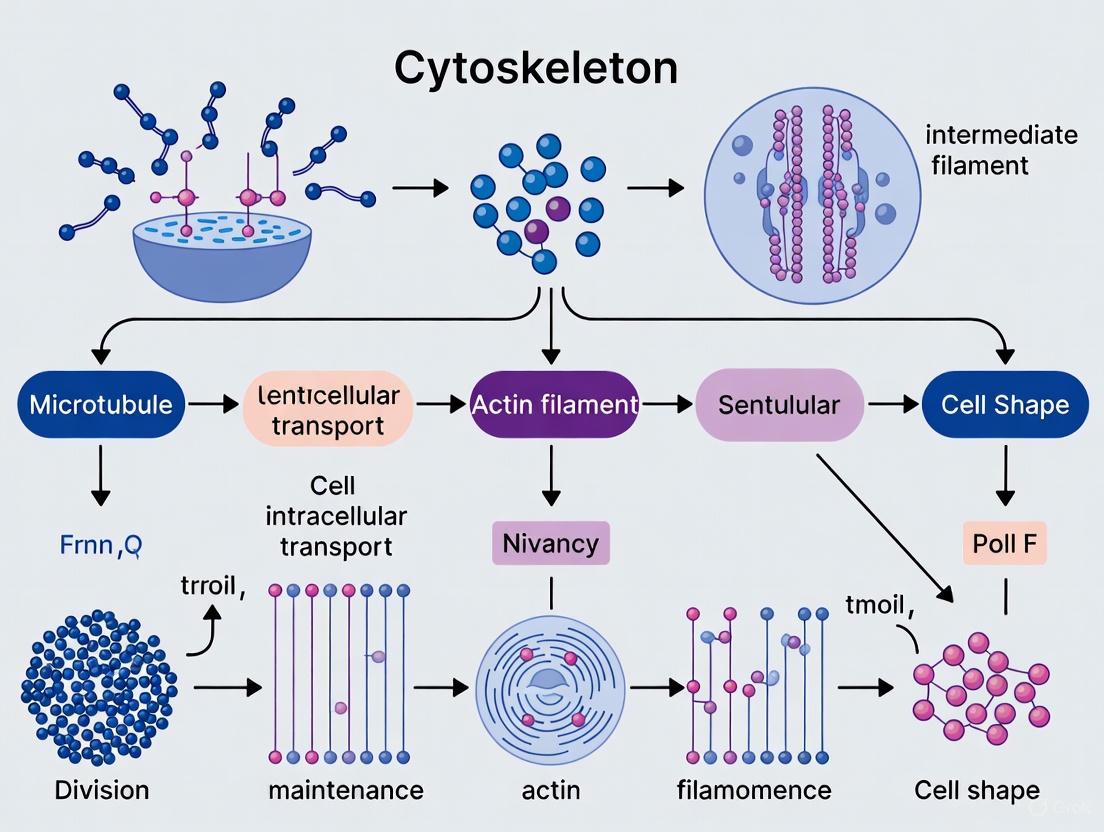
This article provides a comprehensive analysis of the eukaryotic cytoskeleton, exploring its fundamental structure and dynamic functions essential for cell integrity, division, and motility.
The Eukaryotic Cytoskeleton: Structure, Dynamics, and Emerging Therapeutic Targets
Abstract
This article provides a comprehensive analysis of the eukaryotic cytoskeleton, exploring its fundamental structure and dynamic functions essential for cell integrity, division, and motility. Tailored for researchers, scientists, and drug development professionals, it delves into advanced methodologies for cytoskeletal analysis, including AI-driven techniques, and examines the critical interplay between cytoskeletal dynamics and disease mechanisms such as cancer progression and DNA damage response. The review further discusses the optimization of cytoskeleton-targeting agents, compares therapeutic strategies, and validates emerging targets, offering a synthesized perspective on the cytoskeleton's pivotal role in cellular biology and its implications for developing novel clinical interventions.
Architecture and Core Mechanics of the Eukaryotic Cytoskeleton
The cytoskeleton is a complex, dynamic network of interlinking protein filaments present in the cytoplasm of all eukaryotic cells, extending from the cell nucleus to the cell membrane [1]. This tripartite system, composed of microfilaments, microtubules, and intermediate filaments, serves as a fundamental structural determinant that is indispensable for cellular life. Its functions transcend mere architectural support, encompassing critical roles in maintaining cell shape, enabling motility, facilitating intracellular transport, and ensuring proper cell division [2] [1]. For researchers and drug development professionals, understanding the distinct properties and synergistic interactions of these three filament systems is crucial, not only for deciphering basic cell biology but also for identifying novel therapeutic targets in diseases such as cancer, neurodegenerative disorders, and infectious diseases [3] [1]. This whitepaper provides a detailed technical guide to the core components of the cytoskeletal network, framing their characteristics within the context of modern biomedical research.
Core Components of the Cytoskeleton
Microfilaments (Actin Filaments)
Structure and Composition: Microfilaments, with a diameter of approximately 7 nm, are the narrowest components of the cytoskeleton [2]. They are composed of the globular protein actin (G-actin) that polymerizes to form a double-helical strand known as filamentous actin (F-actin) [2] [4]. These filaments are polarized, featuring a fast-growing barbed end (+) * and a slow-growing *pointed end (-) [5] [4]. Their dynamics are powered by ATP and tightly regulated by a suite of actin-binding proteins (ABPs) such as profilin (promotes assembly), formin (promotes elongation), and cofilin (promotes disassembly) [5].
Primary Functions:
- Cell Motility and Contraction: Working with motor proteins like myosin, actin filaments facilitate muscle contraction and cellular crawling, as exemplified by white blood cells chasing pathogens [2] [1].
- Maintenance of Cell Shape: They form a cortical network beneath the plasma membrane that defines cell morphology [2].
- Cytokinesis: The contractile ring that pinches a dividing cell into two is composed of actin and myosin [1] [4].
- Cytoplasmic Streaming: In plant cells, actin networks facilitate the flow of cytosol to distribute nutrients and organelles [2] [4].
- Mechanotransduction: Actin stress fibers, connected to the extracellular matrix via focal adhesions, allow cells to sense and respond to mechanical cues from their environment [5].
Microtubules
Structure and Composition: Microtubules are the largest cytoskeletal components, with a diameter of about 25 nm [2]. They are hollow cylinders whose walls are composed of protofilaments—linear chains of alternating α-tubulin and β-tubulin heterodimers [2] [4]. Typically, 13 protofilaments associate to form a single microtubule. They are nucleated from a microtubule-organizing center (MTOC), such as the centrosome in animal cells [2]. Like microfilaments, microtubules are polarized, with a dynamic plus end (+) * that grows rapidly and a more stable *minus end (-) that is often anchored to the MTOC [4].
Primary Functions:
- Intracellular Transport: Microtubules serve as tracks for motor proteins (kinesins and dyneins) that transport vesicles, organelles, and protein complexes [3].
- Cell Division: They form the mitotic spindle, which is responsible for the accurate segregation of chromosomes during mitosis [2] [3].
- Cell Shape and Compression Resistance: Their rigidity helps the cell resist compressive forces [2].
- Formation of Cilia and Flagella: Microtubules are the core structural elements of these motile and sensory organelles, arranged in the characteristic "9+2" axoneme [2].
Intermediate Filaments
Structure and Composition: Intermediate filaments have an intermediate diameter of 8-12 nm, from which they derive their name [2] [1]. Unlike the other two filament types, they are non-polar and are composed of a diverse family of fibrous proteins, including keratin (in epithelial cells), vimentin (in mesenchymal cells), neurofilaments (in neurons), and nuclear lamins [2] [1]. Their assembly involves the formation of a coiled-coil dimer, which then associates into tetramers and ultimately into the final, ropelike filament [1].
Primary Functions:
- Mechanical Strength: Their primary role is purely structural—to bear tension and provide mechanical strength to the cell and tissues [2] [1].
- Anchorage of Organelles: They anchor the nucleus and other organelles in place within the cytoplasm [2].
- Tissue Integrity: Through desmosomes and other junctions, intermediate filaments create a continuous network that provides tensile strength across entire tissues [1].
Table 1: Comparative Summary of Cytoskeletal Components
| Feature | Microfilaments | Microtubules | Intermediate Filaments |
|---|---|---|---|
| Diameter | ~7 nm [2] | ~25 nm [2] | ~10 nm [2] [1] |
| Protein Subunit | Actin (G-actin) [2] | α- and β-Tubulin heterodimer [2] | Various (e.g., Keratin, Vimentin, Lamin) [2] [1] |
| Structure | Two intertwined actin strands [4] | Hollow cylinder of 13 protofilaments [4] | Ropelike, fibrous tetramers [1] |
| Polarity | Polar (Barbed+/Pointed-) [5] | Polar (Plus+/Minus-) [4] | Non-polar [1] |
| Nucleotide | ATP [5] | GTP [4] | None |
| Dynamic Instability | Yes (Treadmilling) | Yes (Dynamic instability) [4] | No (Stable) [2] |
| Primary Function | Cell motility, contraction, cytokinesis [2] | Intracellular transport, mitosis, cell shape [2] | Mechanical strength, organelle anchorage [2] |
Experimental Methodologies for Cytoskeletal Analysis
Studying the cytoskeleton requires a multidisciplinary approach that combines biochemical, imaging, and pharmacological techniques. Below are detailed protocols for key experimental procedures used in the field.
Immunofluorescence Staining and Microscopy for Filament Visualization
This protocol is foundational for visualizing the spatial organization of all three cytoskeletal networks in fixed cells.
Materials:
- Cultured cells grown on glass coverslips
- Phosphate-buffered saline (PBS)
- Fixative (e.g., 4% paraformaldehyde in PBS)
- Permeabilization buffer (e.g., 0.1% Triton X-100 in PBS)
- Blocking solution (e.g., 1-5% BSA in PBS)
- Primary antibodies (e.g., anti-α-tubulin for microtubules, anti-vimentin for intermediate filaments)
- Fluorescently-labeled secondary antibodies
- Actin stain (e.g., phalloidin conjugated to a fluorophore) [6]
- Mounting medium with DAPI (for DNA counterstain)
- Fluorescence or confocal microscope
Procedure:
- Cell Fixation: Aspirate the culture medium from cells on a coverslip and rinse gently with warm PBS. Fix the cells by incubating in 4% paraformaldehyde for 15 minutes at room temperature.
- Permeabilization: Remove the fixative and wash the cells 3 times with PBS. Incubate with permeabilization buffer (0.1% Triton X-100) for 10 minutes to allow antibodies access to the cytoskeleton.
- Blocking: Wash the coverslip with PBS and apply blocking solution (e.g., 1% BSA) for 30-60 minutes to reduce nonspecific antibody binding.
- Primary Antibody Incubation: Apply the primary antibody diluted in blocking solution to the coverslip. Incubate in a humidified chamber for 1 hour at room temperature or overnight at 4°C.
- Secondary Antibody and Phalloidin Incubation: Wash the coverslip 3 times with PBS to remove unbound primary antibody. Apply a mixture of fluorescent secondary antibody and fluorescent phalloidin (to label F-actin) diluted in blocking solution. Incubate for 1 hour at room temperature in the dark.
- Mounting and Imaging: Perform final washes with PBS and then distilled water. Mount the coverslip onto a glass slide using an anti-fade mounting medium. Seal the edges with nail polish. Image using a fluorescence or confocal microscope with appropriate filter sets.
In Vitro Tubulin Polymerization Assay
This biochemical assay is used to quantify the polymerization dynamics of microtubules and is critical for screening drugs that target tubulin [3].
Materials:
- Purified tubulin protein (>99% pure)
- PEM buffer (80 mM PIPES, 1 mM EGTA, 2 mM MgCl₂, pH 6.9)
- GTP (Guanosine-5'-triphosphate)
- Spectrophotometer or fluorometer with temperature control
- Pre-warmed microcuvettes
Procedure:
- Sample Preparation: On ice, prepare a tubulin solution (e.g., 3 mg/mL) in PEM buffer containing 1 mM GTP. Keep the solution on ice to prevent premature polymerization.
- Baseline Measurement: Transfer the tubulin solution to a pre-warmed cuvette in the spectrophotometer set to 37°C. Immediately start monitoring the turbidity (absorbance at 350 nm) or fluorescence if using a tubulin-coupled fluorophore.
- Data Collection: Continue measuring the absorbance for 60-90 minutes. The absorbance will initially be low, then increase as microtubules polymerize and scatter light, eventually plateauing as the reaction reaches equilibrium.
- Data Analysis: Plot absorbance vs. time. Key parameters to analyze include the nucleation lag time, the maximum growth rate (slope), and the final polymer mass. To test a drug's effect, include it in the initial reaction mix; inhibitors will suppress the turbidity increase, while stabilizers may enhance it or lower the critical concentration for assembly [3].
Drug-Based Perturbation of the Actin Cytoskeleton
This functional assay uses specific pharmacological agents to disrupt actin dynamics and observe the phenotypic consequences.
Materials:
- Cultured cells
- Actin-targeting drugs (e.g., Latrunculin B, Cytochalasin D, Jasplakinolide) [5] [6]
- Cell culture medium
- Live-cell imaging setup (optional)
Procedure:
- Cell Seeding: Seed cells onto culture dishes or coverslips and allow them to adhere and spread normally.
- Drug Application: Prepare a working concentration of the chosen drug in culture medium.
- Incubation and Observation: Replace the culture medium with the drug-containing medium. Incubate cells for a predetermined time (e.g., 30 minutes to 2 hours).
- Analysis: Fix and stain the cells with phalloidin (as in Protocol 3.1) to visualize changes in actin architecture. Alternatively, use live-cell imaging to monitor dynamic processes like cell edge retraction or the cessation of cytoplasmic streaming in real-time. Expected outcomes include the disappearance of stress fibers (with Latrunculin B/Cytochalasin D) or excessive actin aggregation (with Jasplakinolide).
Visualization of Cytoskeletal Dynamics and Signaling
The following diagrams, generated using DOT language, illustrate key signaling pathways and experimental workflows central to cytoskeletal research.
Actin Mechanotransduction Pathway
This diagram visualizes the pathway through which extracellular mechanical signals are transduced into transcriptional changes via the actin cytoskeleton and YAP/TAZ signaling, a key pathway in cell fate determination [5].
Workflow for Screening Cytoskeletal-Targeting Compounds
This flowchart outlines an integrated strategy for the discovery and validation of novel cytoskeletal-targeting drugs, as demonstrated in the identification of Gatorbulin-1 [3].
The Scientist's Toolkit: Research Reagent Solutions
A curated selection of pharmacological agents is indispensable for probing cytoskeletal structure and function. The table below details key reagents used to manipulate and study the cytoskeleton in experimental settings.
Table 2: Key Research Reagents for Cytoskeletal Manipulation
| Reagent Name | Target | Effect on Cytoskeleton | Primary Research Application |
|---|---|---|---|
| Latrunculin B [6] | Actin | Sequesters G-actin; prevents polymerization & enhances depolymerization | Disrupting actin-based structures to study motility, endocytosis, and mechanotransduction. |
| Cytochalasin D [6] | Actin | Caps F-actin barbed ends; prevents polymerization. | Inhibiting actin filament elongation; studying cytokinesis and cell shape. |
| Jasplakinolide [6] | Actin | Stabilizes F-actin; promotes polymerization. | Hyper-stabilizing actin filaments to study consequences of reduced dynamics. |
| Phalloidin [6] | Actin | Stabilizes F-actin; prevents depolymerization. | Fluorescently-labeled: Staining and visualizing F-actin in fixed cells. |
| Nocodazole [7] [6] | Microtubules | Binds β-tubulin; prevents polymerization. | Depolymerizing microtubules to study mitosis, intracellular transport, and organelle positioning. |
| Paclitaxel (Taxol) [6] | Microtubules | Binds and stabilizes microtubules; suppresses dynamics. | Hyper-stabilizing microtubules; a common chemotherapeutic and research tool. |
| Vinblastine [7] [6] | Microtubules | Binds tubulin dimers; prevents polymerization. | Inducing mitotic arrest; studying vesicular transport. |
| Colchicine [6] | Microtubules | Binds tubulin; prevents polymerization. | Studying microtubule dynamics; treating gout (clinical use). |
| Gatorbulin-1 [3] | Microtubules | Binds a novel intradimer site; inhibits polymerization. | Example of a novel, naturally-derived compound with a unique mechanism of action. |
The eukaryotic cytoskeleton, a tripartite network of microfilaments, microtubules, and intermediate filaments, represents a pinnacle of cellular engineering. Its components—each with distinct structural properties, dynamic behaviors, and molecular regulators—are not isolated systems but are functionally integrated to orchestrate complex cellular behaviors. From enabling the rapid migration of an immune cell to the faithful segregation of genetic material, the cytoskeleton is fundamental to life. Current research continues to reveal the complexity of this network, including its roles in signal transduction, nuclear functions, and cellular reprogramming [5]. For the drug development community, the cytoskeleton remains a "validated target for novel therapeutic drugs" [3]. The ongoing discovery of new binding sites and compounds, coupled with a deeper understanding of the off-target effects of cytoskeletal drugs on processes like protein folding [7], promises a new generation of more specific and effective therapeutics for cancer and other devastating diseases. The methodologies and reagents outlined in this whitepaper provide the foundational toolkit for driving these innovations forward.
Molecular Composition and Structural Properties of Each Filament System
The cytoskeleton of eukaryotic cells is a dynamic, multifaceted network of protein filaments essential for cellular integrity, intracellular organization, and motility. This system is not a static scaffold but a highly regulated infrastructure composed of three principal filament classes: microfilaments, microtubules, and intermediate filaments [8]. Each system possesses a unique molecular composition and structural profile, enabling a diverse yet integrated set of mechanical and transport functions within the cell [9]. For researchers and drug development professionals, understanding these distinct properties is paramount, as the cytoskeleton presents a rich target for therapeutic interventions in diseases ranging from cancer to chronic kidney disease [10]. This whitepaper provides a detailed technical guide on the core molecular and structural features of each filament system, framing this knowledge within contemporary research methodologies.
Core Filament Systems: A Comparative Analysis
The following section delineates the defining characteristics of the three cytoskeletal filaments, with quantitative data summarized for direct comparison.
Molecular and Structural Properties
Table 1: Comparative Structural Properties of Cytoskeletal Filaments
| Property | Microfilaments | Intermediate Filaments | Microtubules |
|---|---|---|---|
| Protein Subunit | Actin (globular) [9] [11] | Keratin family, Vimentin, Desmin, Lamins, Neurofilaments (fibrous) [12] [13] [14] | Tubulin heterodimer (α- and β-tubulin) [9] [13] |
| Diameter | ~7 nm [11] [2] | ~10 nm [12] [13] | ~25 nm [12] [13] |
| Structure | Two intertwined strands of actin (helical) [2] | Ropelike, eight protofibrils forming a staggered array [12] [14] | Hollow cylinder of 13 linear protofilaments [9] [13] |
| Polarity | Yes (barbed and pointed ends) [12] | No [12] | Yes (plus and minus ends) [13] |
| Dynamic Instability | High (ATP-dependent) [9] [11] | Low (very stable) [9] [8] | High (GTP-dependent) [13] [11] |
| Primary Mechanical Role | Bears tension, cortical strength [9] | Bears tension, mechanical strength [11] [8] | Resists compression [9] [11] |
| Motor Proteins | Myosin [9] [15] | None known | Kinesin, Dynein [9] [15] |
Detailed System Profiles
Microfilaments (Actin Filaments): Microfilaments are composed of globular actin (G-actin) monomers that polymerize into helical filaments (F-actin) in an ATP-dependent manner [9] [13]. This polarity is critical for their function, as the barbed end elongates faster than the pointed end. They form a meshwork known as the cell cortex beneath the plasma membrane, providing mechanical support and determining cell shape [14]. Their dynamic nature allows them to rapidly assemble and disassemble, facilitating processes like cell crawling, cytokinesis, and cytoplasmic streaming [11] [2]. The motor protein myosin interacts with actin filaments to generate contractile forces in muscle and non-muscle cells [15].
Intermediate Filaments: Constructed from a diverse family of fibrous proteins, intermediate filaments are the most stable and durable component of the cytoskeleton [9] [8]. Their assembly involves the formation of a staggered, ropelike structure from coiled-coil dimers, resulting in non-polar filaments that lack known motor proteins [12]. Their primary function is mechanical integrity, as they distribute tensile stress throughout the cell and anchor organelles like the nucleus [11] [2]. Different cell types express specific intermediate filament proteins (e.g., keratins in epithelial cells, desmin in muscle, neurofilaments in neurons), making them valuable cell-type-specific markers [12] [14].
Microtubules: As the largest cytoskeletal filaments, microtubules are hollow tubes composed of α/β-tubulin heterodimers that assemble in a GTP-dependent manner [9] [11]. Their inherent polarity is fundamental to their role as tracks for intracellular transport; the plus ends typically extend toward the cell periphery, while the minus ends are anchored at the microtubule-organizing center (MTOC), or centrosome [12] [13]. Motor proteins kinesin (plus-end-directed) and dynein (minus-end-directed) transport vesicles, organelles, and other cargo along these tracks [9] [15]. Microtubules are also the fundamental components of mitotic spindles, cilia, and flagella, the latter possessing a characteristic "9+2" array of microtubule doublets [11] [2].
Experimental Analysis of Cytoskeletal Dynamics
Research into cytoskeletal function often requires assessing filament organization and dynamics in response to genetic or chemical perturbations. The following protocol, inspired by recent research, details a methodology for evaluating the role of a cytoskeleton-associated protein in podocytes, which can be adapted for other cell types.
Experimental Protocol: Investigating Cytoskeletal Protein Function via Knockdown and Imaging
This protocol outlines the steps to analyze the functional role of a cytoskeleton-associated protein (e.g., Cytoskeleton-associated protein 4, CKAP4) in maintaining cytoskeletal architecture [10].
1. Objective: To determine the effect of targeted protein knockdown on the actin and microtubule cytoskeleton in cultured human podocytes (applicable to other eukaryotic cells).
2. Materials and Reagents:
- Cell Line: Human Podocytes (HPODs) or other relevant eukaryotic cell line.
- Knockdown Reagent: Specific small interfering RNA (siRNA) or translation-blocking morpholino (MO) targeting the gene of interest [10].
- Control Reagent: Non-targeting siRNA or control MO.
- Transfection Reagent: Appropriate agent for delivering siRNA/MO into the cells.
- Cell Culture Media: Standard growth media for the chosen cell line.
- Hyperglycemic Stimulus: Glucose solution to prepare 60 mM glucose media for diabetic disease modeling [10].
- Fixative: 4% paraformaldehyde (PFA) in phosphate-buffered saline (PBS).
- Permeabilization Agent: 0.1% Triton X-100 in PBS.
- Blocking Buffer: 1-5% Bovine Serum Albumin (BSA) in PBS.
- Primary Antibodies: Mouse anti-α-tubulin antibody, Rabbit anti-CKAP4 antibody [10].
- Actin Stain: Phalloidin conjugate (e.g., Alexa Fluor 488-phalloidin) for labeling F-actin.
- Secondary Antibodies: Fluorescently-labeled anti-mouse and anti-rabbit antibodies.
- Nuclear Stain: DAPI (4',6-diamidino-2-phenylindole).
- Mounting Medium: Antifade mounting medium.
- Imaging Equipment: High-resolution fluorescence or confocal microscope.
3. Methodology: 1. Cell Seeding and Transfection: Plate human podocytes in appropriate culture vessels and allow them to adhere. Transfert cells with either the targeted siRNA/MO or the control reagent using the manufacturer's protocol [10]. 2. Experimental Stimulation (Optional): For disease modeling, treat a subset of transfected cells with 60 mM glucose media for a sustained period (e.g., two weeks) to mimic a pathological hyperglycemic environment [10]. 3. Cell Fixation and Processing: After the experimental period, wash cells with PBS and fix with 4% PFA for 15 minutes at room temperature. Permeabilize cells with 0.1% Triton X-100 for 10 minutes, then block with 1% BSA for 1 hour. 4. Immunofluorescence Staining: Incubate cells with primary antibodies (e.g., anti-α-tubulin, anti-CKAP4) diluted in blocking buffer overnight at 4°C. Wash and incubate with appropriate fluorescent secondary antibodies and phalloidin conjugate for 1 hour at room temperature. Include DAPI to label nuclei [10]. 5. Microscopy and Image Analysis: Mount stained cells and image using a high-resolution fluorescence or confocal microscope. Acquire z-stack images to capture the full 3D structure of the cytoskeleton. Analyze images for changes in actin cytoskeleton architecture (e.g., disruption of stress fibers) and microtubule organization (e.g., loss of oriented growth) in knockdown cells compared to controls [10].
The workflow for this experimental approach is summarized in the following diagram:
Figure 1: Experimental workflow for cytoskeletal analysis.
The Scientist's Toolkit: Key Research Reagents
Table 2: Essential Reagents for Cytoskeletal Research
| Reagent | Function/Application in Research |
|---|---|
| Tubulin Dimers (Purified) | In vitro polymerization assays to study microtubule dynamics and drug effects [9]. |
| Phalloidin Conjugates | High-affinity staining of F-actin for fluorescence microscopy; stabilizes filaments [10]. |
| siRNA / Morpholinos | Gene knockdown tools to deplete specific cytoskeletal proteins and study loss-of-function phenotypes [10]. |
| Anti-Tubulin Antibodies | Immunofluorescence and Western blotting to visualize and quantify microtubule organization and protein levels [10]. |
| Anti-Actin Antibodies | Detection of actin isoforms and total actin levels in cellular lysates or tissues. |
| Paclitaxel (Taxol) | Microtubule-stabilizing drug used to suppress dynamic instability and probe microtubule function [13]. |
| Latrunculin A | Actin-depolymerizing agent used to disrupt the actin cytoskeleton and study its roles in cellular processes [13]. |
| 3D Bioprinted Spheroids | Advanced cell culture models that recapitulate the biomechanical and spatial cues of the tumor microenvironment for studying invasion [16]. |
Cytoskeletal Dysfunction in Disease and Therapeutic Targeting
Dysregulation of the cytoskeleton is a hallmark of numerous diseases, making it a critical area for drug development. In Diabetic Kidney Disease (DKD), the loss of cytoskeleton-associated protein 4 (CKAP4) in podocytes leads to dysregulation of both microtubule and actin networks, causing foot process effacement and proteinuria [10]. This exemplifies how a defect in a single regulator can disrupt the entire cytoskeletal infrastructure.
In cancer, the concept of cytoskeletal remodeling is central to invasion and metastasis [16]. Tumor cells adapt to mechanical stress within their microenvironment by altering their cytoskeleton, enhancing their ability to squeeze through tissue barriers. This has spurred the development of migrastatic therapies, which aim to halt metastasis by targeting the cytoskeletal machinery of cell motility rather than proliferation [16]. These therapies may target motor proteins, actin polymerization, or the associated signaling pathways.
The relationships between cytoskeletal dysfunction, cellular adaptation, and therapeutic intervention are illustrated below.
Figure 2: Cytoskeletal remodeling in disease and therapy.
The cytoskeleton is a dynamic, adaptive network of protein filaments that provides mechanical support, organizes intracellular contents, and generates coordinated forces essential for cellular function in eukaryotic cells. Unlike a static skeleton, this system undergoes continuous remodeling through regulated assembly and disassembly of its constituent polymers—actin filaments, microtubules, and intermediate filaments [17]. These processes are fundamental to cell division, motility, intracellular transport, and shape determination. For researchers and drug development professionals, understanding the precise mechanisms governing cytoskeletal dynamics offers valuable therapeutic targets, particularly in oncology and neurodegenerative diseases where these processes are frequently dysregulated [18] [1]. This technical guide examines the core principles of cytoskeletal polymerization and the sophisticated regulatory systems that control these dynamics, providing a framework for both basic research and translational applications.
Core Polymer Systems: Structure and Assembly Dynamics
The eukaryotic cytoskeleton comprises three distinct filament systems, each with unique structural properties and dynamic behaviors. The quantitative characteristics of these systems are summarized in Table 1.
Table 1: Comparative Properties of Cytoskeletal Polymers
| Property | Actin Filaments | Microtubules | Intermediate Filaments |
|---|---|---|---|
| Diameter | 7-9 nm [19] | 23-25 nm [1] [19] | 8-12 nm [1] [19] |
| Subunit | G-actin [20] | αβ-tubulin heterodimer [21] | Tissue-specific proteins (e.g., vimentin, keratin) [1] |
| Persistence Length | ~17 µm [17] (as a semi-flexible polymer) | ~5 mm [17] | Not specified in results |
| Structural Polarity | Yes (+ and - ends) [20] | Yes (+ and - ends) [21] | No (apolar) [19] |
| Nucleotide Dependence | ATP [19] | GTP [21] | None |
| Critical Concentration | ~0.1 µM for polymerization [20] | Dependent on tubulin concentration [19] | Not applicable |
| Primary Mechanical Role | Bear tension, generate protrusive forces [1] [17] | Resist compression, organize intracellular space [17] [19] | Provide mechanical stability, bear tension [1] [19] |
Actin Filaments: Force Generation and Motility
Actin exists in monomeric (G-actin) and filamentous (F-actin) states, assembling into helical polymers that are semi-flexible in nature [20]. Polymerization proceeds through a nucleation-elongation mechanism, where the formation of an actin trimer serves as the rate-limiting nucleation step, followed by rapid elongation [20] [22]. Filaments exhibit structural polarity, with a fast-growing barbed end (+) and a slow-growing pointed end (-) [20]. The (+)-end has a approximately ten times higher polymerization rate than the (-)-end [20]. ATP hydrolysis following monomer incorporation regulates filament dynamics, with ATP-actin predominating at the (+)-end and ADP-actin at the (-)-end [20]. Actin polymerization drives essential cellular processes including cell migration, phagocytosis, and cytokinesis by generating protrusive forces against cellular membranes [1] [17].
Microtubules: Architectural Scaffolds and Intracellular Highways
Microtubules are hollow cylinders composed of 13 protofilaments, each formed by αβ-tubulin heterodimers arranged in a head-to-tail fashion, creating structural polarity [21]. Microtubules exhibit dynamic instability, a stochastic switching between growth (polymerization) and shrinkage (catastrophe), powered by GTP hydrolysis [21] [17]. The GTP-bound tubulin at the growing end forms a protective "cap" that stabilizes the microtubule; hydrolysis to GDP-tubulin in the lattice promotes depolymerization if the cap is lost [21]. This dynamic behavior allows microtubules to rapidly reorganize their architecture and "search" intracellular space [17]. Microtubules originate from microtubule-organizing centers (MTOCs), with their minus ends anchored at the centrosome and plus ends extending toward the cell periphery, establishing a polarized network for intracellular transport [21] [19].
Intermediate Filaments: Mechanical Integrators
Intermediate filaments are non-polar, stable polymers that provide mechanical integrity and resistance to stress [1] [19]. Their assembly mechanism differs fundamentally from actin and microtubules, involving the formation of tetramers that associate laterally into protofilaments and ultimately mature filaments [19]. Unlike the other cytoskeletal systems, intermediate filament assembly is not nucleotide-dependent [19]. Their composition is tissue-specific (e.g., keratins in epithelial cells, vimentin in mesenchymal cells, neurofilaments in neurons), allowing specialized mechanical properties tailored to different cell types [1]. The primary role of intermediate filaments is to provide structural continuity throughout the cell, distributing mechanical stress and stabilizing cellular architecture [1] [19].
Regulatory Systems: Controlling Polymer Dynamics
Cytoskeletal dynamics are precisely controlled through a sophisticated network of regulatory proteins and signaling pathways that respond to intracellular and extracellular cues.
Actin-Binding Proteins and Their Functions
Actin dynamics are regulated by a diverse array of actin-binding proteins that control nucleation, elongation, capping, severing, and cross-linking. The functions of key regulatory proteins are summarized in Table 2.
Table 2: Key Regulatory Proteins for Actin Dynamics
| Regulatory Protein | Primary Function | Mechanism of Action |
|---|---|---|
| Profilin | Polymerization regulation [20] | Binds G-actin, inhibits spontaneous nucleation, promotes ATP-ADP exchange [20] |
| Arp2/3 Complex | Nucleation [20] | Binds existing filaments to nucleate branched networks [20] |
| Formins (mDia1/2) | Nucleation & elongation [20] | Processively caps barbed ends, promoting rapid elongation with profilin [20] |
| Cofilin/ADF | Severing & depolymerization [18] [20] | Binds and severs ADP-rich filaments, promoting disassembly [18] [20] |
| Capping Protein | Elongation control [20] | Binds barbed ends to prevent further polymerization [20] |
| α-actinin/Fascin | Cross-linking [20] | Bundles filaments into higher-order structures [20] |
| Myosin II | Contractility [20] | Motor protein that generates force on actin filaments [20] |
The regulation of actin networks extends beyond individual proteins to include complex signaling pathways. The Rho GTPase family (Rho, Rac, Cdc42) serves as a master regulator of actin organization, controlling the formation of specific actin-based structures in response to extracellular signals [18] [20]. The following diagram illustrates the key signaling pathways regulating actin dynamics:
Microtubule-Associated Proteins and Regulation
Microtubule dynamics are controlled by microtubule-associated proteins (MAPs) that either stabilize or destabilize filaments, and by motor proteins that transport cargo and organize the network [21] [19]. Stabilizing MAPs, such as tau and MAP2, bind along microtubule lattices, promoting assembly and reducing catastrophe frequency [18] [21]. These proteins often contain projection domains that space microtubules in bundles, particularly evident in neuronal axons [21] [19]. Conversely, destabilizing MAPs like katanin sever microtubules, while Op18/stathmin promotes depolymerization by sequestering tubulin dimers [19]. Motor proteins of the kinesin and dynein families transport vesicles, organelles, and proteins along microtubule tracks, with most kinesins moving toward the plus end and dyneins toward the minus end [21] [19]. The coordinated activity of these regulatory elements enables the microtubule cytoskeleton to establish and maintain polarized cellular organization.
Integrated Regulatory Mechanisms
Beyond filament-specific regulators, broader mechanisms control cytoskeletal dynamics across all three systems:
Allosteric Regulation: Many cytoskeletal regulators function through allosteric mechanisms, where binding of a small molecule at one site alters protein conformation and activity at a distant site [23]. Feedback inhibition in metabolic pathways represents a classic example of this regulatory paradigm [23].
Protein Phosphorylation: Reversible phosphorylation serves as a universal switch controlling cytoskeletal protein activity [23]. Kinases and phosphatases regulate everything from myosin contractility to MAP binding affinity, allowing rapid integration of signaling cues [23] [20].
Mechanical Forces: The cytoskeleton functions as a mechanosensitive system, where applied physical forces can directly influence assembly and organization [17]. This mechanoresponsive capability allows cells to adapt their architecture to environmental stiffness and mechanical stresses.
The integration of these regulatory mechanisms enables the cytoskeleton to function as a coordinated system that responds appropriately to diverse cellular needs.
Experimental Approaches: Methodologies and Reagents
Studying cytoskeletal dynamics requires specialized methodologies that capture both structural organization and temporal dynamics. This section outlines key experimental protocols and essential research reagents for investigating polymerization and regulatory mechanisms.
Kinetic Analysis of Actin Polymerization
The classic protocol for analyzing actin polymerization kinetics involves monitoring the increase in light absorbance or fluorescence that accompanies the G-actin to F-actin transition [22]. The following workflow details the essential steps:
Table 3: Essential Research Reagents for Cytoskeletal Dynamics Studies
| Reagent/Category | Specific Examples | Research Application & Function |
|---|---|---|
| Purified Cytoskeletal Proteins | G-actin [22], Tubulin heterodimers [17] | In vitro reconstitution of polymerization dynamics; fundamental building blocks for assembly studies |
| Nucleotide Analogs | Non-hydrolyzable ATP/GTP analogs, Mant-labeled nucleotides | Probe nucleotide dependence of polymerization; visualize real-time kinetics |
| Pharmacological Inhibitors | Latrunculin (actin depolymerizer) [18], Colchicine (microtubule depolymerizer), Taxol (microtubule stabilizer) [18] | Specific perturbation of cytoskeletal dynamics; therapeutic candidate screening |
| Fluorescent Probes | Phalloidin (F-actin stain) [19], Immunofluorescence antibodies for MAPs [19] | Structural visualization of cytoskeletal networks; localization of regulatory proteins |
| Regulatory Proteins | Profilin [20], Cofilin [18] [20], Tau protein [18] [21], Arp2/3 complex [20] | Mechanistic studies of regulation; reconstitution of complex dynamics |
| Live-Cell Imaging Systems | TIRF microscopy [17], FRAP, Super-resolution microscopy [18] | Real-time visualization of cytoskeletal dynamics in living cells |
Advanced Methodologies for Cytoskeletal Research
Contemporary cytoskeleton research employs increasingly sophisticated approaches:
In Vitro Reconstitution: Combining purified components (e.g., actin, Arp2/3, capping proteins) to reconstruct complex cytoskeletal structures, enabling definitive testing of molecular mechanisms [17]. Remarkably, only three proteins are required to reconstitute active cargo transport on growing microtubule ends [17].
Single-Molecule Imaging: Using total internal reflection fluorescence (TIRF) microscopy to visualize the dynamics of individual filaments and their associated proteins in real time [17].
Mechanical Perturbation: Applying precisely controlled forces to cells or reconstituted networks using optical tweezers, atomic force microscopy, or substrate stretching to investigate mechanotransduction [17].
These methodologies, combined with the research reagents detailed in Table 3, provide powerful tools for dissecting the complex regulation of cytoskeletal dynamics.
Pathophysiological Correlations and Therapeutic Targeting
Dysregulation of cytoskeletal dynamics contributes significantly to human disease pathogenesis, offering potential targets for therapeutic intervention:
Cancer Progression: Malignant cells exhibit altered actin dynamics that facilitate invasion and metastasis [18] [20]. Overexpression of actin-binding proteins like fascin and cortactin correlates with poor prognosis [18]. Microtubule-targeting agents (e.g., taxanes, vinca alkaloids) represent mainstay cancer therapeutics that exploit the heightened dependence of rapidly dividing cells on dynamic microtubules [18].
Neurodegenerative Disorders: Alzheimer's disease involves tau hyperphosphorylation, which reduces its microtubule-stabilizing function and contributes to neuronal dysfunction [18] [1]. Mutations in genes encoding cytoskeletal proteins are implicated in Parkinson's disease and amyotrophic lateral sclerosis [1].
Cardiovascular Disease: Abnormal actin dynamics in vascular smooth muscle cells contribute to increased vascular tone in hypertension and atherosclerosis [18]. Rho kinase (ROCK) inhibitors have emerged as potential therapeutics for cardiovascular diseases through their effects on the actin cytoskeleton [18].
The cytoskeleton's central role in these pathological processes highlights the therapeutic potential of targeting cytoskeletal dynamics, with several existing clinical agents and many more in development.
The dynamic assembly and disassembly of cytoskeletal polymers, governed by complex regulatory networks, represents a fundamental biological process with broad implications for cellular function and dysfunction. The principles outlined in this technical guide—from the basic thermodynamics of polymerization to the sophisticated control by associated proteins and signaling pathways—provide a foundation for understanding how cells establish shape, generate movement, and organize internal contents. For researchers and drug development professionals, continued elucidation of these mechanisms offers exciting opportunities for therapeutic intervention in cancer, neurodegenerative conditions, and other diseases characterized by cytoskeletal dysregulation. The integrated view presented here emphasizes that the cytoskeleton functions not as a collection of individual components, but as a coherent, adaptive system that responds to both chemical and mechanical cues to direct cellular behavior.
Mechanical Roles in Cell Shape, Support, and Resistance to Deformation
The cytoskeleton is a dynamic, hierarchical network of protein filaments that provides the fundamental mechanical framework of eukaryotic cells, enabling them to resist deformation, maintain structural integrity, and generate coordinated forces for shape change and movement [17] [1]. Far from being a static scaffold, it is an adaptive structure whose component polymers and regulatory proteins are in constant flux, allowing the cell to respond to both internal and external physical forces [17]. This mechanical role is critical for fundamental cellular processes, including division, migration, and the uptake of extracellular material, and its dysfunction is implicated in a range of diseases, from cancer to neurodegenerative disorders [24] [1]. This whitepaper details the distinct and collaborative mechanical functions of the three primary cytoskeletal networks—microfilaments, intermediate filaments, and microtubules—and provides a technical overview of the experimental methodologies used to quantify their mechanical properties and organization.
Mechanical Properties of Cytoskeletal Filaments
The cytoskeleton's overall mechanical behavior emerges from the distinct biophysical characteristics of its three constituent filament systems and the architecture of their assembled networks [17].
Table 1: Fundamental Mechanical Properties of Cytoskeletal Filaments
| Filament Type | Diameter | Primary Mechanical Role | Stiffness (Persistence Length) | Key Structural Features |
|---|---|---|---|---|
| Actin Filaments (Microfilaments) | ~7 nm [25] [26] | Resist tension, generate contractile forces [1] | Lower stiffness; highly flexible [17] | Double helix of F-actin [26]; form branched networks, bundles, and stress fibers [17] |
| Intermediate Filaments | ~10 nm [1] [26] | Resist tension, provide mechanical toughness [1] | Flexible, but great tensile strength [27] | Ropelike, apolar structure of coiled-coil dimers [27] [1]; tissue-specific expression (e.g., keratin, vimentin) [1] |
| Microtubules | ~25 nm [24] [1] | Resist compression, provide structural tracks [1] | High stiffness (~5 mm persistence length) [17] | Hollow tubes of α/β-tubulin heterodimers [17] [26]; exhibit dynamic instability [17] |
Table 2: Network-Level Mechanical Behavior of Cytoskeletal Structures
| Structure/Network | Composition & Organization | Mechanical Function | Regulatory Proteins |
|---|---|---|---|
| Cortical Actin Mesh | Dense, crosslinked meshwork of actin filaments beneath the plasma membrane [25] | Determines cell surface mechanics, resists deformation, and facilitates membrane protrusions [25] | Filamins, actinin, myosin for crosslinking and contractility [25] |
| Actomyosin Stress Fibers | Contractile bundles of actin filaments with non-muscle myosin II [25] [5] | Generate contractile force, transmit tension to substrates via focal adhesions, and enable mechanosensing [25] [5] | α-actinin (crosslinker), myosin II (motor), Rho/ROCK signaling [5] |
| Microtubule Array | Radial array of stiff microtubules nucleated from the centrosome [17] | Provides compressive resistance, defines intracellular organization, and serves as a track for motor-based transport [17] [1] | Microtubule-associated proteins (MAPs), severing proteins, +TIPs [17] |
| Perinuclear Actin Cap | Thick actomyosin bundles spanning the apical nuclear surface [5] | Transmits mechanical forces from the ECM to the nucleus, influencing nuclear shape and YAP/TAZ signaling [5] | LINC complex, focal adhesions [5] |
Experimental Methodologies for Quantifying Cytoskeletal Mechanics
Atomic Force Microscopy (AFM) for Viscoelasticity Measurements
AFM is a cornerstone technique for directly probing the mechanical properties of cells and their internal structures. In a typical experiment, a cell is indented with a calibrated AFM tip, and the force-displacement relationship is recorded. This data is used to derive key viscoelastic parameters, such as elastic (Young's) modulus and viscosity [28].
Detailed Protocol: Decoupling Viscoelastic Parameters of Subcellular Compartments [28]
- Cell Culture and Preparation: Seed cells onto sterile, compliant culture dishes suitable for AFM.
- AFM Calibration: Calibrate the AFM cantilever's spring constant using thermal tuning or a reference method.
- Force Mapping: Perform a grid of force-indentation measurements across the surface of the cell. To target the nucleus, indent the cell's apical center; for peripheral cytoskeleton, indent the cell edge.
- Data Fitting: Fit the resulting force-distance curves to a mechanical model (e.g., Hertzian model for elastic properties, or a standard linear solid model for viscoelasticity).
- Parameter Extraction: Extract the elastic modulus (E) and viscosity (η) for the membrane, cytoskeleton, and nucleus by analyzing the loading and relaxation phases of the indentation.
- Strain Recovery Analysis: Apply a sustained deformation and monitor the time-dependent recovery of the nuclear and cellular shape after force removal to quantify plasticity and elastic recovery [28].
Quantitative Image Analysis of Cytoskeletal Organization
Fluorescence microscopy of stained or live-cell cytoskeletal components provides rich data on organization, which can be quantified using specialized software tools to infer mechanical states.
Detailed Protocol: Quantifying Actin Stress Fiber Organization with Stress Fiber Extractor (SFEX) [25]
- Sample Preparation and Imaging:
- Fix and stain cells with fluorescent phalloidin to label F-actin.
- Acquire high-resolution confocal or super-resolution images.
- Image Pre-processing:
- Enhance linear cytoskeletal structures in the raw image to facilitate binarization.
- Fiber Segmentation and Reconstruction:
- Generate a skeletonized image containing linear stress fiber fragments.
- Reconstruct full traces of stress fibers by iteratively searching for and connecting fragment pairs.
- Parameter Quantification:
- From the reconstructed fibers, automatically extract quantitative metrics, including fiber width (correlates with contractility), length, orientation, and abundance [25].
Detailed Protocol: Segmenting Focal Adhesions and Ventral Stress Fibers with SFALab [25]
- Generate Cell Mask: Create a mask from a cytoplasmic stain to define the cell area for analysis.
- Segment Focal Adhesions (FAs): Use shape-fitting algorithms on images stained for FA proteins (e.g., paxillin) to identify FA structures. Quantify morphological features like area and aspect ratio.
- Identify Ventral Stress Fibers: Enhance the original actin channel and combine it with the segmented FA image. Perform curve fitting between FA pairs to identify connecting ventral stress fibers.
- Quantification: Report metrics such as the number of ventral stress fibers per cell and per focal adhesion, which relate to the cell's contractile engagement with its substrate [25].
The following diagram illustrates the core experimental workflow for analyzing cytoskeleton mechanics, from sample preparation to data interpretation.
The Scientist's Toolkit: Key Research Reagents
Table 3: Essential Reagents for Cytoskeletal Mechanics Research
| Reagent / Tool | Function / Target | Primary Application |
|---|---|---|
| Phalloidin (Fluorescent conjugates) | High-affinity stain for F-actin [25] | Fixed-cell imaging of actin filaments and structures (e.g., stress fibers, cortex) [25] |
| Rho/ROCK Pathway Inhibitors (e.g., Y-27632) | Inhibits ROCK kinase, reducing actomyosin contractility [5] | Probing the role of cellular tension in shape, motility, and mechanotransduction [5] |
| Actin Polymerization Inhibitors (e.g., Latrunculin A, Cytochalasin D) | Disrupts F-actin dynamics (prevents polymerization or severs filaments) [5] | Dissecting the mechanical role of actin networks in cell shape and support [5] |
| Microtubule-Targeting Agents (e.g., Taxol/Paclitaxel, Nocodazole) | Stabilizes (Taxol) or depolymerizes (Nocodazole) microtubules [1] | Investigating the role of microtubules in compressive support and intracellular organization [17] [1] |
| Tubulin Antibodies | Labels α- and β-tubulin | Immunofluorescence staining of microtubule networks and organizing centers |
| Live-Cell Actin Probes (e.g., LifeAct, F-tractin) | Peptides or protein domains binding F-actin without disrupting dynamics [25] | Real-time visualization of actin cytoskeleton remodeling in living cells [25] |
Integrated Mechanical Signaling and Cellular Memory
The cytoskeleton is a key mediator of mechanotransduction, translating physical forces into biochemical signals. A central pathway involves the Rho/ROCK cascade, which is activated by external mechanical cues like substrate stiffness. ROCK then promotes the formation of contractile actomyosin stress fibers, which transmit tension to the nucleus via the LINC complex. This force transmission can alter nuclear shape and chromatin organization, influencing the activity of mechanosensitive transcription factors like YAP/TAZ, which shuttle into the nucleus to regulate genes controlling cell fate, proliferation, and survival [5]. Furthermore, recent work suggests that long-lived cytoskeletal structures may function as an epigenetic "memory," integrating past mechanical interactions to influence future cellular behavior and fate decisions [17] [5]. This underscores the profound role of the cytoskeleton not only as a mechanical scaffold but as a dynamic and adaptive regulator of cellular identity.
Spatial Organization of Cellular Contents and Intracellular Compartmentalization
The spatial organization of cellular contents and intracellular compartmentalization represents a fundamental principle of eukaryotic cell biology, directly influencing cellular function, signaling efficiency, and phenotypic behavior. This organization extends beyond mere physical arrangement to encompass dynamic, self-organizing systems that enable sophisticated information processing and response mechanisms within the cell [29] [30]. The cytoskeleton, comprising microfilaments, microtubules, and intermediate filaments, provides the structural framework that establishes and maintains this organization, serving as both scaffold and dynamic regulator of intracellular architecture [8] [27].
Within this context, spatial organization is not static but emerges from complex interactions between molecular components. As Bastiaens et al. note, "Biological structures that generate function can arise from fluctuations and local interactions of proteins by self-organization" [29]. This dynamic organization enables cells to perform specialized functions, respond to environmental cues, and maintain homeostasis. Recent advances in imaging technologies and computational analysis have revealed that this organization is remarkably robust, maintaining core relationships between cellular structures despite significant cell-to-cell variation in shape and size [31].
The implications of spatial organization extend to numerous biomedical applications, particularly in drug development, where understanding the spatial context of drug targets can inform therapeutic strategies. Disruptions in spatial organization are linked to various disease states, highlighting the importance of comprehending these principles for developing targeted interventions.
Quantitative Imaging of Cellular Organization
Large-Scale Imaging Approaches
Cutting-edge research in cellular organization has been revolutionized by high-content imaging approaches that enable quantitative analysis of multiple cellular structures simultaneously. The integrated intracellular organization study generated the WTC-11 hiPSC Single-Cell Image Dataset v1, containing more than 200,000 live cells in 3D, spanning 25 key cellular structures [31]. This unprecedented scale has enabled researchers to move beyond qualitative descriptions to quantitative, statistical analyses of cellular organization.
The imaging methodology employed standardized pipelines using spinning-disk confocal microscopy with fluorescently tagged proteins representing specific organelles and cellular structures. To accurately delineate cellular boundaries in tightly packed epithelial-like hiPS cells, researchers applied deep-learning-based segmentation algorithms, achieving highly accurate 3D cell and nuclear segmentation across 18,100 fields of view [31]. This approach allowed for the precise assignment of cellular structures to individual cells, minimizing misassignment to neighboring cells.
Computational Framework for Spatial Analysis
To quantitatively describe cellular organization, researchers developed a sophisticated computational framework based on two complementary coordinate systems:
- Cell and Nuclear Shape Space: Using spherical harmonic expansion (SHE) to parameterize 3D cell and nuclear shapes, followed by principal component analysis (PCA) to create a dimensionality-reduced shape space. The first eight principal components represented approximately 70% of the total variance in cell and nuclear shape [31].
- Intracellular Coordinate System: Specifying the spatial location of every cellular structure within individual cells, normalized to the cell shape space.
This combined approach enabled the development of statistical measurements that distinguish among different types of organizational changes: (1) changes in average location of individual structures, (2) changes in location variability, and (3) changes in pairwise interactions among structures [31].
Experimental Workflow for Quantitative Imaging
The following diagram illustrates the integrated experimental and computational workflow for analyzing cellular spatial organization:
Figure 1: Experimental workflow for quantitative analysis of cellular spatial organization, showing the integration of imaging, segmentation, and computational analysis steps.
Key Findings from Quantitative Analysis
Application of this framework to large cell populations revealed several fundamental principles of cellular organization:
- Robustness in Interphase Cells: The integrated intracellular organization of interphase cells remained robust despite wide variation in cell shape within the population [31].
- Polarization at Colony Edges: Cells at colony edges exhibited polarization of certain structures while maintaining their functional "wiring" or interactions with other structures [31].
- Mitotic Reorganization: Early mitotic reorganization involved both changes in structure locations and their wiring, representing a fundamental shift in organizational principles [31].
Table 1: Quantitative Descriptors of Cellular Spatial Organization
| Spatial Descriptor | Measurement Approach | Biological Significance |
|---|---|---|
| Structure Location | Normalized coordinates relative to cell and nuclear boundaries | Identifies polarization and intracellular positioning patterns |
| Location Variability | Coefficient of variation across cell populations | Measures organizational robustness or plasticity |
| Structure Interactions | Pairwise correlation of spatial distributions | Reveals functional relationships and organizational modules |
| Shape Dependence | Correlation with principal components of shape space | Determines how organization adapts to cell morphology |
Spatial Organization of Biochemical Information Processing
Spatial Designs in Biochemical Pathways
The spatial organization of intracellular components is not merely structural but fundamentally influences biochemical information processing. Cells employ various spatial "designs" – specific patterns of localization and non-localization of enzymes and substrates – that significantly impact pathway behavior [30]. These designs include compartmentalization within organelles, localization to specific membrane domains, and formation of biomolecular condensates.
The effect of spatial organization is particularly evident in basic building blocks of signaling pathways, such as covalent modification cycles (CMCs) and two-component systems (TCSs). In these systems, spatial organization can alter fundamental information processing characteristics including ultrasensitivity, threshold behavior, concentration robustness, and bistability [30]. For example, the spatial segregation of kinases and phosphatases can create signaling gradients that guide cellular responses.
Mechanisms of Spatial Regulation
Spatial organization of biochemical pathways is regulated through multiple mechanisms:
- Scaffolding Proteins: Proteins that physically assemble signaling components into functional complexes, enhancing reaction efficiency and specificity.
- Lipid Rafts and Membrane Domains: Specialized membrane microdomains that concentrate specific receptors and signaling molecules.
- Cytoskeletal Transport: Active transport of signaling components along cytoskeletal elements, particularly microtubules and actin filaments [8] [27].
- Reaction-Diffusion Mechanisms: Generation of spatial patterns through the interplay of chemical reactions and molecular diffusion [29].
The cytoskeleton plays a central role in many of these mechanisms, serving as both a structural scaffold and an active transport network. Microtubules and actin filaments provide tracks for motor proteins that move signaling complexes to specific cellular locations, enabling precise spatial control of signaling events [8].
Spatial Regulation of Bifunctional Enzymes
A particularly insightful example of spatial regulation occurs with bifunctional enzymes, which can perform both phosphorylation and dephosphorylation activities. The spatial organization of these enzymes significantly influences their functional output:
"In the model system Caulobacter crescentus, the dynamic localization of proteins at cell poles and the spatial distribution of signalling proteins play an important role during its asymmetric development. Furthermore, the choreographed temporal and spatial control of multiple bifunctional enzyme modules (enzymes, substrates) is at the heart of cell-cycle regulation and the transition between different phases" [30].
This spatial control allows cells to generate distinct signaling outputs from the same biochemical components simply by altering their spatial arrangement, providing a powerful mechanism for regulating complex processes like cell cycle progression and cellular differentiation.
Table 2: Effects of Spatial Organization on Biochemical Pathway Properties
| Pathway Property | Effect of Spatial Organization | Biological Consequence |
|---|---|---|
| Ultrasensitivity | Enhanced through co-localization | Sharper transition between pathway states |
| Threshold Behavior | Modified by compartmentalization | Altered sensitivity to input signals |
| Concentration Robustness | Disrupted or enhanced by localization | Changes in output stability to concentration variations |
| Bistability | Created or eliminated by spatial coupling | Generation of stable alternative states |
| Signal Propagation | Guided by spatial gradients | Directional information flow within cells |
Cytoskeletal Architecture and Intracellular Organization
Structural Components of the Cytoskeleton
The cytoskeleton provides the primary structural framework for spatial organization in eukaryotic cells, consisting of three major filament systems with distinct mechanical properties and organizational capabilities:
- Microfilaments (Actin Filaments): The thinnest cytoskeletal components (3-5 nm diameter), composed of actin monomers polymerized into helical filaments [27]. They occur as meshworks or parallel bundles that determine cell shape, facilitate adhesion, and enable cell motility through continuous assembly and disassembly.
- Microtubules: The largest cytoskeletal elements (15-20 nm diameter), hollow tubes composed of α- and β-tubulin heterodimers that assemble into protofilaments [27]. They radiate from the centrosome in animal cells, forming an intracellular transport network and the mitotic spindle during cell division.
- Intermediate Filaments: The most durable cytoskeletal components (8-10 nm diameter), comprising a diverse family of proteins including keratins, vimentin, and lamins [8] [27]. They provide mechanical strength, anchor the nucleus, and withstand cellular tension.
Cytoskeletal Functions in Spatial Organization
The cytoskeleton performs multiple essential functions in cellular spatial organization:
- Structural Support and Shape Determination: The cytoskeleton provides mechanical support, particularly important in animal cells lacking cell walls [27]. It establishes and maintains cell shape through a balance of tensile forces from microfilaments, compressive resistance from microtubules, and mechanical stability from intermediate filaments.
- Intracellular Transport: Microtubules and actin filaments serve as tracks for motor proteins (kinesins, dyneins, and myosins) that transport vesicles, organelles, and macromolecular complexes throughout the cell [27]. This directed transport enables precise positioning of cellular components.
- Organelle Positioning and Anchoring: The cytoskeleton positions and anchors organelles, often through connections with intermediate filaments [8]. For example, the nucleus is positioned within the cell by a network of intermediate filaments that connect it to the plasma membrane.
- Cell Motility: Coordinated assembly and disassembly of actin filaments, often with microtubule participation, enables cell crawling, amoeboid movement, and extension of cellular protrusions [8] [27].
- Cell Division: The cytoskeleton undergoes dramatic reorganization during cell division, forming the mitotic spindle (composed of microtubules) that segregates chromosomes and the contractile ring (composed of actin filaments) that enables cytokinesis [8] [27].
The following diagram illustrates the structural relationships and functional interactions between cytoskeletal components:
Figure 2: Cytoskeletal components and their primary functions in cellular spatial organization, showing how different filament types specialize in distinct organizational tasks.
Dynamic Properties of the Cytoskeleton
The cytoskeleton is a highly dynamic structure, constantly remodeling in response to intracellular and extracellular signals. Microfilaments and microtubules undergo rapid assembly and disassembly, a property known as dynamic instability, which allows for rapid reorganization of cellular architecture [27]. This dynamic behavior enables cells to change shape, migrate, and respond to environmental cues.
The dynamic nature of the cytoskeleton is particularly evident during cell division, when the interphase cytoskeleton disassembles and reforms as the mitotic spindle, and then reorganizes again during cytokinesis to form the contractile ring that separates the daughter cells [8]. These dramatic reorganizations demonstrate the plasticity of cytoskeletal structures and their central role in coordinating cellular spatial organization throughout the cell cycle.
Research Toolkit: Methodologies and Reagents
Essential Research Reagents and Tools
Studying spatial organization and intracellular compartmentalization requires specialized reagents and methodologies. The following table summarizes key research tools used in this field:
Table 3: Research Reagent Solutions for Studying Cellular Spatial Organization
| Reagent/Tool | Composition/Type | Research Application | Key Function |
|---|---|---|---|
| Endogenously Tagged Cell Lines | hiPSC with GFP/RFP-tagged proteins | Live-cell imaging of specific organelles [31] | Precise localization of cellular structures |
| Cytoskeletal Inhibitors | Small molecules (e.g., nocodazole, latrunculin) | Perturbation studies of cytoskeletal function [8] | Dissecting cytoskeletal contributions to organization |
| Fluorescent Biosensors | Genetically encoded tension/activity sensors | Monitoring mechanical forces and signaling activity [29] | Real-time observation of spatial dynamics |
| Photoactivatable Proteins | PA-GFP, Dronpa, and other photoswitchable FPs | Protein tracking and mobility measurements [29] | Analyzing molecular diffusion and dynamics |
| Deep Learning Segmentation Tools | Convolutional neural networks | Automated 3D cell and structure segmentation [31] | High-throughput quantitative morphology analysis |
| Spherical Harmonic Parameterization | Mathematical modeling approach | Quantitative shape analysis and normalization [31] | Standardizing shape comparisons across cells |
Advanced Imaging Methodologies
Cutting-edge research in spatial organization relies heavily on advanced imaging technologies that enable high-resolution, multi-dimensional data collection:
- Fluorescence Recovery After Photobleaching (FRAP): Measures protein mobility and dynamics within specific cellular compartments [29].
- Single Quantum Dot Tracking: Enables high-precision tracking of individual receptor molecules with nanometer-scale precision [29].
- Photoactivated Localization Microscopy (PALM): Allows high-density mapping of single-molecule trajectories at sub-diffraction resolution [29].
- Stimulated Emission Depletion (STED) Microscopy: Provides super-resolution imaging of cellular structures beyond the diffraction limit.
- Spatiotemporal Image Correlation Spectroscopy (STICS): Analyzes protein velocity maps and flow patterns within living cells [29].
These methodologies, combined with the computational framework described in Section 2.2, create a powerful pipeline for quantitative analysis of cellular spatial organization from the molecular to the cellular scale.
Experimental Considerations for Spatial Organization Studies
When designing experiments to investigate spatial organization, several critical factors must be considered:
- Cell State Context: Spatial organization varies with cell cycle stage, differentiation state, and environmental conditions. Studies should carefully control for these factors or explicitly incorporate them into experimental design [31].
- Multi-scale Analysis: Comprehensive understanding requires integrating data across spatial scales, from molecular interactions to cellular architecture.
- Dynamic Measurements: Static snapshots may miss important organizational dynamics. Live-cell imaging provides crucial temporal context for organizational changes [29] [31].
- Population Heterogeneity: Cell-to-cell variability is inherent in biological systems. Large-scale datasets and single-cell analysis approaches are essential for distinguishing consistent organizational principles from random variation [31].
The spatial organization of cellular contents and intracellular compartmentalization represents a fundamental determinant of cellular function, integrating structural, biochemical, and informational aspects of cell biology. Through the coordinated action of the cytoskeleton and sophisticated spatial regulation of biochemical pathways, cells achieve a remarkable level of organizational complexity that enables precise control of cellular processes.
Recent advances in quantitative imaging, computational analysis, and molecular tools have transformed our understanding of these principles, revealing both the remarkable robustness of core organizational features and the dynamic adaptability of cellular architecture. The development of large-scale datasets and analytical frameworks has moved the field from qualitative description to quantitative, statistical analysis of spatial relationships within cells.
For researchers and drug development professionals, understanding these organizational principles provides critical insights into cellular function in both health and disease. Spatial organization affects drug targeting, signaling pathway modulation, and cellular responses to therapeutic interventions. As our understanding of these principles deepens, it opens new possibilities for manipulating spatial organization for therapeutic benefit, particularly in diseases characterized by disruptions in cellular architecture or organization. The continued integration of imaging, computational, and molecular approaches will undoubtedly yield further insights into the intricate spatial logic of cellular life.
Advanced Imaging, AI, and Functional Analysis in Cytoskeleton Research
Fluorescent Probes and Live-Cell Imaging for Cytoskeletal Dynamics
The cytoskeleton, a dynamic network of filamentous proteins, is fundamental to eukaryotic cell biology, providing structural support, enabling intracellular transport, and facilitating cell division and migration [5]. Its major components—actin filaments, microtubules, and intermediate filaments—undergo continuous remodeling, and visualizing these dynamics in living cells is critical for understanding cellular function and for drug development, particularly in oncology and neurodegenerative diseases [32] [33]. Live-cell imaging of the cytoskeleton requires highly specific, bright, and minimally perturbing fluorescent probes. Advanced fluorogenic probes, combined with high-resolution microscopy techniques such as STED and SIM, now enable researchers to observe cytoskeletal architecture and dynamics with unprecedented clarity, revealing details like the ninefold symmetry of the centrosome and the organization of actin in neuronal axons [34]. This guide details the key probes, methodologies, and analytical frameworks for investigating cytoskeletal dynamics in live cells.
Fluorescent Probes for Cytoskeletal Imaging
A diverse toolkit of fluorescent probes has been developed to label and monitor the cytoskeleton in live cells. These include genetically encoded fluorescent proteins, small-molecule fluorogenic probes, and labeled chemical inhibitors that bind specifically to cytoskeletal components.
Table 1: Fluorescent Probes for Live-Cell Imaging of the Cytoskeleton
| Probe Name | Target | Type / Mechanism | Key Characteristics | Example Applications |
|---|---|---|---|---|
| CellLight Tubulin-GFP/RFP [35] | Microtubules | BacMam vector expressing β-tubulin fusion | Genetically encoded; consistent expression | Imaging cytokinesis & microtubule rearrangement |
| SiR-tubulin [34] | Microtubules | Far-red, fluorogenic small molecule | Minimal cytotoxicity; >100x brightness increase upon binding; suitable for STED | Long-term imaging; super-resolution microscopy |
| TubulinTracker Green [35] | Microtubules | Oregon Green 488 paclitaxel bis-acetate | Cell-permeant esterase-activated probe; binds polymerized tubulin | Staining polymerized tubulin in live cells (inhibits cell division) |
| Oregon Green 488 Paclitaxel (Flutax-2) [35] | Microtubules | Fluorescent paclitaxel derivative | Binds microtubules with high affinity (Kd ~10⁻⁷ M) at 37°C | Imaging microtubule formation & motility; HTS for microtubule assembly drugs |
| CellLight Talin-GFP/RFP [35] | Focal Adhesions / Actin | BacMam vector expressing talin fusion | Labels actin via talin C-terminal actin-binding domain | Studying integrin-mediated adhesion; labeling cytoskeletal actin |
| SiR-actin [34] | Actin Filaments | Far-red, fluorogenic small molecule | Minimal cytotoxicity; high photostability; suitable for STED | Long-term imaging; super-resolution microscopy of actin |
| BODIPY FL Vinblastine [35] | β-tubulin | Fluorescent analog of vinblastine | Inhibits proliferation by capping microtubule ends | Investigating β-tubulin & drug-transport mechanisms in MDR cells |
Experimental Protocols for Live-Cell Imaging
This section provides detailed methodologies for employing key fluorescent probes to visualize cytoskeletal dynamics, from basic labeling to advanced super-resolution applications.
Live-Cell Microtubule Labeling with SiR-tubulin
Principle: SiR-tubulin is a cell-permeant, fluorogenic probe that exhibits a significant increase in fluorescence upon binding to microtubules, allowing for long-term, high-resolution imaging with minimal background [34].
Reagents:
- SiR-tubulin (commercially available, e.g., CY-SC002 from Cytoskeleton, Inc.)
- Complete cell culture medium (e.g., DMEM with serum)
- Live cells (e.g., HeLa Kyoto, human primary dermal fibroblasts) seeded in imaging dishes
Procedure:
- Probe Preparation: Prepare a 1-5 mM stock solution of SiR-tubulin in DMSO. Aliquot and store at -20°C.
- Cell Staining: Add the SiR-tubulin stock solution directly to the complete culture medium to achieve a final working concentration of 0.1 - 2 µM.
- Incubation: Incubate cells with the dye-containing medium for 60 minutes at 37°C in a standard CO₂ incubator.
- Washing (Optional): For some cell types, removing the dye-containing medium and replacing it with fresh pre-warmed medium can reduce background. However, SiR-tubulin's fluorogenic nature often makes this step unnecessary.
- Imaging: Image live cells on a confocal, SIM, or STED microscope using appropriate far-red laser lines and filters (e.g., 650 nm excitation, 670 nm emission).
Technical Notes:
Labeling Polymerized Tubulin with TubulinTracker Green
Principle: TubulinTracker Green reagent is a non-fluorescent, cell-permeant paclitaxel derivative. Intracellular esterases cleave lipophilic blocking groups, generating a charged, green-fluorescent molecule that binds specifically to polymerized tubulin [35].
Reagents:
- TubulinTracker Green reagent (T34075, Thermo Fisher Scientific)
- 20% Pluronic F-127 solution in DMSO (provided in kit)
- Live cells in imaging dishes
Procedure:
- Stock Solution: Reconstitute the lyophilized TubulinTracker Green reagent with the provided 20% Pluronic F-127/DMSO solution to facilitate dispersal in aqueous media.
- Working Solution: Dilute the stock solution in pre-warmed serum-free medium or a suitable buffer to the manufacturer's recommended working concentration.
- Staining: Incubate cells with the working solution for 30 minutes at 37°C.
- Washing: Carefully wash cells 2-3 times with fresh, pre-warmed buffer or medium to remove excess probe.
- Imaging: Image immediately using standard FITC/GFP filter sets.
Technical Notes:
- Critical Consideration: Because paclitaxel stabilizes microtubules, this probe will inhibit cell division and may disrupt other dynamic microtubule-dependent processes [35]. It is ideal for snapshot imaging of microtubule networks but not for long-term studies of dynamics.
Visualizing Actin Dynamics with SiR-actin
Principle: SiR-actin is a far-red, fluorogenic probe that binds to F-actin, offering high specificity and low toxicity for prolonged imaging of actin structures [34].
Reagents:
- SiR-actin (commercially available)
- Complete cell culture medium
Procedure:
- Probe Preparation: Prepare a mM stock solution of SiR-actin in DMSO.
- Cell Staining: Add SiR-actin to the culture medium to a final concentration of 0.1 - 2 µM.
- Incubation: Incubate cells for 120 minutes at 37°C.
- Imaging: Image live cells directly without washing using a far-red compatible microscope. For high-resolution imaging of structures like lamellipodia, 3D-SIM is recommended [34].
Genetically Encoded Labeling with BacMam Technology
Principle: CellLight reagents use BacMam 2.0 technology (baculovirus-based gene delivery) to express fluorescent protein fusions (e.g., GFP, RFP) with cytoskeletal proteins like tubulin or talin in mammalian cells [35].
Reagents:
- CellLight reagent (e.g., Tubulin-GFP, C10509; Talin-GFP, C10611)
- Appropriate cell culture medium
Procedure:
- Transduction: Add the CellLight BacMam reagent directly to the cell culture medium at the manufacturer's recommended particle-per-cell ratio.
- Expression: Incubate cells for 16-24 hours at 37°C to allow for adequate protein expression and incorporation into the cytoskeleton.
- Imaging: Image live cells using standard fluorescence filter sets. The expressed fusion proteins are fully integrated into the cellular cytoskeleton, allowing for accurate reporting of dynamics.
Quantitative Analysis of Cytoskeletal Dynamics
Quantifying the movement and turnover of cytoskeletal components is key to understanding force transmission and cellular motility. The molecular clutch model, developed from 2D studies, describes how retrograde flow of the actin cytoskeleton is coupled to the substrate via integrin adhesions to generate traction. Recent research confirms that a similar mechanism operates in 3D environments [36].
In primary human fibroblasts embedded in a soft 3D fibrin matrix, quantitative 3D time-lapse imaging of fiducial markers (e.g., EGFP-α-actinin-1 puncta on actin, paxillin in focal adhesions, and the fibrin matrix itself) reveals a velocity hierarchy: α-actinin-1 (actin) moves faster than paxillin (adhesions), which in turn moves faster than the local matrix [36]. This differential motion is indicative of force transduction. Furthermore, a subset of stress fibers continuously elongates at their adhesion points, providing stable yet dynamic coupling to the extracellular matrix (ECM). This "3D clutch" allows fibroblasts to maintain contractile attachments while migrating through and remodeling the ECM, a crucial process in wound healing and cancer [36].
Table 2: Quantitative Tracking of Cytoskeletal and Adhesion Dynamics in a 3D Fibrin Matrix
| Tracked Component | Biological Role | Quantified Motion | Interpretation |
|---|---|---|---|
| EGFP-α-actinin-1 puncta [36] | Marker on contractile actomyosin bundles | Fastest retrograde movement | Represents internal cytoskeletal flow driven by actin polymerization and myosin contractility. |
| Paxillin-rich adhesion plaques [36] | Component of integrin-based focal adhesions | Intermediate velocity; slower than actin | Indicates the engagement of the "clutch," transferring force from the cytoskeleton to the ECM. |
| Fluorescently-labeled Fibrin Matrix [36] | Extracellular matrix (ECM) | Slowest movement; deformed by cellular forces | Direct readout of cellular traction and matrix remodeling; reveals nanonewton-scale forces. |
The Scientist's Toolkit: Essential Research Reagents
This table catalogs key reagents and their functions for experiments in cytoskeletal dynamics and imaging.
Table 3: Essential Research Reagents for Cytoskeletal Studies
| Reagent / Tool | Function / Application |
|---|---|
| SiR-actin & SiR-tubulin [34] | Far-red, fluorogenic probes for long-term, super-resolution live-cell imaging of actin and microtubules with minimal toxicity. |
| CellLight BacMam 2.0 Reagents [35] | For consistent, genetically encoded labeling of tubulin or talin (and thus actin) in live cells. |
| Oregon Green 488 Paclitaxel [35] | Fluorescent derivative for high-affinity labeling of microtubules and screening of microtubule-targeting compounds. |
| BODIPY FL Vinblastine [35] | Fluorescent analog to study β-tubulin binding, drug transport, and mechanisms of multidrug resistance (MDR). |
| Anti–α-Tubulin Antibody (A11126) [35] | Monoclonal antibody for visualizing microtubules in fixed cells and tissues via immunofluorescence, or for western blotting. |
| Paclitaxel (Taxol) [35] | Microtubule-stabilizing drug; promotes tubulin assembly into stable aggregates, arresting cells in G2/M phase. |
| DAPI [35] | Nuclear stain that also binds tubulin; can be used as a sensitive probe for investigating microtubule assembly kinetics in vitro. |
| Pluronic F-127 [35] | Solubilizing agent used to facilitate the loading of hydrophobic dyes (e.g., TubulinTracker) into live cells. |
Visualization of Experimental Workflows and Signaling
The following diagrams, created using DOT language, illustrate key experimental and conceptual frameworks.
Diagram 1: Live-Cell Cytoskeletal Imaging Workflow
Diagram 2: Cytoskeletal Force Transduction (Molecular Clutch)
The cytoskeleton, a complex and dynamic network of protein filaments, is a fundamental component of all eukaryotic cells, providing structural support, enabling intracellular transport, and facilitating cell division and response to environmental stimuli [27] [1]. Comprising microfilaments (actin), intermediate filaments, and microtubules, this intricate system is essential for maintaining cellular integrity and function [1]. Traditional methods for analyzing cytoskeleton organization have heavily relied on qualitative, microscopy-assisted visual inspection, a process that is not only time-consuming but also prone to subjective bias [37] [38]. The transition to digital microscopy, while beneficial, introduced significant technical challenges, particularly in the accurate segmentation of cytoskeletal structures, which is a critical step for quantitative measurement of parameters like density, alignment, and angular distribution [38]. This methodological gap has hindered high-throughput, reproducible research in cellular biology. The recent integration of deep learning-based segmentation techniques represents a paradigm shift, enabling precise, automated, and high-throughput quantitative analysis of cytoskeleton organization, thereby revolutionizing this cornerstone of eukaryotic cell research [37] [38].
Deep Learning Revolutionizes Cytoskeleton Segmentation
A groundbreaking deep learning-based method developed by researchers at Kumamoto University addresses the long-standing challenge of quantifying cytoskeleton density with high accuracy [37] [38]. This AI-powered technique utilizes a model trained on hundreds of confocal microscopy images, enabling it to distinguish cytoskeletal structures with remarkable precision [37].
Core Methodology and Technical Workflow
The developed method focuses on segmenting cortical microtubules from confocal microscopy images, such as those from tobacco BY-2 cells [38]. The following workflow outlines the key experimental and computational steps involved in this deep learning-based analysis:
Performance Comparison: Deep Learning vs. Conventional Methods
The superiority of the deep learning approach is evident when its performance is quantitatively compared against conventional segmentation methods. The table below summarizes key performance metrics across different analytical tasks:
Table 1: Performance comparison of cytoskeleton analysis methods
| Analysis Metric | Conventional Methods Performance | Deep Learning Method Performance | Significance for Research |
|---|---|---|---|
| Density Measurement | Inaccurate, prone to error [38] | High accuracy, reliable quantification [38] | Enables study of subtle density changes in physiological processes |
| Angle & Alignment Measurement | Effective for measuring filament angles and parallelness [38] | Effective, comparable to conventional methods [38] | Suitable for analyzing cytoskeleton orientation and organization |
| Throughput & Automation | Low throughput, manual intervention often required [37] | High-throughput, automated analysis of large datasets [38] | Makes large-scale studies feasible; removes subjective bias |
This performance data demonstrates that while conventional methods are sufficient for certain parameters, the deep learning approach provides a critical advantage for the accurate, high-throughput measurement of cytoskeleton density, a parameter essential for understanding many cellular dynamics [38].
Experimental Protocols for Cytoskeleton Analysis
Protocol 1: Deep Learning-Based Segmentation for Density Quantitation
This protocol details the specific methodology for implementing the deep learning-based segmentation to analyze cytoskeleton density in plant cells [38].
Cell Culture and Preparation:
- Tobacco BY-2 Cells: Maintain cultured tobacco BY-2 (Nicotiana tabacum L. cv. Bright Yellow-2) cells in a suitable liquid medium under continuous agitation in the dark at 27°C. Subculture every 7 days [38].
- Arabidopsis Guard Cells: Grow Arabidopsis thaliana plants under controlled light conditions (e.g., 16-h light/8-h dark cycle). Isolate epidermal tissues from young leaves for guard cell observation [38].
- Arabidopsis Zygotes: Utilize fertilized Arabidopsis ovules at specific developmental stages for analysis of zygotic polarization [38].
Microscopy and Image Acquisition:
- Sample Staining: Employ appropriate fluorescent protein tags (e.g., GFP-tagged tubulin for microtubules) or immunofluorescence staining to label the cytoskeletal structures of interest.
- Image Capture: Use a confocal laser scanning microscope with a 60x or higher magnification oil-immersion objective lens. Acquire z-stack images to capture the full 3D structure of the cortical cytoskeleton. Maintain consistent laser power, gain, and resolution across all samples in an experiment.
Deep Learning Model Application:
- Model Access: The pre-trained deep learning models for enhancing cortical microtubule structures are publicly available on figshare and are optimized for use with AIVIA software (https://doi.org/10.6084/m9.figshare.27683220.v1) [38].
- Segmentation: Input the acquired confocal image stacks into the deep learning platform. The model will automatically segment and extract the filamentous structures from the background.
Quantitative Analysis:
- Density Calculation: Use the software's built-in functions to calculate cytoskeleton density from the segmented images, typically expressed as the total length of filaments per unit area or the percentage of area occupied by filaments.
- Data Export: Export the numerical density data for statistical analysis and graphical representation.
Protocol 2: Validating Physiological Relevance in Guard Cells and Zygotes
To demonstrate the biological utility of the method, apply the above protocol to the following specific experimental systems [38]:
Induction of Stomatal Movement:
- Treat Arabidopsis leaf epidermal peels with a solution containing abscisic acid (ABA) or light/dark cycles to induce stomatal closing or opening, respectively.
- Fix and stain actin filaments in the guard cells at multiple time points.
- Perform deep learning-based segmentation and quantify actin filament density.
- Expected Outcome: Detect significant changes in actin cytoskeleton density that correlate with stomatal aperture, demonstrating reorganization during environmental response [37] [38].
Analysis of Zygote Development:
- Collect Arabidopsis ovules containing fertilized zygotes at early stages of development.
- Fix and stain microtubules to visualize the cytoskeleton.
- Apply the deep learning segmentation to quantify microtubule density along the apical-basal axis of the elongating zygote.
- Expected Outcome: Accurately capture the redistribution and polarization of microtubules, which is crucial for asymmetric cell division and early embryogenesis [38].
The Scientist's Toolkit: Essential Research Reagents and Materials
Successful implementation of this deep learning-based cytoskeleton analysis requires a suite of specific biological and computational resources. The following table catalogs the key reagents, materials, and datasets used in the featured research.
Table 2: Key research reagents and solutions for deep learning-based cytoskeleton analysis
| Reagent/Material | Function/Description | Example/Source |
|---|---|---|
| Tobacco BY-2 Cell Line | A model plant cell line for cytoskeleton studies due to its homogeneity and rapid growth. | Nicotiana tabacum L. cv. Bright Yellow-2 [38] |
| Arabidopsis thaliana | A model organism for studying cytoskeleton dynamics in specific cell types like guard cells and zygotes. | Various ecotypes (e.g., Col-0) [38] |
| Fluorescent Protein Tags | Genetically encoded tags (e.g., GFP) for labeling cytoskeletal proteins in vivo. | GFP-tagged tubulin or actin [38] |
| Confocal Microscopy | High-resolution imaging technique for optical sectioning of fluorescently labeled cytoskeletons. | Laser Scanning Confocal Microscope [38] |
| Training Image Dataset | Curated sets of microscopy images used to train the deep learning model for segmentation. | Publicly available on figshare (DOI: 10.6084/m9.figshare.27634116.v1) [38] |
| Pre-trained Deep Learning Model | The core AI tool that performs the segmentation of cytoskeleton structures from raw images. | Available on figshare, optimized for AIVIA software (DOI: 10.6084/m9.figshare.27683220.v1) [38] |
| Image Analysis Software | Platform for running the AI model and performing subsequent quantitative measurements. | AIVIA [38] |
The integration of deep learning into the analysis of the eukaryotic cytoskeleton marks a significant technological leap forward. This AI-powered method moves the field beyond qualitative description and unreliable quantification, enabling precise, high-throughput measurement of critical parameters like cytoskeleton density [37] [38]. The successful application of this technique in physiologically relevant contexts—such as stomatal movement in guard cells and polarization in zygotes—confirms its versatility and power to provide novel insights into fundamental cellular processes [38]. This advancement is poised to accelerate discovery across plant biology, medical research, and drug development by providing a robust, automated tool for large-scale cytoskeletal analysis. Future work will likely focus on refining these models for broader application across different cell types, organisms, and cytoskeletal components, further solidifying the role of deep learning as an indispensable tool in cell biology.
Cytoskeletal Roles in DNA Damage Repair and Cellular Reprogramming
The eukaryotic cytoskeleton, comprising actin filaments, microtubules, and intermediate filaments, extends beyond its traditional structural roles to directly influence critical processes including DNA damage repair and cellular fate determination. This whitepaper synthesizes current research demonstrating how cytoskeletal dynamics regulate DNA repair pathway efficiency and facilitate cellular reprogramming through mechanotransduction signaling. We detail specific mechanisms by which cytoskeletal components participate in damage response, organize repair machinery, and transmit mechanical cues that influence epigenetic states and lineage commitment. Experimental methodologies for investigating these connections are provided, alongside quantitative analyses of cytoskeletal interventions on functional outcomes. Understanding these sophisticated roles offers novel therapeutic avenues for cancer treatment, regenerative medicine, and controlled cellular reprogramming strategies.
The cytoskeleton is a dynamic, multifaceted network fundamental to eukaryotic cell organization, comprising three primary filament systems: actin filaments (microfilaments), microtubules, and intermediate filaments [39] [40]. Each component exhibits distinct structural properties and functional specializations while maintaining interconnected functionality.
Table 1: Core Components of the Eukaryotic Cytoskeleton
| Filament Type | Diameter | Subunit Composition | Primary Mechanical Properties | Key Cellular Functions |
|---|---|---|---|---|
| Actin Filaments | 6-7 nm | Globular actin (G-actin) polymers | Tensile strength, elastic | Cell shape, migration, cytokinesis, mechanotransduction, cortical support |
| Microtubules | 25 nm | α/β-tubulin heterodimers | Compression resistance, rigid | Intracellular transport, mitotic spindle, organelle positioning, cilia/flagella |
| Intermediate Filaments | 10 nm | Various fibrous proteins (e.g., vimentin, keratins) | Tensile strength, flexible, durable | Mechanical integrity, nuclear lamina, organelle anchoring, stress resistance |
Actin filaments are polarized structures that undergo continuous polymerization and depolymerization, powered by ATP hydrolysis and regulated by numerous actin-binding proteins (ABPs) [5]. Microtubules emanate from microtubule-organizing centers (MTOCs) and display dynamic instability, growing and shrinking through GTP-bound tubulin incorporation [39]. Intermediate filaments are non-polar, stable polymers that form rope-like structures providing mechanical strength and resistance to shear stress [39] [40]. Collectively, these networks establish cell morphology, facilitate intracellular transport, enable motility, and serve as scaffolds for signaling molecules.
Cytoskeletal Mechanisms in DNA Damage Repair
Direct Involvement in DNA Repair Pathways
The cytoskeleton actively participates in the DNA damage response (DDR) by regulating the recruitment and mobility of repair factors, facilitating damage site positioning, and providing structural support for repair complex assembly [41]. Different cytoskeletal components contribute to specific DDR pathways:
Base Excision Repair (BER): Cytoskeletal integrity directly influences BER efficiency. Studies demonstrate that actin filament destabilization using latrunculin B, cytochalasin B, or Jasplakinolide decreases recruitment of key BER factors (XRCC1, PCNA) to laser-induced DNA damage sites [42]. Conversely, microtubule disruption via nocodazole increases BER factor accumulation, suggesting opposing regulatory roles for actin and tubulin networks [42].
Non-Homologous End Joining (NHEJ) and Homologous Recombination (HR): Actin dynamics influence double-strand break repair. Both globular (G-) and filamentous (F-) actin forms contribute to efficient homology-directed repair and NHEJ [42]. DNA-dependent protein kinase (DNA-PK), a crucial NHEJ component, directly phosphorylates the intermediate filament vimentin at Ser459, creating a direct biochemical link between DNA damage signaling and cytoskeletal remodeling [43].
Nuclear Cytoskeletal Networks: Within the nucleus, actin and actin-related proteins form integral components of chromatin remodeling complexes (BAF, INO80, SRCAP, TIP60) that regulate DNA accessibility for repair [42]. These nuclear filaments facilitate damaged DNA mobility to nuclear periphery repair domains and coordinate repair machinery assembly.
Mechanistic Insights from Experimental Evidence
Table 2: Quantitative Effects of Cytoskeletal Perturbation on DNA Repair
| Experimental Intervention | Target Cytoskeleton | DNA Damage Type | Effect on Repair Factor Recruitment | Functional Repair Outcome |
|---|---|---|---|---|
| Latrunculin B/Cytochalasin B | Actin filaments (depolymerization) | Laser-induced damage/BER substrates | ↓ XRCC1, ↓ PCNA accumulation [42] | Impaired BER, synergistic toxicity with Zeocin [42] |
| Nocodazole | Microtubules (depolymerization) | Laser-induced damage/BER substrates | ↑ XRCC1, ↑ PCNA accumulation [42] | Altered BER dynamics, modified checkpoint signaling |
| Dbait32Hc (DNA-PK activation) | Intermediate filaments (vimentin) | Double-strand break mimics | Phosphorylation of vimentin at Ser459 [43] | Reduced cell adhesion and migration [43] |
| Nuclear actin level increase | Nuclear G/F-actin balance | Zeocin-induced damage | Altered BER factor mobility [42] | Compromised BER efficiency (yeast and mammalian models) [42] |
Experimental Protocols for Investigating Cytoskeleton-DNA Repair Connections
Protocol 1: Assessing Cytoskeletal Contribution to BER Factor Dynamics
- Cell Preparation: Culture human cell lines (e.g., HeLa, U2OS) on glass-bottom dishes for 24-48 hours to 70-80% confluence [42].
- Cytoskeletal Perturbation: Treat cells with specific inhibitors: Latrunculin B (1-5 µM, 1-2 hours) for actin depolymerization, Nocodazole (10 µM, 1-2 hours) for microtubule disruption, or equivalent DMSO vehicle control [42].
- DNA Damage Induction: Induce localized DNA damage using 405-nm laser microirradiation with standardized parameters (e.g., 5-10% laser power, 5-10 iterations) [42].
- Imaging and Quantification: Perform live-cell imaging of fluorescently tagged BER factors (XRCC1-GFP, PCNA-GFP) pre- and post-damage induction. Quantify recruitment kinetics by measuring fluorescence intensity at damage sites over time using image analysis software [42].
- Validation: Verify cytoskeletal disruption efficiency by parallel immunofluorescence staining with phalloidin (F-actin) or anti-tubulin antibodies.
Protocol 2: Evaluating DNA Damage-Induced Cytoskeletal Modifications
- DNA Damage Activation: Transfect cells with Dbait32Hc molecules (2 µg in 1.3 ml serum-free medium with polyethyleneimine transfection reagent for 5 hours) to activate DNA-PK without chromosomal damage [43].
- Phosphoproteomic Analysis: Harvest cells 1 hour post-recovery in complete medium. Prepare protein extracts in 2D lysis buffer (7 M urea, 2 M thiourea, 4% CHAPS, 20 mM DTT). Perform two-dimensional gel electrophoresis with isoelectric focusing (pH 4.5-5.5) followed by SDS-PAGE [43].
- Immunoblotting: Probe membranes with phospho-specific antibodies (e.g., anti-Ser459-phosphorylated vimentin). Confirm DNA-PK dependence using specific inhibitors (NU7026, wortmannin) [43].
- Functional Assays: Assess downstream physiological effects using adhesion assays (cell attachment to collagen/fibronectin) and migration assays (wound healing/transwell) following DNA-PK activation [43].
Cytoskeletal Regulation of Cellular Reprogramming
Mechanotransduction Pathways in Cell Fate Determination
The cytoskeleton serves as a primary mediator of mechanotransduction, converting extracellular biophysical cues into biochemical signals that influence epigenetic states and lineage specification. Key mechanisms include:
Rho/ROCK and YAP/TAZ Signaling: Mechanical forces transmitted through focal adhesions and actin stress fibers activate Rho GTPase and its effector ROCK, promoting actin polymerization and tension [44] [5]. This mechanical signaling regulates YAP/TAZ nuclear translocation, where they interact with transcription factors to control genes governing proliferation, differentiation, and apoptosis [44]. The perinuclear actin cap, directly connected to the nucleus via LINC complexes, is particularly crucial for transmitting forces to the nuclear envelope, influencing nuclear shape and YAP/TAZ activity [5].
Nuclear Connections and Epigenetic Regulation: Cytoskeletal forces transmitted to the nucleus through LINC complexes cause nuclear deformation, potentially altering chromatin organization and gene expression [44]. Actin itself participates directly in transcription regulation through associations with RNA polymerases I, II, and III, and chromatin remodeling complexes [5]. Nuclear myosin I (NM1) collaborates with actin in transcription activation, demonstrating sophisticated nuclear cytoskeletal functions in gene regulation [5].
Experimental Modulation of Reprogramming via Cytoskeletal Manipulation
Table 3: Cytoskeletal-Targeting Approaches in Cellular Reprogramming
| Intervention Type | Specific Agents/Methods | Target Pathway | Effect on Reprogramming/Cell Fate |
|---|---|---|---|
| Biochemical Modulators | Cytochalasin D (actin disruptor), Jasplakinolide (actin stabilizer) | Actin polymerization dynamics | Alters differentiation efficiency; context-dependent effects on lineage commitment [44] |
| Substrate Mechanics | Tunable hydrogels (varying stiffness) | Integrin-mediated mechanotransduction | Directs stem cell differentiation: softer substrates promote neurogenesis, stiffer substrates promote osteogenesis [44] |
| Geometric Confinement | Microcontact printing, micropatterned surfaces | Cell spreading, cytoskeletal tension | Regulates YAP/TAZ localization; confined spreading promotes differentiation [44] |
| Microtubule-Targeting | Nocodazole, Taxol/paclitaxel | Microtubule dynamics, intracellular transport | Affects asymmetric division, organelle positioning, and transcriptional factor nuclear localization [44] |
Experimental Protocols for Reprogramming Studies
Protocol 3: Modifying Substrate Properties for Fate Control
- Substrate Fabrication: Prepare polyacrylamide hydrogels with tunable stiffness (0.5-50 kPa) by varying bis-acrylamide crosslinker concentration. Functionalize surfaces with collagen I or fibronectin using sulfo-SANPAH chemistry [44].
- Cell Seeding and Culture: Plate pluripotent or multipotent stem cells at controlled densities (e.g., 10,000-50,000 cells/cm²) on fabricated substrates. Maintain in defined differentiation media without serum to isolate stiffness effects [44].
- Cytoskeletal and Nuclear Analysis: Fix cells at specific timepoints (24-72 hours) and stain for F-actin (phalloidin), focal adhesions (vinculin/paxillin), and YAP/TAZ localization. Quantify nuclear/cytoplasmic YAP/TAZ ratio and nuclear circularity using high-content imaging [44] [5].
- Lineage Commitment Assessment: Analyze differentiation markers via qRT-PCR (e.g., Runx2 for osteogenesis, Tuj1 for neurogenesis) or immunostaining after 5-7 days of culture [44].
Protocol 4: Real-Time Monitoring of Cytoskeletal Dynamics During Reprogramming
- Fluorescent Reporter Generation: Engineer reporter cells with fluorescently tagged cytoskeletal proteins (LifeAct-GFP for actin, EYFP-tubulin for microtubules) and fate markers (Nanog-mCherry for pluripotency).
- Live-Cell Imaging: Perform time-lapse microscopy over 5-14 days of reprogramming. Maintain physiological conditions (37°C, 5% CO₂) throughout imaging.
- Multiparameter Quantification: Analyze cytoskeletal organization metrics (filament orientation, density, dynamics) and correlate with expression of fate markers using computational image analysis.
- Intervention Studies: Apply cytoskeletal modulators at specific reprogramming stages to identify critical windows for cytoskeletal influence.
Integrated Signaling Pathways
The following diagrams illustrate key signaling pathways connecting cytoskeletal dynamics to DNA damage repair and cellular reprogramming, created using Graphviz DOT language with specified color palette.
Cytoskeletal Signaling in DNA Damage Repair
Cytoskeleton-DNA Repair Signaling
Cytoskeletal Mechanotransduction in Cell Fate
Mechanotransduction in Cell Fate
Research Reagent Solutions
Table 4: Essential Research Reagents for Cytoskeleton Studies
| Reagent Category | Specific Examples | Mechanism of Action | Application Context |
|---|---|---|---|
| Actin Modulators | Latrunculin A/B, Cytochalasin D | Binds actin monomers/prevents polymerization; depolymerizes filaments | Studying actin role in BER, cell migration, mechanotransduction [42] |
| Microtubule Modulators | Nocodazole, Paclitaxel (Taxol) | Depolymerizes microtubules; stabilizes microtubules against depolymerization | Investigating intracellular transport, mitotic spindle, organelle positioning [42] |
| DNA Damage Activators | Dbait32Hc, Zeocin | Activates DNA-PK; induces single/double-strand breaks | Studying cytoskeleton-DNA damage cross-talk without chromosomal damage [42] [43] |
| Kinase Inhibitors | NU7026, KU-55933, Wortmannin | Inhibits DNA-PK; inhibits ATM; inhibits PI3K-related kinases | Determining specific kinase involvement in cytoskeletal phosphorylation [43] |
| Mechanical Tools | Tunable stiffness hydrogels, Micropatterned substrates | Alters substrate rigidity/geometry to control cell spreading | Investigating mechanotransduction in stem cell differentiation [44] |
| Live-Cell Reporters | LifeAct-GFP, EYFP-tubulin, SiR-actin | Labels F-actin structures; labels microtubule network; fluorescent actin probe | Real-time visualization of cytoskeletal dynamics during reprogramming/DDR |
The cytoskeleton emerges as a central signaling hub that integrates mechanical and biochemical information to coordinate DNA damage repair and direct cell fate decisions. Beyond its canonical structural functions, cytoskeletal networks facilitate DNA repair machinery assembly, regulate repair factor mobility, and directly participate in damage signaling through molecular connections like DNA-PK-mediated vimentin phosphorylation. Simultaneously, cytoskeletal dynamics transmit extracellular mechanical cues to the nucleus through Rho/ROCK and YAP/TAZ pathways, influencing epigenetic states and lineage specification during cellular reprogramming.
These insights reveal promising therapeutic opportunities, including cytoskeletal co-targeting strategies to overcome resistance to DNA-damaging cancer treatments and biomechanical manipulation approaches to enhance regenerative medicine applications. Future research should focus on elucidating precise molecular mechanisms connecting specific cytoskeletal rearrangements to chromatin modifications and developing advanced tools for real-time monitoring of cytoskeletal signaling in living cells. Understanding the sophisticated language of cytoskeletal regulation provides a more comprehensive framework for manipulating cellular behavior in disease treatment and tissue engineering contexts.
The cytoskeleton of eukaryotic cells is a complex, dynamic, and functionally versatile structure composed of three primary filament types: actin, microtubules, and intermediate filaments [20]. This interconnected meshwork is not merely a structural scaffold but a fundamental determinant of cell shape, mechanical properties, intracellular transport, division, and motility [20]. In the context of disease, particularly cancer, the cytoskeleton undergoes precise alterations that facilitate pathological processes such as uncontrolled proliferation, invasion, and metastasis. Glioma, especially its most aggressive form, glioblastoma multiforme (GBM), provides a compelling model for investigating these cytoskeletal modifications. The cytoskeletal reorganization in glioma cells is intrinsically linked to their invasive potential, a major contributor to tumor recurrence and therapeutic resistance [20] [45]. This technical review dissects the specific alterations of each cytoskeletal component within glioma models, details advanced methodologies for their quantification, explores the underlying molecular signaling, and discusses emerging therapeutic strategies that target the cytoskeletal machinery.
Core Cytoskeletal Components and Their Alterations in Glioma
The three classical cytoskeletal filament systems undergo distinct, coordinated changes during glioma pathogenesis, which are summarized quantitatively in Table 1.
Table 1: Quantitative Alterations of Cytoskeletal Elements in Glioma Models
| Cytoskeletal Element | Observed Alteration in Glioma | Measurement Technique | Quantitative Findings |
|---|---|---|---|
| Actin Filaments | Increased polymerization and dense network formation [45] | Flow Cytometry (F-actin intensity) [45] | Fluorescence intensity of F-actin significantly higher in C6 glioma cells (202.54 ± 11.06) vs. astrocytes (62.64 ± 10.23), P < 0.01 [45] |
| Formation of invasive structures (lamellipodia, filopodia) [20] | Immunofluorescence microscopy [45] | C6 glioma cells showed an irregular edge root with creber and dense microfilaments [45] | |
| Microtubules | Altered organization and morphology [46] | Computational pipeline analysis [46] | In invasive cells, microtubules are shorter, have disperse orientations, and are more compactly distributed [46] |
| Formation of tight, long bundles [45] | Atomic Force Microscopy (AFM) [45] | Microtubules in C6 cells were relatively big and long, forming tight bundles with close connections [45] | |
| Intermediate Filaments | Remodeling of expression profiles (e.g., upregulation of vimentin, GFAP) [20] [47] | Immunofluorescence microscopy [45] | Intermediate filaments in C6 cells showed an extensive network structure with non-polarized multipoint connections [45] |
Actin Filaments and Force Generation
Actin exists in monomeric (G-actin) and filamentous (F-actin) states, and its dynamics are tightly regulated by a suite of actin-binding proteins [20]. In glioma cells, this equilibrium is shifted towards excessive F-actin polymerization, leading to a denser and more elaborate actin network compared to normal astrocytes [45]. This provides the mechanical force necessary for cell movement. Key actin-rich structures at the cell front, such as lamellipodia and filopodia, are driven by a dendritic actin network nucleated by the Arp2/3 complex, which is activated by signaling molecules like WASP/WAVE and N-WASP [20]. At the cell rear, contractile forces are generated by non-muscle myosin II, which forms bipolar minifilaments that pull on anti-parallel actin filaments, facilitating retraction [20]. The regulatory pathways controlling myosin II activity, including phosphorylation of the regulatory light chain (RLC) by ROCK and MLCK, are frequently dysregulated in cancer, enhancing contractility and invasion [20].
Microtubules and Intracellular Organization
Microtubules, composed of α-/β-tubulin heterodimers, are responsible for intracellular transport and directing proteins to the leading edge of migrating cells [46]. In glioma and other cancer models, microtubules undergo significant topological reorganization. A novel computational pipeline analyzing parameters such as fiber orientation, compactness, and radiality revealed that microtubules in invasive cells are shorter, exhibit dispersed orientations, and are more compactly distributed within the cytoplasm compared to their non-invasive counterparts [46]. Atomic force microscopy studies corroborate these findings, showing that microtubules in C6 glioma cells form relatively large, long, and tightly bundled structures [45].
Intermediate Filaments and Mechanical Integrity
Intermediate filaments, including vimentin and glial fibrillary acidic protein (GFAP), form an extensive network that maintains cellular integrity and mediates interplay with the extracellular matrix [46] [47]. In C6 glioma cells, intermediate filaments present as a non-polarized, multipoint connection network [45]. The upregulation of Connexin 43 (Cx43) in reactive astrocytes at the tumor periphery is crucial for establishing contacts with glioma cells and promotes glioma cell invasion [47]. This highlights the role of intermediate filaments not only in intracellular stability but also in facilitating detrimental cell-cell communication within the tumor microenvironment.
Analytical and Computational Methodologies
Investigating cytoskeletal alterations requires a combination of high-resolution imaging and quantitative computational analysis.
Experimental Protocol: Atomic Force Microscopy (AFM) of the Cytoskeleton
- Sample Preparation: Cultured cells (e.g., C6 glioma cells vs. normal astrocytes) are grown on sterile glass coverslips until they reach 60-80% confluence [45].
- Cell Extraction: Cells are treated with a cytoskeletal extraction buffer (typically containing Triton X-100) to solubilize the cell membrane and remove soluble cytoplasmic components, leaving the insoluble cytoskeletal network intact and anchored to the substrate [45].
- Fixation: The extracted cytoskeletons are gently fixed, for example, using glutaraldehyde, to preserve their native structure for AFM imaging [45].
- AFM Imaging: The coverslip is mounted on the AFM stage. Imaging is performed in tapping mode in air or fluid using a sharp silicon tip. The tip scans the sample surface, and height data is collected to generate a three-dimensional topographic map of the cytoskeleton with nanoscale resolution [45].
- Data Analysis: The resulting images allow for qualitative and quantitative assessment of the whole cytoskeletal network and individual elements, including filament density, bundle thickness, and network porosity [45].
Experimental Protocol: Computational Analysis of Microtubule Organization
- Image Acquisition: Cells are immunofluorescently stained for α-tubulin and a nuclear marker. Multiple images along the Z-axis are acquired to create a Z-stack using a fluorescence microscope [46].
- Pre-processing: Z-stacks are projected into a 2D image using maximum intensity projection (MIP). Images are deconvoluted to remove noise and blur, improving contrast and resolution [46].
- Fiber Enhancement and Segmentation: A Gaussian filter is applied to smooth the signal, followed by a Sato filter to highlight curvilinear structures corresponding to microtubules. A Hessian filter is then used to generate a binary image of the fibers [46].
- Skeletonization: The binary image is skeletonized, reducing each fiber to a single-pixel-wide line segment for quantitative extraction [46].
- Feature Extraction: The skeletonized network is analyzed to extract two classes of features:
- Line Segment Features (LSFs): Including fiber length, orientation, and distance from the nucleus [46].
- Cytoskeleton Network Features (CNFs): Describing network topology, such as branch points, connectivity, and tortuosity [46]. Parameters like the Orientational Order Parameter (OOP) quantify the degree of fiber alignment [46].
Diagram 1: Computational workflow for analyzing microtubule architecture from immunofluorescence images [46].
The Tumor Microenvironment and Signaling Pathways
The cytoskeletal alterations in glioma cells are not autonomous but are significantly influenced by the tumor microenvironment (TME). Stromal cells, including neurons, astrocytes, and cancer-associated fibroblasts (CAFs), engage in crosstalk with tumor cells, activating key signaling pathways that drive cytoskeletal remodeling.
Neuron-Glioma Crosstalk
Neurons in the TME promote glioma proliferation and invasion by secreting various factors. Nerve Growth Factor (NGF) released by neurons binds to TrkA receptors on glioma cells, activating the RAS-MAPK and PI3K-AKT pathways to stimulate proliferation and survival [47]. Neurons also secrete Vascular Endothelial Growth Factor (VEGF) to enhance tumor angiogenesis and Interleukin-6 (IL-6) to boost metastatic capability [47].
RhoA-YAP Signaling in Stromal Fibroblasts
In the stroma, cytoskeletal changes in Cancer-Associated Fibroblasts (CAFs) are critical. Interaction with cancer cells activates RhoA in fibroblasts, leading to cytoskeletal reorganization and increased contractility [48]. RhoA activation promotes the nuclear localization of the transcriptional coactivator YAP [48]. Nuclear YAP drives the expression of genes that enhance the contractile and matrix-remodeling properties of CAFs, increasing matrix stiffness and thereby facilitating cancer cell invasion [48]. This pathway can be inhibited using the ROCK inhibitor Y27632 [48].
Diagram 2: RhoA-YAP signaling pathway in stromal fibroblasts promotes cancer cell invasion [48].
The Scientist's Toolkit: Key Research Reagent Solutions
Table 2: Essential Reagents for Cytoskeletal Research in Disease Models
| Reagent / Material | Function / Target | Brief Explanation of Application |
|---|---|---|
| Latrunculin A (Lat.A) [48] | Actin Polymerization Inhibitor | Disrupts F-actin assembly by sequestering G-actin; used to dissect the specific role of actin dynamics in cell invasion and morphology [48]. |
| Y-27632 (Dihydrochloride) [48] | ROCK Inhibitor | Selectively inhibits Rho-associated kinase (ROCK), a downstream effector of RhoA; used to probe the role of Rho/ROCK signaling in myosin-based contractility and invasion [48]. |
| SC-514 [47] | IKK-2 Inhibitor | Selective inhibitor of I kappa B kinase 2 (IKK-2); used in glioma microenvironment studies to suppress neuronal secretion of IL-6, thereby inhibiting tumor angiogenesis [47]. |
| Larotrectinib (LOXO-101) [47] | TrkA Inhibitor | Orally administered inhibitor targeting the NGF receptor TrkA; used in clinical contexts and research models to block NGF-mediated survival and proliferation signals in tumor cells [47]. |
| SiRNA (e.g., against Cx43) [47] | Gene Silencing | Used to knock down specific target genes like Connexin 43 (Cx43) to investigate their functional role in gap junction-mediated astrocyte-glioma interactions and invasion [47]. |
| Antibody: α-Smooth Muscle Actin (α-SMA) [48] | CAF Marker | Immunostaining to identify activated, myofibroblastic Cancer-Associated Fibroblasts (CAFs) within the tumor stroma [48]. |
| Antibody: Phospho-FAK (Tyr397) [48] | Focal Adhesion Marker | Immunostaining or western blot to assess the activation status of Focal Adhesion Kinase (FAK), a key regulator of adhesion and motility signaling [48]. |
| Type I Collagen [48] | Extracellular Matrix (ECM) | Used for preparing 3D matrices (e.g., for invasion assays) to study cell migration in a more physiologically relevant environment [48]. |
Concluding Perspectives and Therapeutic Implications
The investigation of cytoskeletal alterations in glioma reveals a deeply interconnected system where actin, microtubules, and intermediate filaments are dynamically and coordinately reorganized to drive tumor progression. The quantitative and topological profiling of these components, as detailed herein, provides a powerful framework for identifying disease-specific signatures associated with invasiveness. Targeting the cytoskeleton directly, or the signaling hubs that regulate its dynamics (such as the RhoA-YAP axis or NGF-TrkA pathway), presents a promising frontier for therapeutic intervention [20] [47] [48]. Future research will benefit from integrating multi-omics data with the quantitative cytoskeletal features generated by advanced computational pipelines [46] to build predictive models of disease behavior and response to therapy, ultimately paving the way for novel cytoskeleton-targeting strategies to contain glioma invasion and improve patient outcomes.
Application of Cytoskeletal Probes in Drug Screening and Development
The cytoskeleton, a dynamic network of protein filaments comprising actin, microtubules, and intermediate filaments, serves fundamental roles in maintaining cellular structure, enabling intracellular transport, facilitating cell division, and transducing mechanical signals [1]. In eukaryotic cells, this intricate system not only determines cell shape and mechanical properties but also participates in critical signaling pathways that influence cell fate, migration, and response to environmental stimuli [49]. The cytoskeleton's pivotal role in cellular physiology makes it an attractive target for therapeutic intervention, particularly in oncology and neurodegenerative diseases [50] [1]. Cytoskeletal probes—comprising fluorescent ligands, labeled proteins, antibodies, and small-molecule inhibitors—have therefore become indispensable tools in modern drug discovery and development workflows.
Advanced probe technologies enable researchers to visualize cytoskeletal dynamics in real-time, quantify structural rearrangements, and assess compound effects on living systems with unprecedented precision [35] [25]. The application of these probes has revealed fundamental insights into drug mechanisms of action, cellular resistance pathways, and compound efficacy across different model systems. Particularly in cancer research, where cytoskeletal-targeting drugs represent a mainstay of chemotherapy, these tools provide critical information about drug effects on microtubule stability, actin-mediated cell migration, and mitotic progression [50]. This technical guide examines the current state of cytoskeletal probe applications in drug screening and development, with emphasis on practical methodologies, quantitative approaches, and emerging trends in the field.
Key Cytoskeletal Targets for Therapeutic Intervention
Microtubules as Drug Targets
Microtubules, composed of α- and β-tubulin heterodimers, play crucial roles in intracellular transport, cell division, and maintenance of cell shape [1]. Their dynamic instability during mitosis makes them particularly vulnerable to chemotherapeutic intervention. Microtubule-targeting drugs primarily function through two mechanisms: stabilization or destabilization of tubulin polymers [35]. Paclitaxel (marketed as Taxol) represents the prototypical microtubule-stabilizing agent that promotes tubulin assembly into stable structures resistant to depolymerization, effectively arresting cell division at the G2/M phase [35]. Conversely, vinblastine inhibits microtubule formation by capping microtubule ends and suppressing mitotic spindle dynamics [35]. The clinical success of these agents has spurred continued development of novel tubulin-targeting compounds with improved therapeutic indices.
Table 1: Microtubule-Targeting Agents in Drug Development
| Drug/Tool Name | Molecular Target | Mechanism of Action | Primary Applications | Cellular Outcome |
|---|---|---|---|---|
| Paclitaxel | β-tubulin | Promotes microtubule assembly and stability | Ovarian, breast, lung cancers | G2/M cell cycle arrest |
| Vinblastine | β-tubulin | Inhibits microtubule polymerization by capping ends | Hematologic malignancies, testicular cancer | Mitotic spindle disruption |
| Oregon Green 488 Paclitaxel | Microtubules | Fluorescent paclitaxel derivative for imaging | Microtubule motility and assembly studies | High-affinity microtubule labeling (Kd ~10⁻⁷ M) |
| BODIPY FL Vinblastine | β-tubulin | Fluorescent analog for drug transport studies | Multidrug resistance research | P-glycoprotein interaction analysis |
| Colchicine | Tubulin | Binds to tubulin heterodimers, prevents polymerization | Acute gout, familial Mediterranean fever | Microtubule destabilization |
| Docetaxel | β-tubulin | Semi-synthetic taxane, enhances microtubule stability | Prostate, breast, gastric cancers | Enhanced binding affinity to tubulin |
Actin Filaments as Therapeutic Targets
Actin microfilaments, composed of globular G-actin subunits polymerized into filamentous F-actin structures, regulate cell motility, cytokinesis, and mechanical integrity [49] [1]. As cancer metastasis fundamentally depends on cell migration and invasion, compounds targeting actin dynamics represent promising therapeutic approaches for limiting tumor dissemination [50]. Several natural products and synthetic compounds directly interfere with actin polymerization or depolymerization, disrupting the cytoskeletal remodeling essential for metastatic progression. Drugs such as cytochalasin D and latrunculin inhibit actin polymerization by distinct mechanisms, while geodiamolides disrupt existing actin filaments [50]. Additionally, emerging evidence indicates that conventional chemotherapeutics like doxorubicin may exert part of their anti-tumor effects through secondary impacts on actin cytoskeleton dynamics [50].
Table 2: Actin-Targeting Compounds in Preclinical and Clinical Development
| Compound | Target | Mechanism | Therapeutic Potential | Cellular Phenotype |
|---|---|---|---|---|
| Cytochalasin D | F-actin | Caps filament ends, prevents polymerization | Anti-metastatic | Inhibition of cell migration |
| Latrunculin | G-actin | Sequesters monomers, prevents polymerization | Anti-metastatic | Loss of cell shape integrity |
| Geodiamolides | F-actin | Disrupts existing actin filaments | Anti-metastatic | Cytoskeletal collapse |
| Phalloidin | F-actin | Stabilizes filaments, prevents disassembly | Experimental tool only | Fluorescent staining |
| Doxorubicin nanoparticles | Actin dynamics | Disrupts cytoskeleton through oxidative stress | Breast cancer | Inhibited cell migration |
| Tyrosine kinase inhibitors (e.g., imatinib) | Signaling to actin | Affects actin remodeling through kinase inhibition | Chronic myeloid leukemia | Reduced invasion and spread |
Advanced Probe Technologies for Cytoskeletal Imaging
Live-Cell Imaging Probes
Contemporary drug screening increasingly utilizes live-cell imaging to capture dynamic cytoskeletal responses to therapeutic compounds in real-time. BacMam technology has emerged as a particularly valuable platform for introducing fluorescent protein tags into mammalian cells with low cytotoxicity [35]. CellLight reagents employing BacMam 2.0 delivery enable researchers to express GFP- or RFP-tagged versions of cytoskeletal proteins, including β-tubulin, talin, and actin, in diverse cell types [35] [51]. These probes incorporate into endogenous cytoskeletal networks, allowing direct visualization of dynamics without significantly disrupting normal cellular functions. For example, CellLight Tubulin-GFP (C10509, C10613) and CellLight Tubulin-RFP (C10503, C10614) generate autofluorescent proteins fused to the N-terminus of human β-tubulin, enabling detailed observation of microtubule rearrangements during cell division, vesicle transport, and response to chemotherapeutic agents [35].
Small-molecule fluorescent probes provide complementary approaches for live-cell cytoskeletal imaging. TubulinTracker Green reagent (T34075) represents an advanced paclitaxel-based probe that enables visualization of polymerized tubulin in living cells [35]. This innovative reagent arrives as an uncharged, nonfluorescent compound that readily crosses plasma membranes. Once inside the cell, endogenous esterases cleave lipophilic blocking groups, generating a green-fluorescent, charged paclitaxel derivative that binds specifically to microtubules. Similarly, Oregon Green 488 paclitaxel (Flutax-2, P22310) serves as a direct fluorescent derivative that maintains high-affinity microtubule binding, making it suitable for imaging microtubule formation and motility in live cells [35]. These probes have been successfully implemented in high-throughput screening assays to identify novel compounds affecting microtubule dynamics.
Fixed-Cell and Multiplexed Imaging Approaches
While live-cell imaging captures dynamic processes, fixed-cell approaches enable detailed architectural analysis and multiplexed biomarker detection. Phalloidin conjugates represent the gold standard for F-actin visualization in fixed cells, with multiple Alexa Fluor derivatives available for different fluorescence channels [51] [25]. These highly specific probes bind with high affinity to filamentous actin, generating exceptional signal-to-background ratios essential for quantitative image analysis. Antibody-based approaches further expand multiplexing capabilities, with monoclonal antibodies against α-tubulin (A11126) enabling specific microtubule visualization when combined with appropriate secondary immunoreagents [35]. The Zenon antibody labeling technology facilitates rapid labeling of primary antibodies with various fluorophores, significantly expanding experimental flexibility for cytoskeletal studies [35].
Table 3: Research Reagent Solutions for Cytoskeletal Analysis
| Reagent Name | Target | Format/Conjugate | Primary Applications | Key Features |
|---|---|---|---|---|
| CellLight Tubulin-GFP, BacMam 2.0 | β-tubulin | GFP fusion protein | Live-cell microtubule dynamics | Low cytotoxicity, high labeling efficiency |
| TubulinTracker Green | Polymerized tubulin | Oregon Green 488 paclitaxel bis-acetate | Live-cell microtubule staining | Enzyme-activated, membrane-permeant |
| Alexa Fluor 488 Phalloidin | F-actin | Phalloidin conjugate | Fixed-cell actin visualization | High affinity, photostable |
| Anti-α-tubulin monoclonal antibody | α-tubulin | Unconjugated or biotin-XX conjugate | Microtubule staining in fixed cells | Recognizes amino acid residues 69-97 |
| CellMask Actin Tracking Stain | F-actin | Live-cell dye | Live-cell actin dynamics | Compatible with live and fixed cells |
| BODIPY FL vinblastine | β-tubulin | Fluorescent vinblastine analog | Drug transport studies | Investigates multidrug resistance mechanisms |
| ReadyProbes ActinGreen 488 | F-actin | Ready-to-use solution | Fixed-cell actin staining | No dilution or pipetting required |
Quantitative Methodologies for Cytoskeletal Analysis
Image Analysis Algorithms for Cytoskeletal Quantification
Advanced image analysis algorithms have transformed qualitative cytoskeletal observations into quantitative, reproducible metrics that enhance drug screening accuracy and predictive power. These computational approaches extract meaningful parameters from fluorescence microscopy data, including filament orientation, density, length, and abundance [25]. Stress Fiber Extractor (SFEX), an open-source image processing software, reconstructs and quantifies actin stress fibers through image enhancement, binarization, and skeletonization processes [25]. This algorithm generates quantitative outputs for fiber width, length, orientation, and shape—parameters that correlate with cellular mechanical properties and contractility. Similarly, FSegment enables temporal analysis of stress fibers, capturing dynamic changes in length, width, orientation, and intensity distribution over time [25]. These tools prove particularly valuable for assessing how cytoskeletal-targeting drugs alter cellular mechanics and architecture.
For integrated analysis of cytoskeletal-adhesion complexes, SFALab represents a recent advancement that simultaneously segments focal adhesions and identifies associated ventral stress fibers [25]. This algorithm employs cell masking, shape fitting for adhesion identification, and curve fitting between adhesion pairs to reconstruct stress fibers. The resulting parameters, including focal adhesion density per cell and ventral stress fibers per focal adhesion, provide insights into how drugs affect force transmission between the cytoskeleton and extracellular matrix [25]. These quantitative approaches move beyond simple morphological assessment to provide mechanistically rich data on drug effects, potentially predicting compound efficacy in more complex physiological environments.
Experimental Workflows for Drug Screening
Figure 1: Integrated workflow for cytoskeletal-targeted drug screening combining model selection, probe application, and quantitative analysis.
3D Culture Models in Cytoskeletal Drug Screening
Traditional two-dimensional (2D) monolayer cultures have significantly advanced our understanding of cytoskeletal biology and drug mechanisms, but they lack the physiological complexity of in vivo microenvironments [50]. Spheroid-based three-dimensional (3D) cell cultures have emerged as superior models that more accurately mimic clinical scenarios for drug screening, particularly for anti-cancer compounds [50]. These 3D models establish nutrient and oxygen gradients that create heterogeneous cellular subpopulations—proliferative outer layers, quiescent intermediate regions, and necrotic cores—that more closely resemble tumor architecture [50]. This spatial organization significantly impacts drug penetration and efficacy, with many compounds demonstrating reduced effectiveness in 3D models compared to 2D monolayers despite more clinically relevant dosing [50].
The cytoskeletal organization in 3D models differs substantially from 2D cultures, with increased intercellular adhesion that can limit compound penetration and efficacy [50]. Drugs such as 5-fluorouracil, romidepsin, docetaxel, oxaliplatin, and binimetinib typically show reduced activity in 3D spheroids compared to monolayer cultures [50]. However, certain compounds including olaparib, vincristine, and imatinib demonstrate effective penetration and activity in 3D models, providing valuable predictive data for clinical translation [50]. The pharmaceutical industry and regulatory agencies increasingly prefer 3D culture systems over traditional models for their enhanced predictive capability, particularly as research focuses on cytoskeletal-targeting agents that may affect invasion and metastasis [50].
Experimental Protocols for Cytoskeletal Drug Screening
Protocol 1: Microtubule Stability Assay Using Live-Cell Imaging
Purpose: To assess compound effects on microtubule dynamics and stability in live cells. Materials: CellLight Tubulin-GFP BacMam 2.0 (C10509 or C10613), TubulinTracker Green (T34075), appropriate cell culture vessels, live-cell imaging medium, spinning-disk confocal microscope with environmental chamber, analysis software (e.g., ImageJ, SFEX). Methodology:
- Plate cells at 50-70% confluence in appropriate culture vessels 24 hours before transduction.
- Transduce cells with CellLight Tubulin-GFP BacMam 2.0 according to manufacturer's instructions (typically 10-50 particles per cell for 16-24 hours).
- Replace medium with fresh pre-warmed live-cell imaging medium.
- Acquire baseline images of microtubule networks using confocal microscopy (488 nm excitation).
- Treat cells with test compounds at desired concentrations, including appropriate controls (e.g., DMSO vehicle, paclitaxel as positive control).
- Perform time-lapse imaging every 5-15 minutes for 4-24 hours, maintaining constant temperature (37°C) and CO₂ (5%).
- Analyze microtubule dynamics using tracking software to quantify growth/shrinkage rates, catastrophe frequency, and polymer mass.
- For fixed-endpoint analysis, substitute TubulinTracker Green according to manufacturer's protocol following compound treatment.
Data Interpretation: Microtubule-stabilizing compounds (e.g., paclitaxel) will increase polymer mass and suppress dynamic instability, while destabilizing agents (e.g., vinblastine) will promote microtubule disassembly and fragmentation. Intermediate phenotypes may indicate novel mechanisms of action.
Protocol 2: Actin Organization Analysis in 3D Spheroids
Purpose: To quantify compound effects on actin cytoskeleton organization in 3D tumor spheroids. Materials: U-bottom low-attachment plates, appropriate cell lines, Alexa Fluor 488/555/647 Phalloidin (depending on available filter sets), 4% formaldehyde, 0.1-0.5% Triton X-100, confocal microscope with 20-40× water immersion objectives, image analysis software (e.g., FSegment). Methodology:
- Generate spheroids by seeding 500-2000 cells per well in U-bottom low-attachment plates.
- Culture for 3-7 days until compact spheroids form (200-500 μm diameter).
- Treat spheroids with test compounds for 24-72 hours, refreshing medium and compounds daily.
- Fix spheroids with 4% formaldehyde for 45-60 minutes at room temperature.
- Permeabilize with 0.1-0.5% Triton X-100 for 30 minutes.
- Stain with Alexa Fluor Phalloidin (1:100-1:500 dilution) overnight at 4°C.
- Acquire z-stack images through entire spheroids using confocal microscopy.
- Process images using 3D analysis algorithms to quantify cortical actin intensity, stress fiber abundance, filopodia density, and spheroid compaction.
Data Interpretation: Anti-metastatic compounds typically reduce cortical actin intensity and filopodia density while increasing disordered actin networks. Cytotoxic compounds may show actin fragmentation at higher concentrations. Compare results with 2D cultures to identify model-specific responses.
Signaling Pathways in Cytoskeletal-Targeted Therapies
Figure 2: Molecular pathways and cellular outcomes for cytoskeletal-targeting therapeutic agents.
Emerging Trends and Future Perspectives
The field of cytoskeletal probe development and application continues to evolve rapidly, with several emerging trends shaping future research directions. Super-resolution microscopy techniques are pushing beyond the diffraction limit, enabling visualization of cytoskeletal structures at nanometer resolution [25]. These advances necessitate development of new probe technologies with improved photostability and labeling precision. Similarly, the integration of artificial intelligence and machine learning with image analysis is automating complex pattern recognition tasks, enabling high-content screening of extensive compound libraries against cytoskeletal targets [25].
Functionally, research is increasingly focused on the mechanical aspects of cytoskeletal regulation and how drugs alter cellular force generation, stiffness, and mechanotransduction pathways [25]. Compounds that specifically modulate these mechanical properties without inducing catastrophic cytoskeletal collapse represent a promising frontier for therapeutic development. Additionally, the continued refinement of 3D culture models and organoid systems provides more physiologically relevant contexts for evaluating cytoskeletal-targeting drugs, potentially bridging the gap between traditional in vitro screening and clinical efficacy [50]. As our understanding of cytoskeletal biology in disease deepens, particularly in cancer metastasis and neurodegenerative conditions, probes that specifically detect pathological cytoskeletal alterations will further enhance drug discovery efforts.
The cytoskeleton's fundamental role in cellular architecture and function ensures that it will remain a fertile area for drug discovery. Cytoskeletal probes provide the essential tools to visualize, quantify, and understand how potential therapeutics interact with this dynamic system, guiding development of more effective and specific treatments for diverse human diseases.
Targeting Cytoskeletal Vulnerabilities: From Drug Resistance to Therapeutic Optimization
Overcoming Challenges in Cytoskeleton Density Quantification and Analysis
The cytoskeleton is a dynamic, intricate network of protein filaments that provides structural integrity, facilitates intracellular transport, and enables cellular motility in eukaryotic cells. Comprising primarily actin filaments, microtubules, and intermediate filaments, this structural framework is fundamental to numerous cellular processes including division, signaling, and response to mechanical stimuli [52]. Within cytoskeleton research, accurate density quantification serves as a critical metric for understanding cellular state and function. Density measurements provide insights into structural reorganization during processes such as division, migration, and response to pathological stimuli [38] [53].
However, traditional quantification methods face significant technical challenges. Conventional approaches often rely on qualitative visual assessment or semi-quantitative measurements derived from fluorescence microscopy, which are susceptible to human bias, information loss from dimensional reduction, and poor reproducibility across sample types and laboratories [54] [55]. The inherent complexity and heterogeneity of cytoskeletal networks, particularly in specialized cells such as guard cells or neurons, further complicate automated analysis [56] [53]. This technical guide examines these challenges in detail and presents advanced methodological solutions for robust, quantitative cytoskeleton analysis, with particular emphasis on applications in basic research and drug development.
Key Challenges in Cytoskeleton Density Quantification
Methodological Limitations
Traditional cytoskeleton analysis methods suffer from several inherent limitations that compromise data accuracy and reliability:
- Dimensional Reduction Bias: Most conventional algorithms are limited to 2D image analysis, requiring researchers to manually generate z-axis projections from 3D confocal datasets. This process results in substantial information loss, particularly for cytoskeletal components oriented perpendicular to the imaging plane [54].
- Segmentation Variability: The widespread use of Manual Global Thresholding (MGT) for segmenting cytoskeletal structures from background introduces considerable user bias, especially when processing large datasets. This variability directly impacts the reproducibility of density measurements across different laboratories and experiments [54] [38].
- Sample-Dependent Performance: Many existing algorithms were developed using cytoskeletal images from animal cells, which typically feature straight, complanate filaments. These tools often perform poorly when analyzing plant cells or other samples with curvy and spherically distributed filaments, creating a systemic analytical bias [54].
Technical and Standardization Hurdles
Beyond methodological limitations, the field faces significant technical and standardization challenges:
- Information Loss: The practice of projecting 3D structures into 2D representations for analysis collapses spatial relationships and fails to capture the true architectural complexity of cytoskeletal networks [54].
- Lack of Standardized Metrics: Without consensus on critical quality attributes (CQAs) for cytoskeletal morphology and traceability to standardized units, comparing results across studies remains challenging [55].
- Processing Limitations: Manual evaluation of cytoskeletal structures is exceptionally labor-intensive and prone to error, particularly when analyzing the large image datasets generated by high-throughput screening approaches [56].
Table 1: Key Challenges in Traditional Cytoskeleton Density Analysis
| Challenge Category | Specific Limitation | Impact on Research |
|---|---|---|
| Methodological | 2D Image Projection | Loss of 3D spatial information, inaccurate density measurements |
| Methodological | Manual Thresholding | User bias, poor reproducibility across labs and experiments |
| Technical | Algorithm Performance Variation | Inconsistent results across sample types (plant vs. animal cells) |
| Standardization | Lack of Unified Metrics | Difficulty comparing results across studies and platforms |
Advanced Solutions and Methodologies
Computational and Algorithmic Innovations
Recent computational advances have yielded powerful new tools for overcoming traditional limitations in cytoskeleton analysis:
- ILEE (Implicit Laplacian of Enhanced Edge) Algorithm: This unguided, high-performance approach enables 2D/3D-compatible quantification of cytoskeletal status and organization. ILEE utilizes native brightness, first-order derivative (gradient), and second-order derivative (Laplacian) information from cytoskeleton images to achieve superior segmentation accuracy without requiring manual thresholding [54].
- Deep Learning-Based Segmentation: Convolutional neural networks trained on annotated cytoskeleton images can now automatically segment structures with human-like accuracy at high throughput. This approach significantly improves measurement accuracy for cytoskeleton density compared to conventional methods and is particularly effective for analyzing large-scale image datasets [38].
- Differential Dynamic Microscopy (DDM): This Fourier analysis technique combines features of dynamic light scattering and microscopy to quantify dynamics in reconstituted cytoskeleton networks. DDM analyzes time sequences of images to extract characteristic decorrelation times of density fluctuations across a span of wave vectors, providing robust, unbiased quantification of network dynamics with minimal user-defined parameters [57].
Integrated Analytical Frameworks
Comprehensive analytical frameworks now enable multi-parameter assessment of cytoskeletal organization:
- Semi-Automatic Quantification and Clustering: Advanced image analysis frameworks allow for simultaneous quantification of cytoskeletal orientation, bundling, and density through newly-developed metric parameters. Subsequent unsupervised clustering based on these metric patterns enables collective investigation of large cytoskeletal structure image datasets without laborious manual inspection [56].
- Multi-Parameter Indices: The ILEE algorithm extends analytical capabilities by proposing several novel indices—linear density, diameterTDT, diameterSTD, segment density, and static branching activity—to enable enhanced measurement of (de-)polymerization, bundling, severing-and-nucleation, and branching dynamics of the cytoskeleton [54].
Table 2: Advanced Computational Tools for Cytoskeleton Analysis
| Tool/Method | Core Principle | Key Advantages | Applicable Sample Types |
|---|---|---|---|
| ILEE Algorithm | Unguided local thresholding using brightness, gradient & Laplacian | 3D compatibility, superior accuracy, no manual thresholding | Plant and animal cells, complex filament networks |
| Deep Learning Segmentation | Neural networks trained on annotated images | High-throughput, human-like accuracy, handles large datasets | Tobacco BY-2 cells, Arabidopsis guard cells and zygotes |
| Differential Dynamic Microscopy | Fourier analysis of image time sequences | Minimal user parameters, works with embedded tracers or labeled filaments | Reconstituted cytoskeleton networks, active composites |
| Semi-Automatic Framework | Metric-based quantification and clustering | Collective image analysis, eliminates manual inspection bias | Arabidopsis guard cells, various plant cell types |
Experimental Workflow: From Imaging to Quantification
The following workflow diagram illustrates a comprehensive pipeline for cytoskeleton density quantification, integrating both advanced computational approaches and traditional methods:
Detailed Experimental Protocols
ILEE-Based Cytoskeleton Analysis Protocol
The ILEE algorithm provides a robust pipeline for cytoskeletal image analysis without manual thresholding requirements:
- Sample Preparation and Imaging: Culture cells on appropriate substrates and transfect with fluorescent tags (e.g., GFP-ABD2 for actin). Image using confocal or spinning disk confocal microscopy with consistent settings across samples. For 3D analysis, acquire z-stacks with optimal section spacing [54] [52].
- Image Preprocessing: Apply consistent denoising algorithms across all images while preserving filament structures. Maintain original bit-depth throughout processing to ensure accurate intensity measurements [54].
- ILEE Processing: Utilize the ILEE_CSK Python library for automated analysis. The algorithm applies implicit Laplacian of enhanced edge detection using native brightness, gradient, and Laplacian information without user-defined thresholds [54].
- Parameter Extraction: Extract multiple cytoskeletal indices including:
- Density metrics: Occupancy, linear density
- Bundling metrics: DiameterTDT, diameterSTD
- Connectivity metrics: Segment density, branching activity
- Orientation metrics: Directionality, alignment [54]
- Validation: Compare results with manual segmentation for a subset of images to ensure accuracy. Perform statistical analysis on extracted parameters to identify significant differences between experimental conditions [54].
Deep Learning Segmentation Protocol
For high-throughput density measurements, deep learning-based segmentation offers superior accuracy:
- Training Data Preparation: Collect high-quality confocal images of cytoskeletal structures. Manually annotate filaments to create ground truth data. Apply data augmentation techniques (rotation, flipping, brightness adjustment) to increase dataset diversity [38].
- Model Training: Implement a U-Net or similar architecture for semantic segmentation. Train using annotated datasets with appropriate loss functions (e.g., Dice loss) to handle class imbalance between foreground (filaments) and background [38].
- Segmentation and Analysis: Apply trained model to new images to generate binary masks of cytoskeletal structures. Calculate density metrics from segmented images using occupancy measurements (percentage of area occupied by filaments) [38].
- Validation: Quantify accuracy using intersection-over-union (IoU) metrics against manually-annotated test images. Compare density measurements with those obtained through traditional methods to verify improvement [38].
Proteomic Analysis of Cytoskeleton Fractions
For comprehensive characterization of cytoskeletal composition:
- Cytoskeleton Extraction: Utilize specialized extraction buffers to isolate cytoskeleton fractions while maintaining protein-protein interactions. For trabecular meshwork cells, a protocol has been developed that preserves native protein states [58].
- Protein Separation and Identification: Separate proteins using gel electrophoresis or liquid chromatography. Identify proteins using mass spectrometry, with particular attention to cytoskeleton-associated proteins and post-translational modifications [58].
- Quantitative Analysis: Implement label-free or labeled quantitation methods to compare protein abundance across experimental conditions. Combine proteomic data with morphological analysis from imaging for integrated assessment [58].
The Scientist's Toolkit: Essential Research Reagents and Materials
Table 3: Key Research Reagents and Tools for Cytoskeleton Analysis
| Reagent/Tool | Function/Application | Specific Examples |
|---|---|---|
| Fluorescent Tags | Live-cell imaging of cytoskeletal dynamics | GFP-ABD2, GFP-mTn, fluorescently-labeled phalloidin |
| Algorithm Libraries | Automated image analysis | ILEE_CSK Python library, PyDDM, FibrilTool for ImageJ |
| Visualization Software | 3D reconstruction and analysis | AIVIA, ImageJ, CellProfiler |
| Cytoskeleton Modulators | Experimental manipulation of cytoskeleton | Cytochalasin D (actin disruptor), nocodazole (microtubule disruptor) |
| Proteomic Tools | Composition analysis of cytoskeleton fractions | Liquid Chromatography-Mass Spectrometry (LC-MS/MS) |
Biological Applications and Significance
Insights into Cellular Processes
Advanced quantification methods have revealed fundamental relationships between cytoskeletal density and cellular function:
- Stomatal Regulation in Plants: Quantitative analysis in Arabidopsis guard cells demonstrated that actin microfilaments are radially oriented and transiently bundled during diurnal stomatal opening. Expression of mouse talin GFP-ABD continuously induced microfilament bundling and suppressed diurnal patterns of stomatal opening, establishing a direct relationship between bundling levels and physiological function [56].
- Intracellular Transport: Numerical analysis of vesicle diffusion in human alveolar cells revealed that a four-fold increase in actin filament density leads to a 35% increase in vesicle transport time due to increased hindrance, while reduced expression of filament cross-linking proteins accelerates transport through sparser networks [53].
- Cell Division and Development: Deep learning-based segmentation has enabled precise quantification of cytoskeleton density changes during Arabidopsis zygote elongation and polarization, providing insights into how cytoskeletal reorganization guides developmental processes [38].
Pathological Implications
Cytoskeletal density alterations are implicated in numerous disease states:
- Neurodegenerative Disorders: Dysregulation of actin dynamics within dendritic spines contributes to synaptotoxicity in Alzheimer's disease, while microtubule dysfunction can trigger neuropsychiatric disorders [54].
- Cancer Mechanisms: Breast cancer cells deploy aberrant actin aggregation to resist cytotoxic natural killer (NK) cells from the immune system, highlighting how cytoskeletal reorganization can promote immune evasion [54].
- Plant Pathogenesis: During infection, pathogens specifically manipulate host actin and microtubule dynamics to paralyze plant immunity, demonstrating the clinical relevance of cytoskeletal quantification for agricultural applications [54].
The field of cytoskeleton density quantification has evolved from subjective qualitative assessment to robust, quantitative analysis through advanced computational methods. The development of algorithms like ILEE and deep learning approaches has addressed fundamental challenges related to dimensional reduction bias, segmentation variability, and sample-dependent performance. These technical advances now enable researchers to extract comprehensive morphological parameters—including density, bundling, connectivity, and directionality—with unprecedented accuracy and reproducibility.
For the research community, adopting these advanced quantification methods will be essential for elucidating the intricate relationships between cytoskeletal architecture and cellular function in both health and disease. The ongoing development of standardized metrics and reference materials will further enhance reproducibility and comparability across studies. As these methodologies continue to mature, they will undoubtedly provide deeper insights into cytoskeletal dynamics and their roles in fundamental biological processes and pathological conditions, accelerating discovery in cell biology and drug development.
Mechanisms of Resistance to Cytoskeleton-Targeting Chemotherapeutics
Cytoskeleton-targeting agents represent a cornerstone in cancer therapeutics, yet the development of resistance significantly limits their efficacy. This in-depth technical guide explores the multifaceted mechanisms by which cancer cells evade the cytotoxic effects of these drugs. Resistance arises through a complex interplay of genetic, epigenetic, and adaptive cellular processes, including drug efflux, target protein alterations, enhanced DNA damage repair, and metabolic adaptations. This review synthesizes current research findings, provides detailed experimental methodologies for investigating resistance, and presents quantitative data on resistance markers. Framed within the broader context of cytoskeleton biology, this analysis aims to equip researchers and drug development professionals with the knowledge to design novel strategies to overcome these formidable resistance mechanisms.
The cytoskeleton is a dynamic, intricate network of protein filaments that maintains cellular structure, facilitates intracellular transport, enables cell motility, and coordinates cell division [8] [1]. In eukaryotic cells, it is primarily composed of three filament systems: microfilaments (actin filaments, 7 nm diameter), intermediate filaments (8-12 nm diameter), and microtubules (25 nm diameter) [27] [1]. The coordinated assembly and disassembly of these structures, governed by a suite of regulatory proteins, is critical for cellular homeostasis.
Cancer cells often exhibit dysregulated cytoskeletal dynamics, which contributes to uncontrolled proliferation, invasion, and metastasis [41]. Cytoskeleton-targeting chemotherapeutics exploit this vulnerability. Key drug classes include:
- Microtubule-Targeting Agents: Taxanes (e.g., paclitaxel) stabilize microtubules, preventing their depolymerization, while vinca alkaloids (e.g., vincristine) inhibit microtubule assembly. Both disrupt mitotic spindle formation, halting cell division [41] [13].
- Actin-Targeting Agents: Compounds such as cytochalasins inhibit actin polymerization, disrupting cell shape, motility, and cytokinesis [41].
Despite initial potency, tumor cells frequently develop resistance, leading to treatment failure. The following sections detail the mechanisms underlying this resistance, supported by experimental data and methodologies.
Core Mechanisms of Resistance
Resistance to cytoskeleton-targeting drugs is mediated by a multitude of interconnected mechanisms at the molecular and cellular levels.
Genetic Alterations and Expression Changes
Genetic mutations and altered expression of cytoskeletal components or associated proteins allow cancer cells to circumvent drug effects.
- Altered Drug Targets: Mutations in genes encoding β-tubulin isoforms can reduce the binding affinity of microtubule-targeting drugs. For instance, point mutations in the tubulin M40 loop can confer resistance to taxanes without critically compromising microtubule function [41]. Furthermore, shifts in the expression of specific tubulin isotypes (e.g., elevated βIII-tubulin in breast cancer) have been correlated with paclitaxel resistance [41].
- Overexpression of Target Proteins: Cancer cells may overexpress the direct protein target of the drug. While less common for cytoskeletal proteins themselves, this mechanism is exemplified by the overproduction of dihydrofolate reductase in response to methotrexate, a principle that can extend to other targets [59].
Drug Transport and Metabolism
A primary defense mechanism involves reducing intracellular drug concentration.
- Enhanced Drug Efflux: Overexpression of ATP-binding cassette (ABC) transporter proteins, such as P-glycoprotein (ABCB1), is a well-established resistance mechanism [59] [60]. These efflux pumps use ATP hydrolysis to actively export a wide range of structurally diverse chemotherapeutics from the cell, including taxanes and vinca alkaloids, thereby diminishing their cytotoxic effects [59].
- Altered Drug Uptake: Reduced permeability of the cell membrane or changes in the endocytic pathways responsible for drug internalization can also limit intracellular drug accumulation [59].
Activation of Pro-Survival and DNA Damage Repair Pathways
The cytoskeleton's interplay with DNA damage response (DDR) pathways is a critical and often overlooked resistance mechanism.
- Cytoskeleton-Mediated DDR Activation: The cytoskeleton is not merely a structural scaffold but actively participates in the DDR. It facilitates the recruitment of key DDR proteins like 53BP1 and BRCA1 to DNA break sites and aids in the mobility of damaged DNA within the nucleus to specialized repair foci [41]. Cancer cells can co-opt this function to survive therapy-induced damage.
- Upregulation of Specific DNA Repair Pathways: Resistance to DNA-damaging agents is often linked to enhanced repair capacity. For example, elevated expression of ERCC1, a critical component of the nucleotide excision repair (NER) pathway, is associated with resistance to platinum-based drugs, with clinical studies showing a 50% reduction in progression-free survival in non-small cell lung cancer patients with high ERCC1 levels [61]. Similarly, increased activity of homologous recombination repair (HRR) proteins like RAD51 is linked to platinum and PARP inhibitor resistance [61].
Epigenetic, Metabolic, and Cellular Plasticity
Adaptive cellular states and plasticity provide alternative routes to resistance.
- Cancer Stem Cells (CSCs): A subpopulation of tumor cells with stem-like properties, CSCs are frequently drug-tolerant. They exhibit enhanced DNA repair capacity, with studies showing upregulation of both base excision repair (BER) and nucleotide excision repair (NER) proteins, and possess altered metabolic profiles that favor survival under stress [61].
- Epithelial-Mesenchymal Transition (EMT): The transition to a mesenchymal state, characterized by actin cytoskeleton reorganization and increased expression of vimentin intermediate filaments, is associated with enhanced invasiveness and resistance to multiple chemotherapeutic agents [41] [59].
- Metabolic Plasticity: Tumors can rewire their metabolism to resist treatment. For instance, in colorectal cancer, specific metabolic subtypes (e.g., IMC2, which relies on oxidative phosphorylation and glutamine metabolism) are associated with resistance to both cytotoxic agents and anti-EGFR therapies by supporting antioxidant defenses [62].
Table 1: Quantitative Data on Key Resistance Mechanisms and Their Prevalence
| Resistance Mechanism | Key Mediators | Associated Drug Classes | Quantitative Impact / Prevalence |
|---|---|---|---|
| Altered Drug Target | β-tubulin mutations & isotype switching | Taxanes, Vinca alkaloids | Upregulated βI-tubulin expression in resistant breast cancer [41] |
| Enhanced Drug Efflux | P-glycoprotein (ABCB1) | Taxanes, Vinca alkaloids, Anthracyclines | Up to 3-fold increased efflux activity reported in resistant cell lines [59] |
| Dysregulated DNA Repair | ERCC1, RAD51, PARP1 | Platinum-based drugs, PARP inhibitors | High ERCC1: 50% reduction in PFS in NSCLC [61]; RAD51: 2.5-fold increase in platinum-resistant ovarian cancer [61] |
| Tumor Heterogeneity | Pre-existing resistant subclones | Targeted therapies, Cytotoxics | Up to 63% of somatic mutations can be heterogeneous within a single tumor [61] |
Experimental Protocols for Investigating Resistance
To systematically study these resistance mechanisms, robust and reproducible experimental protocols are essential.
Protocol 1: Generating an Isogenic Resistant Cell Line Model
This protocol establishes a cellular model to compare drug-sensitive and resistant populations.
Methodology:
- Cell Line Selection: Choose a parental cancer cell line (e.g., MCF-7 breast cancer, A549 lung cancer) with known sensitivity to the cytoskeletal drug of interest (e.g., paclitaxel).
- Chronic Drug Exposure: Culture cells in progressively increasing concentrations of the drug over 6-9 months. Start at the IC₁₀ concentration and double the dose once cells demonstrate stable proliferation (typically every 4-8 weeks).
- Clonal Selection: Use limiting dilution or colony picking to isolate single-cell clones from the bulk resistant population after the target resistance level is achieved.
- Validation of Resistance Phenotype:
- Determine the IC₅₀ values for both parental and resistant clones using a cell viability assay (e.g., MTT or CellTiter-Glo).
- Calculate the Resistance Index (RI) = IC₅₀ (resistant) / IC₅₀ (parental). An RI > 3 is generally considered significant.
- Confirm cell cycle arrest or apoptosis evasion via flow cytometry (Annexin V/PI staining) following drug treatment.
Protocol 2: Quantifying Drug Efflux via Flow Cytometry
This assay directly measures the functional activity of efflux pumps like P-glycoprotein.
Methodology:
- Dye Loading: Harvest and resuspend ~1x10⁶ parental and resistant cells in serum-free media. Load cells with a fluorescent substrate of the efflux pump (e.g., 5 µM Calcein-AM or 2 µg/mL Rhodamine 123) for 30 minutes at 37°C.
- Efflux Phase: Wash cells to remove extracellular dye. Resuspend one aliquot in effux-permissive media (37°C) and another in ice-cold media (4°C control to inhibit efflux). Incubate for 60 minutes.
- Inhibition Control: Pre-treat a separate aliquot of cells with an efflux pump inhibitor (e.g., 10 µM Verapamil) for 15 minutes before and during dye loading and the efflux phase.
- Analysis: Analyze cell-associated fluorescence immediately using a flow cytometer. A lower median fluorescence intensity (MFI) in the resistant cells at 37°C, which is reversible by inhibitor treatment, confirms enhanced efflux activity. Calculate the Efflux Ratio = MFI (4°C control) / MFI (37°C).
Protocol 3: Assessing DNA Damage Repair Activation
This protocol evaluates the recruitment of DNA repair proteins to damage sites, a process potentially aided by the cytoskeleton [41].
Methodology:
- Induction of DNA Damage: Treat parental and resistant cells with a DNA-damaging agent (e.g., 5 Gy ionizing radiation or 10 µM cisplatin) for a defined period.
- Immunofluorescence Staining: At specific time points post-treatment (e.g., 1, 4, 24 hours), fix cells, permeabilize, and block non-specific binding.
- Antibody Incubation: Incubate cells with primary antibodies against DNA damage markers (e.g., γH2AX for double-strand breaks) and repair proteins (e.g., RAD51 for HRR, 53BP1 for NHEJ). Use appropriate fluorescently-labeled secondary antibodies.
- Microscopy and Quantification: Image cells using a confocal microscope. Quantify the number and intensity of nuclear foci colocalizing γH2AX with RAD51 or 53BP1 in at least 50 cells per condition. Resistant cells typically show faster and more robust foci formation, indicating enhanced DDR.
Diagram 1: Workflow for generating isogenic resistant cell lines.
The Scientist's Toolkit: Key Research Reagents
Table 2: Essential Reagents for Studying Cytoskeletal Drug Resistance
| Reagent / Tool | Function / Application | Example Product Codes / Targets |
|---|---|---|
| Cytoskeleton-Targeting Drugs | Selective pressure for resistance generation; tool compounds. | Paclitaxel (Microtubule stabilizer), Vincristine (Microtubule destabilizer), Cytochalasin D (Actin polymerization inhibitor) |
| Efflux Pump Inhibitors | Functional blocking of ABC transporters to confirm efflux-mediated resistance. | Verapamil (P-gp inhibitor), Ko143 (BCRP inhibitor) |
| Antibodies for Immunofluorescence | Visualization and quantification of cytoskeletal and DNA damage response proteins. | Anti-β-tubulin, Anti-γ-actin, Anti-γH2AX (DNA damage), Anti-RAD51 (Homologous recombination), Anti-vimentin (EMT marker) |
| Live-Cell Dyes | Tracking drug accumulation and localization. | SiR-tubulin (Microtubules), Phalloidin conjugates (F-actin), Calcein-AM (Efflux substrate) |
| qPCR Arrays | Profiling expression of resistance-related genes. | Arrays for ABC Transporters, DNA Damage Signaling, Epithelial-Mesenchymal Transition |
| CRISPR/Cas9 Knockout Kits | Functional validation of candidate resistance genes. | Lentiviral kits for targeted knockout of genes like ABCB1 (P-gp), ERCC1 |
Visualization of Key Resistance Pathways
The following diagram synthesizes the major interconnected pathways that contribute to resistance against cytoskeleton-targeting chemotherapeutics.
Diagram 2: Integrated pathways of resistance to cytoskeleton-targeting chemotherapeutics.
Discussion and Future Perspectives
The challenge of resistance to cytoskeleton-targeting chemotherapeutics is a multifaceted problem rooted in the dynamic nature of the cytoskeleton and the adaptive capabilities of cancer cells. The interplay between the cytoskeleton and DNA damage repair pathways presents a particularly compelling area for future research, as it suggests that the cytoskeleton acts as a central hub coordinating survival signals [41]. Overcoming resistance will require moving beyond monotherapies toward rational combination strategies.
Promising future directions include:
- Co-targeting Cytoskeleton and DNA Repair: Combining microtubule stabilizers with PARP or ATR inhibitors may synergize to overcome resistance, particularly in tumors with inherent genomic instability [41] [61].
- Exploiting Metabolic Vulnerabilities: Targeting subtype-specific metabolic pathways, as defined by classifications like IMMETCOLS in colorectal cancer, could reverse resistance by disrupting the energy and biomass production needed for repair and survival [62].
- Inhibiting Efflux Pumps: The development of potent, non-toxic efflux pump inhibitors remains a key goal to restore sensitivity to a broad range of cytotoxic drugs [59] [60].
- Targeting the Tumor Microenvironment: Disrupting the supportive niche provided by cancer-associated fibroblasts and immune cells in the tumor microenvironment can mitigate external resistance signals [61].
A deep understanding of cytoskeletal biology, therefore, is not only fundamental to cell biology but also directly informs the next generation of therapeutic approaches designed to outmaneuver the evolved defenses of cancer cells.
The cytoskeleton, a dynamic filamentous network comprised of actin microfilaments, microtubules, and intermediate filaments, serves as a fundamental structural component within eukaryotic cells, maintaining cellular shape, enabling motility, and facilitating intracellular transport [8] [63]. Beyond these traditional roles, emerging research has revealed its intricate involvement in critical signaling pathways, including the DNA damage response (DDR) [41]. The DDR encompasses a sophisticated network of signaling and repair pathways that detect and repair DNA lesions, with key players including homologous recombination (HR), non-homologous end joining (NHEJ), and regulators such as PARP, ATM, and ATR [64] [65]. In cancer cells, where genomic instability is a hallmark, the DDR is crucial for survival under genotoxic stress, making it a prime therapeutic target [41] [65].
The interplay between the cytoskeleton and DDR presents a novel frontier for cancer therapy. Cytoskeletal components are not only implicated in the recruitment of specific DDR molecules to DNA break sites but also in regulating the spatial mobility of damaged DNA within the nucleus [41] [66]. This interaction suggests that targeting the cytoskeleton could disrupt the efficiency of DDR pathways in cancer cells. Consequently, combining cytoskeleton-targeting agents with DDR inhibitors represents a promising synergistic strategy to overwhelm cancer cells' repair capacity, induce catastrophic DNA damage, and trigger cell death [41]. This whitepaper provides an in-depth technical examination of this synergistic approach, detailing the underlying mechanisms, experimental methodologies, and therapeutic potential for researchers and drug development professionals.
Cytoskeleton Fundamentals and DNA Damage Response Pathways
The Eukaryotic Cytoskeleton: Structure and Function
The cytoskeleton is a multi-faceted system, with each component possessing distinct structural and functional characteristics. Microtubules, the largest of the filaments (~25 nm in diameter), are hollow tubes composed of α/β-tubulin heterodimers. They are highly dynamic, undergoing continuous cycles of polymerization and depolymerization, and are essential for intracellular transport, mitotic spindle formation, and cellular polarity [63] [3]. Actin filaments (or microfilaments), with a diameter of approximately 7 nm, are formed by the polymerization of G-actin into F-actin. They are central to cell motility, cytokinesis, and the maintenance of cell shape by forming a dense network in the cell cortex [41] [63]. Intermediate filaments (~10 nm in diameter) are more stable and provide crucial mechanical strength to cells. This family includes keratins in epithelial cells, vimentin in mesenchymal cells, neurofilaments in neurons, and nuclear lamins that underpin the nuclear envelope [41] [63]. The dynamics of these structures are meticulously regulated by a host of associated proteins, such as actin-binding proteins (ABPs) and microtubule-associated proteins (MAPs) [41].
DNA Damage Response: Caretakers and Gatekeepers
The DDR machinery can be conceptually divided into "caretakers" that directly repair DNA lesions, and "gatekeepers" that coordinate the response with cell cycle progression and cell fate decisions [65]. Key DDR pathways are activated by specific types of DNA damage. Double-strand breaks (DSBs), among the most deleterious lesions, are primarily repaired by homologous recombination (HR), which is error-free and active in the S and G2 phases, or non-homologous end joining (NHEJ), which is error-prone and operates throughout the cell cycle [64]. Other pathways include nucleotide excision repair (NER) for bulky adducts and base excision repair (BER) for small base modifications [41] [65]. Central to the DSB response are sensor proteins like the MRN complex (MRE11-RAD50-NBS1), transducer kinases such as ATM and ATR, and effector proteins including p53 and BRCA1 [64] [65]. The clinical validation of targeting the DDR, particularly through PARP inhibitors in BRCA-deficient cancers, has established the principle of synthetic lethality in cancer therapy [65].
Mechanistic Interplay Between the Cytoskeleton and DDR
Recent evidence underscores a critical role for the cytoskeleton in facilitating an efficient DDR. The cytoskeleton is involved in the recruitment and retention of DDR proteins at sites of DNA damage. For instance, actin and its nucleating factors contribute to the formation of nuclear actin filaments that promote the recruitment of DDR factors [41]. Furthermore, cytoskeletal components regulate the movement of damaged DNA loci to specialized repair foci within the nuclear periphery. This directed mobility is essential for efficient repair and is facilitated by connections between the nuclear envelope, the lamina network, and the cytoplasmic cytoskeleton [41]. In cancer cells, where cytoskeletal dynamics are often altered, this interplay can be exploited. Disrupting cytoskeletal dynamics can impair the recruitment of key repair proteins like 53BP1 and BRCA1, thereby sensitizing cells to DNA-damaging agents and DDR inhibitors [41] [66].
Figure 1: Conceptual Framework of Cytoskeleton-DDR Interplay. The diagram illustrates how DNA damage activates and is responded to by cytoskeletal dynamics, which in turn facilitate key steps in the DNA damage response, ultimately influencing cell fate. DSB: Double-Strand Break; HR: Homologous Recombination; NHEJ: Non-Homologous End Joining; BER: Base Excision Repair; NER: Nucleotide Excision Repair.
Experimental Methodologies for Investigating the Cytoskeleton-DDR Axis
Model Systems for Studying Pathway Dynamics
Choosing appropriate model systems is paramount for investigating cytoskeleton-DDR interactions. Immortalized cell lines, such as the hepatocellular carcinoma line HepG2, are widely used due to their ease of culture and genetic manipulation. HepG2 reporter cell lines engineered with fluorescent tags for DDR components (e.g., p53-GFP, MDM2-GFP) enable real-time monitoring of DDR dynamics in response to genotoxic stress [67]. However, given the potential for altered signaling in immortalized lines, validation in primary human cells is crucial. Studies utilizing Primary Human Hepatocytes (PHHs) from multiple donors have revealed significant interindividual variability in DDR dynamics, highlighting the importance of considering genetic background in therapeutic response [67]. For in vivo validation, patient-derived xenograft (PDX) models can provide a more physiologically relevant context for evaluating drug efficacy and resistance mechanisms.
Protocol: Assessing DDR Protein Dynamics and Foci Formation
This protocol outlines a combined immunofluorescence and live-cell imaging approach to quantify the effect of cytoskeletal disruption on DDR activation.
Cell Seeding and Treatment:
- Seed cells (e.g., HepG2 p53-GFP reporter cells) into black-walled, glass-bottom 384-well plates at a density of 8,000 cells per well and allow to adhere for 24 hours [67].
- Pre-treat cells with cytoskeleton-targeting agents (e.g., 100 nM Paclitaxel, 1 μM Cytochalasin D) or vehicle control (DMSO) for 4-6 hours.
- Induce DNA damage by adding a genotoxic agent such as cisplatin (e.g., 10-25 μM) or by exposing cells to ionizing radiation (e.g., 2-5 Gy) [67].
Fixation and Immunostaining (For Endpoint Analysis):
- At designated time points post-damage induction (e.g., 1, 3, 6, 8, 16, 24 hours), fix cells with a solution of 1% formaldehyde/0.1% Triton X-100 for 15 minutes to permeabilize and fix simultaneously [67].
- Incubate with primary antibodies against DDR markers for 48 hours at 4°C. Key targets include:
- Phospho-Histone H2A.X (Ser139) (γH2AX), a marker for DSBs [67].
- 53BP1 or p53, key DDR mediators.
- Tubulin or Actin, to visualize cytoskeletal architecture.
- Incubate with fluorescently conjugated secondary antibodies (e.g., Alexa Fluor 647) for 1 hour at room temperature. Protect from light.
Live-Cell Imaging (For Kinetic Analysis):
- For reporter cells, place the plate in a live-cell imager maintained at 37°C and 5% CO₂.
- Acquire images every 30-60 minutes for 24-48 hours post-treatment to track the dynamics of GFP-tagged DDR proteins (e.g., p53, MDM2) [67].
Image Acquisition and Quantification:
- Acquire high-resolution images using a confocal or high-content microscope.
- Quantify the number, size, and intensity of DNA damage foci (e.g., γH2AX/53BP1) per nucleus using image analysis software (e.g., ImageJ, CellProfiler).
- For live-cell data, generate kinetic curves of fluorescence intensity for the GFP-tagged proteins to model DDR pathway dynamics.
Figure 2: Experimental Workflow for Analyzing Cytoskeleton-DDR Interference. The flowchart outlines the parallel paths for fixed-cell and live-cell analysis to quantify the impact of cytoskeletal disruption on DNA damage response efficiency.
Protocol: Clonogenic Survival Assay for Synergy Evaluation
The clonogenic assay is the gold standard for measuring long-term cell survival and proliferative capacity after combined treatment.
Cell Treatment and Plating:
- Treat cells in culture flasks with single agents or combinations (e.g., DDR inhibitor + cytoskeletal drug) for 24 hours. Include a range of doses for each drug alone and in combination.
- Trypsinize, count, and seed a low number of cells (e.g., 200-1000, depending on cell line) into 6-well plates to allow for colony formation. Each condition should be plated in triplicate.
Colony Formation:
- Incubate plates for 1-3 weeks, until visible colonies (typically >50 cells) have formed in the control wells. Do not disturb the plates during this period.
Staining and Counting:
- Aspirate the medium and carefully wash with PBS.
- Fix colonies with 70% ethanol for 10 minutes, then stain with 0.5% crystal violet (in 20% methanol) for 15-30 minutes.
- Rinse gently with water to remove excess stain and air-dry the plates.
- Count colonies manually or using an automated colony counter. A colony is defined as a group of at least 50 cells.
Data Analysis:
- Calculate the plating efficiency (PE) and surviving fraction (SF) for each treatment.
- Analyze drug interactions using software such as CompuSyn to calculate the Combination Index (CI). A CI < 1 indicates synergy, CI = 1 additivity, and CI > 1 antagonism.
Therapeutic Targeting: DDR and Cytoskeleton Agents
Compendium of Cytoskeleton-Targeting Agents
A diverse array of small molecules exists to manipulate cytoskeletal dynamics, primarily targeting actin or tubulin. These drugs operate through distinct mechanisms, as summarized in the table below.
Table 1: Characterization of Common Cytoskeleton-Targeting Agents
| Drug Name | Target | Molecular Effect | Research Application | Clinical Use |
|---|---|---|---|---|
| Paclitaxel (Taxol) [6] [3] | Microtubule | Stabilizes polymers, prevents depolymerization | Studying mitosis, intracellular transport | Chemotherapy |
| Colchicine [6] [3] | Microtubule | Binds tubulin monomers, prevents polymerization | Investigating microtubule dynamics | Gout treatment |
| Vinblastine [6] | Microtubule | Prevents tubulin polymerization | Mitosis and cargo transport research | Chemotherapy |
| Cytochalasin D [6] | Actin | Caps filament (+) end, prevents polymerization | Studying cell motility, cytokinesis | Research tool |
| Latrunculin [6] | Actin | Sequesters G-actin, promotes depolymerization | Disrupting actin networks | Research tool |
| Phalloidin [6] | Actin | Stabilizes F-actin, prevents depolymerization | Staining actin filaments (fixed cells) | Research tool |
| Jasplakinolide [6] | Actin | Stabilizes and promotes actin polymerization | Inducing actin polymerization | Research tool |
Compendium of DNA Damage Response Inhibitors
The landscape of DDR inhibitors has expanded significantly beyond the first-generation PARP inhibitors, with numerous agents in clinical development targeting various nodes of the DDR network.
Table 2: Selected DNA Damage Response Inhibitors in Development
| Target | Inhibitor Examples | Therapeutic Mechanism | Development Status |
|---|---|---|---|
| PARP1/2 [65] | Olaparib, Talazoparib | Synthetic lethality in HR-deficient cells; blocks repair of SSBs, leading to replication-associated DSBs | Approved (BRCA-mutated cancers) |
| PARP1 (Selective) [65] | SAR439600, AZD5305 | Improved safety profile; avoids hematological toxicities linked to PARP2 inhibition | Clinical Trials |
| WEE1 [65] | Adavoser tib (AZD1775) | Checkpoint kinase inhibitor; forces cell cycle progression with unrepaired DNA | Clinical Trials |
| ATR [65] | Ceralaser tib (AZD6738), M4344 | Targets replication stress response; synergistic with genotoxic agents | Clinical Trials |
| CHK1 [65] | Prexaser tib (GDC-0575) | Abrogates cell cycle checkpoint; enhances cytotoxicity of DNA-damaging drugs | Clinical Trials |
| Polθ [65] | N/A | Synthetic lethality in HR-deficient cells; inhibits alternative end-joining | Preclinical/Clinical |
| RAD51 [65] | N/A | Inhibits key HR protein; sensitizes to crosslinking agents and radiation | Preclinical |
The Scientist's Toolkit: Essential Research Reagents
Table 3: Key Research Reagent Solutions for Cytoskeleton-DDR Studies
| Reagent / Tool | Function / Specificity | Example Application |
|---|---|---|
| HepG2 Reporter Cells [67] | GFP-tagged DDR proteins (p53, MDM2, p21) | Real-time kinetic analysis of DDR pathway dynamics upon treatment. |
| γH2AX (Ser139) Antibody [67] | Recognizes phosphorylated H2AX, a sensitive marker of DSBs | Immunofluorescence staining to quantify DNA damage foci formation. |
| 53BP1 Antibody | Recognizes a key mediator protein in the NHEJ repair pathway | Co-staining with γH2AX to confirm DSB sites and study repair pathway choice. |
| Cisplatin [67] | DNA crosslinking agent, induces intra-strand and inter-strand crosslinks | Standard genotoxic agent to induce DNA damage in experimental models. |
| Paclitaxel (Taxol) [6] [3] | Microtubule-stabilizing agent | To test the effect of suppressed microtubule dynamics on DDR proficiency. |
| Cytochalasin D [6] | Actin polymerization inhibitor | To disrupt the actin cytoskeleton and assess its role in DDR protein recruitment. |
| Clonogenic Assay Kit | Reagents for fixing and staining cell colonies | To measure long-term cell survival and proliferative capacity after combined treatments. |
The synergistic combination of DDR inhibitors and cytoskeleton-targeting agents represents a compelling and innovative strategy in oncology, grounded in the growing understanding of the non-canonical roles of the cytoskeleton in genome maintenance [41] [66]. The experimental frameworks and compendiums provided herein offer a roadmap for researchers to rigorously investigate this interplay and develop novel therapeutic regimens. Key future directions include the identification of robust biomarkers to predict which patients and cancer types are most likely to benefit from this approach. Furthermore, overcoming resistance mechanisms, which can arise through rewiring of both cytoskeletal and DDR pathways, remains a critical challenge. As our knowledge of the complex cytoskeleton-DDR crosstalk deepens, and with the ongoing development of more selective inhibitors for both target classes, this synergistic approach holds significant promise for improving outcomes for cancer patients with limited treatment options.
Optimizing Actin and Microtubule Polymerization Inhibitors in Preclinical Models
The cytoskeleton, a dynamic network of filamentous polymers, is a fundamental component of eukaryotic cells, providing structural integrity, facilitating intracellular transport, and enabling cell motility and division [5] [17]. This integrated system consists of three primary filament types: actin filaments (microfilaments), microtubules, and intermediate filaments. Actin filaments are double-stranded helical polymers of actin protein, while microtubules are hollow cylinders composed of αβ-tubulin heterodimers [68] [17]. The cytoskeleton is not a static structure but rather a highly adaptive system whose components undergo constant assembly and disassembly, processes known as polymerization and depolymerization [17]. This dynamic reorganization is regulated by a vast array of accessory proteins and is crucial for cellular functions ranging from mitosis to signal transduction [5] [69].
Within the context of preclinical research, targeted pharmacological disruption of cytoskeletal dynamics has emerged as a powerful strategy for investigating fundamental cell biology and developing novel therapeutic interventions, particularly in oncology and regenerative medicine [68] [70] [71]. Inhibitors of actin and microtubule polymerization serve as indispensable tools for deciphering the roles of these cytoskeletal components in disease processes, with their optimization being critical for enhancing efficacy and reducing off-target effects in complex biological systems [68] [70].
Molecular Mechanisms of Cytoskeletal Inhibitors
Actin Polymerization Inhibitors
Actin polymerization inhibitors function through distinct molecular mechanisms to disrupt the delicate equilibrium between monomeric globular actin (G-actin) and filamentous actin (F-actin). Among the most potent are the latrunculins, natural toxins isolated from the marine sponge Latrunculia magnifica [68]. Latrunculin A and B bind to G-actin in a 1:1 stoichiometric ratio, preventing the incorporation of actin monomers into growing filaments and thereby promoting the disassembly of existing F-actin structures [68] [72]. This action effectively dismantles the actin cytoskeleton, impairing processes such as cell motility, phagocytosis, and cytokinesis [68].
Another class of actin-disrupting agents, the cytochalasins (including forms A, B, C, D, and E), operates through a different mechanism. These fungal metabolites bind preferentially to the barbed (fast-growing) ends of actin filaments, reversibly inhibiting both elongation and depolymerization [68] [72]. By capping the filament ends, cytochalasins effectively block actin-dependent cellular functions, including cell division, migration, and vesicle trafficking [68]. The specificity and potency of these compounds make them valuable tools for dissecting actin-dependent processes in preclinical models.
Microtubule Polymerization Inhibitors
Microtubule polymerization inhibitors target the dynamic instability of microtubules—a property characterized by stochastic transitions between growth and shrinkage phases [17]. Microtubule-targeting agents can be broadly categorized into two classes: those that stabilize microtubules (e.g., paclitaxel) and those that disrupt their polymerization. The latter class includes compounds such as PTC596 and EAPB02303, which have shown promise in preclinical cancer models [70] [71].
PTC596 is a novel small molecule that directly inhibits microtubule polymerization while exhibiting favorable pharmacologic properties, including a long circulating half-life and lack of P-glycoprotein substrate activity, which enhances its penetration into chemoresistant tumors [70]. EAPB02303 represents a more sophisticated prodrug approach. This compound requires bioactivation by the enzyme catechol-O-methyltransferase (COMT) to generate its active metabolite, which subsequently inhibits microtubule polymerization [71]. This mechanism is particularly relevant in pancreatic ductal adenocarcinoma (PDAC), where COMT is frequently overexpressed and associated with poor prognosis [71]. Interestingly, EAPB02303 demonstrates synergistic effects when combined with the microtubule-stabilizer paclitaxel, highlighting the therapeutic potential of simultaneously targeting different aspects of microtubule dynamics [71].
Table 1: Characteristics of Representative Cytoskeletal Inhibitors
| Compound | Target | Mechanism of Action | Key Applications in Research |
|---|---|---|---|
| Latrunculin A | Actin | Binds G-actin; prevents polymerization & promotes depolymerization [68] | Cell migration studies, cancer metastasis research, phagocytosis inhibition [68] |
| Cytochalasin B | Actin | Binds barbed ends of F-actin; inhibits elongation & shortening [68] | Cytoskeletal reorganization, nuclear extrusion, cell division studies [68] |
| PTC596 | Microtubules | Direct microtubule polymerization inhibitor [70] | Pancreatic cancer models, combination therapy with standard regimens [70] |
| EAPB02303 (prodrug) | Microtubules | COMT-activated; inhibits microtubule polymerization [71] | PDAC models, synergistic combinations with paclitaxel [71] |
| Jasplakinolide | Actin | Induces and stabilizes actin polymerization [68] [72] | Actin stabilization studies, autophagy/phagocytosis research [68] |
Experimental Optimization in Preclinical Models
In Vitro Assessment and Protocol Design
Robust in vitro characterization forms the foundation for optimizing cytoskeletal inhibitors in preclinical models. Standardized protocols for assessing compound efficacy typically begin with 2D and 3D cell culture systems. For viability assays, cells are seeded in appropriate multi-well plates and treated with a concentration gradient of the inhibitor for 24-72 hours. Viability is quantified using metabolic assays (e.g., MTT, CellTiter-Glo), and IC₅₀ values are calculated using nonlinear regression analysis [71]. For actin inhibitors like latrunculin A, effective concentrations typically range from nanomolar to low micromolar, depending on the cell type and exposure duration [68].
For more physiologically relevant models, 3D spheroid cultures can be employed. In the case of EAPB02303 testing in PDAC models, spheroids were formed by co-culturing pancreatic cancer cells with cancer-associated fibroblasts (CAFs) at a 1:50 ratio, after which they were treated with the compound for 72-96 hours. Spheroid volume and viability are then assessed using high-content imaging systems [71]. This approach provides valuable information on compound penetration and efficacy in a more tissue-like context.
Mechanistic validation requires specialized assays to confirm target engagement and cytoskeletal disruption. For microtubule inhibitors, immunofluorescence staining of tubulin is performed after compound treatment. Cells are fixed, permeabilized, and stained with anti-α-tubulin and anti-β-tubulin antibodies, followed by high-resolution confocal microscopy to visualize microtubule organization [71]. For actin inhibitors, phalloidin conjugates (which specifically bind F-actin) are used to visualize actin filaments. Flow cytometry-based cell cycle analysis is crucial for microtubule inhibitors, as they typically induce G₂/M arrest due to disrupted mitotic spindle formation [71].
In Vivo Translation and Combination Strategies
Successful translation to in vivo models requires careful consideration of pharmacokinetic properties and dosing regimens. For PTC596, efficacy was demonstrated in patient-derived xenograft (PDX) models of pancreatic cancer. Mice bearing established tumors (≥150 mm³) were treated with PTC596 at 3, 10, or 30 mg/kg via intraperitoneal injection daily for 30 days. Tumor volume was measured regularly, and overall survival was tracked as a primary endpoint [70]. Similarly, EAPB02303 was administered at 30 mg/kg daily in PDAC PDX models, showing significant tumor growth inhibition [71].
Combination strategies with standard-of-care chemotherapies have shown remarkable synergy in preclinical models. The combination of EAPB02303 with paclitaxel demonstrated synergistic effects in both 2D and 3D PDAC cultures, which was subsequently validated in vivo [71]. Mice treated with the combination showed significantly enhanced tumor growth inhibition compared to either agent alone, accompanied by increased mitotic arrest (measured by phosphohistone H3 staining) and apoptosis (measured by cleaved caspase-3 immunohistochemistry) [71]. These findings highlight the importance of mechanistic synergy in combination therapy design.
Table 2: Quantitative Efficacy Data from Preclinical Studies
| Compound/Model | Experimental Setup | Key Efficacy Metrics | Reported Outcomes |
|---|---|---|---|
| EAPB02303 (PDAC in vitro) [71] | 2D culture of PDAC cell lines; 72h treatment | IC₅₀ values | 4 nM (CFPAC-1) to 78 nM (Capan-1) |
| EAPB02303 (PDAC in vivo) [71] | PDX models; 30 mg/kg daily for 30 days | Tumor growth inhibition; Survival | Significant growth reduction (p<0.0001); Increased survival (p=0.012) |
| PTC596 (PDA in vivo) [70] | KPC model; combination with gemcitabine/nab-paclitaxel | Tumor regression; Synergy | Potent, durable regressions; Specific synergy with nab-paclitaxel |
| Latrunculin A (Cancer models) [68] | Peritoneal dissemination model of human gastric cancer | Anticancer effect | Strong reduction in dissemination |
Diagram 1: Mechanism of Action of Cytoskeletal Inhibitors - This flowchart illustrates the molecular mechanisms through which major classes of actin and microtubule inhibitors disrupt cytoskeletal function, leading to therapeutic effects in preclinical models.
The Scientist's Toolkit: Essential Research Reagents
A well-curated toolkit is essential for rigorous investigation of cytoskeletal inhibitors. Beyond the inhibitors themselves, specific biological reagents, detection tools, and model systems enable comprehensive mechanistic studies.
Table 3: Essential Research Reagents for Cytoskeleton Studies
| Reagent Category | Specific Examples | Research Application |
|---|---|---|
| Actin Inhibitors | Latrunculin A & B, Cytochalasins (A-E) | Disrupt actin polymerization; study cell motility, division [68] [72] |
| Microtubule Inhibitors | PTC596, EAPB02303, Colchicine-site binders | Inhibit microtubule dynamics; investigate mitosis, intracellular transport [70] [71] |
| Actin Polymerization Inducers | Jasplakinolide | Stabilize actin filaments; study actin dynamics [68] [72] |
| Visualization Tools | Phalloidin conjugates, Anti-tubulin antibodies | Visualize cytoskeletal structures via fluorescence microscopy [72] [71] |
| Mechanotransduction Inhibitors | Y27632 (ROCK inhibitor) | Suppress actin polymerization via Rho-kinase pathway; study mechanotransduction [73] |
| Nucleation Inhibitors | CK666 (Arp2/3 inhibitor), Wiskostatin (WASp inhibitor) | Block branched actin network formation; study cytoskeletal organization [72] |
Signaling Pathways and Mechanotransduction
The cytoskeleton serves as a central hub for mechanotransduction—the process by which cells convert mechanical stimuli into biochemical signals [5] [17]. Key pathways include the Rho/ROCK and YAP/TAZ signaling cascades, which regulate actin polymerization and gene expression in response to mechanical cues [5]. Inhibition of ROCK1 with Y27632 has demonstrated efficacy in keloid models by suppressing stretch-induced actin polymerization and nuclear translocation of fibrotic markers, highlighting the therapeutic potential of targeting cytoskeletal signaling networks [73].
In neuronal development, actin waves coordinate with microtubule polymerization to direct kinesin-based transport and neurite outgrowth during axon specification [74]. These waves transiently widen neurites, creating space for increased microtubule polymerization that directs the transport of axon-promoting components [74]. This intricate coordination between actin and microtubule dynamics underscores the complexity of cytoskeletal regulation in development and disease.
Diagram 2: Cytoskeletal Signaling and Inhibitor Targets - This diagram outlines key mechanotransduction pathways connecting external mechanical cues to cytoskeletal reorganization and nuclear responses, highlighting points of pharmacological intervention.
Optimizing actin and microtubule polymerization inhibitors in preclinical models requires a multidisciplinary approach that integrates molecular pharmacology, cell biology, and translational medicine. The continued development of novel agents with improved therapeutic indices—such as the COMT-activated prodrug EAPB02303 and the favorable pharmacokinetic profile of PTC596—represents promising advances in the field [70] [71]. Furthermore, the strategic combination of cytoskeletal inhibitors with standard chemotherapeutic regimens has demonstrated synergistic efficacy in resistant cancer models, offering new avenues for overcoming treatment resistance [70] [71].
Future directions should focus on refining patient selection strategies through biomarker development (e.g., COMT overexpression for EAPB02303 [71]), exploring tissue-specific delivery systems to enhance therapeutic targeting, and developing more sophisticated in vitro models that better recapitulate the mechanical and biochemical microenvironment of human tissues. As our understanding of cytoskeletal dynamics in health and disease continues to evolve, so too will our ability to strategically manipulate this fundamental cellular system for therapeutic benefit.
Addressing Cytoskeletal Dysregulation in Neurodegenerative Diseases
The neuronal cytoskeleton, a dynamic network of microtubules, neurofilaments, and microfilaments, is fundamental to maintaining neuronal structure, facilitating intracellular transport, and ensuring synaptic connectivity. A growing body of evidence indicates that cytoskeletal dysregulation is not merely a consequence but a critical driver in the pathogenesis of various neurodegenerative diseases, including Alzheimer's disease (AD), Parkinson's disease (PD), Amyotrophic Lateral Sclerosis (ALS), and frontotemporal dementia [75] [76] [77]. This whitepaper examines the molecular mechanisms through which cytoskeletal dysfunction contributes to neurodegeneration, summarizes contemporary experimental methodologies for its investigation, and explores emerging therapeutic strategies that target the cytoskeleton to promote neuronal survival and function.
In eukaryotic cells, the cytoskeleton is an essential scaffold that determines cellular architecture, enables intracellular trafficking, and facilitates cell division and motility. Neurons, with their extraordinary morphological complexity and polarized structure extending over immense distances, are critically dependent on a robust cytoskeletal framework [75] [78]. This framework consists of three primary filament systems:
- Microtubules: Hollow tubes composed of α- and β-tubulin heterodimers. They serve as tracks for the intracellular transport of organelles, vesicles, and proteins, powered by motor proteins like kinesins (anterograde transport) and dyneins (retrograde transport) [75] [78].
- Neurofilaments: The intermediate filaments of neurons, formed from subunits including neurofilament-light (NEFL), -medium (NEFM), and -heavy (NEFH). They provide structural support and regulate axonal diameter, which influences conduction velocity [77] [78].
- Actin Microfilaments: Dynamic filaments that underpin the structural plasticity of dendritic spines, growth cones, and synaptic terminals [76].
The dynamic instability of microtubules—the continuous cycles of polymerization and depolymerization—is crucial for their function and is regulated by Microtubule-Associated Proteins (MAPs), most notably tau [75]. In neurodegenerative diseases, the dysfunction of this finely tuned system manifests through aberrant protein aggregation, disrupted axonal transport, and the collapse of neuronal integrity, ultimately leading to cell death [75] [76] [79].
Molecular Mechanisms of Cytoskeletal Disruption in Neurodegeneration
Tauopathies and Microtubule Destabilization
A hallmark of several neurodegenerative diseases, collectively known as tauopathies, is the abnormal hyperphosphorylation and aggregation of the microtubule-associated protein tau.
- Alzheimer's Disease (AD): In AD, tau becomes hyperphosphorylated, detaching from microtubules and losing its stabilizing function. This leads to microtubule destabilization and the self-assembly of dissociated tau into neurofibrillary tangles (NFTs) [76] [77] [80]. The loss of functional tau disrupts axonal transport, contributing to synaptic failure and neuronal degeneration [79] [80].
- Frontotemporal Dementia with Parkinsonism-17 (FTDP-17): Mutations in the MAPT gene encoding tau are directly causative for FTDP-17 [77]. These mutations can impair tau's binding to microtubules, alter the ratio of its isoforms (e.g., 3-repeat vs. 4-repeat tau), or promote its aggregation, underscoring that tau dysfunction is sufficient to cause neurodegeneration [76] [77].
Table 1: Select Tau Mutations in FTDP-17 and Their Functional Consequences
| Mutation | Location | Effect on Splicing | Effect on Microtubule Binding | Phenotype |
|---|---|---|---|---|
| P301L | Exon 10, R2 | No change | Reduced | FTDP-17 [77] |
| P301S | Exon 10, R2 | No change | Reduced | FTDP-17, CBD-like [77] |
| V337M | Exon 12 | No change | Reduced | FTDP-17 [77] |
| R406W | Exon 13 | No change | Reduced | PSP-like [77] |
The following diagram illustrates the pathogenic cascade from tau hyperphosphorylation to neuronal dysfunction.
Diagram 1: Tauopathy Pathogenic Cascade
Neurofilament Dysfunction and Aggregation
Mutations in genes encoding neuronal intermediate filaments are implicated in diseases like Charcot-Marie-Tooth (CMT) and ALS [77]. These mutations disrupt the assembly and stoichiometry of neurofilaments, leading to their abnormal accumulation and disruption of axonal transport.
- ALS: Peripherin gene mutations and deletions in the heavy phosphorylation domain of NEFH have been identified in familial and sporadic ALS cases [77]. These accumulations are a pathological hallmark and contribute to axonal swellings, which impede the transport of essential cargos [78].
Table 2: Neurofilament Gene Mutations in Human Disease
| Gene | Mutation | Domain | Associated Disease |
|---|---|---|---|
| NF-L | P8R | Head | Charcot-Marie-Tooth disease, type 2 (CMT-2) [77] |
| NF-L | Q333P | Rod | CMT-2 [77] |
| NF-H | ΔK790 | KSP Repeat Domain | Amyotrophic Lateral Sclerosis (ALS) [77] |
| Peripherin | Various | - | ALS [77] |
Dysregulation of Motor Proteins and Axonal Transport
The efficient transport of mitochondria, vesicles, and other cargoes is vital for neuronal function. Defects in the motor proteins and their tracks underpin several neurodegenerative conditions.
- Amyotrophic Lateral Sclerosis (ALS): Mutations in the kinesin motor protein gene KIF5A are linked to ALS. Furthermore, aggregates containing kinesin and neurofilaments are found in ALS patients, suggesting a defect in anterograde transport [76] [78]. In models of SOD1-linked ALS, a slowing of axonal transport is a very early event in the pathogenic process [76].
- Huntington's Disease (HD): The mutant huntingtin protein interferes with microtubule-based transport. It enhances the phosphorylation of kinesin, disrupting its binding to microtubules and leading to impaired axonal transport [81].
The diagram below summarizes how cytoskeletal defects converge on axonal transport failure.
Diagram 2: Axonal Transport Failure in Neurodegeneration
Experimental Protocols for Investigating Cytoskeletal Pathology
Analyzing Tau Aggregation and Phosphorylation
Objective: To isolate and characterize insoluble tau aggregates and assess tau phosphorylation status from brain tissue.
Materials:
- Reagents: RIPA buffer, Sarkosyl, protease inhibitors, phosphatase inhibitors, protein assay kit, SDS-PAGE gel, PVDF membrane, primary antibodies (e.g., anti-tau [AT8] for phospho-Ser202/Thr205, anti-tau [total]), HRP-conjugated secondary antibodies, enhanced chemiluminescence (ECL) substrate [77].
Procedure:
- Tissue Homogenization: Homogenize frozen brain tissue in high-salt RIPA buffer containing protease and phosphatase inhibitors.
- Sarkosyl Extraction: Centrifuge the homogenate at high speed. Incubate the resulting supernatant with 1% Sarkosyl for 1 hour at 37°C to enrich for insoluble aggregates.
- Centrifugation: Ultracentrifuge the Sarkosyl-insoluble pellet, which contains pathological tau aggregates (e.g., PHFs).
- Western Blot Analysis:
- Resuspend the Sarkosyl-insoluble pellet in SDS-sample buffer.
- Separate proteins by SDS-PAGE and transfer to a PVDF membrane.
- Probe the membrane with phosphorylation-specific and total tau antibodies.
- Quantify band intensities to determine the ratio of phosphorylated to total tau [77].
Assessing Axonal Transport in Primary Motor Neurons
Objective: To visualize and quantify the velocity and trajectory of mitochondrial transport in live neurons.
Materials:
- Reagents: Primary motor neurons from rodent embryos, neurobasal medium, MitoTracker Deep Red or adenovirus expressing Mito-GFP, microfluidic chamber, live-cell imaging system, CO₂-independent medium [78].
Procedure:
- Cell Culture: Plate primary motor neurons in a microfluidic chamber designed to fluidically isolate axons from cell bodies.
- Mitochondrial Labeling: Incubate neurons with MitoTracker dye or transduce with Mito-GFP virus.
- Live-Cell Imaging: Place the chamber on a confocal microscope with an environmental chamber maintained at 37°C. Acquire time-lapse images of axons every 5-10 seconds for 10-15 minutes.
- Kymograph Analysis: Use image analysis software (e.g., ImageJ) to generate kymographs from the time-lapse sequences. From the kymographs, quantify:
- Velocity: The speed of moving mitochondria (μm/sec).
- Motility Frequency: The percentage of mitochondria that are motile.
- Directionality: The proportion of anterograde vs. retrograde movement [78].
Emerging Therapeutic Strategies Targeting the Cytoskeleton
Therapeutic approaches aim to correct the core cytoskeletal pathologies, offering hope for disease modification.
Microtubule Stabilizers
Drugs like paclitaxel and its brain-penetrant analogs are being explored to counteract microtubule destabilization. In preclinical models, such stabilizers have shown potential in improving axonal transport and function, though challenges with blood-brain barrier penetration and side effects remain [80].
Kinase Inhibitors
As aberrant kinase activity (e.g., GSK-3β, CDK5) is a major driver of tau hyperphosphorylation, small-molecule inhibitors of these kinases are under active investigation [82] [80]. For instance, inhibitors of GSK-3β can reduce tau phosphorylation in cellular and animal models [80].
Advanced Modalities
- Antisense Oligonucleotides (ASOs): ASOs are being developed to target mutant genes causing cytoskeletal defects, such as those in SOD1 for ALS or MAPT for tauopathies, to reduce the production of the pathogenic protein [82].
- Nanotechnology-Based Delivery: Nanoparticles are engineered to cross the blood-brain barrier and deliver therapeutic cargo (e.g., kinase inhibitors, tau antibodies) directly to the CNS, enhancing efficacy and reducing off-target effects [81].
Table 3: Selected Kinase Targets in Neurodegenerative Diseases
| Kinase | Role in Pathogenesis | Therapeutic Approach | Development Stage |
|---|---|---|---|
| GSK-3β | Phosphorylates tau, promoting detachment & aggregation [82] [80] | Small-molecule inhibitors (e.g., tideglusib) | Preclinical/Clinical trials [82] [80] |
| LRRK2 | Mutated in familial PD; influences vesicular trafficking & cytoskeletal dynamics [82] | LRRK2 kinase inhibitors | Clinical trials [82] |
| CK1/PLK | Phosphorylates α-synuclein at Ser129, promoting Lewy body formation in PD [82] | Selective kinase inhibitors | Preclinical [82] |
The Scientist's Toolkit: Essential Research Reagents
Table 4: Key Reagents for Cytoskeletal Research
| Reagent/Category | Specific Examples | Primary Function in Research |
|---|---|---|
| Phospho-Specific Antibodies | Anti-phospho-tau (AT8, AT100, PHF1) | Detect pathological hyperphosphorylation of tau in immunohistochemistry and Western blot [77] |
| Protein Aggregation Assays | Sarkosyl extraction; Thioflavin-S/T | Isolate and visualize insoluble protein aggregates (NFTs, Lewy bodies) [77] |
| Live-Cell Imaging Probes | MitoTracker (e.g., Deep Red); SNAP-tag technology | Label and track organelles (mitochondria) and proteins in live neurons [78] |
| Genetic Models | Transgenic mice expressing mutant human tau (e.g., P301S), NF-L, or SOD1 (G93A) | Model human neurodegenerative diseases in vivo to study pathogenesis and test therapies [77] [78] |
| Kinase Activity Assays | GSK-3β activity kits; FRET-based kinase sensors | Quantify the activity of kinases known to phosphorylate cytoskeletal proteins [82] [80] |
The integrity of the neuronal cytoskeleton is paramount to neuronal health and function. Its dysregulation through multiple mechanisms—including pathological protein aggregation, genetic mutations, and disrupted transport—represents a convergent pathway in the pathogenesis of a broad spectrum of neurodegenerative diseases. While the complexity of these disorders is immense, the cytoskeleton presents a promising node for therapeutic intervention. Future research must focus on developing brain-penetrant compounds that can safely stabilize the cytoskeletal network, correct aberrant post-translational modifications, and restore efficient axonal transport. Success in this endeavor holds the potential to develop transformative treatments that can slow or halt the progression of these devastating diseases.
Comparative Cytoskeletal Biology and Validation of Novel Therapeutic Targets
The cytoskeleton is a dynamic, adaptable, and mechanical scaffold fundamental to the spatial organization of eukaryotic cells. Far from being a static structure, it is a three-dimensional meshwork of entangled, transiently crosslinked biopolymers that stabilizes the cell, determines its shape, and powers its movement [39] [19]. This active framework is built from three core filament systems: actin filaments (microfilaments), microtubules, and intermediate filaments. Each system possesses distinct biochemical composition, mechanical properties, and dynamic behaviors, allowing them to perform specialized yet often collaborative functions. The coordinated action of these networks enables critical processes such as intracellular transport, cell division, migration, and the ability to withstand mechanical stress [12] [39]. Within the context of eukaryotic cell research, understanding the comparative mechanics of these systems is crucial for elucidating fundamental cell biology and for developing therapeutic interventions that target cytoskeletal dynamics in diseases such as cancer [6] [83]. This whitepaper provides a technical comparison of these systems, focusing on their structural mechanics, dynamics, and the experimental tools used to study them.
Structural Composition and Mechanical Properties
The three cytoskeletal filaments are constructed from distinct protein subunits and assembled into structures with unique mechanical characteristics, enabling them to perform diverse roles in cellular mechanics.
Table 1: Structural Composition and Physical Properties
| Property | Actin Filaments (Microfilaments) | Microtubules | Intermediate Filaments |
|---|---|---|---|
| Protein Subunit | Globular (G-) actin [84] | α/β-Tubulin heterodimer [39] | Diverse proteins (e.g., vimentin, keratins, lamins) [85] [12] |
| Filament Structure | Two intertwined helical strands of G-actin (F-actin) [19] | Hollow cylinder of 13 parallel protofilaments [39] [19] | Ropelike, apolar structure from staggered tetramers [12] [39] |
| Diameter | ~7 nm [12] [84] | ~25 nm [12] [19] | ~10 nm [12] [19] |
| Polarity | Polar (barbed/+ and pointed/- ends) [84] | Polar (plus/+ and minus/- ends) [19] | Non-polar [12] |
| Persistence Length | Moderate (relative to contour length) [19] | High (most rigid cytoskeletal element) [19] | Low (flexible) [19] |
| Primary Mechanical Role | Bear tension, determine cell shape [19] | Resist compression [19] | Provide mechanical strength, resist shear stress [39] |
| Stability & Dynamics | Highly dynamic [85] [84] | Highly dynamic [85] | Stable, less dynamic [85] |
The mechanical roles of these filaments are a direct consequence of their assembly. Actin filaments are helical polymers that form a dense, cross-linked network beneath the plasma membrane known as the actin cortex, which supports the membrane and enables it to resist tension [19]. Microtubules, as hollow tubes, are the most rigid cytoskeletal elements and function as compressive struts that prevent the cell from collapsing [19]. In contrast, intermediate filaments are ropelike and apolar, formed from staggered tetramers of elongated fibrous subunits. This structure allows them to be twisted and stretched without breaking, forming a durable network that provides mechanical strength and resilience to shear stress throughout the cytoplasm and nucleus [39].
Figure 1: Structural and mechanical relationships between the three cytoskeletal filament systems.
Dynamic Behaviors and Assembly Kinetics
The dynamics of cytoskeletal filaments—their controlled assembly and disassembly—are critical for their cellular functions and are regulated by a host of accessory proteins and nucleotide hydrolysis.
Actin filaments exhibit rapid, polarized polymerization. G-actin subunits bind ATP and assemble more rapidly at the barbed end than at the pointed end. Following incorporation into the filament, ATP is hydrolyzed to ADP, which promotes disassembly at the pointed end. This treadmilling cycle, where a filament grows at one end while shortening at the other, is a key driver of cell motility [39] [19]. Proteins like profilin (promotes polymerization), cofilin (severs and depolymerizes filaments), and the Arp2/3 complex (nucleates branched networks) tightly regulate this dynamic process [83] [84].
Microtubules undergo a behavior known as dynamic instability, a stochastic cycle of growth and rapid shrinkage. The GTP-bound tubulin dimers in the growing microtubule cap protect it from disassembly. Hydrolysis of GTP to GDP in the incorporated subunits creates an unstable GDP-tubulin core. If growth slows and the GTP cap is lost, the microtubule undergoes a "catastrophe" and shrinks rapidly. This "rescue" back to growth can occur when a new GTP cap is established [39] [19]. Microtubule-associated proteins (MAPs) and organizing centers (MTOCs) spatially and temporally control this dynamic process.
Intermediate filaments are the most stable of the three systems and do not exhibit the same rapid, nucleotide-dependent dynamics [85]. Their assembly involves the initial formation of dimers via alpha-helical coiled-coil interactions, which then assemble laterally and longitudinally into mature, stable filaments. While less dynamic, their organization can be altered by phosphorylation, particularly during cell division [39] [83].
Table 2: Kinetic Parameters and Dynamic Behaviors
| Parameter/Behavior | Actin Filaments | Microtubules | Intermediate Filaments |
|---|---|---|---|
| Nucleotide Involvement | ATP [19] | GTP [39] | None [85] |
| Critical Concentration (Cc) | Yes, differs for each end [39] | Yes, differs for each end [39] | Not characterized similarly |
| Key Dynamic Process | Treadmilling [39] | Dynamic Instability [39] | Stable, reorganization via phosphorylation [83] |
| Nucleation | Spontaneous or catalyzed (Arp2/3) [83] | Catalyzed by γ-TuRC at MTOC [39] | Self-assembles [39] |
| Primary Regulatory Proteins | Profilin, Cofilin, Arp2/3, Capping Protein [83] [84] | MAPs, Stathmin, Katanin, γ-TuRC [39] [19] | Kinases/Phosphatases [83] |
Functional Specialization in Cellular Processes
The distinct mechanical and dynamic properties of each filament system dictate its specialized role within the eukaryotic cell.
Actin Filaments: Masters of Motility and Shape. Actin networks are indispensable for cell migration. At the leading edge of a moving cell, activated Rac1 and Cdc42 GTPases stimulate the Arp2/3 complex to nucleate a branched actin network, pushing the membrane forward as lamellipodia and filopodia [83] [86]. Actin also forms contractile bundles in conjunction with myosin II motor proteins, which power the retraction of the cell's rear and the separation of daughter cells during cytokinesis via the contractile ring [39] [86].
Microtubules: Intracellular Highways and Mitotic Orchestrators. Microtubules serve as polarized tracks for the long-distance transport of vesicles, organelles, and proteins. Motor proteins kinesins (typically plus-end-directed) and dyneins (minus-end-directed) drive this intracellular trafficking [39] [19]. During mitosis, microtubules radically reorganize to form the bipolar spindle, which uses dynamic instability to capture and segregate chromosomes accurately [39]. They are also the core structural elements of cilia and flagella.
Intermediate Filaments: Mechanical Integrators and Safeguards. The primary function of intermediate filaments is to provide mechanical integrity. They form a continuous, rope-like network from the nuclear lamina to the cell periphery, distributing mechanical stress and protecting the cell from deformation [39]. Their cell-type-specific expression (e.g., keratins in epithelial cells, neurofilaments in neurons, vimentin in fibroblasts) allows tissues to be tailored to their specific mechanical environments [12] [83].
Experimental Methodologies for Cytoskeletal Analysis
Research into cytoskeletal mechanics relies on a combination of pharmacological perturbation, high-resolution imaging, and in vitro reconstitution assays.
Pharmacological Perturbation and Research Reagents
Small molecule drugs that specifically target actin or tubulin are indispensable tools for dissecting cytoskeletal function.
Table 3: Research Reagent Solutions for Cytoskeletal Manipulation
| Reagent | Target | Mechanism of Action | Research Application |
|---|---|---|---|
| Latrunculin A/B [6] | Actin | Binds G-actin, prevents polymerization & enhances depolymerization | Disassembles actin cytoskeleton; inhibits cell migration [6] |
| Cytochalasin D [6] | Actin | Caps barbed end of F-actin, blocking subunit addition | Inhibits actin-based processes (e.g., cytokinesis) [6] |
| Phalloidin [6] | Actin | Stabilizes F-actin, prevents depolymerization | Used with fluorophores to stain and visualize actin filaments |
| Jasplakinolide [6] | Actin | Stabilizes filaments, enhances nucleation | Promotes actin polymerization in live cells [6] |
| Nocodazole [6] | Microtubules | Binds β-tubulin, prevents polymerization | Depolymerizes microtubules; arrests cells in mitosis [6] |
| Paclitaxel (Taxol) [6] | Microtubules | Binds and stabilizes microtubules | Halts mitosis; used in cancer research and therapy [6] |
| Colchicine [6] | Microtubules | Binds tubulin dimers, prevents polymerization | Inhibits microtubule polymerization; studies on mitosis and transport [6] |
Key Experimental Protocols
Detailed methodologies are critical for reproducibility. The following protocols are foundational in cytoskeletal research.
Protocol 1: Analyzing Actin Dynamics in Cell Migration via Live-Cell Imaging.
- Cell Preparation: Plate migratory cells (e.g., fibroblasts, endothelial cells) on a glass-bottom dish in full growth medium.
- Transfection/Staining: Transfert cells with a fluorescent protein tag (e.g., GFP-LifeAct) or load with a cell-permeable actin dye (e.g., SiR-actin) to visualize F-actin.
- Image Acquisition: Use a confocal or TIRF microscope equipped with an environmental chamber (37°C, 5% CO₂). Acquire time-lapse images every 5-10 seconds for 15-30 minutes at the basal plane of the cell.
- Pharmacological Perturbation (Optional): To establish the actin-specific role, add Latrunculin A (e.g., 1 µM) and continue imaging to observe network collapse and migration arrest [6] [83].
- Data Analysis: Quantify protrusion velocity of lamellipodia, retrograde flow rates, and filament turnover using kymography and particle image velocimetry (PIV) software.
Protocol 2: In Vitro Reconstitution of Microtubule Dynamic Instability.
- Protein Purification: Purify tubulin from bovine or porcine brain. Label a fraction with a fluorescent dye (e.g., Alexa Fluor 488) for visualization.
- Flow Chamber Assembly: Create a simple flow chamber using a glass slide and coverslip separated by double-sided tape.
- Surface Passivation: Flow in a solution of biotin-BSA, followed by streptavidin, to create a neutral surface and prevent nonspecific sticking.
- Microtubule Polymerization: Mix unlabeled and labeled tubulin in BRB80 buffer (80 mM PIPES, pH 6.9, 1 mM MgCl₂, 1 mM EGTA) with 1 mM GTP. Incubate at 37°C for 5-10 minutes to nucleate microtubules.
- Image Acquisition: Dilute the microtubule solution and introduce it into the flow chamber. Image using TIRF microscopy at 37°C, acquiring frames every 1-5 seconds.
- Data Analysis: Track individual microtubule ends to measure growth and shrinkage rates, catastrophe frequency, and rescue frequency [39].
Figure 2: A generalized experimental workflow for the analysis of cytoskeletal filaments, highlighting key tools and techniques at each stage.
The actin cytoskeleton, microtubules, and intermediate filaments form an integrated, dynamic mechanical system that is fundamental to eukaryotic life. Their unique properties—the tensile, dynamic networks of actin; the rigid, compass-like microtubules; and the durable, resilient intermediate filaments—are not redundant but synergistic. The continued refinement of research reagents, high-resolution imaging modalities, and in vitro reconstitution approaches is essential for unraveling the complex mechanobiology of this system. As research progresses, particularly in understanding the crosstalk between these networks, new therapeutic avenues will emerge for a wide range of diseases, from metastatic cancer to neurodegenerative disorders, where cytoskeletal mechanics play a central role.
Validating Cytoskeletal Proteins as Biomarkers in Cancer Diagnosis and Prognosis
The cytoskeleton, a dynamic network of microtubules, actin microfilaments, and intermediate filaments, constitutes a fundamental structural framework in eukaryotic cells, regulating essential processes including cell division, intracellular transport, and maintenance of cell shape. Malignant transformation is frequently accompanied by extensive cytoskeletal reorganization, which promotes tumor progression, metastasis, and therapeutic resistance. This technical guide examines the evolving role of cytoskeletal proteins as biomarkers in oncology, detailing the analytical frameworks and experimental methodologies for their validation in cancer diagnosis and prognosis. We provide a comprehensive overview of current validation pipelines, quantitative proteomic approaches, and technical considerations essential for translating cytoskeletal biomarkers from discovery to clinical application, positioning them as crucial tools in personalized cancer management.
In eukaryotic cells, the cytoskeleton is an intricately organized system of intracellular filaments classically divided into three primary structures: microfilaments (composed of actin, ≈7 nm diameter), microtubules (composed of α/β-tubulin heterodimers, ≈25 nm diameter), and intermediate filaments (cell-type specific, ≈10 nm diameter) [87]. This network provides mechanical support, determines cell morphology, enables cellular motility, and facilitates intracellular transport and signaling [88] [87].
During carcinogenesis, cancer cells co-opt the cytoskeletal machinery to drive hallmarks of cancer. Key alterations include:
- Expression of specific cytoskeletal isoforms: Upregulation of βIII-tubulin is associated with tumor aggressiveness and poor prognosis in various epithelial cancers [88].
- Reorganization of actin dynamics: Increased ratio of G-actin to F-actin and altered expression of actin-bundling proteins like fascin promote cellular metastasis [88] [87].
- Aberrant intermediate filament expression: Epithelial-mesenchymal transition (EMT) is often marked by a shift from cytokeratin to vimentin expression, enhancing cell motility and invasion [88] [87].
- Dysregulation of cytoskeleton-associated proteins: Loss of E-cadherin and catenins at cell-cell adhesion junctions stimulates increased tumor cell migration and metastasis [88].
These molecular alterations not only facilitate cancer progression but also release cytoskeletal components and fragments into the circulation, making them promising candidate biomarkers for liquid biopsy [89] [90].
Cytoskeletal Proteins as Clinically Actionable Biomarkers
Cytoskeletal proteins demonstrate significant utility across multiple clinical contexts, including diagnosis, prognosis, and prediction of treatment response. The table below summarizes key cytoskeletal biomarkers under investigation.
Table 1: Key Cytoskeletal Protein Biomarkers in Cancer
| Biomarker | Cytoskeletal Class | Cancer Type(s) | Clinical Utility | Reported Association |
|---|---|---|---|---|
| βIII-tubulin [88] | Microtubule | Various epithelial cancers | Prognostic / Predictive | Tumor aggressiveness, Poor prognosis, Chemoresistance |
| Vimentin [88] [91] | Intermediate Filament | Breast cancer, Melanoma, Glioblastoma | Prognostic | EMT, Increased motility, Poor prognosis |
| Fascin [87] | Actin-associated | Multiple carcinomas | Prognostic | Formation of invasive protrusions, Metastasis |
| GFAP [91] | Intermediate Filament | Glioblastoma | Diagnostic | Potential diagnostic biomarker |
| RAC1 [90] | Actin regulatory protein | Lung Adenocarcinoma (LUAD) | Prognostic | Malignant prognosis |
| ARPC2 [90] | Actin-related protein | Lung Adenocarcinoma (LUAD) | Prognostic | Malignant prognosis |
| PBK/TOPK [92] | Cytoskeleton-associated kinase | Breast Cancer | Prognostic | Poor prognosis, Correlates with immune infiltration |
The prognostic value of these biomarkers is striking. For instance, high expression of PBK/TOPK, a serine-threonine kinase involved in cytoskeletal motility, is significantly associated with poor patient prognosis in breast cancer and correlates with immune infiltration [92]. Similarly, in lung adenocarcinoma, proteomic analysis of patient plasma identified RAC1 and ARPC2—proteins regulating actin polymerization—as biomarkers associated with malignant prognosis [90].
Biomarker Validation Pipeline: From Discovery to Clinical Translation
The translation of a putative cytoskeletal biomarker into a clinically validated tool requires a rigorous, multi-stage pipeline. Key stages include discovery, verification, and validation, with careful consideration of study design at each step [93].
Diagram 1: Biomarker validation pipeline with critical checkpoints (red) at each stage.
Critical Considerations in Study Design and Execution
Clinical Context and Cohort Definition: The intended use of the biomarker (diagnostic, prognostic, or predictive) must drive study design. For complex diseases like cancer, accounting for heterogeneity is crucial. For example, bladder cancer encompasses distinct molecular phenotypes (e.g., NMIBC vs. MIBC) that may express different biomarker profiles [93]. Cohorts must include not only healthy controls but also patients with related diseases to establish specificity.
Sample Biobanking and Pre-analytical Variables: Standardized protocols for sample collection, processing, and storage are fundamental to minimize pre-analytical variability. The selection of the biological source (e.g., urine for bladder cancer, plasma/serum for systemic diseases) must balance proximity to the disease site, availability, and invasiveness of collection [93]. For cytoskeletal proteins, which can be sensitive to mechanical and proteolytic stress, consistent handling is particularly important.
Evaluation of Analytical Performance: Rigorous assessment of sensitivity, specificity, and reproducibility of the analytical platform is required. Recommendations for increased consistency through standardized protocols have been introduced to ensure data quality and comparability across studies [93].
Statistical Rigor and Powering: Appropriate statistical design, including covariate adjustment and adequate sample size estimation, is critical to avoid biased assessment. One study proposed that an initial cohort of 50 cases and 50 controls can yield good candidates, with independent verification in a cohort 5 times larger (250 cases/250 controls) increasing the chance of successful clinical validation to over 90% [93].
Experimental Methodologies for Biomarker Identification and Validation
Quantitative Proteomics in Biomarker Discovery
Mass spectrometry (MS)-based proteomics is a powerful, unbiased technology for identifying and quantifying proteins in complex biological specimens like plasma [90] [94]. The workflow for identifying circulating cytoskeletal biomarkers typically involves the following stages:
Table 2: Key Research Reagent Solutions for Proteomic Analysis
| Reagent / Platform | Function / Principle | Application in Cytoskeletal Biomarker Research |
|---|---|---|
| SP3 Magnetic Beads [94] | Protein immobilization & purification using carboxylated magnetic particles. | Efficient protein cleanup and digestion prior to MS analysis. |
| Proteograph Nanoparticles [94] | Panel of engineered magnetic nanoparticles capturing distinct protein patterns from plasma. | Deep plasma proteome profiling; over 3,100 protein groups/sample identified. |
| PreOmics ENRICHplus [94] | Magnetic bead-based kit for protein enrichment from plasma and subsequent sample preparation. | Identified >5,500 protein groups from 50µL plasma samples. |
| Olink Platform [94] | Proximity Extension Assay (PEA) using antibody pairs with DNA oligonucleotide tags. | Highly multiplexed, high-sensitivity validation of candidate protein biomarkers. |
| SomaScan Platform [94] | Multiplexed protein profiling using modified, slow off-rate aptamers (SOMAmers). | Large-scale validation; can profile up to 11,000 proteins. |
| LC-Orbitrap Exploris 480 [90] | High-resolution mass spectrometer for peptide analysis. | Identification and quantification of peptides from digested patient samples. |
Diagram 2: Experimental workflow for MS-based cytoskeletal biomarker discovery.
Sample Collection and Preparation: Blood plasma is a preferred source due to its minimal invasive collection and reflection of systemic physiology. However, its immense dynamic range of protein concentrations (over 10 orders of magnitude) poses a challenge. To access lower-abundance cytoskeletal proteins, high-abundance protein depletion or nanoparticle-based enrichment (e.g., Seer Proteograph, PreOmics ENRICHplus) is employed [94]. Proteins are then digested into peptides using trypsin.
Liquid Chromatography and Tandem MS (LC-MS/MS): Peptide mixtures are separated by liquid chromatography and ionized for analysis in a mass spectrometer like the Orbitrap Exploris 480. The instrument fragments the peptides and sequences them by matching the resulting MS/MS spectra to protein databases [90].
Data Analysis and Biomarker Candidate Selection: Bioinformatics tools (e.g., Proteome Discoverer) are used for protein identification and quantification. Differentially expressed proteins (DEPs) between case and control groups are identified based on statistical significance (e.g., p-value ≤ 0.05) and fold-change thresholds (e.g., Log2FC > 1.5 for up-regulation) [90]. Cytoskeletal proteins meeting these criteria become candidates for verification.
Verification and Validation using Targeted Assays
Candidates from the discovery phase must be verified in larger, independent cohorts using targeted, quantitative methods.
Parallel Reaction Monitoring (PRM): A high-specificity targeted MS technique where the mass spectrometer is set to selectively monitor parent ions and all their fragment ions for pre-defined candidate biomarkers. This provides highly reproducible and accurate quantification, as demonstrated in the validation of RAC1 and ARPC2 in lung adenocarcinoma plasma [90].
Immunohistochemistry (IHC) for Tissue Validation: IHC on formalin-fixed, paraffin-embedded (FFPE) tissue sections allows for the visualization of biomarker expression within the tumor architecture and its correlation with clinicopathological features. For example, IHC was used to validate PBK/TOPK overexpression in breast cancer tissues and its correlation with CD4+ and CD8+ T-cell infiltration [92].
Case Studies in Cancer Diagnostics and Prognostics
Cytoskeletal Biomarkers in Glioblastoma
Glioblastoma, a highly aggressive brain cancer, lacks efficient biomarkers and treatments. Cytoskeletal proteins have emerged as potential targets. Glial Fibrillary Acidic Protein (GFAP), an intermediate filament, has gained attention as a potential diagnostic biomarker [91]. Vimentin, another intermediate filament, and microtubules are considered prospective therapeutic targets. Microtubule-targeting agents like taxanes and vinca alkaloids, which suppress dynamic instability and cause cell death, have been tested in clinical trials. Additionally, the Tumor Treating Fields (TTFields) modality, which disrupts microtubule formation, has shown efficacy and is recognized as a novel physical treatment approach [91].
Circulating Biomarkers in Lung Adenocarcinoma
A 2022 quantitative proteomics study identified circulating cytoskeletal-related biomarkers for lung adenocarcinoma (LUAD) diagnosis and prognosis [90]. The study performed LC-MS/MS on plasma from 10 LUAD patients and 10 healthy controls, identifying 317 DEPs. Forty prognostic-associated DEPs were selected for PRM validation in another 10 plasma pairs. Kaplan-Meier analysis revealed that high expression of RAC1 (a GTPase regulating actin cytoskeleton reorganization) and ARPC2 (a component of the Arp2/3 complex that nucleates actin branching) was significantly associated with poorer overall survival. Receiver operating characteristic (ROC) curve analysis showed that many of these proteins, including UQCRC1 (AUC=0.960), have high diagnostic potential, suggesting their utility as non-invasive biomarkers for early LUAD detection [90].
The validation of cytoskeletal proteins as cancer biomarkers represents a promising frontier in clinical oncology. Their direct involvement in critical processes of tumor progression, such as cell division, migration, and invasion, provides a strong biological rationale for their clinical utility. Advances in quantitative proteomics technologies, including improved MS instrumentation and novel sample enrichment strategies, are progressively overcoming the challenge of detecting low-abundance cytoskeletal proteins in bodily fluids.
Future development will hinge on the standardized implementation of the validation pipeline, with particular emphasis on robust study design, minimization of pre-analytical variability, and rigorous statistical evaluation. Furthermore, the integration of cytoskeletal biomarkers with other molecular data (genomic, transcriptomic) will pave the way for multi-parametric biomarker panels, offering enhanced diagnostic and prognostic precision. As these tools mature, cytoskeletal biomarkers are poised to become integral components of personalized cancer care, enabling earlier detection, more accurate prognosis, and monitoring of treatment response.
Efficacy and Mechanisms of Established vs. Novel Cytoskeletal-Targeting Compounds
The eukaryotic cytoskeleton is an essential, dynamic network of protein filaments that maintains cellular structure, facilitates intracellular transport, enables cell motility, and ensures proper cell division [5] [17]. Comprising microtubules, actin filaments, and intermediate filaments, this sophisticated infrastructure coordinates nearly every aspect of cellular physiology [95] [17]. In pathological conditions, particularly cancer, the cytoskeleton is often co-opted to promote disease progression, making it an attractive therapeutic target [95]. The efficacy of cytoskeletal-targeting compounds hinges on their ability to disrupt the delicate equilibrium of cytoskeletal dynamics, thereby impairing critical cellular functions in diseased cells [6] [3].
This review comprehensively examines the mechanisms, clinical applications, and experimental approaches for both established and novel compounds targeting the cytoskeleton. We place special emphasis on how these agents differentially affect cytoskeletal components and their implications for therapeutic development within the broader context of cytoskeleton research.
Established Microtubule-Targeting Agents
Microtubules are polarized polymers of α/β-tubulin heterodimens that undergo continuous assembly and disassembly, a property known as dynamic instability [17] [96]. This dynamic nature is crucial for proper mitotic spindle formation during cell division, making it a vulnerable target for chemotherapeutic intervention [3] [96].
Table 1: Classification and Properties of Established Microtubule-Targeting Agents
| Compound Class | Representative Agents | Primary Mechanism | Tubulin Binding Site | Key Clinical Applications |
|---|---|---|---|---|
| Vinca Alkaloids | Vinblastine, Vincristine, Vinorelbine | Microtubule destabilization; prevent polymerization | Vinca site on β-tubulin | Hematological malignancies, breast cancer, testicular cancer [95] [96] |
| Taxanes | Paclitaxel, Docetaxel | Microtubule stabilization; prevent depolymerization | Taxane site on β-tubulin | Breast cancer, ovarian cancer, non-small cell lung cancer [95] [6] |
| Colchicine-site Agents | Colchicine, Combretastatin A-4 | Microtubule destabilization; prevent polymerization | Intradimer interface (α/β-tubulin) | Gout (colchicine), investigational for cancer [95] [6] |
| Maytansinoids | Maytansine, DM1 (emtansine) | Microtubule destabilization | Maytansine site on β-tubulin | Antibody-drug conjugates (e.g., T-DM1 for HER2+ breast cancer) [95] |
Mechanism of Vinca Alkaloids and Colchicine-site Agents
Vinca alkaloids bind specifically to the vinca domain on β-tubulin, which is located at the inter-dimer interface [95]. This binding event sequesters tubulin dimers into ring-like oligomers and blocks their incorporation into growing microtubules [95]. Similarly, colchicine binds in a deep pocket near the α/β-tubulin intradimer interface, effectively preventing tubulin polymerization [95]. Although both classes are categorized as microtubule destabilizers, they achieve this through distinct structural interactions with tubulin.
Mechanism of Microtubule Stabilizers
Taxanes operate through a contrasting mechanism by binding to and stabilizing polymerized microtubules, primarily within the β-tubulin subunit in the microtubule lumen [95] [6]. This stabilization prevents the normal depolymerization process, resulting in excessively stable microtubule bundles that cannot reorganize during mitosis [96]. Despite their opposing effects on microtubule polymerization, both stabilizers and destabilizers ultimately disrupt microtubule dynamics and initiate mitotic arrest [95].
Novel Compounds and Emerging Therapeutic Strategies
While traditional microtubule-targeting drugs have demonstrated clinical success, their utility is often limited by toxicity and resistance mechanisms. Recent research has focused on developing novel compounds with improved therapeutic indices and innovative targeting strategies.
Table 2: Novel Cytoskeletal-Targeting Compounds and Strategies
| Compound/Strategy | Class/Source | Mechanism of Action | Development Status |
|---|---|---|---|
| Eribulin | Synthetic analog of Halichondrin B (marine sponge) | Vinca-site binder with distinct effects; reverses epithelial-to-mesenchymal transition [95] | Approved for metastatic breast cancer and liposarcoma [95] |
| Gatorbulin-1 | Cyclodepsipeptide (marine cyanobacterium) | Inhibits tubulin polymerization via newly identified binding site at intradimer interface [3] | Preclinical investigation |
| Antibody-Drug Conjugates (ADCs) | Conjugated cytotoxic payloads | Targets microtubule agents to specific cancer cells (e.g., MMAE to CD30; DM1 to HER2) [95] | Approved (brentuximab vedotin, T-DM1); multiple in clinical trials [95] |
| Plinabulin | Chemical probe | Binds near colchicine site; induces tubulin depolymerization [96] | Investigational for fibrosarcoma |
The discovery of Gatorbulin-1 from the marine cyanobacterium Lyngbya cf. confervoides represents a significant advancement in the field. Structural studies have revealed that this compound binds to a previously unidentified site at the intradimer interface of tubulin, distinct from the colchicine binding site [3]. This discovery not only enriches our understanding of tubulin structure but also opens new avenues for drug development against potential resistance mechanisms.
Furthermore, computational analyses using molecular dynamics simulations have predicted the existence of multiple additional binding pockets on both α- and β-tubulin subunits, with evidence of communication networks between these sites [3]. This suggests that the complexity of tubulin as a drug target extends well beyond the traditionally recognized six binding sites.
Actin-Targeting Compounds and Their Potential
Although less clinically utilized than microtubule-targeting agents, compounds that interact with the actin cytoskeleton serve as valuable research tools and may offer future therapeutic potential.
Actin-Destabilizing Compounds
Cytochalasin D, a fungal alkaloid, binds to the barbed end (+) of actin filaments and blocks the addition of new actin subunits [6]. Latrunculin, a sponge-derived toxin, employs a different mechanism by sequestering G-actin monomers and preventing their polymerization [6]. Both compounds effectively disassemble the actin cytoskeleton and inhibit cell motility when applied to live cells [6].
Actin-Stabilizing Compounds
Phalloidin, a toxin from the death cap mushroom (Amanita phalloides), stabilizes actin filaments by binding between F-actin subunits and locking them together [6]. Similarly, jasplakinolide, isolated from sponges, stabilizes actin filaments and enhances nucleation, thereby lowering the critical concentration required for filament formation [6].
The clinical application of actin-targeting compounds remains limited due to their inability to distinguish between different actin isoforms (e.g., muscle vs. cytoskeletal), leading to unacceptable off-target effects [6]. However, they remain indispensable tools for fundamental research into actin biology and its role in disease processes.
Experimental Approaches for Evaluating Cytoskeletal-Targeting Compounds
Atomic Force Microscopy (AFM) for Nanomechanical Assessment
AFM has emerged as a powerful technique for quantifying the nanomechanical properties of living cells with high spatial resolution, enabling researchers to trace cytoskeletal reorganization in response to drug treatment [97]. The technique operates by probing the cell surface with a delicate cantilever while measuring interaction forces in physiologically relevant conditions [97].
Experimental Protocol for AFM Nanomechanical Analysis:
- Cell Preparation: Seed cells on sterile Petri dishes or glass coverslips and allow them to adhere under appropriate culture conditions.
- Drug Treatment: Apply cytoskeletal-targeting compounds at various concentrations and time points.
- AFM Measurement: Position the AFM cantilever over the central part of individual cells and record force curves in a grid pattern using a maximum load force of 0.5-2 nN.
- Data Analysis: Convert cantilever deflection to load force and calculate indentation depth by subtracting a reference curve obtained on a stiff surface.
- Elastic Modulus Calculation: Fit the force-indentation curves using the Hertz-Sneddon contact mechanics model to derive Young's modulus values [97].
This approach has demonstrated that cancer cells typically exhibit lower Young's modulus values (increased deformability) compared to non-malignant cells, which correlates with a poorly differentiated cytoskeleton [97]. Treatment with cytoskeletal-targeting compounds often increases cellular stiffness by stabilizing the cytoskeletal network, whereas destabilizing agents can further decrease stiffness [97].
Diagram 1: AFM Experimental Workflow for Assessing Cytoskeletal Drug Effects. This diagram illustrates the sequential process of using atomic force microscopy to evaluate nanomechanical changes in cells following treatment with cytoskeletal-targeting compounds.
Biochemical and Cellular Assays
Tubulin Polymerization Assays:
- In Vitro Tubulin Polymerization: Purified tubulin is incubated with test compounds in polymerization buffer at 37°C. Tubulin polymerization is monitored by measuring light scattering or fluorescence enhancement with tubulin-binding dyes [3].
- Cellular Microtubule Integrity: Treated cells are fixed and stained with anti-tubulin antibodies for immunofluorescence analysis. Microtubule organization and density are evaluated using confocal microscopy [3].
Actin Polymerization Assays:
- F-Actin Staining: Cells treated with actin-targeting compounds are fixed, permeabilized, and stained with fluorescent phalloidin to visualize F-actin structures.
- G-Actin/F-Actin Fractionation: Biochemical separation of monomeric (G-actin) and filamentous (F-actin) pools followed by Western blot analysis to quantify the ratio under different treatment conditions.
The Scientist's Toolkit: Essential Research Reagents
Table 3: Key Research Reagents for Cytoskeletal Studies
| Reagent/Category | Specific Examples | Primary Research Application | Mechanistic Insight |
|---|---|---|---|
| Microtubule Stabilizers | Paclitaxel (Taxol) | Induce microtubule bundling; mitotic arrest studies | Demonstrates that hyperstabilized microtubules disrupt cellular function [6] [96] |
| Microtubule Destabilizers | Colchicine, Vinblastine, Nocodazole | Depolymerize microtubules; study of dynamic instability | Reveals importance of microtubule turnover for cellular functions [6] [96] |
| Actin Stabilizers | Phalloidin, Jasplakinolide | Stabilize F-actin; study actin dynamics and organization | Useful for visualizing actin structures but toxic to live cells [6] |
| Actin Destabilizers | Cytochalasin D, Latrunculin | Disrupt actin networks; inhibit cell motility | Reveals role of actin in cell shape and movement [6] |
| Immunofluorescence Reagents | Anti-α-tubulin, Anti-β-tubulin antibodies; Phalloidin conjugates | Visualize cytoskeletal elements by microscopy | Enable spatial assessment of cytoskeletal organization [97] |
| Live-Cell Imaging Reagents | GFP-tagged tubulin, SiR-actin, EB3-GFP | Real-time visualization of cytoskeletal dynamics | Reveal dynamic instability and filament turnover in living cells [17] |
Signaling Pathways in Cytoskeletal Regulation and Drug Action
Cytoskeletal-targeting compounds exert their effects not only through direct interaction with cytoskeletal components but also by influencing key signaling pathways that regulate cytoskeletal dynamics.
Diagram 2: Cytoskeletal Mechanotransduction Pathway Targeted by Therapeutic Compounds. This diagram illustrates how mechanical cues are transduced into biochemical signals through cytoskeletal reorganization, ultimately influencing cell fate decisions—a pathway that can be modulated by cytoskeletal-targeting agents.
The Rho/ROCK and YAP/TAZ signaling pathways serve as critical connectors between cytoskeletal integrity and transcriptional regulation [5]. Mechanical forces from the extracellular environment are sensed through focal adhesions and transmitted via the actin cytoskeleton to regulate the nucleocytoplasmic shuttling of YAP/TAZ transcriptional coactivators [5]. Compounds that alter actin organization consequently influence these mechanotransduction pathways, potentially affecting cell differentiation, proliferation, and survival decisions [5].
The perinuclear actin cap, a highly organized network of actomyosin bundles covering the apical nuclear surface, plays a particularly important role in this process by physically connecting the cytoskeleton to the nucleus through LINC complexes [5]. This connection allows direct transmission of mechanical signals from the extracellular matrix to the nucleus, influencing nuclear shape, chromatin organization, and gene expression patterns [5].
The continued development of cytoskeletal-targeting compounds represents a promising frontier in therapeutics, extending beyond oncology to potential applications in neurological disorders, cardiac diseases, and infectious diseases [3] [98]. The contrasting mechanisms of established microtubule-targeting agents provide a foundation for understanding how subtle differences in tubulin binding sites translate to distinct clinical profiles.
Future directions in this field include the development of isoform-specific compounds that can distinguish between different tubulin and actin variants, the optimization of antibody-drug conjugates for improved targeted delivery, and the exploration of combination therapies that exploit cytoskeletal modulation to enhance the efficacy of other treatment modalities [95] [3]. Furthermore, the emerging understanding of cytoskeletal functions in interphase cells, rather than just dividing cells, may unlock new therapeutic applications for these compounds in non-mitotic cellular processes [95] [3].
As our structural knowledge of cytoskeletal components expands and technologies for assessing cytoskeletal integrity advance, the rational design of next-generation cytoskeletal modulators with enhanced specificity and reduced off-target effects will continue to evolve, offering new hope for patients with various debilitating diseases.
The cytoskeleton, a dynamic network of filamentous proteins, serves as a primary cellular mechanotransducer, converting mechanical stimuli from the extracellular matrix (ECM) and cell-cell contacts into biochemical signals. This whitepaper elucidates the central role of the cytoskeleton in regulating the Yes-associated protein (YAP) and transcriptional coactivator with PDZ-binding motif (TAZ) signaling pathways, the key effectors of mechanotransduction. We provide a critical review of the molecular mechanisms integrating cytoskeletal tension with YAP/TAZ nuclear translocation and transcriptional activity, supported by quantitative computational models and experimental data. Furthermore, we detail methodologies for investigating cytoskeleton-mediated YAP/TAZ signaling and present a toolkit of essential research reagents. Understanding these mechanisms is paramount for advancing therapeutic strategies in cancer, regenerative medicine, and fibrotic diseases, where dysregulated mechanosignaling is a hallmark.
The cytoskeleton is not a static scaffold but a dynamic, adaptive system essential for maintaining eukaryotic cell shape, enabling motility, facilitating intracellular transport, and mediating cell division [17] [1]. Composed of three primary filament systems—actin filaments (microfilaments), intermediate filaments, and microtubules—the cytoskeleton organizes the cell's interior and connects it physically and biochemically to the external environment [17]. Beyond these structural roles, a critical function is its capacity for mechanotransduction, the process by which cells sense and convert mechanical cues into biochemical signaling cascades that dictate cellular behavior and fate [99].
Mechanical cues, such as ECM stiffness, fluid shear stress, and cell-cell contact, are sensed by the cell and transmitted via the cytoskeleton to the nucleus, leading to alterations in gene expression [100] [99]. At the heart of this mechanoresponsive transcription are YAP and TAZ. These transcriptional co-activators shuttle between the cytoplasm and nucleus, and their activity is potently regulated by mechanical signals relayed through the cytoskeleton [101] [100]. When localized to the nucleus, YAP/TAZ bind to TEAD transcription factors, driving the expression of genes that regulate cell proliferation, survival, and differentiation [102]. This whitpaper will dissect the molecular pathways through which the cytoskeleton validates and controls YAP/TAZ signaling, providing a technical guide for researchers exploring this pivotal axis in cell biology and disease.
Molecular Mechanisms of Cytoskeleton-Mediated YAP/TAZ Regulation
The cytoskeleton regulates YAP/TAZ through multiple, interconnected pathways, encompassing both the canonical Hippo kinase cascade and various Hippo-independent mechanisms.
The Core Hippo Pathway and Cytoskeletal Inputs
The canonical Hippo pathway is a kinase cascade that inactivates YAP/TAZ. When activated, the MST1/2 kinase phosphorylates and activates the LATS1/2 kinase, which in turn phosphorylates YAP/TAZ. Phosphorylated YAP/TAZ is sequestered in the cytoplasm by 14-3-3 proteins or targeted for degradation [100]. Critically, the activity of this kinase cascade is suppressed by mechanical cues transmitted through the cytoskeleton. For instance, F-Actin Polymerization and Actomyosin Contractility directly inhibit LATS1/2 activity, thereby promoting YAP/TAZ activation [101] [99]. This is mediated by Rho GTPase and its effector ROCK (Rho-associated protein kinase), which promote actin polymerization and myosin II-mediated contractility [103] [100].
Hippo-Independent Regulation
The cytoskeleton also controls YAP/TAZ through mechanisms that bypass the Hippo kinases. Nuclear Translocation and Nuclear Flattening are two key Hippo-independent processes.
- Nuclear Translocation: Mechanical forces, transmitted via the Linker of Nucleoskeleton and Cytoskeleton (LINC) complex, can alter the conformation of nuclear pore complexes, potentially facilitating the passive entry of YAP/TAZ into the nucleus [101] [99].
- Nuclear Flattening: Actomyosin-generated tension, transmitted to the nucleus through the cytoskeleton, can cause nuclear deformation. This flattening expands the nuclear membrane area, which has been proposed to enhance the exposure of YAP/TAZ to the nuclear import machinery [101] [103]. The perinuclear actin cap, a specialized structure of actomyosin bundles spanning the apical nucleus, is particularly effective in transmitting forces to the nucleus and regulating YAP/TAZ activity [5].
The following diagram illustrates the integrated signaling pathways from ECM mechanics to YAP/TAZ activation:
Diagram Title: Integrated Cytoskeletal Regulation of YAP/TAZ Signaling.
Computational Modeling of Cytoskeleton-YAP/TAZ Signaling
Computational models have become indispensable tools for deciphering the complex, non-linear relationships between cytoskeletal dynamics and YAP/TAZ signaling. These models help integrate multiplexed stimuli, feedback loops, and crosstalk between pathways, enabling researchers to generate testable hypotheses [101] [103].
Key Modeling Frameworks
Ordinary Differential Equation (ODE) Models provide a well-mixed, biochemical perspective. The seminal model by Sun et al. (featured in [101] [103]) establishes a mathematical framework linking ECM stiffness to YAP/TAZ activation. This model converts ECM properties into a biochemical cascade: stiffness → FAK activation → RhoA-GTP → ROCK/mDia → F-actin and myosin → YAP/TAZ nuclear import. The model successfully recapitulated experimental data showing that FAK overexpression can rescue YAP/TAZ activity on soft substrates.
Spatial and Stochastic Models incorporate geometry and mechanical forces explicitly. For example, Scott et al. extended the ODE framework to a spatial model, revealing the crucial impact of cell shape and nuclear shape on YAP/TAZ response to substrate stiffness [101] [103]. Furthermore, motor-clutch models explicitly simulate force-dependent dynamics at focal adhesions and their effect on nuclear deformation and YAP/TAZ activity [101].
The table below summarizes representative computational models of cytoskeleton-mediated YAP/TAZ signaling.
Table 1: Computational Models of Cytoskeleton and YAP/TAZ Signaling
| Model Type | Key Components Simulated | Key Findings | Validation |
|---|---|---|---|
| ODE (Sun et al.) [101] [103] | ECM stiffness, FAK, RhoA, F-actin, myosin, LATS | Synergistic effect of mechanosensing & Hippo pathways; FAK sets stiffness threshold. | Comparison of YAP/TAZ nuclear fraction vs. ECM stiffness in MSCs. |
| ODE & PDE (Scott et al.) [101] [103] | Cell/nuclear shape, spatial signaling, nuclear pores | Non-linear effect of substrate area & dimensionality; cell/nuclear shape are critical. | Activation of key species in response to stiffness. |
| Stochastic (Zhang et al.) [101] | Focal adhesions, nuclear flattening | Inhibiting integrin binding reduces nuclear deformation & YAP/TAZ ratio. | Traction forces, nuclear flattening, YAP N/C ratio vs. stiffness in hMSCs. |
Experimental Protocols for Validating the Mechanism
To empirically validate the role of the cytoskeleton in YAP/TAZ signaling, the following integrated experimental workflow is recommended, combining biochemical, mechanical, and imaging approaches.
Modulating Cytoskeletal Tension and Stiffness Sensing
Protocol 1: Pharmacological Disruption of Actomyosin Contractility
- Objective: To determine the requirement of actomyosin contractility for YAP/TAZ activation.
- Reagents: Blebbistatin (myosin II inhibitor), Latrunculin A/B (actin polymerization inhibitor), Y-27632 (ROCK inhibitor), Lysophosphatidic Acid - LPA (ROCK activator).
- Procedure:
- Culture cells (e.g., mesenchymal stem cells or fibroblasts) on stiff (≥20 kPa) and soft (≤1 kPa) hydrogel substrates or glass/plastic.
- Treat cells with inhibitors (e.g., 10-50 μM Blebbistatin) or activators for 2-24 hours.
- Fix and immunostain for YAP/TAZ and F-actin (using phalloidin).
- Quantify the nuclear-to-cytoplasmic (N/C) ratio of YAP/TAZ and assess actin architecture.
- Expected Outcome: Inhibition of actomyosin contractility should shift YAP/TAZ to the cytoplasm, especially on stiff substrates, while LPA should promote nuclear localization.
Protocol 2: Traction Force Microscopy (TFM) with YAP/TAZ Localization
- Objective: To correlate cellular traction forces with YAP/TAZ activation at a single-cell level.
- Reagents: Fluorescent beads, polyacrylamide hydrogels of tunable stiffness.
- Procedure:
- Fabricate polyacrylamide hydrogels embedded with fluorescent beads, functionalized with ECM proteins (e.g., collagen I, fibronectin).
- Plate cells on gels and allow them to adhere and spread for 6-24 hours.
- Acquire images of the beads with and without the cell present to map displacement fields.
- Fix cells and perform immunostaining for YAP/TAZ.
- Calculate traction stresses from bead displacements and correlate with the YAP/TAZ N/C ratio.
- Expected Outcome: A positive correlation between the magnitude of cellular traction forces and nuclear YAP/TAZ.
Analyzing Nuclear Shuttling and Transcriptional Output
Protocol 3: Fluorescence Recovery After Photobleaching (FRAP) of YAP/TAZ
- Objective: To measure the nucleocytoplasmic shuttling kinetics of YAP/TAZ under different cytoskeletal tensions.
- Reagents: Cells expressing YAP- or TAZ-GFP, cytoskeletal drugs.
- Procedure:
- Transfert cells with a YAP-GFP or TAZ-GFP construct.
- On a confocal microscope, define a region of interest (ROI) in the nucleus and bleach the fluorescence.
- Monitor the fluorescence recovery in the ROI over time.
- Repeat experiments in cells treated with cytoskeletal drugs or plated on different stiffnesses.
- Fit recovery curves to calculate the mobile fraction and halftime of recovery (t₁/₂).
- Expected Outcome: Increased cytoskeletal tension may lead to faster recovery kinetics, indicating enhanced nuclear import.
Protocol 4: Quantitative PCR (qPCR) of YAP/TAZ-TEAD Target Genes
- Objective: To assess the functional transcriptional output of the pathway.
- Reagents: Primers for target genes (e.g., CTGF, CYR61, ANKRD1), siRNA against YAP/TAZ.
- Procedure:
- Treat cells as required (e.g., different substrates, drug treatments).
- Extract total RNA and synthesize cDNA.
- Perform qPCR using primers for YAP/TAZ target genes and housekeeping genes (e.g., GAPDH, HPRT).
- Normalize data using the ΔΔCt method and report fold changes.
- (Optional) Validate functional requirement by knocking down YAP/TAZ with siRNA prior to stimulation.
- Expected Outcome: Stiff substrates and actomyosin activators should upregulate expression of YAP/TAZ-TEAD target genes.
The following diagram illustrates a generalized experimental workflow integrating these protocols:
Diagram Title: Experimental Workflow for Validating Cytoskeleton-YAP/TAZ Signaling.
The Scientist's Toolkit: Key Research Reagents
A robust investigation of cytoskeleton-mediated YAP/TAZ signaling requires a suite of well-validated reagents. The table below catalogues essential tools for perturbation, detection, and functional analysis.
Table 2: Essential Research Reagents for Cytoskeleton and YAP/TAZ Studies
| Reagent Category | Specific Examples | Function/Application |
|---|---|---|
| Cytoskeletal Modulators | Blebbistatin (Myosin II inhibitor), Latrunculin A (Actin depolymerizer), Y-27632 (ROCK inhibitor), Jasplakinolide (Actin stabilizer) | To perturb actomyosin contractility and actin dynamics and assess effect on YAP/TAZ. |
| Validated Antibodies | YAP (D8H1X) XP Rabbit mAb #14074 [102], TAZ (E9J5A) XP Rabbit mAb #72804 [102], Phalloidin conjugates (e.g., for F-actin) | For immunofluorescence detection of YAP/TAZ localization and cytoskeletal architecture. |
| Genetic Tools | siRNA/shRNA for YAP/TAZ, RhoA, LATS1/2; Constitutively active/dominant-negative RhoA constructs; YAP/TAZ-GFP fusion constructs | For loss/gain-of-function studies and live-cell imaging of localization and dynamics. |
| TEAD Reporters | Luciferase reporters under control of TEAD-responsive elements (e.g., 8xGTIIC-luciferase) | To measure functional YAP/TAZ-TEAD transcriptional activity in a high-throughput manner. |
| Engineered Biomaterials | Polyacrylamide or PEG hydrogels with tunable stiffness (0.1 - 50 kPa); functionalized with collagen or fibronectin | To provide defined mechanical environments for cell culture and traction force microscopy. |
The cytoskeleton is unequivocally established as a central mechanotransducer that validates and controls YAP/TAZ signaling through a sophisticated network of biochemical and biophysical pathways. The integrated view presented here—encompassing molecular mechanisms, computational models, and experimental validations—provides a roadmap for researchers to interrogate this critical axis. The continued development of sophisticated biomaterials to mimic tissue mechanics, high-resolution imaging techniques, and multi-scale computational models will further refine our understanding. As the role of YAP/TAZ in cancer, fibrosis, and regeneration becomes increasingly clear, targeting the cytoskeleton-mechanotransduction interface offers a promising, albeit complex, therapeutic frontier for drug development professionals.
Cross-Species and Cell-Type Specificity in Cytoskeletal Organization and Function
The cytoskeleton is a dynamic, filamentous network essential for life in eukaryotic cells, providing structural support, intracellular transport, cell migration, and division. Composed primarily of actin filaments, microtubules, and intermediate filaments, this system exhibits remarkable conservation across species while simultaneously demonstrating exquisite specialization to meet the functional demands of specific cell types [104] [105]. In the context of a broader thesis on cytoskeleton structure and function, this whitepaper explores the tension between this evolutionary conservation and cell-type-specific adaptation. The cytoskeleton is not a static scaffold but a dynamic structure that constantly switches between polymeric and monomeric states, with both its dynamics and mechanics being crucial for cellular functions such as growth, division, differentiation, and aging [106]. Understanding the principles of cross-species conservation and cell-type-specific variation is paramount for researchers and drug development professionals aiming to manipulate cellular behavior for therapeutic purposes, including cellular reprogramming and regenerative medicine [5].
Cross-Species Conservation and Divergence in Cytoskeletal Organization
The core components of the cytoskeleton—actin, microtubules, and intermediate filaments—are conserved across the eukaryotic kingdom, from plants and fungi to animals [105]. However, the specific organization, regulation, and functional specialization of these networks can vary significantly between species, reflecting their adaptation to diverse biological contexts.
Core Structural Conservation
At its most fundamental level, the cytoskeletal architecture is universally defined by three filament types. Microtubules are hollow tubes approximately 25 nanometers in diameter, built from tubulin subunits, and provide tensile strength and rigidity [105]. Microfilaments (actin filaments) are solid, thinner fibers about 5-7 nanometers in diameter, built from actin, and confer elasticity and contractile forces [105]. Intermediate filaments, with a diameter of about 10 nanometers, are more diverse in their protein composition and form flexible, elastic networks that provide mechanical stability [104] [105]. The dynamic, assembly-disassembly nature of microtubules and microfilaments is a conserved feature, allowing for rapid remodeling in response to cellular needs [106] [105].
Functional Divergence in Model Systems
Table 1: Cross-Species Comparison of Key Cytoskeletal Functions
| Species/Cell Type | Cytoskeletal Structure | Primary Function | Distinctive Features |
|---|---|---|---|
| Mammalian Neurons [107] | Microtubule networks, actin patches | Intracellular transport, asymmetric signal processing | Heritable asymmetric organization supporting higher-order cognition |
| Plant Pollen Tubes [108] | Apical actin fragments, axial actin bundles in shank, microtubules absent at tip | Polarized tip growth | Reverse-fountain cytoplasmic streaming; actin "collar" or "funnel" |
| Mammalian Endothelial Cells [109] | Junctional actin, stress fiber-like bundles, apical/basal actin | Angiogenesis, lumen formation, mechanosensation | Lifeact-EGFP labels junctional actin, filopodia, and stress fibers |
| Mammalian Cultured Cells [5] | Stress fibers, perinuclear actin cap | Mechanotransduction, cell migration | Actin cap links ECM to nucleus via LINC complex, regulating YAP/TAZ |
A compelling example of functional divergence is observed in the realm of cell polarity. In tip-growing plant cells, such as pollen tubes and root hairs, the actin cytoskeleton is organized into highly specific structures—including longitudinal bundles in the shank and short, dynamic fragments at the apex—to direct vesicle trafficking and confine growth to the tip [108]. This contrasts with the role of actin in mammalian cells, where a perinuclear actin cap of acto-myosin bundles connects the extracellular matrix (ECM) to the nucleus, influencing nuclear shape and mechanotransduction via the YAP/TAZ pathway [5]. Even within a single organism, cytoskeletal organization is tailored to cell function. In the mouse retina, the actin cytoskeleton of endothelial cells is organized into structures associated with cell-cell junctions, apical and basal membranes, filopodia, and stress fiber-like cytoplasmic bundles, all critical for sprouting angiogenesis [109].
Recent research also points to cross-species conservation at the level of intrinsic functional organization. Studies of the cerebral cortex have revealed that asymmetric organization along a functional hierarchy is heritable in humans and shows a similar spatial distribution with macaques, suggesting phylogenetic conservation. However, networks associated with uniquely human cognitive functions, like language, exhibit qualitatively larger asymmetry, highlighting species-level divergence [107].
Cell-Type Specificity of the Cytoskeleton
Within a single organism, the cytoskeleton is uniquely adapted in different cell types to support specialized functions, a phenomenon governed by differential expression of cytoskeletal proteins, associated regulators, and unique upstream signaling pathways.
Cytoskeletal Structures Define Cellular Identity
Table 2: Cell-Type Specific Cytoskeletal Architectures and Their Regulators
| Cell Type | Actin (AF) Structures | Microtubule (MT) Structures | Key Regulators | Biological Process |
|---|---|---|---|---|
| Plant Pollen Tube [108] | Axial bundles (shank), short fragments (apex), "collar" (subapex) | Longitudinal bundles (shank), absent from tip | ROP GTPases, RICs | Polarized tip growth |
| Plant Stomatal Cells [108] | Actin patches | MT exclusion zones ("clear zones") | BASL, BRXf proteins | Asymmetric cell division |
| Mammalian Endothelial Cell [109] | Junctional actin, stress fibers, filopodia | Not Specified | VECad, αSMA, NG2 | Angiogenesis, barrier function |
| Mammalian Fibroblast [5] | Stress fibers, perinuclear actin cap | Radial arrays from MTOC | Rho/ROCK, YAP/TAZ | Cell migration, mechanosensing |
| Plant Trichome [108] | Actin clusters | Microtubule rings | WAVE/SCAR, Arp2/3 | Branching morphogenesis |
The diversity of cytoskeletal structures is vividly illustrated in plant development. In the Arabidopsis stomatal lineage, cell polarity preceding asymmetric division is marked by the formation of actin patches and the creation of microtubule "clear zones" through localized depolymerization [108]. In developing trichomes, the coordinated action of actin clusters and microtubule rings regulates branching morphogenesis [108]. In xylem cells, actin forms ring-like structures that direct localized cell wall modifications during pit formation [108]. Each of these structures is assembled and disassembled by a specific set of regulators to execute a precise morphogenetic program.
In mammals, endothelial cells (ECs) during angiogenesis exhibit a cytoskeletal organization distinct from that of fibroblasts or epithelial cells. ECs contain actin associated with cell-cell junctions (e.g., VECadherin), apical and basal membranes, and prominent stress fiber-like bundles, all of which can be vividly labeled using Lifeact-EGFP transgenic mice [109]. This specialized organization is critical for processes such as tip cell migration, fusion, and lumen formation. Furthermore, the specificity extends to vascular mural cells, where smooth muscle cells express different cytoskeletal markers like αSMA compared to pericytes, which are positive for NG2 [109].
Signaling Pathways Governing Specificity
The establishment of cell-type-specific cytoskeletal architectures is directed by conserved signaling pathways that are themselves subject to precise spatial and temporal regulation. A prime example is the Rho GTPase family.
- In Plants: ROP (Rho-of-plant) GTPases are master regulators of polarity. They recruit effector proteins like RICs (ROP-interactive CRIB motif-containing proteins) to directly modulate the assembly of both actin and microtubule arrays at the polarity site, thereby controlling tip growth in pollen tubes and root hairs [108].
- In Mammals: The Rho/ROCK pathway is a critical mechanotransduction pathway. Mechanical forces sensed at focal adhesions activate Rho and its effector ROCK, which in turn promotes the formation of actomyosin stress fibers by stabilizing F-actin and activating myosin II contractility [104] [5]. This pathway converges on transcriptional co-activators like YAP/TAZ, which translocate to the nucleus upon mechanical stimulation to regulate genes controlling cell proliferation, migration, and fate [5].
Another conserved module is the WAVE/SCAR regulatory complex, which activates the Arp2/3 complex to nucleate branched actin networks, a process essential for membrane protrusion and morphogenesis in diverse cell types across species [108].
Quantitative Data and Experimental Analysis
A thorough understanding of cytoskeletal specificity requires quantitative analysis and robust experimental methods to visualize, quantify, and manipulate cytoskeletal dynamics.
Quantitative Structural Data
Table 3: Quantitative Properties of Cytoskeletal Filaments
| Filament Type | Diameter (Nanometers) | Subunit | Polarity | Motor Proteins | Dynamic Behavior |
|---|---|---|---|---|---|
| Actin Filaments [105] [5] | 5 - 7 nm | G-Actin | Barbed (+)/Pointed (-) | Myosin | Treadmilling, rapid assembly/disassembly |
| Microtubules [105] [104] | ~25 nm | α/β-Tubulin dimer | Plus (+)/Minus (-) | Dynein, Kinesin | Dynamic instability |
| Intermediate Filaments [105] | ~10 nm | Various (e.g., Vimentin) | Non-polar | None | Subunit exchange, less dynamic |
Advanced computational approaches have revolutionized the quantification of cell shape and cytoskeleton architecture. Techniques such as MorphoGraphX enable 4D quantification of morphogenesis, allowing researchers to segment cells in developing tissues and quantify the order and structure of cytoskeletal dynamics during events like gastrulation [110]. These methods have been critical in moving from qualitative descriptions to quantitative models of how cytoskeletal organization dictates cell and tissue shape.
Key Experimental Protocols
Protocol 1: Visualizing F-Actin In Vivo Using Lifeact-EGFP Mice
This protocol is ideal for studying the actin cytoskeleton in mammalian vascular development [109].
- Animal Model: Use transgenic mice ubiquitously expressing Lifeact-EGFP, a 17-amino-acid peptide that binds F-actin without affecting its dynamics.
- Tissue Preparation:
- For postnatal retinal angiogenesis, collect eyes between postnatal days P5-P10.
- Fix whole eyes in 4% Paraformaldehyde (PFA) for 2 hours at room temperature.
- Dissect retinas and prepare as whole mounts.
- Immunostaining:
- Stain whole-mounted retinas with specific markers to identify cell types. Common markers include:
- ECs: Isolectin B4 (IB4) or anti-Vascular Endothelial Cadherin (VECad) antibody.
- Pericytes/Smooth Muscle Cells: Anti-NG2 or anti-αSMA antibody.
- Use appropriate fluorescent secondary antibodies if needed.
- Stain whole-mounted retinas with specific markers to identify cell types. Common markers include:
- Image Acquisition and Processing:
- Acquire images using a confocal microscope (e.g., Leica TCS SP5 II).
- Use deconvolution software (e.g., SoftWoRx) to enhance image clarity.
- Analyze structures such as endothelial filopodia, junctional actin, and stress fibers using imaging software (e.g., IMARIS).
Protocol 2: Investigating Cytoskeletal Function in Cellular Reprogramming
This protocol outlines the use of biochemical agents to probe cytoskeletal function in cell fate determination [5].
- Cell Culture: Use primary cells or stem cells cultured under defined conditions.
- Modulation of Cytoskeletal Dynamics:
- Actin Polymerization Inhibition: Treat cells with small molecules such as Latrunculin A/B (inhibits actin polymerization) or Cytochalasin D (caps filament ends).
- Microtubule Polymerization Inhibition: Treat cells with Nocodazole (depolymerizes microtubules) or Taxol/Paclitaxel (stabilizes microtubules).
- Rho/ROCK Pathway Inhibition: Use Y-27632 (ROCK inhibitor) to reduce actomyosin contractility.
- Analysis of Outcomes:
- Fixation and Staining: Fix cells and stain with phalloidin conjugates (for F-actin) and anti-tubulin antibodies (for microtubules) to assess cytoskeletal organization.
- Functional Assays: Quantify reprogramming efficiency, differentiation markers (via immunostaining or qPCR), and changes in nuclear translocation of effectors like YAP/TAZ.
- Biophysical Manipulation:
- Culture cells on substrates of tunable stiffness (e.g., polyacrylamide gels) to assess the role of mechanotransduction in lineage commitment.
The Scientist's Toolkit: Research Reagent Solutions
Targeted research reagents are indispensable for dissecting the complexity of cytoskeletal organization and function. The following table details key tools for visualization and manipulation.
Table 4: Essential Research Reagents for Cytoskeletal Studies
| Reagent/Tool | Target | Function and Application | Live/Fixed Cell Use |
|---|---|---|---|
| Phalloidin Conjugates (e.g., Alexa Fluor 488, 555, 647) [111] | F-actin | High-affinity staining for visualizing actin filament organization. Essential for fixed-cell imaging. | Fixed |
| Lifeact-EGFP/RFP Transgenics [109] | F-actin | Genetically encoded tag for visualizing actin dynamics without disrupting function in live cells and tissues. | Live |
| CellLight Tubulin-GFP/RFP, BacMam 2.0 [111] | β-Tubulin | BacMam system for delivering fluorescent protein-tagged tubulin to label microtubules in live cells. | Live |
| Tubulin Tracker Green/Deep Red [111] | β-Tubulin | Cell-permeable fluorescent probes for labeling microtubules in live cells, no transfection required. | Live |
| Latrunculin A/B [5] | Actin Polymerization | Inhibits actin polymerization by sequestering G-actin. Used to disrupt the actin cytoskeleton. | Live |
| Nocodazole [5] | Microtubule Polymerization | Reversibly depolymerizes microtubules. Used to study microtubule function in transport and division. | Live |
| Y-27632 [5] | ROCK (Kinase) | Selective inhibitor of ROCK kinase. Reduces actomyosin contractility, improves cell survival after dissociation. | Live |
| Anti-Tubulin Antibodies [111] | Tubulin Isotypes | Immunostaining for microtubules in fixed cells. Allows study of tubulin isotype expression. | Fixed |
| HCS CellMask Stains [111] | Whole Cell | Label cytoplasm and nucleus to provide cellular context for evaluating cytoskeletal features. | Both |
The cytoskeleton is a masterfully adapted cellular system that maintains a conserved core structure while exhibiting profound functional specialization across species and cell types. This specificity, governed by distinct regulatory pathways and manifested in unique architectures, is fundamental to diverse biological processes from plant tip growth to human angiogenesis and neural asymmetry. The continued development of quantitative imaging techniques, sophisticated experimental protocols, and highly specific research reagents, as detailed in this guide, provides scientists and drug developers with a powerful arsenal to probe these complexities. Understanding the principles of cross-species and cell-type-specific cytoskeletal organization is not only crucial for fundamental cell biology research but also opens avenues for novel therapeutic interventions in cancer, regenerative medicine, and beyond.
Conclusion
The cytoskeleton is unequivocally established as a central, dynamic integrator of cellular structure, mechanical force, and biochemical signaling. Its roles extend far beyond passive structural support to active participation in critical processes like DNA damage repair, cell fate determination, and disease progression. The integration of advanced methodologies, particularly deep learning, is revolutionizing our capacity to analyze cytoskeletal networks with unprecedented precision. The emerging paradigm of targeting the cytoskeleton, both directly and in combination with other pathways like DDR, presents a powerful therapeutic strategy to overcome drug resistance in oncology and other diseases. Future research must focus on elucidating the precise mechanisms of cytoskeletal memory and epigenetic regulation, developing next-generation cytoskeletal drugs with improved specificity, and translating our understanding of cytoskeletal mechanics into innovative clinical applications for cancer and neurodegenerative disorders. The cytoskeleton, therefore, represents not just the cell's scaffold, but a fundamental determinant of cell behavior and a promising frontier for therapeutic intervention.
References
- 1. Cytoskeleton - Wikipedia [https://en.wikipedia.org/wiki/Cytoskeleton]
- 2. The Cytoskeleton | Biology for Majors I [https://courses.lumenlearning.com/suny-wmopen-biology1/chapter/the-cytoskeleton/]
- 3. Frontiers | The microtubule cytoskeleton: An old validated target for novel therapeutic drugs [https://www.frontiersin.org/journals/pharmacology/articles/10.3389/fphar.2022.969183/full]
- 4. Cytoskeleton structure . Microfilaments , microtubules and... [https://www.slideshare.net/slideshow/cytoskeleton-structure-microfilaments-microtubules-and-intermediate-filaments/240005724]
- 5. Frontiers | Role of the cytoskeleton in cellular reprogramming: effects of biophysical and biochemical factors [https://www.frontiersin.org/journals/molecular-biosciences/articles/10.3389/fmolb.2025.1538806/full]
- 6. Cytoskeletal drugs - Wikipedia [https://en.wikipedia.org/wiki/Cytoskeletal_drugs]
- 7. Cytoskeletal Drugs Modulate Off-Target Protein Folding Landscapes Inside Cells - PubMed [https://pubmed.ncbi.nlm.nih.gov/32567840/]
- 8. Cytoskeleton | Description, Structure, & Function | Britannica [https://www.britannica.com/science/cytoskeleton]
- 9. Biochemistry/Cell Organelles/ Structural - Wikibooks... Cytoskeleton [https://en.wikibooks.org/wiki/Structural_Biochemistry/Cell_Organelles/Cytoskeleton]
- 10. Cytoskeleton-associated protein 4 affects podocyte cytoskeleton dynamics in diabetic kidney disease - PMC [https://pmc.ncbi.nlm.nih.gov/articles/PMC12288980/]
- 11. 4.5 Cytoskeleton - Biology for AP® Courses | OpenStax [https://openstax.org/books/biology-ap-courses/pages/4-5-cytoskeleton]
- 12. , Microtubules | Learn Science at Scitable Filaments [https://www.nature.com/scitable/topicpage/microtubules-and-filaments-14052932/?error=cookies_not_supported&code=50d6ddb2-7855-4de3-bdb2-6980f2a363f3]
- 13. - Definition, Cytoskeleton , Components... - GeeksforGeeks Structure [https://www.geeksforgeeks.org/biology/cytoskeleton-definition-structure-components-functions/]
- 14. Cytoskeleton: definition, structure and function | Kenhub [https://www.kenhub.com/en/library/anatomy/cytoskeleton]
- 15. Cytoskeleton Structure [https://byjus.com/biology/cytoskeleton/]
- 16. Unraveling the Mechanisms Behind Cancer Invasion [https://bioengineer.org/unraveling-the-mechanisms-behind-cancer-invasion/]
- 17. Cell mechanics and the cytoskeleton - PMC [https://pmc.ncbi.nlm.nih.gov/articles/PMC2851742/]
- 18. Unlocking the Secrets of Cytoskeleton Dynamics [https://www.numberanalytics.com/blog/cytoskeleton-dynamics-mechanisms-and-significance]
- 19. Introduction: Cytoskeleton - Soft Matter Physics Division - University... [https://home.uni-leipzig.de/pwm/web/?section=introduction&page=cytoskeleton]
- 20. The Cytoskeleton—A Complex Interacting Meshwork - PMC [https://pmc.ncbi.nlm.nih.gov/articles/PMC6523135/]
- 21. The Cytoskeleton : Structure , Function , and Cellular Dynamics ... [https://www.slideshare.net/slideshow/the-cytoskeleton-structure-function-and-cellular-dynamics-maha-hammady-pptx/272727273]
- 22. Kinetic analysis of actin polymerization - PubMed [https://pubmed.ncbi.nlm.nih.gov/6863231/]
- 23. Regulation of Protein Function - The Cell - NCBI Bookshelf [https://www.ncbi.nlm.nih.gov/books/NBK9923/]
- 24. Biophysics Essentials Cytoskeleton [https://www.numberanalytics.com/blog/cytoskeleton-biophysics-essentials]
- 25. Quantifying cytoskeletal organization from optical microscopy data - PMC [https://pmc.ncbi.nlm.nih.gov/articles/PMC10792062/]
- 26. - the muscle and the bone of a Cytoskeleton - definition, structure... cell [https://rsscience.com/cytoskeleton/]
- 27. : Structure, Functions & Key Cytoskeleton in Roles Cells [https://www.vedantu.com/biology/cytoskeleton]
- 28. stability of the Mechanical nucleus - cell played by the... roles [https://pubmed.ncbi.nlm.nih.gov/29777038/]
- 29. of Spatial communication: insights from... organization intracellular [https://www.nature.com/articles/nrm2903?error=cookies_not_supported&code=dbcba936-dc42-4fc8-b934-2d52597ba8b2]
- 30. The interplay of spatial and biochemistry in building... organization [https://pmc.ncbi.nlm.nih.gov/articles/PMC7276544/]
- 31. Integrated intracellular organization and its variations in human iPS cells | Nature [https://www.nature.com/articles/s41586-022-05563-7]
- 32. of Live in neurons using... cell imaging cytoskeletal dynamics [https://pubmed.ncbi.nlm.nih.gov/20370315/]
- 33. Cytoskeleton - Latest research and news | Nature [https://www.nature.com/subjects/cytoskeleton]
- 34. Fluorogenic probes for live - cell of the... | Nature Methods imaging [https://www.nature.com/articles/nmeth.2972?error=cookies_not_supported&code=80a69bdd-f38f-48ba-b49f-0bd0625410e6]
- 35. for Tubulin and Other Probes Proteins—Section 11.2 Cytoskeletal [https://www.thermofisher.com/ru/ru/home/references/molecular-probes-the-handbook/probes-for-cytoskeletal-proteins/probes-for-tubulin-and-other-cytoskeletal-proteins.html]
- 36. A cytoskeletal clutch mediates cellular force transmission in a soft... [https://pmc.ncbi.nlm.nih.gov/articles/PMC5541846/]
- 37. revolutionizes Deep research | ScienceDaily learning cytoskeleton [https://www.sciencedaily.com/releases/2025/03/250318141822.htm]
- 38. -based Deep for accurate... learning cytoskeleton segmentation [https://link.springer.com/article/10.1007/s00709-024-02019-9]
- 39. The Self-Assembly and Dynamic Structure of Cytoskeletal Filaments - Molecular Biology of the Cell - NCBI Bookshelf [https://www.ncbi.nlm.nih.gov/books/NBK26862/]
- 40. Microtubules, Filaments | Learn Science at Scitable [https://www.nature.com/scitable/topicpage/microtubules-and-filaments-14052932/]
- 41. Interplay Between the Cytoskeleton and DNA Damage Response in... [https://pmc.ncbi.nlm.nih.gov/articles/PMC12025774/]
- 42. Cytoskeleton integrity influences XRCC1 and PCNA dynamics at DNA ... [https://pmc.ncbi.nlm.nih.gov/articles/PMC8684753/]
- 43. -PK Target Identification Reveals Novel Links... | PLOS One DNA [https://journals.plos.org/plosone/article?id=10.1371/journal.pone.0080313]
- 44. Role of the cytoskeleton in cellular : effects of... reprogramming [https://pubmed.ncbi.nlm.nih.gov/40123979/]
- 45. Assessing the Cytoskeletal System and its Elements in C6 Glioma ... [https://link.springer.com/article/10.1007/s10571-008-9267-0]
- 46. A novel computational approach to dissect the cytoskeletal ... [https://pmc.ncbi.nlm.nih.gov/articles/PMC11825699/]
- 47. Targeting stromal cells in tumor microenvironment as a novel treatment... [https://cancerci.biomedcentral.com/articles/10.1186/s12935-025-03692-3]
- 48. modulates Cytoskeletal cell invasion... | PLOS One alteration cancer [https://journals.plos.org/plosone/article?id=10.1371/journal.pone.0214553]
- 49. Cytoskeleton Structure & Analysis | AAT Bioquest [https://www.aatbio.com/catalog/cytoskeleton-structure-analysis]
- 50. 3D Cell Cultures Improve Drug Accuracy but Show Lower... Screening [https://www.azolifesciences.com/news/20240621/3D-Cell-Cultures-Improve-Drug-Screening-Accuracy-but-Show-Lower-Efficacy-for-Anti-Cancer-Drugs.aspx]
- 51. Cytoskeleton Structure | Thermo Fisher Scientific - UK [https://www.thermofisher.com/uk/en/home/life-science/cell-analysis/cell-structure/cytoskeleton.html]
- 52. Actin in Action: Imaging Approaches to Study Cytoskeleton Structure and Function - PMC [https://pmc.ncbi.nlm.nih.gov/articles/PMC3972653/]
- 53. Numerical analysis of the impact of cytoskeletal actin filament density alterations onto the diffusive vesicle-mediated cell transport | PLOS Computational Biology [https://journals.plos.org/ploscompbiol/article?id=10.1371/journal.pcbi.1008784]
- 54. ILEE: Algorithms and toolbox for unguided and accurate quantitative analysis of cytoskeletal images - PMC [https://www.ncbi.nlm.nih.gov/pmc/articles/PMC9768434/]
- 55. Frontiers | Evaluation of image analysis tools for the measurement of... [https://www.frontiersin.org/journals/cell-and-developmental-biology/articles/10.3389/fcell.2025.1572212/full]
- 56. Quantification and cluster analysis of actin cytoskeletal structures in plant cells: role of actin bundling in stomatal movement during diurnal cycles in Arabidopsis guard cells - PubMed [https://pubmed.ncbi.nlm.nih.gov/20092030/]
- 57. Dynamics Using Differential Dynamic... Quantifying Cytoskeleton [https://www.jove.com/t/63931/quantifying-cytoskeleton-dynamics-using-differential-dynamic]
- 58. Scholars@Duke publication: Protocol for the Extraction and... [https://scholars.duke.edu/publication/1651462]
- 59. Drug Resistance - an overview | ScienceDirect Topics [https://www.sciencedirect.com/topics/biochemistry-genetics-and-molecular-biology/drug-resistance]
- 60. Combating Antibiotic Resistance: Mechanisms, Multidrug-Resistant Pathogens, and Novel Therapeutic Approaches: An Updated Review [https://www.mdpi.com/1424-8247/18/3/402]
- 61. Multilevel Mechanisms of Cancer Drug Resistance [https://www.mdpi.com/1422-0067/25/22/12402]
- 62. Metabolic plasticity drives specific mechanisms of chemotherapy and... [https://www.explorationpub.com/Journals/etat/Article/1002337]
- 63. The Cytoskeleton – Fundamentals of Cell Biology [https://open.oregonstate.education/cellbiology/chapter/cytoskeleton/]
- 64. Dynamics of DNA damage response proteins at DNA breaks [https://pmc.ncbi.nlm.nih.gov/articles/PMC3049283/]
- 65. A new wave of innovations within the DNA damage response [https://www.nature.com/articles/s41392-023-01548-8]
- 66. Interplay Between the Cytoskeleton and DNA Damage ... [https://pubmed.ncbi.nlm.nih.gov/40282554/]
- 67. Model-based translation of DNA damage signaling dynamics ... [https://journals.plos.org/ploscompbiol/article?id=10.1371/journal.pcbi.1010264]
- 68. Latrunculin A & B - Potent Actin Polymerization Inhibitors [https://nordicbiosite.com/blog/latrunculin-a-b-potent-actin-polymerization-inhibitors]
- 69. Cytoskeleton Research: Cell & Developmental Biology: Feinberg School of Medicine [https://www.feinberg.northwestern.edu/sites/cdb/research/cytoskeleton.html]
- 70. Effective Delivery of a Microtubule Polymerization Inhibitor Synergizes with Standard Regimens in Models of Pancreatic Ductal Adenocarcinoma - PubMed [https://pubmed.ncbi.nlm.nih.gov/31175095/]
- 71. Inhibiting microtubule with EAPB02303, a prodrug... polymerization [https://www.nature.com/articles/s41419-025-07747-1?error=cookies_not_supported]
- 72. and Promoters for Inhibitors Research Actin Polymerisation [https://www.news-medical.net/whitepaper/20190205/Inhibitors-and-Promoters-for-Actin-Polymerisation-Research.aspx]
- 73. Novel therapeutic strategy for intractable keloids: suppression of... [https://pubmed.ncbi.nlm.nih.gov/39392935/]
- 74. Waves of actin drive... and microtubule polymerization [https://elifesciences.org/articles/12387]
- 75. Tubulin Cytoskeleton in Neurodegenerative –not Only... Diseases [https://pmc.ncbi.nlm.nih.gov/articles/PMC10287795/]
- 76. Neurodegeneration: diseases of the cytoskeleton? | Cell Death & Differentiation [https://www.nature.com/articles/4400764]
- 77. The cytoskeleton in neurodegenerative diseases - PMC [https://pmc.ncbi.nlm.nih.gov/articles/PMC3011821/]
- 78. New perspectives on cytoskeletal dysregulation and mitochondrial mislocalization in amyotrophic lateral sclerosis | Translational Neurodegeneration | Full Text [https://translationalneurodegeneration.biomedcentral.com/articles/10.1186/s40035-021-00272-z]
- 79. The neuronal cytoskeleton as a potential therapeutical target in neurodegenerative diseases and schizophrenia - PubMed [https://pubmed.ncbi.nlm.nih.gov/15581421/]
- 80. Cytoskeletal modulators and pleiotropic strategies for Alzheimer drug discovery - ScienceDirect [https://www.sciencedirect.com/science/article/abs/pii/S1552526006048217]
- 81. Frontiers | Targeted drug delivery in neurodegenerative diseases: the role of nanotechnology [https://www.frontiersin.org/journals/medicine/articles/10.3389/fmed.2025.1522223/full]
- 82. Protein kinases in neurodegenerative diseases: current understandings and implications for drug discovery | Signal Transduction and Targeted Therapy [https://www.nature.com/articles/s41392-025-02179-x]
- 83. The roles and regulation of the actin cytoskeleton, intermediate ... [https://pmc.ncbi.nlm.nih.gov/articles/PMC5385055/]
- 84. - GeeksforGeeks Actin Filaments [https://www.geeksforgeeks.org/biology/actin-filaments-structure-function/]
- 85. Lecture 7 Flashcards | Quizlet [https://quizlet.com/504552681/lecture-7-flash-cards/]
- 86. The Cytoskeleton | HHMI's Beautiful Biology [https://www.hhmi.org/beautifulbiology/scroll-and-tell/cytoskeleton]
- 87. Novel Insights into the Role of the Cytoskeleton in Cancer | IntechOpen [https://www.intechopen.com/chapters/53708]
- 88. Cytoskeletal Proteins in Cancer and Intracellular Stress: A Therapeutic Perspective - PMC [https://pmc.ncbi.nlm.nih.gov/articles/PMC7017214/]
- 89. Components as Cytoskeletal and Targets for... Biomarkers [https://www.frontiersin.org/research-topics/24935/cytoskeletal-components-as-biomarkers-and-targets-for-anti-cancer-therapy-how-treatment-of-the-cytoskeleton-can-inhibit-tumor-progression/magazine]
- 90. Quantitative proteomics identified circulating biomarkers in lung adenocarcinoma diagnosis | Clinical Proteomics | Full Text [https://clinicalproteomicsjournal.biomedcentral.com/articles/10.1186/s12014-022-09381-x]
- 91. as glioblastoma Cytoskeletal and targets for... proteins biomarkers [https://pubmed.ncbi.nlm.nih.gov/33667657/]
- 92. Correlation study of PBK/TOPK expression, prognosis, and immune infiltration in breast cancer | Scientific Reports [https://www.nature.com/articles/s41598-025-96542-1]
- 93. Clinical proteomic biomarkers: relevant issues on study design & technical considerations in biomarker development - PMC [https://pmc.ncbi.nlm.nih.gov/articles/PMC3994249/]
- 94. Blood proteomics for quantitative biomarkers of cellular therapies - PMC [https://pmc.ncbi.nlm.nih.gov/articles/PMC12481993/]
- 95. and Extending the Eukaryotic Druggable Genome with... Targeting [https://pmc.ncbi.nlm.nih.gov/articles/PMC7797185/]
- 96. the Cytoskeleton with Plant-Bioactive Targeting in... Compounds [https://www.intechopen.com/chapters/53741]
- 97. Nanomechanics in Monitoring the Effectiveness of Drugs Targeting the Cancer Cell Cytoskeleton - PMC [https://pmc.ncbi.nlm.nih.gov/articles/PMC7699791/]
- 98. Frontiers | Cytoskeletal Inflammation: Mechanisms , Pathways, and... [https://www.frontiersin.org/research-topics/66856/cytoskeletal-inflammation-mechanisms-pathways-and-therapeutic-advances]
- 99. Frontiers | Mechanoregulation of YAP and TAZ in Cellular Homeostasis... [https://www.frontiersin.org/journals/cell-and-developmental-biology/articles/10.3389/fcell.2021.673599/full]
- 100. An overview of signaling pathways regulating YAP/TAZ activity - PMC [https://pmc.ncbi.nlm.nih.gov/articles/PMC11071991/]
- 101. Insights gained from computational modeling of YAP / TAZ for... signaling [https://pmc.ncbi.nlm.nih.gov/articles/PMC11327324/]
- 102. Targeting the YAP/TAZ-TEAD Signaling Pathway in Cancer Research [https://blog.cellsignal.com/small-molecule-yap-taz-tead-signaling]
- 103. Insights gained from computational modeling of YAP/TAZ signaling for cellular mechanotransduction | npj Systems Biology and Applications [https://www.nature.com/articles/s41540-024-00414-9]
- 104. - Latest Cytoskeleton and news | Nature research [https://www.nature.com/subjects/cytoskeleton?error=cookies_not_supported&code=77aa8c65-e7ff-43fc-9b87-32855df76ebf]
- 105. | Cytoskeleton Starters | EBSCO Research Research [https://www.ebsco.com/research-starters/botany/cytoskeleton]
- 106. and Mechanics in Cytoskeletal Growth, Division... Dynamics Cell [https://www.frontiersin.org/research-topics/14561/cytoskeletal-dynamics-and-mechanics-in-cell-growth-division-differentiation-and-aging/magazine]
- 107. Heritability and cross - species of human cortical... comparisons [https://pubmed.ncbi.nlm.nih.gov/35904242/]
- 108. Establishing cell polarity in plants: the role of cytoskeletal structures... [https://pmc.ncbi.nlm.nih.gov/articles/PMC12098400/]
- 109. Visualization of Endothelial Actin Cytoskeleton in the Mouse Retina | PLOS One [https://journals.plos.org/plosone/article?id=10.1371/journal.pone.0047488]
- 110. Quantitative analysis of cell shape and the cytoskeleton in developmental biology - PubMed [https://pubmed.ncbi.nlm.nih.gov/30168893/]
- 111. Cytoskeleton Structure | Thermo Fisher Scientific - US [https://www.thermofisher.com/us/en/home/life-science/cell-analysis/cell-structure/cytoskeleton.html]